How to Grow and Care for Wood Grass: Planting to Pruning
Wood grass adds blue-green leaves and golden fall plumes. Get practical advice on soil, seed starting, pruning, cultivars, spread, and firewise placement.
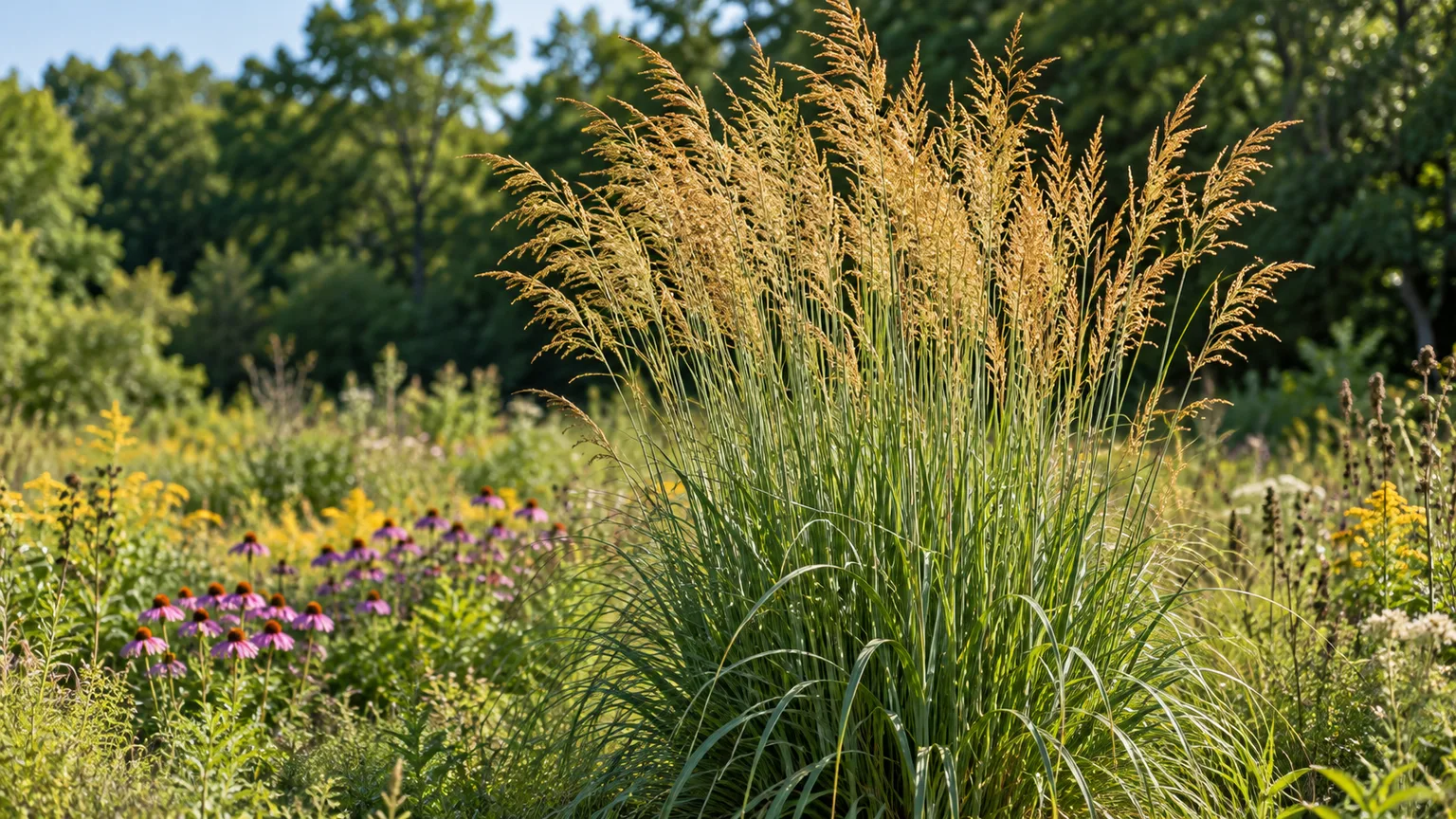
Wood grass is a common name for Indiangrass, Sorghastrum nutans, a tall North American warm-season perennial grass with blue-green leaves and airy gold-to-bronze seed plumes. It is a handsome choice for a sunny native planting, but its height, seasonal growth, and dry winter foliage make it a better fit for an open bed or meadow edge than a small, closely clipped border.
The care is simple once the site is right: give it sun, avoid a chronically soggy root zone, keep weeds from smothering young plants, and do most cleanup before spring shoots appear. The details that make the biggest difference are choosing a locally suitable seed source, watering during establishment instead of on autopilot, and planning for the plant’s eventual scale.
What wood grass is and how it grows
Names vary. Nurseries and references may call the same species Indiangrass, Indian grass, yellow Indiangrass, or wood grass, so check the botanical name, Sorghastrum nutans, before buying. This guide uses “wood grass” for the species in the title and “Indiangrass” when referring to its broader horticultural and ecological literature.
The grass is native across much of central and eastern North America, though a species being native somewhere on the continent does not make every seed source appropriate for every local ecosystem. The USDA Forest Service describes it as a native, warm-season perennial with short rhizomes and a broad North American range (USDA Forest Service).
Indiangrass starts growth later than cool-season lawn grasses because it is adapted to warm weather. In spring, a new clump can look dormant while nearby plants have already leafed out; most of its vertical growth follows as temperatures rise. A mature plant commonly reaches roughly 5 to 7 feet in a garden, while wild and conservation references report a broader 3-to-8-foot range depending on ecotype and growing conditions (North Carolina State Extension; USDA NRCS Plant Guide).
The narrow leaves form a dense fountain-like clump, and flower stalks rise above the foliage in late summer or fall. The plume-like panicles begin yellow or golden, then deepen toward bronze and hold their form into winter; the seedheads also provide seasonal interest when many garden flowers have finished. Flowering month varies by latitude, weather, and seed source, so use the local display—not a fixed calendar date—to judge when to collect seed or cut back.
Choose a sunny, open site
Choose a spot with at least six hours of direct sun for the strongest stems and best flowering. Indiangrass may tolerate some light shade, but shade combined with rich soil or excess water makes an upright clump more likely to lean or open in the middle. If your site only gets a few hours of sun, select a shorter, more shade-tolerant grass instead of trying to correct the problem with fertilizer or frequent pruning.
Give the plant room to reach both its mature height and its spreading width. A single clump can be an accent, but a mass planting can form a tall seasonal screen; either way, leave enough distance from paths, windows, and smaller perennials that the arching leaves and stems do not smother them. The published width varies from about one to two feet for a clump to a wider spread as plants age, so allow more space than the nursery pot suggests and check the selected cultivar’s label.
Soil: adaptable, but not swampy
Wood grass is not fussy about soil texture. It can grow in sand, loam, clay, and even relatively poor ground, provided excess water drains away; the USDA guide lists a broad soil-pH range and medium tolerance of drought and salinity (USDA NRCS Plant Guide). Clay is therefore not an automatic reason to reject it.
What matters is whether the root zone drains between rains and whether compaction causes water to pool around the crown. A plant can tolerate occasional wet periods without thriving in permanent saturation.
Avoid planting it in a winter-wet depression or beside a downspout that saturates the soil. In heavy clay, improve drainage across the planting area or choose a better-drained site; do not make a small pocket of loose potting mix surrounded by dense soil, which can collect water like a bowl.
Plant plugs at the right time
A nursery-grown plug or small pot is the easiest route to a visible clump. Plant in spring after the soil has warmed and the danger of hard frost has passed in your area, giving roots a full growing season to settle in before winter. For a site-specific date, follow your local Cooperative Extension guidance rather than a national calendar; warm-season grasses respond to soil temperature as well as air temperature.
Water the root ball before planting, then set the crown at the same level it occupied in its pot. Backfill with the native soil, firm gently to remove large air gaps, and soak the planting area so soil contacts the roots. Avoid burying the crown under a deep mulch layer, and keep mulch a few inches away from the plant’s base so moisture does not sit against the stems.
For multiple plugs, space them according to the mature width and the effect you want. Close spacing fills a bed faster but increases competition and makes the middle harder to access for cleanup; wider spacing keeps individual forms legible and gives companion plants room. Clear existing weeds and turf before planting because young Indiangrass grows slowly enough at first to lose the competition for light and moisture.
Grow wood grass from seed
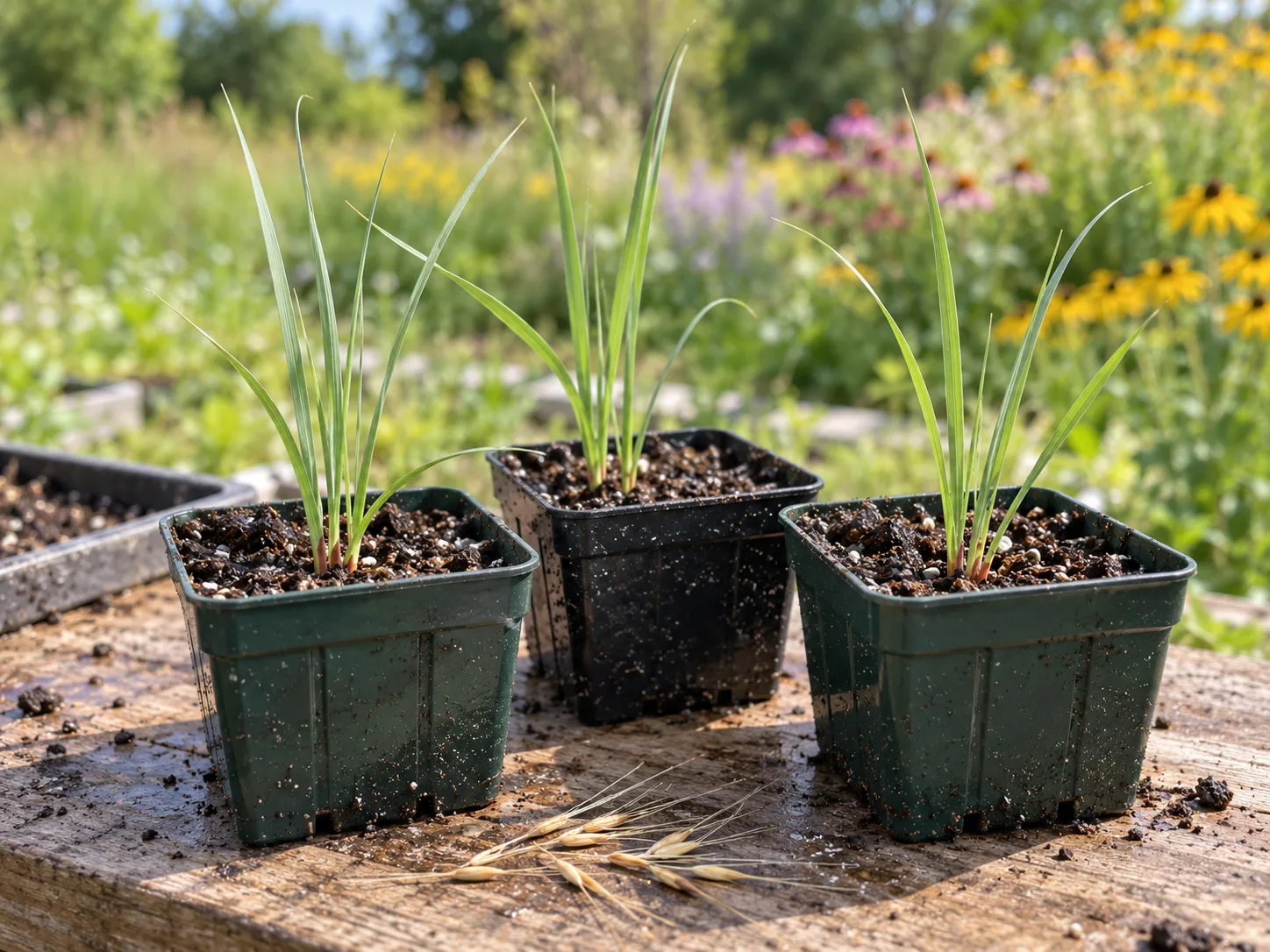
Seed is economical for a meadow or a larger planting, but it demands a clean, firm seedbed and patience. Remove competing vegetation before sowing, rake or lightly firm the surface, and scatter seed so it has good soil contact.
As a garden-scale rule, sow shallowly—about one-quarter inch deep or less—and press the seed into the surface rather than burying it under a thick layer of soil or mulch. The USDA plant guide recommends seed depths no greater than one-half inch and notes that equipment and seeding rates vary with location and method (USDA NRCS Plant Guide).
Sow outdoors when local soil is warm enough for warm-season grasses and follow the supplier’s instructions for that seed lot. References differ on whether Indiangrass needs cold stratification: an older Forest Service synthesis describes cold stratification as a requirement, while the Tallgrass Prairie Center’s updated production guide says greenhouse seed pre-treatment is unnecessary (USDA Forest Service; Tallgrass Prairie Center).
Seed source, storage, and dormancy can affect results. If your packet explicitly calls for cold-moist stratification, follow that direction; otherwise, sow a small test batch without treatment rather than chilling an entire purchase based on a generic rule.
Keep the seedbed evenly moist while germination begins, but do not keep it waterlogged. Once seedlings emerge, the priority shifts to weed control and steady establishment moisture. If annual weeds begin to overtop the seedlings, high mowing can reduce their shade without scalping the slower young grasses; conservation guidance commonly advises leaving several inches of stubble in first-year stands rather than mowing down to the soil (Tallgrass Prairie Center).
Do not judge a seeded planting by its first few months. Indiangrass often spends energy establishing roots before it makes a large, ornamental clump, and a productive stand from direct seeding can take two to three years to develop. If a small garden needs immediate structure, buy a plug and use seed to expand the planting later; for acreage or prairie restoration, use locally recommended seed rates and establishment practices because ornamental-bed directions do not scale to a field.
Water for establishment, then taper off
Water a new plug deeply at planting and keep its root zone from drying completely during the first growing season. The exact schedule depends on rainfall, soil texture, wind, and heat: check the soil a few inches below the surface and water when it is drying, rather than giving the plant a small daily sprinkle. Sandy soil may need checks more often than clay, but clay needs more time between deep waterings because it holds moisture longer.
After the plant has rooted into the surrounding soil, reduce routine irrigation. Established Indiangrass tolerates dry spells and can grow in dry-to-medium moisture conditions, but drought tolerance is not the same as never needing water; prolonged extreme heat and drought can still reduce growth or flowering. A deep soak during a long dry period is more useful than frequent shallow watering that keeps only the surface wet.
If the clump is leaning, first look at sunlight, drainage, and fertilizer history before assuming it is thirsty. Overwatering can weaken the stand or encourage lush growth that flops, especially where soil is fertile. Conversely, crispy leaves and stalled growth during a long drought can indicate that a young plant needs water while it is still establishing.
Fertilize only for a clear reason
Most established plants do not need routine fertilizer. Indiangrass evolved in open grassland conditions and can perform in relatively lean soil; adding nitrogen simply because growth looks slow may produce soft, tall foliage without stronger stems. In a small garden bed, improve the soil only when a test or a clear deficiency indicates a need, and avoid placing a heavy dose of lawn fertilizer over the clump.
A seeded restoration has different needs from a single garden specimen. Prairie production guidance may discuss amendments to increase harvested seed yield, but those field recommendations are not automatic instructions for an ornamental border. For a home planting, prioritize sun, weed control, and establishment watering before reaching for fertilizer.
Plan for the plant’s height, spread, and bloom
The show begins after the leaves have filled out: slender flowering stems rise above the foliage and carry open, branched panicles. North Carolina State Extension describes yellow panicles appearing in late summer and fall, with golden to bronze tones persisting into winter (NCSU Extension Plant Toolbox). A plant that has not flowered yet may simply be young, shaded, overfed, or growing in a cooler region where the season is shorter.
Expect the plant to look different in each season. In spring, old foliage remains until you cut it back, while new green shoots emerge from the base; in summer, the green clump builds height; in autumn, seedheads and foliage color make the plant conspicuous; in winter, the dry stems add texture and hold seeds. Leave them standing if they are not obstructing a path or creating a fuel concern, since winter structure can benefit a wildlife garden and protects the crown from abrupt exposure.
For a restrained garden, choose a named selection sold for a more compact habit and verify its mature height at purchase. ‘Sioux Blue’ is one example of a blue-gray, shorter selection mentioned by university horticulture references, but cultivar names and dimensions can vary across suppliers (UW–Madison Extension). Ask for the botanical name and mature size rather than relying on a common name printed on a tag.
Prune once, before spring growth
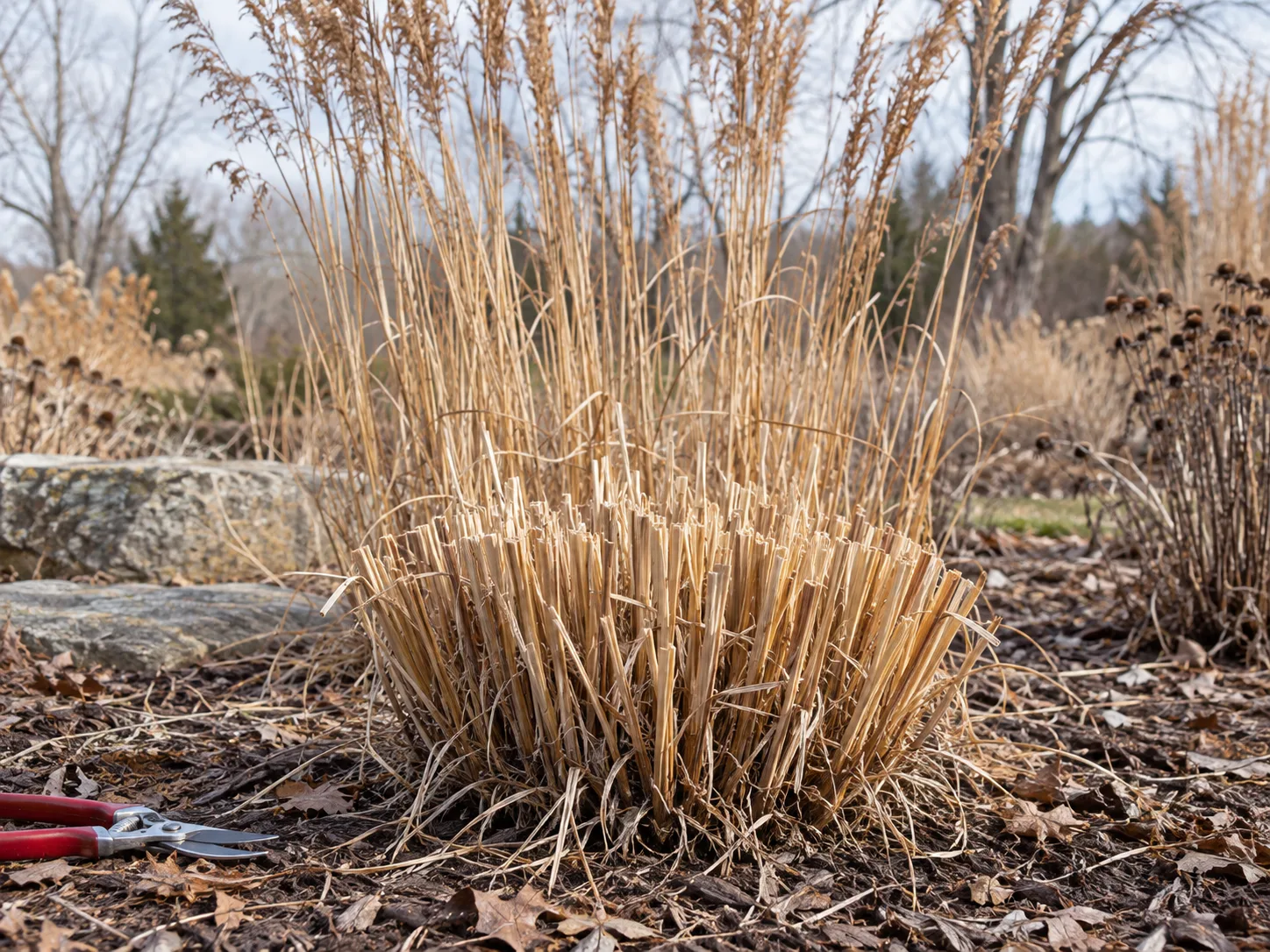
Leave the dried stems through winter if you like their form and your site is safe for standing dry vegetation. In late winter or early spring, cut the previous year’s foliage down to a low clump—often around 6 to 10 inches—before fresh shoots begin to rise.
The Royal Horticultural Society recommends removing dead foliage and old flower stems in spring (RHS plant profile). Cutting too late can clip the new leaves along with the old ones.
Tie the leaves together loosely before cutting if the clump is wide, then use clean, sharp shears or hedge trimmers to make an even cut. Wear gloves and eye protection; dry leaf edges and seed awns can be scratchy, and a bundle of stiff stems can spring outward as you cut. Remove the cut material from the crown instead of leaving a damp, matted layer against new shoots.
Do not routinely shear the grass in fall just to make the bed look tidy. That removes winter structure and seed before wildlife can use it, and it does not increase next season’s flower count. If you need to limit volunteers, selectively remove seedheads before they disperse or pull unwanted seedlings while they are small; the plant does not need deadheading for health.
Divide carefully—or leave the clump alone
Division is possible, but it is not the easiest propagation method for an old, established clump. The center can become dense and the roots tough to cut, so division may require a sharp spade or saw and substantial effort. If the plant is healthy and has enough room, leaving it undisturbed is usually the simpler choice.
If you must move or divide it, work in early spring as growth resumes, dig widely around the plant, and retain a substantial section of roots with each division. Replant immediately at the former depth and keep the pieces watered while they re-establish. For additional plants, seed is generally more practical; the RHS lists both seed and spring division as propagation options (RHS plant profile).
Choose seed source and cultivar
For a native planting, ask where the seed or plant was sourced and whether that source is recommended for your region. Local or regionally adapted material is especially important in restoration projects, where genetic provenance and ecological fit matter beyond how the plant looks in a nursery pot. The Tallgrass Prairie Center lists several source-identified germplasms tied to particular regions, a reminder that “one species” does not mean every seed lot is interchangeable everywhere (Tallgrass Prairie Center).
For a formal garden, a named cultivar can provide a predictable color or shorter habit, but check mature dimensions and hardiness with the grower. Some selections were bred or released for forage, seed production, or conservation use rather than for a compact home border. A tag that says “Indiangrass” with no cultivar name may be perfectly suitable; it simply gives you less certainty about final size or local adaptation.
When comparing seed packets, look for the botanical name, harvest or test information, purity and germination where provided, and any treatment instructions. Native grass seed can have awns or chaff that make it less free-flowing than ordinary lawn seed, and poor seed-to-soil contact can make a broadcast sowing patchy. Buy from a supplier that can answer questions about origin and intended use rather than choosing only by the lowest price per ounce.
Use it in a prairie-style design
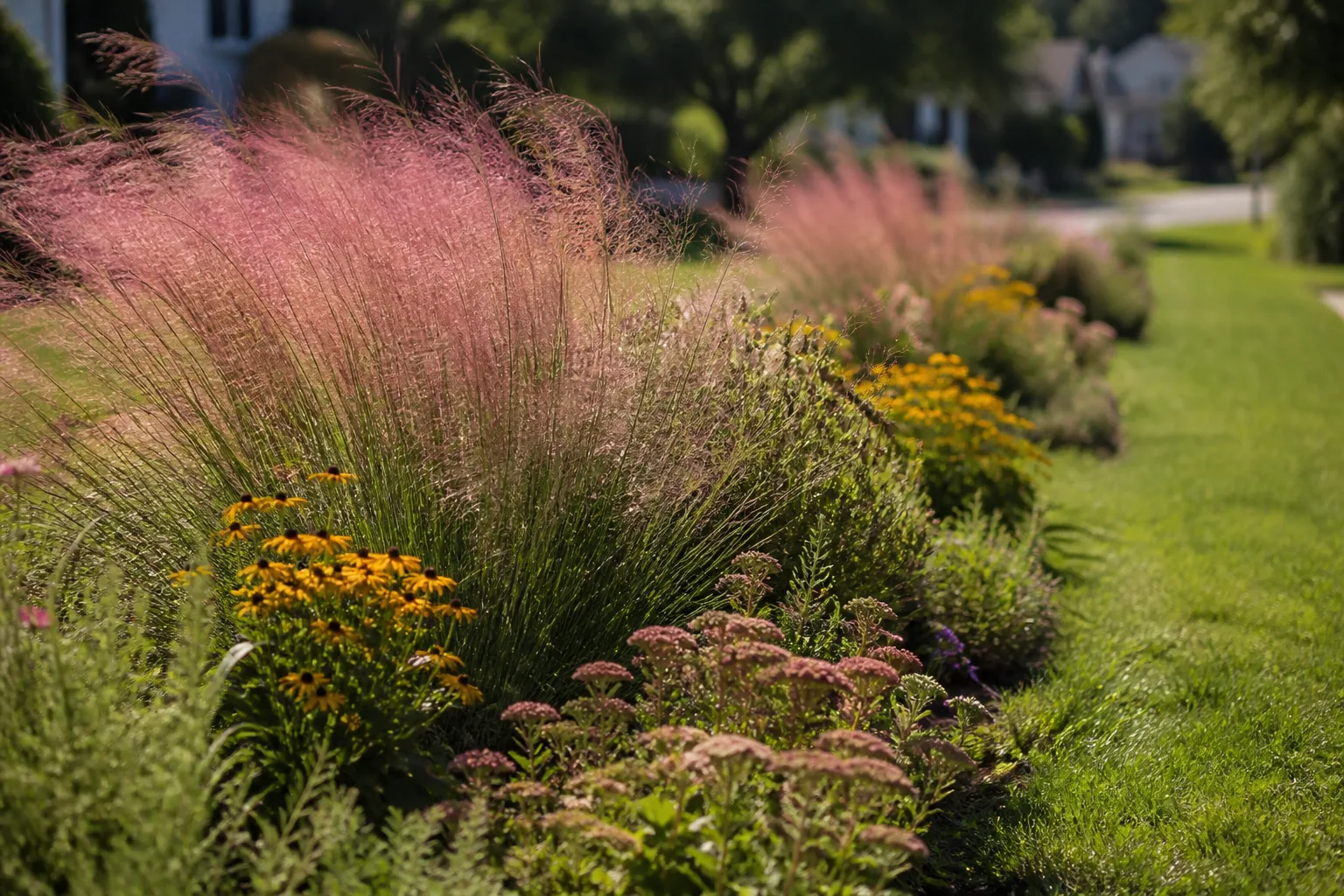
Indiangrass works well as a repeated vertical accent, at the back of a sunny perennial bed, or in a native meadow with enough room for its mature size. Its airy fall panicles contrast with rounded flowers such as purple coneflower and asters, while companion grasses such as little bluestem and switchgrass make the planting feel like a plant community instead of a row of isolated specimens. Choose companions suited to the same light and soil rather than pairing it with moisture-loving plants that need frequent irrigation.
Use repetition for a naturalistic effect: plant several clumps in a loose drift, then interrupt the grass with flowering perennials and open patches. In a small garden, a single plant can still work as a specimen, but position it where its late-season stems will not block sightlines or shade shorter plants. Its leaves start later and grow taller as summer advances, so consider the view from a window and the position of neighboring plants at full size, not only the empty spring bed.
The species can help stabilize a sunny slope once established, and native grass stands provide structure and cover for wildlife. The USDA guide notes cover and nesting value for birds and that some native bees gather nesting material from the plant (USDA NRCS Plant Guide). That habitat value is strongest in a diverse planting with other native flowers and grasses; one ornamental clump alone is not a substitute for a habitat garden.
Troubleshoot weak, floppy, or sparse growth
A clump that flops often has too much shade, too much water, overly rich soil, or some combination of those conditions. Move a young plant if it is badly shaded, reduce irrigation after establishment, and stop fertilizing unless a soil test supports it. Staking mature grass can hide the symptom for a season, but it will not correct the conditions that produce weak stems.
A plant that remains small or fails to flower may be young, competing with weeds, or receiving too little sun. Warm-season grasses also emerge later than cool-season plants, so wait for sustained spring warmth before deciding that a clump is dead. If no shoots appear after neighboring warm-season perennials have resumed growth, inspect the crown for firm living tissue and review winter drainage, planting depth, and watering history.
Brown leaf tips near the end of the season are not automatically a disease. Foliage naturally dries and changes color as the plant enters dormancy. Persistent spotting or widespread decline is more likely to need diagnosis if it appears during active growth and spreads despite appropriate moisture and airflow; photograph the affected leaves and ask a local extension office before using a fungicide.
Pests and diseases are usually minor
Indiangrass is generally considered low-maintenance and relatively free of serious pest or disease problems. The RHS rates it as generally pest- and disease-free, and the Tallgrass Prairie Center production guide lists no pests or diseases as noted (RHS; Tallgrass Prairie Center). Aphids or mites may appear, as they do on many plants, but a few insects rarely justify spraying a large grass clump.
Start by checking for drought stress, poor drainage, or overcrowding. If you confirm a damaging pest, identify it before choosing a treatment and follow the label for any product you use; insecticidal soap and horticultural oils can injure plants or beneficial insects when misapplied. Good spacing and correct watering are better first responses than routine preventive sprays.
Manage reseeding and fire exposure
Indiangrass can expand slowly through short rhizomes and can also produce seedlings when mature seeds land on open soil. These are different kinds of spread: the rhizomes enlarge the established clump, while seed can start new plants some distance away.
A thick, closed planting is less likely to admit seedlings than a bare, frequently cultivated patch, but no plant is guaranteed to stay exactly where it was placed. The Forest Service notes that the species can establish in disturbed bare ground, while the USDA plant guide advises checking local status because it may become weedy in some settings (USDA Forest Service; USDA NRCS Plant Guide).
In much of its native range, Indiangrass is a valuable prairie species; outside its native or recommended region, check with local extension or natural-resource agencies before planting. Keep it from spreading into sensitive habitat if local guidance recommends containment, and remove volunteer seedlings while they are small. If you want a tidy border, cut selected seedheads before they shed rather than removing the whole plant.
Treat fire placement as part of site selection. Green, actively growing foliage is different from a tall clump of cured, dry leaves and stems: dry grass can ignite and carry fire under the right conditions.
North Carolina State Extension identifies Indiangrass as highly flammable and advises against placing it in the home’s defensible space (NCSU Extension Plant Toolbox); local defensible-space rules vary, so follow your fire department or regional wildfire guidance. Do not use a backyard burn to copy prairie management: prescribed fire requires expertise, permits, and suitable conditions.
Can wood grass grow in a container?
It can be grown temporarily in a large, deep container, but it is not an ideal long-term potted accent. The species is tall, develops a substantial root system, and may need frequent watering in a pot even though an in-ground plant tolerates dry periods. Choose a container with drainage holes, use a stable mix that drains freely, and expect to divide or move the plant sooner than you would in the ground.
A pot is most practical when you have a large patio, want to observe a young specimen before planting, or need to control reseeding in a small space. Keep the container outdoors in full sun, protect it from prolonged winter saturation, and do not let the root ball dry out completely during establishment. If your main goal is a compact container grass, a naturally smaller species or cultivar will be easier to manage.
Conclusion
Wood grass rewards the gardener who matches its prairie growth habit to a sunny, open site. Give a new plug or seedbed moisture and weed control while roots establish, then avoid the extra water and fertilizer that can make stems weak; cut old foliage back before spring growth and leave the seedheads standing when the site is safe for winter structure.
Before buying, confirm the plant is Sorghastrum nutans, check the mature size, and ask whether the seed source fits your region. Those few choices matter more than an elaborate care routine, and they let this tall native grass deliver its blue-green summer foliage and bronze-gold autumn plumes without becoming an awkward fit for the garden.



