Flying Ants vs. Termites: ID and Control
Winged ants indoors usually mean a mating swarm—not termites. Learn ant vs. termite ID, why winter swarms matter, and how to stop carpenter ants.
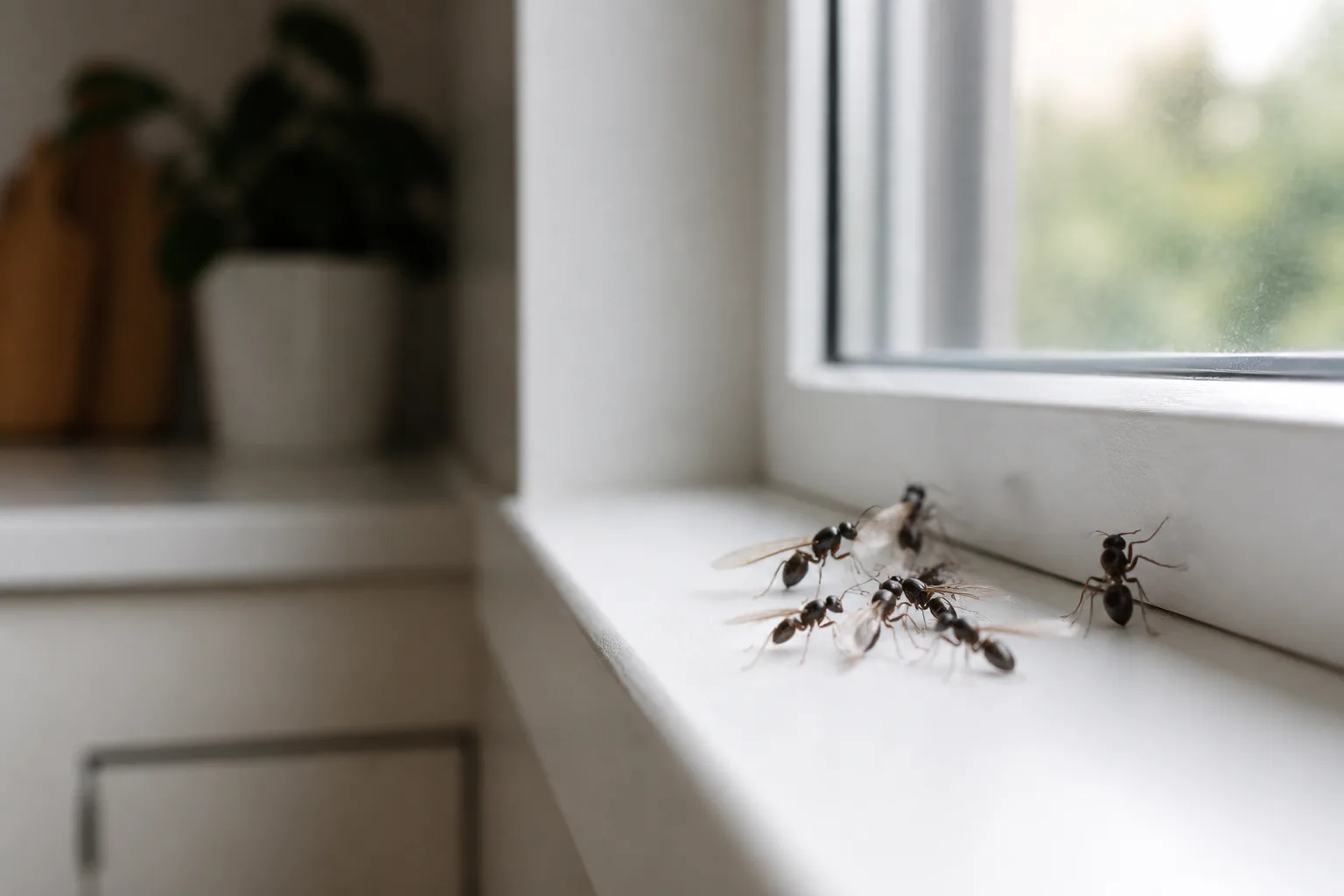
A cluster of winged insects at the kitchen window looks like a horror-movie teaser. Most of the time it is something more ordinary and more fixable: flying ants on their nuptial flight—the mating swarm mature colonies release once or twice a year. The wings are temporary. The question that actually matters is whether those insects are harmless pavement ants passing through or carpenter ants signaling moisture-damaged wood inside your walls.
This guide walks you through identification, urgency, and control in the order a homeowner needs it: tell ants from termites, judge structural risk, handle the swarm today, then target the colony so you are not vacuuming the same scene next spring.
What Flying Ants Actually Are
Flying ants are not a separate species. They are the reproductive caste—queens and males—of an existing ant colony. Workers you see year-round are wingless females. When a colony reaches maturity, it produces winged alates that leave the nest to mate and start new colonies elsewhere.
According to Harvard Forest’s ant life-cycle overview, queens and males both develop wings for this flight. They mate in the air; males die shortly after. Fertilized queens land, shed their wings—leaving small wing scars you can sometimes spot on a found queen—and excavate a starter nest. A single afternoon of chaos at your window can be the visible tip of a colony that has lived quietly in a wall void or tree stump for years.
The Nuptial Flight and Why Wings Appear
Swarm timing depends on species and weather. UC IPM notes that western black carpenter ants (Camponotus modoc) often fly in late afternoon, frequently after rain. Pavement and odorous house ants may swarm on warm days in spring or summer. Indoors, swarms cluster near bright windows and lights because alates navigate toward light while searching for exit routes.
The swarm itself is short-lived—often a few hours to a couple of days. That does not mean the problem is gone. It means the breeding event ended. Workers, queens, and any satellite nests remain. If you only kill the winged individuals, you have treated the fireworks, not the factory.
Flying Ants vs. Termites: How to Tell Them Apart
Misidentifying a termite swarm as flying ants can cost thousands in delayed treatment. Misidentifying flying ants as termites sends you toward fumigation you may not need. Size alone fails—both can look similar at a glance. Use body architecture.
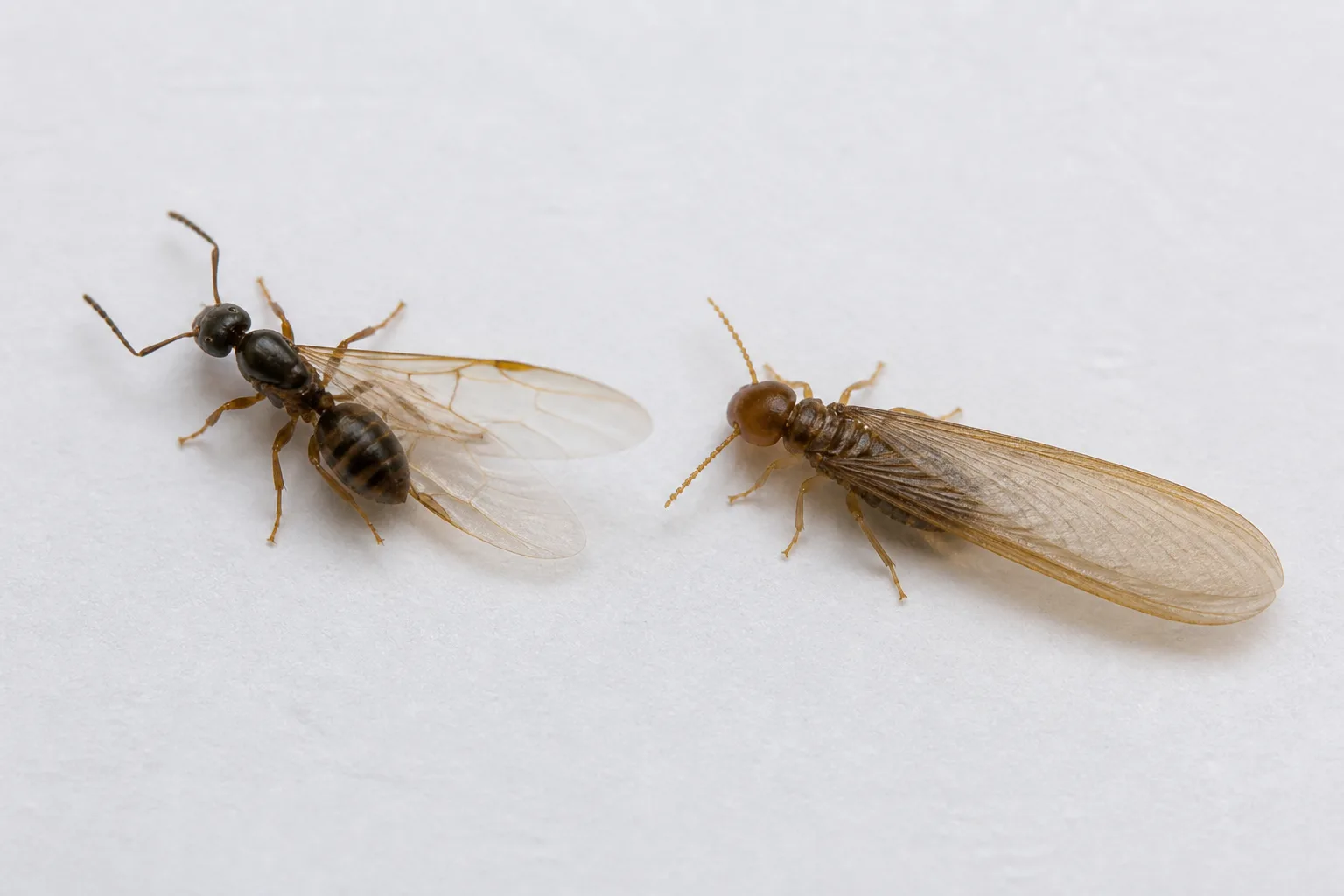
UC IPM’s ant–termite comparison boils down to three field marks visible on winged adults:
| Feature | Flying ant | Termite |
|---|---|---|
| Waist | Narrow, pinched | Broad, thick |
| Antennae | Elbowed (bent) | Straight, bead-like |
| Wings | Front pair longer than hind pair | Equal length |
Body Shape, Antennae, and Wing Length
Hold a dead specimen on white paper or zoom a phone photo. Ants look like an hourglass with wings; termites look like a straight cigar with wings. Ant hind wings are noticeably shorter than the front wings, so at rest you may see a staggered wing outline. Termite wings are uniform and, when shed, often lie in matching pairs near windowsills.
Color is unreliable. Some carpenter ants are black; some termites are dark. Behavior and frass matter more than shade.
Behavior and Evidence Beyond the Insect
Termite workers (the ones that eat wood) usually stay hidden in mud tubes or inside galleries. A winged termite swarm indoors strongly suggests an active structural infestation nearby. Ants forage openly. You may see wingless workers on counters the same week as a swarm.
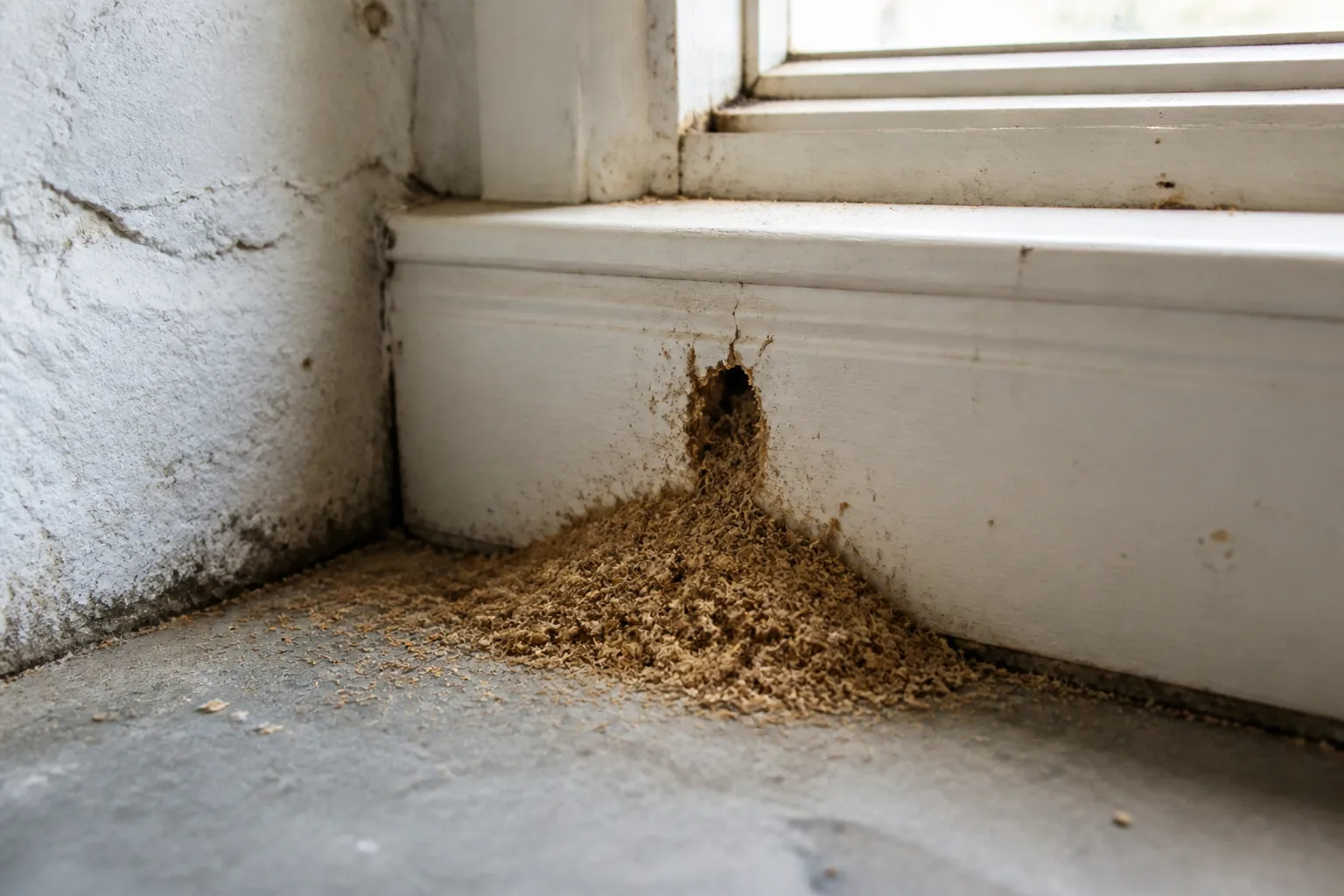
Check the debris. Carpenter ant frass is fibrous sawdust mixed with insect parts—like pencil shavings pushed out of a kick-out hole. Drywood termite pellets are hard, six-sided, and granular. Neither belongs in a clean windowsill track. If you find either, photograph it before vacuuming; a pest pro or county extension office can confirm species from clear images.
Which Ant Species Are You Probably Seeing?
Not every flying ant is a carpenter ant. ID at the genus level sets your urgency and treatment path.
Carpenter Ants and Structural Risk
Carpenter ants are among the largest household ants in North America—workers often 1/4 to 1/2 inch long for common western species. They do not eat wood like termites; they excavate galleries for nests. Damage usually starts where wood is already damp or decayed, then can move into sound lumber in large, long-lived colonies.
Indoor satellite nests can hold thousands of ants while a parent nest lives outdoors in a stump, firewood pile, or tree. Several satellite nests may connect to one queen-bearing parent. Winged carpenter ant reproductives are a red flag that the colony is mature—not that it just arrived.
Carpenter ants cannot sting but can deliver a sharp bite and spray formic acid into the wound. They are not harmless to the house even if they ignore you.
Pavement Ants, Odorous House Ants, and Other Swarmers
Smaller dark ants swarming from sidewalk cracks or basement slabs are often pavement ants (Tetramorium species). They are a nuisance indoors but rarely threaten structure. Odorous house ants (Tapinoma sessile) swarm too; crush one and a coconut-like smell is a tell. Argentine and other sweet-feeding ants produce alates as well, especially where honeydew-producing pests live on landscape plants.
If workers are tiny, trails follow baseboards to pet food, and you find no sawdust, structural panic is usually misplaced. You still want to eliminate the colony—not just the wings—because trails invite ongoing kitchen invasions.
What Causes Flying Ants in Your Home
Flying ants appear when three conditions align: a mature colony, the right season and weather, and a path indoors. Cracks around windows, utility penetrations, and gaps under siding give alates an accidental route from wall voids to your living room. Porch lights and interior lamps finish the trap.
Moisture pulls carpenter ants specifically. Leaky window frames, bath plumbing in exterior walls, clogged gutters, and earth-to-wood contact create the decay they prefer. UC IPM emphasizes that infestations often begin in water-damaged wood and expand from there. Fixing the leak matters as much as killing ants.
Why Indoor Swarms in Winter Raise the Alarm
Outdoor ants swarm in warm months. Winged ants indoors in winter usually mean the colony is inside the heated building—not visiting from the yard. A brief outdoor swarm through an open door is annoying. A January cloud at the kitchen window suggests nest sites in walls, crawl spaces, or attic timbers worth inspecting soon.
That does not automatically mean termites. It does mean “wait and see” is a weak plan. Capture a sample, compare wing and waist shape, and look for frass in basement sills and garage headers the same week.
Are Flying Ants Dangerous?
To people, flying ants are mostly a nuisance during the swarm. They do not invade like biting flies, and most species do not sting. Carpenter ants can bite if handled. The real risk is property, not blood.
Carpenter ant galleries weaken wood over years, especially where moisture hides the damage. Pavement and odorous house ants mainly contaminate food and stress homeowners. Termites, if misidentified, pose a different and often more expensive damage profile.
If anyone in the home has respiratory sensitivity, avoid broadcasting aerosol insecticides in closed rooms during a swarm. Vacuuming and discarding the bag is lower risk and more immediately effective than fogging.
First 24 Hours: What to Do When Winged Ants Appear
Treat the first day as evidence collection plus containment, not full eradication.
Capture specimens. Trap ten to twenty in a jar or on tape. Photograph wings, waist, and antennae with a coin for scale. If they are termites, skip DIY wood treatments and schedule a professional inspection.
Vacuum the swarm. Use a hose attachment on windowsills, lights, and baseboards. Remove and seal the vacuum bag or empty the canister outside immediately. Live alates can crawl back out of indoor trash.
Do not spray blindly. Pyrethroid aerosols kill on contact but rarely reach queens in wall voids. UC IPM ant management guidance notes sprays hit only foraging workers; the colony replaces them. Save chemicals until you know species and nest location.
Follow workers after dark. Carpenter ants are most active after sunset. Set a dab of honey or sugar milk on cardboard near the swarm site and watch where steady workers carry food. That trail leads toward a nest opening—not a guarantee, but better than guessing.
Inspect for frass and moisture. Probe sill plates, deck attachments, and bath walls for sawdust piles, hollow-sounding wood, or rustling in voids. Note leaks to repair in parallel with any insect treatment.
How to Get Rid of Flying Ants for Good
Killing winged ants solves today’s mess. Colony control solves next year. Rank methods by how deeply they reach the queen.
Vacuuming, Traps, and Contact Sprays
Vacuuming is the fastest way to clear a room. It is not a colony strategy. Sticky glue boards catch stragglers near windows; place them along sills, not where pets walk. Soap-and-peppermint sprays immobilize individual ants but do not penetrate nests and can make kitchen surfaces slippery. Use them on a paper towel for spot cleanup, not as whole-house treatment.
Indoor pyrethroid sprays (read labels for ants) kill visible insects on contact. Keep pets and children out until dry. Understand the ceiling: you may see fewer ants tomorrow while the nest remains. Sprays also kill beneficial insects if you broadcast them outdoors without targeting.
Pouring boiling water into an outdoor anthill can collapse a shallow lawn nest. It is a poor and risky choice for indoor or structural nests—heat damages wiring, finishes, and plants without reaching deep galleries. Reserve boiling water for visible outdoor mounds you can identify as non-structural pavement ants.
Baits and Colony-Level Control
Slow-acting baits are the preferred chemical approach for many ant species because workers carry toxicant back to the nest during food sharing (UC IPM). Expect one to two weeks before activity drops. Place baits on flat cards or in labeled stations along trails—not on surfaces where kids eat.
Species differ in appetite. Some colonies want sugar baits in spring; others prefer protein/grease baits. Carpenter ants are finicky—UC IPM recommends attracting them first with a nontoxic bait such as sugar milk or diced mealworms, then swapping in a labeled slow bait they actually accept. If ants ignore a bait after 48 hours, switch type before declaring failure.
Boric acid–sugar water solutions work on sweet-feeding species when mixed at 0.5 to 1% boric acid; higher concentrations repel ants. Keep bait stations where pets cannot tip them; the attractants are sugary enough to interest dogs.
Treating Carpenter Ant Nests
When you confirm carpenter ants, nest treatment beats perimeter spraying. Drill into voids only when you are confident of location—or hire a pro who uses moisture meters, listening devices, and borescopes. Dust formulations (e.g., silica gel or borate dusts where labeled) injected into galleries can be effective; licensed applicators have access to products homeowners do not.
Replace rotted sill plates and trim after elimination; leaving decay invites the next colony. Trim branches that touch the roof, move firewood off the ground and away from walls, and reduce mulch to 2–3 inches near foundations as UC IPM prevention guidance advises.
How to Prevent Flying Ants From Coming Back
Prevention is exclusion plus moisture and food discipline—not a single caulk gun pass.
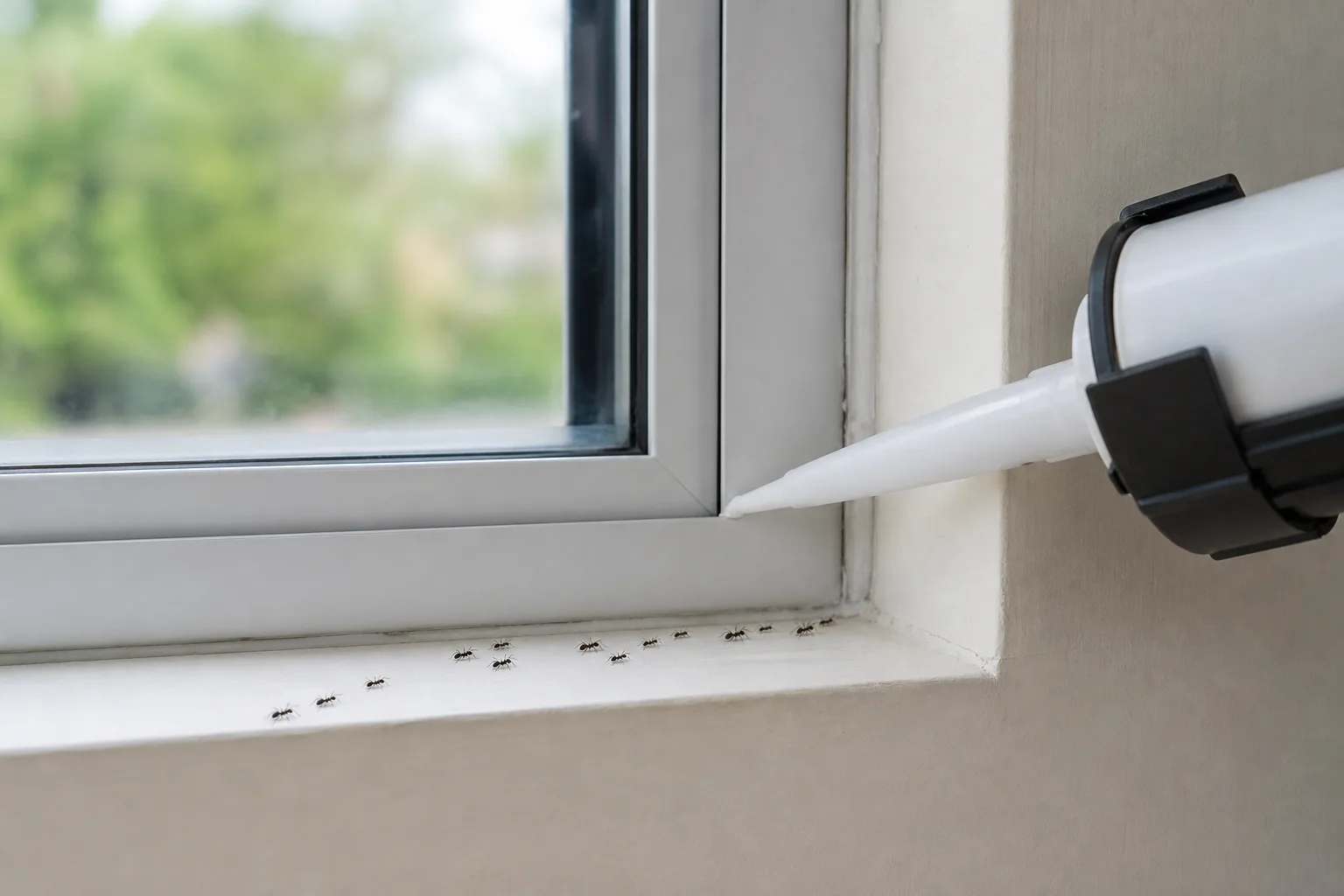
Seal utility entries, window frames, door thresholds, and cable penetrations with quality silicone or polyurethane sealant. Repair torn screens. Ants need surprisingly little clearance.
Eliminate indoor food sources: sealed pantry containers, nightly pet-bowl pickup, and prompt counter wiping after sugary spills. Grease films behind stoves matter as much as cookie crumbs.
Fix moisture: gutter downspouts that dump against foundations, bath fan ducts that terminate in attics, and dripping outdoor faucets. Carpenter ants recruit to wet wood; dry wood is harder to excavate.
Manage honeydew producers on landscape plants—aphids, scales, and whiteflies—so ants are not farming insects on shrubs that touch your siding. Prune plant bridges away from walls.
Store firewood outdoors and elevated, and inspect new lumber and mulch piles before they lean against the house. Land clearing next to new construction often disturbs established colonies and pushes them inward.
When to Call a Pest Professional
Call a pro when you confirm carpenter ants and cannot locate the nest, when frass reappears after DIY baiting, or when you suspect termites instead of ants. Whole-structure fumigation is a termite tool, not a typical flying-ant fix; do not let panic purchase the wrong service.
Licensed applicators can use fipronil perimeter treatments and certain silica dusts restricted from retail sale. They also carry insurance if drilling into structural voids goes wrong. Typical ant treatments run roughly $150–$500 depending on region and nest count; termite remediation scales with linear footage and can reach four figures—another reason accurate ID matters.
You do not need an emergency midnight visit for a one-day pavement-ant swarm in July. You do need a timely inspection for winter indoor swarms, recurring sawdust, or winged insects you cannot confidently separate from termites. Bring photos, vacuumed specimens in alcohol or freezer, and notes on where workers trail.
Conclusion
Flying ants are winged reproductives on a mating mission—not a new pest species and not automatically termites. Compare waist, antennae, and wing lengths, check for sawdust versus pellets, and note whether the swarm arrived in winter inside heated space. Vacuum the room today, bait or treat the colony this week, and fix moisture and entry points so the next nuptial flight happens outdoors, not at your kitchen window.
If you also battle sugar-seeking trails at hummingbird feeders or fruit bowls, see our guide on keeping ants out of hummingbird feeders for barrier tactics that complement colony control indoors.



