How to Grow and Care for Ivy Geraniums
Ivy geranium care for hanging baskets and containers: light, watering, heat tactics, oedema fixes, propagation, and overwintering—backed by extension guidance.
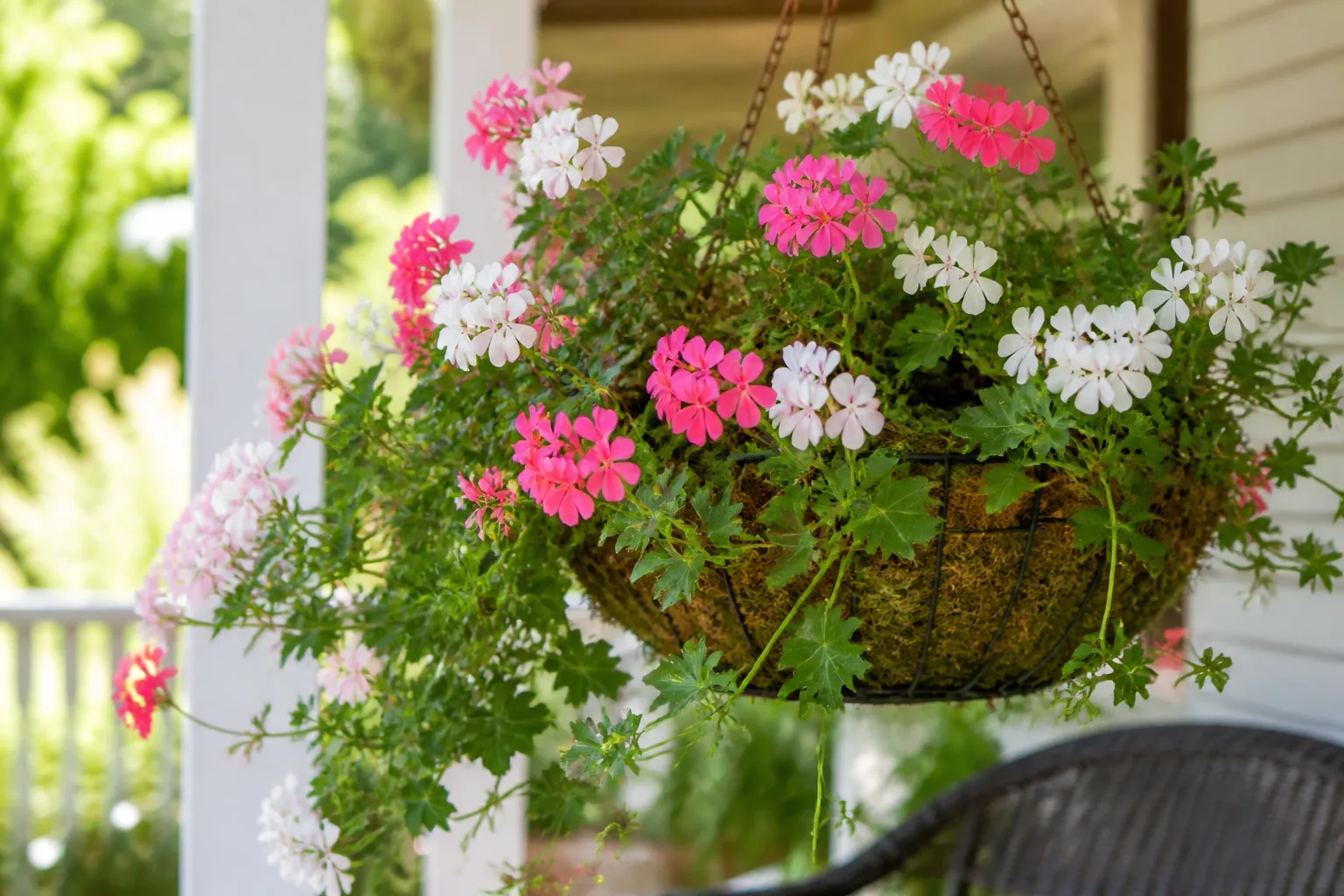
Ivy geraniums (Pelargonium peltatum) are the trailing cousins of the upright bedding geraniums you see at every garden center in May. Where zonal types stand tall in window boxes, ivy-leaved pelargoniums cascade—sometimes 3 to 5 feet of stems hung with loose clusters of pink, red, salmon, or white blooms. They are tender perennials from South Africa’s Cape region, grown as annuals in most of the U.S. and as short-lived perennials only in USDA zones 9b through 10b, according to NC State Extension. Get the basics right—sun, drainage, and a watering rhythm that respects their succulent stems—and a single hanging basket can carry a porch through spring, summer, and fall. Get them wrong and you get leggy green ropes, corky leaf bumps, or a bloom stall the first week temperatures touch 90°F.
What Ivy Geraniums Actually Are
Despite the common name, ivy geraniums are pelargoniums, not true geraniums in the genus Geranium. The giveaway is in the leaves: peltate, shield-shaped blades with the petiole attached near the center, lobed like English ivy (Hedera helix). Stems are somewhat succulent, brittle at the base, and built to trail rather than bush up. Flowers arrive in umbel-like clusters on long peduncles—single, semi-double, or double forms in white, pink, red, and bicolor patterns.
The RHS describes ivy geranium as a bushy evergreen trailing perennial with rapid growth and a long bloom season in warm months. In practice, most North American gardeners treat it as a seasonal container plant because frost kills top growth and because overwintered specimens rarely match the flush of a fresh spring basket.
Ivy Geranium vs Zonal Geranium
Confusing ivy and zonal types is the fastest way to pick the wrong plant for the job. Zonal geraniums (Pelargonium × hortorum) have round, often banded leaves and an upright mounding habit perfect for formal bed edges. Ivy geraniums have pointed lobed leaves and a cascading form built for hanging baskets, wall pockets, and elevated containers where stems can spill downward.
| Trait | Ivy geranium (P. peltatum) | Zonal geranium (P. × hortorum) |
|---|---|---|
| Habit | Trailing, cascading | Upright, mounding |
| Leaf shape | Ivy-lobed, peltate | Round, often with dark zone |
| Best use | Hanging baskets, tall pots | Beds, window boxes (upright) |
| Seed | Some series available; many hybrids vegetative | Mostly vegetatively propagated |
| Heat pause | Common; choose heat-tolerant cultivars | Also pauses; different genetics |
If your goal is a spiller in a mixed container, ivy geranium is the correct choice. If you need a thriller height in the center of a pot, reach for zonal types—or browse our geranium care hub for shared watering and light principles that apply to both.
Where Ivy Geraniums Work Best
Ivy geraniums earn their keep where gravity helps the display: hanging baskets, pedestal urns, wall-mounted hayracks, and window boxes set high enough that stems can trail freely. NC State Extension recommends hanging baskets or containers on pedestals as the ideal presentation because the plant’s natural prostrate habit reads as intentional design rather than a floppy mess on flat ground.
They also work as ground-covering annuals on slopes or retaining-wall tops where stems can drape over an edge. They are less successful as low edging in flat beds—stems sprawl sideways, flowers face the soil, and air circulation drops, which invites foliar disease. Match the container to the root system: a 12- to 14-inch basket for one vigorous plant, or a 16-inch pot if you want a fuller ball by midsummer without constant pinching.
Before you buy, walk your site and note hours of direct sun and afternoon heat. South-facing brick walls radiate extra warmth that speeds drying but also triggers mid-summer bloom slowdown. Our container garden tips for beginners cover drainage and thriller-filler-spiller planning if you are building mixed baskets around a trailing geranium.
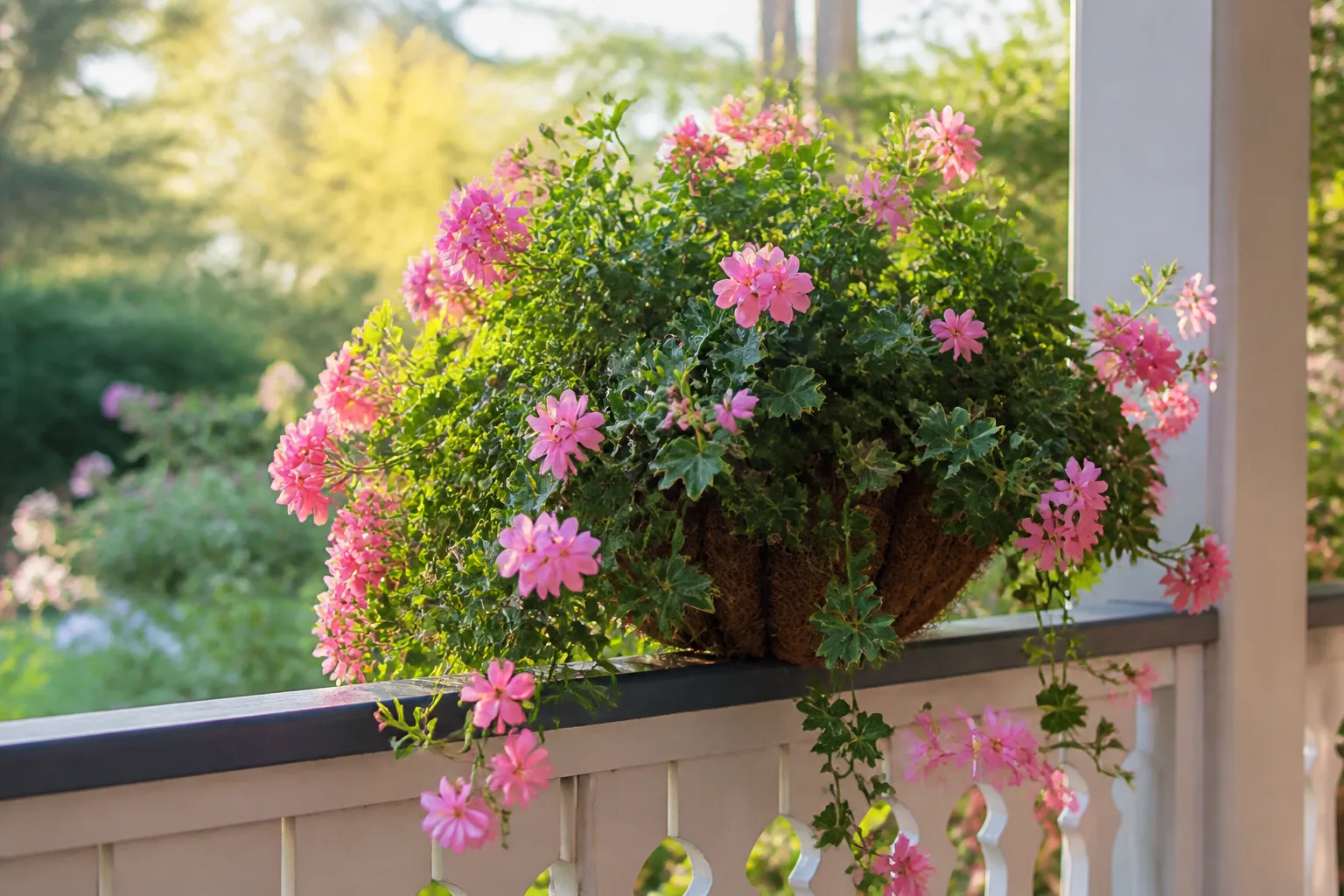
Light Requirements and Summer Heat Tactics
Ivy geraniums want bright light and ample bloom. NC State lists partial shade (roughly 2–6 hours of direct sun) as acceptable cultural conditions, but insufficient light produces leggy stems and sparse flowers. For hanging baskets, aim for at least 4–6 hours of direct sun daily, with more in cool coastal climates and slightly less in desert Southwest afternoons.
When sustained highs climb above roughly 80°F (27°C), many ivy geraniums slow or stop flowering even though the plant survives. New leaves may look pale or whitish—a stress response to extreme heat, not necessarily a nutrient deficiency. Recovery tactics that work in real gardens:
- Shift baskets to eastern exposure or dappled afternoon shade during heat waves.
- Choose heat-tolerant cultivars such as ‘Royal Amethyst’ or newer series bred for continuous bloom.
- Avoid dark containers that bake root zones; light-colored pots stay cooler.
- Maintain even moisture without saturating—stress from both drought and overwatering worsens heat shutdown.
Signs Your Plant Needs More or Less Sun
Too little light: internodes stretch, leaves shrink, flower clusters become infrequent, and the plant leans toward the brightest window or open sky. Too much scorching sun: bleached leaf centers, crispy margins, and rapid soil drying that outpaces your watering schedule. The fix for too little light is relocation, not fertilizer. The fix for too much is filtered afternoon shade and a mulch layer on top of the potting mix to slow evaporation—not deeper shade all day.
Soil, Containers, and Drainage
Drainage matters more than richness. Ivy geraniums accept sand, loam, or high-organic mixes as long as water moves through quickly (NC State Extension). A commercial peat-free or peat-based potting mix labeled for containers is the right default. Do not use garden soil in pots—it compacts, holds cold water, and invites root rot.
Every container needs unblocked drainage holes. In hanging baskets, line coir or moss forms with a thin layer of fiber to hold mix, but never seal the bottom. Repot perennial specimens every two years into a slightly larger pot before they become root-bound and woody at the base. When repotting, lift by the root ball, not the stems—ivy geranium stems snap easily when grabbed, and a broken leader costs you weeks of length.
Watering Without Triggering Oedema
Consistent moisture keeps ivy geraniums flowering, but soggy soil is worse than brief dryness. Allow the top inch of mix to dry between waterings, then soak until water runs from drainage holes. In hanging baskets, weight is a useful cue: a light basket needs water; a heavy one probably does not.
Oedema—raised corky or rusty-brown bumps on leaf undersides—is the signature ivy geranium problem. The Connecticut Agricultural Experiment Station explains it as a physiological disorder, not a fungus: roots take up water faster than leaves transpire, especially during cloudy, cool, humid weather or when light is marginal. Cells rupture and scar into corky patches that gardeners often mistake for scale insects.
Prevention beats cure:
- Water less volume but on a steady schedule during overcast stretches.
- Improve air circulation around baskets—do not pack them against walls.
- Move plants to brighter positions in spring and fall when days are cool but cloudy.
- Select oedema-resistant cultivars if your porch is chronically humid.
If corky spots appear, do not increase feeding and do not spray fungicides—they will not help. Adjust watering first; damaged leaves can be removed cosmetically, but new growth should stay clean once moisture and light balance improve.
Temperature, Humidity, and Bloom Cycles
Ivy geraniums prefer moderate summer warmth, not tropical oven heat. They tolerate brief heat waves but pause bloom until nights cool. Average to low humidity suits them outdoors; high humidity indoors or on sheltered porches encourages Botrytis blight—gray fuzzy mold on spent flowers and leaf spots (Connecticut CAES).
Expect the heaviest flush in cool spring and again in early fall when days are warm and nights drop. Deadheading spent umbels redirects energy into new buds and prevents Botrytis from using old flowers as entry points. In frost-free climates (zones 9b–10b), plants can bloom until winter short days slow growth.
Fertilizing for Continuous Flowers
Ivy geraniums are moderate feeders, not hungry monsters. Two reliable approaches:
- Slow-release fertilizer mixed into potting compost at planting—many bagged mixes include enough for one season.
- Half-strength water-soluble feed every two weeks from spring through early fall, stopping six weeks before you plan to overwinter.
Overfeeding produces soft lush growth that oedema and aphids love. Underfeeding shows up as small pale leaves and weak flower counts. If bloom stalls in heat despite good light, reduce nitrogen slightly and prioritize even moisture—fertilizer will not force flowers when the plant is thermally paused.
Best Ivy Geranium Cultivars to Know
More than 75 named cultivars exist, with new releases each season. A few standouts worth asking for by name:
- ‘Crocodile’ and ‘White Mesh’ — ornamental foliage with white veining; strong basket interest even between bloom waves.
- ‘Royal Amethyst’ — early lilac flowers on heat-resistant genetics.
- ‘Temprano Butterfly’ — dense bright pink petals for high flower count.
- ‘Mahogany’ — bicolor red-and-white blooms for contrast in mixed baskets.
- ‘Tornado’ and ‘Summer Showers’ series — seed-grown options when you want volume on a budget.
Older favorites like ‘Sybil Holmes’, ‘Beauty of Eastbourne’, and ‘Salmon Queen’ remain solid performers in cool-summer regions. When shopping, read tags for “heat tolerant” or “continuous bloom” if your summers run hot and dry.
Pruning, Pinching, and Deadheading
Three grooming habits keep baskets dense:
- Deadhead faded flower heads promptly to prevent seed formation and Botrytis.
- Pinch growing tips in late spring when stems reach 6–8 inches—this branches the plant and multiplies flower stems.
- Cut back by one-third to one-half if the basket goes leggy midsummer or before bringing plants indoors for winter.
Woody, sparse specimens that have overwintered several years may need hard rejuvenation pruning in spring—cut back to healthy green tissue and repot into fresh mix. Recovery takes weeks, so plan a backup basket if the display must look perfect on Memorial Day.
Propagating Ivy Geraniums from Cuttings
Commercial ivy geraniums are cloned by stem cuttings, and home gardeners should do the same—hybrids rarely come true any other way. NC State Extension notes cuttings taken in July and August root well under glass or in a bright window.
Steps that work:
- Snip a 3–4 inch stem tip with sterilized scissors; remove lower leaves.
- Dip the cut end in rooting hormone (optional but speeds rooting).
- Insert into moist sand, perlite, or seed-starting mix—not heavy potting soil.
- Keep in bright indirect light; maintain evenly moist (not wet) medium.
- Pot into standard container mix when new growth appears, usually 4–6 weeks.
Fall-rooted cuttings can overwinter on a cool bright windowsill and become next year’s baskets without a greenhouse budget. For shared geranium propagation principles, see our geranium propagation guide.
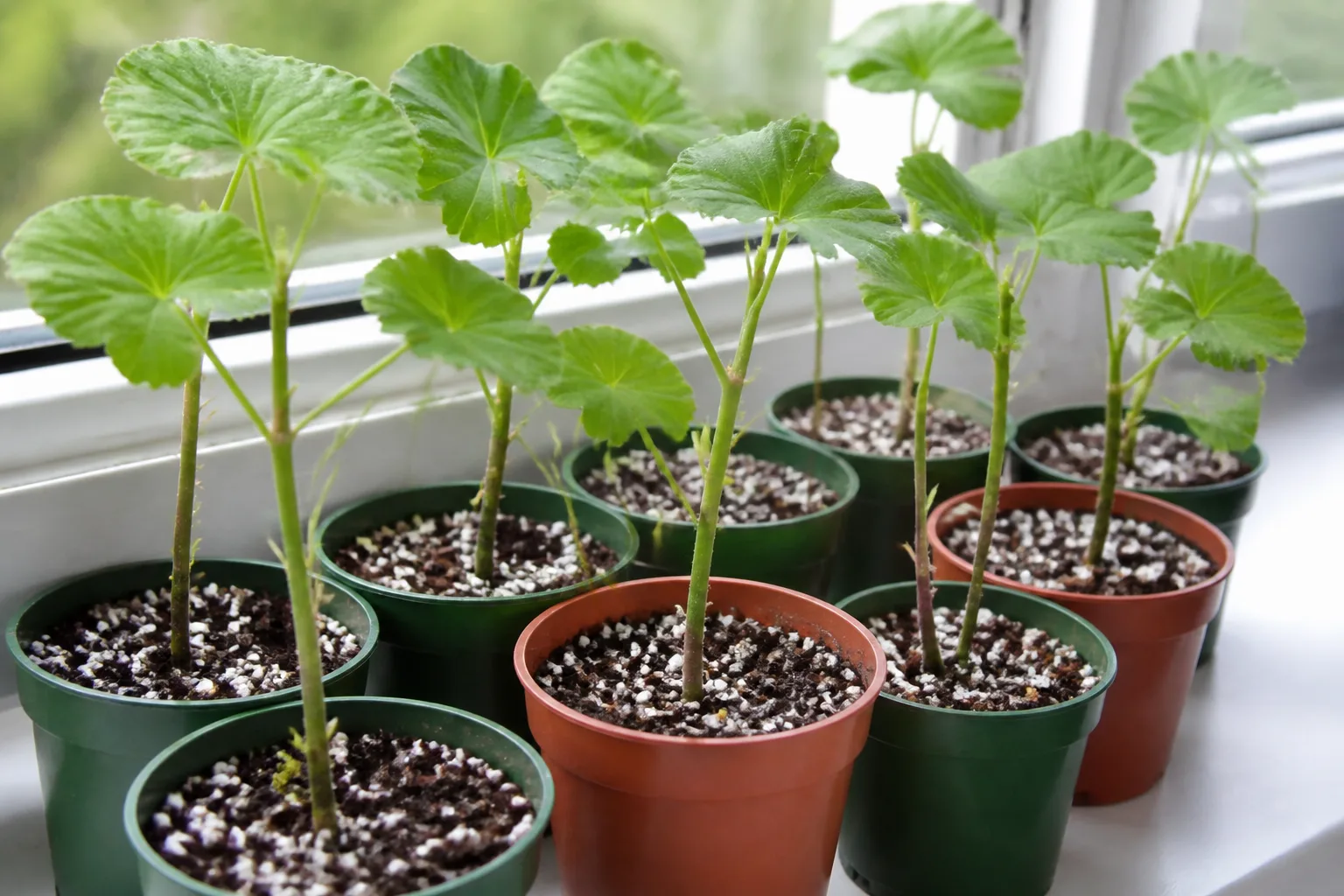
Growing Ivy Geraniums from Seed
Seed is practical mainly for F1 series bred to grow true, such as ‘Tornado’ and ‘Summer Showers’. Open-pollinated seeds saved from random garden hybrids will not match the parent—you may still get pretty plants, but not duplicates.
Start indoors mid to late winter:
- Sow in flats with seed-starting mix at about 74°F (23°C) under cover to hold humidity.
- Barely cover seeds—light aids germination, which often occurs within a week.
- Transplant seedlings into individual pots when true leaves form; flowering size takes roughly three months.
Seed-grown plants tend to branch naturally and can be excellent for mass plantings where identical clones are not required.
Overwintering Ivy Geraniums Indoors
Most gardeners treat ivy geraniums as disposable annuals—and that is a valid choice. If you want to save a favorite cultivar, success looks like survival, not a lush houseplant.
Before first frost:
- Cut foliage back by about one-third to reduce transpiration.
- Move to a very bright, cool room—target 55°F (13°C) nights and no warmer than 70°F (21°C) days.
- Reduce watering; let the top of mix dry more than in summer.
- Provide good air circulation to limit Botrytis and spider mites.
Plants may drop leaves and look sparse all winter. In spring, repot, harden off, and resume feeding as new growth starts. Expect the first outdoor flush to lag behind freshly purchased baskets—many gardeners keep backup cuttings rooted in fall for insurance.
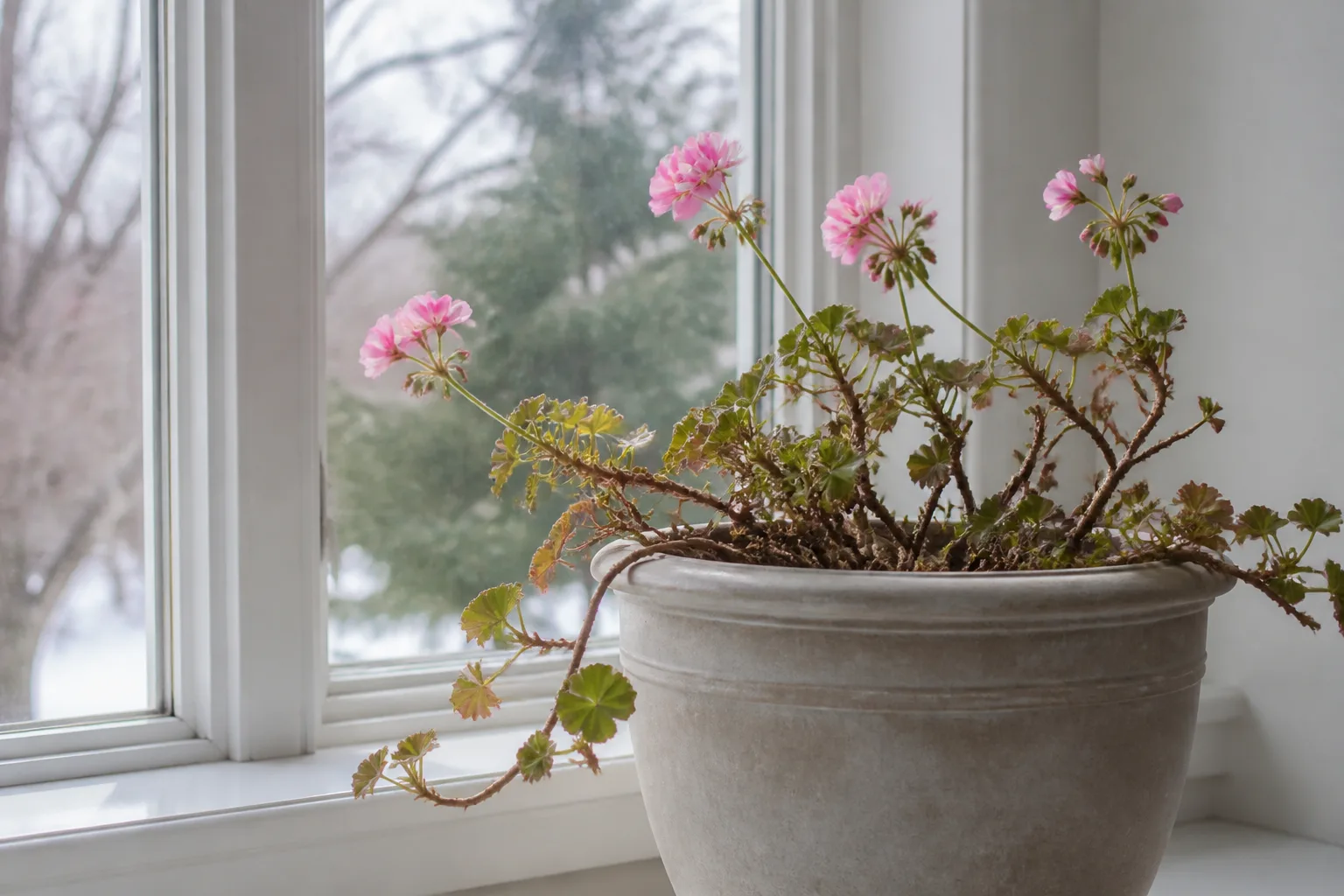
Common Pests, Diseases, and Physiological Problems
Outdoor ivy geraniums with airflow rarely suffer serious pest pressure. Problems spike when baskets move indoors for winter or sit crowded on humid porches.
Watch for:
- Aphids, spider mites, mealybugs, and thrips on overwintered plants—insecticidal soap or neem oil applied to undersides of leaves on cool days.
- Botrytis blight on wet spent flowers—remove debris, avoid wetting blooms when watering, increase spacing (Connecticut CAES).
- Bacterial blight (Xanthomonas) — wedge-shaped tan leaf spots and stem blackening; isolate and discard infected plants; do not propagate from them.
- Whiteflies and fungus gnats in greenhouse-like conditions—sticky traps plus let the surface dry between waterings.
NC State lists caterpillars, greedy scale, and gladiolus thrips as occasional outdoor pests on pelargoniums—inspect regularly and treat early before populations explode in enclosed spaces.
Oedema — Corky Spots on Undersides
Worth repeating because it is ivy-specific: corky leaf bumps mean adjust water and light, not spray chemicals. Compare affected leaves in good light—oedema patches are irregular and on the underside; scale insects are uniform raised disks you can scrape. If in doubt, fix watering for two weeks before treating for pests.
Pet and Human Safety
All pelargoniums commonly sold as geraniums carry low-severity poison characteristics for humans (NC State Extension). The ASPCA lists geranium (Pelargonium species) as toxic to dogs, cats, and horses, with toxic principles geraniol and linalool. Clinical signs in pets include vomiting, anorexia, depression, and dermatitis. Keep baskets off low railings where dogs can chew them, and call ASPCA Poison Control at (888) 426-4435 or your veterinarian if ingestion is suspected.
Conclusion
Ivy geranium care boils down to giving Pelargonium peltatum what its trailing South African biology expects: bright light, fast-draining container mix, steady but not soggy water, and grooming that redirects energy into new flower umbels. Choose ivy types for cascading displays—not upright beds—and pick heat-tolerant cultivars if your summers run fierce. Watch leaf undersides for oedema when weather turns cool and cloudy, propagate favorites by cuttings before frost, and treat overwintering as a survival exercise rather than a décor contest. Do that, and a single hanging basket can anchor a porch from the last spring frost deep into fall color.