Japanese Cedar Care: Planting, Pruning, and Watering
Japanese cedar care made practical: compare cultivar sizes, choose sun and soil, plant with a visible root flare, water young trees, and diagnose browning.
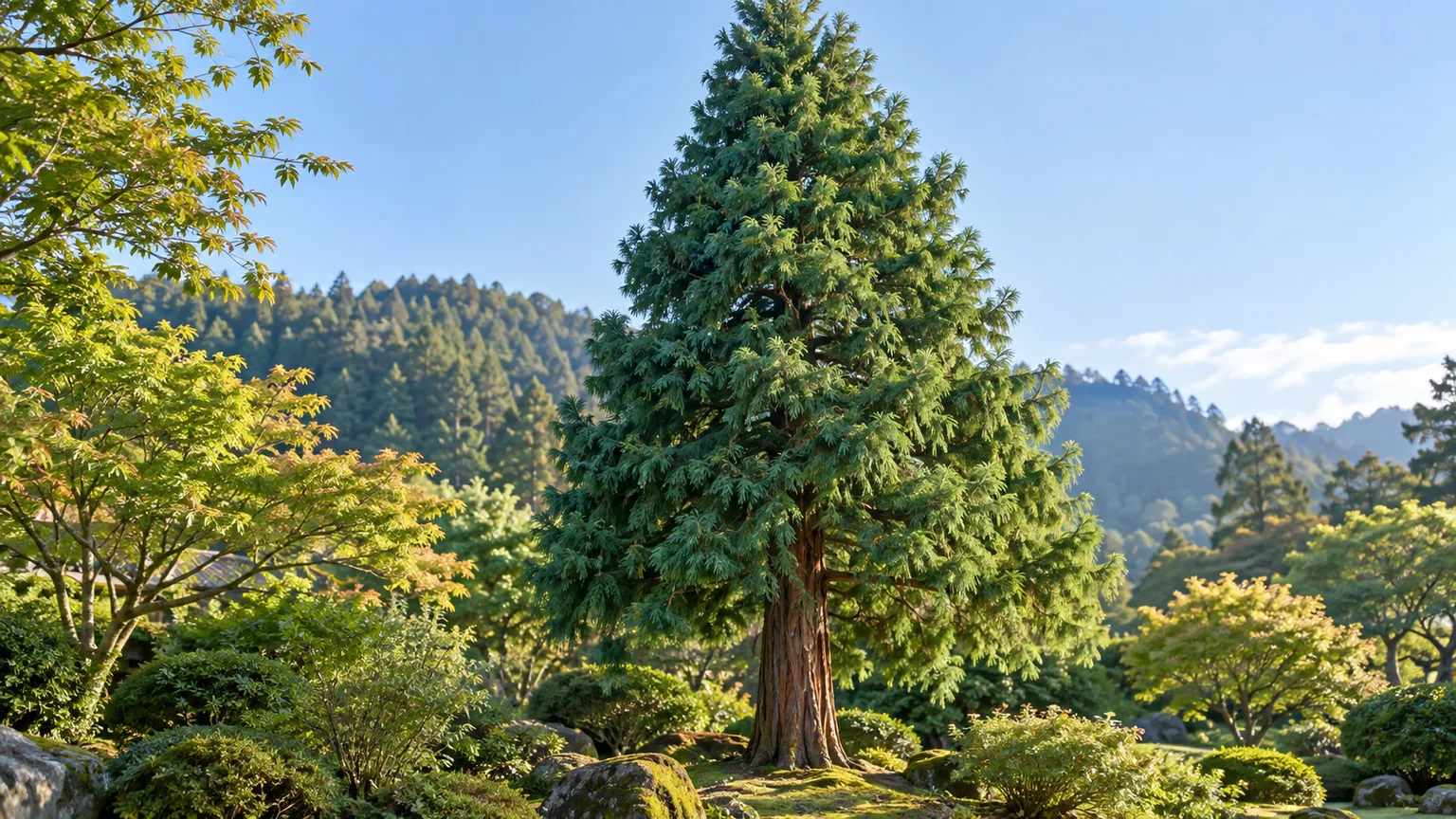
Japanese cedar is a handsome evergreen with fine blue-green foliage and reddish, peeling bark, but the full-size species is a large landscape tree. Before planting one, check the botanical name and the cultivar: Cryptomeria japonica can reach 50 to 70 feet tall and 20 to 30 feet wide, while selected dwarf forms stay shrub-sized. Good drainage, a sheltered site, and steady moisture while young matter more than a strict weekly chore list.
Despite its common name, Japanese cedar is not a true cedar in the genus Cedrus. It is a conifer in the cypress family, Cupressaceae, native to Japan and China and often called sugi. Its usefulness in a garden depends on matching the exact form to the space you have for its roots and mature canopy.
First, decide whether Japanese cedar fits your yard
Choose the ordinary species if you have room for a medium-to-large evergreen specimen or an informal screen that can widen over time. NC State Extension lists a mature range of about 50 to 70 feet tall and 20 to 30 feet wide, with planting space guidance that can span 24 to 60 feet depending on the use and cultivar. Gardening Know How notes that trees can reach 80 to 100 feet in some settings, so treat any published size as a planning estimate rather than a guaranteed ceiling. Those figures are a better planning starting point than the small tree in a nursery container.
Japanese cedar suits gardeners who want year-round structure, a graceful pyramidal outline, and colorful bark that remains visible after lower branches are cleared by age. It is less suited to a narrow foundation bed, a site directly beneath overhead wires, compacted soil that stays wet, or an exposed windy corner. The species grows at a medium rate, so it may take years to look large; that delay does not make it a small tree.
A dwarf cultivar can work in a rock garden, conifer collection, or large container, but confirm its name and mature spread on the tag. Cultivar descriptions are not always consistent among references, and “compact” is not a precise size promise. If the planting area has less than the eventual width listed for the specific selection, choose a naturally narrower or smaller plant instead of planning to prune a large one into place.
How to identify Cryptomeria japonica
Look for short, awl-shaped needles that curve inward and spiral around the twig, giving the branchlets a soft, plume-like or bottlebrush texture. The foliage is usually bright to blue-green; fresh spring growth can be lighter, and older foliage may turn bronze or rusty red in cold weather. NC State Extension notes that individual needles can persist for four to five years, so not every older needle remains green indefinitely.
The trunk develops attractive fibrous, reddish-brown bark that peels in long strips. Branches usually spread horizontally or droop slightly, while the young tree has a fairly regular cone or pyramid shape. Small round cones mature from green to brown. These traits help distinguish it from a true cedar, which has foliage arranged in clusters on short shoots, and from many junipers with scale-like or sharper, stiffer foliage.
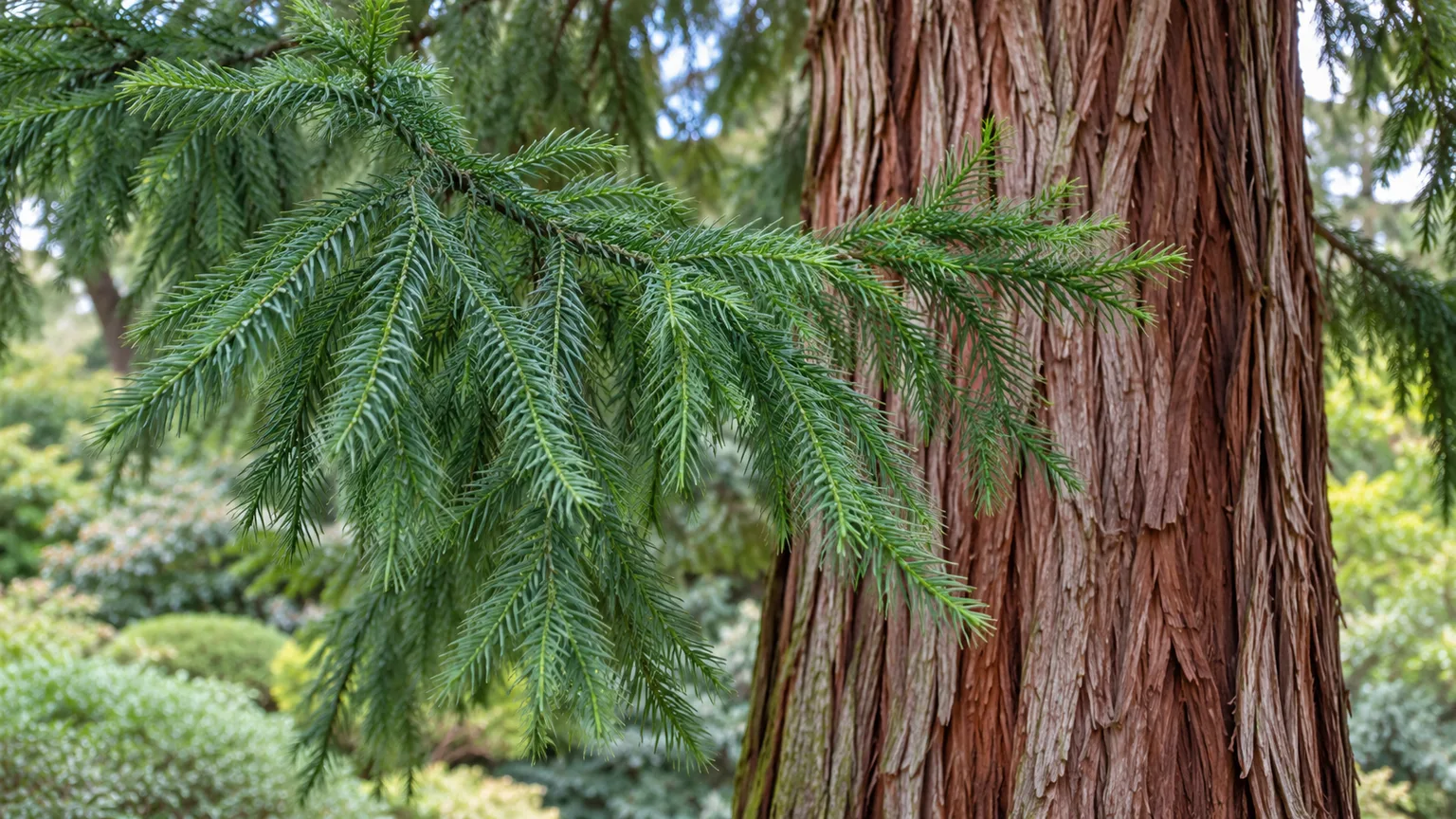
Short spiral needles and stringy red-brown bark are useful identification clues on Japanese cedar.
Do not rely on the common name alone when buying. A nursery may use “Japanese cedar,” “Japanese red cedar,” “sugi,” or the botanical name. The safest tag includes Cryptomeria japonica plus a cultivar name if you are choosing a compact or unusual form.
Choose a cultivar by mature size
The standard species is only one option. The table gives a practical starting point from NC State Extension’s plant profile; some entries describe form rather than a guaranteed final size, so use the nursery’s local mature-size information before setting the tree in the ground.
| Cultivar | Habit and useful trait | Planning note |
|---|---|---|
| ‘Yoshino’ | Narrow pyramidal or columnar; blue-green foliage | NC State lists it around 30 to 50 feet tall, so it still needs substantial height clearance. |
| ‘Elegans’ | Broadly columnar; good winter color | Listed around 15 to 20 feet tall; verify its spread for the form sold locally. |
| ‘Black Dragon’ | Dense, irregular pyramid with very dark foliage | A distinctive smaller-looking selection, but the profile gives no dependable mature dimensions; ask the grower. |
| ‘Globosa Nana’ | Rounded dwarf with bluish-green foliage that bronzes in winter | NC State describes a low, spreading form; confirm width because a broad mound can occupy more room than its height suggests. |
| ‘Tenzan’ | Very dwarf, tight cushion form | Listed as less than a foot tall; best used as a foreground accent, not a screen. |
| ‘Elegans Nana’ | Compact, flat-topped form | Useful in a conifer collection; ask whether the local plant is grafted and how wide it becomes. |
NC State’s Japanese cedar profile lists these and other selections, including ‘Magic Dragon’ and ‘Giokumo’. Its species size and zone data are not interchangeable with cultivar dimensions. A label for C. japonica without a cultivar name usually refers to the full-size tree, not a dwarf.
Compare both width and height at the age that matters to you. A compact conifer may look tidy for a decade and then broaden enough to overlap a path; a narrow upright cultivar may stay slim but grow above a roofline. If the seller lists only a 10-year size, ask for a mature estimate and whether it is based on a specimen in your climate.
Light and exposure: sun, shade, and wind
Japanese cedar grows in full sun, dappled light, and partial shade. For the densest growth and best color, choose a bright site with several hours of direct sun; light afternoon shade can help in hotter regions if the soil does not dry out. In deep shade, the tree may grow more loosely and lose some of the compact, balanced form that makes it appealing.
Shelter matters too. The Royal Horticultural Society lists a sheltered position, and Fine Gardening advises protection from high winds. A young tree has a relatively small root system supporting a top-heavy canopy; repeated strong wind can rock it, dry the foliage, or expose tender growth to winter injury. A hedge or building can provide some protection, but leave enough distance for air circulation and eventual canopy spread.
Hardiness listings vary: NC State gives a broad USDA range of zones 5a through 9b, while Fine Gardening lists zones 6 through 9 and the RHS uses its own H6 rating. These scales and local conditions are not identical. Use your local extension service and nearby established examples to judge winter lows, summer heat, humidity, and wind exposure instead of treating one zone number as a guarantee.
Soil and drainage matter more than acidity
The most dependable target is deep soil that stays moderately moist but drains after rain. Japanese cedar can grow in clay, loam, or sandy ground when the site drains well; persistent saturation starves roots of oxygen and raises the risk of root disease. The Royal Horticultural Society profile lists the species across several soil types and pH ranges, while NC State notes an acidic preference. In practice, texture and drainage should be fixed before you try to adjust pH.
If water stands in the planting area long after a storm, or the soil has a sour smell and remains glossy and sticky, choose a better site or improve drainage across the planting area before buying. Do not dig a small “drainage pocket” in dense clay and fill it with loose potting mix; that can collect water around the root ball like a basin. If the soil is merely alkaline but drains well, ask a local extension office whether a soil test justifies an amendment before adding sulfur or iron.
A two- to three-inch layer of organic mulch can help conserve moisture and reduce competition from turf. Keep mulch several inches away from the trunk; piled mulch holds moisture against bark and hides the root flare. Do not use a deep mulch mound to compensate for compacted, waterlogged soil.
How to plant Japanese cedar correctly
Plant during a mild period when the ground is workable and you can keep the root ball from drying out. Spring and early fall often provide manageable temperatures, but local climate and nursery stock matter more than a fixed date. Avoid planting into frozen ground, extreme heat, or a site that is saturated after rain.
Before you dig, find the trunk flare—the point where the trunk widens into the first major roots. Soil or nursery mix may cover it, so brush the top of the root ball until the flare is visible. Dig a hole two to three times as wide as the root ball but no deeper than the distance from the bottom of the root ball to that flare. The University of Georgia Cooperative Extension gives the same broad, shallow-hole principle in its tree-planting instructions.
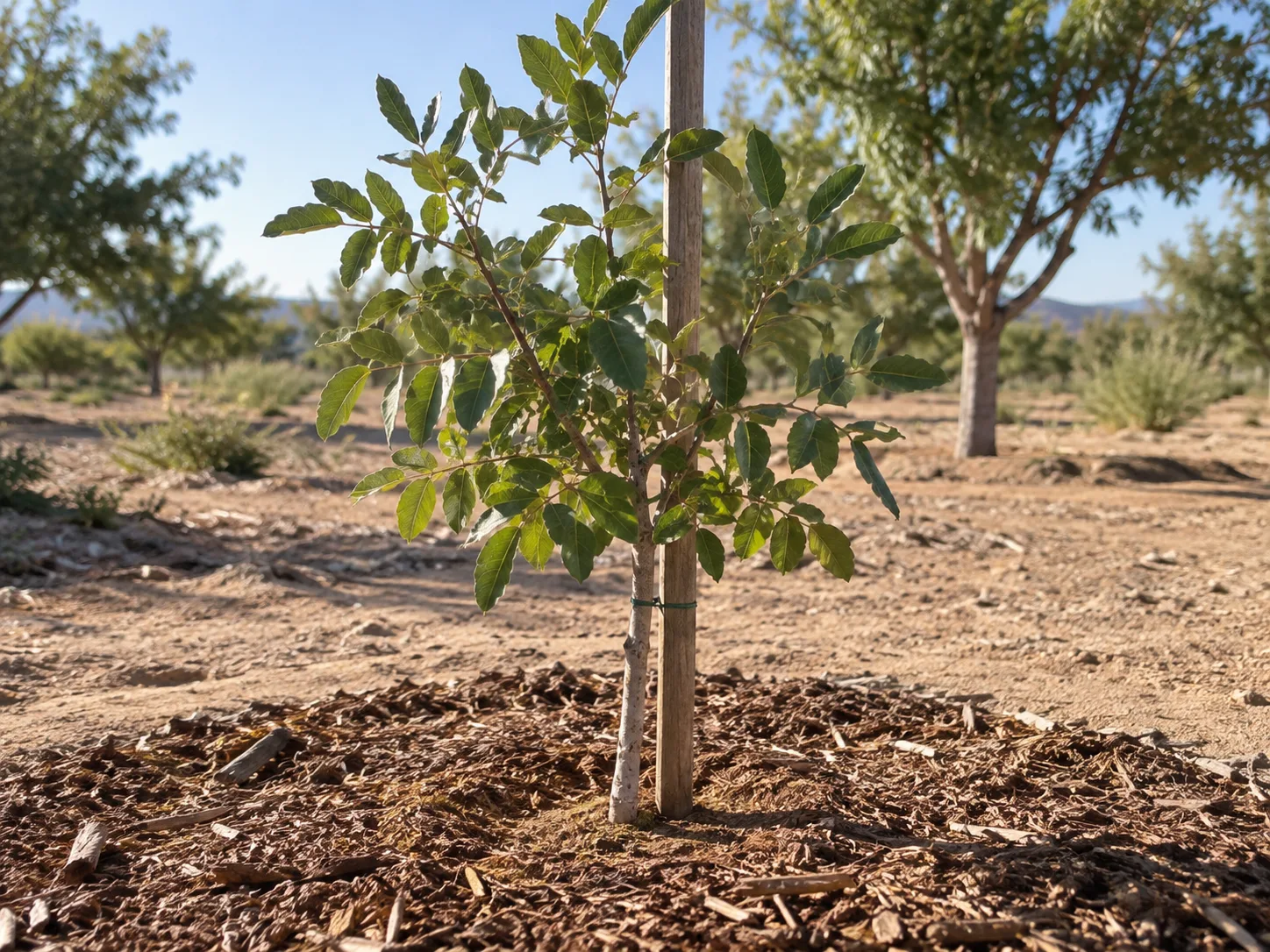
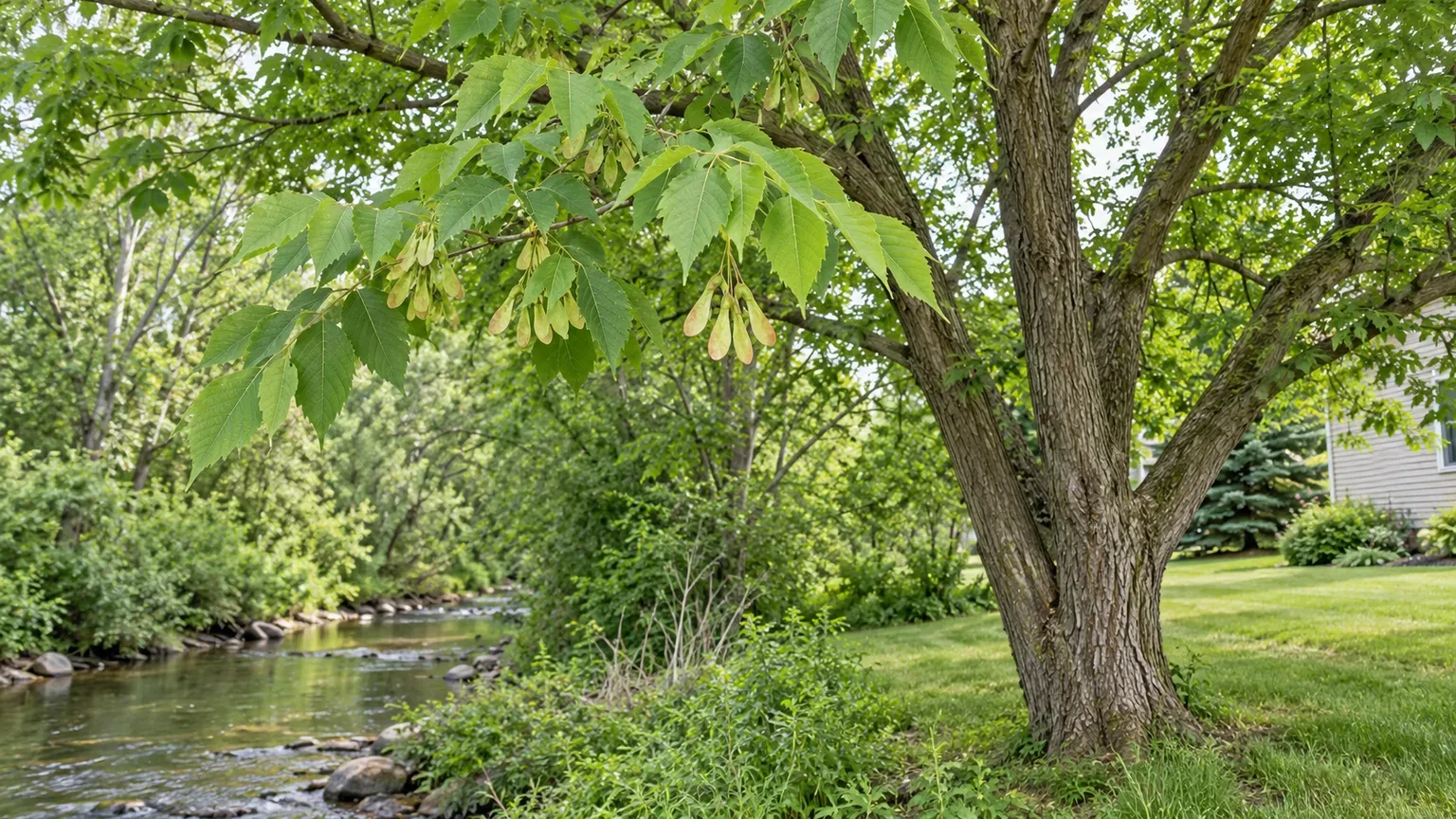
Use the planting area as a wide root zone; the image shows a young landscape tree and illustrates spacing and mulch, not Japanese cedar identification.
Set the tree upright with the flare at or just above the surrounding grade so the root ball will not settle below ground. If roots circle around the outside of the container, loosen or cut them so they point outward; remove the container, ties, and synthetic materials. Backfill with the native soil you removed, firm it gently by hand, and water slowly to settle it. Avoid placing fertilizer or a pocket of rich potting soil under the root ball.
Stake only if the tree leans, the root ball is unstable, or the site is exposed to wind. If staking is necessary, use a flexible support that allows slight trunk movement and remove it after establishment rather than leaving it indefinitely. Finish with a broad mulch ring and clear space around the trunk instead of a volcano-shaped pile.
Watering: keep new roots moist, not swampy
For the first growing season, water the root ball and surrounding soil deeply whenever they begin to dry. Check below the mulch with a finger or a narrow trowel; the surface can look dry while the root zone still holds water, or look dark while the root ball itself is dry. Adjust to rainfall, temperature, soil texture, and root-ball size rather than following an automatic weekly rule.
Fine Gardening recommends regular watering in spring and a deep summer soak, while UGA Extension advises slow, thorough watering and continued care during establishment. These approaches share the same useful principle: wet the root zone deeply, then allow air back into the soil. Frequent shallow sprinkling encourages roots to stay near the surface and keeps the trunk and foliage unnecessarily wet.
During hot, dry, or windy spells, check more often. A newly planted tree may need water before nearby established trees show stress because its roots have not spread into surrounding soil. As it establishes over the next few years, gradually reduce supplemental irrigation, but water during a prolonged drought even if the canopy looks evergreen and unchanged. Do not water simply because a calendar reminder fired when the soil is already saturated.
If the foliage turns dull or bronze, check the soil before adding more water. Dry soil around the root ball points to drought stress; wet soil that stays wet suggests a drainage or root problem. Changing both irrigation and fertilizer at once makes it harder to see which condition was responsible.
Should you fertilize Japanese cedar?
A healthy Japanese cedar in reasonably fertile soil usually does not need a routine high-nitrogen feeding. Extra fertilizer will not correct poor drainage, insufficient light, a root flare buried under soil, or a cultivar that has outgrown its location. Heavy feeding can push soft growth at the wrong time and add salts around young roots.
Do not put fertilizer in the planting hole. UGA Extension advises using native soil for backfill and delaying fertilizer around newly planted trees until they establish; use a soil test or a clear nutrient diagnosis to decide whether feeding is warranted. If a test shows a deficiency, follow its recommendations and the product label, spreading fertilizer over the root zone rather than against the trunk.
If the tree is growing well and producing normal seasonal foliage, leave it alone. A preference for acidic soil is not a reason to add sulfur every year; pH amendments should be based on soil results and local advice.
Pruning, shaping, and bonsai limits
Most Japanese cedar needs little routine pruning. Remove dead, broken, or crossing branches when you can identify a sound cut, and preserve the central leader if you want the natural pyramidal shape. The RHS says no pruning is required and notes that the species can be coppiced, but coppicing is a specialized renewal technique for suitable established trees—not a way to reduce an oversized garden specimen casually.
For a young landscape tree, keep cuts modest and maintain branch structure rather than shearing the outside into a tight cone. Conifers often respond poorly when cuts expose bare interior wood, and a large cut can leave a permanent gap. If a branch must be removed, cut just outside the branch collar without leaving a stub or cutting flush to the trunk. Avoid removing more than needed at one time.
Japanese cedar can be trained as bonsai, but a bonsai is a separate long-term practice involving root pruning, a suitable cultivar or seedling, a shallow container, and careful moisture management. A small potted tree is not automatically a bonsai and will not remain miniature without maintenance. If you want an ornamental tree for the ground, select the mature form you can accommodate instead of expecting pruning to do the sizing.
Why Japanese cedar turns bronze in winter
A uniform shift toward bronze, russet, or reddish foliage during cold weather can be normal. NC State Extension notes that Japanese cedar needles may bronze in winter, and several cultivars are selected for this seasonal color. The foliage remains on the tree and often returns to greener tones as growth resumes in spring; this is not the same as the tree losing every needle at once.
Read the pattern and timing before acting. A gradual color change across much of the crown during cold weather is less concerning than a sharply defined brown patch, branch dieback, or browning that begins during a warm growing season and continues to spread. Interior needles may age and drop while outer growth remains healthy, since individual needles do not live forever.
If browning is uneven, inspect the likely stressors in order: feel the soil at the root ball, check whether water drains, look for wind exposure or reflected heat, and examine branchlets for spots, lesions, or dieback. Avoid spraying fungicide or increasing irrigation based on color alone. If the change persists into active spring growth or entire branches die, take a sample and photographs to a local extension diagnostic service.
Pests and diseases: what to check first
Japanese cedar is generally described as low-maintenance and relatively pest-free, but young or stressed trees can develop fungal problems. NC State lists leaf spot, leaf blight, and fungi among possible issues; the RHS notes susceptibility to Phytophthora root rot and rare honey fungus. Saturated soil, poor airflow, and wounds can make diagnosis and recovery harder.
Look closely at the whole branch, not only the brown needles. Discrete spots or lesions, progressive dieback, and discolored bark near the base deserve a closer inspection; broad winter bronzing without dead twigs points to a different explanation. Mites or other insects may be present, but check for webbing, stippling, or visible pests before treating. A tree-care professional or extension office can help distinguish a disease from winter color, drought, root injury, or normal needle age.
Start with cultural corrections that match the evidence: redirect irrigation away from the trunk, improve air movement by removing a limited number of crowded branches, or correct the site’s drainage if possible. Do not apply a pesticide or fungicide “just in case”; products may not address the cause, and labeled uses and local requirements differ. Remove and dispose of clearly diseased material according to local guidance, and sanitize tools between cuts when disease is suspected.
Propagating Japanese cedar from cuttings or seed
Semi-hardwood cuttings are the practical route when you want to preserve a named cultivar. Fine Gardening and the RHS both describe late-summer propagation from semi-hardwood or ripewood cuttings. Take several healthy current-season shoots because not every cutting roots, and keep the cuttings in a clean, airy medium with steady moisture and sheltered humidity while roots form.
Use a sharp, clean tool and take cuttings from a plant that is healthy and true to the label. A propagator or loose clear cover can slow water loss, but ventilate it so the medium does not become stagnant. Rooting can be slow and variable; wait for signs of new growth and a rooted plug before potting on, and protect young plants from hard freezes and drying wind while they establish.
Seed is useful for growing the species, experimentation, or producing a group of seedlings. It is not a reliable way to reproduce the exact color and shape of a named cultivar because seedlings vary. If you need ‘Black Dragon’, ‘Yoshino’, or another selection to retain its traits, buy a correctly labeled plant or use vegetative propagation from that clone.
Can Japanese cedar grow in a pot?
A dwarf cultivar can live in a large, well-drained container for years, and Japanese cedar is sometimes trained as bonsai. Use a frost-resistant pot with drainage holes and a mix that holds some moisture but does not stay waterlogged. In a container, soil dries faster in summer and freezes more quickly in winter than garden soil, so monitor it more closely and protect the root ball from temperature extremes.
The full species is a poor permanent choice for a patio pot. Its long-term size and root system eventually exceed ordinary containers, and a root-bound tree is harder to keep evenly watered. Repot a young dwarf selection when roots fill the container, increasing pot size gradually rather than shifting it into an oversized tub that stays wet.
Do not keep the tree indoors as a houseplant. It is an outdoor temperate conifer that needs seasonal conditions and strong natural light. A bright room cannot substitute for an outdoor climate suited to the species.
Use it as a specimen or screen
Japanese cedar’s strongest landscape role is as a specimen that can be seen from several sides. Its year-round outline, peeling bark, and soft-textured foliage give it interest even without flowers. A group can create a loose evergreen screen, but spacing should reflect the mature width of the cultivar; tight rows that are planted for immediate privacy can become crowded and difficult to maintain.
Measure from buildings, fences, utilities, paths, and neighboring trees before digging. A mature canopy needs room above ground, while roots need a broad, oxygenated soil zone below it. NC State lists the plant as slightly salt-tolerant and resistant to deer damage, but these traits do not make it immune to road spray, drought, browsing, or poor soil.
The Invasive Plant Atlas of the United States lists Japanese cedar as exotic in the United States and reports it as invasive in Haleakala National Park in Hawaii. That is a localized record, not evidence that the species is invasive in every U.S. region. If you garden in Hawaii or near a sensitive natural area, consult local invasive-plant guidance before planting; elsewhere, check regional recommendations and consider a suitable native conifer if ecological fit is a priority.
Conclusion
Japanese cedar care starts before the tree goes into the ground: identify Cryptomeria japonica, choose a cultivar by its mature height and width, and reject sites that stay waterlogged or expose the young tree to relentless wind. Plant with the root flare visible, backfill with native soil, mulch without touching the trunk, and water the root zone according to its moisture and the weather while roots establish.
Expect some winter bronzing, and look for the pattern before changing care. A tree planted in the right place needs little fertilizer and usually little pruning; a full-size specimen cannot be kept small by shearing. When you match the cultivar to the space and give it well-drained soil with steady early moisture, Japanese cedar can provide a strong evergreen presence for decades.