7 Lawn Care Mistakes That Quietly Damage Your Yard
Learn which lawn care mistakes weaken roots, invite weeds, and waste water—plus grass-type, mowing, fertilizing, and aeration fixes you can use this season.
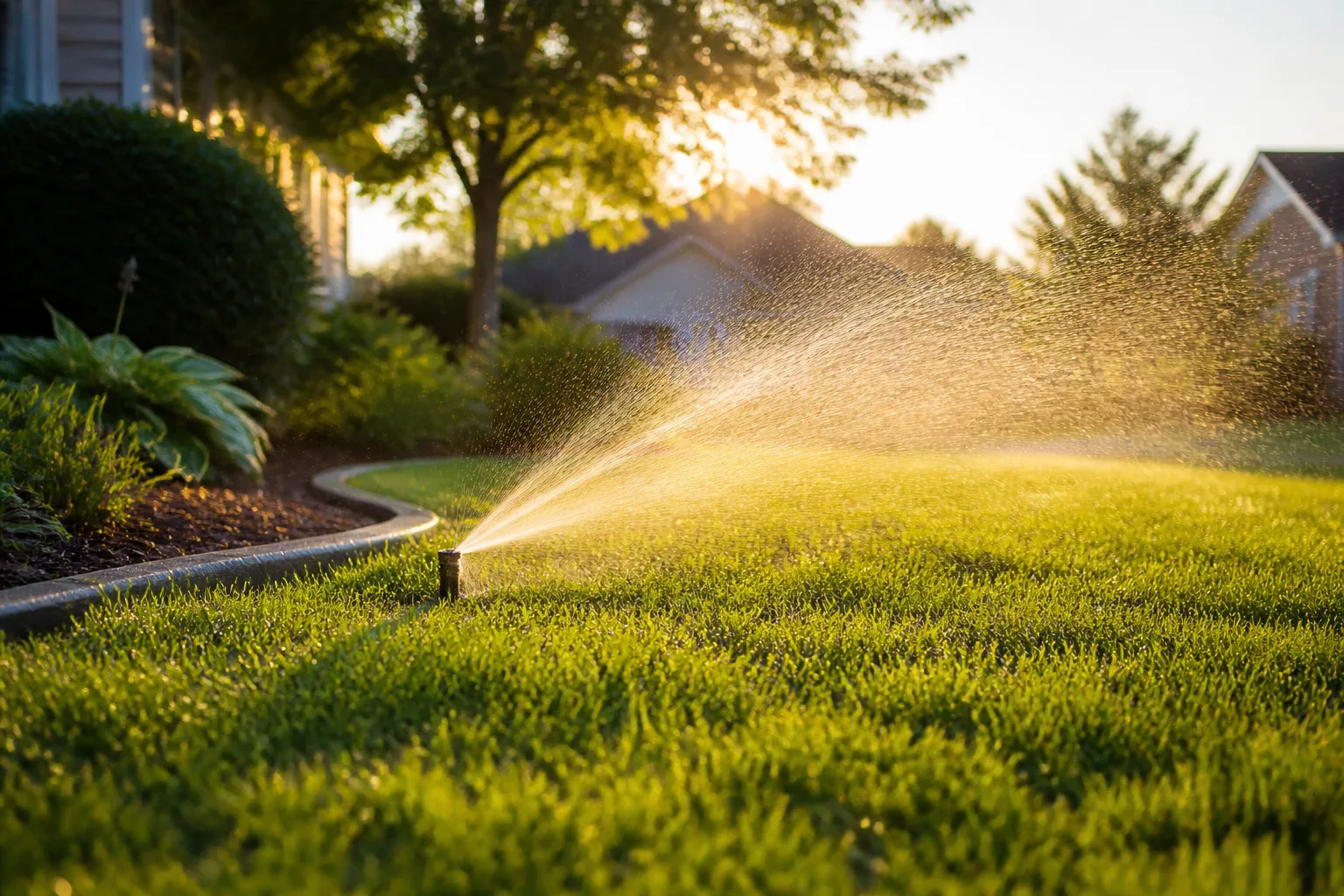
A lawn can decline while you are caring for it faithfully. Daily irrigation, a short “clean” cut, or another application of fertilizer may make the yard look briefly greener, but each can weaken the root system or create a new problem underneath the surface.
The fix is not a universal weekly schedule. Healthy turf depends on the grass species, soil, sunlight, weather, traffic, and the amount of water and nitrogen already present. Use the seven practices below as a diagnosis guide: identify what is happening, change one variable, and measure the response before adding more products.
First, identify the grass before you change the routine
The same instruction can be helpful for one lawn and harmful for another. A tall-fescue lawn in a cool region, a bermudagrass lawn in the South, and a shaded blend under mature trees do not have identical growth cycles or mowing heights.
Why grass type changes the rules
Cool-season grasses such as Kentucky bluegrass, perennial ryegrass, fine fescue, and tall fescue grow most strongly in the cooler parts of the year. Warm-season grasses such as bermudagrass, zoysiagrass, centipedegrass, and St. Augustinegrass do most of their growing in warm weather and may brown during cool-season dormancy. A calendar copied from a neighbor can therefore put fertilizer or irrigation on your lawn when its roots are least able to use it.
University of Georgia Extension also points out that light changes the decision: tall fescue can tolerate less light than warm-season grasses, but even shade-tolerant turf has a minimum light requirement. If grass is failing under dense tree shade, more fertilizer will not turn the site into a sunny lawn; a ground cover or a different landscape treatment may be the honest solution.
Run a simple site check before adding inputs
Walk the lawn at three different times of day and note full sun, filtered shade, slopes, low spots, and high-traffic routes. Push a screwdriver or soil probe into both a healthy area and a struggling area after irrigation; a surface that is wet while the root zone is dry suggests shallow watering, while water that sits at the surface suggests slow infiltration, compaction, or heavy soil.
Also look at the grass itself. If the blades fold lengthwise, turn blue-gray, or hold footprints after you walk across them, drought stress is plausible. If the lawn stays spongy, develops persistent puddles, or grows fungus despite wet soil, stop increasing the watering time and investigate drainage and coverage first. New Mexico State University Extension treats species selection, climate, traffic, soil preparation, and irrigation as site decisions, not afterthoughts, because those choices set the ceiling for how well a lawn can perform.
Practice 1: Watering on a calendar instead of by conditions
Running the sprinkler every day—or every Tuesday and Friday no matter what the weather does—can create the appearance of care while keeping the lawn’s roots near the surface. It also wastes rain, encourages prolonged leaf wetness, and sends water and dissolved nutrients across pavement when the soil cannot accept any more.
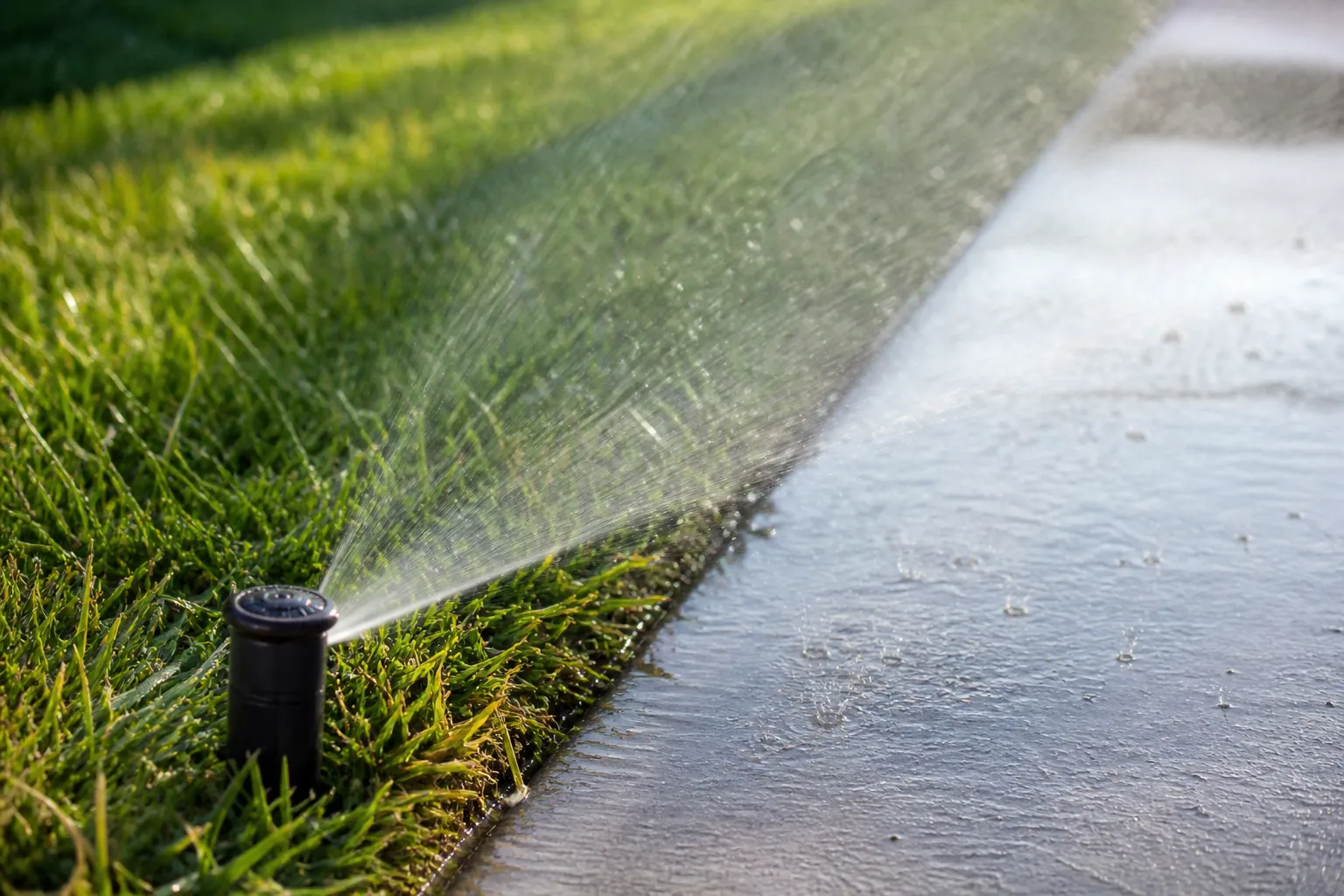
The better rule for established turf is to water deeply enough to moisten the active root zone, then wait until the lawn shows a real need. UF/IFAS Extension describes folded blades, a blue-gray cast, and footprints that remain visible as useful drought signals. It recommends watering established grass on an as-needed basis rather than leaving an automatic controller running by habit (UF/IFAS Extension).
There is no honest universal minute count. A sprinkler’s output depends on nozzle type, pressure, wind, overlap, and whether the water is landing on grass or the driveway. A common starting point for established turf is roughly one-half to three-quarters of an inch per irrigation event, adjusted for rainfall, soil, grass type, and local rules; sandy sites may need more frequent applications, while clay or a compacted layer may need shorter cycles.
The timing matters too. Early morning irrigation gives water a chance to soak in before peak evaporation and allows foliage to dry. Late-night watering leaves blades wet for hours, which is a poor default in humid weather. Fine Gardening’s practical discussion of overhead watering makes the useful point that timing changes the outcome: a brief, sunlit rinse in a specialized nursery setting is different from repeatedly keeping foliage wet overnight, but that exception is not a reason to make midday lawn watering your routine (Fine Gardening).
Measure what your sprinklers actually deliver
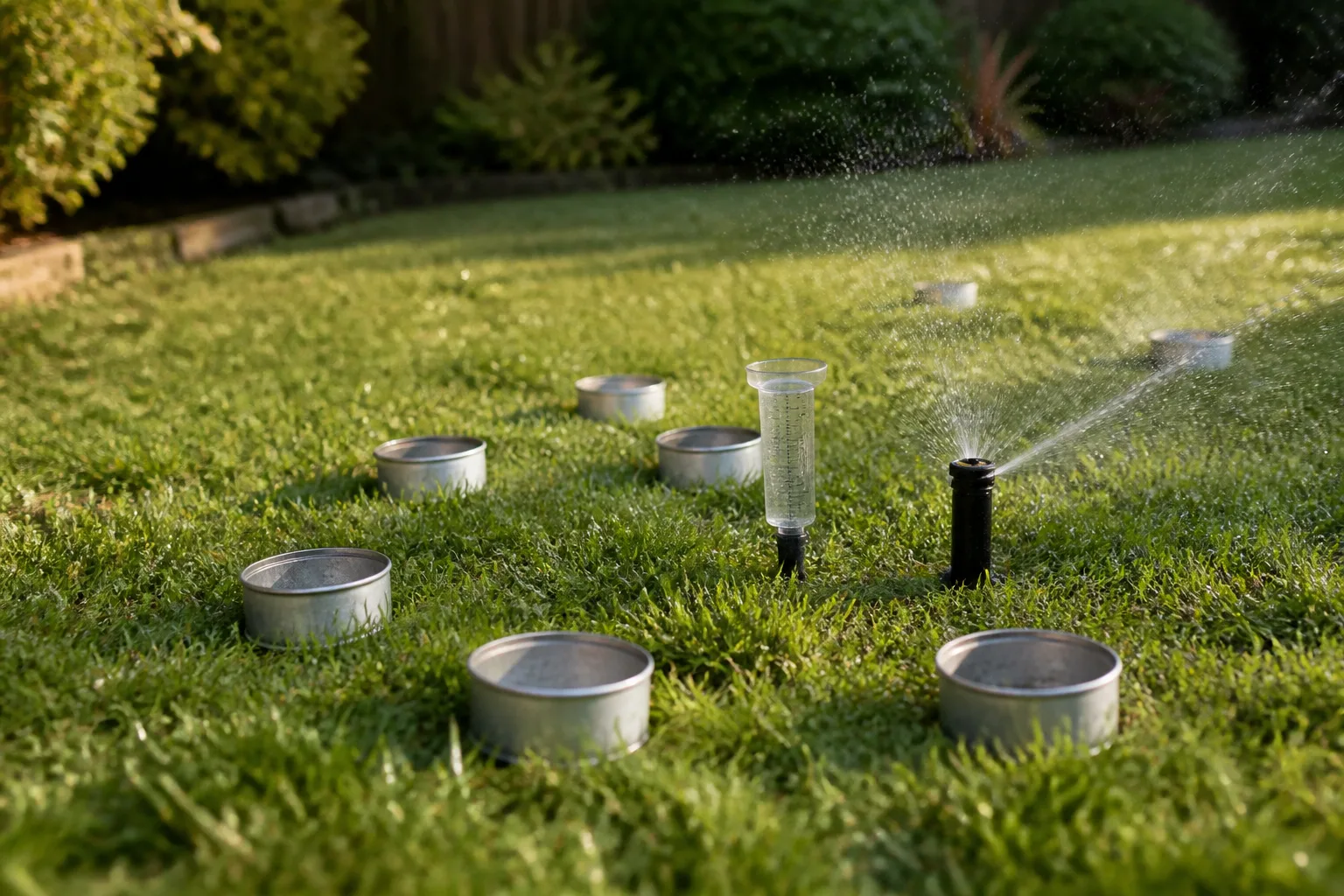
The catch-can test turns a timer guess into a measurement. Use several straight-sided containers—rain gauges, tuna cans, or small cups with vertical sides—and place them across one irrigation zone, including the center, edges, corners, and any area that looks unusually dry.
- Run the zone for a known period, such as 15 minutes.
- Measure the water depth in each container and calculate the average.
- Compare the containers. Large differences show a coverage problem, not a need for a longer cycle.
- Scale the runtime to your desired depth, then split the cycle if runoff begins before the water reaches the soil.
UF/IFAS Extension recommends the same basic container method and notes that each zone can require a different runtime. On a slope or compacted clay, use cycle-and-soak: stop when water begins to run off, wait for infiltration, then finish the measured application. More minutes on top of runoff are not deeper watering; they are wasted water.
Practice 2: Letting turf go thirsty for too long
Overwatering and underwatering are opposite mistakes with similar consequences: both can leave the lawn thin and vulnerable. A lawn that receives too little water loses turgor, stops growing, and may become more susceptible to traffic, insects, weeds, and heat injury. A lawn that receives too much may have weak shallow roots, poor oxygen in the soil, disease pressure, and yellowing that tempts you to add even more fertilizer.
Do not diagnose from color alone. Straw-colored grass may be dead, but it may also be dormant cool-season turf protecting its crown during heat or warm-season turf resting during cold. Check the crown and surrounding soil, compare a shaded section with a sunny one, and see whether the lawn responds after a properly measured soak. If only one strip stays brown, suspect sprinkler coverage, salt or deicing exposure, a buried obstruction, traffic, or a root-zone problem before changing the entire yard’s schedule.
When the lawn is genuinely dry, water the root zone rather than misting the surface. The goal is not to keep the top fraction of an inch perpetually damp; it is to make a measured application that penetrates several inches without creating runoff. In a hot spell, the sunniest or most exposed zones may need attention sooner than shaded areas. A rain gauge and a soil probe are more useful here than a fixed timer because they show what the lawn has actually received.
Practice 3: Mowing too short or removing too much at once
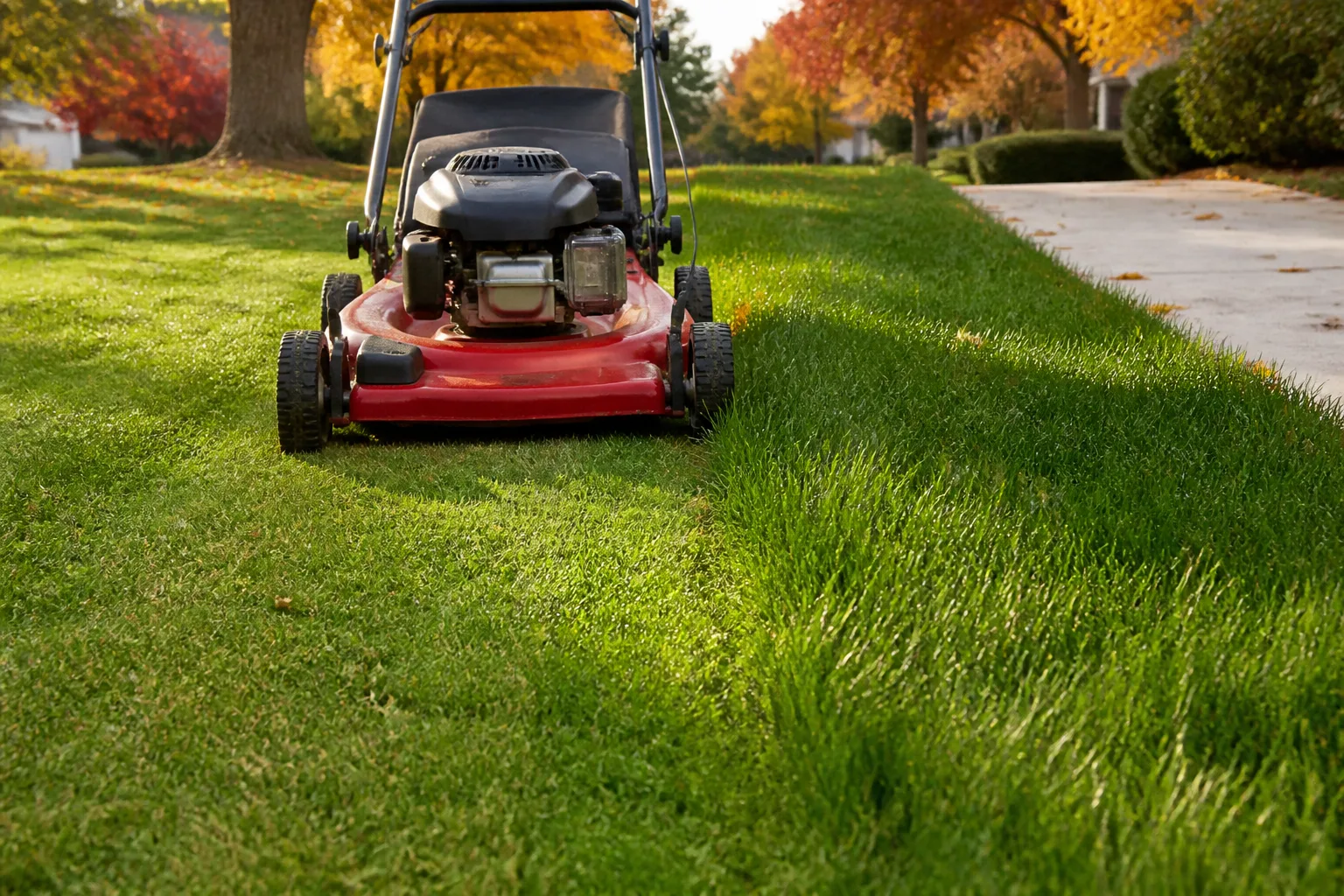
Short grass can look tidy right after mowing and stressed a few days later. Removing too much leaf area reduces photosynthesis, exposes the crown to heat, dries the soil faster, and gives weeds more open light and space. The Ohio State University’s current lawn-mowing guidance links higher mowing to better density, drought tolerance, and weed competition, while warning that low mowing produces shallower roots and greater summer stress (Ohio State University Extension).
Set the deck by grass type and follow the one-third rule
Start with the upper end of the recommended range for your grass, especially during heat, drought, or shade. Ohio State lists broad home-lawn ranges of about 2 to 4 inches for Kentucky bluegrass, perennial ryegrass, and fine fescues; 2.5 to 4 inches for tall fescue; 1 to 2.5 inches for zoysiagrass; and 1 to 2 inches for common bermudagrass. Cultivar and regional recommendations can narrow those ranges, so treat them as a starting point rather than a universal setting.
Then use the one-third rule: remove no more than one-third of the blade’s height in a single mowing. If you maintain grass at 3 inches, mow before the average height reaches about 4.5 inches; cut it back to 3 inches rather than waiting until it is 6 inches and scalping it. Lawn Love’s practical explanation is useful for one reason: it frames the rule as a height trigger, not a promise that every lawn must be mowed on the same weekday (Lawn Love).
Do not obsess over measuring every blade. The rule is a dependable guardrail, while growth rate changes with rain, fertilizer, temperature, and season. Check the average height of the lawn and mow often enough that a single pass is a light trim. A fuller canopy shades the soil and gives the grass more leaf area to make and store energy.
Recover from overgrown, wet, or drought-stressed grass
If grass has grown far beyond its target height, raise the mower and take a partial cut. Let the lawn recover, then lower the deck gradually over later mowings. The worst catch-up move is to drop the deck to the final setting and remove half the blade in one pass.
Mow when the blades are reasonably dry. Wet grass folds, clumps, clogs the mower, and produces an uneven cut, so it can look as though you used the correct setting when you actually removed more leaf tissue than intended. Keep the blade sharp as well; Ohio State notes that dull blades fray the leaf tips, leaving a brown cast and damaged tissue.
During severe drought, postpone mowing if the grass has stopped actively growing and reduce traffic. A dormant lawn is already conserving energy. If it must be cut for safety or appearance, use the highest reasonable setting and avoid a heavy pass when the soil is brittle or the crown is visibly stressed.
Return fine clippings to a growing lawn when they are not clumping and no active disease is present. They decompose quickly and return nutrients; they do not automatically create thatch. Collect heavy windrows after an overgrown cut, and collect clippings when weeds are carrying seed or a diagnosed disease could be spread by the debris.
Practice 4: Fertilizing too often or too heavily
Fertilizer cannot compensate for the wrong grass, poor light, compacted soil, or broken irrigation. Excess nitrogen can push soft, fast growth that needs more mowing and water, increase the chance of burn, and send nutrients into runoff when applied to pavement or before heavy rain.
Use the four-part test from UF/IFAS Extension: the right source, right rate, right time, and right place. A slow-release or controlled-release nitrogen source can reduce a flush of growth and lower burn risk, but “organic” on the bag is not a license to apply extra. Plants ultimately take up nutrients in usable chemical forms; the rate and timing still control the outcome.
Extension recommendations often use up to about one pound of actual nitrogen per 1,000 square feet per application for established lawns, but that is not a universal annual program. Species, soil, clippings, traffic, climate, irrigation, and local rules change the total. Penn State’s turfgrass guidance shows why: Kentucky bluegrass and perennial ryegrass generally need more annual nitrogen than fine fescues, and excessive nitrogen on fine fescue can increase susceptibility to heat, drought, and disease (Penn State Extension).
Read the label and calibrate the spreader
The first number on a fertilizer bag is the nitrogen percentage by weight. A 20-0-10 product contains 20 percent nitrogen, so supplying one pound of actual nitrogen requires five pounds of product per 1,000 square feet. That calculation tells you the nutrient amount; it does not override the product label, local restrictions, or a soil-test recommendation.
Measure the lawn area instead of guessing. Mark the spreader setting, apply half the calculated product in one direction, and apply the other half at a right angle. Sweep granules from sidewalks and driveways back onto the lawn rather than washing them into a storm drain. NC State Extension recommends starting with a soil test, calibrating a rotary or push spreader, and avoiding lime or extra phosphorus unless a test shows a need (NC State Cooperative Extension).
Do not fertilize ahead of flooding rain or when the lawn is not actively growing. If a lawn remains pale after a correctly timed, measured application, test the soil and inspect roots, light, and irrigation instead of repeating the application the next weekend.
Practice 5: Feeding cool-season grass through summer
Summer fertilizer is not automatically wrong; the mistake is treating summer as the same growth season for every lawn. Cool-season turf often slows or enters partial dormancy during high heat, especially when moisture is limited. Penn State Extension identifies late summer and early fall as an important feeding period for cool-season grasses because they can recover from summer stress and store carbohydrates before winter, while fertilizer during heat and drought can injure the plants.
Warm-season turf follows a different rhythm. It may be actively growing and able to use nutrients during summer, but it still needs a species-appropriate rate, adequate moisture, and compliance with local fertilizer restrictions. UF/IFAS Extension notes that nutrient uptake and leaching risk vary with growth, root mass, location, and season; its homeowner guidance also emphasizes waiting until grass is growing and applying only what the lawn needs (UF/IFAS Extension).
Read “summer fertilizer” as a conditional decision. If cool-season turf is heat-stressed, brown from drought, or not growing, repair water delivery and reduce traffic first. If warm-season turf is actively growing, use the local extension schedule and the label rather than a cool-season program. When the grass type is mixed or unknown, identify it before selecting a product; applying the wrong schedule is one of the easiest ways to create the thin, weak growth you were trying to prevent.
Practice 6: Feeding too little—or guessing instead of testing
Underfertilizing can leave turf thin and slow to recover from traffic, heat, or cold. But a lawn that looks hungry may not need more fertilizer. Low pH, poor drainage, shade, compacted soil, shallow roots, insect injury, and uneven irrigation can all limit growth even when nutrients are present.
That is why “fertilizing too little” and “fertilizing without diagnosis” belong in the same warning. Adding more nitrogen to a lawn that cannot absorb it may produce a short green flush followed by more mowing, more thirst, and greater stress. A thin lawn also loses its ability to crowd out weeds, so the visible symptom can intensify while the underlying cause remains untouched.
When a soil test is worth more than another bag
Order a soil test when the lawn stays weak after irrigation coverage and mowing height are corrected, when you are considering lime, or when the same patch fails year after year. NC State Extension explains that a soil test can measure pH, phosphorus, and potassium and guide amendments for the next several seasons; it also notes that a routine soil test does not directly measure nitrogen, so nitrogen recommendations are based on grass response and management.
Use the report to decide whether to add lime, phosphorus, potassium, or nothing. Wisconsin Extension notes that phosphorus may be restricted by law in some places and that potassium is not automatically needed just because a product is marketed as a “winterizer.” It recommends controlled-release nitrogen and careful application so granules land on turf rather than hardscape (University of Wisconsin–Madison Extension).
If the soil pH is outside your grass’s useful range, correct that only according to the test and local guidance. Overliming is difficult to undo. Likewise, a fertilizer that contains every nutrient is not automatically better; unnecessary phosphorus or micronutrients can add cost and environmental risk without helping the grass.
Practice 7: Skipping aeration on compacted soil
Aeration is useful when compaction is limiting air, water, and root growth—not because every lawn needs the same annual ritual. Look for soil that is hard to penetrate, water that runs off or puddles, thinning along walkways, shallow roots, and a lawn that stays wet on top while nearby soil dries normally.
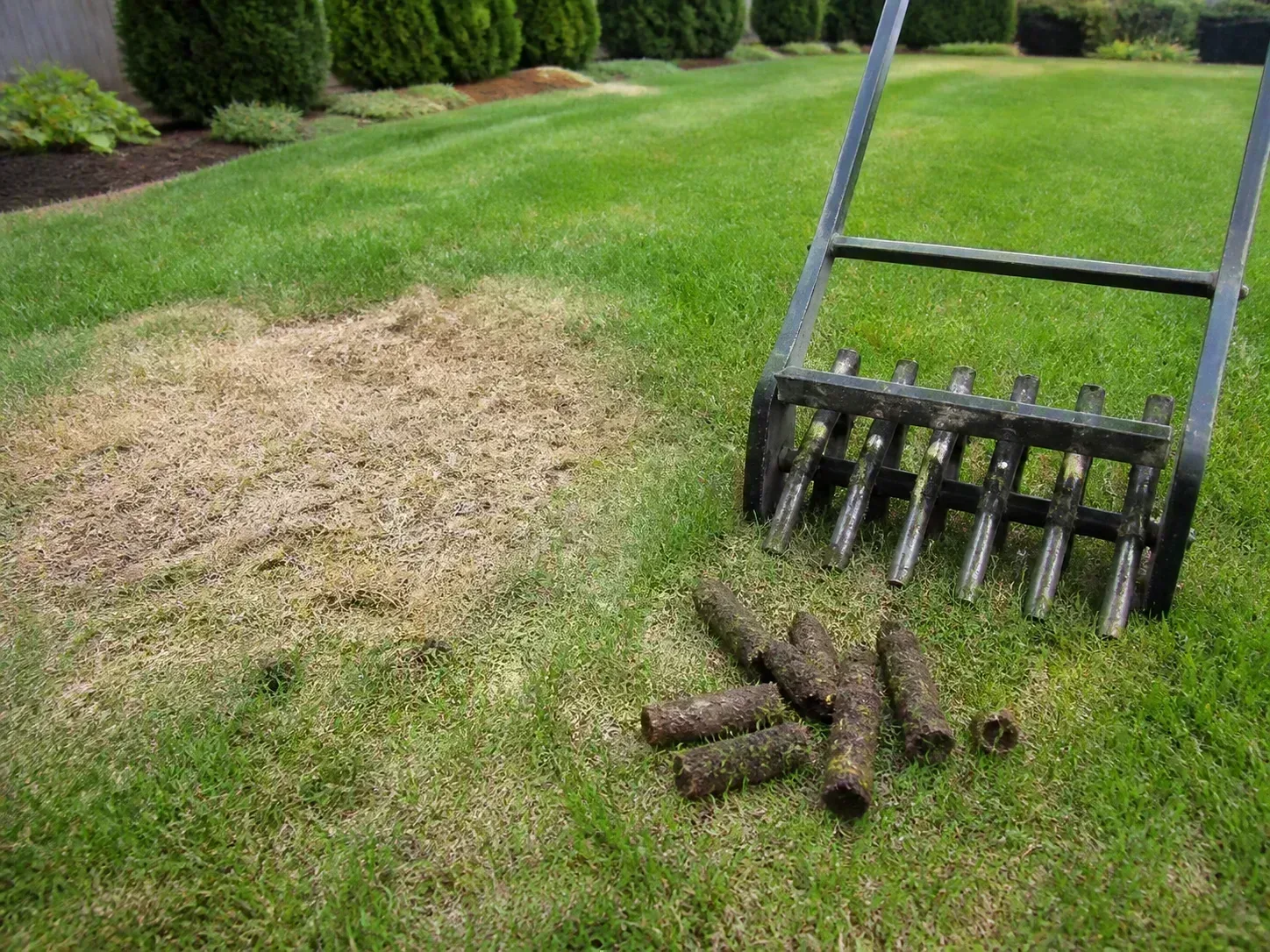
Penn State Extension describes core aeration as removing plugs of soil to create larger pores that improve movement into the root zone. It recommends aerating during cool weather and adequate moisture so the turf can recover, and it warns that spring aeration can bring weed seeds to the surface. The same seasonal guide says not to dethatch or disturb a lawn during high heat or drought, and not to remove thatch unless it is actually excessive (Penn State lawn management through the seasons).
Use core aeration only when the site calls for it
Use a hollow-tine core aerator for true compaction; a spike shoe or solid tine makes holes without removing soil and can press material around the hole. Water the lawn enough for the machine to penetrate, but do not aerate a muddy surface that smears and seals the soil.
After core aeration, leave the plugs on the lawn to dry and break apart. Overseeding at the same time can make sense when the turf is thin and the season is right, because seed has improved contact with exposed soil. It is not a reason to seed a heat-stressed lawn or a site that cannot provide enough light and water for the new grass.
Heavy traffic may require more frequent aeration than a lightly used front lawn, while sandy soil may not need mechanical aeration at all. Test first: if a screwdriver penetrates easily, infiltration is good, and roots occupy the soil without a hard layer, spend your effort on mowing, irrigation, or species fit instead.
A recovery sequence for a struggling lawn
When several mistakes have been running together, change everything at once and you will not know what helped. Use this order instead:
- Pause automatic inputs. Turn off routine irrigation and fertilizer until you inspect soil moisture, rainfall, growth, and the forecast. Follow local watering and fertilizer restrictions.
- Map the lawn. Mark sunny and shaded areas, slopes, puddles, traffic lanes, brown strips, and places where spray reaches pavement. Treat distinct zones differently.
- Identify the grass. Use blade shape, growth habit, old seed or sod records, and local extension resources. Set mowing and feeding expectations from the species, not a neighbor’s calendar.
- Audit water. Use catch cans to check depth and uniformity. Repair blocked or sunken heads, correct overspray, and split cycles where runoff begins.
- Mow conservatively. Raise the deck, keep the blade sharp, wait for dry conditions, and remove no more than one-third of the average blade in a pass. Reduce traffic during drought dormancy.
- Test before amending. Submit a soil sample if pH or nutrient imbalance is plausible. Do not add lime or phosphorus because the lawn looks pale.
- Feed in the correct growth window. Use the grass-specific schedule, actual-nitrogen math, and a calibrated spreader. Sweep spills from hard surfaces and avoid heavy rain windows.
- Aerate or reseed only when conditions support it. Correct compaction during a recovery-friendly season, then seed a grass that matches the site’s light, climate, water, and traffic.
Give the lawn several weeks of consistent, measured care before judging the result. New roots and a denser canopy take longer than a cosmetic green-up, and a patch that does not respond after the basic audit deserves a closer inspection for pests, disease, buried construction debris, drainage defects, or a site that is simply unsuitable for turf.
Conclusion
The lawn-care habits that cause the most trouble are usually attempts to make turf look better quickly: water a little every day, cut it very short, apply fertilizer whenever the color fades, or aerate because the calendar says it is time. Those shortcuts ignore the plant’s root zone and the conditions that control it.
Replace them with a few durable rules: water by measured need, mow high enough to preserve leaf area, follow the one-third guardrail, fertilize only when the grass can use it, test soil before adding amendments, and aerate compacted ground only when the lawn can recover. Once the routine matches the grass and the site, the lawn has a better chance to become dense and resilient with less water, less fertilizer, and less emergency repair.



