7 Drought-Tolerant Ground Covers for a Low-Care Yard
Compare seven drought-tolerant ground covers by sun, soil, spread, and water needs, with planting steps and invasive plants to avoid.
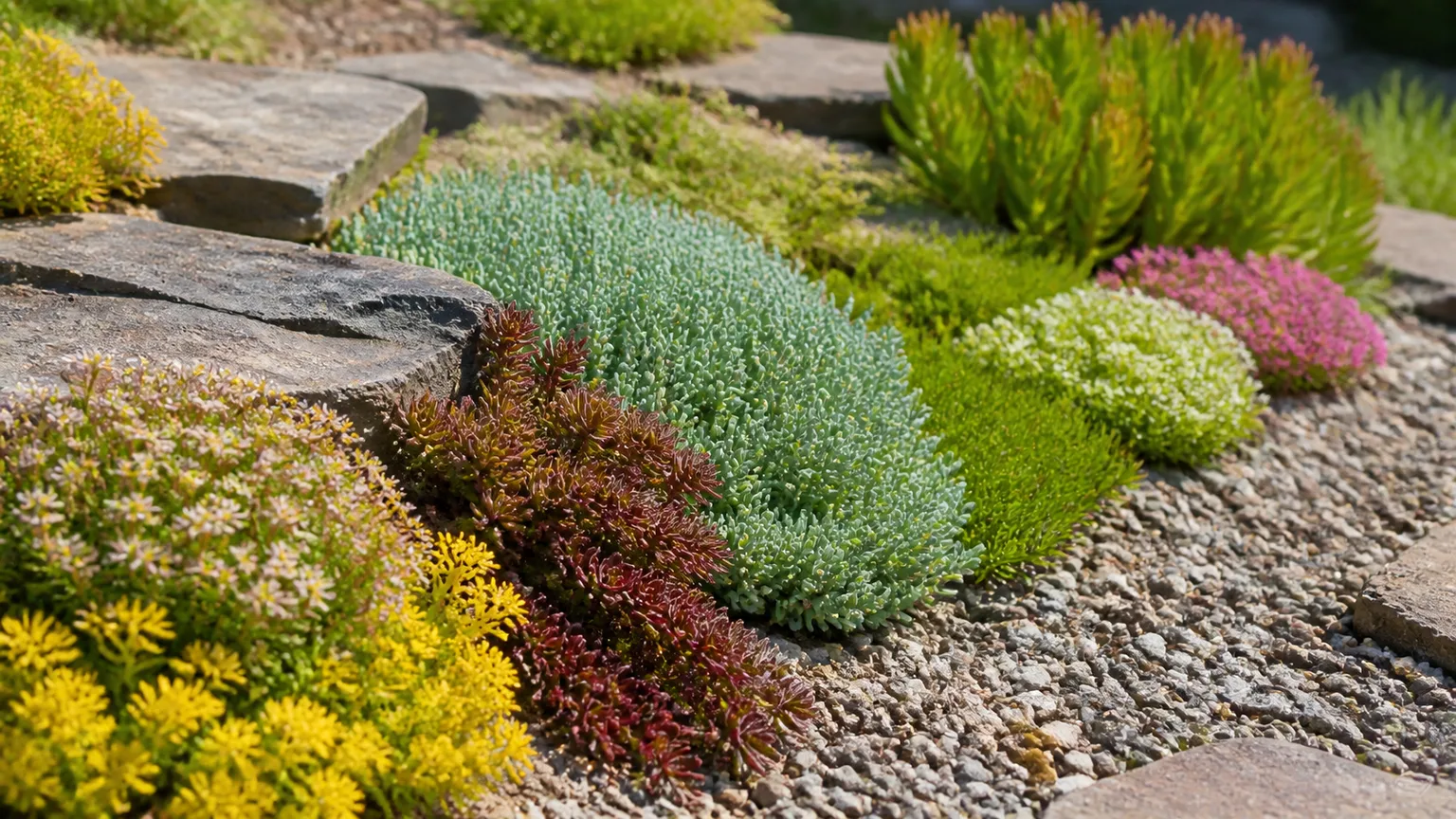
The best drought-tolerant ground cover is not simply the plant that survives the longest without rain. It is the plant whose mature size, root behavior, drainage needs, and light level match the patch you want to cover. A low mat for a sunny path needs a different plant from a broad evergreen bank, and a plant that spreads aggressively can create more work than the bare soil did.
This list focuses on seven useful choices for sunny, dry, rocky, or lean sites: Angelina sedum, creeping thyme, hardy ice plant, basket-of-gold, candytuft, creeping phlox, and creeping juniper. They still need regular attention while establishing, but once rooted in the right place they can reduce exposed soil, slow erosion, and make mowing or repeated irrigation unnecessary in selected areas. The Royal Horticultural Society also stresses that drought-adapted plants need water while they build the roots that let them handle dry conditions later.
What to look for in a drought-tolerant ground cover
Look for a plant with a low, spreading habit and a clear reason it can handle dry conditions. Fleshy leaves, leathery or finely cut foliage, deep or extensive roots, and a natural preference for gritty or rocky soil are useful clues. The New York Botanical Garden groups these adaptations with practical site rules: many silvery-leaved plants need full sun and good drainage, while stonecrops and other succulents store water in their leaves.
“Low maintenance” also has a boundary. A ground cover can suppress weeds and still need edging, thinning, or a hard boundary if it runs into a lawn or neighboring bed. Fine Gardening’s ground-cover advice is useful here: choose the amount of aggressiveness that fits the location, because a mat-forming root system that is helpful on a bank can be a nuisance beside a perennial border.
Check sun, soil, and winter drainage before you buy
Start with three observations. Count the hours of direct summer sun, squeeze a handful of soil after rain to see whether it stays wet, and measure the bare patch rather than relying on the label’s word “spreading.” Six or more hours of direct sun opens the door to the most drought-tolerant choices, but a south-facing wall can be much hotter and drier than an open bed in the same yard.
Dry soil is not the same as dead or sterile soil. Sandy and stony soil drains quickly, so plants need help during establishment; compacted clay may be dry on top while remaining airless and wet around roots below. BBC Gardeners’ World Magazine notes that sandy or stony soils warm quickly and drain fast, while plants that dislike wet roots often struggle when winter cold and poor drainage occur together.
If you have heavy clay, improve the planting zone broadly with finished compost and correct the grade so water can leave. Do not dig a small “drainage pocket” of gravel into a bathtub-shaped hole; water can collect at the edge of the amended soil. For a wet winter site, choose a plant that tolerates those conditions or fix the drainage before choosing a succulent.
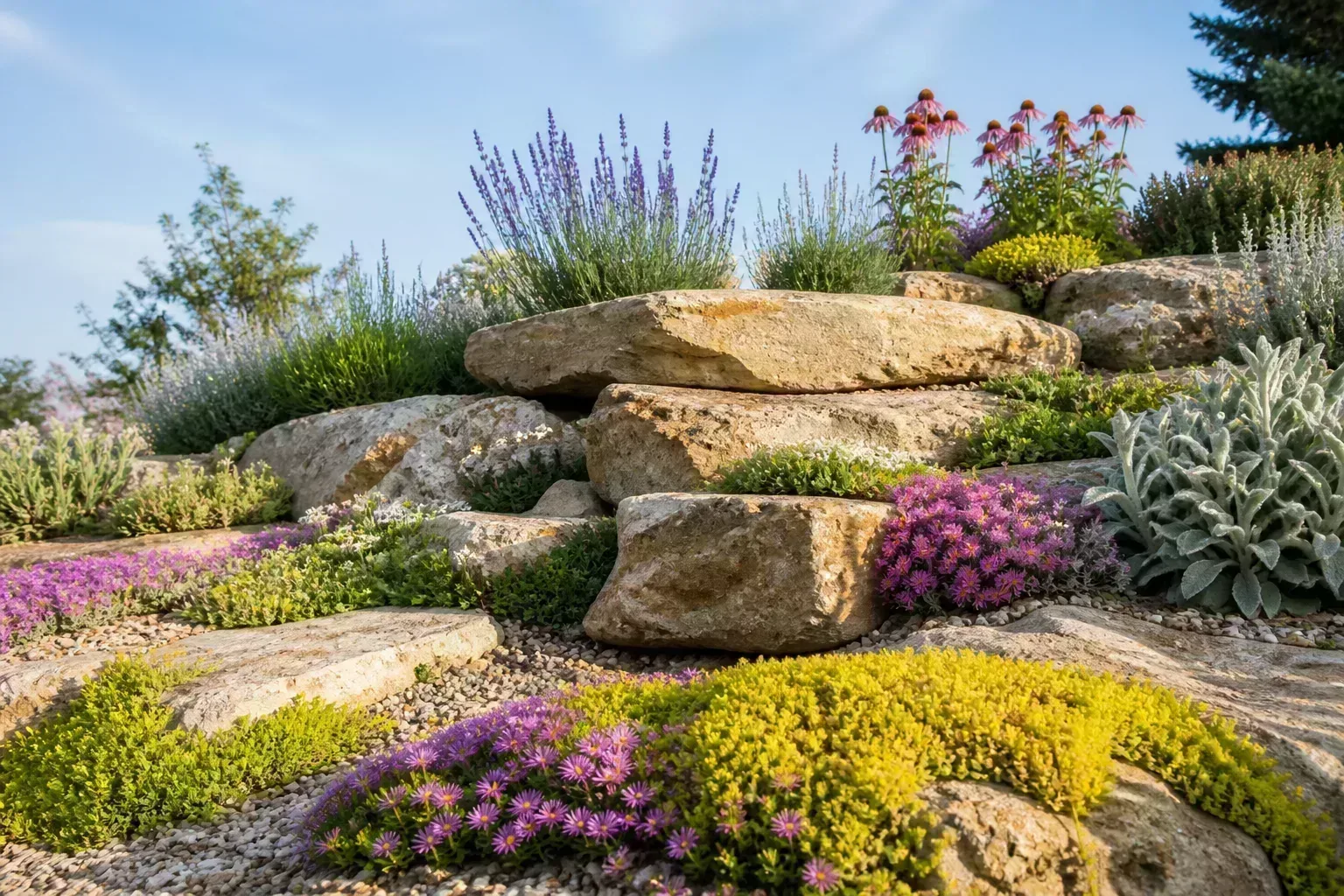
The seven best drought-tolerant ground covers
The seven plants below are not ranked from universally best to worst. They are arranged by the kind of job they do, because the right match saves more water and maintenance than a popularity contest. Use the height and width ranges as planning numbers, then check the cultivar label: named selections can be smaller, larger, slower, or more colorful than the species.
1. Angelina sedum
Best for: a sunny rock garden, gravel border, wall, or small slope where a colorful succulent mat is wanted. Size: about 3 to 6 inches tall and roughly 1 to 2 feet wide, depending on growing conditions and cultivar. Water: low after establishment. Main risk: rapid spread and wet soil.
Angelina sedum, also called rocky stonecrop or Petrosedum rupestre ‘Angelina’, forms a low mat of needle-like yellow-green foliage that can take on orange or red tones in cold weather. The North Carolina Extension Gardener Plant Toolbox describes it as drought tolerant, suited to dry rocky soil and full sun, and useful draped over rock walls or planted in groups. Its foliage is the main show; small yellow flowers are a bonus rather than the reason to plant it.
Give it a site where water drains quickly and where a stem wandering a few inches will not cause trouble. Fallen leaves and pieces can root, which is part of its easy coverage and part of why it should not be tucked against a lawn edge without a clean boundary. A yearly trim of escaped stems is a reasonable maintenance task; constant irrigation or rich, wet soil is not.
2. Creeping thyme
Best for: the edge of a path, a gravel garden, crevices between stepping stones, or a low flowering carpet in full sun. Size: roughly 2 to 3 inches tall and 3 to 12 inches wide for Thymus serpyllum. Water: low after rooting. Main risk: poor drainage and expecting a delicate mat to behave like turf.
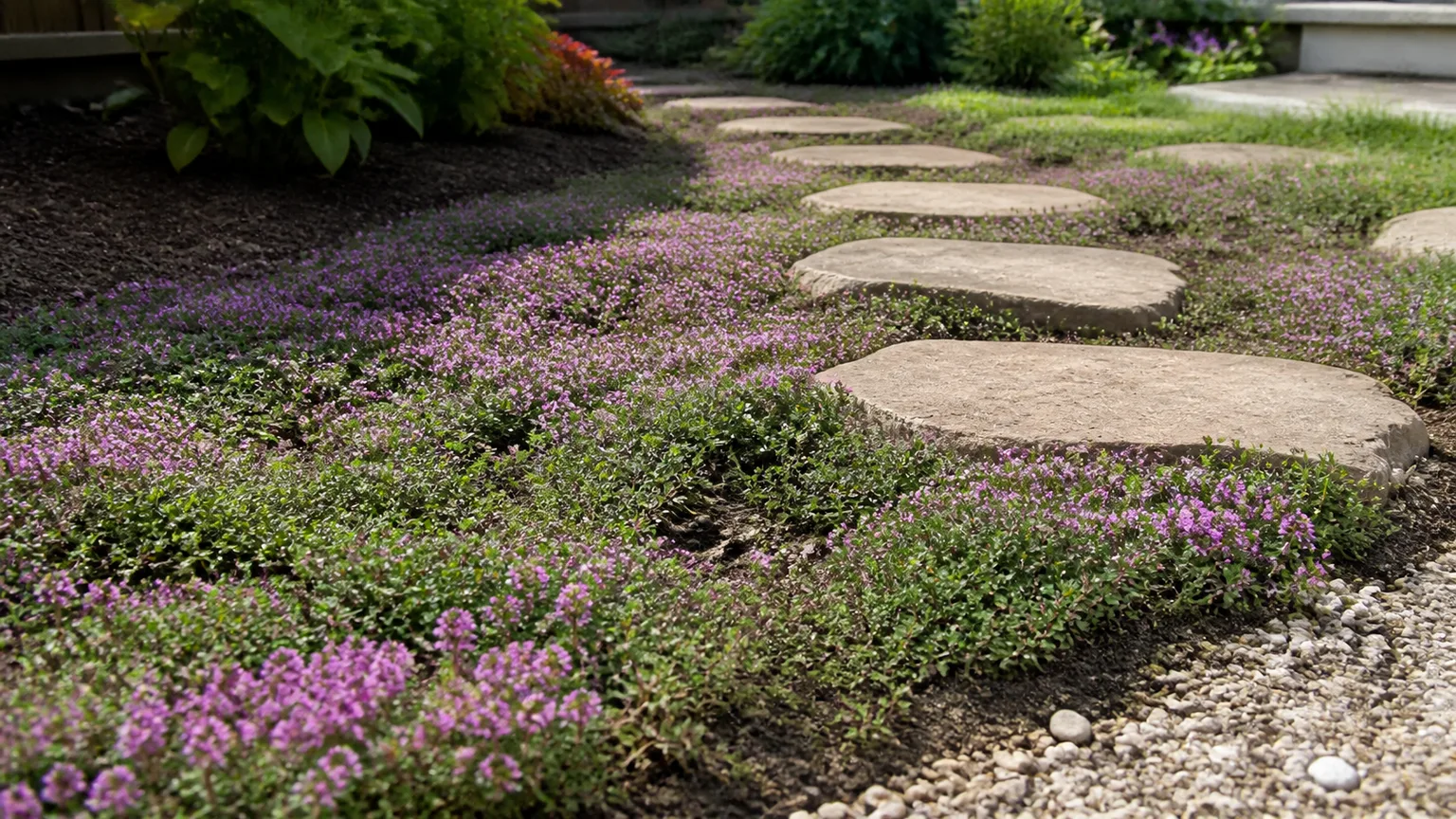
Creeping thyme is a dwarf, woody evergreen with tiny aromatic leaves and small pink-to-purple flowers. The NC State profile says it tolerates poor soil and prefers sandy, gritty, or rocky soil with average to dry moisture; it also notes that the plant may stay evergreen in mild winters and can attract bees and butterflies.
Use it where you want a plant that visually links paving and planting, not as a promise of a walkable lawn. Keep the crown from being buried under mulch, and shear or prune lightly when stems become woody or spill farther than the design allows. It fills slowly in a crowded, shaded, or soggy bed, so give it the open sun and sharp drainage it is adapted to use.
3. Hardy ice plant
Best for: a hot, sunny, sandy, sharply drained slope or rock wall with long-season flowers. Size: commonly about 3 to 6 inches tall and 1 to 2 feet wide. Water: very low after establishment. Main risk: wet winter soil, heavy clay, and overwatering.
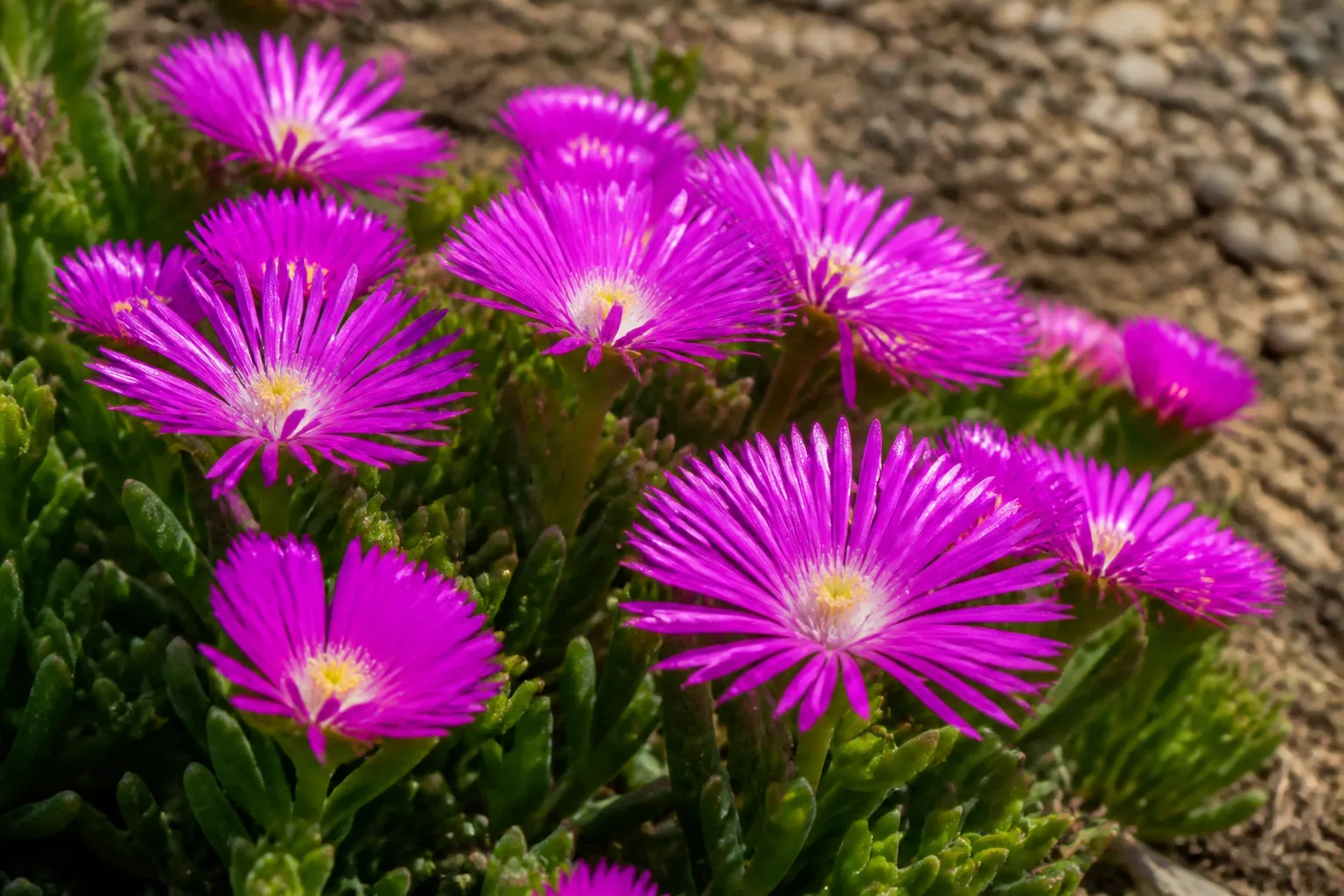
Hardy ice plant, or Delosperma cooperi, makes a carpet of fleshy green leaves and bright purplish-pink, daisy-like flowers. NC State recommends full sun, dry sandy soil, and 16 to 24 inches of spacing, and warns that the plant may have trouble returning in wet winter areas. That combination is the important detail: ice plant handles drought because it stores water, but stored water does not make its roots tolerant of standing water.
Plant it high on a slope, in a raised rock garden, or where rain can move away from the crown. If your soil is sticky clay or your winter is cool and rainy, choose creeping thyme, basket-of-gold, or a locally adapted native instead of trying to rescue ice plant with more gravel and less hope. Remove spent flower stems only if you want a tidier edge; do not keep the plant constantly wet to force faster growth.
4. Basket-of-gold
Best for: a sunny rock wall, ledge, or cool-to-moderate summer garden where spring flowers matter most. Size: about 6 to 12 inches tall and 1 to 1.5 feet wide. Water: low after establishment. Main risk: heat, humid summers, and soil that drains too slowly.
Basket-of-gold, or yellow alyssum (Aurinia saxatilis), makes a mound of gray-green foliage followed by a dense spring display of yellow flowers. NC State describes it as a low-growing plant for full sun and very well-drained sandy or rocky soil, with drought tolerance and a tendency to struggle in zones higher than 7. That zone note is a useful reminder not to treat a plant’s drought label as a guarantee for every climate.
Use it where the spring bloom can spill over stone and where the foliage still looks good after flowering. It is not the strongest choice for a blazing, humid lowland bed or a space that must look lush through a long hot summer. If it becomes short-lived in your climate, replace it rather than compensating with daily watering that keeps the roots too wet.
5. Candytuft
Best for: a bright border front, walkway edge, raised bed, or low wall where evergreen structure and spring flowers are both valuable. Size: about 6 to 12 inches tall and 6 to 18 inches wide. Water: moderate while establishing, then low to moderate depending on soil and heat. Main risk: crown rot in wet soil and winter scorch in cold climates.
Candytuft (Iberis sempervirens) is a low, spreading evergreen or semi-evergreen subshrub with leathery leaves and dense clusters of white spring flowers. The NC State profile lists full sun or light shade, well-drained moist to slightly dry soil, and drought tolerance; it also recommends cutting the plant back by about one-third after flowering to encourage new growth.
Candytuft is a better choice than a succulent when you want a tidy, flower-heavy edge that can tolerate a little more ordinary garden soil. It still cannot sit in a wet pocket. Plant the crown high enough that water does not collect around the woody center, and use a thin mulch layer that leaves the foliage and stems open to air.
6. Creeping phlox
Best for: a sunny slope, rock garden, wall, or large edge where a broad spring-blooming mat is more useful than a tiny path filler. Size: up to about 6 inches tall and 2 to 3 feet wide. Water: regular moisture while establishing, then relatively drought tolerant in well-drained soil. Main risk: a center that thins as the plant spreads and summer heat in humid climates.
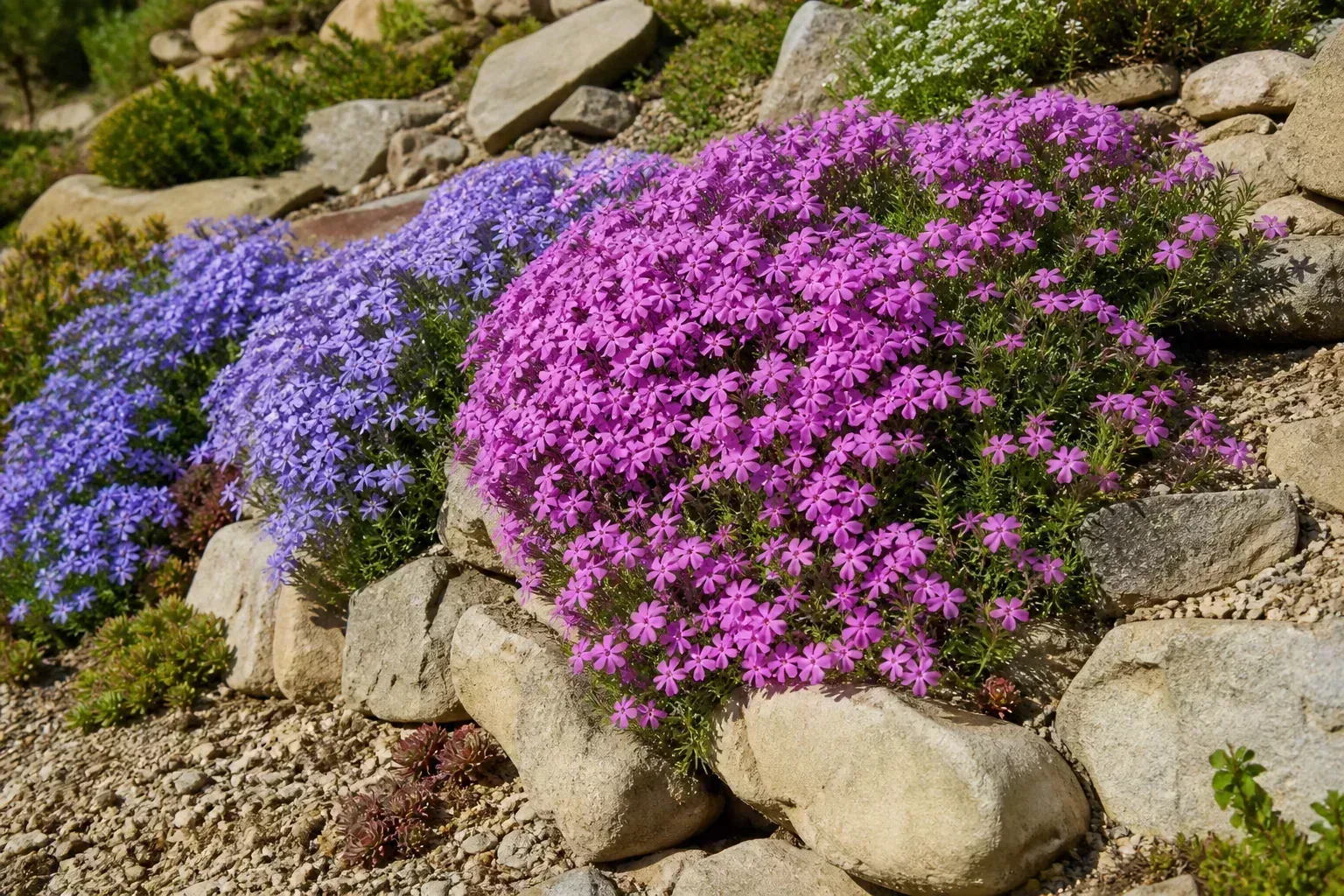
Creeping phlox, moss phlox, or Phlox subulata is a North American native mat-forming perennial with needle-like leaves and masses of pink, lavender, purple, or white flowers in spring. NC State describes it as tolerant of drought and erosion, happiest in full sun with sandy or gravelly soil, and better able to take hot, dry conditions than many other phlox species.
Give it room to spread instead of planting several small plugs shoulder to shoulder. Older mats can thin in the center as fresh growth moves outward; cutting the stems back by about half after flowering helps maintain a denser shape. It is a strong compromise for gardeners who want spring color and a regional native option, but it is not a no-water plant during its first season.
7. Creeping juniper
Best for: a broad bank, difficult slope, retaining wall, or large sunny area where an evergreen shrub-like ground cover can spread horizontally. Size: up to about 1.5 feet tall and potentially 10 feet wide. Water: low after establishment. Main risk: choosing it for a small bed or planting too densely.
Creeping juniper (Juniperus horizontalis) is a North American native, needled evergreen shrub rather than a soft perennial carpet. NC State notes that it prefers full sun and well-drained soil, tolerates drought, heat, poor soil, and some salt, and can form a dense mat useful for erosion control on slopes.
Its mature width changes the design calculation. Space plants for their eventual spread rather than filling the area with a hedge of young containers, and keep the foliage away from paths where it will be brushed or crushed. Creeping juniper is one of the lowest-water options here once established, but it is not a solution for a narrow strip that needs a delicate, frequently walked edge.
Plants that spread too aggressively for most yards
Toughness and good behavior are separate traits. A plant that roots at every node, travels by rhizome, or escapes into nearby natural areas may cover bare ground quickly, but the future maintenance is removal rather than watering. Check your state, province, county, or local extension plant list before buying any ground cover marketed as “fast spreading.”
Why vinca, bugleweed, and Chinese lantern deserve caution
Vinca minor is attractive: glossy evergreen leaves, blue-purple flowers, and a dense mat in shade or partial shade. But the NC State profile says its rapid growth and ability to root at nodes can make it weedy and high maintenance, and classifies it as invasive through the NC Invasive Plant Council. The Washington State Noxious Weed Control Board also notes that periwinkle can escape ornamental plantings and reproduce both by seed and vegetatively.
Bugleweed (Ajuga reptans) is another plant that can be useful in a difficult, moist-to-moderately-dry shady spot but is a risky default beside lawns and perennial borders. NC State describes its dense mat and quick growth, says it is listed as invasive in parts of the country, and specifically advises avoiding it near beds or lawns where spread creates removal problems.
Chinese lantern (Physalis alkekengi) earns caution for a different reason: its novelty orange husks can distract from how quickly a planting can become difficult to manage. I would not make it one of the seven default low-maintenance choices. If you already grow it, keep it in a contained bed, deadhead before unwanted self-sowing where appropriate, remove wandering shoots promptly, and check local guidance before sharing or planting it near natural areas.
If you need a safer substitute, start with a locally native ground-covering perennial recommended for your soil and light rather than swapping one aggressive import for another. A slower plant that stays inside its allotted bed often beats a fast mat that requires yearly excavation.
How to plant ground covers so they establish
Planting is where many “drought-tolerant” beds fail. New roots have not yet reached the surrounding soil, so a plant that can handle a dry August after two seasons may still die if its root ball dries repeatedly during the first few months. Plan the irrigation before you plant, not after the leaves wilt.
Prep the bed and space for the mature spread
Remove perennial weeds and their roots before setting out plants. A ground cover can shade newly emerging weeds later, but it will not smother an established crown of bindweed, nutsedge, or a runner-forming grass simply because it is low growing.
Loosen the planting zone, blend in finished compost where soil structure needs improvement, and correct drainage before planting. Keep amendments consistent across the bed rather than creating isolated pockets. For a gravel-loving sedum or ice plant, preserve a lean, fast-draining surface; for candytuft or phlox, aim for soil that holds some moisture but never stays saturated.
Space from the label’s mature width, not from the size of the nursery pot. If a plant reaches 2 feet wide, two centers 8 inches apart may close the gap quickly but will also create crowding, rot, and pruning work. Wider spacing costs patience; tighter spacing costs plants and often defeats the water-saving goal.
Set each crown at the same height it grew in its container, or slightly high in heavy soil. Water the bed thoroughly after planting so air pockets collapse around the roots, then add a thin organic mulch layer that stops short of the stems. The RHS recommends spreading mulch when the soil is already moist so it traps existing moisture and supports weed suppression while plants fill out.
Water deeply during the first season
Use a hose at the soil line, a soaker hose, or drip irrigation rather than wetting the foliage every day. Water slowly enough to moisten the whole root ball and the surrounding few inches of soil, then wait until the surface begins to dry before checking again. The exact interval depends on rainfall, soil, heat, wind, plant size, and season, so a calendar reminder is less reliable than a finger or trowel check.
The New York Botanical Garden recommends watering deeply and less frequently, checking moisture several inches down, and paying close attention to newly planted plants for the first year or two while roots establish. A rain gauge or empty can can show whether a shower actually reached the bed; a ten-minute drizzle may leave the root ball dry beneath a damp surface.
Reduce watering gradually as the plants root outward. Do not fertilize a plant that is visibly water-stressed, and do not use fast growth as the only measure of success: the goal is a dense, healthy canopy with roots adapted to the site, not soft foliage that collapses as soon as irrigation stops.
How to reduce weeds while the plants fill in
Ground cover suppresses weeds once its leaves or stems shade enough soil to reduce open germination space. It does not create a weed-free bed on day one. The most effective low-maintenance plan has three layers: remove perennial weeds first, keep the soil covered while plants are small, and hand-pull new weeds before they seed.
Use 1 to 2 inches of organic mulch between young plants, keeping it away from crowns and woody stems. Replenish it lightly rather than burying the bed under a thick, wet blanket. USDA Climate Hubs notes that keeping soil covered lowers soil temperature and reduces water loss from evaporation, while the RHS describes mulch as useful for both moisture retention and weed suppression.
Once the canopy closes, let the plant do more of the work. Edge a fast spreader with a path, lawn, or shallow trench that you can inspect; keep a slower clumper visible enough to hand-weed around. If weeds remain vigorous after two growing seasons, the issue may be shade, compacted soil, poor plant spacing, or the wrong ground cover rather than a need for stronger herbicide.
Choose the right plant by yard condition
Use this table as a starting point, then verify the cultivar and local hardiness before buying. “Low water” means after establishment and in a site that matches the plant; every row needs an establishment plan.
| Yard condition or job | Best starting choices | Why they fit | Watch for |
|---|---|---|---|
| Sunny gravel or rock garden | Angelina sedum, hardy ice plant | Fleshy foliage and a low mat suit hot, fast-draining soil | Wet winter, overwatering, rapid spread |
| Dry path edge or stepping stones | Creeping thyme | Tiny, low foliage and summer flowers connect paving to planting | Shade, soggy soil, heavy foot traffic |
| Sunny spring-flowering bank | Creeping phlox, basket-of-gold | Both make a flowering mat; phlox covers more area | First-year watering, summer heat, center thinning |
| Bright border front with year-round structure | Candytuft | Leathery foliage and dense spring flowers | Crown rot and winter scorch |
| Broad sunny slope or erosion-prone bank | Creeping juniper | Evergreen horizontal growth and large mature spread | Too large for narrow beds; inspect for pests |
| Lawn or border beside a natural area | Local native alternative first | Local species can support habitat and fit regional conditions | Confirm mature size and local availability |
For a small yard, start with one or two plants that behave similarly rather than mixing every texture in the list. A bed of thyme and sedum can look intentional in a sunny rock garden, while juniper needs enough room to be treated as the structure of the slope. Repeating a compatible plant usually looks calmer and is easier to water than a collection of seven unrelated “tough” plants.
Common mistakes that make drought-tolerant plants fail
Choosing by the word drought alone. A plant can be drought tolerant and still need moist soil in its first season, protection from wet winter roots, or afternoon shade in a hot climate. Read the drainage and climate notes, not just the water label.
Putting a dry-site plant in a low spot. Sedum and ice plant often fail because rainwater collects around their crowns. Raise the bed, redirect runoff, or choose a plant that accepts the existing moisture; adding gravel to the hole rarely fixes a drainage problem by itself.
Planting too close for instant coverage. Dense young plants look efficient at the garden center, but mature width is the number that determines pruning, rot, and competition. If you need immediate weed suppression, use a temporary mulch layer while the plants close the gaps.
Treating mulch like irrigation. Mulch slows evaporation but cannot replace water reaching new roots, and a thick wet layer can trap moisture against stems. Water the soil first, use a modest layer, and leave the crown visible.
Assuming evergreen means attractive in every season. Candytuft can be evergreen or semi-evergreen depending on climate, thyme can lose some winter color, and ice plant may not return after wet winters. Plan for the season when the plant rests, not only for the week it blooms.
Ignoring the edge. A ground cover that reaches a lawn, sidewalk joint, or neighboring bed will eventually need a decision. Choose a path or stone edge that makes inspection easy, and remove escapes while they are still a handful of stems.
Watering on a fixed schedule forever. The goal is to taper supplemental water as roots establish and weather changes. Check the soil, use rainfall as part of the calculation, and increase attention during a heat wave instead of maintaining the same timer through cool, wet weather.
Conclusion
For the smallest sunny, dry spaces, start with Angelina sedum, creeping thyme, or hardy ice plant, choosing among them by drainage and how close the bed is to a lawn. For spring flowers, basket-of-gold and creeping phlox bring different scales of color, while candytuft gives a more structured edge. For a broad bank where evergreen coverage matters, creeping juniper is the long-term choice—but its mature width must be part of the design from day one.
Prepare the soil, space for the adult plant, water deeply during establishment, and keep the ground mulched while the canopy closes. Most importantly, check the local status of fast-spreading plants before buying. A ground cover becomes genuinely low maintenance when it saves water without creating a new removal project.