When to Prune a Butterfly Bush (and What to Do If Late)
Forgot to prune your butterfly bush? Use this season-by-season plan to protect blooms, remove winter damage, deadhead safely, and reset it in spring.
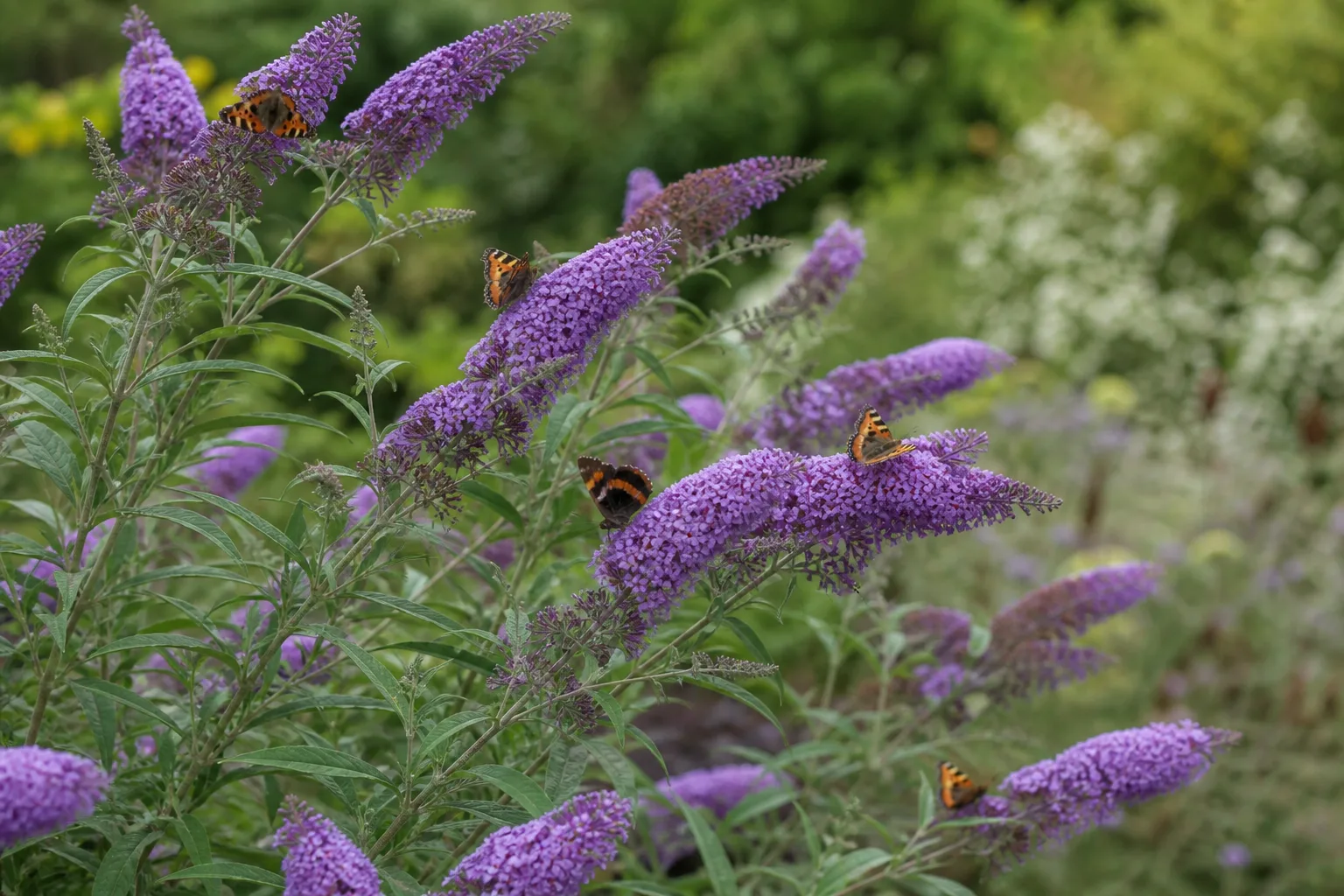
If you forgot to prune a typical butterfly bush, do not rush outside with the loppers. Most Buddleja davidii cultivars bloom on new wood, so the shrub can usually wait for the next useful pruning window; the right action depends more on the season, live growth, and forecast than on a missed date.
If spring has passed and the plant is already leafy, remove only what creates an immediate problem: dead or broken wood, a branch blocking a path, or spent flower heads that are about to release seed. Save the hard structural reset for the next late-winter or spring window. If you are still in early spring and can see swelling buds, you probably have not missed the window at all.
The quick answer if you missed the pruning window
For the common summer-flowering butterfly bush, the best time for a hard prune is late winter to early spring, after the plant begins to show live buds and the immediate threat of a hard freeze has passed. That timing lets you remove winter damage while leaving enough growing season for new shoots to carry summer flowers. NC State Plant Toolbox describes Buddleja davidii as a new-growth bloomer that is best pruned in early spring.
The practical rule is simple: prune hard when the plant is waking up, not when the calendar merely says spring. In a mild climate that cue may arrive in February; in a cold garden it may be April or even May. Butterfly bush can leaf out later than nearby shrubs, so a bare-looking framework is not proof that the roots have failed.
If you are looking at a full canopy in midsummer or a dormant plant just before winter, a hard cut is usually the wrong rescue. Clean up hazards, deadhead when appropriate, keep the root zone from drying out, and put the structural prune on next year’s calendar. One unpruned season generally produces a taller, less balanced shrub; it does not automatically make the plant unsalvageable.
Identify which butterfly bush you have before cutting
“Butterfly bush” is a common name for several Buddleja species and hybrids, and they do not all put flower buds on the same wood. The familiar shrub with long summer flower spikes is usually Buddleja davidii or a hybrid selected from it. That is the type most likely to tolerate a strong spring renewal cut.
Look at the plant’s bloom timing and habit rather than relying on flower color. Summer flowers on vigorous upright or arching shoots, opposite gray-green leaves, and substantial winter dieback point toward B. davidii. A label that names a compact series may indicate a smaller, better-branched cultivar, but the marketing name alone does not tell you how low to cut it.
The distinction matters because a hard spring cut removes old stems. On a new-wood shrub, that is mostly a reset before the season’s flowering shoots develop. On an old-wood shrub, the same cut can remove the branches carrying the year’s flowers. If the plant label is missing, use light cleanup until you can match the plant’s bloom timing to a reliable species or cultivar description.
New-wood types: the usual summer-flowering butterfly bush
Most B. davidii types flower on shoots produced during the current growing season. Colorado State University Extension groups most butterfly bushes with summer-flowering shrubs that can be thinned or rejuvenated in early spring before growth begins. Its flowering-shrub guidance also explains why an older, unpruned shrub tends to flower farther out on the canopy: new flowering growth is being produced on an aging framework instead of from a refreshed base.
That biology gives you flexibility. A healthy plant can be cut to a low framework in spring, left somewhat taller for height, or selectively thinned if it already has a good shape. The goal is not to punish the shrub for being forgotten; it is to put next season’s flowers on strong, well-placed shoots.
Old-wood types: slow down before a hard spring cut
Some related butterfly bushes, including Buddleja alternifolia and Buddleja globosa, flower on older stems or have a different flowering rhythm. B. alternifolia is often recognized by its fountain-like arching branches and flowers that appear along the previous season’s wood, while B. globosa is known for rounded orange flower clusters.
For these plants, prune after flowering rather than automatically cutting them to a short stump in early spring. The species distinction and this old-wood exception are also emphasized in Blooming Backyard’s pruning guide. If you cannot identify the shrub, preserve the main framework and remove only clearly dead, damaged, or badly placed branches until the flowers provide a clue.
Use the season and frost forecast as your decision rule
The phrase “best time to prune” is useful only when it is translated into a decision you can make in your own garden. Ask two questions: Is the plant actively growing, and is a damaging freeze still likely? Then choose the smallest cut that meets your immediate goal.
If winter is still ahead
Do not hard-prune a new-wood butterfly bush in late fall or winter just because the branches look untidy. Removing the outer framework exposes the crown and fresh cut surfaces to cold, wind, and freeze-thaw cycles. Some guidance also warns that water entering hollow stems can freeze and split the wood; whether that happens depends on the weather, but the risk is unnecessary when the plant can wait.
Garden Gate notes that in very cold areas butterfly bush may die back naturally, while in milder areas an early-spring cut keeps the new growth compact. Its practical recommendation is to avoid the fall reset because the exposed crown is more vulnerable to winter damage. The Garden Gate pruning guide is useful here because it separates the cold-climate cleanup from the mild-climate pruning decision.
Winter is still a good time to plan. Confirm the cultivar, check your local average last-frost date, sharpen your tools, and decide whether you want a low shrub or a taller screen. If a storm has snapped a branch or a dead limb is dangerous, remove that hazard with a clean cut; emergency cleanup is different from a full rejuvenation prune.
If spring growth has started
This is often the ideal moment, even if you feel late. Wait until you can identify live buds or new leaves near the base and the forecast no longer points to a hard freeze immediately after the cut. Epic Gardening’s step-by-step pruning guidance makes the same useful point: wait for visible new growth, because butterfly bushes can leaf out late and early cuts can expose emerging growth to a surprise freeze.
Remove winter-killed tips first, then decide how much healthy framework to keep. If the plant has already pushed a few inches of new growth, you can still prune a new-wood type, but cut with the buds in view rather than blindly leveling every stem. Expect the first flush to be slightly later if you remove a large amount of active growth.
If summer or fall has arrived
Once the shrub is leafy and flowering, skip the dramatic reset. A hard cut now removes photosynthetic leaves and the stems doing the work of producing this season’s flowers. It can also trigger tender regrowth at a time when the plant needs to slow down before cold weather.
Instead, remove dead or broken branches, shorten one or two shoots that are obstructing a walkway, and deadhead faded panicles when rebloom or seed control is useful. If the plant is simply tall and bare at the bottom, tolerate the season’s shape and make a more thoughtful renewal cut next spring.
Inspect the shrub for live wood and winter damage
Butterfly bush can look alarming after winter. The top may be gray and brittle while the crown remains capable of producing vigorous shoots. K-State Research and Extension describes winterkill in the canopy as common enough that scattered dieback is not, by itself, a reason to remove the plant; wet, cold conditions can be more serious because the roots are vulnerable in poorly drained soil. Its butterfly-bush profile is a helpful reminder to inspect both top growth and the root-zone conditions.
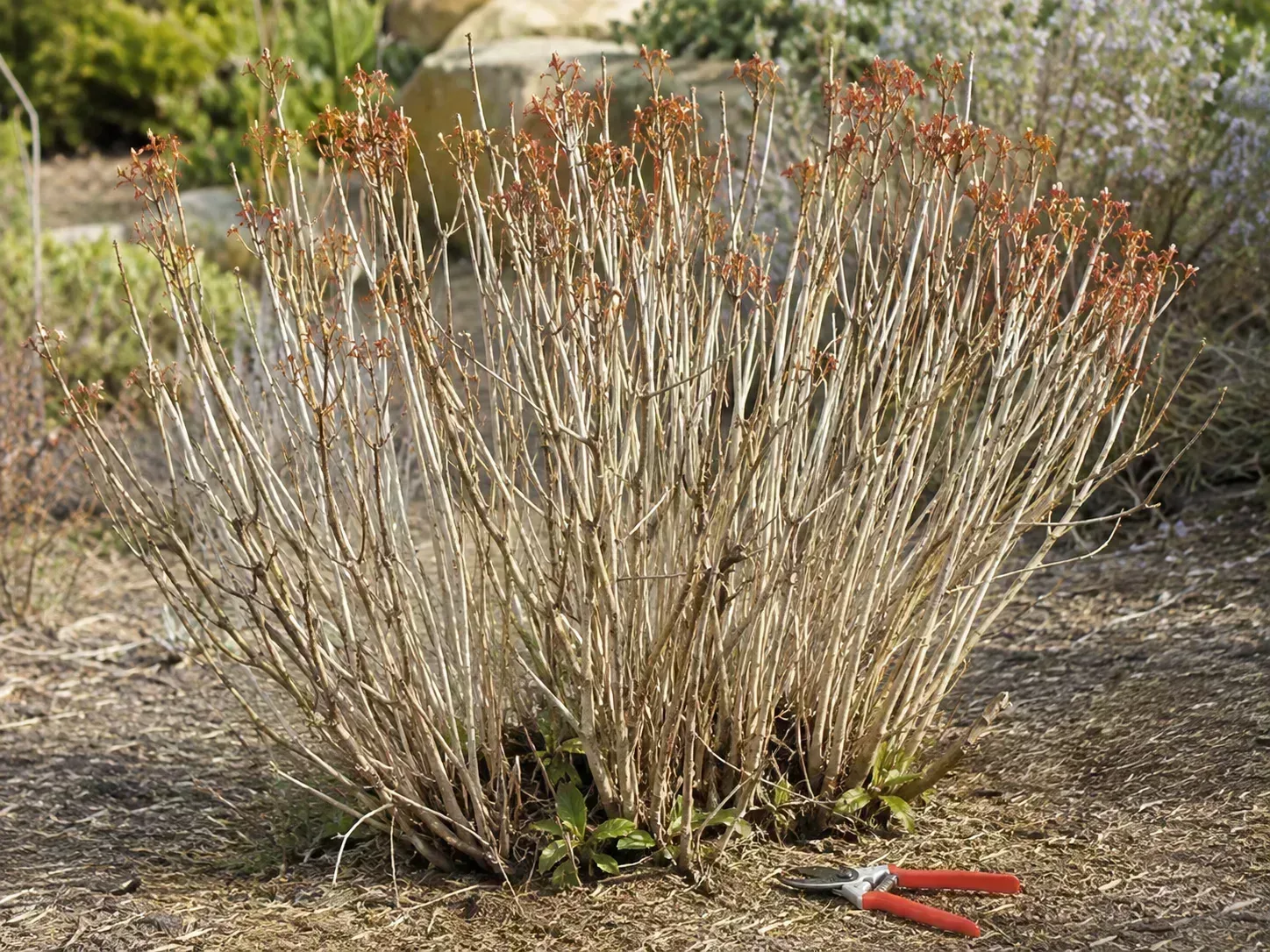
Use three checks together rather than trusting one brown twig. First, look for swelling buds, fresh leaves, or green shoots at the base. Second, scratch a small patch of outer bark with a clean fingernail or knife; green, moist tissue indicates live wood, while dry brown tissue indicates that you should keep moving down the stem. Third, bend a pencil-thin twig gently. Flexible wood may still be alive, while dead wood tends to snap.
Make the smallest inspection you need. Do not peel bark all the way around a stem, and do not turn a scratch test into a deep wound. If a branch is alive at its base but dead at the tip, cut the tip back to the first live bud or lateral branch. If the entire stem is brittle and brown, remove it at ground level or at its base without damaging the crown.
The timing of this inspection matters. If the plant is still completely dormant and nearby shrubs have only just begun to wake, wait a little longer before declaring it dead. If the base has produced healthy shoots but the old canopy remains bare, the shrub is telling you where its recovery is coming from.
Match the pruning job to the problem you want to solve
Pruning is not one action with one correct height. Cleanup removes wood that is dead, broken, diseased, or hazardous. Heading back shortens a living branch to a bud or side shoot. Thinning removes an entire stem at its origin to open the center. Renewal pruning reduces a vigorous new-wood shrub to a low framework so a new canopy can develop from the base.
Choose cleanup when the plant is basically the right size but has winter damage or storm breakage. Choose heading back when one branch is too long or is leaning into a path. Choose thinning when the center is crowded, several stems rub, or the shrub has become dense on the outside and bare inside. Choose renewal in spring when a large B. davidii has become a tall, woody fountain with flowers out of reach and little useful structure near the base.
Avoid using tip shearing as a substitute for any of these jobs. Colorado State University Extension warns that repeated shearing concentrates foliage on the outside, shades the interior, and fails to encourage the basal growth that keeps a flowering shrub youthful. It also recommends removing about one-third of the oldest wood to the ground each year as a thinning method when you want gradual renewal rather than a single hard reset.
The “smallest cut that solves the problem” rule has one important exception: an extremely overgrown, new-wood butterfly bush may respond better to a full spring renewal than to years of topping. Even then, keep the plant’s vigor, location, cultivar size, and frost exposure in mind. Pruning can reset a shrub; it cannot make a naturally tall cultivar stay permanently small in a space that is too tight.
Gather tools and make cuts the plant can heal
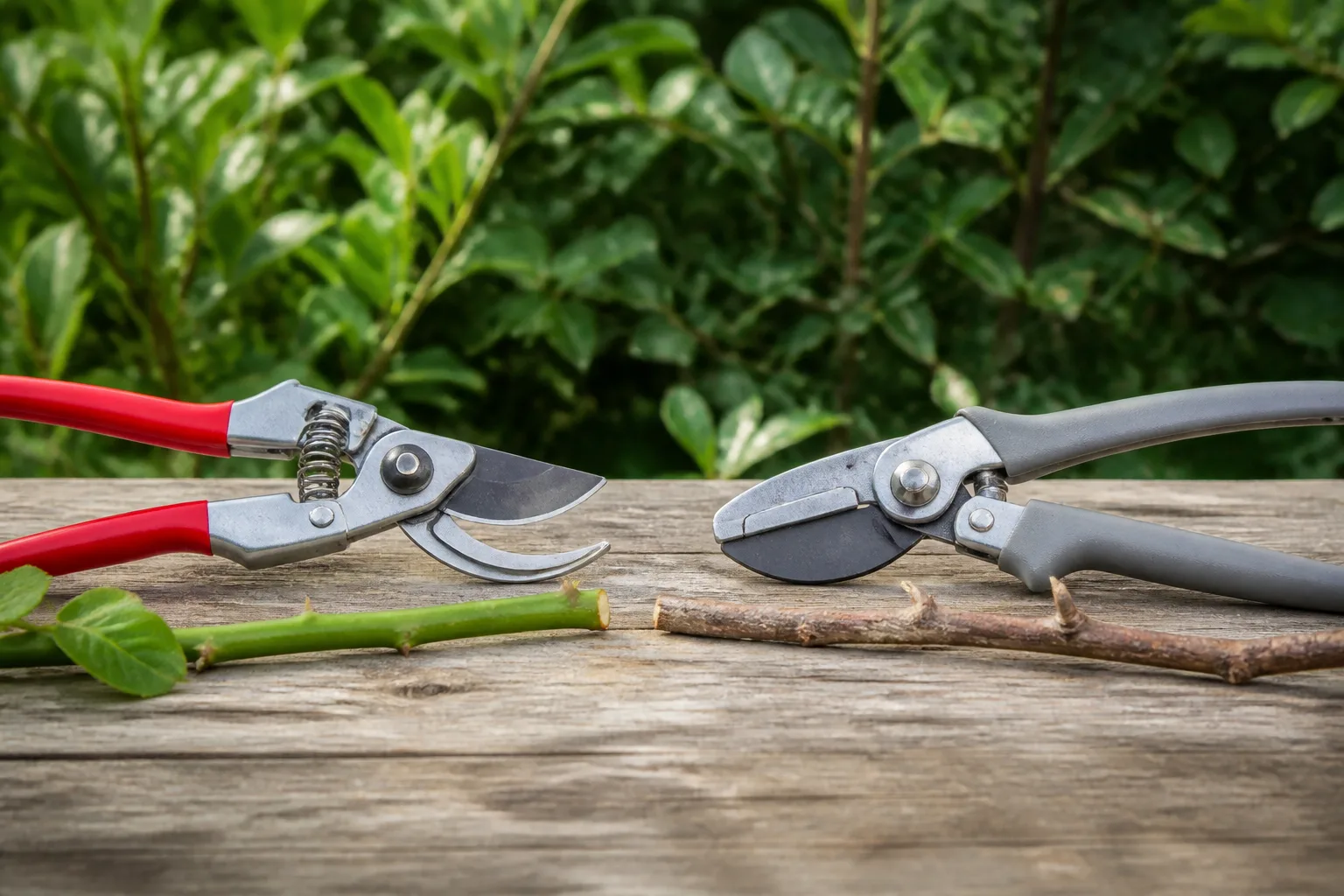
Use sharp bypass pruners for flower stalks and small shoots. The curved blade passes the counter-blade and tends to make a cleaner cut through flexible wood. Use loppers for thicker stems that fit within their capacity, and switch to a pruning saw rather than forcing loppers through a branch they cannot cut cleanly.
Clean soil and plant residue from the blades before you begin. If you have been cutting a plant with a known disease, disinfect the cutting surfaces between plants; on a healthy shrub, the more important priorities are sharp tools, controlled cuts, and not crushing the bark.
For a heading cut, place the blade just above a healthy bud or strong lateral branch that points in the direction you want new growth to travel. A slight angle can shed water, but the exact angle matters less than leaving no long stub and not cutting so close that the bud is damaged. For a thinning cut, follow the stem to its point of origin and remove it without injuring the remaining branch or crown.
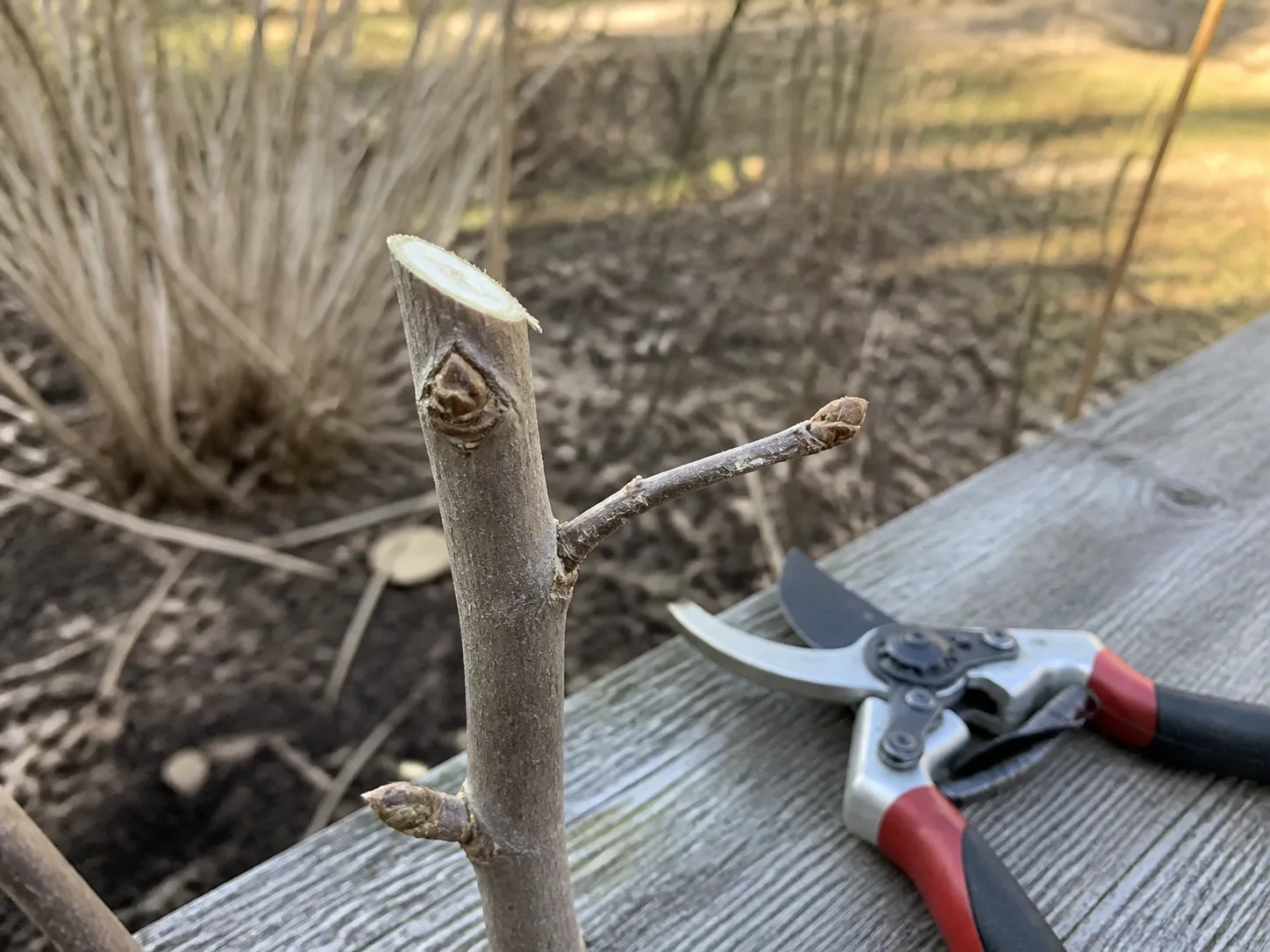
Stand back often. A butterfly bush has an open, arching habit, so an evenly clipped ball is usually a sign that the shrub has been shaped for the pruner’s convenience rather than for healthy light penetration. Keep strong stems distributed around the base and remove crossing, weak, inward-growing, or path-blocking branches one at a time.
What to do today if you missed spring pruning
If the plant is already in active summer growth, begin with a calm triage rather than a full makeover. The following sequence handles the problems that cannot wait while preserving the plant’s ability to finish the season:
- Remove hazards. Cut out broken limbs, branches rubbing against a structure, and growth that blocks a walkway. If the branch is healthy and the obstruction is minor, shorten it to an outward-facing lateral rather than cutting the entire shrub down.
- Remove confirmed dead wood. Follow brown tips downward until the scratch or bend test finds live tissue, then cut back to that point. Take an entirely dead stem to the base.
- Deadhead selectively. Remove faded flower panicles before seed capsules mature if your local guidance permits keeping the plant and you want to reduce seed spread. Collect the flower heads instead of leaving them under the shrub.
- Stop there. Do not strip the canopy to make the shrub look tidy. Healthy leaves are producing energy for the roots and new growth, and the next hard prune will be more useful when the plant is entering its proper spring window.
If you missed spring by only a few weeks and the plant has just started leafing out, you have more choice. A moderate structural prune can still work on B. davidii, but it may delay flowering and leave the plant uneven for part of the season. When the shrub is valuable for late-summer nectar or you are uncertain about its species, take the conservative route and wait.
Do not try to compensate for a missed prune with a heavy dose of nitrogen fertilizer. A fertilizer-driven flush of soft shoots does not recreate a balanced framework, and excess growth can be especially awkward on a plant already placed in shade or wet soil. Correct the timing, light, and drainage before adding inputs.
Reset a new-wood butterfly bush next spring
When late winter is ending and the plant shows live buds, begin the spring reset by removing dead and damaged wood. Work from the outside inward so you can see the framework as it opens. Once the dead material is gone, remove a few weak or rubbing stems at their origin before shortening the healthy framework.
For a standard B. davidii, many gardeners use a framework around 12 to 24 inches tall. A cut near one foot creates a compact starting point and works well when the shrub is vigorous and has room to regrow. Leaving the framework closer to two feet preserves more structure, gives the plant height sooner, and can be sensible in a short growing season or an exposed site.
Cut just above live buds or side shoots, favoring buds that point outward. Do not leave a ring of long stubs above the framework, and do not cut below every visible bud simply because a shorter shrub sounds better. The plant needs enough healthy nodes to make a balanced canopy.
Choose a low or taller framework
Use the lower target when the plant is large, bare-legged, or crowding neighboring plants and you want new flowers closer to eye level. A vigorous old shrub can often handle a near-ground spring renewal, but it will respond with a fast flush of shoots and may need thinning later. Colorado State University Extension describes rejuvenation as a spring method that can renew many multi-stemmed flowering shrubs, while also noting that severely woody or heavily dead plants may respond poorly.
Keep a taller framework when the cultivar is compact, the growing season is short, the plant sits at the back of a border, or you want to preserve a little screening height. In either case, make the decision from the plant’s condition and mature size rather than treating one foot as a universal law.
After the new shoots emerge, do not keep shortening them every week. Remove weak shoots that are packed tightly together or growing into the center, and let several strong, well-spaced stems develop. A little early thinning is usually more useful than repeated topping, which recreates the crowded outer shell you were trying to correct.
Deadhead flowers while controlling seed spread
Deadheading is optional for survival, but it can improve the shrub’s appearance, encourage another flush of flowers on new growth, and reduce the number of seed capsules that mature. When a flower panicle fades, trace its stalk down to the first strong pair of leaves or a side shoot and cut just above that point. Use small bypass pruners and collect the removed heads.
The seed question deserves more attention than a simple “deadhead for more blooms” instruction. NC State’s B. davidii profile reports that a single panicle can contain as many as 40,000 lightweight seeds and that seeds may remain viable in soil for several years. The NC State Plant Toolbox profile also notes that the species self-seeds and naturalizes easily, while Washington State invasive-plant guidance identifies B. davidii as a serious concern in parts of the Pacific Northwest.
That does not mean every cultivar or every region has the same legal or ecological status. Some compact hybrids are marketed as sterile or near-sterile, but check the exact cultivar and local rules rather than assuming the label settles the question. If your area lists butterfly bush as invasive or regulated, follow local removal guidance; do not move seed-bearing cuttings to a natural area, and bag mature flower heads before disposal.
Deadheading reduces seed production; it does not turn a seeding plant into a sterile one. It also does not make butterfly bush a complete pollinator habitat, because adult nectar visits and caterpillar host-plant support are different functions. If you keep the shrub where permitted, pair it with regionally appropriate native plants that support the broader insect life cycle.
Give dwarf and sterile cultivars a lighter touch
Compact butterfly bushes are often selected to branch low and stay within a smaller mature footprint. Some need little more than removal of dead tips and a few long shoots each spring. Starting with a one-foot hard cut can remove useful structure without making the plant fuller.
Read the nursery tag or cultivar information before choosing the height. If the plant is naturally two to three feet tall and already branches from the base, preserve that shape and cut only what has outgrown the outline. If it produces long, weak stems from a congested center, thin the weakest stems at the base rather than clipping the entire perimeter.
Sterile or near-sterile cultivars reduce the seed-spread problem, but they still need the right light and drainage. Sterility is not a cure for shade, root stress, winter injury, or a plant that is simply too large for its bed. Treat the cultivar’s growth habit as a pruning instruction, not just its flower color or series name.
Support recovery with light, water, and drainage
Pruning cannot make up for a poor site. B. davidii performs best in full sun and well-drained soil; Oregon State University’s plant profile and RHS plant profile both point gardeners toward a sunny position and drainage, with RHS also allowing partial shade. In practical terms, a little afternoon shade may be tolerated, but heavier shade usually means fewer flowers and a lankier framework.
Water slowly and deeply during a dry spell after a spring prune, especially while the new shoots are developing. Then let the surface begin to dry rather than keeping the root zone constantly saturated. K-State Extension notes that wet, cold winters can contribute to root problems, so a plant that looks vigorous above ground but repeatedly fails in soggy soil needs a drainage solution, not a more aggressive haircut.
Keep mulch about two to three inches deep over the root zone, but pull it away from the crown and stems. Mulch can moderate temperature swings and slow evaporation; piled mulch holds moisture against the base and can create a different problem. As the new canopy fills, monitor the shoots for crowding rather than shaping them into a tight hedge.
Expect recovery to vary by climate and cultivar. A low spring reset can produce vigorous shoots quickly in a long, warm season, while a cold-climate plant may take longer to leaf out and flower. The absence of early leaves is not an invitation to cut lower; check the base, wait for live growth, and protect the plant’s remaining structure.
Know when pruning is not the answer
Pruning is unlikely to fix a shrub that has outgrown its location year after year. Colorado State University Extension points out that pruning can influence size but is not a reliable way to keep a naturally large shrub permanently small. If the plant repeatedly crowds a path, building, or neighboring plants, replace it with a smaller cultivar or a better-suited shrub rather than making increasingly severe cuts.
Consider removal when the plant is mostly dead, has a large woody base with little healthy basal growth, or keeps failing in waterlogged soil. An old, overgrown plant may recover from a spring reset, but recovery is not guaranteed if more than a small portion of the framework is healthy. If the plant is seeding into nearby habitat or local authorities classify it as invasive, removal and replacement with native plants may be the responsible choice.
Before digging, confirm whether shoots are coming from the crown or whether seedlings are appearing around it. Butterfly bush can re-sprout from cut stems and can produce wind-dispersed seed, so dispose of removed material carefully. When the goal is a pollinator-friendly garden, choose replacement plants that provide both nectar and regionally useful host-plant value.
Conclusion
If you forgot to prune your butterfly bush, the safest response is usually to wait for the right cue instead of forcing a late rescue. For most summer-flowering Buddleja davidii, prune in late winter or spring after live buds appear and hard-freeze risk eases. Remove dead wood first, then choose a low or taller framework based on the plant’s vigor, cultivar, growing season, and space.
If summer or fall has already arrived, clean up hazards, deadhead when it helps, and leave the healthy canopy in place. Confirm the species before cutting an old-wood butterfly bush, avoid repeated shearing, keep the root zone well drained, and check local guidance for seeding forms. Missing one pruning window may cost you some shape or flowers, but matching the next cut to the plant’s biology gives it a much better chance to return full and manageable.



