17 Low-Growing Perennials for a Garden Border
Compare 17 low-growing perennials for a garden border by sun, shade, mature size, spread, bloom season, soil, and maintenance needs.
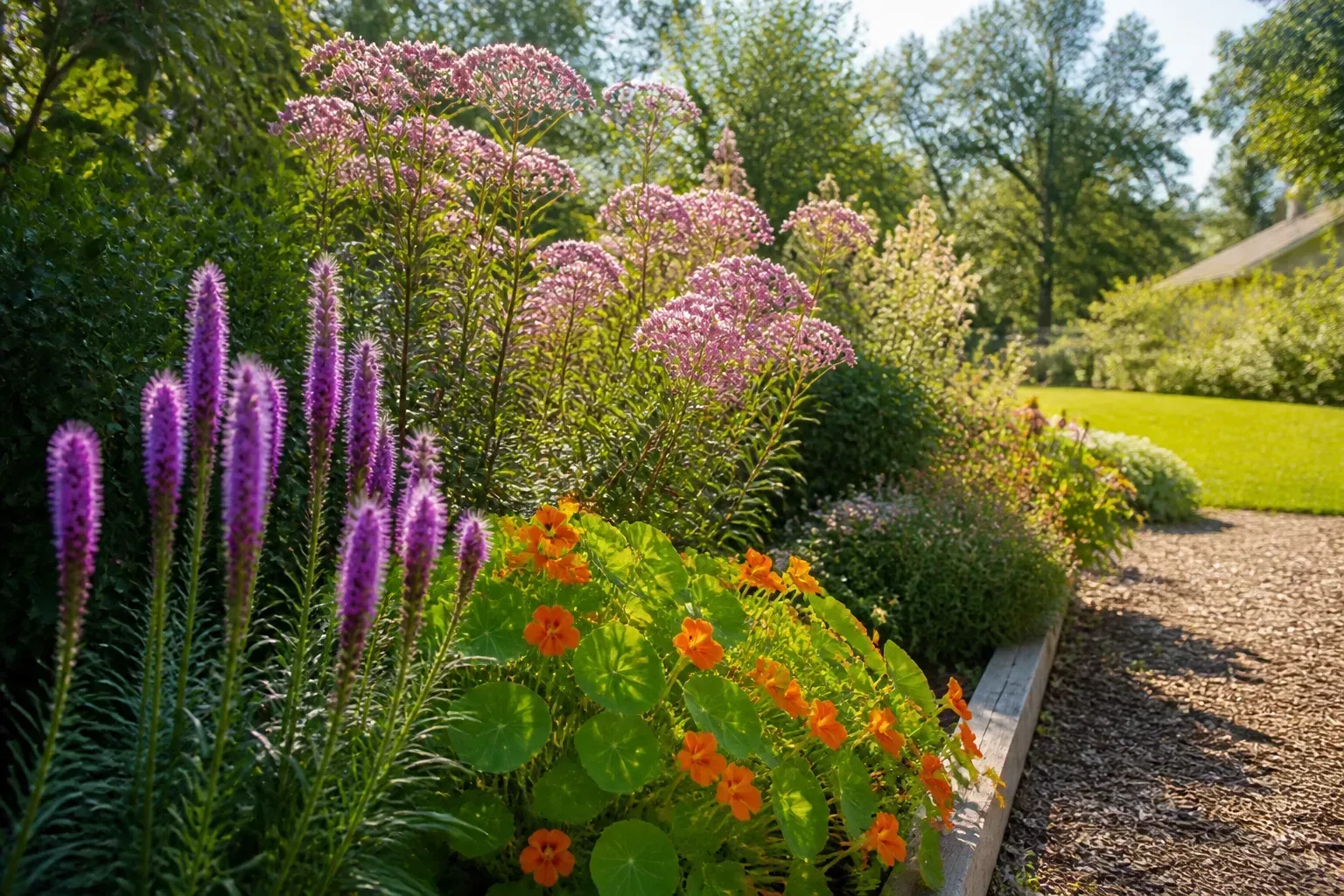
The front row of a flower bed has a deceptively difficult job. A plant must stay short enough to show what is behind it, wide enough to soften the edge, and tough enough to handle reflected heat, mower drift, foot traffic, or the dry soil beneath a tree. Flower color is useful, but mature width, moisture, and growth habit decide whether an edging plant looks intentional or becomes a yearly wrestling match.
The 17 low-growing perennials below cover sunny gravel edges, ordinary garden soil, dry shade, moist woodland borders, and paths that need a little softness. Use the list as a menu, not a recipe: choose one or two plants that fit your actual site, then repeat them in small groups so the border looks designed rather than dotted with one of everything.
How to choose a perennial for the front row
Start with mature height and width, not the nursery pot
For a bed viewed from a path or patio, a mature height of roughly 6 to 18 inches is a useful starting range. A plant can be taller and still work if its stems are airy or if the bed is viewed from a distance, but a dense 30-inch mound at the edge will hide smaller plants behind it. Fine Gardening’s guide to perennials for the edge makes the same practical distinction: close-up edges generally need shorter plants, while distant beds can carry taller or more transparent forms.
Width matters just as much. A six-inch-tall sedum that spreads two feet needs more room than a compact hosta that stays in a ten-inch clump. Measure the open strip from the path or lawn to the first permanent plant, and check the label for mature spread, not the diameter of the container you are holding.
Match light, moisture, and drainage before flower color
“Part shade” is not one condition. Morning sun with afternoon shade is kinder to many plants than deep shade under a dense evergreen, while dry shade beneath a mature tree is very different from moist shade beside a downspout. Watch the bed on a clear day, push a finger or trowel into the soil after rain, and notice whether the ground dries quickly or stays damp for days.
Drainage is the deal-breaker for several popular edging plants. Creeping sedum, creeping phlox, dwarf bearded iris, and compact penstemon prefer soil that drains promptly; primrose, woodland phlox, and lungwort are better choices where moisture is steady but the soil still has air. The Missouri Botanical Garden’s low-maintenance perennial guide also makes an important distinction: low maintenance does not mean no maintenance. Even reliable perennials may need a spring cutback, deadheading, division, or occasional soil correction.
Quick selector: 17 plants by site and garden job
| Plant | Best border job | Typical mature size | Site to aim for | Main watch-out |
|---|---|---|---|---|
| Woodland phlox | Spring color in shade | 10–15 in. × 18–24 in. | Part shade, evenly moist | Can thin in hot, dry sites |
| Cranesbill geranium | Flexible mounding filler | 6–18 in. × 12–36 in. | Sun to part shade | Size and spread vary by cultivar |
| Creeping sedum | Dry, sunny living mulch | 3–6 in. × 12–24 in. | Full sun, sharp drainage | Wet soil causes decline |
| Coral bells | Colorful foliage mound | 8–18 in. × 12–24 in. | Part shade, well-drained moisture | Crowns dislike winter wet |
| Leadwort | Late blue flowers and red fall color | 6–10 in. × 12–18 in. | Sun to part shade | Emerges late; can spread |
| Epimedium | Dry-shade groundcover | 8–12 in. × 12–36 in. | Part to full shade | Slow to fill in |
| Dwarf hosta | Bold shade foliage | 6–12 in. × 10–18 in. | Shade to morning sun | Slugs and hot afternoon sun |
| Creeping phlox | Spring mat over rocks | 4–9 in. × 18–24 in. | Full sun, well-drained | Needs air and a post-bloom trim |
| Threadleaf coreopsis | Fine texture and summer flowers | 8–18 in. × 12–24 in. | Full sun, average soil | Taller forms flop at the edge |
| Bellflower | Spilling color over a hard edge | 4–12 in. × 18–24 in. | Sun to part shade | May run into cracks or paths |
| Lady’s mantle | Dew-catching foliage and soft edge | 12–18 in. × 18–24 in. | Sun to part shade, moderate moisture | Can self-sow in favorable sites |
| Woods blue aster | Compact late-season color | 8–12 in. × 12–18 in. | Sun to part sun | Pinch or shear for a dense mound |
| Lungwort | Silver foliage in shade | 6–12 in. × 12–18 in. | Part to full shade, moist | Crowding can invite mildew |
| Dwarf bearded iris | Upright spring accents | 8–16 in. × 24–36 in. | Sun, lean and well-drained | Do not bury the rhizomes |
| Primrose | Early flowers in moist shade | 6–12 in. × 8–20 in. | Part shade, moisture-retentive soil | Drought quickly spoils the display |
| Geum | Warm-colored late-spring flowers | 8–15 in. × 15–18 in. | Sun to part shade | Deadhead for a tidier repeat bloom |
| Compact beardstongue | Pollinator-friendly upright color | 8–18 in. × 8–20 in. | Full sun, fast drainage | Some penstemons are much taller |
Low-growing perennials for sun
Full sun means at least six hours of direct light in the growing season, but a border at the base of a pale wall can be hotter and drier than an open bed. The sun group below is arranged by the job each plant does, from low mats to slightly taller accents.
Ground-hugging plants for dry edges
1. Creeping sedum (Sedum spp.) is the practical choice for a sunny edge that dries quickly. Depending on the species or cultivar, it forms a 3- to 6-inch mat of fleshy leaves and spreads outward rather than growing into a tall clump. Use it between stepping stones, along a gravel path, or below taller perennials whose roots leave the surface soil dry.
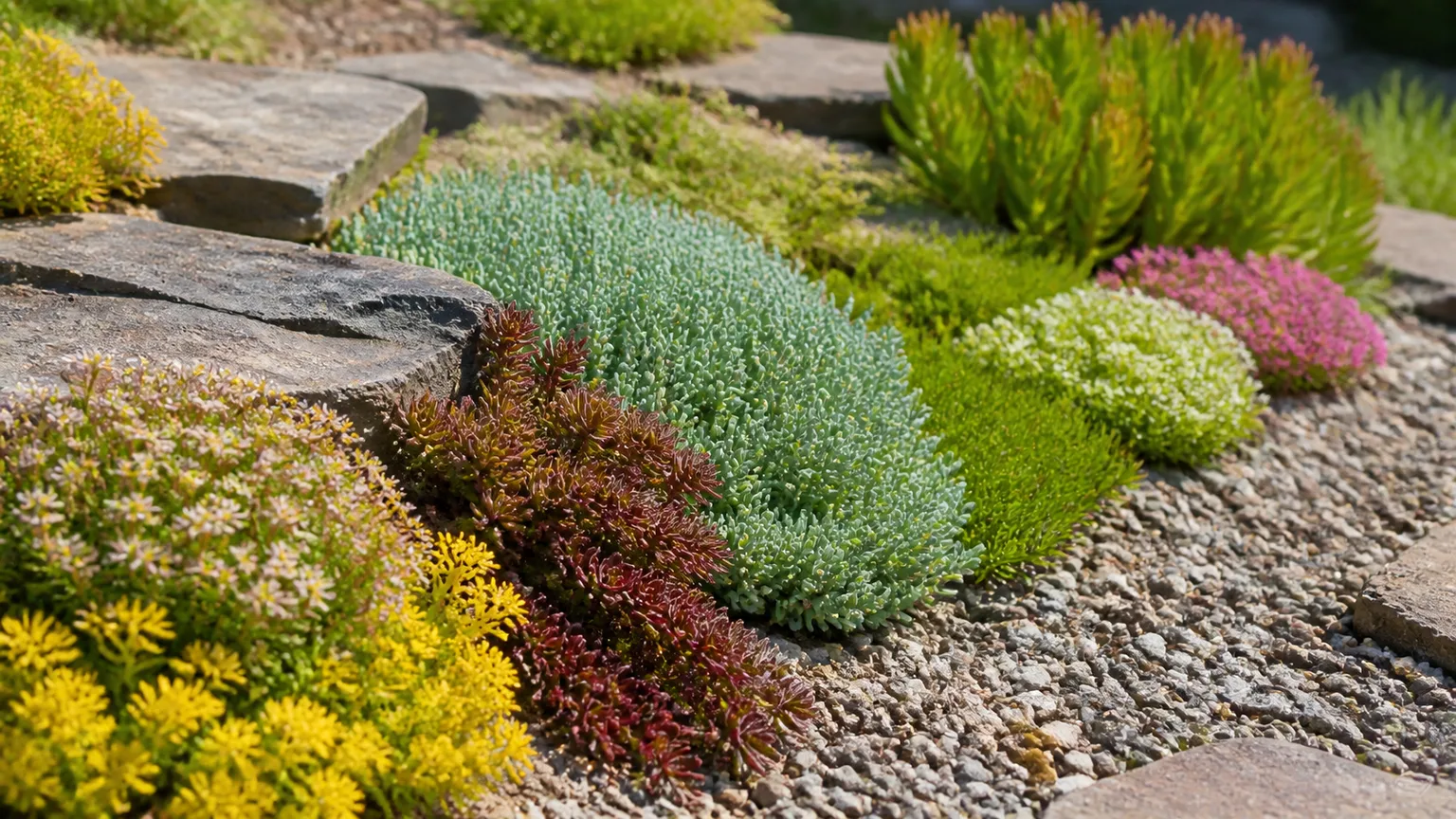
Treat “sedum” as a broad label, not a complete care instruction. Creeping stonecrops want sharp drainage and little fertilizer; they are a poor choice for a low spot that stays wet after rain. The upright autumn stonecrops sold under the same common name are useful perennials, but they are a different scale and belong farther back. The groundcover advice in Gardening Know How’s border guide also supports using vigorous mats where they can be checked at the edge. Let the plants knit together before adding more—sedum is easy to root from small stem pieces, and an overfilled edge can look messy.
2. Creeping phlox (Phlox subulata) makes a dense spring carpet over rocks, retaining walls, and the top of a sunny border. The needlelike foliage stays low, while the flowers cover the mat in pink, lavender, purple, or white. It is especially good where you want the edge to read as a clean ribbon rather than a set of individual mounds.
Give it sun, air movement, and soil that drains. After flowering, lightly shear or trim the outer stems if the plant has sprawled beyond the intended line; this keeps the mat compact and encourages fresh foliage. Avoid tucking it into a damp, crowded pocket just because the flowers are pretty. Poor airflow and wet foliage can leave the center thin.
3. Leadwort (Ceratostigma plumbaginoides) earns a place in a border that looks empty after spring bloomers finish. Its vivid blue flowers arrive in late summer, and the foliage often turns a strong red or bronze as temperatures cool. NC State Extension’s blue leadwort profile lists it as a low-growing groundcover with good drought tolerance but an intolerance of wet soil, which is why it suits a sunny, well-drained edge better than a boggy bed.
It is also a plant to mark on the calendar. Leadwort emerges late in spring, so do not mistake an empty patch for a dead plant and dig through it. A few early bulbs can occupy that space, or you can simply leave room for the blue flowers to arrive. Where it spreads beyond the design, lift the outer pieces in spring while the boundary is easy to see.
Long-blooming and late-season sun plants
4. Threadleaf coreopsis (Coreopsis verticillata) brings airy texture and yellow daisy flowers to the front half of a sunny border. Compact cultivars such as ‘Moonbeam’ and ‘Zagreb’ are more reliable edging choices than the taller species forms. They tolerate average soil, handle summer warmth once established, and respond well to removing spent flowers.
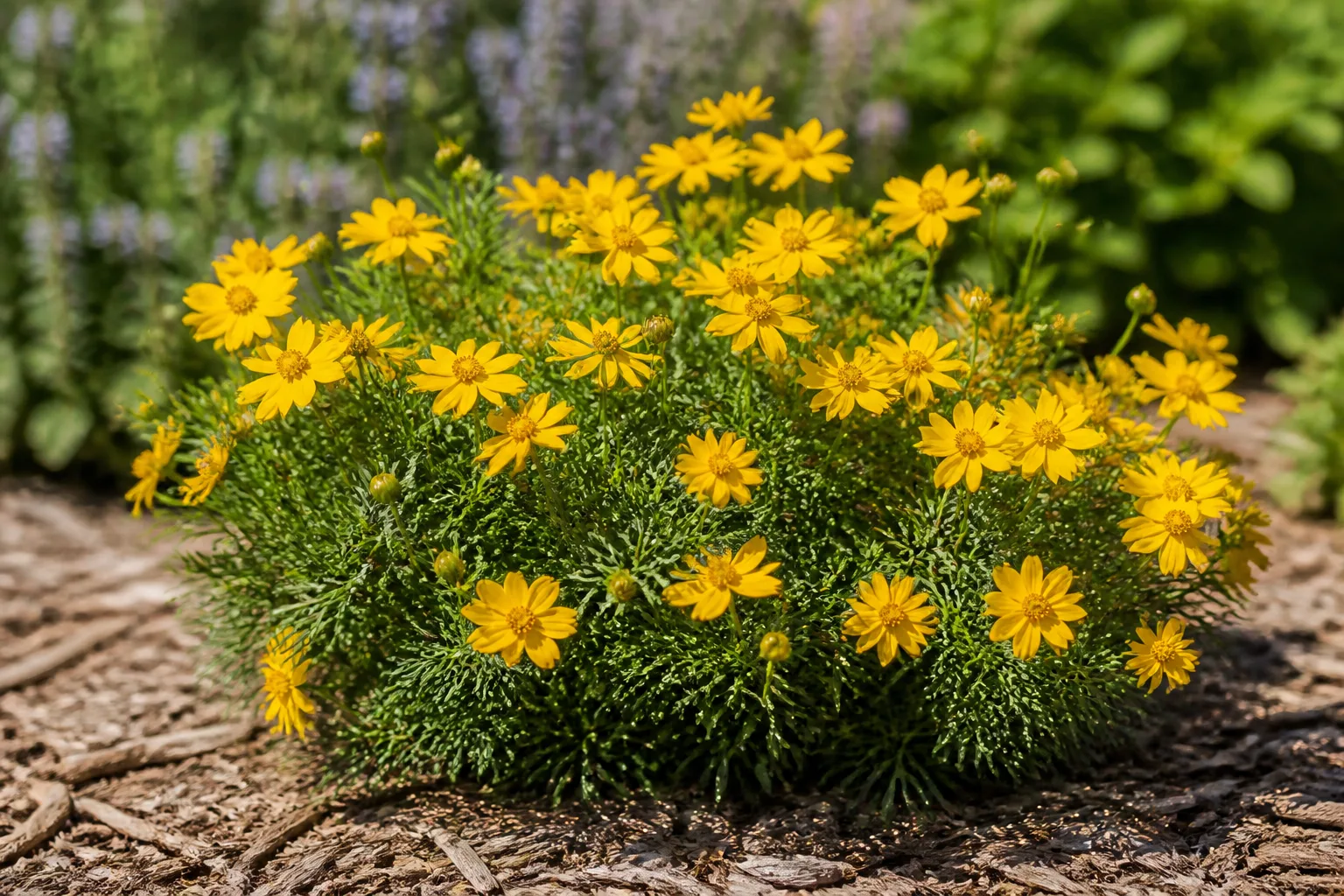
Do not plant it as a solitary dot. Three or five plants repeated along the edge make the fine foliage visible and give the yellow flowers enough mass to register. If the mound becomes floppy, shear it after its first flush rather than feeding it more; rich soil and excess water can produce soft growth that is too tall for the front row.
5. Woods blue aster (Symphyotrichum or compact aster cultivars) is a smart late-season counterpoint to spring phlox and early iris. The small blue flowers and yellow centers arrive when many borders are losing color, and compact forms generally stay close to 8 to 12 inches tall. Plant it where it receives sun and has enough air around the foliage.
Pinching the growing tips once in late spring or early summer can produce a fuller mound, but stop early enough for flower buds to form. If your local nursery uses “Woods Blue” for a specific cultivar, follow that tag’s mature size; asters vary widely, and a full-sized New England aster is not a front-edge plant simply because the flowers are similar.
6. Geum (Geum spp.) is a good bridge between a low edging mat and taller mid-border perennials. Its tidy foliage clump supports warm flowers in cream, yellow, orange, pink, or red in late spring and early summer. Give it sun or light shade and soil that drains but does not become powder-dry for weeks.
Cut spent stems down to the foliage after the first flush. Many cultivars will produce a tidier second display, and the plant will not look like a brown bundle at the front of the bed. Divide an old, crowded clump in spring or early fall if the center has become thin.
7. Dwarf bearded iris (Iris pumila and compact hybrids) provides a vertical note without the height of tall bearded iris. The flowers arrive in spring, and the swordlike leaves remain useful after bloom if the fans are spaced well. A 2- to 3-foot spread may sound large for a low plant, but the rhizomes form a broad, flat fan that works beautifully along a path when given room.
Plant the rhizome at the soil surface or just barely covered; deep planting is a common reason bearded iris sulk or rot. Choose a sunny, lean, well-drained site, and divide when the clump becomes crowded or the flowering declines. Keep the rhizomes away from thick mulch that holds moisture against them.
8. Compact beardstongue (Penstemon spp. and cultivars) is for gardeners who want pollinator-friendly tubular flowers without putting a six-foot plant at the front of the bed. Compact forms such as ‘Blue Mist’ stay near 8 to 10 inches, while other short cultivars may reach 15 to 18 inches. The flowers rise above narrow foliage and make a border look more vertical without blocking everything behind it.
This is another label-dependent choice. Read the cultivar name and mature height, not just “penstemon.” Full sun and very good drainage matter more than rich soil; in heavy clay, plant on a broad mound or choose a different species. Cut spent stalks after bloom if you want a cleaner outline, but leave some seedheads when birds and winter texture matter more than tidiness.
Low-growing perennials for part shade and shade
Shade plants succeed when you match light with water. A bed under deciduous trees may be dry in midsummer even if it is bright in spring, while a north-facing path can stay damp and cool. The plants below separate foliage-first choices from moisture-loving bloomers so you do not put a dry-shade plant beside a sprinkler head.
Foliage-first plants for dry or average shade
9. Woodland phlox (Phlox divaricata) is a spring-blooming native-style groundcover for part shade and rich, well-drained soil. Its fragrant, pale flowers float above loose stems rather than forming the tight carpet of creeping phlox. It works well along a woodland path or beneath deciduous shrubs where the soil is evenly moist in spring.
Let it move naturally instead of forcing it into a clipped line. Once flowering ends, the stems can be trimmed lightly if they reach into the path, but avoid treating it like lawn. In hot, dry shade it may bloom briefly and thin out; improve the root zone with organic matter and water during establishment rather than adding fertilizer.
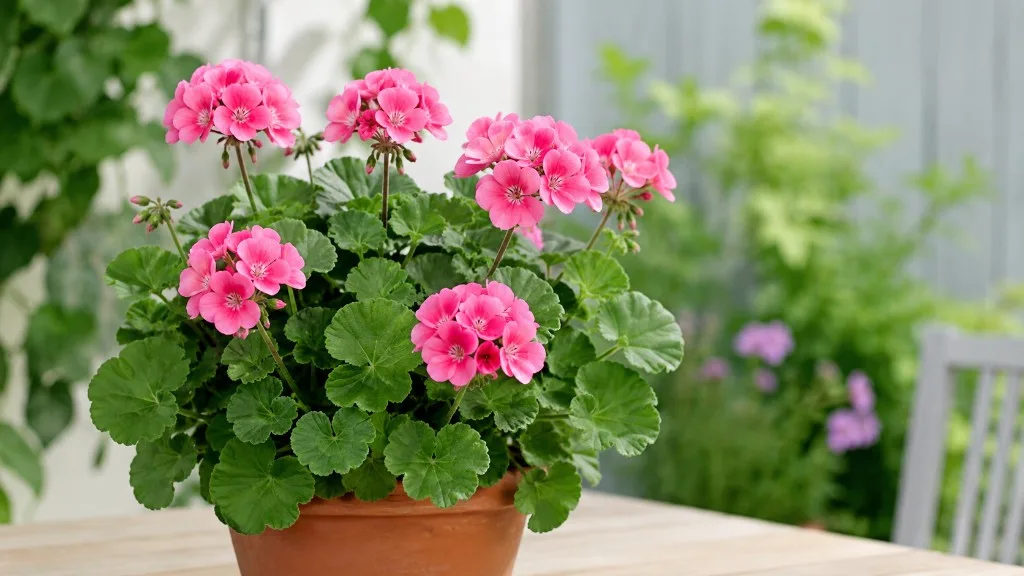
10. Cranesbill geraniums (Geranium spp. and cultivars) are among the most adaptable choices in this list. Some form compact mounds, while others spread by rhizomes and weave through neighboring plants. Their saucer-shaped flowers come in pink, blue, purple, and white, and many cultivars tolerate sun to part shade.
The word “geranium” causes confusion here: these are hardy perennial geraniums, not the tender Pelargonium plants often sold as annuals. Use the cultivar’s mature size to choose between a tidy path-side mound and a wider filler. If the foliage looks tired after flowering, shear the plant by about one-third; fresh leaves often return and the edge looks better than it would after piecemeal trimming.
11. Coral bells (Heuchera spp.) are foliage plants that happen to send up flower stalks. Their mounds of ruffled leaves can be lime, bronze, purple, silver, or green, which makes them valuable when a shady border needs contrast after spring flowers fade. They prefer moisture-retentive but well-drained soil and usually look best with morning sun or filtered light.
Keep the crown at soil level and avoid burying it under a thick, wet mulch layer. In hot, humid climates, give plants room for air movement and choose cultivars known to perform locally. The leaves may look perfect in a garden center yet scorch in reflected afternoon heat, so a bright east-facing edge is often safer than a west-facing wall.
12. Epimedium (Epimedium spp.) is a patient, durable groundcover for dry shade. Heart-shaped leaves and small spring flowers appear above wiry stems, and the plants gradually form a mat beneath trees or shrubs. It is useful where shallow tree roots make it hard to keep thirsty plants happy.
Do not expect instant coverage. Epimedium often spends its first seasons establishing roots, and some cultivars are evergreen while others are deciduous. Cut back old foliage in late winter or early spring if needed, before the new flowers become tangled. Plant it where its slow expansion is an advantage, not where you need a filled-in border this summer.
13. Dwarf hostas (Hosta cultivars) bring strong leaf shapes to a shade edge, from blue-green, corrugated leaves to bright chartreuse or variegated forms. Miniature types such as ‘Blue Mouse Ears’ stay close to the ground and work beside a path where a full-size hosta would crowd the walkway. Hostas are clumping plants, so they are easier to keep within a planned line than a fast runner.
Provide consistent moisture while they establish, especially beneath trees. Morning sun can improve color on some cultivars, but intense afternoon sun can scorch leaves, particularly in hot climates. Slugs may damage the foliage; thinning the bed for air and avoiding constantly wet mulch helps, but no hosta is universally slug-proof.
Flowering plants for moist shade
14. Lady’s mantle (Alchemilla mollis) has scalloped leaves that hold raindrops like glass beads and sprays of small chartreuse flowers in late spring. It makes a soft, low mound along a path or beside blue-leaved hostas. The Missouri Botanical Garden includes it among border plants valued for groundcover and foliage, not just for a short flowering window.
It tolerates sun in cooler climates but appreciates some afternoon protection where summers are hot. Cut the flower stems after bloom if you do not want seedlings in the gravel or path cracks. If you like a looser cottage-garden edge, let a few seed; if you want a crisp boundary, remove the heads before they mature.
15. Lungwort (Pulmonaria spp.) starts the season with blue, pink, white, or raspberry flowers and keeps earning its space through silver-spotted leaves. It is a strong choice for a shady border that needs foliage after the flowers fade. Plant it in moist, well-drained soil and leave enough space around the clump for air.
Fine Gardening notes that lungwort can develop powdery mildew in hot, humid conditions, especially when crowded. Treat the spacing as part of the plant choice: do not wedge several clumps into a narrow strip and then blame the cultivar when the center looks tired. Remove damaged leaves after the main display, and water the soil rather than repeatedly wetting the foliage.
16. Primrose (Primula spp.) is the early-season color specialist for part shade and moisture-retentive soil. The flowers can be yellow, pink, red, purple, or white, often appearing before the rest of the border wakes up. It is particularly useful beside a cool path, downspout-fed bed, or woodland edge that dries only gradually.
Primrose is not a drought-tolerant filler. If the leaves wilt repeatedly, the site is probably too dry or too hot for that type. A layer of leaf mold or compost improves the root zone, but do not bury the crown. In warmer climates, choose species and cultivars recommended locally; “primrose” covers plants with different heat and moisture tolerances.
17. Bellflower (Campanula poscharskyana or C. portenschlagiana) can spill over a low wall, path edge, or the front of a rock garden with a long succession of purple-blue bells. It handles sun to part shade and average soil, and its trailing stems soften hard masonry better than a stiff clipped edge would.
Give it a boundary if the border meets lawn or paving. Small pieces can root in cracks, and a happy plant may travel farther than its nursery tag suggests. Gardening Know How’s overview of low-growing summer bloomers includes compact bellflowers among long-blooming options, but the same spreading habit that makes them useful can make them untidy in a narrow strip. Shear after the first bloom to remove tired stems and keep the mat from covering neighboring crowns. It is a good choice when you want movement; it is less suitable for a formal edge that must stay within a narrow strip.
Three border plans that are easier to maintain
Sunny gravel or path edge
Start with creeping sedum or creeping phlox as the low repeating plant. Add dwarf bearded iris for spring height, threadleaf coreopsis for summer yellow, and leadwort or Woods blue aster for late color. Compact beardstongue can sit just behind the mats, where its flower stalks rise without hiding the path.
Keep this combination in a raised or naturally fast-draining bed. Group the plants in threes or five rather than alternating every 12 inches, and leave a narrow inspection strip between the mat and the path so you can lift runners or trim stems before they cross the boundary.
Shady woodland or north-side edge
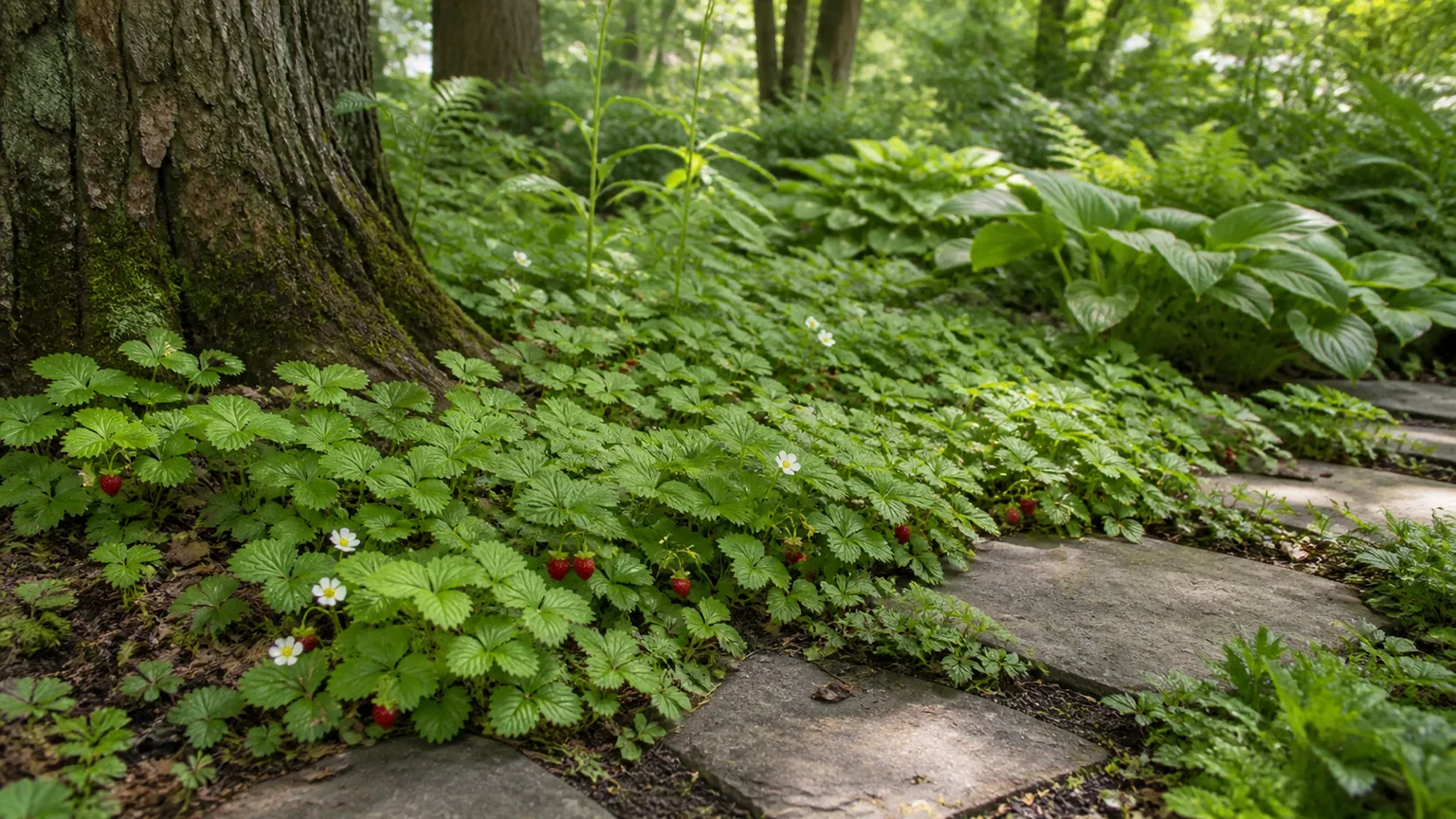
Use woodland phlox and primrose for the early display, then let lungwort, coral bells, and dwarf hostas carry the foliage. Epimedium is the better filler where tree roots make the soil dry; lady’s mantle suits a brighter, more evenly moist edge. The group looks calmer when one foliage color repeats through the bed instead of every plant bringing a different variegation.
Keep the path edge visible. Shade plants can lean outward toward light, and wet leaf litter can hide crowns from inspection. Thin crowded foliage in late spring, water deeply during the first growing season, and use a modest organic mulch that stops short of each crown.
Mixed border with a long season of interest
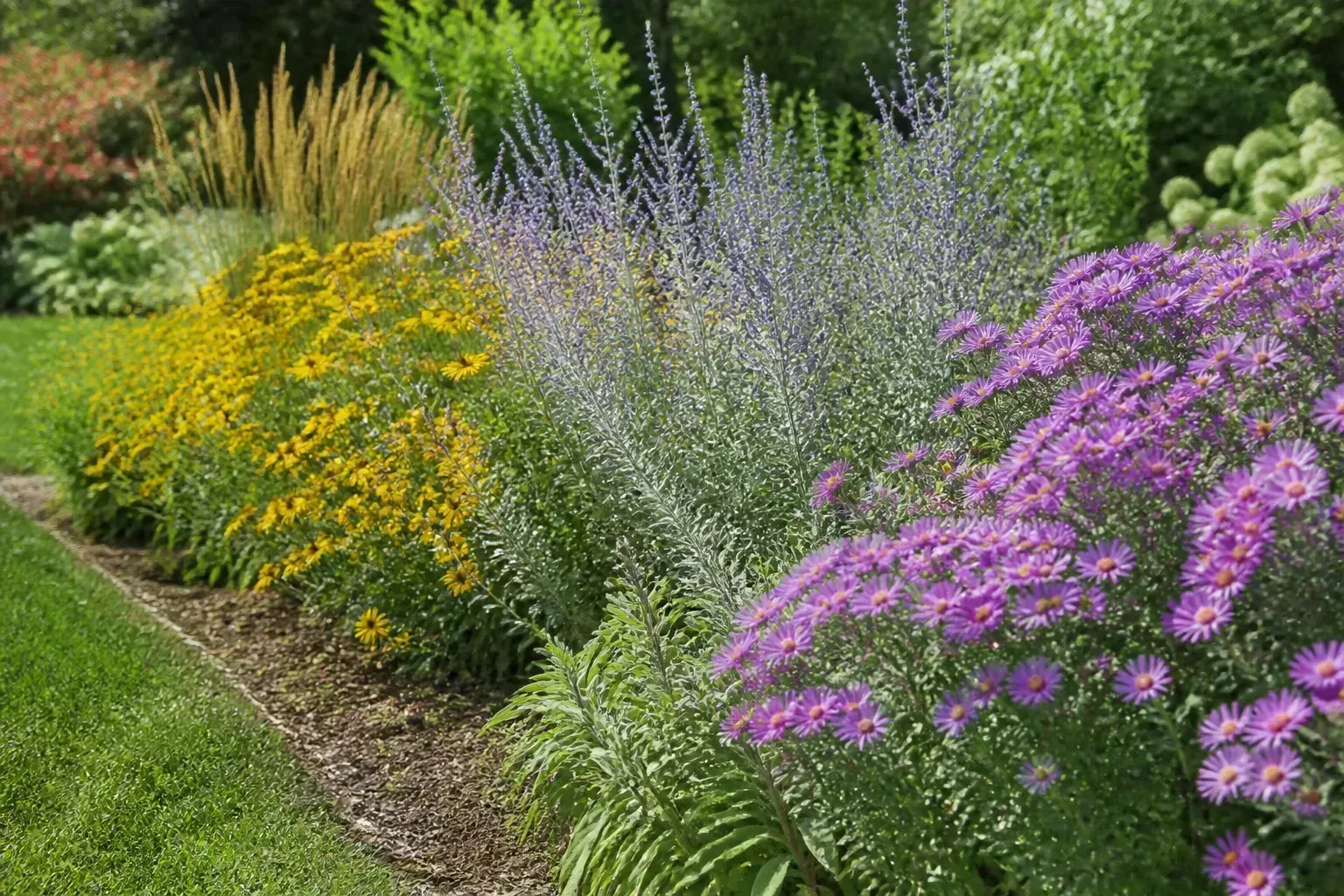
Build the border in layers of time as well as height. Let spring belong to woodland phlox, creeping phlox, dwarf iris, primrose, and lungwort; let summer hand off to cranesbill, coral bells, coreopsis, geum, and beardstongue; then reserve a few pockets for leadwort and a compact aster.
The most reliable long-season borders are not made from 17 simultaneous bloomers. They combine a few spring flowers with durable foliage and two or three late-season plants, while leaving room for the early plants’ leaves to decline naturally. The Missouri Botanical Garden’s season-long bloom guide uses a similar succession principle: choose plants by when they perform, not only by their catalog photograph.
Planting and maintenance that keeps the edge tidy
Space by mature spread and water the first season
Lay out the pots before digging. Put the lowest mats nearest the path, the 12- to 18-inch mounds behind them, and any airy flower stalks where they can rise without blocking the bed. If a plant has a 24-inch mature spread, two plants 12 inches apart will merge quickly; that may be perfect for a carpet and a mistake for a formal dotted line.
Plant at the same depth as the container, except for special cases such as bearded iris rhizomes, which should sit at or just below the soil surface. Water the root ball slowly after planting, then check the soil with a finger or trowel rather than following a fixed daily schedule. New plants need consistent moisture while roots extend, but a saturated bed is not a sign of good establishment.
Mulch can reduce evaporation and keep soil from splashing onto foliage, but it is not a substitute for drainage or weed removal. Keep mulch a little away from crowns, especially coral bells, iris, and other plants prone to rot when the crown stays wet.
Deadhead, divide, and control spread at the right time
Deadhead when a tidier plant or repeat bloom is the goal. Coreopsis, geum, cranesbill, and some penstemons respond well to a trim, while leaving aster seedheads can add winter texture and bird food. Shear creeping phlox after flowering if it has outgrown the edge, and remove tired lungwort leaves after the main spring show.
Divide clumping plants when the center thins or flowering drops, usually in spring or early fall. Do not divide every perennial on a calendar: epimedium may need years to establish, and leadwort should not be dug while it is still dormant simply because the bed looks bare. Watch spreading plants at the edge of the bed and lift the outer pieces while the soil is workable.
For groundcovers, spread is a design characteristic, not an automatic virtue. NC State Extension advises caution with Chinese wild ginger because its rhizomes can spread and become difficult to eradicate; the same principle applies to any plant sold as a vigorous groundcover. Check local invasive-plant lists before planting a species that spreads quickly, and keep a runner-forming plant away from natural areas unless you know its behavior.
Common mistakes with low-growing border plants
Choosing by current pot size. A one-gallon hosta or sedum is not a mature measurement. Read the width range and leave room for the plant to reach it without swallowing the path.
Treating every shade as moist shade. Tree roots can create some of the driest soil in the garden. Use epimedium or a drought-tolerant cranesbill where the soil dries, and reserve primrose or lungwort for places that stay evenly moist.
Putting dry-site plants in a low spot. Sedum, creeping phlox, iris, and many compact penstemons decline when their roots sit in saturated soil. Fix the grade or choose a moisture-tolerant perennial instead of watering more.
Burying the crown or rhizome. Deep planting is especially damaging to bearded iris, and a thick mulch blanket can smother low crowns. Set the plant at the depth it grew in its container and keep the crown visible.
Making a one-of-everything border. Seventeen species are useful for comparison, but a real bed usually looks stronger with three to five repeated plants and a smaller supporting cast. Repeat a leaf color, flower shape, or bloom season so the eye can read the border as one composition.
Ignoring the view from the path. Stand where you will actually see the bed. A plant that is technically short can still lean over a narrow walkway, and a 12-inch plant may be too tall if it blocks a favorite ground-level view.
Conclusion
The best low-growing perennial for a garden border is the one that fits the site before it fits the color scheme. Use creeping sedum, creeping phlox, leadwort, iris, or a compact penstemon for a sunny, fast-draining edge; choose woodland phlox, epimedium, coral bells, hostas, lungwort, primrose, or lady’s mantle when shade and moisture are the bigger constraints. Cranesbill, geum, coreopsis, bellflower, and compact asters help bridge the spaces between those conditions.
Before planting, measure the mature spread, decide whether you want a clump or a mat, and check how the bed drains after rain. Repeat a short list of plants, water them through establishment, and control runners while they are still easy to lift. That small amount of planning is what turns a row of short plants into an edge that stays legible, layered, and easier to care for.



