Strawberry Care Guide: Light, Water & Fruit
Fragaria × ananassa
Grow garden strawberries in full sun and fertile, well-drained soil. Learn crown planting depth, container watering, runner propagation, and how to keep fruit clean and mould-free.
Strawberry Care Guide: Light, Water & Fruit
Start with wateringThe most common care mistake for StrawberryWatering guide →Strawberry care essentials
Light
Water
Keep soil evenly moist while plants establish and fruit. Water during dry spells in the growing season; containers and hanging baskets need frequent checks because the mix dries quickly. Avoid soaking the crown or ripening berries.
Soil
Fertile, organically rich, moist but well-drained loam. Slightly acidic to neutral; improve heavy clay with organic matter or use raised beds for drainage.
Humidity
Temperature
Fertilizer
About Strawberry
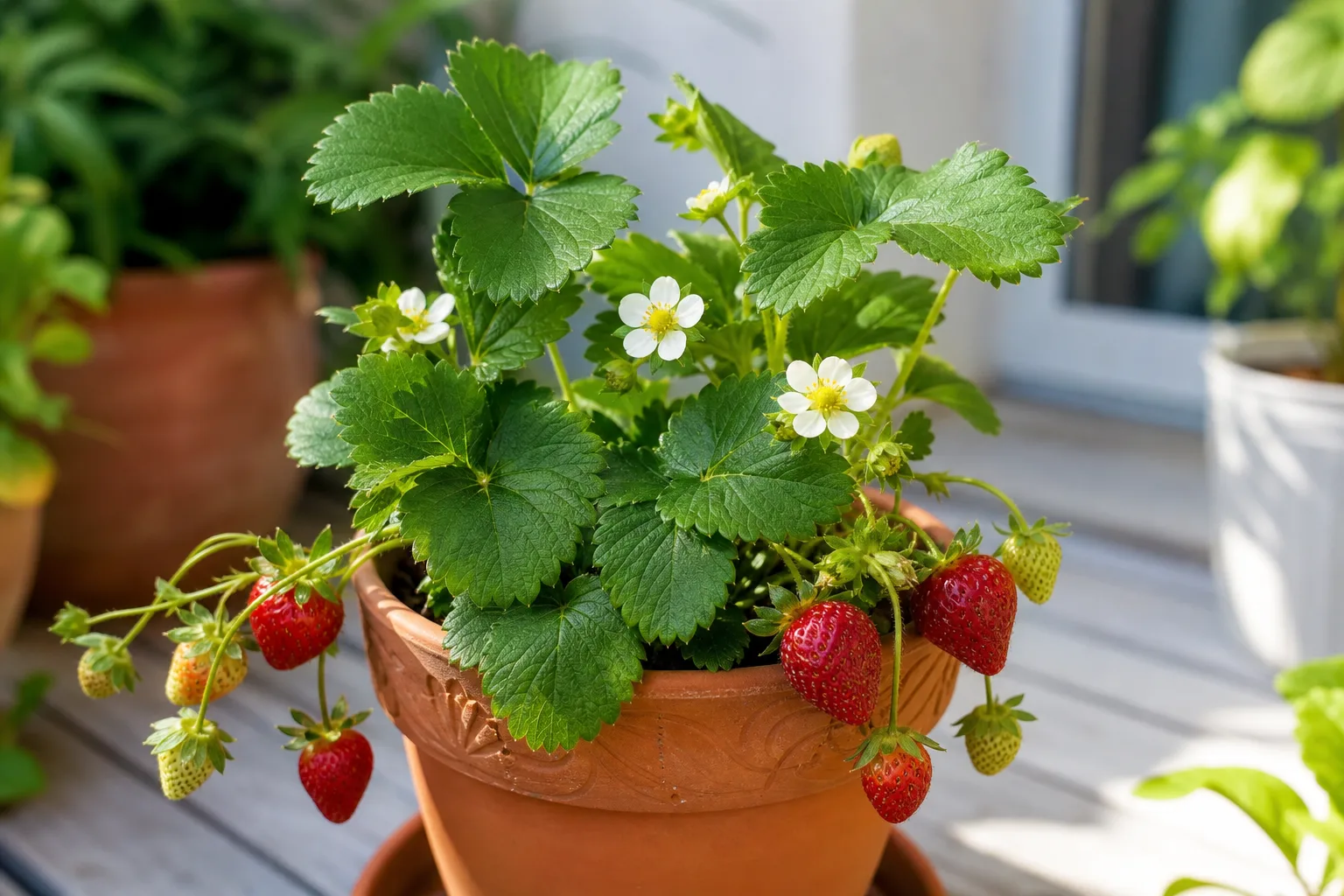
Strawberry is native to Cultivated hybrid of Chilean strawberry (Fragaria chiloensis) and Virginia strawberry (Fragaria virginiana); grown worldwide for fruit, typically reaches 10–20 cm (4–8 in) tall; 30–60 cm (1–2 ft) spread per plant, forming wider mats via runners indoors, with moderate to fast in cool, sunny conditions once established growth. Strawberry has a mat forming stoloniferous herbaceous perennial growth habit and part of the Rosaceae family. It is also known as Garden Strawberry, Cultivated Strawberry, June-bearing Strawberry, Everbearing Strawberry, and Day-neutral Strawberry.
| Detail | Information |
|---|---|
| Also known as | Garden Strawberry, Cultivated Strawberry, June-bearing Strawberry, Everbearing Strawberry, Day-neutral Strawberry |
| Native region | Cultivated hybrid of Chilean strawberry (Fragaria chiloensis) and Virginia strawberry (Fragaria virginiana); grown worldwide for fruit |
| Mature size | 10–20 cm (4–8 in) tall; 30–60 cm (1–2 ft) spread per plant, forming wider mats via runners |
| Growth rate | Moderate to fast in cool, sunny conditions once established |
| Growth habit | Mat Forming Stoloniferous Herbaceous Perennial |
| Scientific name | Fragaria × ananassa |
| Family | Rosaceae |
Strawberry Care Guide: Light, Water & Fruit
Garden strawberry is a low, fruiting perennial grown for sweet red berries—not a foliage houseplant. Fragaria × ananassa belongs to the Rosaceae (rose) family and originated in Europe as a hybrid between a North American species and one from Chile. In a bright Indian balcony bed or cool hill garden it can crop well, but only when strong light, even moisture around a shallow crown, and good drainage work together.
The first priorities are simple: give it full sun, keep the upper root zone moist without drowning the crown, use a fertile free-draining mix near pH 6.0–6.5, and choose a fruiting type that matches your climate. Fertilizer cannot replace six hours of usable sunlight or rescue a plant sitting in soggy, buried crowns.
Strawberry care at a glance
Give strawberry full sun—NC State Extension lists six or more hours of direct light as the preferred range, with partial shade only as a secondary option. Plants typically stay 15–30 cm (6–12 in) tall and spread 30–60 cm (1–2 ft) through runners. Prefer moist, highly organic loam or clay that still drains well, and water frequently because roots are short.
Expect medium growth and fairly high maintenance: runner management, mulch, and timely harvest matter as much as watering. In warm lowland India, treat many plantings as a cool-season crop; in cooler hill stations, a bed can behave more like a short-lived perennial that needs renewal every few years.
Know the plant you are growing
Fragaria × ananassa forms a rosette of trifoliate leaves around a compressed stem called the crown. Flowers are usually white with yellow centers; the red “berry” is an accessory fruit that carries the true fruits as tiny surface achenes. That structure is why berries do not sweeten much after picking—you harvest for color and flavor on the plant.
Temperature and day length steer whether the plant pushes leaves, runners, or flowers. Penn State Extension notes that the aboveground plant is a crown with leaves, runners, flowers, and fruit, and that day length plus temperature determine which parts grow fastest. That biology is why the same pot can look leafy in heat and then set few berries if nights stay too warm or light is weak.
Growth habit and realistic size
Expect a clumping, low canopy rather than a tall shrub. NC State describes height of about 6–12 inches and width of 1–2 feet, with plants often replaced every 3–4 years as crowns age and disease pressure builds. Runners (stolons) root daughter plants and can fill a bed quickly; removing excess runners usually improves fruit on the mother plant.
In containers, one healthy crown per small pot—or a few in a wide trough—is easier to manage than a crowded hanging basket. Crowns must sit at soil level: buried too deep they rot; planted too high they dry out.
June-bearing, everbearing, and day-neutral types
Home catalogs usually group strawberries as June-bearing, everbearing, or day-neutral. Penn State explains that June-bearing types produce a concentrated late-spring to early-summer crop in temperate regions, while day-neutral types fruit across a longer window when temperatures allow. Everbearing types historically meant two main flushes; modern day-neutrals are often what home growers want for staggered harvests.
For warm Indian plains, day-neutral or heat-tolerant short-day cultivars sold for winter fruiting are usually more practical than classic long-day June-bearers bred for cool summers. UF/IFAS lists Florida-friendly cultivars such as ‘Sweet Charlie’, ‘Camarosa’, ‘Chandler’, ‘Oso Grande’, ‘Selva’, and ‘Festival’ for cool-season culture—useful analogues when your local nursery offers winter strawberry starts. Match the label to your elevation and season, not just fruit photos.
Choose full sun and a cool-season window in India
Place strawberry where it receives direct sun for most of the day: an open terrace, south- or west-facing balcony, raised bed, or unshaded courtyard. Weak light produces soft leaves, long runners, and few flowers. In plains and coastal cities, plant for a cool growing season—roughly autumn through early spring—because prolonged summer heat often stalls fruiting and invites decline, similar to Florida’s cool-season approach.
Hill gardeners can often keep plants longer if nights cool down, but still protect flowers from hard frost and avoid waterlogged monsoon soil. Acclimate nursery plants gradually when moving from shade net into harsh terrace sun so tender leaves do not scorch.
Can strawberry grow well in a container on a balcony?
Yes—NC State explicitly lists containers and hanging baskets as suitable sites—provided the pot drains freely and receives full sun. Use a wide, shallow container rather than a deep narrow one, because roots explore only the upper soil. One drainage hole is not enough if the saucer stays full after every watering.
Keep pots off hot metal floors when possible, and move them under temporary shade cloth only during extreme heat waves, then return them to full sun for flowering. For window-by-window light diagnosis, use the Strawberry light guide.
Water the shallow root zone carefully
Strawberry roots are extremely shallow. Penn State reports roots extending only about 15 cm (6 inches) deep in clay loam, which is why frequent irrigation is recommended. NC State likewise notes short roots and frequent watering on the order of about 2.5 cm (1 inch) of water as a garden guideline. Check the top few centimeters of mix; water when that layer begins to dry, then soak until excess drains.
Do not aim water at the crown in a stagnant puddle, and avoid leaving foliage wet overnight during humid weather. Monsoon rain can replace irrigation for days, but a pot that never lightens between storms needs better drainage, not more fertilizer. For seasonal check methods and overwatering vs underwatering cues, use the Strawberry watering guide.
Build a moist but free-draining soil mix
Garden strawberries want moisture without standing water. NC State prefers highly organic loam or clay that stays moist with good drainage. Penn State targets a soil pH of 6.0 to 6.5 and warns against poorly drained profiles even on sloping sites. In containers, blend quality potting mix with compost and a drainage amendment such as perlite or coarse sand so the mix wets evenly and then releases excess water.
Avoid following tomatoes, peppers, eggplant, or potatoes in the same bed without a long rotation because of Verticillium risk. Raised beds help where monsoon clay stays saturated. For DIY ratios and drainage troubleshooting, open the Strawberry soil guide.
Feed for fruit, not only leaves
Feed only after plants are rooted and actively growing. UF/IFAS recommends regular fertilizing with a balanced fertilizer for home plantings in rich soil or potting media. In containers, use a balanced fruit or general-purpose fertilizer at the label’s pot rate in modest doses through the cool growing season, then ease off when heat stalls growth.
Excess nitrogen makes lush foliage and weak fruiting. Pale leaves in full sun with wet soil are more often a root-oxygen problem than a missing feed. Use the Strawberry fertilizer guide before correcting a suspected deficiency.
Manage runners, crowns, and renewal
Runners are the plant’s natural propagation system. In the first weeks after planting, many growers remove early flowers so energy builds the crown—NC State recommends picking blooms in the first year for establishment in perennial systems. For winter annual plantings in warm climates, you may keep flowers if transplants are already sized for fruiting, but still thin excess runners so berries size up.
Renew tired beds every few years rather than nursing sparse, woody crowns forever. Propagate healthy runners into fresh mix, or start new certified plants. Step-by-step runner rooting and timing live in the Strawberry propagation guide; pot-up and crown-depth details are in the Strawberry repotting guide. For thinning foliage and removing old leaves or runners without stripping the crown, use the Strawberry pruning guide.
Support flowering and berry quality
Fruiting needs sun, a healthy crown, and pollination from insects or gentle airflow across open flowers. Keep soil evenly moist while berries swell; drought then causes small, seedy fruit, while constant saturation invites soft rot. Pick when most of the berry surface is red—UF/IFAS notes berries will not sweeten further after harvest and keep only a few days fresh.
Net against birds if needed, and clear rotting fruit promptly to reduce gray mold pressure. Do not stack hard pruning, repotting, and heavy feeding while a plant is carrying a large crop.
Adjust strawberry care through Indian seasons
During the cool growing window (often October–February on the plains), prioritize sun, steady moisture, and light feeding. In pre-monsoon heat, expect flowering to falter; many home growers treat plants as finished or move them to a cooler, brighter hill site rather than forcing a summer crop. During monsoon, protect crowns from roof runoff, raise pots for drainage, and water only when the mix actually dries—prolonged wet foliage and fruit invite Botrytis and other rots flagged in NC State disease notes.
In hill stations with mild summers, maintain perennial beds with runner control and annual renovation. Match your schedule to local nursery planting dates the way UF/IFAS regional planting windows do for Florida.
Read common warning signs correctly
Yellow leaves over a heavy, sour-smelling pot point first to poor drainage or a buried crown. Crisp leaf edges with a bone-dry mix suggest underwatering of the shallow root zone. Soft brown fruit and fuzzy gray growth signal wet fruit and poor airflow more than a fertilizer gap.
A leafy plant with almost no flowers is often too shady, too nitrogen-rich, or stuck in heat that suppresses fruiting. Diagnose light, crown depth, and soil moisture together before changing three care factors at once.
Pet safety and edible harvest notes
Ripe strawberries are edible for people, and the plants are generally pet-safer than many ornamentals. The ASPCA lists Fragaria spp. as non-toxic to dogs, cats, and horses, and NC State tags the crop as non-toxic for cats, dogs, and horses. Still rinse fruit before eating, keep fertilizer and fungicide products secured, and accept that curious pets may still dig in pots or steal ripe berries.
This is not medical or veterinary advice—contact a professional if a pet shows unusual symptoms after chewing any garden plant treated with chemicals.
When to use this page vs other Strawberry guides
- Use this overview to understand strawberry as a sun-loving, shallow-rooted fruiting plant and to decide whether your balcony or bed can support it.
- Use Strawberry light to judge terrace orientation, shade cloth, and low-light failure signs.
- Use Strawberry watering when pots dry too fast, stay wet, or crowns look stressed.
- Use Strawberry soil for mix recipes, pH targets, and drainage fixes.
- Use Strawberry fertilizer before choosing a product or correcting pale growth.
- Use Strawberry repotting when crowns crowd the pot or mix collapses.
- Use Strawberry propagation to root runners and renew plantings.
- Use Strawberry pruning for runner and leaf cleanup without damaging the crown.
Related Strawberry guides
- Strawberry plant hub — species profile and the full care cluster entry point.
- Strawberry light — direct-sun targets and shade problems.
- Strawberry watering — shallow-root moisture checks by season.
- Strawberry soil — free-draining mixes and pH.
- Strawberry fertilizer — feeding through active fruiting.
- Strawberry repotting — crown depth and container upsizing.
- Strawberry propagation — runner daughters and bed renewal.
- Strawberry pruning — runner thinning and leaf cleanup.
Conclusion
Successful strawberry care starts with accepting what the plant is: a low, sun-demanding fruiting perennial with a shallow root system and a crown that hates both drought and burial. Give it full sun, a moist but draining mix near mildly acidic pH, and water that follows the upper root zone rather than a fixed calendar.
In warm Indian lowlands, align planting with the cool season and expect containers to need close moisture watch; in cooler hills, renew aging crowns on a multi-year cycle. Manage runners deliberately, harvest ripe fruit promptly, and open the sibling guides when a single factor—light, water, soil, feeding, or propagation—needs a deeper fix.
How to care for Strawberry?
When should you water Strawberry?
Keep soil evenly moist while plants establish and fruit. Water during dry spells in the growing season; containers and hanging baskets need frequent checks because the mix dries quickly. Avoid soaking the crown or ripening berries.
- Feel the top 2–3 cm of mix - Water during dry spells in the growing season; containers and hanging baskets need frequent checks because the mix dries quickly.
- water at the soil line when it feels dry - Water during dry spells in the growing season; containers and hanging baskets need frequent checks because the mix dries quickly.
- then let excess drain — do not splash the crown or fruit - Avoid soaking the crown or ripening berries.
- Drain excess water - Water during dry spells in the growing season; containers and hanging baskets need frequent checks because the mix dries quickly.
What soil works best for Strawberry?
Fertile, organically rich, moist but well-drained loam. Slightly acidic to neutral; improve heavy clay with organic matter or use raised beds for drainage.
- 50% peat-free multi-purpose or soil-based potting mix - Fertile, organically rich, moist but well-drained loam.
- 30% finished compost
- 20% perlite or coarse grit - Fertile, organically rich, moist but well-drained loam.
Grower notes for Strawberry
What matters most with Strawberry
Garden strawberry is a low, sun-loving fruit plant, not a shade houseplant. Full sun produces the sweetest berries; fertile, moist but well-drained, slightly acidic soil keeps shallow roots healthy. Plant the crown level with the soil surface — too deep and it rots, too shallow and it dries out. Avoid changing light, water, and pot size all at once.
Best placement in a real home
Give strawberries a sheltered, sunny patio, balcony, raised bed, or garden row with at least six hours of direct light. They tolerate light shade but fruit less sweetly. Keep flowering plants away from late-frost pockets that blacken blossoms. Containers, troughs, and hanging baskets work well if you water regularly and use a free-draining peat-free mix.
Water for fruit, not onto the crown
Keep the root zone evenly moist while plants establish and berries swell. Water at soil level in the morning so any splash dries quickly. Wet crowns and fruit invite grey mould. Container plants, especially hanging baskets, dry fast and need more frequent checks than ground beds.
Before you buy this plant
Choose a named June-bearing, everbearing (perpetual), or day-neutral cultivar suited to your climate and harvest window. Buy certified disease-free plants or runners from a reputable nursery. Inspect for firm crowns, clean foliage, and mix that is not sour or waterlogged. Reject soft crowns, sticky residue, or plants held in deep shade.
First season after planting
Plant in spring, late summer, or early autumn so roots settle before peak fruiting. For June-bearers planted into a new bed, removing first-year flowers builds stronger plants for next year’s crop; cold-stored runners planted late spring can be left to fruit. Mulch with straw once fruit forms to keep berries clean and dry. Watch for vine weevil in pots and grey mould after wet weather.
Pet-aware note for Strawberry
ASPCA lists Fragaria spp. (strawberry) as non-toxic to cats, dogs, and horses. Ripe fruit is edible for people, but large amounts of plant fibre can still upset a pet’s stomach. Net ripening fruit from birds and keep fertilisers, mulches, and slug baits out of pet reach.
Is Strawberry safe for pets?
ASPCA lists strawberry (Fragaria spp.) as non-toxic to cats, dogs, and horses. Ripe berries are edible for people; still discourage pets from eating large amounts of leaves or unripe fruit, which can cause mild stomach upset.
ASPCA classifies Fragaria spp. (strawberry / wild strawberry) as non-toxic to dogs, cats, and horses. There is no listed toxic principle for this genus on the ASPCA page reviewed for this hub. Non-toxic does not mean snack food — fibre and unripe fruit can still cause digestive upset if a pet eats a large quantity.
Watering Strawberry
For Strawberry, feel the top 2–3 cm of mix; water at the soil line when it feels dry, then let excess drain — do not splash the crown or fruit and water check beds after dry spells; check containers every 1–3 days in hot weather and every 3–5 days in mild weather. Water more while flowering and fruiting; ease off in cool dormant periods and never leave pots sitting in water.
| Detail | Information |
|---|---|
| How often | Check beds after dry spells; check containers every 1–3 days in hot weather and every 3–5 days in mild weather |
| How to check | Feel the top 2–3 cm of mix; water at the soil line when it feels dry, then let excess drain — do not splash the crown or fruit |
| Seasonal changes | Water more while flowering and fruiting; ease off in cool dormant periods and never leave pots sitting in water |
Signs of overwatering
- crown soft or rotting
- yellowing leaves while soil stays wet
- grey mould on fruit or foliage
- sour-smelling mix
Signs of underwatering
- limp or crispy leaves
- berries small or shrivelled
- mix pulling from the pot edge
- stalled growth in heat
Soil & potting for Strawberry
Use a mix of 50% peat-free multi-purpose or soil-based potting mix, 30% finished compost, 20% perlite or coarse grit for Strawberry. Free drainage is essential — shallow roots rot in waterlogged soil. Target soil pH around Slightly acidic to neutral, approximately 6.0–6.5 (tolerates acid to neutral). Repot refresh container mix every 1–2 years; renew garden beds every 3–4 years in a new location to avoid replant disease, ideally in spring, late summer, or early autumn.
| Detail | Information |
|---|---|
| Recommended mix | 50% peat-free multi-purpose or soil-based potting mix, 30% finished compost, 20% perlite or coarse grit |
| Drainage | Free drainage is essential — shallow roots rot in waterlogged soil |
| Soil pH | Slightly acidic to neutral, approximately 6.0–6.5 (tolerates acid to neutral) |
| Repotting frequency | Refresh container mix every 1–2 years; renew garden beds every 3–4 years in a new location to avoid replant disease |
| Best season to repot | Spring, late summer, or early autumn |
Signs it needs repotting
- crown rising high above the mix or buried too deep
- pot dries within a day in mild weather
- roots packed at drainage holes
- declining fruit size after several seasons
Humidity & temperature for Strawberry
Fertilizer & pruning for Strawberry
Common problems on Strawberry
Yellow Leaves
MediumLikely cause: Common on this plant type; confirm with recent watering, light, and root checks.
Quick fix: Inspect the plant and correct the most likely care stressor before stacking treatments.
Full fix guide →Brown Tips
MediumLikely cause: Common on this plant type; confirm with recent watering, light, and root checks.
Quick fix: Inspect the plant and correct the most likely care stressor before stacking treatments.
Full fix guide →Root Rot
MediumLikely cause: Common on this plant type; confirm with recent watering, light, and root checks.
Quick fix: Inspect the plant and correct the most likely care stressor before stacking treatments.
Full fix guide →Overwatering
MediumLikely cause: Common on this plant type; confirm with recent watering, light, and root checks.
Quick fix: Inspect the plant and correct the most likely care stressor before stacking treatments.
Full fix guide →Underwatering
MediumLikely cause: Common on this plant type; confirm with recent watering, light, and root checks.
Quick fix: Inspect the plant and correct the most likely care stressor before stacking treatments.
Full fix guide →Spider Mites
MediumLikely cause: Common on this plant type; confirm with recent watering, light, and root checks.
Quick fix: Inspect the plant and correct the most likely care stressor before stacking treatments.
Full fix guide →Mealybugs
MediumLikely cause: Common on this plant type; confirm with recent watering, light, and root checks.
Quick fix: Inspect the plant and correct the most likely care stressor before stacking treatments.
Full fix guide →Aphids
MediumLikely cause: Common on this plant type; confirm with recent watering, light, and root checks.
Quick fix: Inspect the plant and correct the most likely care stressor before stacking treatments.
Full fix guide →Leggy Growth
MediumLikely cause: Common on this plant type; confirm with recent watering, light, and root checks.
Quick fix: Inspect the plant and correct the most likely care stressor before stacking treatments.
Full fix guide →Slow Growth
MediumLikely cause: Common on this plant type; confirm with recent watering, light, and root checks.
Quick fix: Inspect the plant and correct the most likely care stressor before stacking treatments.
Full fix guide →Wilting
MediumLikely cause: Common on this plant type; confirm with recent watering, light, and root checks.
Quick fix: Inspect the plant and correct the most likely care stressor before stacking treatments.
Full fix guide →Drooping Leaves
MediumLikely cause: Common on this plant type; confirm with recent watering, light, and root checks.
Quick fix: Inspect the plant and correct the most likely care stressor before stacking treatments.
Full fix guide →Low Humidity
MediumLikely cause: Common on this plant type; confirm with recent watering, light, and root checks.
Quick fix: Inspect the plant and correct the most likely care stressor before stacking treatments.
Full fix guide →Not Enough Light
MediumLikely cause: Common on this plant type; confirm with recent watering, light, and root checks.
Quick fix: Inspect the plant and correct the most likely care stressor before stacking treatments.
Full fix guide →Fungus Gnats
MediumLikely cause: Common on this plant type; confirm with recent watering, light, and root checks.
Quick fix: Inspect the plant and correct the most likely care stressor before stacking treatments.
Full fix guide →Mold on Soil
MediumLikely cause: Common on this plant type; confirm with recent watering, light, and root checks.
Quick fix: Inspect the plant and correct the most likely care stressor before stacking treatments.
Full fix guide →