Strawberry Light Needs: Full Sun Hours & Placement
Strawberry Light Needs: Full Sun Hours & Placement
Strawberry Light Needs: Full Sun Hours & Placement
Garden strawberries (Fragaria × ananassa) are not shade-tolerant foliage houseplants that happen to make fruit. They are low, sun-hungry perennials that turn light into sugars, flower buds, and usable yields. Give them weak light and you still get green leaves for a while. Give them strong, consistent sun and you get denser crowns, more flowers, and sweeter berries.
This guide is about placement first: how many hours of direct sun strawberries need, what “partial shade” really costs you, how balcony and indoor setups compare, and how growers in India and other hot climates should think about light during the cool fruiting season. Pair light decisions with Strawberry watering and Strawberry soil once the pot or bed sits in the right spot.
How Much Light Strawberries Actually Need
Aim for full sun. In practical home-garden language that means at least six hours of direct sunlight per day, and preferably more when you want a real crop. NC State Extension lists cultivated strawberry light as full sun (6 or more hours of direct sunlight a day) and also notes partial shade (2 to 6 hours) as a cultural range plants can occupy. (NC State Extension Plant Toolbox)
UF/IFAS is more aggressive for fruiting performance: strawberries grow best with at least 8 hours of direct sunlight per day, and if a full-sun site is impossible, choose a spot that is sunny through the morning and early afternoon. (UF/IFAS EDIS) Washington State University’s home-garden guidance is blunt: strawberries require full sun and do best in well-drained, slightly acidic soil. (WSU Extension) Penn State Extension similarly tells growers to choose a well-drained site that receives plenty of sun. (Penn State Extension)
The RHS aligns with that fruit-quality goal: plants grow best and produce the sweetest fruits in a sheltered position in full sun, though they will tolerate some shade. (RHS) Treat “tolerates shade” as survival language, not a recommendation for a productive patch.
Full sun vs partial shade for fruit quality
Partial shade is the trap that keeps many balcony growers confused. A strawberry plant in 3 to 4 hours of direct sun may stay alive, put out leaves, and even flower a little. What usually fails is crop quality: smaller fruit, thinner flavor, slower ripening, and a plant that stretches for every bright edge of the railing.
Use this decision rule. If your goal is edible yield and sweetness, start at 6 to 8+ hours of direct sun. If your only available spot is morning sun plus bright open sky for the rest of the day, you can still succeed, especially in containers you can move. If the bed sits under a permanent tree canopy or a deep north-facing balcony with no direct beam, expect foliage more than fruit and reconsider the crop.
Why Light Controls Flavor, Yield, and Flowering
Strawberry fruit sweetness is not a fertilizer trick. Sugars accumulate as leaves photosynthesize under strong light while fruit develops. Weak light reduces the plant’s energy budget, so the plant prioritizes survival tissue over a heavy crop. Crowns stay softer, runners may still appear on June-bearing types, and berries stay pale or tart even when water and feed look “correct.”
Light also interacts with temperature and day length. UF/IFAS notes that temperatures roughly between 10°C and 27°C (50°F and 80°F) and day lengths of 14 hours or less support flower and fruit development on most strawberry varieties. (UF/IFAS EDIS) That is why warm-region growers often treat strawberries as a cool-season crop rather than a midsummer patio plant: the light is still essential, but the heat window must cooperate.
June-bearing, everbearing, and day-neutral types
Not all strawberries schedule flowers the same way. WSU Extension explains that June-bearing types are short-day plants that form flower buds in late summer and fall, then fruit in a concentrated spring or early-summer crop. Day-neutral types are less driven by day length and more by temperature, often fruiting over a long season when conditions stay in a workable range. (WSU Extension)
None of those types become shade plants. Day-neutral cultivars still need strong sun to keep producing quality fruit through a long season. June-bearing plants still need full sun to build next year’s flower buds after the main harvest. Choose the type for your harvest calendar; choose the brightest workable site for every type.
Best Outdoor Placement in India and Similar Climates
In much of India, the practical strawberry season is the cooler months, when days are bright but extreme heat is lower. Think open terrace, unobstructed balcony, or raised bed that receives long morning-to-afternoon sun from roughly October through February or March, depending on your city. UF/IFAS describes Florida home culture as a cool-season cycle for the same physiological reason: flower and fruit favor milder temperatures with adequate light. (UF/IFAS Gardening Solutions)
Pick the brightest available exposure first, then manage heat and wind. A south- or west-facing terrace that gets hard afternoon rays in April may be excellent in December and stressful by late spring. Do not assume “tropical plant” equals “heat plant.” Strawberries want sunlight, not leaf-cooking heat.
Cool-season strategy in hot regions
In hot plains and inland cities, treat light as a seasonal dial. During the main cool fruiting window, prioritize unfiltered sun for most of the day. As temperatures climb toward late spring, afternoon shade cloth (30–40%) can protect leaves and fruit from heat stress without converting the bed into deep shade. Morning sun plus filtered afternoon light is a reasonable compromise when full all-day exposure becomes oppressive.
In hill stations and milder coastal belts, a longer outdoor season is possible, but the light rule does not relax. Permanent shade from buildings or dense trees still cuts yield. Keep beds away from frost pockets if spring flowers are at risk in cooler districts; the RHS warns that late frosts can damage flowers even when light is otherwise good. (RHS)
Balcony, Patio, and Container Light Placement
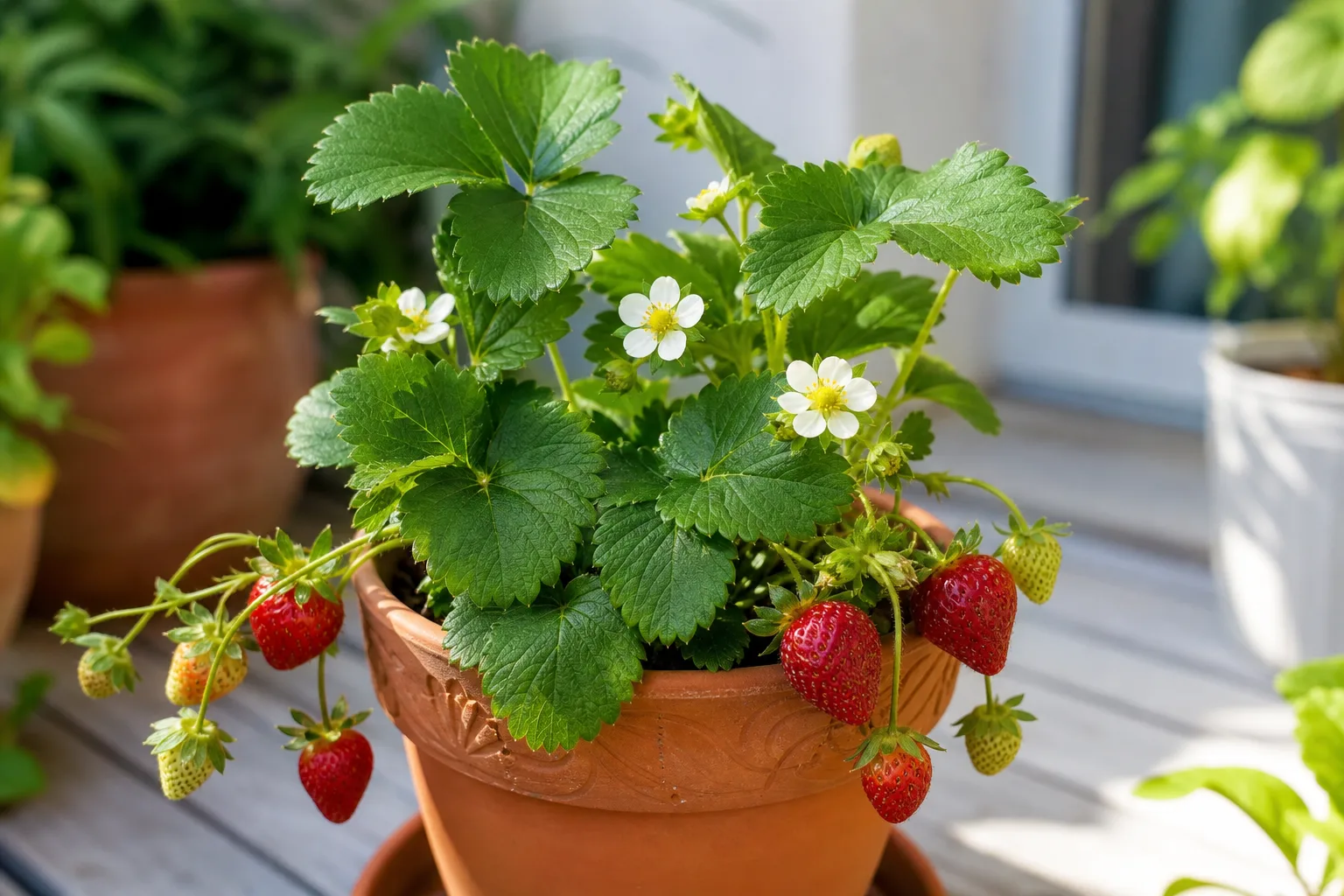
Containers are often the best way to give strawberries the light they need in apartments. NC State notes strawberries work well in containers on a sunny patio, and the RHS says pots should sit in a sheltered, sunny spot with regular watering. (NC State Extension Plant Toolbox) (RHS)
Place troughs and hanging baskets where the leaf canopy sees the sky, not where the pot looks decorative in a dim corner. Rail-mounted boxes on a south or west balcony usually outperform interior shelves. Rotate containers every few days if one side leans hard toward the light. Because pots dry faster in full sun, lock watering to the pot’s dry-down rate after you fix placement—see the Strawberry watering guide rather than watering on a fixed calendar.
Avoid stacking plants under each other in multi-tier stands if lower tiers never receive direct beams. Strawberries fruit poorly as understory fillers. If you must use a crowded balcony, give fruiting plants the front rail and move ornamental foliage plants behind them.
Can Strawberries Grow Indoors Near a Window?
A bright window can keep a strawberry plant alive. It rarely replaces outdoor full sun for a satisfying crop. East windows give useful morning sun. South or west windows can work if leaves receive several hours of direct beam without baking against hot glass. North windows and rooms lit only by reflected indoor light are maintenance zones, not fruiting zones.
If you grow indoors for novelty or winter continuity, judge success by new flower trusses and fruit size, not by whether old leaves stay green. Pale, elongated petioles and few blooms mean the window is too weak. Move the pot outdoors or onto the brightest balcony as soon as weather allows, then readjust Strawberry fertilizer only after light is corrected.
Grow lights when natural sun is short
Use a full-spectrum LED grow light when natural daylength or window intensity cannot deliver multi-hour direct sun. Hang the fixture so it covers the whole canopy evenly, run it roughly 12 to 14 hours during active growth and fruiting attempts, and keep leaves out of heat stress from the lamp. Grow lights help most for seedling starts, runner rooting after Strawberry propagation, and short winter stretches—not as a permanent excuse for a dark living room.
Hand-pollinate indoor flowers with a soft brush if pollinators cannot reach the plants. Light builds the crop energy; pollination finishes the fruit set.
Warning Signs of Too Little Light
Low light on strawberries looks quiet at first. New leaves may emerge thinner and a lighter green. Petioles stretch toward the brightest side of the pot. Flowering stays sparse or aborted. Fruit that does form stays small, pale, or persistently tart. Runners may still appear on June-bearing types, which tricks growers into thinking the plant is “happy” while the edible crop fails.
Soil that stays wet for many days after watering is another clue the plant is not using energy or water quickly. Fix light before you assume the mix is wrong, though chronically soggy media still need attention in the soil guide. First action: move the plant into stronger direct sun for most of the day for two weeks, then judge new growth and any new flower clusters.
Warning Signs of Too Much Heat or Harsh Sun
Direct sun itself is the goal. Damage usually comes from sudden moves into intense heat, hot reflective walls, or midsummer exposure after a cool-season crop. Scorched leaf edges, bleached patches on the sun-facing side, soft fruit that cooks on the surface, and midday wilting even when the root zone is moist all point to heat load more than “too much light” in the botanical sense.
If you see those symptoms, provide temporary afternoon shade, raise watering frequency carefully, improve airflow, and avoid fertilizing a heat-stressed plant. Do not drag the pot into deep shade as a long-term fix. Restore bright morning sun as soon as stress eases so flowering does not stall.
When to use this page vs other Strawberry guides
Use this page when you are choosing terrace orientation, deciding whether a balcony is bright enough, diagnosing pale plants with weak crops, or setting up grow lights. Switch to Strawberry watering when pots dry too fast in full sun or stay wet in shade. Use Strawberry soil for drainage and pH. Use Strawberry fertilizer after light and moisture are stable. Use Strawberry repotting when crowns are overcrowded, and Strawberry propagation when you are rooting runners under strong light.
Related Strawberry guides
- Strawberry overview — habit, season, and where light fits in overall care
- Strawberry watering — how full sun changes dry-down
- Strawberry soil — drainage that supports sunny beds and pots
- Strawberry fertilizer — feeding once photosynthesis is strong
- Strawberry pruning — runners, old leaves, and renovation timing
- Strawberry propagation — rooting runners in bright conditions
- Strawberry repotting — refreshing crowded container crowns
Conclusion
Strawberries repay sun more honestly than almost any other small edible you can grow on a balcony. Target 6 to 8 or more hours of direct light, treat partial shade as a yield compromise, and in hot Indian climates align that bright exposure with the cool fruiting season. Fix placement before you chase fertilizers or variety upgrades. When new leaves look compact, flowers keep appearing, and fruit sweetens on schedule, the light is finally doing the real work.