How to Prune Strawberries: Runners, Leaves & Timing
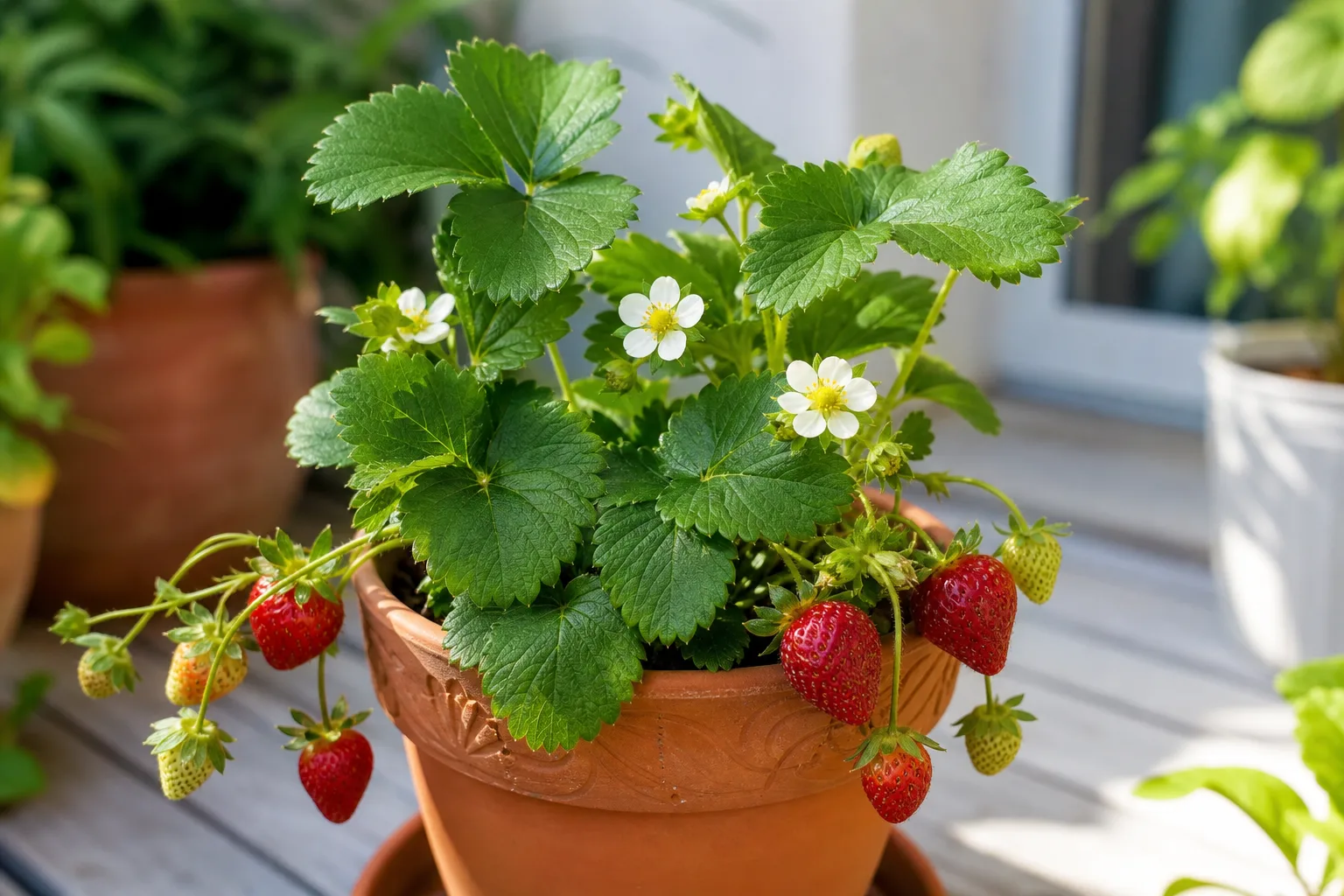
How to Prune Strawberries: Runners, Leaves & Timing
How to Prune Strawberries: Runners, Leaves & Timing
First, remove only dead, fully yellow, damaged, or diseased strawberry leaves—and any rotting fruit still attached—using clean scissors or snips. Cut the leaf stalk close to the crown without nicking the crown itself. Do not shear healthy green foliage or yank runners until that sanitation pass is finished and you know whether your plant is summer-fruiting or everbearing/day-neutral.
Reviewed by LeafyPixels Review Board · Author: sai-ananth
Quick answer
Garden strawberry (Fragaria × ananassa) is a low, stoloniferous perennial grown for fruit, not a houseplant you tip-pinch for bushiness. Most home pruning is three jobs: sanitize failing leaves, manage runners (stolons) so energy stays in the mother crown, and renovate summer-fruiting plants after harvest by cutting old foliage about 10 cm (4 in) above the crown so fresh leaves can replace it (RHS). Perpetual/everbearing types usually need selective removal of dead or diseased leaves rather than a full leaf cutback (RHS). For placement, watering, and overall growing context, start with the Strawberry overview.
What pruning does for strawberries
Left alone, a vigorous strawberry sends long runners that root into daughter plants, crowds the pot or bed, and holds onto old leaves that shade fruit and trap humid air. Pruning redirects sugars into crowns, flowers, and berries instead of endless vegetative runners (Ohio State University indoor berry notes). UC IPM recommends removing runners to encourage single plants to produce several crowns, which is the growth pattern that supports better fruiting in many home systems.
Pruning cannot fix weak light, waterlogged mix, or a crown planted too deep. If leaves look pale and stretched with sparse flowering, improve Strawberry light before expecting runner removal alone to produce a dense plant. Soft crowns and yellowing after wet soil point to watering and drainage issues first.
Four pruning jobs show up on home strawberries:
| Job | What you cut | Typical timing | Goal |
|---|---|---|---|
| Sanitation | Dead, yellow, diseased leaves; rotting fruit | Anytime | Airflow; less disease inoculum |
| Flower pinch | Early flower clusters on new or weak plants | Establishment window | Stronger crowns before cropping |
| Runner control | Stolons at the mother plant | Throughout active growth | Bigger fruit; less crowding |
| Renovation | Old leaf canopy on summer-fruiting types | Right after main harvest | Fresh foliage; bed reset |
When to prune strawberries
Know your type before you cut. Labels may say June-bearing (summer-fruiting), everbearing/perpetual, or day-neutral. Timing and aggressiveness differ.
First-year flower removal
New plants need crown and root growth before a heavy crop. Missouri Botanical Garden advises pinching off all flowers the first year on garden strawberries. Penn State Extension likewise recommends removing blossoms in the planting year for matted-row June-bearers so the bed establishes vigorously.
RHS is more nuanced by type and planting date: summer-fruiting plants planted in autumn or spring need the first flower flush removed only if growth is slow and plants look weak; perpetual strawberries planted in spring establish better if the first flush is removed; cold-stored runners planted late spring to early summer can keep flowers for a ~60-day crop (RHS). For day-neutrals, UC IPM suggests cutting off the first two flower clusters if growth is weak after planting, and Penn State notes removing flowers for about the first six weeks after planting day-neutrals in some systems.
In warm Indian plains where strawberries are often a cool-season container crop, treat “first year” as the first strong establishment flush after planting—not a calendar year that ignores monsoon heat stress.
Runner control during the season
Remove runners as they form unless you are deliberately rooting a few daughters for propagation or gap-filling (UC IPM; RHS). Excess runners during fruiting mean the plant is diverting buds to stolons instead of crowns and flower clusters (Ohio State). In plasticulture or closely spaced pots, runners are usually removed entirely; in a matted-row bed, keep only enough daughters to fill a controlled strip, then cut aisle runners (Penn State).
After-harvest renovation (summer-fruiting)
Once summer-fruiting (June-bearing) cropping finishes, cut old leaves about 10 cm (4 in) above the crown so new leaves can develop (RHS). Commercial and garden renovation often includes mowing foliage, narrowing the row, fertilizing, and restarting watering so the fruiting cycle begins again (Penn State). Do this soon after harvest—not weeks later when the plant is already rebuilding without a reset.
Everbearing and day-neutral cleanup
Do not treat perpetual strawberries like June-bearers. RHS says a full old-leaf cutback is unnecessary; instead remove dead, damaged, or diseased leaves in the end-of-season clear-up (RHS). UC IPM advises removing older leaves that are turning color on day-neutrals, and pruning most leaves from short-day plants in late fall after the first full year of growth—always collecting diseased material away from the planting.
What to check before cutting
- Fruiting type on the label or your notes (summer-fruiting vs perpetual/day-neutral).
- Crown health — firm, green growing center; soft, brown, or hollow crowns are a root/rot problem, not a pruning fix.
- Leaf symptoms — spotty, scorched, or fuzzy mouldy leaves should be bagged and discarded, not composted near the bed (UC IPM).
- Runner intentions — keep 1–2 strong daughters only if you need replacements; otherwise remove them early.
- Light and moisture — sparse stretch often needs brighter placement; soggy mix needs watering correction before hard renovation.
The first cut to make
Take one clearly dead or diseased leaf and cut its petiole close to the crown with sanitized snips. That single cleanup cut sets the rule for the session: protect the crown, remove only failing tissue first, then decide on runners or renovation.
How to prune strawberries step by step
Remove spent, diseased, or yellow leaves
Old strawberry leaves lose gloss and turn yellow; leaving dead leaves in the canopy reduces airflow and can shelter disease (Ohio State). Cut petioles near the crown. Remove any leaves with disease signs and discard them well away from the planting (UC IPM). Wipe blades with 70% isopropyl alcohol between plants if disease is present.
Cut runners at the mother plant
Trace each stolon back to the mother crown and snip it close to the plant before daughter plants root heavily. If a daughter you want is already rooted, sever the runner connecting it to the mother and pot or transplant it using the propagation guide. Unwanted rooted daughters can be dug out to reduce crowding (RHS).
Pinch flower clusters when establishment comes first
Pinch or snip entire flower clusters at the stalk when the plant is newly set, weak, or still building a usable crown. Keep flowers when the plant is already vigorous and you intentionally want an early crop (for example, cold-stored runners under good conditions) (RHS).
Renovate summer-fruiting plants after cropping
After the main June-bearing harvest:
- Clear mulch that is wet or rotting if it traps moisture against crowns.
- Cut foliage about 10 cm above the crowns—high enough to spare the growing points (RHS).
- Thin overcrowded plants or narrow a matted row so remaining crowns have space (Penn State).
- Resume even moisture and feed only if the plant is actively growing and your care plan calls for it—see Strawberry fertilizer rather than dumping feed on a stressed crown.
Where to cut — and what not to cut
Cut: leaf petioles near the crown; runners at their origin on the mother; whole flower clusters at the stalk; old canopy foliage to ~10 cm above crowns on summer-fruiting plants after harvest.
Do not cut: into the crown’s growing tip; healthy green leaves on perpetual types just to “match” a June-bearing renovation; all flowers on a cold-stored runner you planted specifically for a quick crop; roots or crowns as a substitute for fixing wet soil.
The crown is a compressed stem. New leaves, runners, and flowers arise from it (Penn State). Damaging that center can kill the plant even if leaves look plentiful.
How much you can safely remove
- Sanitation: remove all clearly dead or diseased foliage anytime.
- Runners: remove most or all during fruiting unless you need daughters; that is normal and not “over-pruning.”
- Summer-fruiting renovation: cutting the old leaf canopy to ~10 cm above crowns after harvest is the standard reset (RHS).
- Perpetuals/day-neutrals: stay selective—old and diseased leaves only for routine cleanup (RHS; UC IPM).
- Flowers: remove whole early clusters during establishment; do not strip every bloom for an entire season on a mature perpetual plant unless you are deliberately forcing vegetative recovery.
If more than about one-third of the live green canopy looks unhealthy at once, pause aggressive runner or flower work and diagnose light, water, and roots first.
Aftercare and recovery timeline
After sanitation or runner removal, keep the mix evenly moist—not soggy—and maintain bright sun for fruiting cultivars. New leaves on a renovated June-bearer usually push within one to three weeks in warm active growth; judge success by a flush of glossy new foliage and resumed crown firmness, not by same-week flowering. Beds typically decline in fruit size after two to three years even with renovation (Penn State), so plan to replace tired plants with fresh runners rather than pruning forever.
Do not repot on the same day as a hard leaf cutback unless the pot is failing. If the plant needs a larger container or fresher mix, follow Strawberry repotting after new growth stabilizes. Slow recovery with limp leaves often tracks back to soil drainage or watering mistakes rather than the cuts themselves.
Mistakes to avoid
- Shearing into the crown when “mowing” or cutting leaves.
- Applying June-bearing full leaf cutback to everbearing/perpetual plants.
- Leaving diseased leaves in place or composting them beside the bed.
- Letting runners fill a hanging basket until the mother crown starves.
- Removing flowers and renovating hard foliage on the same stressed, newly transplanted plant.
- Expecting pruning to fix chronic shade or wet roots.
When not to prune
Delay elective renovation or heavy flower removal when:
- the plant was transplanted or divided within the last 1–2 weeks;
- crowns are soft or the mix smells sour (fix water and roots first);
- extreme heat is stressing container plants on a terrace;
- you still need the current leaf canopy for a perpetual plant mid-fruit flush—limit cuts to dead or diseased tissue only.
Broken, mouldy, or clearly dead leaves remain fair game anytime.
Related Strawberry guides
- Strawberry overview — type, placement, and whole-plant care baseline
- Strawberry light — sun needs before expecting compact, fruitful growth
- Strawberry watering — moisture rhythm that supports recovery after cuts
- Strawberry soil — drainage that protects shallow crowns
- Strawberry fertilizer — feeding after renovation, not as a first response
- Strawberry propagation — rooting the runners you choose to keep
- Strawberry repotting — container resets separate from leaf pruning