Strawberry Fertilizer Guide: Timing, NPK & Pots
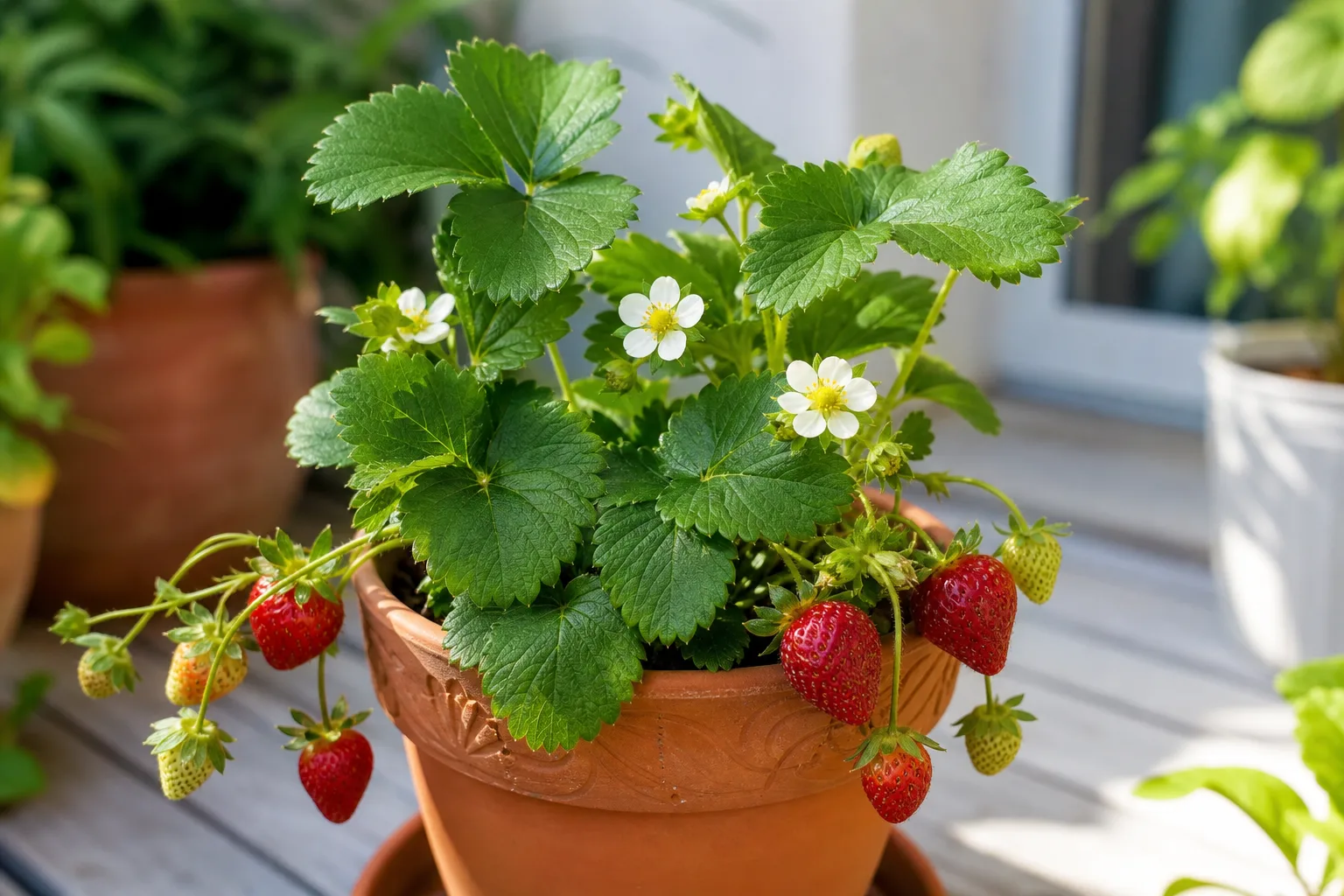
Strawberry Fertilizer Guide: Timing, NPK & Pots
Strawberry Fertilizer Guide: Timing, NPK & Pots
Strawberry fertilizer only works when you feed for fruit, not for a jungle of leaves. Fragaria × ananassa is a shallow-rooted, short-stature perennial fruit plant that packs a large berry crop into a small crown — so nutrient timing and nitrogen restraint matter more than a heavy “grow more” tonic. For beds and terrace pots in India, the safest starting plan is: identify whether your plants are June-bearing or day-neutral, feed on that schedule at half to full label rate for containers, and stop soluble fertilizer when roots are waterlogged, heat-wilted, or out of active growth.
Fertilizer cannot replace the six-plus hours of sun strawberries need, and it cannot rescue a soggy mix. Check the Strawberry light guide and Strawberry watering guide before you double the dose. This page covers what to feed, when to feed by type, India seasonal cues, container dilution, and the first action when berries go soft or foliage races ahead of flowers.
Strawberry fertilizer: the quick answer
Use a complete fertilizer with a declared NPK. In fertile, mulched garden soil, RHS guidance notes strawberry plants often need little extra feeding; if harvests are poor, apply a high-potassium granular fertiliser in spring. In containers and growing bags, RHS recommends fortnightly liquid feeding in the growing season — start with a general-purpose liquid, then switch to a high-potassium liquid when the first flower buds form.
For Florida-style cool-season beds (useful for warm Indian plains winter plantings), UF/IFAS home-garden guidance recommends incorporating about two pounds of 10-5-10 (or equivalent) with micronutrients per 10 feet of row before planting, with roughly half the nitrogen in a slow-release form. That is a bed recipe, not a cup-for-cup pot recipe — scale down hard for containers.
Match the schedule to June-bearing vs day-neutral plants
Washington State University groups modern strawberries as June-bearing, day-neutral, or everbearing. June-bearing types set flower buds in late summer/fall and crop in a concentrated spring/early-summer flush. Day-neutral types flower and fruit across a longer season regardless of daylength, so they keep drawing nutrients for longer. Penn State Extension notes that fertilizer requirements are higher for day-neutrals than for June-bearers.
Master Gardener guidance based on Kansas State recommendations is blunt on timing: do not fertilize June-bearing strawberries in early spring, because that can make berries soft and more prone to rot; feed at renovation and again in late August to early September. For everbearing or day-neutral plants, fertilize as growth starts in spring and again in early August, and skip renovation-style feeding because those types are not renovated the same way (Master Gardeners of Greater Kansas City).
Beds vs terrace pots — dose logic
In-ground beds hold a larger nutrient bank and can lean on compost and preplant fertilizer. Terrace pots, hanging baskets, and grow bags leach with every watering. Follow the RHS container rhythm — light, frequent liquid feeds — rather than dumping a field rate of high-nitrogen lawn fertilizer into a 20-litre pot. Always water first if the mix is bone dry, then feed on a cooler morning so salts do not sit on wilted crowns.
If you just repotted into fresh mix that already contains controlled-release fertilizer, wait several weeks before adding liquid feed. Stacking products is a common path to leaf-edge burn. See the Strawberry repotting guide when a refresh, not a tonic, is what the plant needs.
Why Fragaria × ananassa needs measured, fruit-first feeding
Garden strawberry is a hybrid of North American and South American species, grown worldwide as a low, runner-forming fruit plant rather than a foliage houseplant. NC State Extension describes Fragaria × ananassa as a short, high-maintenance edible perennial typically classed as June-bearing or everbearing, with shallow roots that need frequent moisture in well-drained, organic soil. That shallow root zone is why nutrition and watering are tightly linked: nutrients only help if roots are alive and oxygenated.
The grower’s goal is fruit quality and yield, not maximum leaf mass. Excess nitrogen late in a fruiting cycle can reduce fruit firmness and shipping quality under warmer conditions — a pattern UF/IFAS flags for commercial strawberry nutrient management when too much N is applied in the last weeks of harvest (UF/IFAS nutrient recommendations). Home growers see the same soft, bland, or rot-prone berries when spring nitrogen is piled onto June-bearing plants.
Shallow roots, short fruiting cycles, and nutrient demand
Penn State notes strawberry roots are extremely shallow — often only about six inches deep in clay loam — so plants compete poorly for water and nutrients when weeds or compacted soil intervene (Penn State Extension). In a pot, that same biology means the entire root ball can exhaust soluble nutrients quickly, then suffer salt injury if you compensate with strong solutions.
Fruiting type sets the demand curve. June-bearers need a strong post-harvest rebuild so crowns form next year’s flower buds in late summer and fall. Day-neutrals need steadier, lighter support across repeated flushes. Alpine or woodland types (Fragaria vesca) are lighter croppers and rarely need the same intensity of feeding as large-fruited hybrids.
Nitrogen for leaves vs potassium for fruit quality
Nitrogen drives leaf and runner growth. Phosphorus supports root and flower development when soil supplies are low. Potassium supports fruit development and overall plant function; that is why RHS shifts container plants from a general liquid to a high-potassium liquid once flower buds appear (RHS strawberries).
If soil tests already show adequate phosphorus and potassium, Kansas Master Gardener guidance favors a high-nitrogen product for strawberries (without weed killers) at renovation or seasonal timings; if the soil test calls for P and K, they recommend a balanced 10-10-10 at a higher rate instead (MGGKC). In India, where soil tests are less common on terraces, a balanced or potassium-forward fruit/berry fertilizer at modest rates is safer than lawn fertilizer with herbicide.
When to fertilize strawberries by plant type
Read the nursery tag. “June-bearing,” “summer-fruiting,” “day-neutral,” “everbearing,” and “perpetual” are not interchangeable schedules. If the tag is missing, watch the crop: one heavy early flush suggests June-bearing; repeated smaller flushes suggest day-neutral or everbearing. The Strawberry overview covers type choice for Indian gardens.
June-bearing (summer-fruiting) renovation and late-summer feeds
After the main crop finishes, renovate the bed (mow or trim foliage as appropriate for your system, narrow rows, remove weeds), then fertilize so plants rebuild leaf area and set flower buds for next year. Feed again in late August to early September in temperate calendars — in Indian hill gardens, that maps to the late-monsoon or early-autumn window when days shorten and nights cool enough for bud initiation. Avoid a heavy early-spring nitrogen push while fruit is sizing; soft, rot-prone berries are the usual cost (MGGKC).
Young plantings in their first year sometimes have blossoms removed so energy goes into establishment — fertilizer still belongs with healthy new growth, not with stressed transplants. Pair renovation feeding with the Strawberry pruning guide so you are not fertilizing a crowded, diseased canopy.
Day-neutral and everbearing (perpetual) light, regular feeds
Day-neutrals and everbearers crop in flushes over months, so they need more total fertility across the season but in smaller, repeated doses (Penn State Extension). Fertilize when spring growth starts and again in mid-season (early August in temperate guides; in India, a mid-fruiting window after the first flush). In pots, the RHS fortnightly liquid schedule fits these types especially well: general feed while leaves expand, then high potassium as buds and fruit appear (RHS).
Do not chase every flush with full-strength fertilizer. If leaves are deep green and plants are flowering, stay on a light schedule. If growth stalls in good light with evenly moist, well-drained mix, then increase — after you have ruled out root rot and heat stress.
Cool-season annual crops in warm Indian plains
In peninsular Florida — and similarly in many warm Indian plains gardens — strawberries are often grown as a cool-season annual: planted in fall, fruited through winter and early spring, then removed when heat arrives (UF/IFAS). Fertility is front-loaded into the bed before planting (10-5-10 with micronutrients, half slow-release N), then maintained with irrigation management so nitrogen and potassium are not leached away. UF Gardening Solutions also advises home growers to fertilize regularly with a balanced fertilizer when growing in rich soil or potting media.
For a Delhi, Hyderabad, or Pune winter terrace crop, think “preplant or early establishment feed, then light liquids while flowering,” not a summer houseplant monthly tonic through May heat. When night temperatures stay high and plants decline, stop feeding and plan a fresh planting rather than forcing exhausted crowns.
India seasonal fertilizer cues for strawberry
India is not one climate. Use plant growth and moisture, not a single national calendar.
| Seasonal cue | Hill / cool perennial beds | Warm-plains winter crop | Terrace pots / baskets |
|---|---|---|---|
| Establishment (planting window) | Light feed only after new leaves; avoid crown burn | Incorporate preplant fertilizer into bed; water in | Wait if mix has CRF; else half-strength liquid after roots settle |
| Main flowering / fruit swell | Avoid heavy N on June-bearers; keep moisture steady | Light balanced or K-forward liquids between flushes | Fortnightly liquid; switch to high K at first buds |
| Monsoon / heavy rain | Pause if soil stays saturated | Usually not main season; protect pots from roof runoff | Pause while mix stays wet; resume when drainage normalizes |
| Post-harvest / renovation | Feed June-bearers after crop; late-summer bud feed | Remove plants when heat ends; compost spent plants | Refresh mix or replace plants; do not “catch up” with double doses |
| Hot dormant or decline phase | Reduce or stop soluble feed | Stop feeding; restart next cool season | Stop; store or compost exhausted plants |
Always water a dry pot before fertilizing. Never apply soluble fertilizer to a heat-wilted plant or a pot standing in runoff. The Strawberry soil guide covers drainage and pH — UF/IFAS targets roughly pH 5.5–6.5 for home strawberries, while Penn State cites 6.0–6.5 for production sites (UF/IFAS; Penn State). Out-of-range pH locks nutrients even when fertilizer is present.
Best fertilizer types and NPK for strawberries
Choose products with a guaranteed analysis and clear edible-garden or fruit directions. Avoid “weed and feed” lawn products — herbicide residues can damage strawberries even when the NPK looks convenient (MGGKC).
Preplant bed mixes and micronutrients
For new raised beds in a cool-season system, UF/IFAS’s home-garden rate of 10-5-10 with micronutrients including boron, half slow-release nitrogen, incorporated before planting is a concrete, research-backed starting point (UF/IFAS HS403). Banding part of the fertilizer down the bed center and mixing the rest into the surface reduces burn risk compared with dumping everything against crowns.
Well-rotted compost improves structure and modest nutrient supply; RHS suggests digging in organic matter before planting and mulching regularly so many beds need little extra feed (RHS). Fresh manure against crowns is a burn risk — use only finished material and keep it off the plant center.
Liquid feeds for containers and hanging baskets
Containers are where most Indian terrace growers succeed or fail with strawberry fertilizer. Follow label rates for pots, begin at half strength if you are unsure, and use the RHS pattern: general-purpose liquid fortnightly, then high-potassium liquid from first flower buds through active cropping (RHS). Flush the pot with plain water every few weeks if white crust appears on the surface or drainage holes.
Slow-release granules mixed into fresh potting media can carry a plant through early weeks; they are less flexible mid-season than liquids when you need to cut nitrogen during heavy fruiting. For propagation trays and newly rooted runners, wait until plants show steady new leaves before any feed — see the Strawberry propagation guide.
Warning signs of underfeeding and overfeeding
Underfed strawberries often show pale new leaves, weak runners, small fruit, and stalled flushes despite good sun and moisture. Correct with a measured complete feed — not a sudden high-nitrogen blast — after confirming the soil mix drains and the plant is not root-bound beyond recovery.
Overfed plants push soft, overly lush foliage, few flowers relative to leaf mass, leaf-edge scorch, white salt crust on the mix, and soft berries that bruise or rot quickly. UF/IFAS notes that excessive fertilization can reduce crop quality, and late-season excess nitrogen can soften fruit (UF/IFAS SS730). First action: stop fertilizer, leach the container with plain water if salts are visible, and resume only at half rate after new growth looks firm.
Do not confuse drought or root rot with hunger. Wilt with wet soil is a root problem. Pale leaves in deep shade are a light problem. Fix those first.
When to use this page vs other Strawberry guides
Use this fertilizer page when your question is about NPK choice, timing by cultivar type, dilution, or soft fruit after feeding. Use the Strawberry watering guide when the mix stays wet or bone dry between drinks. Use the Strawberry soil guide for pH, drainage, and mix recipes. Use the Strawberry light guide when plants are leggy or refuse to flower in shade. Use the Strawberry overview for type selection and whole-plant expectations.
Related Strawberry guides
- Strawberry overview — types, climate fit, and care map for Indian growers
- Strawberry light — sun hours before you blame fertilizer for no flowers
- Strawberry watering — moisture rhythm that makes nutrients available
- Strawberry soil — pH and drainage that unlock fertilizer
- Strawberry repotting — when a mix refresh beats another feed
- Strawberry propagation — aftercare for runners before fertilizing
- Strawberry pruning — renovation and foliage cleanup tied to June-bearing feeds
Conclusion
Feed strawberries on a fruit-first schedule matched to June-bearing, day-neutral, or cool-season annual culture. Prefer balanced or potassium-forward products, keep nitrogen modest while fruit is sizing, and use light, regular liquids in pots rather than field rates. In India, pause feeding through saturated monsoon pots and peak heat decline, then restart when crowns are actively growing again. Get sun, drainage, and watering right first — fertilizer is the fine-tuning step that turns a healthy plant into a sweeter, firmer harvest.