How to Grow Strawberries Indoors Year-Round
Grow fresh strawberries indoors year-round: choose a fruiting variety, set up light and airflow, protect the crown, hand-pollinate flowers, and harvest ripe fruit.
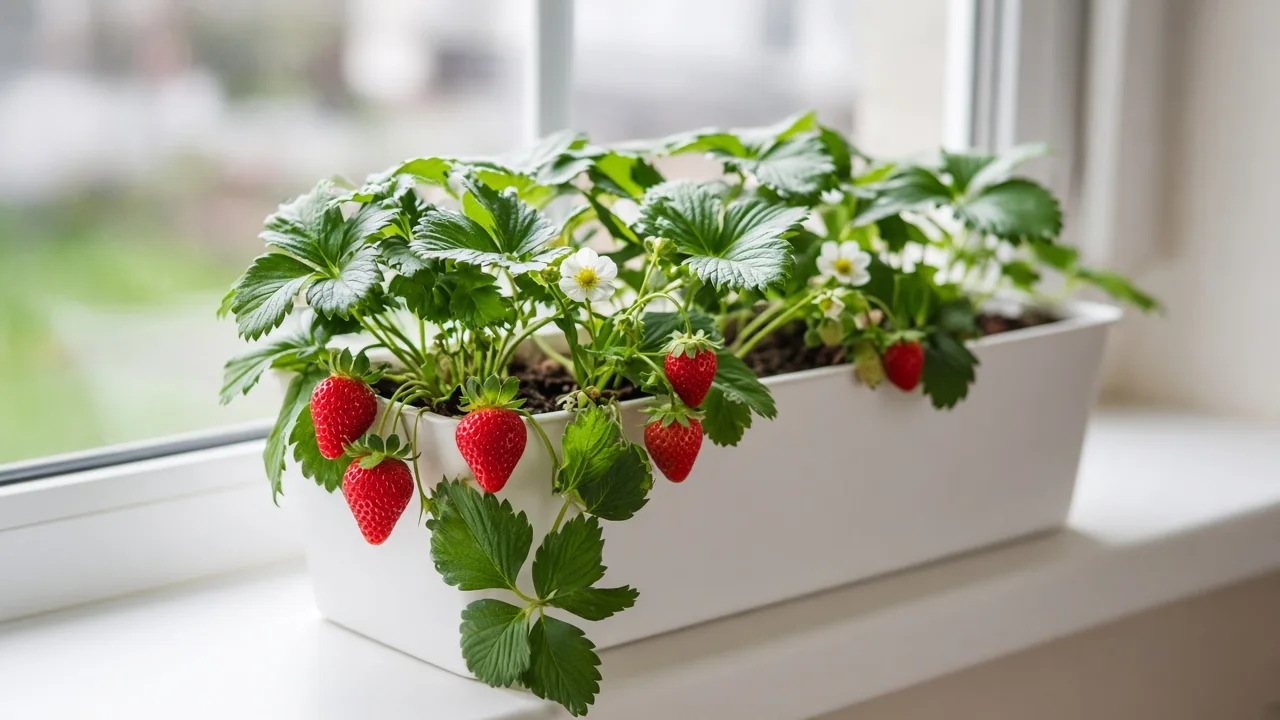
Yes, you can grow strawberries indoors and harvest real fruit, but the plant has to be treated like a small fruit crop rather than a decorative houseplant. The winning combination is a day-neutral or suitable everbearing cultivar, a wide pot with fast drainage, strong light, cool-to-moderate temperatures, steady moisture, and deliberate pollination.
The realistic promise is a succession of small harvests, not a bowl of berries every day. A healthy day-neutral plant can fruit in repeated flushes, while a dim-window plant may grow leaves and still produce little or nothing.
The short answer: indoor strawberries need fruiting conditions
Start with a live, healthy plant if your priority is fruit soon. Put one strawberry plant in a wide container with drainage, keep the crown at the surface, place it in at least six hours of strong direct sun or under a full-spectrum LED on a timer, and hand-pollinate every flower. Water when the upper mix has begun to dry, feed modestly during active growth, and harvest berries only when they are fully colored.
Strawberries are low-growing herbaceous perennials with a shallow root system, a compressed stem called the crown, and runners that make daughter plants. Penn State Extension notes that much of the root mass can sit in the top six inches of soil, which explains both the plant’s need for regular moisture and its dislike of a pot that stays saturated. The crown is the plant’s control center: leaves, flower clusters, and runners all emerge from it, so burying it is a quick way to lose the plant. Read the Penn State Extension strawberry guide for the crop’s basic structure and seasonal behavior.
Here is a practical starting target for one indoor pot:
| Need | Starting target | What to watch |
|---|---|---|
| Plant | Day-neutral or a reliable everbearing type | Flowers and fruit, not only runners |
| Light | Six or more hours of direct sun, or a full-spectrum LED for about 12–16 hours | Stretching, pale leaves, and few flowers mean light is suspect |
| Pot | About 8–10 inches wide for one plant, with open drainage | A pot that stays wet is more dangerous than a slightly small pot |
| Mix | Airy container mix with perlite or another drainage amendment | Water should pass through rather than pool |
| Pollination | A small, clean, soft brush or cotton swab | Uneven fruit set and lopsided berries indicate a problem |
| Temperature | About 68–75°F by day; cooler nights are useful | Heat, heater blasts, and cold window glass can interrupt fruiting |
These are starting points, not a promise that every cultivar will behave identically. Ohio State’s controlled-environment berry program emphasizes that strawberry responses depend on cultivar and on the interaction among temperature, light, day length, humidity, and the growing system.
Choose a strawberry type and starting plant
The plant you buy determines how much of the year-round claim is possible. A June-bearing strawberry concentrates its crop in one seasonal window, which is useful for a garden bed but poorly matched to a warm room where you want repeated indoor harvests. Day-neutral plants are the most practical choice because they can initiate flowers over a longer period when temperature and light are suitable. Everbearing plants can also work, although “everbearing” often describes a pattern of two or more crops rather than uninterrupted fruiting.
Common names you may encounter include Albion, Seascape, Tristar, and Alpine. Treat those as examples to investigate rather than a universal ranking: cultivar performance changes with climate, production system, and the plant’s history before you bought it. Home for the Harvest’s indoor-growing guide also points to day-neutral choices such as Seascape and Tristar and the smaller Alpine type for indoor containers; its practical comparison of starts and seeds is useful in this strawberry-growing guide.
Day-neutral versus everbearing and June-bearing
Choose day-neutral when your goal is a handful of berries every few weeks under a stable light schedule. These plants still slow down when they are too hot, too dim, root-bound, stressed, or poorly pollinated, so “day-neutral” does not mean “needs no seasonal care.” Penn State describes day-neutral plants as fruiting through the growing season in flushes, with peaks and valleys rather than a perfectly even supply.
Choose everbearing when you want a compact container plant that may deliver an early crop and another later crop, or when that is the type available locally. It can be a reasonable indoor choice, but read the plant label carefully because trade names and category names are not always used consistently by nurseries.
Use June-bearing only when a seasonal crop is acceptable or when you already have a plant you want to preserve. You can keep it alive indoors, but forcing a concentrated outdoor-style crop into a spare room is less predictable than starting with a day-neutral cultivar. If a plant makes healthy leaves but refuses to flower under a strong setup, the cultivar’s fruiting habit belongs on your diagnostic list.
Seeds, bare-root plants, or potted starts
Seeds are inexpensive and rewarding if you want to watch the whole cycle, but they are the slow route to fruit. Home for the Harvest estimates roughly five to six months from seed to berries under good conditions, while a young plant or runner may crop in roughly five to six weeks once it is established. Those timelines vary, but the gap is large enough to guide the buying decision.
Seed-grown strawberries also may not come true to the parent plant. The white “seeds” on the outside of a strawberry are achenes, each containing a seed; seedlings from a hybrid fruit can vary in vigor, size, flavor, and fruiting habit. Penn State’s pollination material explains that a plant raised from an achene is not necessarily true to type. Do not rely on seeds scraped from a grocery berry if a predictable day-neutral crop is your goal.
Bare-root plants are a good middle ground when you can find a named cultivar. Keep roots cool and damp, soak them briefly if they arrived dry, and spread them rather than folding them into a cramped hole. A potted nursery plant costs more but gives you the fastest test: if it is already flowering, your job is light and pollination, not a long juvenile wait.
Build an indoor strawberry setup that can produce fruit
Indoor success usually fails at the setup stage, before watering or fertilizer gets a chance to help. Give the plant a place where light can reach the whole crown, air can move gently around the leaves, and runoff can be caught without leaving the pot in a puddle.
Make light the first yield decision
A bright-looking room is not necessarily a bright growing site. Six hours of direct sun through clear glass may maintain a plant and sometimes support fruit, but winter sun, tinted glass, screens, and overhangs can reduce usable light sharply. A plant that stretches toward a window or produces long petioles and few flowers is asking for more light, not fertilizer.
For reliable indoor fruiting, use a full-spectrum LED on a timer. Start around 12–14 hours daily and move toward 16 hours only if the fixture and the plant’s response support it; the plant still needs a dark period. Keep the light close enough to deliver useful intensity but far enough away that the leaves do not bleach, curl, or heat up. Follow the fixture’s distance guidance, then adjust as the canopy grows. Savvy Gardening’s overview of LED grow lights explains why LEDs are useful indoors: they are efficient, long-lived, and generally emit less heat than older lighting choices. See its LED grow-light guide for the practical equipment context.
Hours are only half the light story. Ohio State’s controlled-environment guidance recommends a daily light integral, or DLI, of about 12 mol/m²/day as a minimum for good productivity and 20–25 mol/m²/day as an optimum greenhouse range. A home fixture may not make DLI easy to measure, and those values do not transfer perfectly to every cultivar. Use them as a reason to care about intensity, not as permission to run a weak lamp longer.
If you have a light meter, measure at the leaves rather than at the shelf. Otherwise use the plant as feedback: compact growth, firm green leaves, regular flowering, and enlarging berries are positive signs. Stretching, pale growth, and no flowers call for a closer or stronger fixture or a less shaded window.
Balance temperature, humidity, and airflow
Strawberries prefer a bright, moderate environment rather than the hot, dry corner beside a radiator. Ohio State recommends daytime temperatures around 68–75°F for controlled environments and reports that cooler nights can improve fruit size and flavor. In a home, allowing the room to fall into the low-to-mid 60s at night is a practical compromise; you do not need to turn the plant room into a commercial cold house to get good berries.
Avoid heating vents, air-conditioner outlets, and freezing window glass. Sudden swings can stress flowers and roots even when the room average sounds reasonable; solve heat and airflow problems before increasing fertilizer.
Use a small fan on its lowest setting if air sits still around the foliage, but do not blast flowers or desiccate the pot. Daytime relative humidity around 40–60% is a sensible home range. Ohio State notes that strawberry humidity management is more nuanced in controlled production: very dry conditions can contribute to tipburn in sensitive cultivars, while prolonged dampness raises disease risk. That is a reason to use a hygrometer and gentle airflow, not a reason to mist the flowers or keep the room constantly humid.
Choose a potting mix that protects shallow roots and the crown
Use a fresh, lightweight container mix rather than soil dug from the yard. Garden soil can compact in a pot, drain poorly, and carry pests or disease organisms into a warm indoor setting. A quality indoor or vegetable potting mix amended with perlite, pumice, or another coarse aeration material gives the shallow roots both moisture and air. Coconut coir or peat can form the moisture-holding part of the mix; the goal is a mix that is damp after watering but never soupy.
Strawberries prefer a slightly acidic root zone. Garden.eco gives a useful target of roughly pH 5.6–6.3 in its indoor strawberry overview. You do not need to chase pH every week if you start with a reputable mix and use fertilizer as directed, but a basic test is worthwhile when leaves stay pale despite strong light or when the pot develops a persistent crust of salts.
Choose width over unnecessary depth. An 8–10-inch pot with a drainage hole is a sensible home size for one plant, while a larger window box can hold several if each crown has room and the container drains evenly. The exact diameter is less important than the root volume, spacing, and the ability to lift the pot and inspect its moisture. A decorative cachepot is fine outside the growing pot, but empty standing water after every irrigation.
Plant strawberries at the depth that prevents crown rot
Moisten the mix before planting so you do not have to force a dry root ball into place. Set a potted strawberry at the same depth it was growing, then backfill around the roots without covering the crown. For a bare-root plant, spread the roots downward and outward, keep the crown where the leaf stems meet the roots just at or slightly above the mix surface, and firm the medium gently.
The classic errors are opposite ones. A crown buried under mix stays wet, new leaves can suffocate or rot, and the plant may decline even though the surrounding soil feels moist. A crown perched too high leaves roots exposed, dries quickly, and rocks whenever you water. The correct depth looks almost too shallow: the roots are covered, while the short central crown remains visible and dry.
Water slowly around the root zone until a little drains from the bottom, then empty the saucer. Keep the fruit and crown out of splashing wet mix. If you are starting seeds, sprinkle them on the surface of a fine seed-starting mix and cover them only as deeply as the packet says; strawberry seeds are tiny and are easily buried too far. Keep the surface evenly moist with a gentle spray or pre-moistened mix, provide warmth and strong light, and transplant seedlings after they have developed several true leaves.
For a small potted start that arrives with flowers, let it settle in bright light for several days and watch new growth. If the plant is tiny, root-bound, or visibly stressed, removing the first one or two flowers can help it establish; if it is a robust day-neutral plant with a healthy crown, there is no need to delay every flower. The purpose is to protect a weak start, not to impose an outdoor calendar on an indoor crop.
Water by root-zone condition, not by the calendar
There is no honest indoor strawberry watering schedule that works for every pot. A terracotta pot under a strong LED may dry much faster than a glazed pot several feet from a window. Check the mix with a finger or wooden skewer about an inch below the surface and lift the pot when you can. Water when the upper layer has begun to dry but before the root ball becomes bone-dry and pulls away from the pot.
When it is time to water, soak the full root ball, let excess drain, and discard the runoff. Do not give a small splash every day just because the surface looks dry; that can saturate the lower half of the pot. Do not wait for collapse either: shallow roots can move from moist to wilted quickly while berries swell.
Aim water at the base and keep leaves, flowers, and ripe fruit as dry as practical. Wet foliage in still air invites mold, while a wet crown encourages rot. If the pot remains heavy, smells sour, or stays wet below the surface, improve drainage and airflow; if it is light and the plant wilts repeatedly, water more thoroughly or move it away from heat.
Fertilizer salts accumulate faster in a small pot than in a garden bed. A white crust, brown margins, or decline after feeding calls for a plain-water flush until drainage runs freely. Never mix a stronger solution to compensate for weak light or oxygen-starved roots.
Fertilize for flowers and berries without forcing leaves
Begin feeding after a new plant has settled and is making fresh growth, or follow the label directions for a potting mix that already contains fertilizer. Use a complete liquid fertilizer with micronutrients at the label rate, generally on a modest repeating schedule during active growth and fruiting rather than a large, infrequent dose. Day-neutral strawberries keep growing vegetatively while they flower and fruit, so they need steady nutrition, but “more” is not the same as “more berries.” The University of Minnesota Extension’s day-neutral strawberry guidance highlights those high nutrient demands in production systems.
When the plant is flowering, a fertilizer intended for fruiting vegetables or one with a balanced analysis can be practical. A little more potassium in a flowering-and-fruiting program may be useful, but do not switch to an extreme high-potassium product or assume nitrogen is unnecessary. The safest indoor rule is to follow the label, dilute only as directed, and feed a moist root ball rather than dry soil.
Read the plant before feeding again. Dark, lush leaves, long runners, and few flowers point first to weak light, excess nitrogen, or an unsuitable cultivar. Small pale leaves with strong light may suggest nutrition, root damage, or pH trouble. Change one variable at a time so you can tell whether it improves.
Hand-pollinate every open flower for full fruit set
Strawberry flowers are generally self-fertile, but an indoor room does not provide the steady movement of insects and air found outdoors. A flower can look healthy and still make a small, lopsided berry when pollen does not reach enough of its receptive surface. Penn State’s pollinator material explains that complete pollination produces larger, more symmetrical fruit: each visible achene on the berry represents a successful pollination event, and the fleshy fruit swells around those developing achenes. See Penn State’s strawberry pollination explanation for the flower-to-fruit connection.
Hand-pollinate when the petals are fully open and the flower center is dry. Use a clean, soft paintbrush or cotton swab and follow this sequence:
- Touch the brush gently across the yellow stamens around the flower’s center to pick up pollen.
- Move the brush over the center and inner portion of the same flower, rotating it so several sides receive pollen.
- Repeat on every open flower, moving from flower to flower and refreshing the brush with the stamens as needed.
Do not scrub the flower or shake it hard enough to break the stem. A gentle fan helps, but it is not a substitute for brushing a plant alone in a still room. Pollinate new flowers as they open; two cultivars are not required for fruit set.
Watch the developing berry for feedback. A well-pollinated berry enlarges fairly evenly. One with deep gaps, a pinched side, or an irregular pattern of undeveloped achenes is often a pollination problem, while a berry that was uniform and then turns soft or fuzzy points toward rot. Correct the cause on the next flowers instead of discarding a whole plant after one imperfect berry.
Control runners, remove only what is spent, and renew old plants
Runners are useful when you want new plants, but they compete with flowers and berries in a small indoor pot. Snip unwanted runners close to the mother plant with clean scissors once you have confirmed which growth is a runner and which is a flower stem. If you want replacements, pin a runner’s daughter plant into a small pot of mix while it is still attached, wait until it roots, and then sever the connection.
Remove dead or diseased leaves from the base, but do not shear healthy foliage or cut into the crown. Indoor leaves are valuable solar panels. Clear fallen petals and overripe fruit so they do not become a wet, moldy hiding place.
Plan to renew rather than preserve one plant forever. Strawberry productivity commonly declines as plants age, and Penn State notes that day-neutral plantings are not renovated like June-bearing beds; they are replaced on a shorter cycle. In a home container, rooting a healthy runner during the second year and starting a fresh plant around year two or three is often easier than trying to force an exhausted crown back into heavy production.
Troubleshoot a plant with leaves but no harvest
When an indoor strawberry plant is green but unproductive, troubleshoot in this order: light, cultivar, root-zone moisture, excess nitrogen, temperature, pollination, and plant age. That sequence prevents the common mistake of feeding a dim plant or watering a pot that already has no air around its roots.
If the plant is stretched, pale, or making long-stemmed leaves, put light at the top of the list. Confirm the fixture reaches the leaves, the timer runs correctly, and nothing shades the crown. If the plant is compact but flowerless, check its type, age, recent disturbance, heat, and nitrogen.
If flowers appear but berries never enlarge, hand-pollinate the next open flowers carefully and inspect fruit stems for damage. If berries start but remain tiny, review light intensity, pollination, root-zone moisture, and the number of runners. A plant cannot support a large crop if it is simultaneously trying to fill a pot with daughter plants under a weak lamp.
Misshapen berries, gray mold, and other fruit problems
Misshapen fruit is not automatically a fertilizer problem. Incomplete pollination often leaves an uneven berry because the red flesh expands only around successfully pollinated achenes. Repeat the brush method, improve gentle air movement, and make sure flowers are not being wetted. Cold injury is less likely indoors but can happen when a flowering pot touches a very cold window or enters a sharp temperature swing.
Gray fuzz, soft brown spots, or fruit that collapses where it touches wet mix point more toward rot than pollination. Epic Gardening’s hydroponic strawberry guide notes that ripe fruit can develop fruit rots and that Botrytis, or gray mold, can affect flowers and fruit even in a controlled growing space. Pick fully colored berries promptly, remove affected fruit and dead plant material, improve spacing and airflow, and avoid wetting the canopy. For any plant-protection product, use only a product labeled for the crop and the specific problem, following its label; household soap, random kitchen mixtures, and unapproved sprays are not a safe default around fruit.
Yellowing or sudden collapse needs a root check before a nutrient bottle. Feel the mix and inspect roots if the plant is declining: dry, brittle roots suggest drought stress, while brown, soft roots in a wet pot suggest root damage. Trim only clearly dead roots, repot into fresh airy mix if needed, keep the crown above the surface, and correct the watering pattern. Also inspect leaf undersides for aphids, mites, or webbing, quarantine an infested plant from other indoor crops, and favor an identification-first, label-compliant control.
Harvest ripe indoor strawberries and plan the next flush
Harvest when a berry is fully colored from shoulder to tip and still firm. A white or pale shoulder means it needs more time, while an overripe berry left on the plant becomes a mold source. Pinch or cut the stem just above the cap so the green calyx stays attached; avoid pulling hard enough to tear the fruiting truss.
Under suitable conditions, Penn State Extension gives about 28–30 days after full bloom as a general ripening window. Indoors, use that number only as a planning estimate because light intensity, temperature, cultivar, and pollination change the pace. Pick fruit when it is cool and dry, refrigerate it promptly if you will not eat it, and wait to wash it until just before eating. A short rest at room temperature can bring back some flavor after refrigeration.
After a flush, remove spent fruit, check the crown, pinch unwanted runners, and resume the same steady care. Do not react to a two-week lull by doubling fertilizer. Day-neutral plants produce in waves, and the next flush depends on the leaves rebuilding energy under good light.
For a steadier supply, grow two or three plants at different ages rather than forcing one pot to fruit without pause. Start a runner while the mother plant is productive, or buy a replacement before harvest stops. A simple note of flower, pollination, and ripening dates helps distinguish a normal flush from a setup problem.
Conclusion
The core of indoor strawberry care is straightforward: start with a fruiting cultivar, keep the crown high and the roots airy, provide genuinely strong light, maintain moderate temperatures and moving air, water when the pot begins to dry, and pollinate every open flower. The plant will reward consistency with repeated small harvests, but it will not compensate for a dim window, saturated mix, excess nitrogen, or flowers left without pollen movement.
If you are starting today, choose a healthy day-neutral potted plant, put it in an 8–10-inch draining pot with fresh mix, place it under a timer-controlled full-spectrum LED, and inspect the pot every few days. Once it flowers, brush the centers gently, harvest only fully colored fruit, and root a runner for the next generation. That approach turns year-round indoor strawberries from a vague promise into a manageable crop cycle.