Low-Maintenance Shrubs for Front Yards
Find front-yard shrubs that add flowers, berries, or evergreen structure without constant pruning. Match each pick to your space and growing conditions.
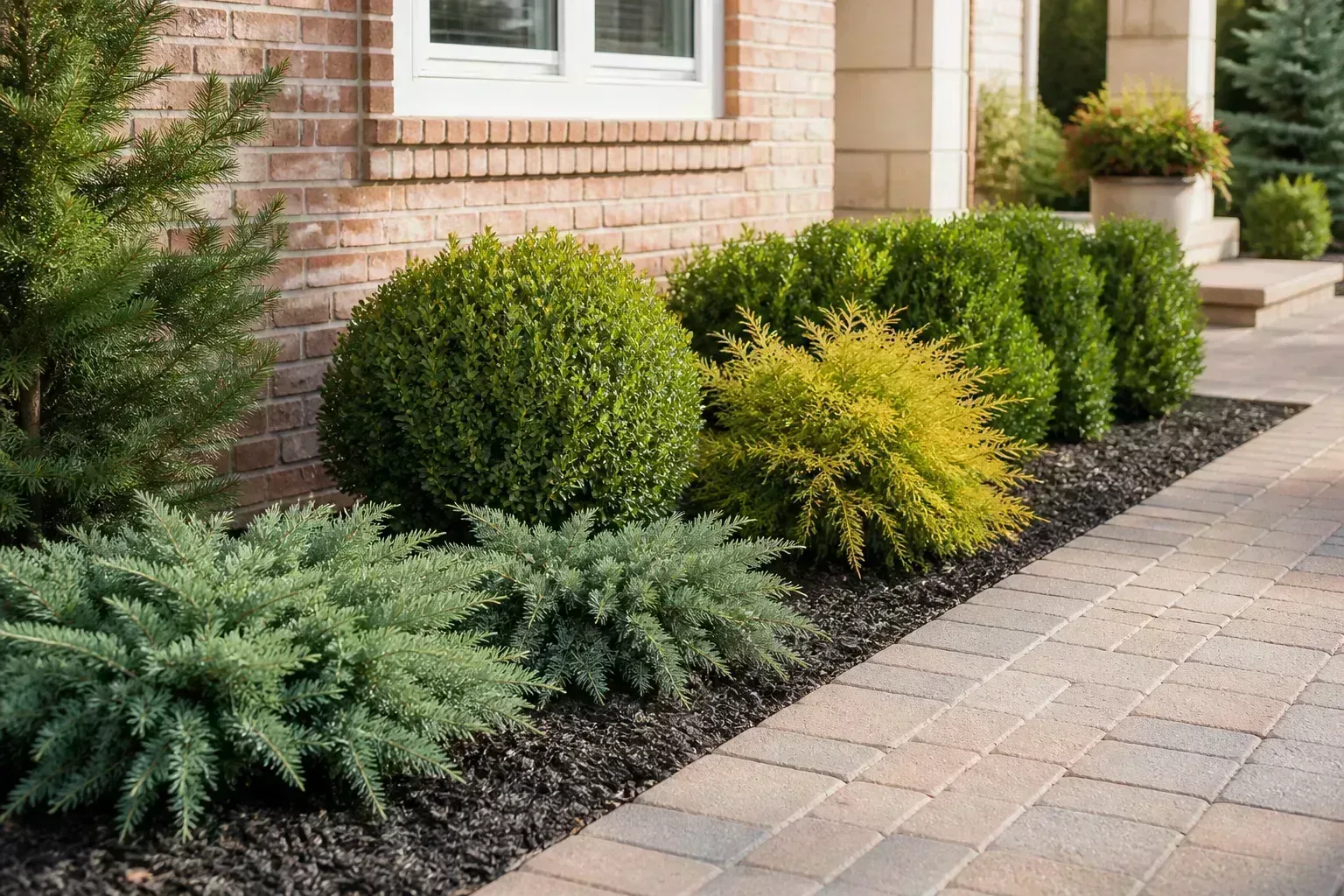
A front-yard shrub is low maintenance when it fits the site and has enough room to reach its natural shape. That sounds obvious, but it is the difference between a plant that needs a quick inspection each season and one that has to be cut back every few weeks because it is blocking a window, swallowing a walk, or fighting the house for light.
The best choices are not all evergreen, all flowering, or all drought tolerant. A front bed usually looks better when it combines one dependable structural plant with a few shrubs that take turns providing flowers, berries, fragrance, or fall color. Use the guide below to choose by mature size and conditions first, then by the feature you want to see from the street.
What “low maintenance” really means for a front-yard shrub
Low maintenance does not mean no maintenance. Every new shrub needs planting, first-year watering, occasional removal of dead or damaged wood, and enough observation to catch a problem before it spreads. It means the plant can do its normal work without constant correction because its mature size, light, soil, and water needs match the bed.
Penn State Extension makes the important point that a plant in the wrong location becomes stressed and more vulnerable to pests and disease, which creates extra work. Before buying, observe the site’s light, drainage, soil texture, pH, wind, and available mature space; its plant-selection checklist is a useful way to make that inspection concrete.
There are four practical signs that a shrub is a good front-yard candidate:
- Its mature width fits the bed without yearly shearing.
- Its natural outline already looks intentional, whether that is a mound, vase, cone, arch, or loose shrub.
- Its preferred moisture and light match the bed instead of requiring a special irrigation pocket.
- Its best season supports the overall planting rather than creating one loud week followed by a blank wall.
Audit the bed before you choose a plant
Stand where the shrub will grow at three different times of day. Note direct sun, reflected heat from pavement or a south-facing wall, shade from the house, and the dry strip beneath roof eaves. A bed that looks sunny in spring may be shaded by a deciduous tree in summer, while a narrow foundation strip can be hotter and drier than the rest of the yard.
Measure mature footprint and clearance
Measure the bed’s usable width from the house to the lawn edge or walkway. Then read the plant tag for mature height and mature spread, not the height of the nursery pot. “Dwarf” is a relative word: a dwarf conifer can be slow growing and still become far too large for a two-foot-wide foundation bed.
Use this simple spacing check before you buy: take half of the shrub’s mature width, add a maintenance and air gap, and place the center of the plant at that distance from the wall. For a shrub listed as 4 feet wide, the center will need at least 2 feet from the house before you add the clearance that lets you paint, inspect siding, clean gutters, and reach the back of the plant. The final distance also depends on windows, roof overhangs, utility lines, snow sliding from the roof, and how much room the walkway needs.
Lay a hose on the ground in the shrub’s expected outline. If it crosses the walkway or sits under a window, the solution is a smaller cultivar or a different plant—not a promise to prune harder. A small front yard often needs fewer, better-spaced shrubs rather than a continuous row packed tightly enough to look full on planting day.
Sort the site by light, soil, and water
Do not put a dry-site plant beside a plant that needs evenly moist soil just because their flowers look good together. English lavender and juniper prefer sharp drainage; azaleas and many hydrangeas perform better with more even moisture. Grouping by water need makes the irrigation line, mulch, and seasonal care much simpler.
Drainage matters as much as rainfall. Dig a test hole about a foot deep, fill it with water, and watch how quickly the water disappears. If it remains for a long time, correct the bed’s grading or choose plants that tolerate the site; adding a small amount of compost to an entire bed can help structure, but it will not turn a chronically wet hole into a dry one.
Soil pH also narrows the choice. Azaleas, mountain laurel, and inkberry prefer acidic conditions, while lavender is more forgiving of neutral to alkaline soil and dislikes wet roots. A soil test is more useful than guessing from a shrub’s common name or buying fertilizer first.
Choose shrubs by the job they need to do
The plant list gets shorter once you decide what the front bed needs. A shrub can frame the entry, hide a utility box, soften a hard corner, repeat an evergreen shape, feed birds, or provide a seasonal focal point. Give each plant one primary job and one supporting job; that keeps the design legible and prevents a row of unrelated “favorites” from becoming a maintenance collection.
Evergreen anchors and clean outlines
Evergreen shrubs supply the visual structure that remains when flowers fade. Use them at corners, beside steps, or in repeated groups, but do not assume every evergreen belongs tight against a wall. Blue-gray juniper can spread across a walkway, and a so-called dwarf spruce can eventually reach the size of a small tree.
For a formal look, choose a cultivar with a naturally compact shape and accept a little selective trimming. For a relaxed look, let the plant keep its mound, cone, or arch. Natural form is one of the easiest ways to cut down on pruning.
Flowers, berries, and seasonal color
Flowering shrubs earn their place when they have a clear season and a clean after-season. Hydrangeas can carry summer color and dried flower heads into colder months; azaleas can light up a part-shade bed in spring; beautyberry can take over after many flowers finish, with clusters of purple fruit in late summer and fall.
Berries add a second design layer and can support wildlife, but fruiting often has conditions. Some hollies are dioecious, meaning a male and female plant are needed for berries, while a single beautyberry can fruit but often looks better and fruits more heavily when several are planted nearby. If berries are the reason you are buying the shrub, check the tag for pollination and fruit-set requirements before planting.
Shrubs worth considering for different front-yard conditions
These are not a universal top-ten ranking. They are a short list of useful plant roles, with the condition that makes each one easy and the mismatch that makes it a poor choice. Confirm the cultivar’s mature size and local hardiness before buying; the same common name can cover plants with very different dimensions.
For dry, sunny beds: juniper and English lavender
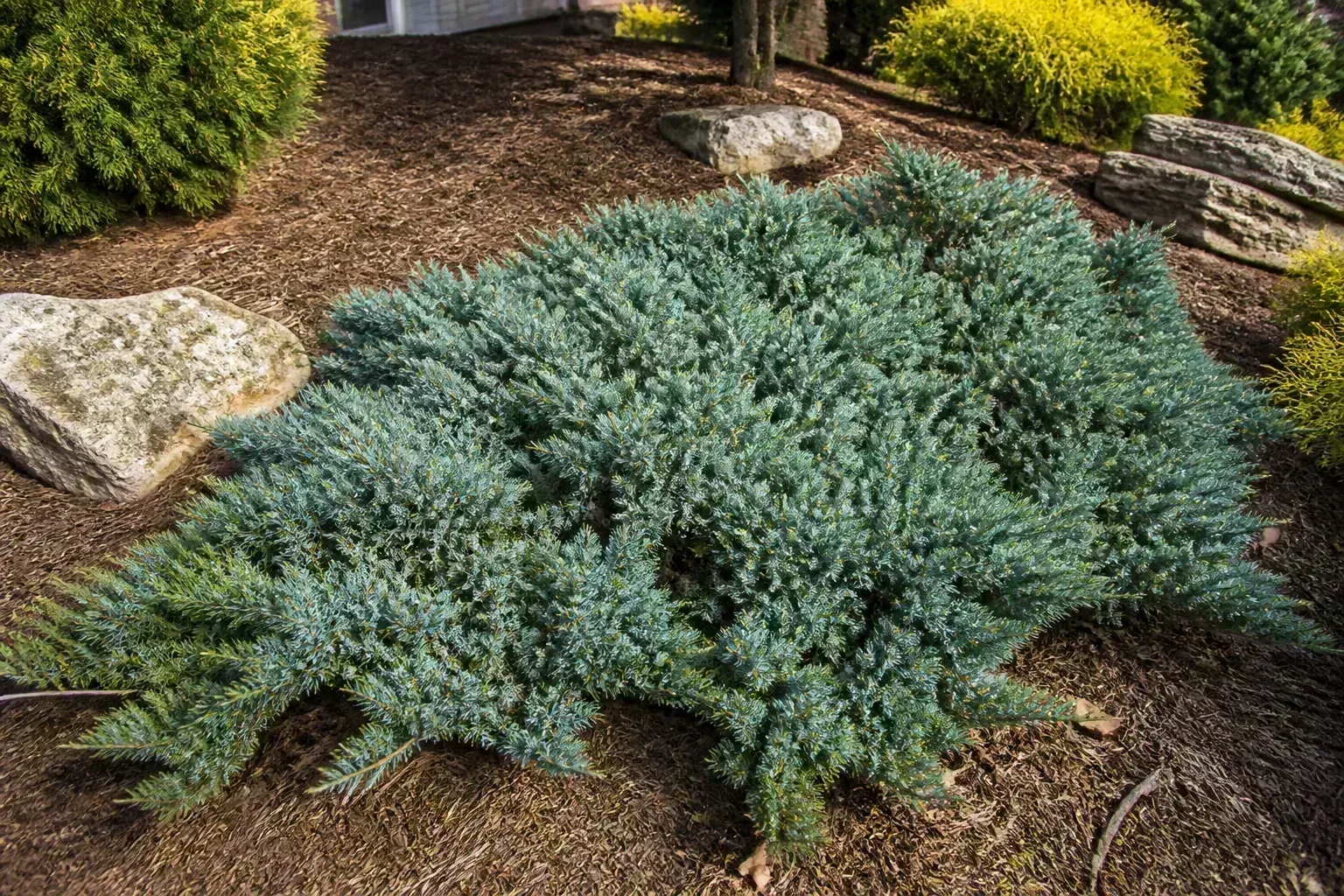
Blue Star juniper (Juniperus squamata ‘Blue Star’) is a strong choice for a sunny slope, gravel-edged bed, or low corner where you want blue-gray needles and very little shaping. It grows wider than it grows tall, so use it as a low mound or repeating drift rather than a narrow pillar. Its maintenance advantage disappears in poorly drained soil: too much irrigation and wet winter soil are bigger problems than forgetting fertilizer.
English lavender (Lavandula angustifolia) gives a compact outline, fragrant summer flowers, and a useful silvery color in full sun. It is a good match for a hot, open edge with gritty or well-drained soil, but it is not a fix for a damp bed. Leave room around the crown for airflow, avoid heavy irrigation, and cut flower stems after bloom without cutting deep into old, leafless wood.
Choose one of these for a dry bed, not both by default. Lavender can look sparse next to a lush hydrangea, while a juniper can rot if it is watered on a hydrangea schedule. The easy combination is the one that shares a watering zone.
For part shade and acidic soil: azalea, hydrangea, and inkberry
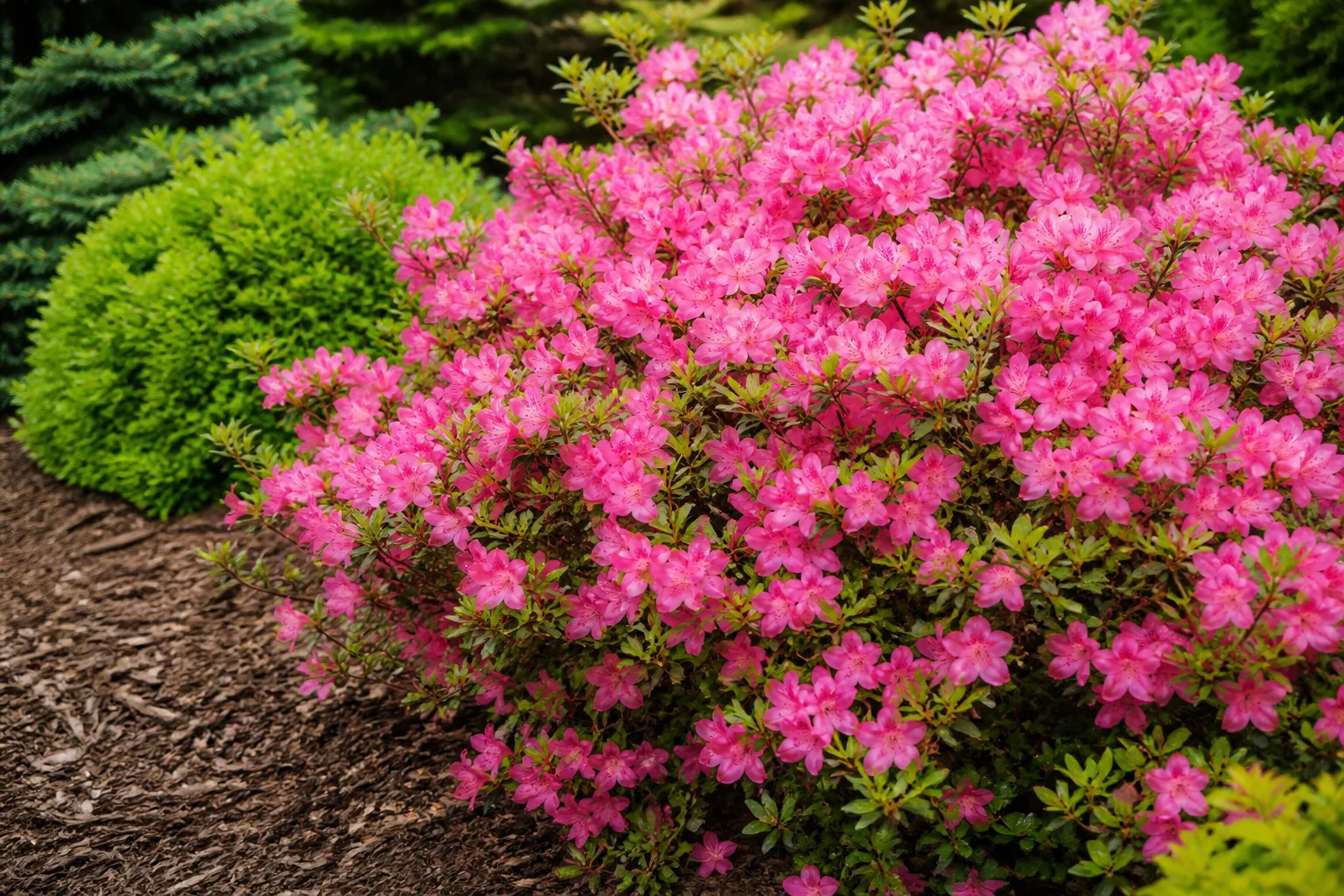
Azaleas are useful foundation shrubs when the bed has bright or dappled shade, acidic well-drained soil, and consistent moisture during bud formation. Choose a compact cultivar for a narrow bed and prune immediately after flowering if it needs light shaping; pruning later can remove next year’s flower buds. They are not low maintenance in alkaline soil that needs constant correction or in a hot, dry strip under roof eaves.
Hydrangea is a group, not one maintenance profile. Panicle hydrangeas generally handle more sun and can be cut back in late winter, while bigleaf or oakleaf types have different flower-bud timing and may prefer more protection from harsh afternoon sun. Pick the type that fits the light and the bed’s eventual width; do not buy a large-growing hydrangea for a small foundation corner and plan to keep it miniature with hedge shears.
Inkberry holly (Ilex glabra) brings spineless evergreen foliage, spring flowers, and dark fruits without the sharp leaves of many hollies. NC State Extension lists inkberry as a low-maintenance shrub and notes that cultivar size varies; selections such as ‘Gem Box’ are more useful in compact beds than the species’ larger natural form. It tolerates sun to part shade and moist soil, but it is still a bad choice for a waterlogged hole or a bed where the available width is less than the cultivar’s mature spread. The NC State Plant Toolbox profile also explains that berries require male and female plants.
For flexible color: beautyberry, viburnum, and weigela
American beautyberry (Callicarpa americana) is a relaxed, arching shrub for a wider bed, woodland edge, or naturalistic front border. NC State Extension describes a mature range of roughly 3 to 8 feet tall and 3 to 6 feet wide, with purple berries from late summer into fall, and recommends late-winter pruning because flowers and fruits form on new shoots. It wants more light than deep shade and needs good drainage even though it tolerates many soil types.
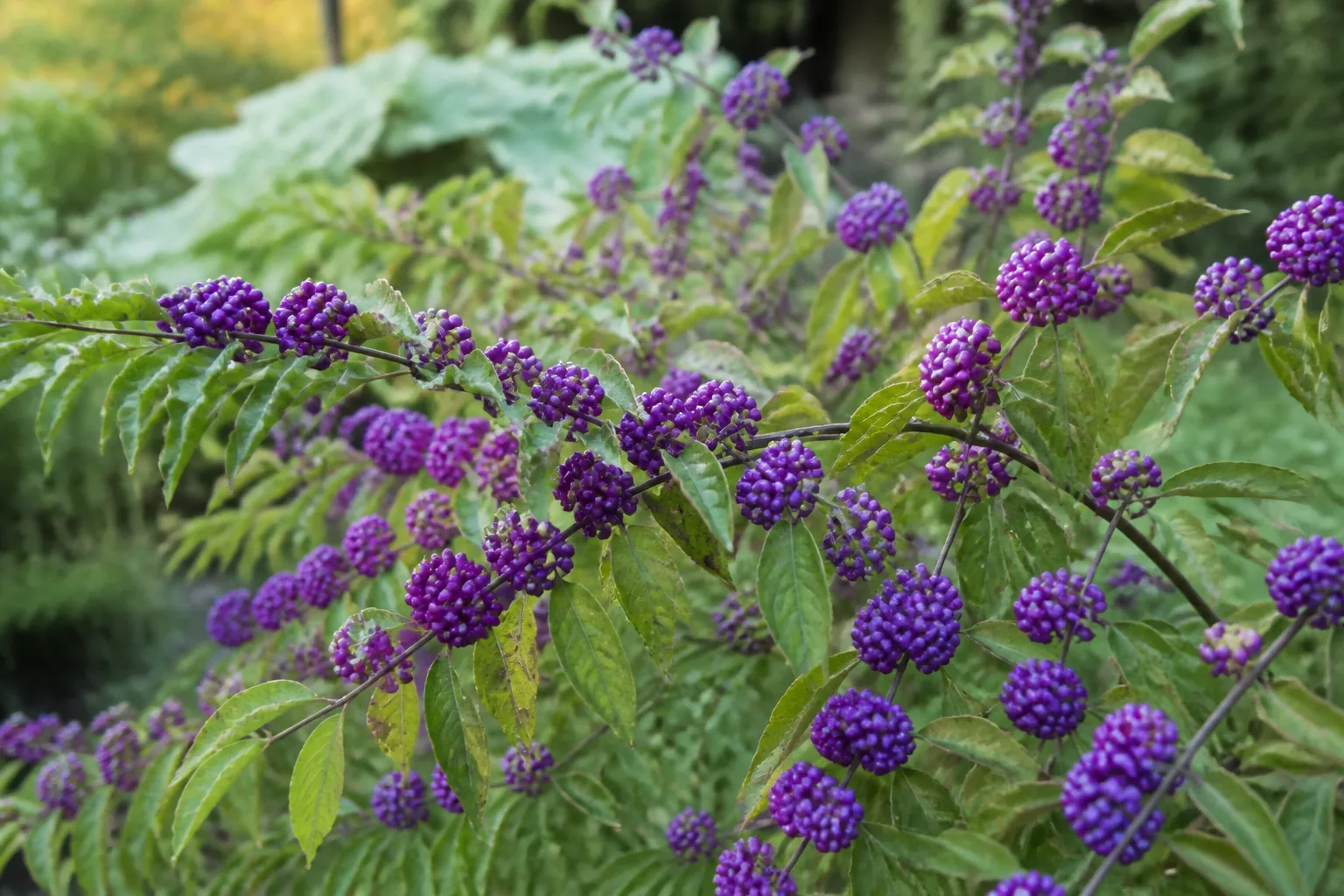
Beautyberry looks best when allowed to arch. If your front bed demands a tight geometric ball, choose boxwood or a compact holly instead. If you have the room for a looser shape, the plant gives you a late-season display and wildlife value without the repeated tip-pruning that makes many shrubs look woody inside.
Viburnum earns a place when you want spring flowers, dense foliage, fall color, or berries, but the genus varies too widely for a blanket size claim. Select a named cultivar for the actual footprint, then place it where a mature vase or mound will not block the entry. Fine Gardening’s regional berry-shrub coverage shows why viburnums are useful beyond bloom season while also making the regional point clear: heat, afternoon shade, fruit persistence, and mature size differ by species and cultivar. Its guide to hardy shrubs with showy berries is a helpful comparison, not a substitute for a local plant tag.
Weigela is a good full-sun option when late-spring flowers and hummingbird visits matter more than winter foliage. It can grow wider than the nursery pot suggests, and it blooms on older wood, so prune after flowering rather than cutting it back in late winter and removing the coming display. Look for a compact cultivar when the planting is close to a walk.
For formal structure: boxwood and compact conifers
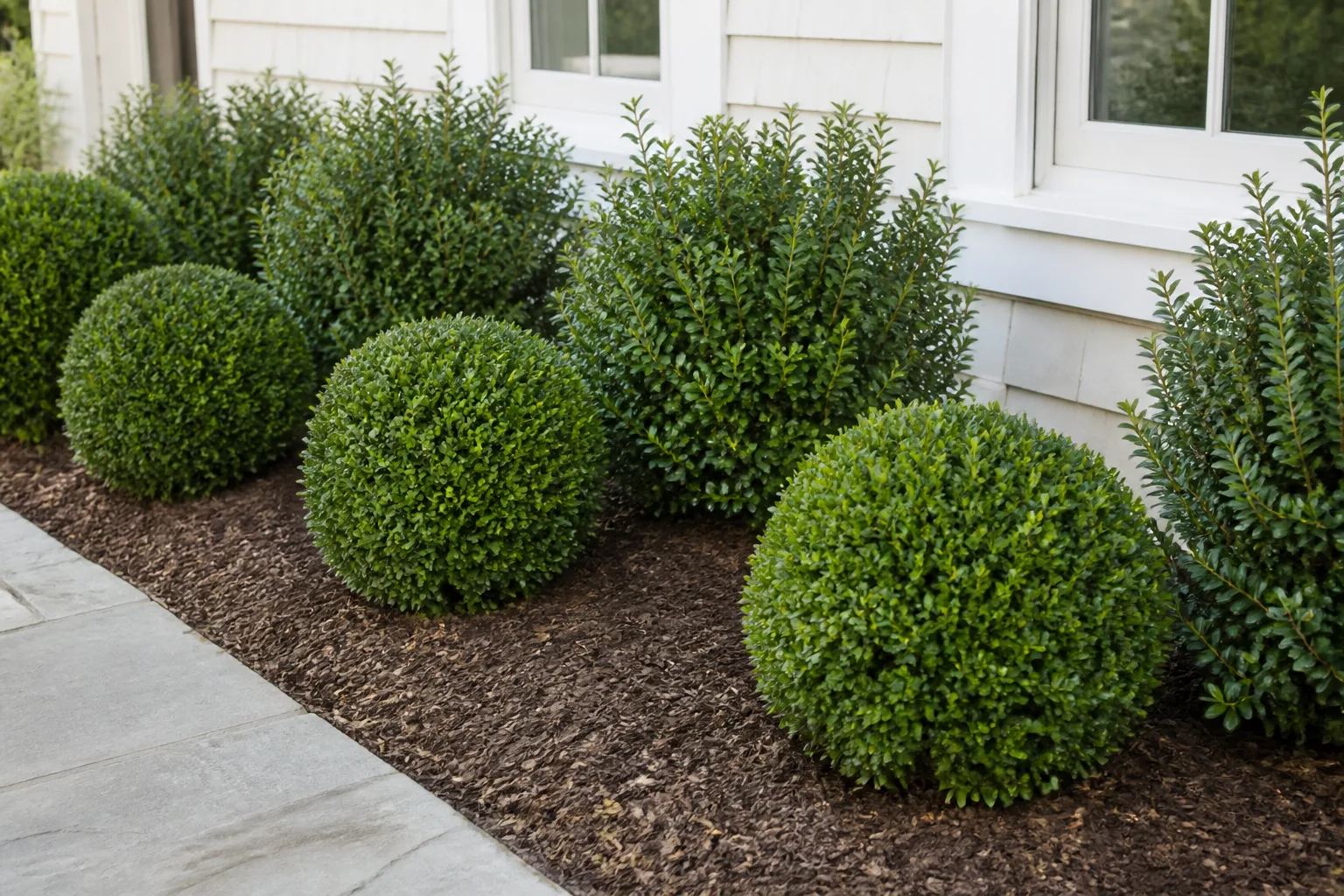
Boxwood remains useful for a clipped edge, low hedge, or evergreen punctuation. NC State Extension describes common boxwood as shallow rooted, adaptable to a range of light and soil conditions, and capable of becoming much larger than a small nursery plant; it also notes the need for well-drained soil, airflow, and attention to boxwood diseases. That makes boxwood low maintenance only when you choose the right cultivar and do not plant it in a stagnant, overly wet pocket.
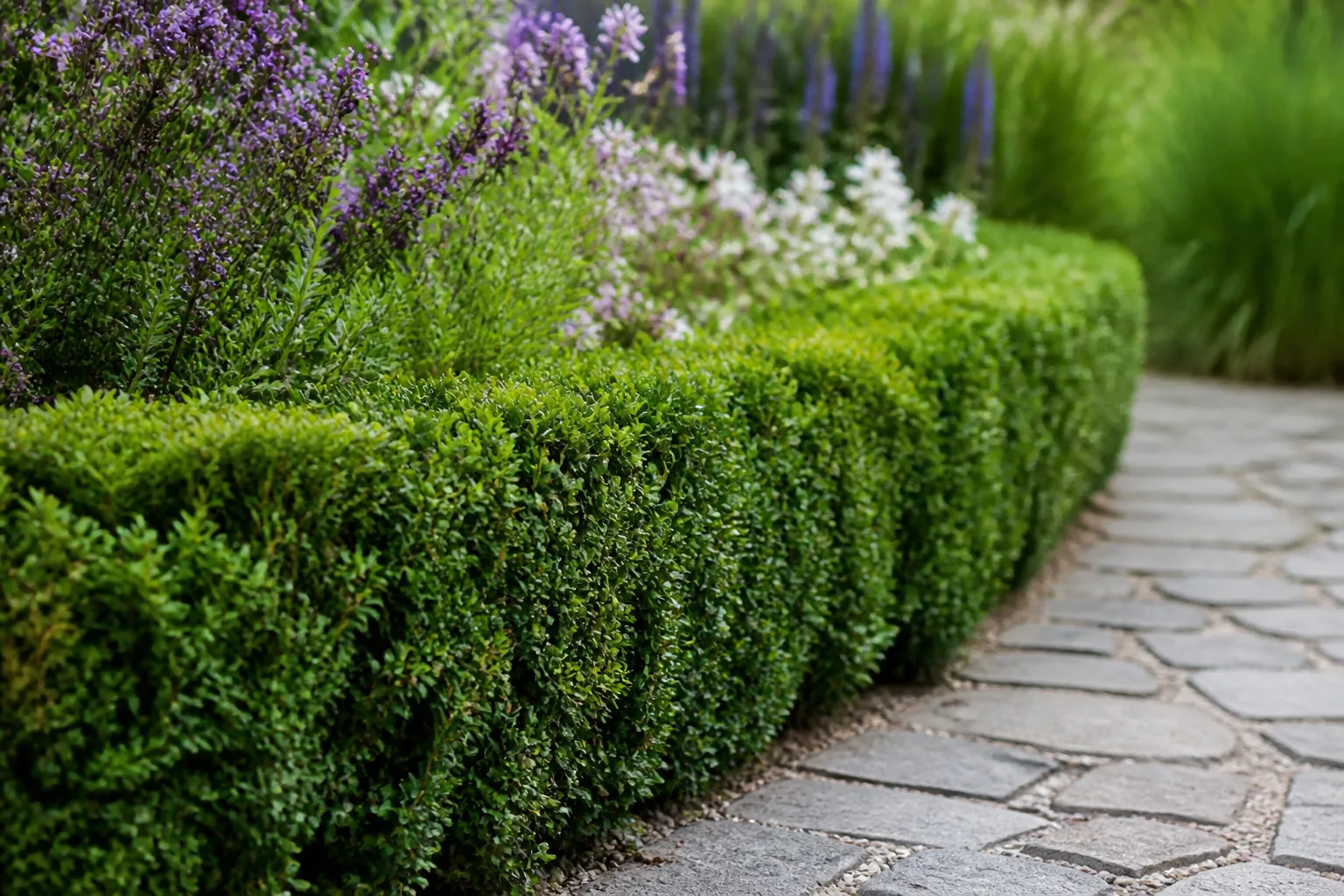
Use thinning cuts to let light and air reach the interior, then make light surface trims only if you truly want a formal outline. A shrub that is clipped into a shape far smaller than its natural size will eventually become a recurring project. If boxwood blight or leafminer is a known local issue, ask your extension office or nursery about a better-adapted alternative such as an inkberry cultivar.
Dwarf Alberta spruce (Picea glauca ‘Conica’) is an attractive conical evergreen for cool climates, but it is one of the clearest examples of why “dwarf” is not the same as “tiny forever.” It can eventually become much taller and wider than a narrow foundation bed can hold, and hot humid summers can make it a poor fit. Use it as a focal point only where the long-term size, climate, and airflow work.
For fragrance: lilac, with room to grow
Miss Kim lilac (Syringa pubescens subsp. patula ‘Miss Kim’) brings fragrance and spring flowers to a sunny entry bed, but it is still a woody shrub with a real mature footprint. Give it open air, full sun, and room for a rounded shape. Lilacs bloom on old wood, so remove spent flower clusters and make any needed shaping cuts soon after bloom; a late-season haircut sacrifices next spring’s flowers.
Lilac is a good choice when the front yard needs a seasonal focal point and the bed can absorb its width. It is a poor choice when the homeowner wants a narrow evergreen screen beside a window. In that situation, selecting a smaller plant at the start is easier than trying to force a naturally broad shrub into a column.
Planting workflow that makes the first year easier
The planting day determines whether “drought tolerant” ever becomes true for your shrub. A plant cannot be drought tolerant while it is still rebuilding roots after transplanting, and a small pot can dry out quickly even when the surrounding lawn looks green.
- Prepare the whole site. Remove competing grass and perennial weeds from the planting area, check drainage, and loosen the surrounding soil. Do not create a rich, loose pocket in hard clay that encourages roots to circle inside the hole instead of moving into the bed.
- Soak the root ball. Water the container thoroughly before sliding it out. If roots are circling the outside of the root ball, tease a few loose with your fingers rather than leaving the plant root-bound.
- Dig wide, not excessively deep. The hole should let the roots spread comfortably, with the top of the root ball level with or slightly above the surrounding soil according to the plant and soil conditions. Gardeners’ World’s shrub-planting guide recommends a hole wider than the root ball, careful firming around the roots, thorough watering, and mulch that holds moisture without burying the stem.
- Water the entire root zone. A slow, deep soak is more useful than a daily sprinkle on the foliage. Build a temporary soil basin just outside the root ball so water moves down rather than running off the bed.
- Mulch without making a volcano. Apply a thin, even layer of organic mulch over the root zone and keep it away from the trunk or main stems. Mulch against bark holds moisture where you do not want it and can invite decay.
- Keep watering after the planting photo. During the first growing season, check soil moisture below the mulch and water deeply when the root zone begins to dry. Gardeners’ World recommends regular deep watering while plants establish and adjusting for heat and dry soil; its establishment guide is a useful reminder that new shrubs need support before they become resilient.
Skip routine fertilizer unless a soil test or a local recommendation identifies a need. Extra nitrogen can push soft, leafy growth that outgrows the space faster without solving poor drainage, wrong light, or a root problem.
Pruning without constant shearing
Start with the right question: Is this branch dead, damaged, crossing, diseased, or genuinely in the way? If the answer is no, leave the plant alone. Removing a little wood for a clear reason is different from repeatedly shaving the outside because the shrub was planted too close.
Shrubs that flower in spring often form their buds on the previous season’s wood. Lilac, weigela, and many azaleas are therefore shaped just after flowering, when you can see what has bloomed and still give new shoots time to mature. Cutting them down in late winter may make the plant look tidy for a few weeks while removing the flowers you bought it for.
Many summer-flowering shrubs bloom on new growth. Beautyberry and panicle hydrangea are common examples, so a light late-winter or early-spring reduction can be appropriate when the cultivar and site call for it. Hydrangea types differ; check the plant label before making a hard cut.
For a mature multi-stem shrub, remove the oldest or weakest stems at ground level, one section at a time. This opens the plant without turning the outside into a dense shell over bare interior wood. Boxwood hedges are a deliberate exception when a clipped hedge is the design goal, but even formal plants benefit from occasional thinning and from being sized correctly at planting.
If the same shrub needs major correction more than once a year, stop and diagnose the pattern. Repeatedly shortening a large shrub to fit a narrow space is a design failure, not a pruning technique. Move it while young, replace it with a smaller cultivar, or let the mature outline determine the bed’s shape.
A simple maintenance rhythm for the front bed
Low maintenance becomes manageable when the work is attached to a season rather than a crisis.
- At planting: Confirm mature size, water deeply, mulch correctly, and label the cultivar. Take a photo of the tag so the pruning and hardiness information is not lost.
- Late winter: Remove dead, broken, or rubbing wood. Rejuvenate shrubs that bloom on new growth only when their cultivar supports it. Do not automatically cut every shrub to the same height.
- After spring bloom: Shape lilac, weigela, and spring-flowering azaleas lightly. Remove spent flower clusters only if you care about appearance or seed production; it is not a requirement for plant survival.
- Summer: Watch the root zone, not just the leaves. Water new plantings during dry weather, check for branch crowding, and keep mulch from touching stems.
- Fall: Rake diseased foliage, refresh mulch, and make notes about sun, drainage, and which shrubs carried color. Avoid late-season shearing that produces tender new growth before cold weather.
This rhythm also makes it easier to notice when a shrub is not actually low maintenance in your yard. A plant that repeatedly wilts, browns, suckers, or loses its shape is giving you useful information about the match between plant and place.
When to skip a shrub, even if the tag says easy
Skip any shrub whose mature width consumes the whole bed. The word “compact” can describe a plant relative to a larger species, and a “slow-growing” plant can still outgrow a narrow entry over a decade. Buy from the mature dimensions, not the photograph on the label.
Skip a moisture mismatch. Do not put lavender or juniper in a wet downspout path, and do not expect an azalea to stay attractive in bone-dry reflected heat without a reliable watering plan. Drought tolerance is a benefit after establishment, not permission to ignore the first year.
Skip plants that require special soil chemistry unless you are willing to maintain that condition. A single acid-loving shrub in a bed of alkaline fill can become a long-term fertilizer experiment; sometimes a plant with broader soil tolerance will look better with less intervention.
Skip a high-maintenance style if your schedule does not support it. A clipped parterre, tightly sheared hedge, and a row of identical flowering shrubs all create a visual promise that must be maintained. A mixed bed with repeating evergreen anchors and a few natural-form flowering shrubs is more forgiving.
Finally, check local extension guidance for invasive plants, deer pressure, fire-prone planting zones, and pets or children that may chew berries or leaves. NC State’s profiles for boxwood, American beautyberry, and mountain laurel show why a shrub’s useful landscape traits should be weighed alongside pest, toxicity, flammability, and site limits. “Low maintenance” is never the only filter.
Conclusion: choose the shrub that fits the site
The easiest front-yard shrub is the one you do not have to fight. Measure the mature footprint, match light and water, choose a natural form, and use flowers, berries, or evergreen foliage as deliberate layers instead of collecting plants by impulse.
If you do those checks before planting, pruning becomes a small seasonal task rather than a rescue operation. The front bed will keep its structure, color, and view to the house—and your pruners can spend more time in the shed.



