How to Make Your Own Flower Food for Cut Flowers
Need flower food without a packet? Use a measured sugar-and-acid recipe, learn when bleach is a bad idea, and keep cut flowers fresh with better vase care.
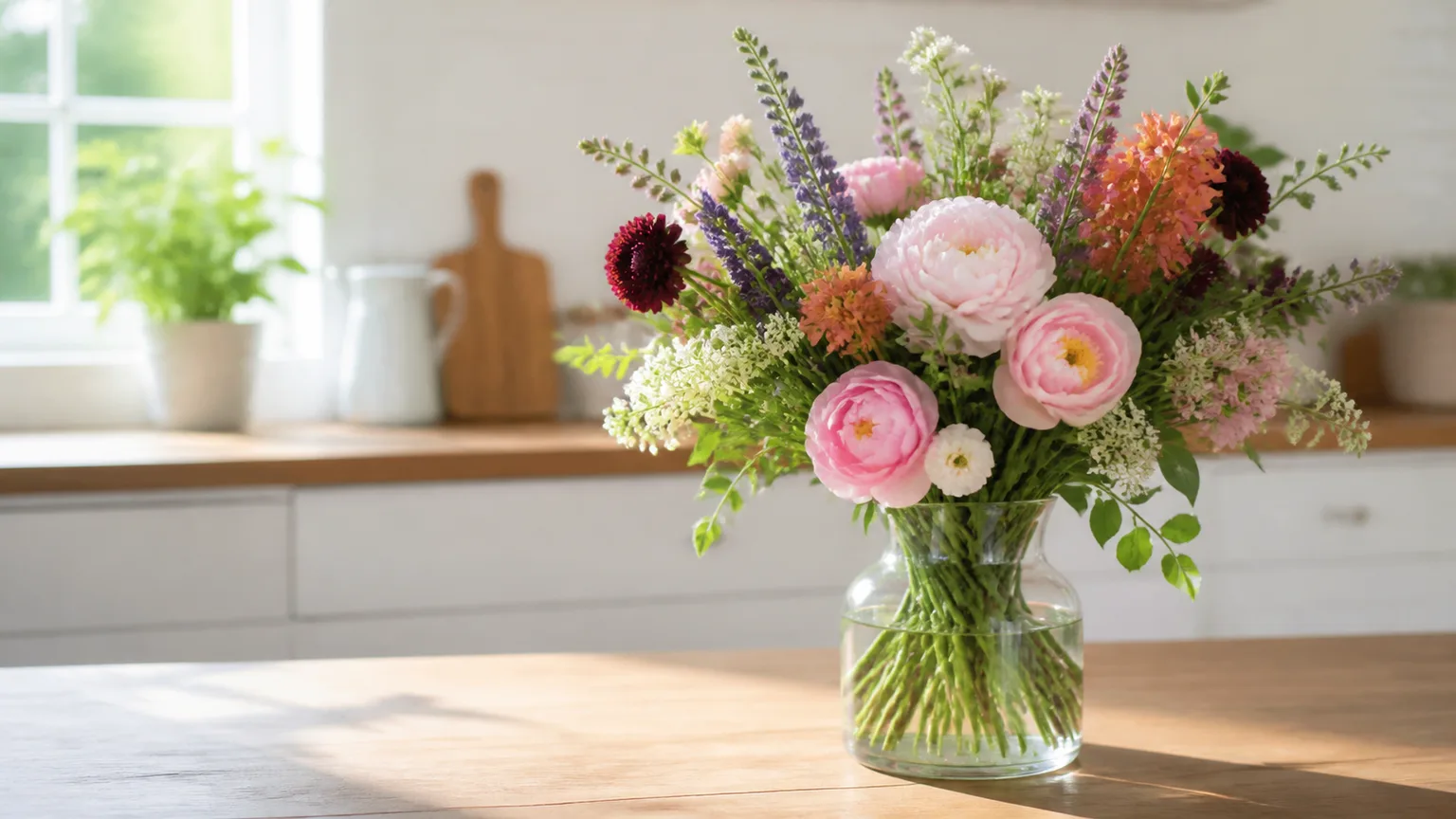
The most useful homemade flower food is not a secret ingredient—it is a measured solution plus clean stem preparation. For a reliable starting batch, mix 1 liter (about 4 cups) of clean water with 1 teaspoon of white sugar and 1 tablespoon of white vinegar, then replace the solution every few days.
That formula is a conservative home substitute based on the Royal Horticultural Society’s one-liter recipe. It will not rescue stems that are already blocked, crushed, overheated, or too old to open, so the rest of the process matters just as much as the ingredients.
Quick answer: use sugar and acid, then change the water
If you need flower food right now, wash a vase, add 1 liter of warm—not hot—water, and stir in 1 teaspoon of granulated white sugar and 1 tablespoon of white vinegar. Let the mixture cool to room temperature before the flowers go in. For a full 4-cup measure, those quantities are close enough to round to 1 teaspoon sugar and 1 tablespoon vinegar; do not keep adding ingredients because the bouquet is large.
Remove every leaf that would sit below the waterline, re-cut the stems with a sharp clean tool, and place them in the solution immediately. Keep the vase in a cool spot away from direct sun, heaters, air-conditioning blasts, and ripening fruit. The Royal Horticultural Society’s cut-flower guidance recommends changing the water and re-cutting stems every two to four days; do it sooner if the water turns cloudy or smells unpleasant.
The key rule is one complete recipe per batch. Sugar, an acid such as vinegar or lemon juice, and an antimicrobial ingredient all appear in different home formulas, but that does not mean every ingredient should be combined. In particular, never mix bleach directly with vinegar, lemon juice, or another cleaner.
What flower food actually does
Cut flowers are still living tissue, even after they leave the garden or florist. They can continue taking up water through the xylem in their stems, but they no longer have roots supplying minerals and leaves supplying the same energy they had on the plant. Vase care is therefore a race between water uptake, tissue aging, and microbial buildup.
Flower food is a dilute vase solution designed to support that process. Its ingredients have different jobs:
- Sugar supplies a small carbohydrate source for living stem and flower tissue. More is not better; excess sugar can also support microbial growth if the solution is not kept clean.
- Vinegar, lemon juice, or citric acid makes the water more acidic. The acid is used to adjust the water environment and can support water uptake, but it is not a substitute for a clean vase or a fresh stem cut.
- An antimicrobial ingredient helps slow the buildup of organisms in the vase. Commercial packets are formulated more precisely than pantry recipes, which is why their performance is usually more consistent.
Martha Stewart’s explanation of flower food similarly separates the roles of sugar, acid, and bacterial control, while the RHS makes the practical limitation clear: homemade preservative is simple and inexpensive but is unlikely to be as effective as a proprietary product. That is the honest expectation. Homemade flower food can support a bouquet; it cannot erase poor harvesting, a dirty container, or a damaged stem.
Choose a recipe before you mix anything
Household recipes differ because they use different acids, sugar levels, water volumes, and sometimes bleach. Treat them as separate starting points rather than a menu of ingredients. Choose the simplest recipe you can measure accurately, and make only as much as the vase needs.
Best default: sugar and white vinegar
For most home bouquets, start with:
- 1 liter (about 4 cups) clean water
- 1 teaspoon granulated white sugar
- 1 tablespoon white vinegar
The RHS publishes this sugar-and-vinegar combination for one liter of solution. It is my preferred default because it uses a short ingredient list and avoids adding bleach to a mixture that may also contain an acid. It is not a laboratory-prescribed universal formula; it is a practical home starting point.
If your vase holds less than a liter, scale the recipe instead of guessing. For 2 cups of water, use about 1/2 teaspoon sugar and 1 1/2 teaspoons vinegar. For 1 cup, use about 1/4 teaspoon sugar and 3/4 teaspoon vinegar. Small errors are less important than avoiding a heaping spoonful or dumping ingredients in by eye.
Lemon juice variation
Lemon juice can stand in for the acidic part of a recipe when that is what you have. It is more variable than bottled white vinegar because fresh lemons differ in size and acidity, so a measured bottled product is easier to repeat. Strain out seeds and pulp; solids make the vase dirtier and do not improve the solution.
One published home variation from Martha Stewart uses 4 cups of warm water, 2 tablespoons sugar, 1 tablespoon vinegar, and 1 tablespoon lemon juice. Another version on the same page uses 4 cups water, 2 tablespoons sugar, and 2 tablespoons white vinegar. Those formulas are stronger than the RHS starting recipe, which is why you should pick one formula rather than combining the highest amount of each ingredient.
If you prefer the lemon version, mix the water, sugar, vinegar, and lemon juice in the proportions above, allow the sugar to dissolve, and cool the solution before adding flowers. When a bouquet is valuable or you are unsure which recipe to trust, use the commercial packet that came with it instead of experimenting.
Bleach option and the safety boundary
Bleach appears in some homemade flower-food recipes because a very small amount can help control microbial growth. Horticulture lists a separate option of 1 quart warm water, 1 tablespoon sugar, and 1/4 teaspoon household bleach. That is a recipe to treat as a precise alternative—not an invitation to add bleach to the sugar-and-vinegar batch.
If you choose that option, use ordinary unscented household bleach only if its label is clear, measure the amount exactly, and add the bleach to the water. Do not use scented, splashless, gel, or mixed cleaning products. Never combine bleach with vinegar, lemon juice, ammonia, or another cleaner. The Centers for Disease Control and Prevention specifically advises not to mix cleaning products or chemicals and to use good ventilation.
For most readers, skipping bleach is the lower-risk choice. Use the sugar-and-vinegar formula, wash the vase well, and replace the solution promptly when it becomes cloudy. If you spill or overmix a bleach solution, do not lean over it to smell-test it; ventilate the area, follow the product label, and discard it safely.
Gather ingredients and tools
You need a clean vase, a measuring spoon, a clean pitcher or jar, water, white sugar, and either white vinegar or lemon juice. If you are cutting flowers from a garden, also set aside a clean bucket with water, sharp floral snips or a knife, and a towel for wiping the vase.
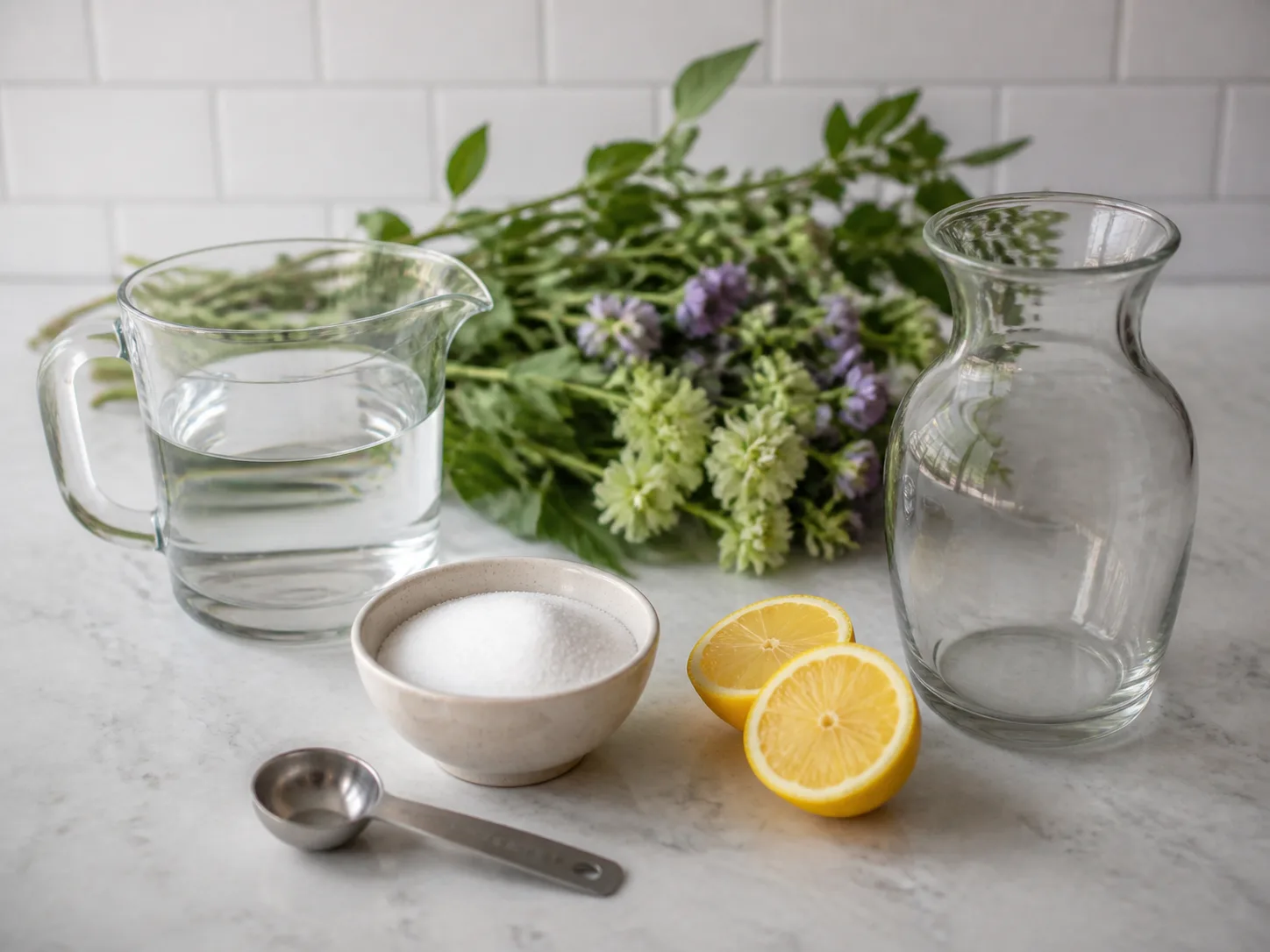
The measuring tools are not fussy extras. A recipe that uses teaspoons per liter can be badly overdosed when someone substitutes a kitchen spoon, and an overdosed mixture can damage delicate stems or make the water foul faster. Use a dedicated, clearly washed measuring spoon if you are including bleach.
Start with water that is clean and warm enough to dissolve sugar but not hot. The goal is a solution that reaches room temperature before the stems enter it. If your tap water is unusually hard or has a strong odor, filtered water can be a sensible comparison, but do not assume bottled water is automatically better; vase hygiene and fresh cuts still matter more.
Mix the solution safely
- Wash the vase, pitcher, and measuring spoon with dish soap. Rinse until no detergent remains.
- Measure the water into the pitcher first. Starting with water gives any acidic or antimicrobial ingredient more room to dilute.
- Add the sugar and stir until it disappears. Undissolved crystals can settle around stem ends and make the dosage uneven.
- Add the vinegar or lemon juice only if you chose the sugar-and-acid recipe. Do not add bleach to this batch.
- Let the solution cool to room temperature, then pour it into the clean vase.
- Discard any leftover mixture after the vase is filled. A fresh batch is easier to measure and less likely to be contaminated than a jar kept for a week.
Do not mix concentrated vinegar and bleach in a separate cup before diluting them. The safe habit is to choose a recipe that uses one antimicrobial approach, follow its measurements, and keep household cleaners away from the vase-making area. If a recipe calls for ingredients that conflict with the product label, the label and basic chemical safety win.
Prepare stems before they enter the vase
Flower food cannot fix a stem that is unable to drink. Conditioning means preparing the plant material so water can reach the stem channels and the solution stays clean. The RHS recommends removing low foliage, re-cutting stems, placing them in clean water, and allowing them to hydrate in a cool place before arranging.
Cut at the right stage and time
Garden flowers are usually best harvested early in the morning, when stems are fully hydrated and plants have not been stressed by the day’s heat. The RHS advises avoiding warm, sunny conditions and placing cut stems into water as soon as possible. If you are working with a purchased bouquet, you cannot change its harvest time, but you can still give it a clean vase and a fresh cut immediately.
Most flowers should be cut when buds are beginning to show color or are partly open, rather than after every flower is fully expanded. Roses and dahlias are exceptions: if they are cut too tightly, they may fail to develop. A flower-food recipe can support a viable bud, but it cannot force open one that was harvested before it was ready.
Make a clean angled cut
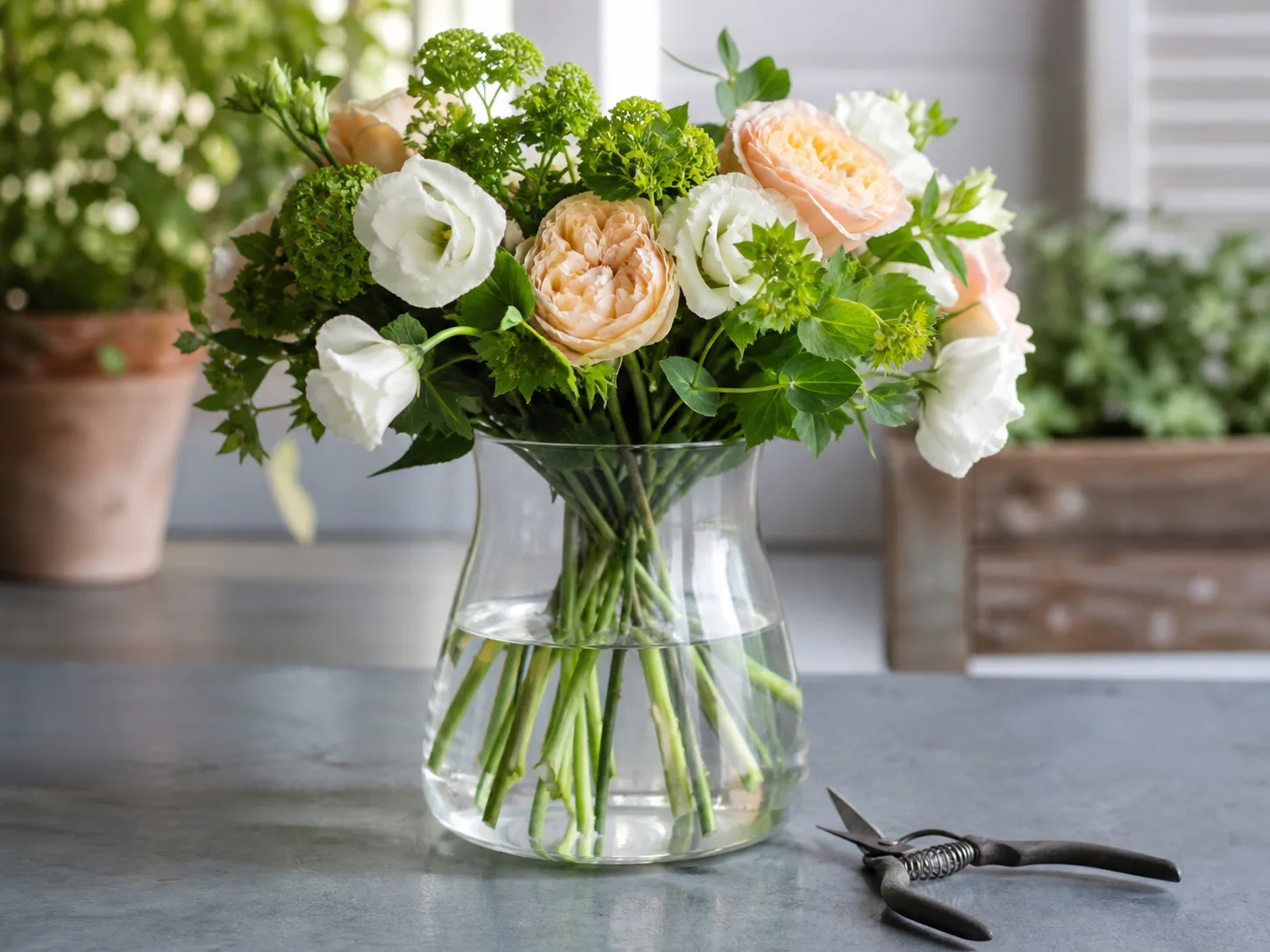
Strip leaves from the bottom half to two-thirds of each stem, or at least remove every leaf that will be underwater. Submerged foliage decays in the vase and feeds the cloudy, smelly water you are trying to prevent. Do not strip leaves that will remain above the waterline unless the arrangement needs it; foliage still contributes to the display.
Use sharp, clean snips or a knife to remove about 1/2 to 1 inch from the bottom of each stem. Make one clean angled cut rather than crushing, sawing, or hammering the stem. The angle keeps the stem from sealing flat against the vase bottom, but the cleanliness of the cut matters more than chasing a perfect 45-degree angle.
Put the freshly cut stems into water immediately. If you are cutting from the garden, carry a bucket with a few inches of clean water and move the flowers to the final solution after they have had time to hydrate. The RHS recommends leaving prepared stems in a cool place for at least two to three hours, or overnight when practical, before bringing them into a warmer room.
Add the flower food without overfilling
Fill the vase high enough to submerge the prepared stem ends but not so high that leaves sit underwater. A tall bouquet may need more water than a short arrangement, but the correct level is determined by the lower clean portion of the stems, not by the vase’s capacity.
Arrange the flowers loosely enough that air can move around the stems and individual blooms are not pressed against a hot window. If water drops noticeably after the first day, top it up with plain clean water or a small amount of freshly made solution. Do not keep pouring sugar concentrate into a vase because the level fell.
For a crowded or especially dirty bouquet, it is often better to change the entire solution than to add more food. Lift the stems out, rinse the vase, re-cut the bottoms if they look brown or slimy, and refill with a fresh measured batch. This reset removes the material that a new spoonful of sugar cannot fix.
Maintain the bouquet every two to four days
Flower food is not a one-time treatment. Check the vase daily for water level, drooping stems, fallen leaves, and discoloration. Replace the entire solution every two to four days, and re-cut a little from the stem bases at the same time. The University of Minnesota Extension’s zinnia guidance also recommends changing water every two days for fresh-cut displays.
Use a shorter interval when the room is warm, the vase is crowded, the water becomes cloudy, or the bouquet contains stems that shed heavily. Never wait for a strong odor. Smell is a late warning that the water has already become a poor environment for the stems.
At each change, remove dead flowers and yellowing leaves. Rinse the vase instead of simply tipping out the old liquid, because a slimy film can remain on the glass. Refill with a freshly measured solution, then return the healthiest stems first and discard any stem that is hollow, mushy, or visibly rotting above the cut.
Keep flowers away from heat, sun, and fruit
Temperature and placement can undo good flower food. Put the vase in bright ambient light or gentle indirect light, not in a hot patch of direct afternoon sun. Keep it away from radiators, fireplaces, heat vents, appliances that exhaust warm air, and cold drafts that shock the stems.
Ripening fruit is another overlooked problem. Apples, bananas, and other fruit release ethylene, a plant hormone that can accelerate aging in many flowers. A vase beside a fruit bowl may look convenient, but a cooler table across the room is usually a better location.
Avoid placing fresh stems next to a fan or air conditioner. Moving air increases water loss from petals and leaves, while a hot or dry stream can make a bouquet wilt even when the vase is full. When the bouquet looks tired, move it to a stable, cooler location before assuming the recipe needs more sugar.
Flower-specific adjustments that matter
The same vase formula can be used for many mixed bouquets, but stems do not all respond identically. Roses and other woody stems may benefit from a short vertical cut through the base; the RHS cautions that hammering woody stems can increase bacterial infection and is usually unnecessary.
Tulips and gerberas can bend because their soft stems cannot always hold a heavy head. The RHS recommends wrapping a bunch and standing it deeply in water for at least two hours to help straighten it. That is a conditioning problem, not a reason to increase the flower-food concentration.
Hollow stems such as delphinium, amaryllis, and lupin can be conditioned by filling the stem with water and plugging the top with cotton wool, according to the RHS. This is an optional species-specific technique; do not poke or split a stem simply because a generic flower-food recipe did not work.
Poppies, euphorbia, smyrnium, and hellebores may need special treatment for drooping stems, but hot-water treatments are not a universal fix. Euphorbia sap can irritate skin, so use gloves and check plant-specific instructions before trying any heat-based conditioning.
The practical decision is simple: first use clean equipment, a fresh cut, the correct water level, and a cool location. Only move to a specialty treatment when you can identify the flower and the problem clearly.
Troubleshoot wilting, cloudy water, and closed buds
When flowers decline early, do not automatically make a stronger batch. Work through the visible symptom and correct the first likely cause.
- Flowers wilt within hours: Re-cut the stems, remove submerged leaves, and place them in a clean vase of fresh solution. If the bouquet was transported dry or cut in heat, let it rest in a cool, shaded place for several hours before arranging.
- The water is cloudy or smells sour: Discard it immediately. Wash and rinse the vase, remove any rotting foliage, re-cut firm stem ends, and refill. More sugar or bleach added to dirty water is not a reset.
- Stem bottoms are brown, soft, or slimy: Cut back to firm tissue. If the stem is mushy well above the cut, remove it from the arrangement so it does not contaminate the rest.
- Buds never open: Consider harvest stage first. Roses and dahlias picked in tight bud may not develop, and no home preservative can reverse that limitation.
- Petals brown at the edges: Check heat, direct sun, drafts, and whether the flowers arrived old or dehydrated. Recipe strength is only one possibility.
- The vase solution was overdosed: Empty it, rinse the vase, and start again with a measured batch. Do not try to rescue an unknown concentration by adding random water or extra acid.
If the bouquet still fails after a clean reset, compare the stems rather than repeating the recipe. A mixed bouquet can contain flowers with very different harvest ages, and one failing variety may not mean the entire arrangement was cared for incorrectly.
When commercial flower food is the better choice
Use a commercial packet when the bouquet came with one, when you are preparing a wedding or event arrangement, or when the flowers are expensive enough that consistency matters more than saving a few cents. Commercial products are made with controlled concentrations and often include ingredients that homemade recipes do not reproduce reliably.
Homemade food makes sense for a garden bouquet, a last-minute vase, or a small arrangement when no packet is available. The trade-off is measurement error and less predictable performance. If you do not have a clean vase, a measuring spoon, and time to change the solution, buying or using a packet will not solve the underlying problem either; clean water and stem preparation still come first.
Conclusion
To make your own flower food, start with 1 liter of clean water, 1 teaspoon sugar, and 1 tablespoon white vinegar. Mix it in that order, let it cool, and use it in a clean vase with freshly cut stems and no submerged leaves.
The bouquet’s longevity will depend just as much on what you do next: change the solution every two to four days, re-cut the stems, remove dying foliage, and keep the vase cool and away from ripening fruit. Choose a single measured recipe, never combine bleach with acids or other cleaners, and switch to commercial flower food when precise, repeatable results matter more than convenience.



