How to Grow and Care for a Dwarf Mugo Pine
Learn how to choose a true dwarf mugo pine, match its cultivar to your space, plant it in draining soil, and prune spring candles without cutting old wood.
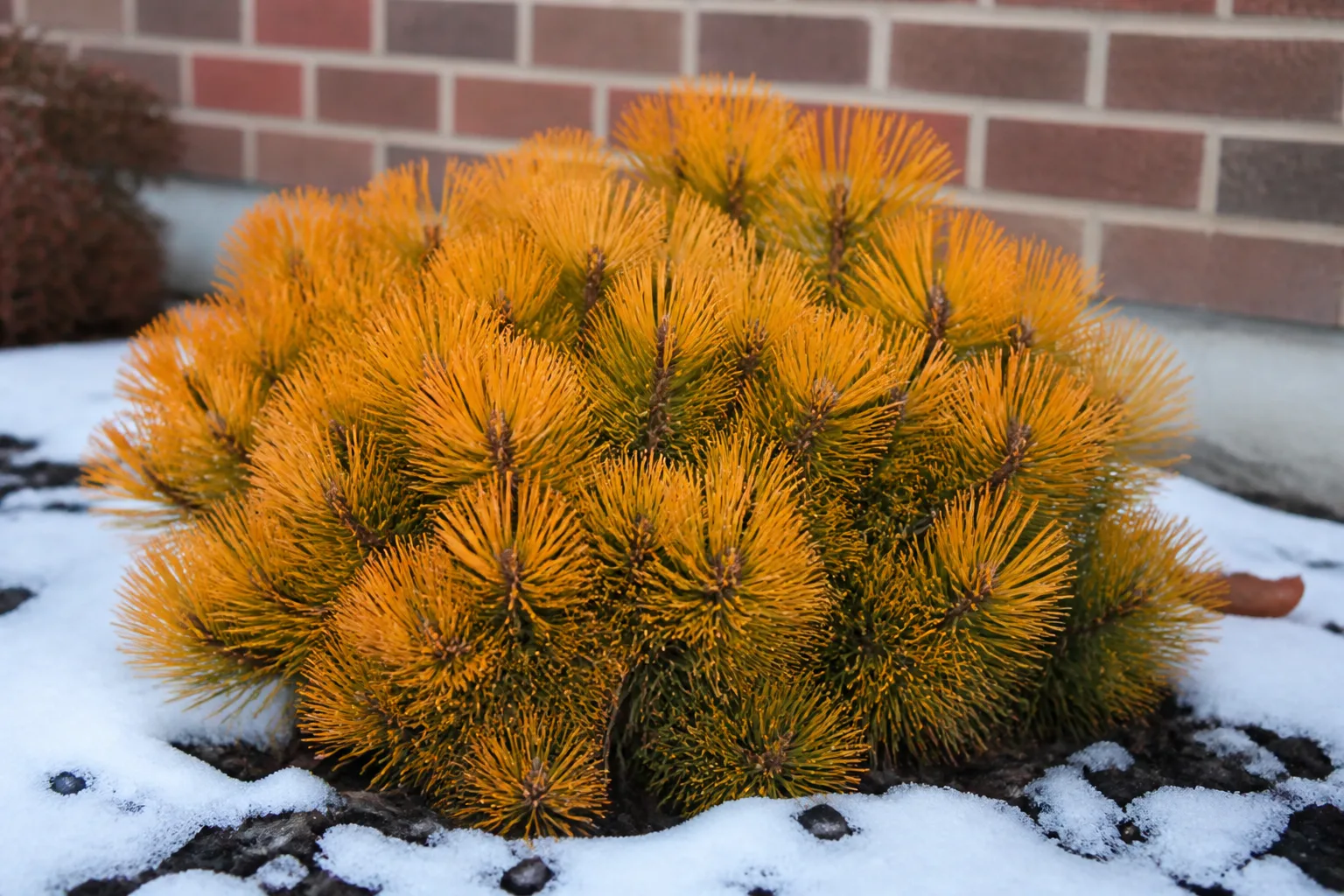
A dwarf mugo pine can be a long-lived, tidy evergreen mound, but “dwarf” on a nursery label is not a promise that the plant will stop growing at knee height. The species, Pinus mugo, varies widely, and the selected cultivar determines whether you get a tight cushion, a broad ground-covering shrub, or a plant that eventually needs more room than its young nursery pot suggests.
Start with the cultivar name and its mature width, then give the roots a sunny site with free drainage. Once established, a mugo pine generally needs little attention: water during a genuine dry spell, skip routine heavy feeding, and pinch or shorten spring candles only if you have a clear reason. Good selection does more to keep this pine in scale than years of corrective pruning.
Start with the right expectations for a “dwarf” pine
Mugo pine is a two-needle evergreen native to mountainous parts of central and southeastern Europe. In gardens, it is valued for dense branching, short dark-green needles, and a naturally low or rounded outline.
The name “dwarf mugo pine,” however, is a garden-trade umbrella term, not a precise size specification. Virginia Tech notes that the species itself can be a medium to large multi-stem tree, while dwarf forms vary in shape and grow at different rates; its cultivar choice should match the available landscape space (Virginia Cooperative Extension).
That distinction matters at purchase. Some plants are seedlings selected for a compact look when young, while others are named clones selected and propagated for a more predictable habit.
A shrub that looks like a perfect small ball at the garden center may still spread substantially over the next decade. A named cultivar with a documented growth rate is the safer buy when you are planting under a window, beside a path, or into a small rock garden.
Choose a cultivar by mature footprint, not the pot size
Before you buy, find the exact cultivar name on the label, ask whether the plant was propagated from that cultivar, and check an independent reference for its height, width, and expected rate of growth. If the label says only “dwarf mugo pine,” “mugo,” or “dwarf pine,” ask the nursery for the botanical name and cultivar. If no one can identify it, plan for a broader plant or choose a different shrub for a narrow site.
Use the plant’s spread to plan placement. A low mound that reaches 3 feet tall can still occupy 6 feet of bed width.
Leave room between it and a walkway, foundation, or neighboring shrub for its branches to expand and for air to move through the foliage. Do not use frequent shearing as a substitute for a proper site allowance; pines do not reliably push new foliage from bare old wood.
Useful cultivar benchmarks
Named forms give you a more useful starting point than a generic “dwarf” label, but published dimensions are estimates rather than a lifetime ceiling. ‘Mops’ is a slow, rounded form; the American Conifer Society database lists a specimen at roughly 28 inches tall and wide after 10 years, with a typical annual growth rate of about 2 to 3 inches (American Conifer Society: ‘Mops’).
‘Sherwood Compact’ is also a compact, slow-growing form often used in small landscapes and containers. ‘Slowmound’ forms a low mound.
These may be useful choices when you want a rounded silhouette, but confirm local nursery stock and mature width before you commit.
‘Compacta’ is not necessarily miniature: North Carolina Extension describes it at about 3 to 4 feet tall and 2 to 4 feet wide. The Pumilio Group tends to spread broadly and can be better as a low mass or groundcover than as a tight little foundation ball; University of Illinois Extension notes that some forms can reach about 10 feet wide (University of Illinois Extension).
The American Conifer Society’s size categories use a 10-year measurement as a comparison point; conifers keep growing after that point, though often slowly (Conifer Size Categories). Treat a “10-year size” as a planning benchmark, not the plant’s final dimensions.
Find a sunny site that does not bake the roots
Choose full sun where summers are moderate; a location with at least six hours of direct light is a useful target. The shrub can tolerate some light shade, but deep shade usually means looser growth and less dense foliage.
In hot-summer climates, especially toward the warm edge of the cultivar’s range, light afternoon shade and a cool, mulched root zone can reduce stress. The species is commonly listed for USDA Zones 3 to 7, but a zone number alone does not promise success in a hot, humid Zone 7 garden; Virginia Tech notes that mugo pine may languish in the hotter parts of that range.
Avoid a spot where roof runoff, irrigation overspray, or a low pocket keeps the root zone wet. A sunny slope or raised bed can be a better choice than a flat planting hole in heavy clay.
Also consider exposure: mugo pines tolerate challenging sites, yet a newly planted shrub can still be stressed by drying wind. Where winter winds are severe, site it near a protective structure without crowding it into shade or trapping damp air around the foliage.
Give the roots drainage before worrying about soil pH
Mugo pine accepts a broad range of soil textures and pH levels; it can grow in acidic, neutral, or alkaline soil. Drainage is the non-negotiable part.
Roots need oxygen as well as moisture, so a dense planting bed that stays saturated after rain can cause decline even when the soil is fertile. Virginia Tech notes the species’ tolerance for dry and alkaline soil, while North Carolina Extension describes ‘Compacta’ as adaptable to clay and sandy soils when drainage is adequate (North Carolina Extension Gardener Plant Toolbox).
Do not try to turn a poorly draining site into a pine bed by filling one small planting hole with gravel. Water can collect at the boundary between amended and native soil, leaving the root ball in a sump.
If the whole area drains slowly, improve the bed broadly, plant on a raised mound, or choose another species better suited to wet soil. Avoid adding lime or fertilizer simply because the pine is coniferous; test the soil first if pH or fertility is a concern.
A simple drainage check
Before planting, dig a hole about as deep as the root ball and fill it with water. Let that water drain, refill the hole, then check it several hours later and the next day.
If water remains or the soil is still saturated, the location needs a broader drainage solution or a raised planting position. This field check is not a formal soil test, but it can reveal a site that stays wet long enough to put a pine’s roots at risk.
Plant at the original soil level
Plant in spring or early fall when the ground is workable and the shrub has time to establish before severe heat or freezing weather. Dig a hole two to three times wider than the root ball, but no deeper than the ball itself.
Set the shrub so the top of its original root mass is level with or just slightly above the surrounding grade; backfill with the soil you removed and water slowly to settle it around the roots. Penn State Extension likewise emphasizes correct planting depth and choosing a site with enough horizontal and vertical room for the mature plant (Review of Successful Tree and Shrub Planting).
If the shrub is in a nursery pot, slide it out and look for circling roots. Loosen the outer roots gently so they can grow into the surrounding soil; do not tear apart the root ball or bare-root a pine.
Keep the top of the root ball uncovered. Spread a shallow layer of organic mulch over the root zone to moderate temperature and conserve moisture, leaving a clear gap around the stems.
A mulch pile that presses against the branches traps moisture and hides the plant’s base.

Water for establishment, then let the root zone breathe
For the first growing season, check the soil rather than following a rigid calendar. When the upper few inches begin to dry, water slowly at the root zone until the original root ball and nearby soil are moist.
In hot, windy weather, that may be more frequent; after cool rain, it may be much less. The objective is a thorough soak followed by some drying, not a constantly damp pocket around the roots.
After the shrub has rooted into the surrounding bed, it is moderately drought tolerant. Water during a prolonged dry spell, especially if the needles look dull, new candles are short, or the soil under the mulch is dry several inches down.
Do not infer that a pine never needs water because it tolerates dry soil. Conversely, browning during a wet period is a reason to inspect drainage before watering again.
Newly planted container-grown shrubs need regular checks because their potting mix and the native soil around the root ball may dry at different rates.
Fertilize lightly—or skip it
Do not make annual feeding part of the routine unless a soil test or clear growth issue suggests a nutrient shortage. Mugo pine is naturally slow growing; a few inches of extension is not a deficiency.
Rich, fast growth is not always desirable in a dwarf cultivar because it can loosen the intended form and create more pruning work. If the site has poor soil, use a thin organic mulch and allow roots to explore the bed rather than pouring fertilizer around the crown.
Container plants lose nutrients as they are watered, so they may benefit from a modest, labeled slow-release fertilizer during active spring growth. Follow the product directions for container conifers, and avoid feeding late in the season when new growth would have little time to harden before winter. If needles pale or growth stalls, first check root moisture, light, pH, and drainage; fertilizer cannot fix waterlogged roots.
Prune spring candles to maintain density
Pines extend their branches in spring through upright shoots commonly called candles. If your shrub is healthy and already fits its space, leave the candles alone.
To hold a mounded outline or encourage denser branching, shorten some of the new growth while the needles are still soft and before the candles harden. North Carolina Extension recommends cutting new shoots when the needles are about half their mature length; Penn State Extension describes removing roughly one-half to two-thirds of a pine candle in the early-summer window (Penn State Extension: Pruning Needled Evergreens).
Work selectively around the shrub instead of shearing every surface into a flat shell. Shorten the candles that are extending beyond the desired outline, and keep enough new growth to maintain an even, natural shape.
If a plant has outgrown its site by several feet, candle pruning will not turn the wrong cultivar into a permanent miniature. In that situation, transplant while the shrub is still manageable or replace it with a cultivar sized for the space.
Time the cut before candles harden
Watch the plant in spring rather than relying on one calendar date. Candles first look like upright, tightly packed shoots; then their new needles begin separating and lengthening.
That soft-growth period is the useful window. In many climates it falls in late spring to early summer, but weather shifts the timing.
Pinching the candle with fingers gives a soft, natural break; clean bypass pruners are useful for thicker shoots. Avoid taking so much growth that the plant loses most of its current-year extension.
Leave old bare wood alone
Do not cut a mugo pine back into brown, needleless interior branches expecting green growth to cover the gaps. Pines generally do not make dependable new shoots from old bare wood, so a severe cut can leave a permanent hole.
Remove dead or damaged branches at their origin, but preserve living green foliage and visible buds. If the plant is already sparse inside, improve light and airflow with selective thinning only where a branch can be removed without exposing a large dead patch.
Grow mugo pine in a container only with a plan
A compact named cultivar can live in a pot, but a container makes watering and winter care more demanding. Choose a heavy pot with several unobstructed drainage holes and room for the root ball plus future growth; a slightly larger pot is easier to manage than an oversized tub full of slow-drying mix.
Use a free-draining container medium rather than garden soil, and keep the pot raised enough that water can escape freely. The American Conifer Society notes that miniature and dwarf conifers continue extending over time, while Fine Gardening recommends slow-growing cultivars such as ‘Sherwood Compact’ for sunny container designs (Fine Gardening).
Check the pot more often than an in-ground plant during summer because wind and sun dry a small volume of mix quickly. Water thoroughly when the top layer begins to dry, then empty any saucer so the roots are not left standing in water.
If roots circle densely or emerge from the drainage holes, shift to a larger container or plant it in the ground rather than repeatedly cutting the root system back. A pot also limits mature size only temporarily; it does not convert a vigorous seedling into a predictable dwarf.
Prepare an in-ground shrub and a potted one differently for winter
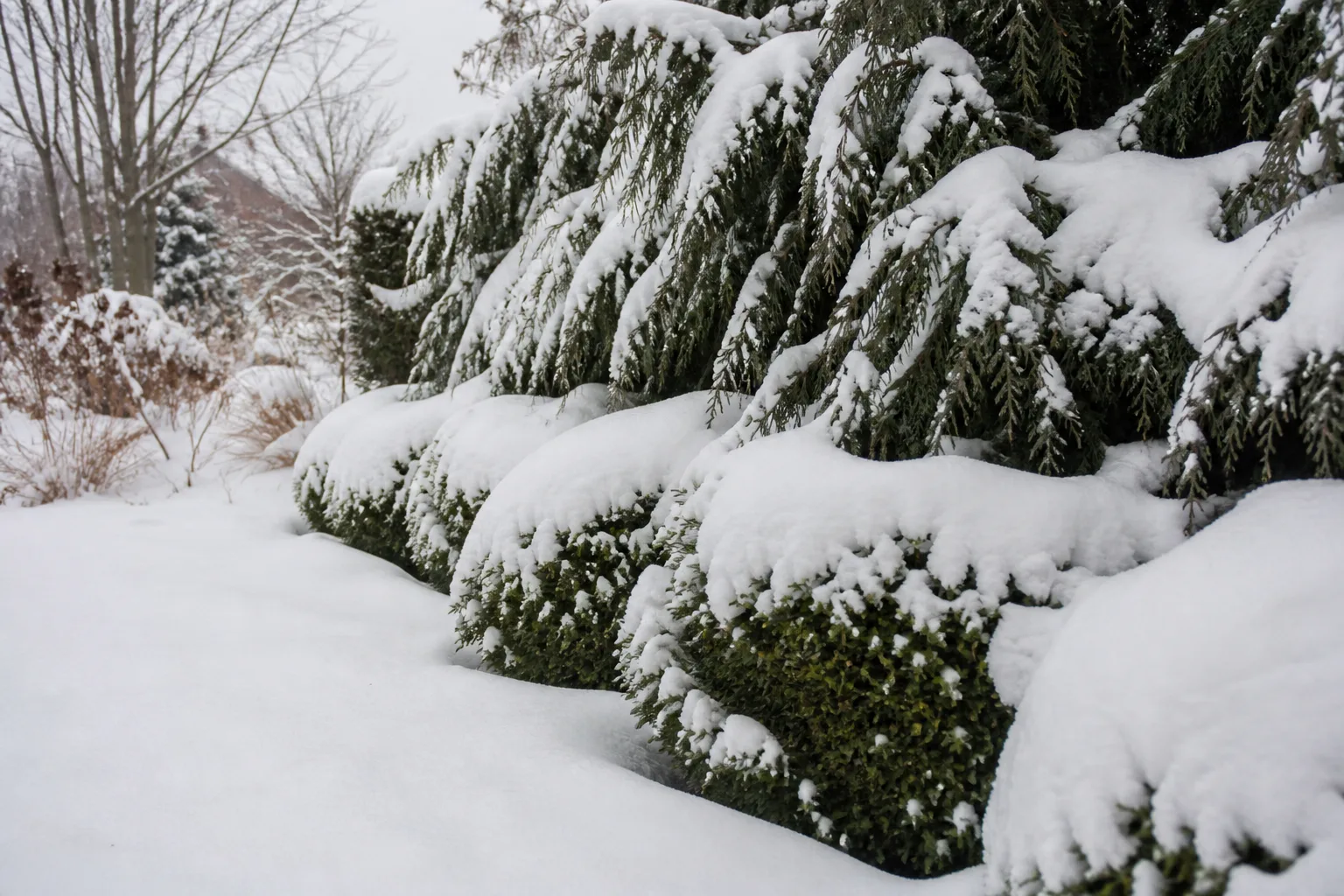
An established mugo pine planted in the ground is naturally cold hardy, with hardiness varying by cultivar and local summer conditions. Protect the root zone of a recent planting with a modest mulch layer, keep it away from stems, and water before the ground freezes if autumn has been unusually dry. Evergreen needles continue losing moisture in winter, so a dry root ball can still stress a cold-hardy plant.
A container’s roots are more exposed to temperature swings than roots in the ground. In cold regions, place the pot in a sheltered outdoor spot, group it with other containers, or insulate the pot sides with a breathable barrier while leaving drainage clear.
Do not move a dormant outdoor pine into a heated room. During winter thaws, check that the mix is not bone dry and water when it has thawed enough to absorb moisture.
A container cultivar’s listed hardiness does not automatically mean its roots can tolerate the same temperatures in a small above-ground pot.
Spot scale, sawflies, and needle blight early
Pine needle scale can appear as small white or gray shells fixed along needles. A light infestation may be easy to miss; persistent scale can weaken a shrub over time.
Pine sawfly larvae feed in groups and can strip needles from branch tips. North Carolina Extension lists both pests on mugo pine, and Penn State’s updated scale guidance includes mugo among the susceptible landscape hosts (Penn State Extension: Pine Needle Scale).
Inspect the inner and outer needles periodically, especially if a patch starts losing color.
If you see chewing or scale, identify the pest and its stage before treating. Small sawfly groups may be removed by hand or pruned away; for a larger problem, contact your local extension service for a region-specific option.
Scale treatments work best when timed to vulnerable crawler stages, which vary with local weather. Use only products labeled for the plant and pest, and follow the label exactly; a generic insecticide application can harm beneficial insects while missing the right treatment window.
Mugo pine can also develop needle diseases such as Dothistroma needle blight. Look for reddish-brown bands or lesions on needles, followed by dead tips, rather than assuming that any yellow needle is fungal disease.
The Missouri Botanical Garden’s Dothistroma guide shows how banding can help distinguish the disease from other causes. Improve air movement, avoid overhead watering that keeps foliage wet, and get a diagnosis before using fungicide; sprays do not restore needles that have already died.
Troubleshoot yellowing, browning, and sparse growth
Some interior needle shedding is normal. Mugo pine needles persist for several years, so older needles near the center can yellow and drop while outer growth stays green.
Some named cultivars also shift toward gold in winter. If the color change is limited to older inner needles or a known winter-gold cultivar, check the newest growth before you reach for fertilizer or spray.
If whole branch tips brown, first check the soil and planting depth. Wet, compacted soil can suffocate roots; a recently planted shrub may also dry out inside the original root ball even while the surrounding bed feels damp.
Reddish cross-bands on needles, clusters of white scale shells, visible chewing, or dieback concentrated on one exposed side point toward different causes and warrant closer inspection. Photograph the pattern, note when it began, and ask a local extension office or certified arborist to confirm disease or pest problems before treatment.
Sparse growth often reflects too much shade, a cultivar that naturally spreads, or repeated pruning at the wrong time. A weak plant may also be recovering from transplant stress. Give it one growing season of appropriate light and watering before making multiple changes; heavy feeding, root disturbance, and severe pruning at once make it harder to learn what is actually wrong.
Propagate named cultivars without losing their traits
Seed-grown mugo pines vary, so a seedling from a named dwarf plant may not keep its parent’s exact habit or size. When a true cultivar matters, propagation is usually done vegetatively—commonly by grafting or rooted cuttings—rather than by saving cones. North Carolina Extension lists grafting and root cuttings among propagation methods, and the University of Arkansas System Division of Agriculture advises buying a vegetatively propagated clone when predictable compact size is essential (Arkansas Extension).
For most home gardeners, purchasing a healthy, accurately labeled plant is more reliable than trying to root pine cuttings. If you propagate as a project, expect variable success and keep new plants in nursery pots until they have a strong root system. Do not assume a young seedling’s first few years of compact growth reveal its mature landscape dimensions.
Conclusion
The reliable way to keep a dwarf mugo pine in scale is to buy the right plant, not to keep cutting the wrong one smaller. Verify the cultivar, plan around its eventual spread, and place it where sun reaches the foliage but water drains freely. During establishment, water deeply when the root zone begins to dry; later, intervene only for real drought, a specific nutrient need, or a clear pest or disease problem.
When shaping is useful, prune the soft spring candles and leave old bare wood intact. A pot can showcase a compact cultivar, but it brings faster drying and greater winter root exposure. With those trade-offs understood before planting, this rugged alpine pine can provide year-round structure without turning into a recurring rescue project.



