Perennial Plants: How to Choose, Plant, and Care for Them
Plan a perennial garden that suits your site. Compare sun and shade choices, prepare soil, establish new plants, and handle seasonal care and common problems.
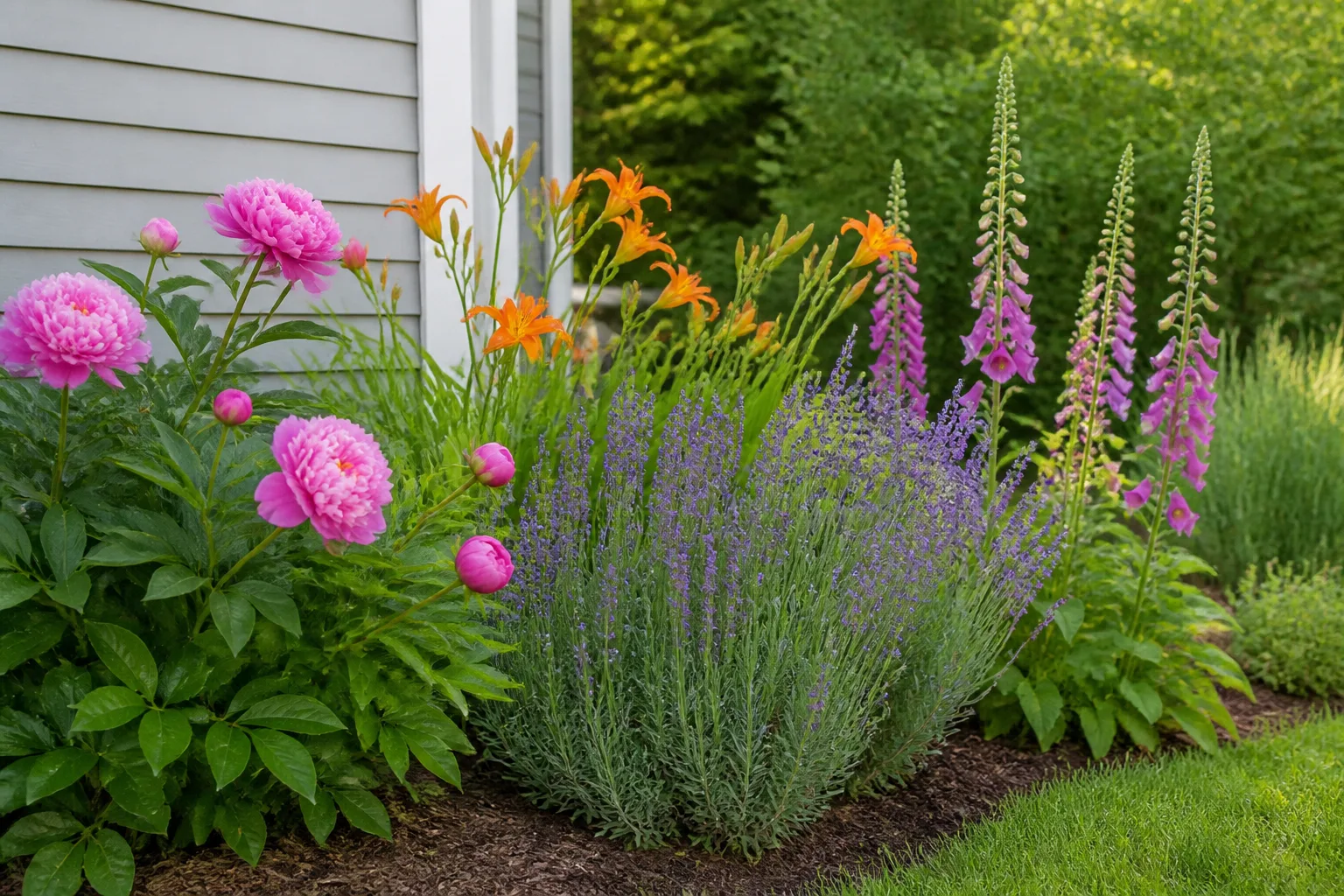
Perennial plants live for more than two growing seasons, but “perennial” does not mean every plant will flower continuously or return reliably in every garden. The useful question is not simply which flowers are perennial; it is which plants can handle your site, climate, and available care after the first flush of nursery blooms is gone.
Start by observing the bed, then choose plants for its actual light, drainage, moisture, and mature space. That order prevents the most common disappointment: buying attractive flowers first and trying to force them into conditions they were never suited to.
What counts as a perennial—and what comes back?
In garden catalogs, a perennial is a plant expected to survive for several years. Many familiar perennials are herbaceous: their stems die back in winter while roots, crowns, bulbs, or rhizomes remain alive and send up new growth when conditions suit them. Other perennials keep some foliage through winter, and woody perennials retain branches. Some are long-lived; others are comparatively short-lived and need replacement or reseeding after a few seasons.
The label describes a plant’s life cycle, not a promise about your yard. A plant may be perennial in a mild climate and behave like an annual where winter is colder than its roots can tolerate. A wet winter can kill a plant that otherwise handles cold, while a warm-zone plant may struggle with a short, cool summer. Cultivars can also differ from the species, so check the label for the plant you are actually buying.
Perennials are not maintenance-free. New plants need attention while roots settle, established clumps may need dividing, and some varieties spread vigorously or self-seed. A well-chosen perennial bed can reduce yearly replanting, but it still needs occasional watering, weeding, observation, and selective cleanup.
Start with the site before choosing plants
Walk the proposed bed at different times of day before shopping. Note where buildings, fences, and deciduous trees cast shade, where wind dries the soil, where rain collects, and how easy it is to reach the bed with a hose or wheelbarrow. A simple sketch with the bed dimensions and nearby paths is more useful than relying on memory once you are comparing plant tags.
Penn State Extension’s perennial-garden planning guidance starts with the same practical questions: sun, shade, wind, soil moisture, compaction, nearby structures, and maintenance access. Its example garden also builds paths wide enough to reach the middle of the beds, a small design choice that makes routine weeding possible without stepping on plants (Penn State Extension: Starting a New Perennial Garden).
Measure light, soil moisture, and drainage
“Sunny” and “shady” are descriptions of a changing site, not permanent labels. Watch the bed on a clear day and record when direct sun reaches it. A spot beneath a deciduous tree may be sunny in early spring and shaded after leaves emerge; a south-facing wall can add reflected heat that makes a plant work harder than the same exposure elsewhere.
Then check moisture. Does the soil stay damp for days after rain, dry quickly, or receive runoff from a roof or slope? Dig a small test hole after watering or rainfall and inspect the soil below the surface; a dry crust can conceal wet clay, and a dry-looking top layer can sit above moist soil. Perennials that prefer sharp drainage, such as many lavenders and sedums, often decline in winter-wet ground even if they tolerate summer drought.
Do not assume every problem calls for added compost. A soil test can identify pH and nutrient issues before you amend, while a drainage problem may need a different planting location, a raised bed, or a species adapted to wetter ground. Penn State notes that many perennials perform in well-drained soil with moderate fertility, but plant-specific needs vary; a blanket fertilizer or amendment is not a substitute for identifying the constraint (Penn State Extension: Care and Maintenance of Perennials).
Use hardiness zones as a starting point
The USDA Plant Hardiness Zone Map is based on average annual extreme minimum winter temperature. It helps you screen for whether a plant is likely to tolerate local winter lows; it does not rate summer heat, humidity, rainfall, soil, wind, or the cold pocket at the bottom of your yard. The U.S. National Arboretum describes the map as a tool for comparing plant cold-hardiness, including at fine geographic scales (USDA Plant Hardiness Zone Map; U.S. National Arboretum: Plant Hardiness Zone Map).
Treat a zone match as necessary information, not a guarantee. If your site is exposed, waterlogged in winter, or unusually hot in summer, read the full growing notes and ask a local extension office or native-plant group what performs in your area. When a label lists a range, choose plants with a comfortable margin for your local conditions instead of relying on a marginally hardy choice in a harsh microclimate.
Choose perennials that fit your goals and maintenance time
Make a shortlist by function before selecting colors. Decide whether the bed needs early spring flowers, a summer focal point, late-season nectar, foliage for shade, groundcover, cut flowers, or a low planting along a path. Then filter that list through the site conditions you recorded. A plant that performs reliably in its preferred spot usually asks for less intervention than a supposedly low-maintenance plant planted in the wrong place.
For a sunny, relatively dry bed, gardeners often consider yarrow, many salvias, catmint, coneflower, coreopsis, or sedum; for a bright but consistently moist shade bed, astilbe and some hostas can be better candidates. These are starting points, not universal recipes: cultivar, region, soil, and deer pressure can change the result. Better Homes & Gardens’ garden-plan examples similarly pair plants by site and purpose—for example, drought-tolerant choices in a water-wise design—and recommend grouping plants with similar water needs (Better Homes & Gardens: No-Fuss Garden Plans).
Match water needs and local conditions
Group plants by how they want to live, not only by bloom color. Put dry-soil plants together where irrigation will not keep them constantly damp; keep moisture-loving plants in a place that stays evenly moist but does not stagnate. This makes watering simpler and prevents a common compromise in which one end of a bed is perpetually too wet while another dries out.
Native plants are often useful choices because local species evolved under regional conditions and can support local wildlife, but “native” is not a single care category. A native wetland flower still needs moisture; a prairie species may resent shade or rich, wet soil. Check whether a plant is native to your region, whether it spreads aggressively, and whether a named cultivar retains the traits you want. Avoid planting species listed as invasive locally, even if they are sold as easy-care.
Check mature size, spread, and lifespan
Read the plant tag for mature height and width, not the dimensions of the small pot on the sales bench. Leave room for airflow and access, and remember that a vigorous plant can expand beyond its advertised clump. A crowded bed may look full in its first year, then become difficult to weed, prone to mildew, and uneven as stronger growers shade out weaker ones.
Also decide whether you want a plant that forms a clump, creeps by runners, or self-sows. Clumping plants are usually easier to contain; spreading plants can cover open ground but may need edging or regular thinning. Some perennials are dependable for decades, while others are relatively short-lived, so design with a few dependable structural plants and allow flexible spaces where seasonal replacements can fit.
Design a bed that stays interesting through the seasons
A perennial border is a sequence, not a single flowering moment. List the bloom periods of candidate plants and look for gaps: many beginner beds are full of spring color and midsummer flowers but thin in late summer or fall. Staggering bloom times helps extend the display, but foliage, seedheads, and plant form keep the bed visually useful between flowers.
Before digging, mark the proposed edge with a garden hose or rope and view it from the patio, windows, and paths. BBC Gardening’s design guidance recommends looking at a planned border from multiple viewpoints, then considering each plant’s height, shape, leaf and flower color, flowering time, and growing conditions as parts of one composition (BBC Gardening: Combining Plants). That observation can reveal a bed that is too narrow, blocks a window, or is hard to maintain before you buy plants.
Layer height, foliage, and bloom windows
In a bed viewed from one side, put taller plants toward the back and shorter plants toward the front; in an island bed, place taller accents near the middle and keep the outside edge low enough to see across. Use mature height as your guide, but also consider whether a plant leans, needs staking, or disappears after flowering. A sturdy foliage plant may carry a space after a nearby bloom fades.
Repeat a few plants in loose groups rather than scattering one specimen of every variety across the bed. Repetition makes the design read as a whole and helps pollinators find resources, while a mix of bloom times spreads color through the season. A compact combination might pair spring bulbs with early foliage, summer coneflowers and salvias, and fall asters, then leave selected seedheads standing through winter.
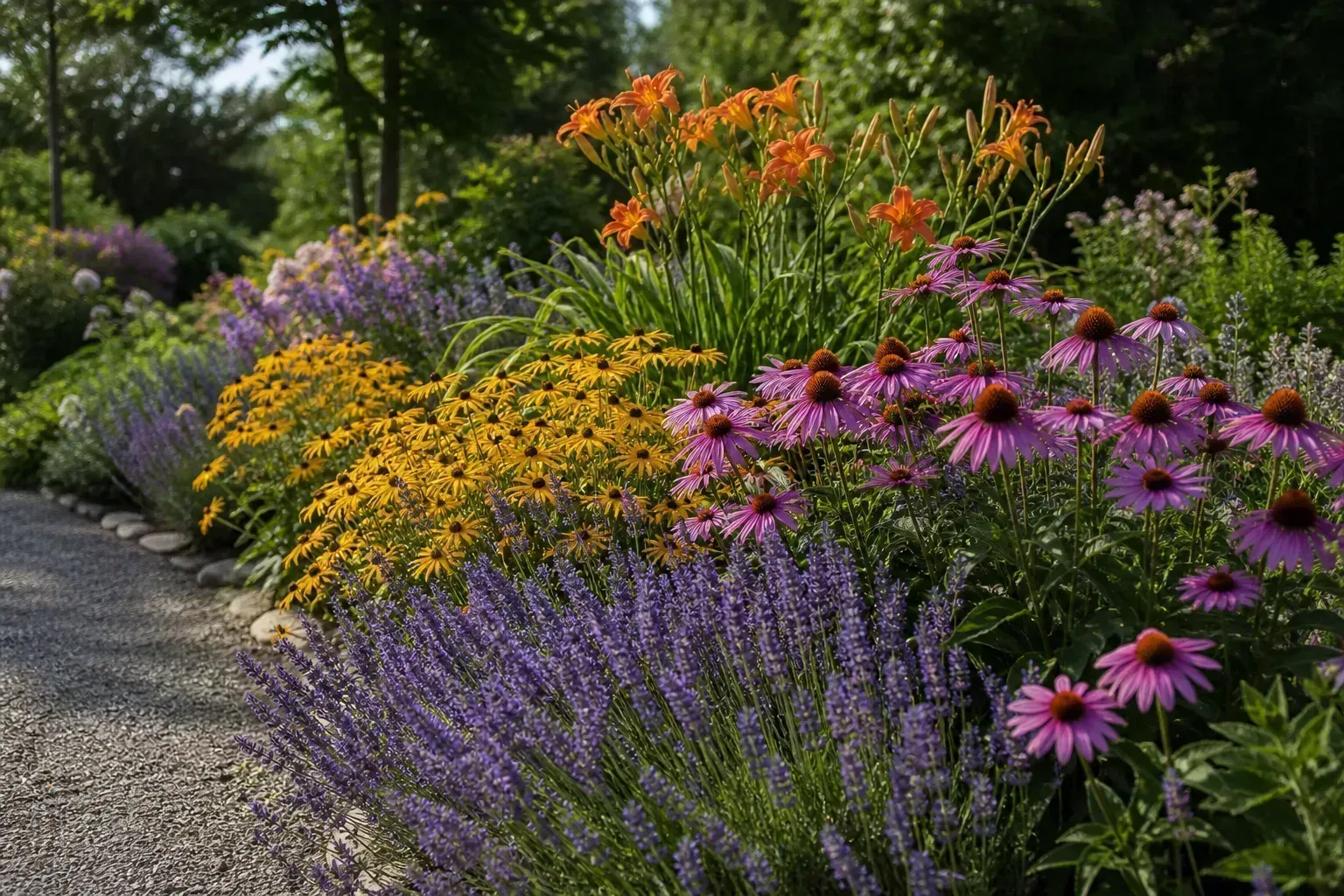
Plant perennials for strong establishment
Spring and early fall are often comfortable planting windows because moderate weather gives roots time to establish before severe heat or cold. The exact window depends on climate, plant type, soil, and the time remaining before hard freezes. Avoid planting into frozen or waterlogged soil, or during a heat spell when you cannot keep the root ball evenly moist; a container perennial can be planted at other workable times if you can provide the extra aftercare.
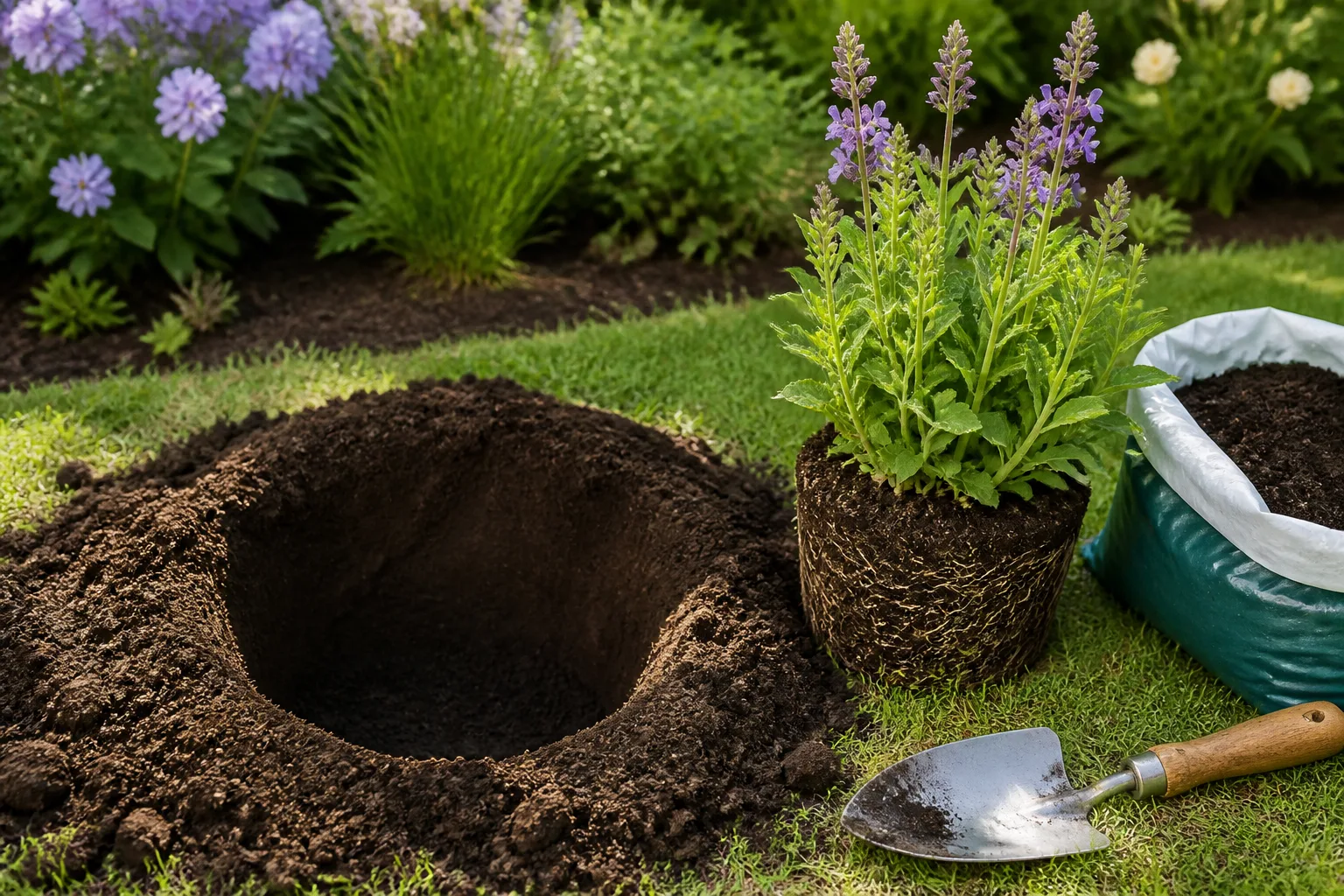
Before planting, water the nursery pot so the root ball is moist but not dripping. Set the plant beside the hole to check spacing, and arrange the whole bed before you start digging; moving pots around is easier than moving freshly planted roots. Dig a hole wide enough to loosen the surrounding soil, then set the plant at the depth specified on its label. Some crowns and rhizomes need shallow placement, so do not bury every perennial to the same depth.
If the roots circle tightly around the pot, gently loosen the outside roots so they can grow into the bed. Backfill with the soil you removed unless a soil test or plant-specific guidance calls for a targeted amendment. Firm the soil lightly to remove large air pockets, water slowly to settle it, and check the plant over the next several days; wilting can mean dry roots, waterlogged soil, heat stress, or transplant shock, so inspect the soil before watering again.
Water, mulch, and fertilize with restraint
The first season is when a perennial needs the most help. Water the root zone after planting, then check soil moisture regularly rather than following a rigid daily schedule. Wind, temperature, rainfall, soil texture, pot size, and plant size all affect how quickly the root ball dries. Water deeply when the root zone is drying, then let the soil drain; frequent shallow sprinkling can leave deeper roots dry and keep foliage wet longer than necessary.
Established perennials usually need supplemental water during prolonged dry weather, but drought tolerance is not immediate. Penn State Extension gives one inch of water per week as a general rule of thumb for established plants, while also recommending less frequent, deeper watering; treat that as a starting estimate and adjust for rainfall, soil, and species rather than applying it as a fixed prescription (Penn State Extension: Care and Maintenance of Perennials). Check soil several inches down before watering. If it is still damp, wait; if it is dry and the plant is not adapted to drought, water slowly at the base.
A moderate layer of organic mulch can reduce evaporation and suppress weeds, but keep it away from crowns and stems so they are not buried or kept constantly wet. Do not assume more mulch is better: thick layers can hide emerging shoots, hold excess moisture, or create a sheltered place for pests. Refresh it only as it thins, and leave the plant’s crown visible.
Most perennials do not need a heavy feeding schedule. Too much nitrogen can encourage lush, weak foliage at the expense of flowers, and fertilizer will not fix shade, bad drainage, or overcrowding. If growth is poor, use a soil test and plant-specific guidance to determine whether nutrients are actually the issue. Compost can improve soil structure, but avoid repeatedly incorporating rich material around plants that prefer lean or sharply drained conditions.
Deadhead, stake, and prune selectively
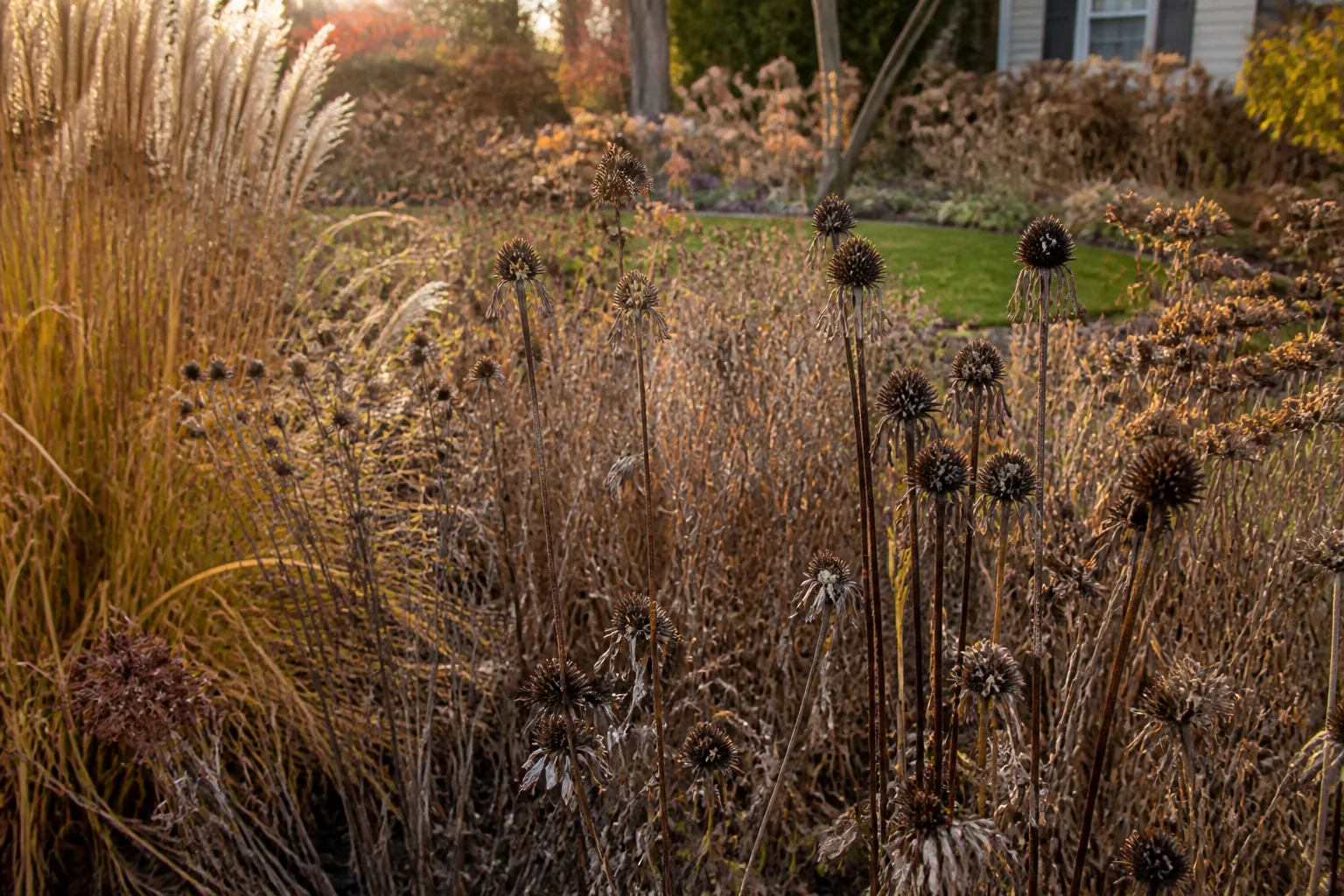
Deadheading means removing spent flowers; it can tidy a bed and, for some plants, encourage another flush of bloom. It will not make every perennial rebloom, and removing all flowers also removes seedheads that feed wildlife or provide winter structure. If you want to save seed, support birds, or enjoy a naturalistic winter garden, leave at least some healthy flower heads standing.
Stake tall stems before they flop, while growth is still short enough to grow through the support and disguise it. Plants with heavy flowers or exposed stems are most vulnerable after rain and wind; discreet hoops or a few linked stakes can be less visible than tying one mature clump tightly to a single stake. If plants flop every year, consider more sun, less nitrogen, closer support, or a shorter cultivar rather than repeatedly correcting the same failure.
Pruning depends on species and purpose. Cut diseased or badly damaged foliage when needed, but do not cut back every perennial simply because the season has changed. Better Homes & Gardens notes that many healthy seedheads can remain into late winter or early spring for winter interest and bird food; remove material sooner when it is diseased, collapsing onto paths, or creating a specific problem (Better Homes & Gardens: No-Fuss Garden Plans). For plant-by-plant timing, use the specific care instructions rather than a one-date calendar.
Divide or move plants when the clump needs it
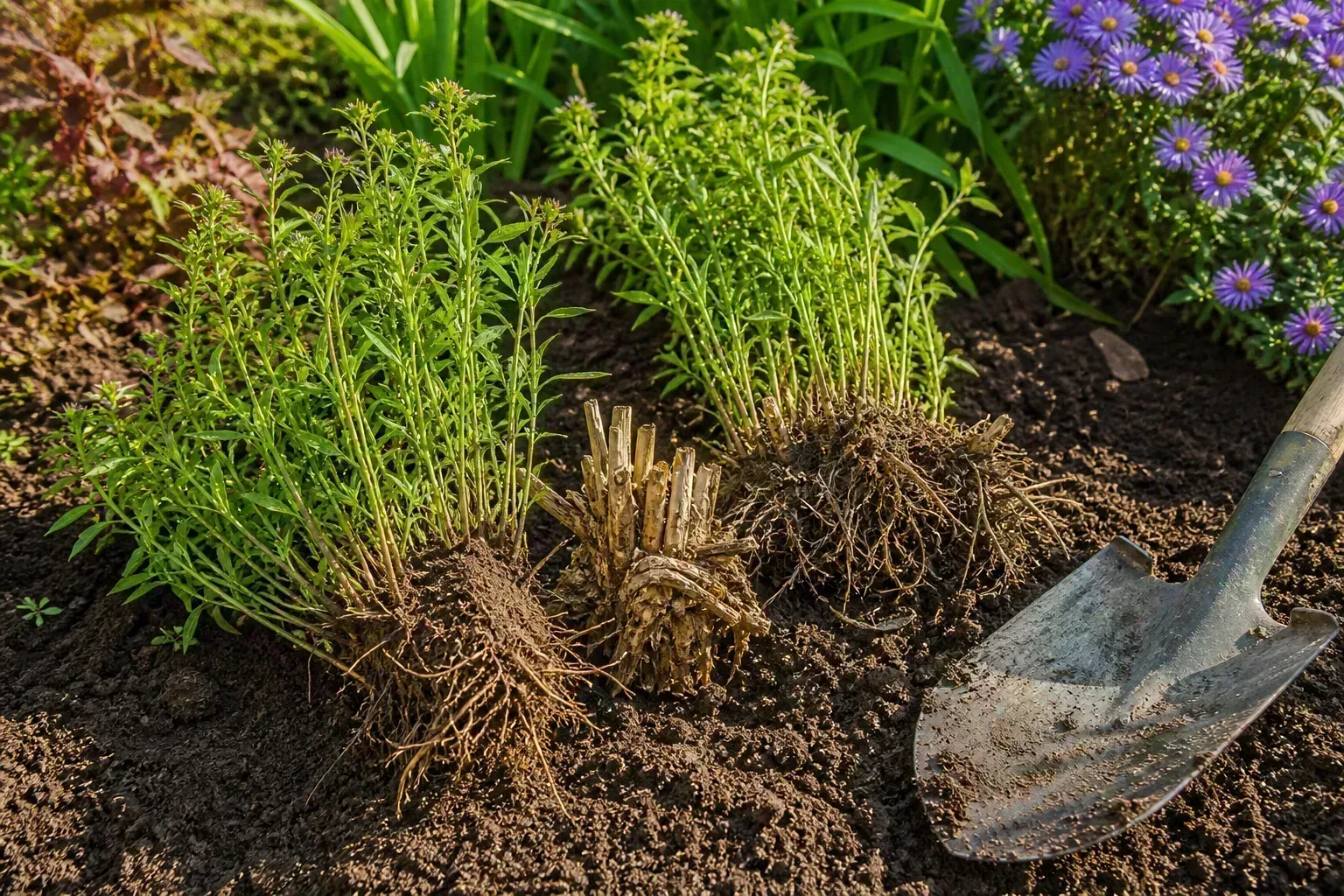
Division is the process of lifting a mature clump and separating it into sections that each have healthy roots and growing points. It can reduce congestion, restore vigor in plants that bloom less as the center ages, and create new plants. It is not an annual task or a universal need: some perennials resent disturbance, while others are readily divided. Penn State notes that many perennials benefit from division every few years, but plant-specific habits should decide the schedule (Penn State Extension: Care and Maintenance of Perennials).
Look for signs rather than relying on the calendar: a thinning or dead center, a clump spreading beyond its allotted space, reduced flowering despite suitable light and care, or a plant crowding its neighbors. Divide when the plant is not under heat or drought stress, and follow timing advice for that species—many spring-flowering plants are easier to divide after bloom or in fall, while others are best handled in spring.
Water the plant beforehand if the soil is dry, lift as much of the root system as practical, and use a clean spade or knife to separate viable sections. Replant divisions promptly at their prior depth, water them in, and keep them from drying while they reestablish. If the clump is healthy and has room, leave it in place; a plant that is supposed to form a broad colony may not need division just because it is large.
Keep a perennial bed healthy through the year
Use a seasonal rhythm as a reminder, not a strict calendar. In spring, wait until you can see what is alive before cutting back dormant stems; clear damaged material, weed early, and add support before tall growth needs it. Plant or divide when the soil is workable and the weather gives roots a chance to settle.
During active growth, check moisture, remove weeds while small, and watch for changes in leaf color, spotting, or distortion. Inspect the undersides of leaves and the base of stems before applying any treatment; many symptoms come from water, light, or crowding rather than an insect or disease. If a problem spreads, identify the plant and the cause before choosing a pesticide or other control.
In fall, assess each plant before cutting. Remove diseased material and anything that will mat or smother neighboring plants, but leave healthy stems or seedheads where they provide structure or food. New plantings and recently divided clumps may need extra protection in exposed climates; follow local advice and avoid burying crowns under dense mulch. A clean label or simple garden map can record each plant’s name, location, bloom period, and any care that worked, making next year’s decisions far easier.
Troubleshoot common perennial garden problems
When a perennial struggles, start with the sequence that affects it most: confirm its identity, compare the site with its stated needs, check soil moisture and drainage, then consider spacing, pests, and nutrients. Change one likely cause at a time when possible. If you water more, fertilize, and move the plant all at once, it becomes harder to know what helped—and a plant already stressed by wet soil can be harmed by extra irrigation.
Look at the pattern as well as the symptom. One plant with damaged leaves may have a local pest; several neighboring plants declining together point more strongly toward water, soil, or exposure. A plant that collapses only after rain may need support or a less exposed position, while repeated winter loss in a low spot may indicate poor drainage rather than insufficient hardiness.
Healthy foliage but few flowers
First check light and age. A shade-loving perennial can produce healthy leaves in too much shade but set few flowers; a recently planted plant may also spend its first seasons building roots. Confirm that nearby shrubs or trees have not changed the amount of sun and that the cultivar normally flowers under those conditions.
Next review fertilizer and pruning. Heavy nitrogen can favor foliage over flowers, while cutting stems at the wrong time can remove developing buds. If the plant is mature and crowded, division may help, but do not divide before ruling out shade, excess fertility, or a pruning mistake. A soil test can confirm nutrient questions more reliably than guesswork.
Flopping, bare centers, or disappearing plants
Flopping often means the plant is tall for its site, exposed to wind or rain, receiving excess nitrogen, or simply needs early staking. If a whole bed leans toward the light, reassess sun and layout; if one plant leans while its neighbors stand, its variety or support needs may be the issue. Better spacing also improves airflow, which can reduce some leaf diseases.
A bare center in a once-large clump can be a sign that division is due, but similar thinning can result from crown rot in wet soil or competition from nearby plants. A plant that disappears after winter may have failed because of a wet crown, inadequate hardiness, or a late freeze rather than a lack of fertilizer. Check the roots and soil where it grew, then replace it with a plant suited to that exact micro-site instead of repeating the same mismatch.
Conclusion
A successful perennial garden begins with observation: measure the light, learn how the soil handles water, and leave room for plants at their mature size. Select varieties for the conditions you actually have, then give them careful establishment watering and adjust maintenance to the plant rather than to a blanket calendar.
Perennials can reward that fit with years of foliage, flowers, and seasonal structure, but no plant is effortless everywhere. When a bed underperforms, diagnose the site and the plant’s needs before adding fertilizer or replacing everything. That habit turns perennial gardening into a series of small, informed corrections—and makes each planting more likely to earn its place.



