Why Do My Plants Drop Leaves in Winter? Causes and Fixes
Diagnose why your houseplants are dropping leaves in winter — low light, overwatering, cold drafts, low humidity, dormancy, or pests — with step-by-step fixes for each cause.
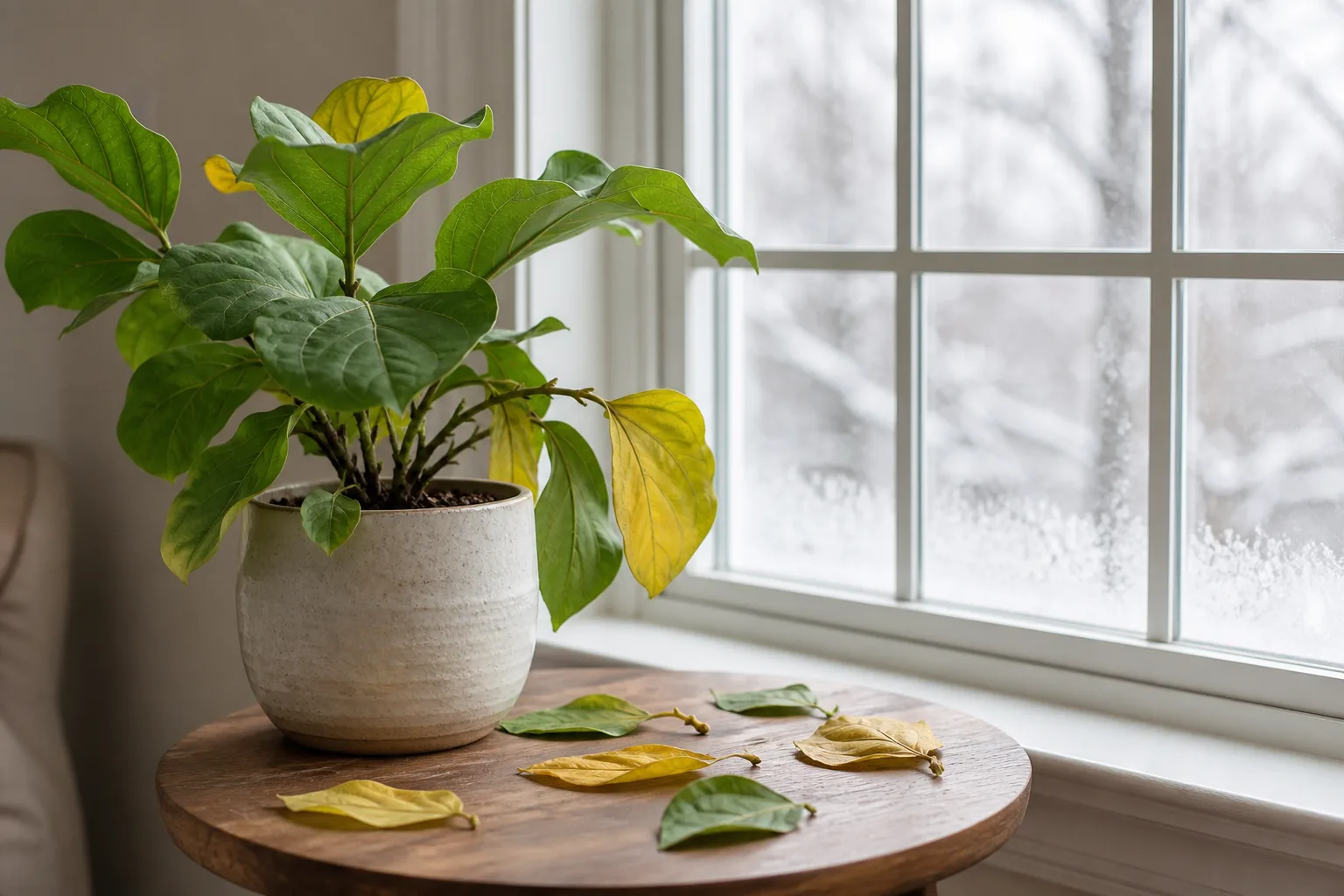
Leaf drop in winter is one of the most common distress signals houseplants send. You walk past your fiddle-leaf fig or pothos, and there is a fresh scattering of leaves on the floor. The plant looked fine in October. Now, in December or January, it is shedding like it is trying to go bare.
The short answer is that winter combines several stressors at once: shorter days, weaker light, dry heated air, cold drafts near windows, and a root zone that stays wet longer because the plant is barely growing. A plant dropping leaves in winter is usually coping with more than one of these at the same time. The good news is that most winter leaf drop is fixable once you identify the real cause.
This guide walks through each reason plants drop leaves in winter, how to tell which one applies to your plant, and what to do about it.
What this guide covers (and what it does not)
This guide covers: why indoor plants drop leaves specifically in winter, how to diagnose the cause by reading leaf patterns and environmental clues, and step-by-step fixes for light, water, humidity, temperature, pests, and dormancy.
This guide does not cover: general year-round leaf drop from disease or nutrient deficiency, detailed root-rot surgery (see the root rot guide), or the full winter maintenance routine for stable plants (see the winter houseplant care checklist).
If your plant is already in decline with multiple symptoms — yellowing, wilting, and dropping all at once — start with the diagnostic companion at why houseplants struggle in winter, then return here for the leaf-drop-specific fixes.
Why winter is different: the four-stress overlap
Winter does not introduce one new variable — it changes four at the same time. That overlap is why leaf drop can seem to come out of nowhere. A plant that tolerated a dim corner in July may start shedding in December because the light got even weaker, the air got drier, the soil stayed wet, and a cold draft crept in after sunset.
| Winter change | How it affects the plant | Link to leaf drop |
|---|---|---|
| Shorter days, lower sun angle | Reduced photosynthesis → less energy | Plant sheds leaves it cannot support |
| Dry heated air | Low humidity, desiccated leaf tissue | Brittle leaves, premature drop |
| Slower water use | Root zone stays wet longer | Root stress, rot, leaf shedding |
| Cold windows and drafts | Thermal shock on tropical foliage | Sudden drop, often on one side of plant |
UVM Extension describes winter houseplant growth as considerably slower under fewer hours and lower intensity of sunlight. That slowdown is the backdrop for everything else. When growth nearly stops but watering and placement do not change, the mismatch shows up as dropped leaves.
Quick diagnosis: read where the leaves are falling from
Before you adjust anything, spend two minutes collecting evidence. The pattern of leaf drop tells you more than the fact that leaves are falling.
| What you see | Most likely cause | First action |
|---|---|---|
| Older lower leaves dropping one at a time; new growth firm | Natural winter slowdown or senescence | Monitor; do not change routine |
| Leaves dropping from all over; soil stays wet for days | Overwatering in low light | Check root-zone moisture; reduce watering frequency |
| Leaves dropping suddenly after a cold night | Cold draft or window contact | Move plant away from cold glass; check overnight temperature |
| Leaves dropping from the side facing the window | Cold glass or sun-scald reflection | Pull pot back from glass at night; add sheer curtain |
| Crispy leaf edges with drop; soil is dry | Underwatering or low humidity | Check soil moisture; measure humidity at leaf height |
| Green leaves falling with no yellowing first | Temperature shock or sudden move | Review recent changes; stabilize location |
| Speckled or stippled leaves dropping | Spider mites or thrips | Inspect leaf undersides; isolate if pests found |
| Yellowing leaves before dropping; plant looks pale overall | Low light | Move to brighter window; clean leaves; consider grow light |
The most damaging reflex: watering a plant because it is dropping leaves without checking the soil first. University of Maryland Extension notes that excess water reduces oxygen in the soil, damaging fine roots and making the plant unable to take up water — so a plant sitting in wet soil may drop leaves for the same reason a thirsty plant does. Check the root zone before you reach for the watering can.
Cause 1: Low light — the most overlooked trigger
When winter days shorten and the sun sits lower in the sky, the amount of usable light reaching your plants drops dramatically. A spot that was bright indirect light in June may be functionally low light in December. The plant cannot photosynthesize enough to support all its leaves, so it sheds the ones it can least afford — usually the oldest, lowest leaves first.
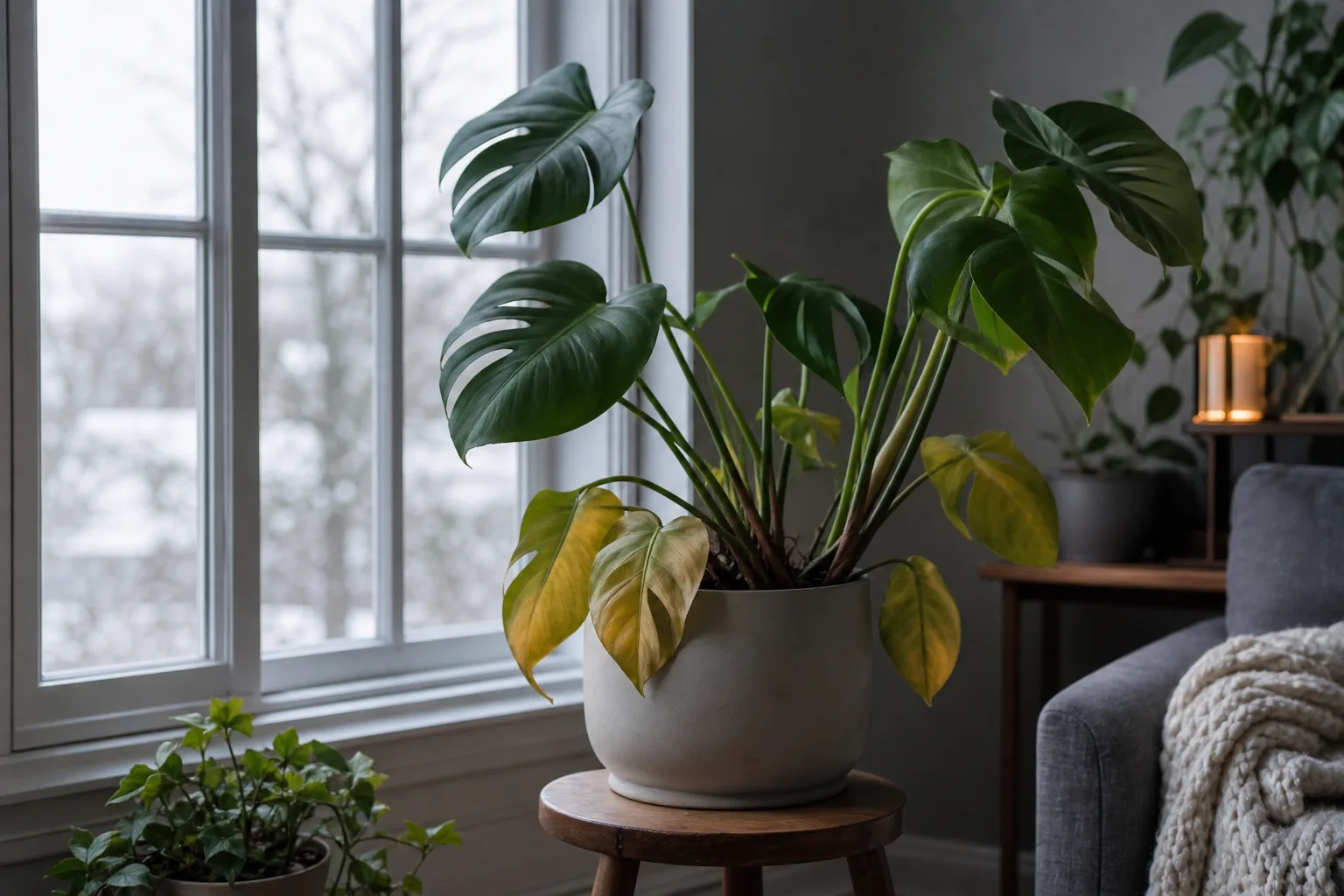
NC State Extension notes dim winter months require clean windows, supplemental lighting, or both to keep most tropicals healthy.
Signs that low light is causing leaf drop
- Older, lower leaves yellow and fall while newer growth at the top stays green
- The whole plant looks paler or more washed out than in summer
- Stems are stretching — longer gaps between leaves than before
- New leaves, if any, are smaller than summer growth
- Leaf drop started gradually and got worse as days shortened
How to fix low-light leaf drop
- Move the plant closer to the brightest safe window. A south or west window is best in winter, but east windows work for lower-light plants. Even moving a plant from 4 feet back to 1 foot from the glass can make a measurable difference.
- Clean the leaves. Dust on broad leaves blocks light. Wipe gently with a damp cloth.
- Clean the windows. Winter grime on glass reduces transmission more than you would think.
- Rotate the pot a quarter turn weekly so all sides of the plant get exposure.
- Add a grow light if natural light is inadequate. A full-spectrum LED on a timer for 10–12 hours a day can be the difference between a plant holding its leaves and going bare. See the complete grow lights guide.
- Protect from cold glass. The brightest window is often the coldest at night. Pull the pot back after sunset or use an insulating curtain that does not trap the plant against the pane.
Do not move a light-starved plant directly into full southern exposure without acclimation. Increase light gradually over a week or two to avoid scorch.
Cause 2: Overwatering — the most common killer
Overwatering is the number one reason houseplants fail, and winter makes it far easier to overwater. University of Maryland Extension states the number one reason for dying plants in winter is usually overwatering, which leads to root rots and leaf drop. When light drops, plants use less water. If the watering routine does not change, the root zone stays wet, oxygen runs low, roots begin to die, and leaves drop as the plant can no longer take up water — even though the soil is wet.
The RHS advises checking whether a pot actually needs water rather than watering on a routine, then watering thoroughly and allowing excess to escape (RHS winter guidance).
Signs that overwatering is causing leaf drop
- Soil stays damp or soggy days after watering
- Pot feels heavy even when you expect it to be dry
- Leaves turn yellow before dropping, often starting with lower and inner leaves
- Leaves feel soft and limp, not crisp or papery
- Soil smells sour or musty
- Fungus gnats hovering around the soil surface
- Stems may feel soft or mushy at the base
How to fix overwatered leaf drop
- Stop watering immediately. Do not add more water until the root zone has dried to the appropriate depth for the species.
- Empty all saucers, cachepots, and decorative outer pots. Never let a pot sit in standing water.
- Move the plant to brighter indirect light to increase water use. Avoid direct harsh sun on an already stressed plant.
- Improve airflow around the pot and foliage.
- Check drainage. If the pot has no drainage hole, repot into one that does.
- Inspect the roots if the plant does not improve. Slide the root ball out. Healthy roots are firm and pale. Rotten roots are brown or black, mushy, and foul-smelling. Trim away all damaged tissue with clean scissors, then repot in fresh, well-draining mix.
- Reduce top growth if root loss was significant. If you removed a large portion of rotten roots, also remove some damaged leaves so the smaller root system is not overburdened.
Recovery from overwatering takes longer than from underwatering. The plant may drop more leaves after root surgery as it adjusts. Judge progress by whether new growth emerges — not by whether existing leaves green up.
Cause 3: Low humidity — slow, cumulative stress
Winter heating systems strip moisture from indoor air. Penn State Extension reports that heated winter homes can fall below 30% relative humidity, while many tropical houseplants prefer 40–60%. Over weeks, dry air desiccates leaf tissue. Leaves develop crisp edges, curl, and eventually drop — even if the roots are perfectly watered.
Low humidity rarely causes leaf drop on its own. It usually combines with one of the other causes: a plant in low light with dry air sheds faster than a plant in low light with adequate humidity.
Signs that low humidity is contributing to leaf drop
- Brown, crispy leaf tips or edges appear before the leaf drops
- Leaves curl inward or look thinner and more brittle than usual
- The problem is worse on thin-leaved plants like calathea, ferns, and prayer plants
- A hygrometer near the plant cluster reads below 35%
- Symptoms worsen when the heating system runs frequently
How to fix low-humidity leaf drop
- Measure first. Place a small hygrometer at leaf height near the affected plants. Do not assume the whole room is the same — spots near vents or radiators can be significantly drier.
- Use a humidifier near the plant cluster. This is the most effective and controllable solution. Size it for the room or area, clean it regularly, and avoid blowing mist directly onto foliage.
- Group plants together. Transpiring leaves create a modest local humidity pocket. Leave enough space for airflow and pest inspection.
- Use a pebble tray as a supplemental aid. A tray wider than the pot, filled with pebbles and water kept below the pot base, provides localized humidity. It will not fix a room-wide problem, but it helps at the individual plant level.
- Misting is not a solution. It evaporates within minutes and does not provide sustained humidity. Do not rely on it as your primary strategy.
For a deeper comparison of humidity strategies, see the houseplant humidity guide.
Cause 4: Cold drafts and temperature shock
Tropical houseplants evolved in stable, warm environments. When a plant sits near a cold window, exterior door, or drafty hallway in winter, the sudden temperature drop can trigger leaf drop — sometimes within hours. The RHS warns that cold windows and drafts can damage plants (RHS winter guidance).
Unlike low light or overwatering, which take days or weeks to cause visible damage, cold shock produces rapid, often dramatic leaf drop. Leaves may fall while still green.
Signs that cold is causing leaf drop
- Leaves drop suddenly, often without yellowing first
- Drop is concentrated on the side facing a window, door, or vent
- Leaves that were touching cold glass show dark, water-soaked patches before falling
- The problem appeared after a sudden cold snap or after moving the plant
- Leaf drop coincides with the heating system cycling on and off
How to fix cold-related leaf drop
- Move the plant away from cold glass, especially at night. Pull pots back at least 6–12 inches from windows after sunset, or use insulating curtains that do not trap the plant against the pane.
- Keep plants away from exterior doors that open frequently in winter.
- Avoid placing plants directly above radiators or in the path of forced-air vents. The hot-dry-cold cycle is worse than either extreme alone.
- Do not let foliage touch cold windowpanes. Even a single leaf pressed against freezing glass can initiate a stress response across the plant.
- Maintain a stable temperature in the plant’s immediate area. Most tropical houseplants do best between 65–75°F (18–24°C) and dislike swings of more than 10–15°F.
A slightly less bright but thermally stable location is better than the brightest window that drops 20°F at night.
Cause 5: Natural dormancy or semi-dormancy
Not all winter leaf drop is a problem. Many houseplants enter a period of slowed or paused growth when light and temperature drop. During this semi-dormancy, they may shed a few older leaves as they conserve energy for essential functions. This is a natural adaptation, not a sign of poor care.
UVM Extension describes winter houseplant growth as considerably slower, and notes that some plants may lose coloring or drop leaves as part of this seasonal rhythm.
Signs that leaf drop is normal winter slowdown
- Only the oldest, lowest leaves are dropping — one or two at a time, not in clusters
- Stems are firm and healthy
- No yellowing, spotting, or pest signs on remaining leaves
- The plant has been in the same spot all season with no sudden changes
- Leaf drop started gradually as days shortened and has not accelerated
What to do about normal winter leaf drop
- Do nothing drastic. Reduce watering frequency to match slower water use, but do not change placement or add fertilizer.
- Do not fertilize. A plant conserving energy cannot process fertilizer, and salt buildup can damage roots.
- Let the plant rest. Growth resumes when days lengthen in late winter or early spring.
- Monitor for change. If the rate of leaf drop accelerates, or if newer leaves start yellowing or dropping, investigate the other causes on this page.
The distinction matters because treating normal dormancy as a crisis — watering more, moving the plant, fertilizing — creates the very problems you are trying to prevent.
Cause 6: Pests — spider mites and winter infestations
Winter conditions favor certain pests, particularly spider mites. Dry air, reduced plant vigor, and the absence of natural predators indoors create ideal conditions for mites to multiply. Iowa State Extension notes that spider mites are commonly noticed on houseplants in winter and should be detected through regular inspection.
Colorado State University Extension identifies stippling, bronzing, webbing, and premature leaf drop as typical spider-mite damage. The webbing often appears between leaves and stems before it becomes visible from a distance.
Signs that pests are causing leaf drop
- Tiny yellow or white speckles (stippling) on leaf surfaces before leaves drop
- Fine webbing, especially where leaves meet stems
- A dull, bronzed, or dusty appearance on leaf undersides
- Visible tiny moving specks on leaf undersides (use a magnifying glass or phone camera zoom)
- Sticky residue on leaves or the surface below the plant (honeydew from aphids, scale, or mealybugs)
- White cottony tufts at stem joints (mealybugs)
- Hard, immobile bumps on stems or leaf veins (scale)
How to fix pest-related leaf drop
- Isolate the affected plant immediately. Mites, mealybugs, and other pests spread to nearby plants.
- Confirm the pest before treating. Different pests require different approaches. Mites need miticides or insecticidal soap; scale needs physical removal plus oil treatments; mealybugs respond to alcohol swabs and systemic treatments.
- Rinse the plant thoroughly in a shower or sink, focusing on leaf undersides.
- Apply insecticidal soap or horticultural oil to all leaf surfaces, repeating every 5–7 days for at least 3–4 weeks to break the pest life cycle.
- Increase humidity around recovering plants. Spider mites reproduce faster in dry conditions, so raising humidity helps suppress reinfestation.
- Remove severely damaged leaves that are more pest than plant. Dispose of them in sealed bags — do not compost.
For comprehensive pest identification and treatment, see the indoor pest management guide.
Cause 7: Recent moves, repotting, or acclimation shock
A plant that was moved recently — whether from outdoors to indoors for winter, from a nursery to your home, or even from one room to another — may drop leaves as it adjusts. The shift in light, temperature, humidity, and airflow is a systemic shock, and leaf drop is one of the fastest ways a plant signals distress.
Signs that shock is causing leaf drop
- Leaf drop started within days to two weeks of a move or repot
- The plant was recently brought indoors for winter
- Leaves drop without yellowing or spotting first
- The plant otherwise looks healthy — firm stems, no pests, appropriate soil moisture
How to fix shock-related leaf drop
- Do not move the plant again. Each relocation restarts the acclimation clock. Pick a suitable spot and leave the plant there.
- Check soil moisture and water only when the root zone has dried appropriately.
- Do not fertilize. A stressed plant cannot use fertilizer and may be damaged by it.
- Give it time. Most plants stabilize within 2–4 weeks. Leaf drop should slow and stop as the plant adjusts.
- Resist the urge to repot unless the pot has no drainage or the roots are actively rotting. Repotting compounds the shock.
Species-specific patterns: how different plants drop leaves
Not all plants drop leaves the same way or for the same reasons. Knowing what is normal for your species prevents treating a natural response as an emergency.
| Plant type | Normal winter behavior | Red-flag leaf drop |
|---|---|---|
| Ficus (fiddle-leaf, rubber plant, weeping fig) | Some lower leaf drop; sensitive to moves | Rapid drop of 5+ leaves; leaves falling while green |
| Pothos and philodendron | Slower growth; occasional older leaf yellowing | Multiple yellow leaves at once; mushy stems |
| Monstera | Slower growth; oldest leaves may fade | Yellowing spreading upward; drooping with wet soil |
| Calathea and prayer plants | Reduced new growth; possible crispy edges | Curling plus leaf drop; widespread browning |
| Succulents and cacti | Little to no growth; may shrink slightly | Soft, translucent, or mushy leaves; black stems |
| Peace lily | Slower growth; may droop between waterings | Wilting that does not recover after watering; blackened leaf tips |
| Snake plant and ZZ plant | Near-total growth pause; unchanged appearance | Mushy, collapsing leaves; leaning or falling over |
| Ferns | Slowed growth; older fronds may brown and drop | Widespread crispness; pale fronds; collapsing crown |
When in doubt about what is normal for your species, check the per-plant care hub for growth patterns and seasonal expectations.
The 5-minute winter leaf-drop checklist
Run through this checklist in order when you notice your plant dropping leaves. It prevents the most common mistake — treating the symptom instead of the cause.
- Check the soil. Push a finger or wooden skewer 2-3 inches into the pot. Wet and cold? Stop watering. Dry and dusty? Water thoroughly. Record what you find.
- Lift the pot. Heavy means wet; feather-light means dry. Learn the weight of your pots after watering and again when dry — this becomes your fastest diagnostic tool.
- Look at where leaves are falling from. Oldest bottom leaves dropping slowly? Likely natural. Leaves dropping from all over or from one side? Investigate light, temperature, or pests.
- Inspect leaf undersides. Use a bright light or phone camera zoom. Look for stippling, webbing, sticky residue, or moving specks.
- Check the plant’s location. Is it touching cold glass? Near a vent? In a draft path from an exterior door? Has it been moved recently?
- Measure humidity at leaf height. If it is below 35%, low humidity may be contributing — especially if leaf edges are brown and crispy.
- Review your watering rhythm. Have you kept the same schedule since summer? Most plants need 30–50% less frequent watering in winter.
If the checklist points to one clear cause — cold glass, wet soil, pest infestation — fix that first and watch the plant for a week before adding another intervention.
How to prevent winter leaf drop next year
Prevention is about adjusting the routine before the leaves start falling. Most winter leaf drop can be reduced or eliminated by making these changes in late October or early November.
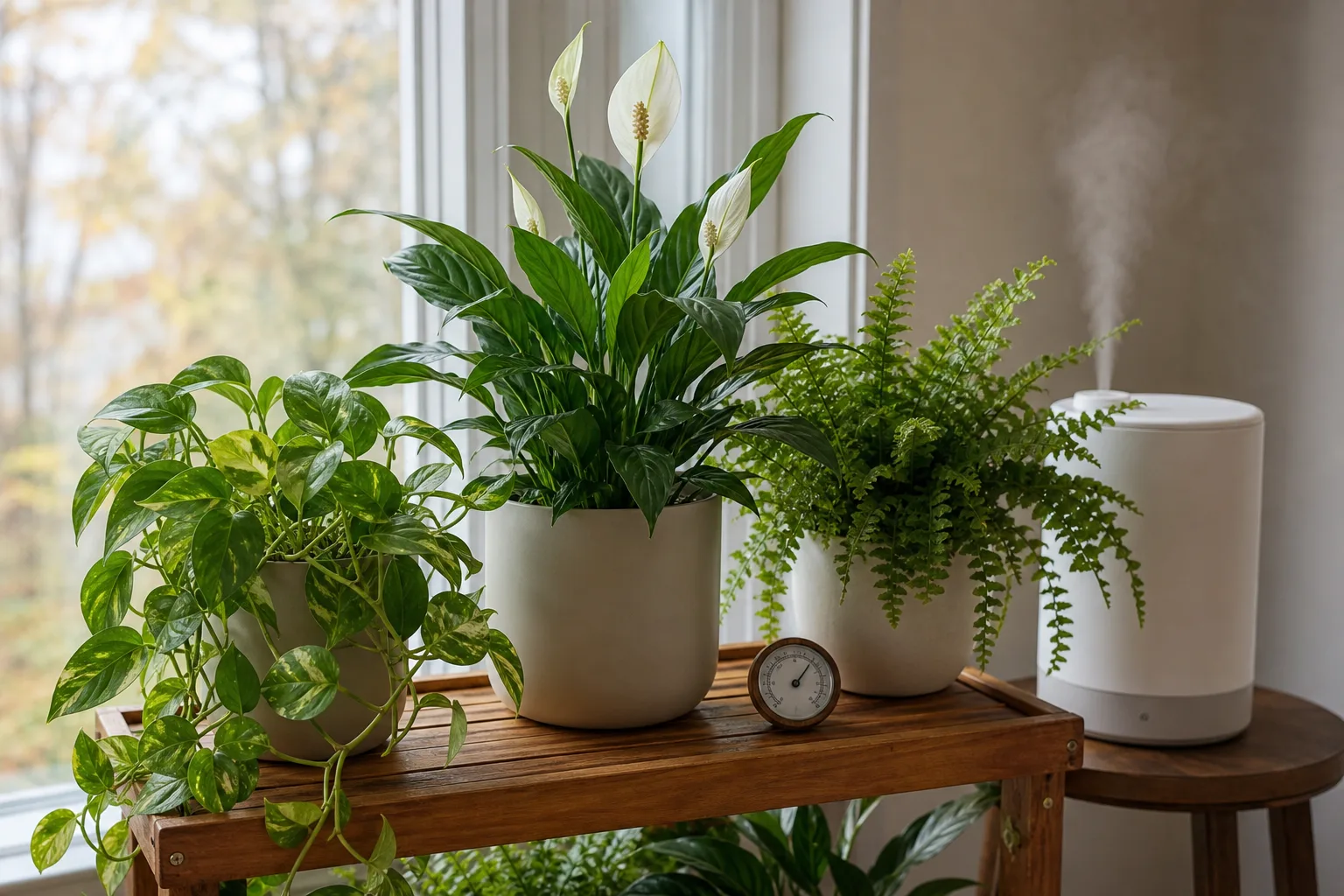
Start early. Move plants closer to windows before days shorten significantly. The gradual transition is less shocking than a sudden move in December when the plant is already stressed.
Reduce watering frequency before the plant shows signs of overwatering. Expect to water 30–50% less often than in summer. Check soil moisture twice a week; water only when the root zone has dried appropriately.
Set up humidity support before the heating season begins. Position a humidifier near the plant cluster and use a hygrometer to track levels. Waiting until leaves are crispy means the plant has already sustained damage.
Inspect for pests weekly from November through March. Dry winter air favors spider mites, and catching an infestation early — before webbing is visible from across the room — makes treatment far easier.
Keep a simple log. Note when you water, when new leaves appear, and when you see changes. A pattern of leaf drop that always starts in late December points to a specific trigger (likely the heating system or the shortest days) that you can address proactively next year.
For a full seasonal routine, see the winter houseplant care checklist. For the diagnostic deep-dive when a plant is already declining with multiple symptoms, see why houseplants struggle in winter.
Related guides
- Why houseplants struggle in winter — diagnostic companion when a plant is declining with multiple symptoms
- Winter houseplant care checklist — weekly maintenance routine for stable plants
- Why is my plant drooping? — underwatering vs overwatering diagnosis
- Why are my indoor plant leaves turning yellow? — yellow-leaf diagnosis and fixes
- Houseplant humidity guide — sustained humidity strategies
- Grow lights complete guide — when natural light is not enough
- Integrated pest management indoors — pest identification and escalation
- Root rot in houseplants — identification and recovery
- How to water indoor plants the right way — moisture checks and watering methods
- Indoor plant watering basics — one-screen watering cheat sheet
Conclusion
Plants drop leaves in winter because four environmental changes — lower light, drier air, slower water use, and colder microclimates — converge on them at the same time. The leaf on the floor is the end of a chain, not a diagnosis. Work backward: check the soil first, then light, then temperature, then humidity, then pests.
Most winter leaf drop is reversible. Correct the clearest mismatch, give the plant stable conditions, and watch new growth — not the old leaves — for signs of recovery. A plant that loses a few leaves in December but pushes out healthy growth in March has done what it needed to survive the season.
When a plant is dropping leaves alongside other symptoms — yellowing, wilting, mushy stems, or widespread decline — switch to the why houseplants struggle in winter diagnostic guide for the full symptom → environment → fix chain.



