How to Grow and Care for Potted Magnolia Trees
Grow a magnolia tree in a pot with cultivar advice, a root-friendly container setup, practical watering cues, and a winter plan for your climate.
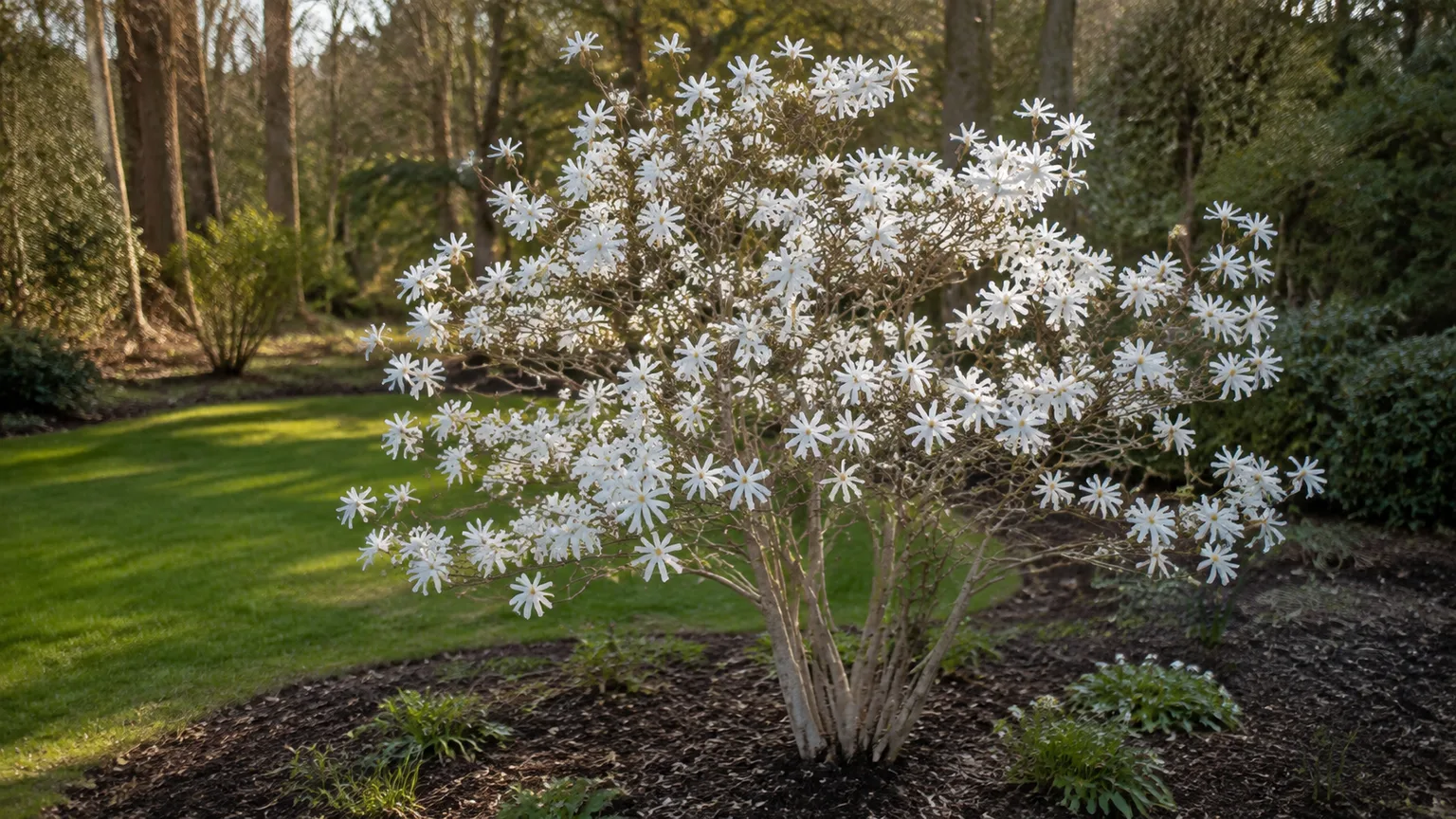
A magnolia can make a patio feel like a garden, but keeping one in a container takes more planning than setting a nursery pot inside a decorative planter. The right plant must stay reasonably compact, the pot has to drain freely, and its exposed roots need more protection from heat, drought, and winter cold than roots in the ground.
Choose the magnolia for its eventual size and your climate first. Then make the container large and stable enough for the root ball, keep the mix evenly moist rather than wet, and accept that a tree in a pot will eventually need its root zone refreshed or a place in the ground.
Can you keep a magnolia in a pot?
Yes. Compact magnolia forms can grow and flower in a container when they receive outdoor light, consistent moisture, a roomy root zone, and winter care suited to the cultivar. The Royal Horticultural Society notes that compact magnolias can grow successfully in containers, while its general tree guidance warns that vigorous trees can become leggy when their roots are confined. Those two facts belong together: magnolia-in-a-pot is possible, but not every small nursery specimen is a permanent patio tree. (RHS magnolia growing guide; RHS trees in containers)
Container culture can help if your garden soil is strongly alkaline or your planting area is small. It also makes watering, feeding, and root-temperature swings your responsibility. A healthy potted magnolia is an outdoor tree in a managed root environment, not a houseplant; a warm, dim living room is not a substitute for the light and seasonal cycle it needs.
The most realistic expectation is a slow-growing ornamental that remains compact for longer than it would in the ground, not a naturally tiny bonsai. If you cannot eventually provide a larger container or plant it out, choose one of the smallest cultivars you can verify and treat the mature dimensions on its label as a serious space requirement.
Choose a compact magnolia that fits your climate
Magnolia labels often emphasize flower color and hardiness zone, but the container decision depends just as much on mature height, spread, evergreen versus deciduous foliage, bloom timing, and how much winter protection you can provide. Check the cultivar name rather than relying on “dwarf” or “patio” in a sales description. A plant that reaches 8 to 12 feet in the landscape is still a small tree, not a tabletop shrub.
Strong candidates for containers
| Magnolia | Why it may fit | What to plan for |
|---|---|---|
| Lily magnolia hybrids such as ‘Ann’ | Compact habit and showy spring flowers; a useful starting point for a smaller patio tree | Verify the exact cultivar’s mature spread; flowering branches can still outgrow a small balcony |
| Star magnolia and selected cultivars | Deciduous habit, fragrant white or pale-pink spring flowers, and broad availability | Early flowers can be browned by late frost; allow room for a multi-stem canopy |
| ‘Genie’ and other compact hybrids | Upright growth and richly colored flowers can suit a narrow space | Compact does not mean root-restricted; plan a substantial, stable final pot |
| ‘Little Gem’ or another compact southern magnolia | Evergreen foliage and large white blooms | It remains a much larger tree over time and needs a warm-enough climate or careful root protection |
These are candidates, not guarantees. Better Homes & Gardens’ horticultural review describes the smallest magnolias as commonly reaching roughly 8 to 12 feet, and identifies ‘Ann’, star magnolia, and ‘Little Gem’ among container options; the actual dimensions and zones vary by selection. For that reason, use the label from the nursery selling your named cultivar, then cross-check it against an extension or botanical reference rather than assuming a generic species profile fits every hybrid. (Better Homes & Gardens’ container magnolia advice; NC State Extension’s Magnolia profile)
The choice between deciduous and evergreen forms changes the winter plan. A deciduous magnolia drops its leaves and can overwinter in a cool, protected place with less light than an evergreen tree; an evergreen keeps transpiring foliage through winter and needs a sheltered outdoor site with enough light and moisture. Either way, its published hardiness zone is not a promise that an exposed pot will tolerate the same low temperature as roots insulated by garden soil.
Choose the spot before you buy
Magnolias generally perform best in sun or light shade with shelter from drying wind. Larger species usually flower best in full sun, while some smaller types tolerate dappled or partial shade; a hot, reflective patio may benefit from afternoon shade so the pot and root ball do not bake. NC State Extension describes magnolias as preferring fertile, acidic, moist but well-drained soil and notes that smaller species can tolerate more shade than larger ones. (NC State Extension’s Magnolia profile)
Look at the site at midday and again late in the afternoon. A north-facing balcony may keep a spring-flowering tree alive but produce sparse growth or few flowers; a west-facing concrete terrace may dry the container rapidly and heat the roots. Wind can also tip a tall canopy or desiccate evergreen leaves, so place the pot where a wall or railing reduces exposure without blocking all the light.
An early-flowering star or lily magnolia can bloom before the last cold snap. If spring frost is common where you live, choose a later-flowering selection or place the tree where you can temporarily move it under a porch roof or cover the buds during a frost warning. Even a hardy tree can lose that year’s display when open flowers freeze. (RHS magnolia growing guide)
Set up the container correctly
Start with a container that will stay outside for the tree’s growing season and drain without a saucer holding water underneath it. A pot sitting in standing water can keep fine roots oxygen-starved even when the surface looks dry. Elevate it on pot feet or blocks, and confirm that rain can leave through the holes rather than pooling on a sealed patio.
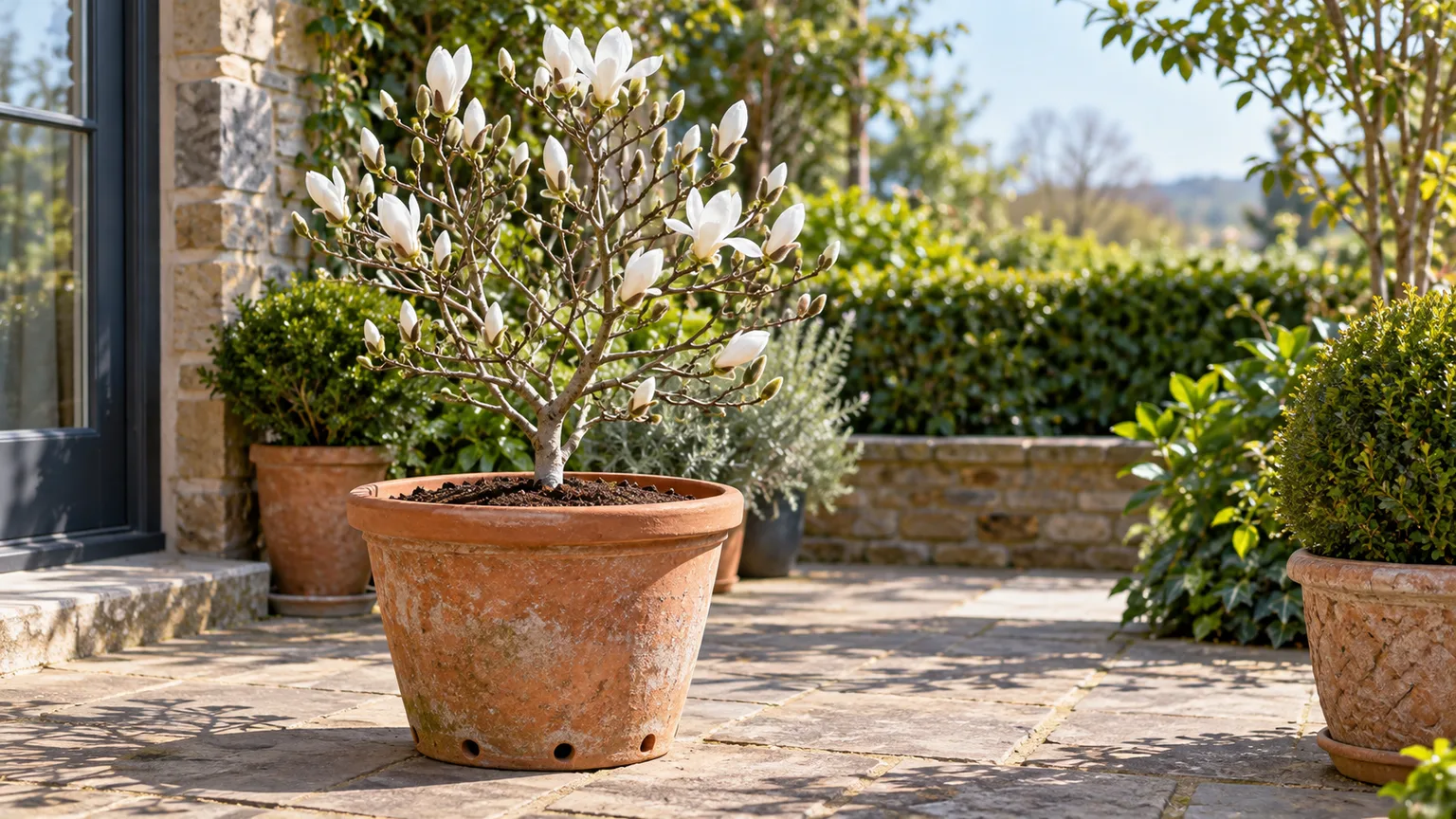
Pick a pot that balances root room and stability
Use a wide, stable pot with several open drainage holes. Heavy frost-resistant terracotta, stone, or a weighty resin planter helps prevent a canopy from toppling in wind, but a heavy pot is difficult to move; if you need to winter the tree in a garage, a sturdy wheeled caddy is easier to plan before the pot is full. John Moore, a professional gardener writing about magnolias in pots, similarly recommends a wide, heavy container and potting up in stages. (Pyracantha’s magnolia-in-pots guide)
Do not jump from a small nursery pot into the largest planter you can find. The RHS recommends increasing container size in stages and gives about 45 cm (18 inches) as a minimum final size for many trees; the appropriate pot for a magnolia depends on its cultivar, root ball, and canopy. Start with a container only moderately wider than the root ball, then move up when the roots actually need more room. (RHS trees in containers)
Plant without burying the root flare
Use a moisture-retentive but open, well-drained mix intended for long-lived woody plants. A loam-based container compost can provide more weight and stability than a very light mix; add organic matter only if the mix needs it, and do not use dense garden soil that can compact in a pot. Magnolias often prefer slightly acidic to neutral conditions, but not every species has the same pH tolerance, so do not add an acidifier automatically. RHS guidance says many magnolias prefer slightly acidic or neutral soil while some tolerate chalkier conditions; NC State notes that high-pH soil can lead to chlorosis. (RHS magnolia growing guide; NC State Extension)
Before planting, slide the root ball from its nursery pot and check for thick roots circling the outside. If they are only lightly circling, loosen a few gently; if a dense mat is wrapping the root ball, use a clean, sharp blade to shave or cut the outer ring so new roots can grow outward. Penn State Extension recommends correcting circling roots on container-grown trees before planting rather than letting them keep winding around the trunk. Make the smallest correction that opens the root ball, because a magnolia is not a good candidate for rough bare-root handling. (Penn State Extension’s container-root guidance)
Set the tree so the root flare and original soil line remain visible at the surface. Backfill around the roots without packing the mix hard, water slowly until it drains, and replace settled mix if needed. A thin organic mulch layer helps slow evaporation, but keep it a finger-width away from the trunk; drainage holes and an airy mix matter more than placing a deep layer of stones or broken pottery under the roots.
Water by checking the root zone
The right watering frequency changes with sun, wind, pot material, root size, and season. Instead of watering by a weekly calendar, check the top inch or two of mix with a finger or a wooden skewer and then feel deeper if the surface has dried. If the root zone is still cool and damp, wait; if it is becoming dry throughout, water before the tree wilts.
When it is time, water slowly over the entire surface until a steady stream runs from the drainage holes. A fast splash can travel down the pot wall and leave a compacted root ball dry in the center, so pause and water again if the mix initially repels moisture. Empty any saucer after the excess drains, and do not let the root ball alternate between bone dry and saturated.
During the first growing season after potting, check more often because the roots have not filled the new mix. In hot or windy weather, a large potted magnolia may need checking every day even when it does not need water every day. Winter is slower, not water-free: a dormant deciduous tree uses less, while an evergreen still loses moisture, and both can dry in a rain shadow beside a wall. The RHS likewise warns that container trees dry faster than in-ground trees and may need several waterings to wet the full depth. (RHS trees in containers)
Feed during active growth
Container mix contains less long-term nutrient reserve than garden soil, so a potted tree may benefit from a measured spring feeding. If the original potting mix contains controlled-release fertilizer, wait until its label says the charge has run down before adding more. Otherwise, top-dress with fresh container compost in spring or use a balanced, slow-release fertilizer labeled for woody ornamentals, following the package rate rather than adding a stronger dose to force blooms.
Do not feed a newly potted magnolia heavily just because it looks slow during establishment. Fertilizer cannot correct low light, blocked drainage, root damage, or a pot that is too small. A tree that is still making soft growth late in the season is not asking for an autumn boost; NC State Extension notes that excess nutrients and favorable fall conditions can extend growth and leave woody nursery plants more vulnerable to early cold. (NC State Extension’s winter preparation guidance)
Avoid feeding a stressed root ball until you have checked its moisture and drainage. If leaves are yellow, test the mix pH or inspect the roots before choosing fertilizer, since high pH can limit nutrient uptake and waterlogged roots cannot use nutrients normally. The fix should match the cause rather than the leaf color alone.
Prune lightly and at the right time
Most magnolias need very little pruning. Remove a broken, dead, or crossing branch with a clean cut, and avoid shaping the tree into a tight ball simply to compensate for choosing a cultivar that is too large. Heavy cuts can remove future flowers, spoil the natural silhouette, and leave a tree with more recovery work than a container can easily support.
For deciduous magnolias, the RHS recommends pruning only when needed and timing it from midsummer to early autumn; late-winter or early-spring cuts may bleed sap. If you want to make a light shape correction, wait until flowering is over and cut back to a natural fork rather than leaving a stub. For evergreen magnolias, prune sparingly as well; the best timing can differ by form, so check the named cultivar before making a substantial cut. (RHS magnolia pruning guidance)
If your tree needs repeated hard reduction to fit its patio, treat that as a mismatch between the cultivar and the site. The RHS advises spreading any renovation over several years because magnolias can be slow to recover. A larger future pot, a permanent spot in the ground, or a smaller replacement is usually a better long-term plan than annual topping. (RHS magnolia growing guide)
Repot when roots or watering tell you to
There is no useful universal repotting date for every magnolia. Look for several clues together: dense roots circling the pot, roots emerging from drainage holes, the tree drying out much faster than it used to despite thorough watering, or several seasons of weak growth despite suitable light and care. A root or two at a drainage hole alone does not mean the tree needs emergency surgery.
When it is time, repot in early spring before strong new growth begins, while the tree is still manageable. Move up one pot size rather than doubling the container, preserve as much healthy root ball as possible, correct any tight circling roots, and return the tree to the same planting depth. If the tree is too large to handle safely, ask a qualified nursery or arborist whether selective root pruning is appropriate instead of making large cuts on impulse.
A magnolia that has reached the largest pot you can safely place and water may be ready for planting out, not another drastic pruning cycle. If you keep it in the same container, refresh the surface compost each spring and monitor for roots re-forming a dense ring. The RHS describes staged potting and annual top-dressing as standard container-tree maintenance, with larger changes depending on the plant and pot. (RHS trees in containers)
Protect the pot through winter
Winter survival depends on more than the zone printed on the cultivar label. In a garden bed, surrounding soil buffers root temperatures; in a container, roots near the outer wall are exposed to freezing and thawing from several sides. The RHS specifically advises winter protection for container trees in exposed sites because roots near the edges can freeze, and NC State’s nursery guidance explains that woody plants must acclimate gradually to cold. (RHS trees in containers; NC State Extension winter preparation)
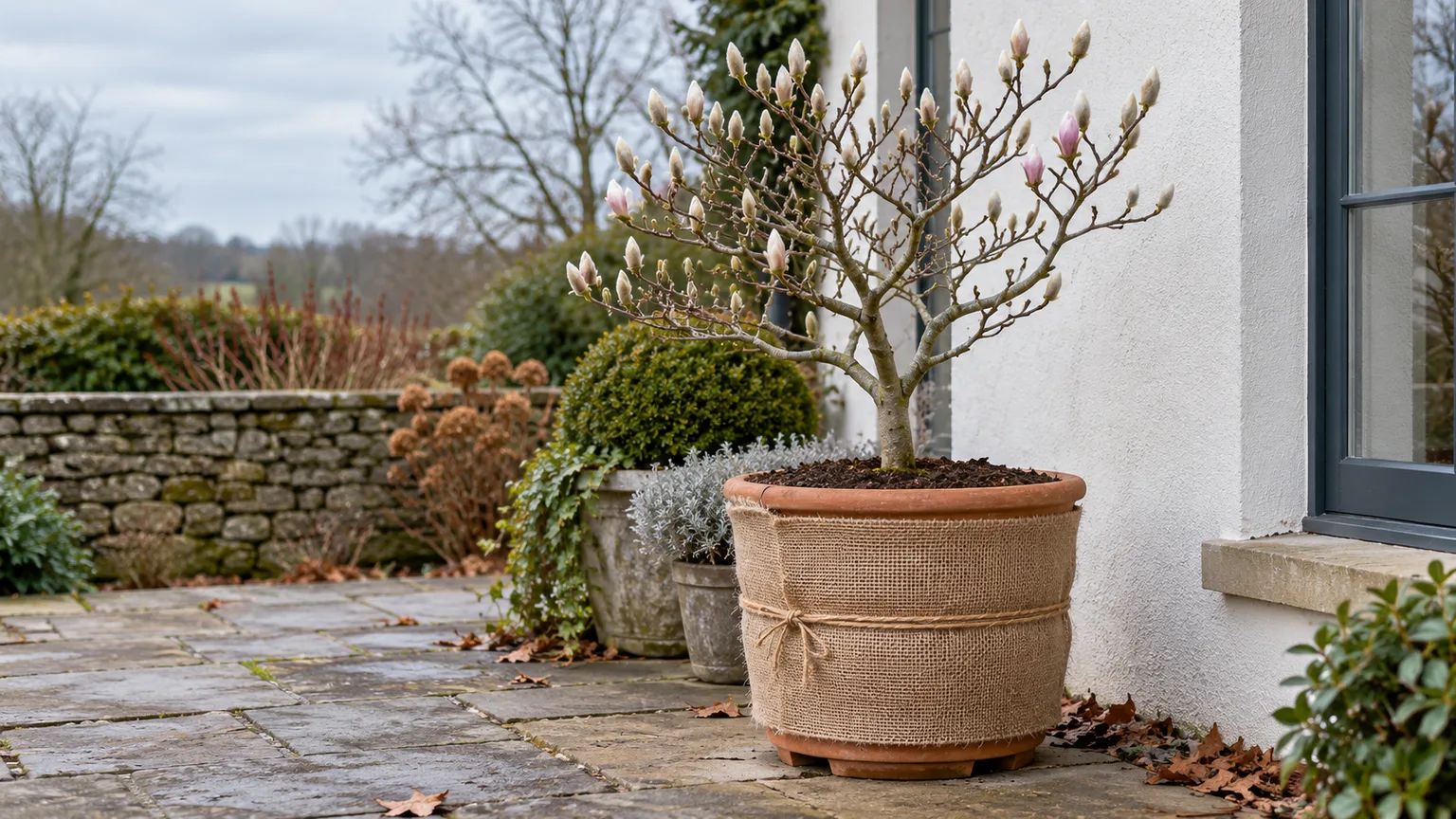
Before a hard cold spell, move the pot to a sheltered, unheated spot against a wall, group it with other containers, or wrap the sides in breathable insulation such as hessian. Insulate underneath if the container sits on cold paving, but keep the drainage holes open. A deciduous magnolia can rest in a cool unheated garage for a severe stretch if the root ball will otherwise freeze; an evergreen magnolia still needs light and should not be shut in a dark space for an entire winter.
Check moisture during mild winter weather and water when the root ball is beginning to dry, then allow excess to drain fully. Do not water frozen mix or leave the pot standing in rainwater. In spring, remove insulation as severe cold passes so the container can drain and warm gradually, and protect early flowers from late frosts rather than moving a dormant tree into a heated room.
Troubleshoot pale leaves, stress, and missing blooms
A single symptom rarely identifies the cause. Look at which leaves are affected, how wet the mix is below the surface, whether the pot drains freely, and whether the change followed heat, a freeze, repotting, or fertilizer. Correct the root-zone or site problem first, then give the tree time to respond instead of stacking several treatments at once.
Yellow leaves and pale new growth
New magnolia leaves can emerge pale and darken as they mature. If older leaves remain yellow while the veins look greener, suspect chlorosis caused by alkaline mix or water before assuming the tree needs more fertilizer; NC State Extension lists chlorosis in high-pH soils as a magnolia problem. Check drainage and the pH of the container mix, and test before applying acidifying products, which can push the root zone too far in the other direction. (NC State Extension’s Magnolia profile; RHS magnolia growing guide)
If the whole tree yellows while the mix stays soggy, inspect the drainage holes and the root ball instead. A pot without open holes, a saucer that never empties, or dense mix can suffocate roots; adding fertilizer will not correct that. Allow the mix to begin drying between thorough waterings, but do not let the tree reach a prolonged wilt.
Sticky leaves, shiny patches, or black sooty growth on branches can indicate magnolia scale rather than a soil problem. NC State Extension describes scale feeding as a source of honeydew, which can make foliage sticky and support sooty mold. Look closely along twigs for scale insects and seek a local extension diagnosis before choosing a treatment, because timing and pesticide labels vary by place and plant size. (NC State Extension’s magnolia scale factsheet)
Wilting, brown edges, or no flowers
Wilting with dry, lightweight mix points to a dry root ball; water slowly until the entire root zone is wet. Wilting when the mix is already wet points the other way: check for blocked holes, standing water, or a sour-smelling root zone before adding more. Crisp brown edges can follow heat, wind, or missed watering, while a sudden scorch after a cold snap can mark winter injury rather than fertilizer deficiency.
If the tree grows leaves but rarely flowers, first check how much sun reaches the canopy and whether it is an early bloomer exposed to spring frost. A recently planted or repotted magnolia may take several seasons to settle before flowering; heavy pruning, excessive nitrogen, or removing buds at the wrong time can also reduce bloom. The RHS notes that flowering can be delayed while a magnolia establishes and that early flowers are especially vulnerable to frost. (RHS magnolia growing guide)
Know when a magnolia no longer suits the pot
A tree can be healthy and still be in the wrong container for its mature size. If the root ball fills the pot soon after every repot, the canopy becomes top-heavy, watering becomes a daily emergency, or the next pot is too heavy for the patio, stop treating severe pruning as the solution. Those are practical signs that the cultivar needs more ground space or a new home.
Planting it out is most successful while the tree is still small enough to move with a generous root ball. Choose a sheltered site with suitable soil and light, and remember that magnolias are slow to recover from major root or canopy damage. If there is no suitable planting spot, a compact replacement may be kinder to both the tree and the gardener than keeping a large magnolia confined indefinitely.
Conclusion
Potted magnolias do best when the cultivar is genuinely compact, the outdoor site is bright and sheltered, and the container gives roots enough room without staying waterlogged. Set the tree at its original depth, water according to the moisture in the root ball, feed modestly while it is growing, and prune only when there is a clear reason.
The long-term question is whether you can protect and refresh the root zone as the tree matures. If you plan for winter insulation and eventual repotting or planting out before you buy, a magnolia can become a lasting patio feature instead of a tree that outgrows its pot after a few seasons.