9 Rudbeckia Varieties for Sunny Garden Borders
Compare nine Rudbeckia varieties by flower color, height, species, and garden use, then choose the right one for a border, container, or naturalized patch.
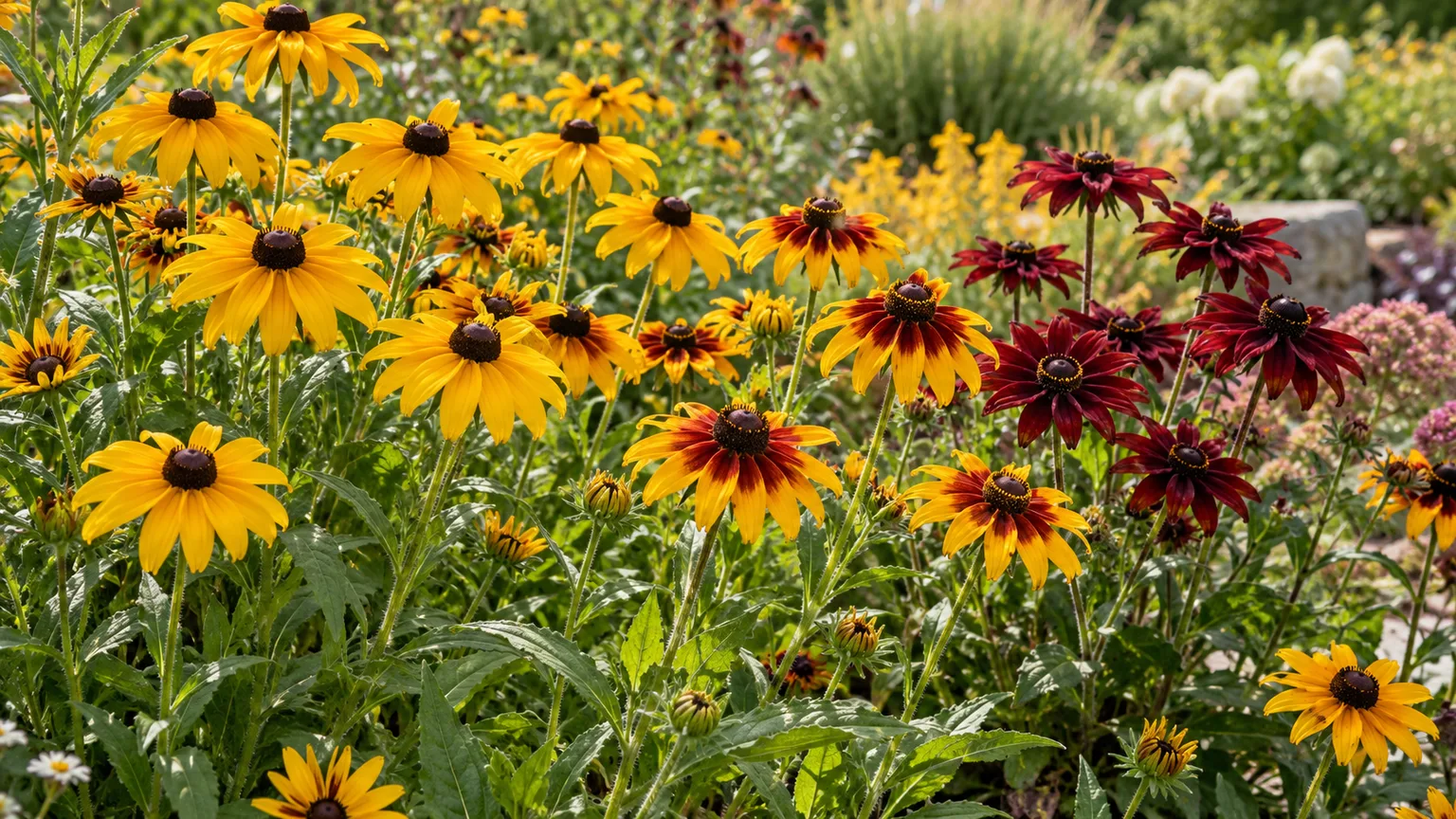
“Black-eyed Susan” can mean more than one plant. Some popular Rudbeckias are short-lived flowers that reseed themselves, others form longer-lived perennial clumps, and their flower colors range from clear yellow to burgundy, copper, and bicolor. Choosing by the common name alone can leave you with a plant that is taller, shorter-lived, or more self-seeding than you expected.
This guide compares nine named choices by species, mature size, flower appearance, and best garden use. The dimensions below are useful planning ranges, not guarantees: soil, growing season, cultivar strain, and the nursery’s own selection can shift a plant’s final size. In colder or wetter regions especially, read the local grower’s label before treating a catalog hardiness range as a promise.
How to choose between annual color and perennial return
Start with the job you want the plant to do. For quick, high-impact color in a sunny annual bed, several Rudbeckia hirta cultivars flower from seed in their first season and can make a strong summer display. They may survive longer in a suitable climate, but this species is often annual, biennial, or short-lived perennial; many gardens keep it going through seedlings rather than one plant living for years. North Carolina State Extension describes R. hirta as a biennial or short-lived perennial that blooms in its first year from early-spring seed and self-sows readily (NC State Extension).
If you want a more persistent perennial framework, look beyond the black-centered annual-style daisies. The list includes R. triloba ‘Prairie Glow’, a branching, short-lived perennial that can reseed, and R. maxima, a tall perennial with distinctive blue-green leaves. These are not interchangeable with R. hirta: their heights, persistence, and visual roles differ, and local moisture and winter conditions still matter.
The botanical name after the cultivar is therefore a useful buying check. A cultivar is a selected, named form of a species; “variety” is commonly used in garden conversation for it, even though botanists use variety more narrowly. A plant tag reading R. hirta ‘Cherry Brandy’ tells you more about its likely behavior than “red black-eyed Susan” alone.
Nine Rudbeckia varieties at a glance
| Selection | Species | Typical height | Flower look | Best fit |
|---|---|---|---|---|
| ‘Indian Summer’ | R. hirta | 2–3 ft | Very large yellow rays, dark center | A bold focal patch or cut flowers |
| ‘Prairie Sun’ | R. hirta | About 2.5–3 ft | Green cone, golden rays, pale tips | A strong-stemmed sunny border |
| ‘Moreno’ | R. hirta | 1–1.5 ft | Burgundy and orange | Front of a border or a pot |
| ‘Irish Eyes’ | R. hirta | About 2–2.5 ft | Yellow rays, yellow-green center | A bright color contrast |
| ‘Cherokee Sunset’ | R. hirta | 2–2.5 ft | Single to double flowers in warm shades | Cutting and mixed-color beds |
| ‘Maya’ | R. hirta | 1–2 ft | Frilly, double yellow petals | Containers and short borders |
| ‘Prairie Glow’ | R. triloba | 3–4 ft | Red-orange petals with yellow tips | A loose, late-season back layer |
| ‘Cherry Brandy’ | R. hirta | 1–2 ft | Deep red to maroon | A compact color accent |
| Giant coneflower | R. maxima | 5–7 ft | Yellow rays and a tall dark cone | A large border or naturalistic planting |
Descriptions and measurements vary among seed companies and regions, so use the table to narrow your choices, then confirm the plant tag. If a certain height is essential—for a container, narrow path, or front-of-border position—buy a labeled cultivar from a grower that gives a mature size rather than assuming every “black-eyed Susan” stays within the same range.
‘Indian Summer’: oversized golden flowers
Choose ‘Indian Summer’ when you want the classic golden daisy shape at a larger scale. Its yellow rays surround a dark center, and mature flowers can reach roughly 6 to 9 inches across; plants commonly reach about 2 to 3 feet. The Missouri Botanical Garden lists it for USDA Zones 3–7 and notes that it can be grown as an annual, biennial, or short-lived perennial, with first-year bloom and free self-seeding (Missouri Botanical Garden Plant Finder).
That combination makes it useful when you want a conspicuous patch quickly, but its large flower heads can look top-heavy in a crowded planting. Give it open air around the foliage, and avoid pushing it with high-nitrogen lawn fertilizer; lush growth and close spacing make foliage more prone to mildew. Deadheading delays seed formation and can extend the show, while leaving a few heads is a simple way to let the patch renew itself.
A naming note: Missouri Botanical Garden cautions against using the same phrase as a weather expression because it can be disrespectful to Native peoples. The cultivar is still sold under its established name, so here it appears only as a plant name, not as a casual seasonal phrase.
‘Prairie Sun’: green centers and pale petal tips
‘Prairie Sun’ gives a more unusual version of the familiar daisy: a green central cone, rich yellow rays, and lighter, almost cream-toned tips. Fleuroselect describes its upright stems, weather resistance, and flowering from summer into fall; it also records the cultivar’s award recognition, including an All-America Selections award (Fleuroselect cultivar profile). A plant height around 30 inches makes it tall enough to read across a border without dominating it.
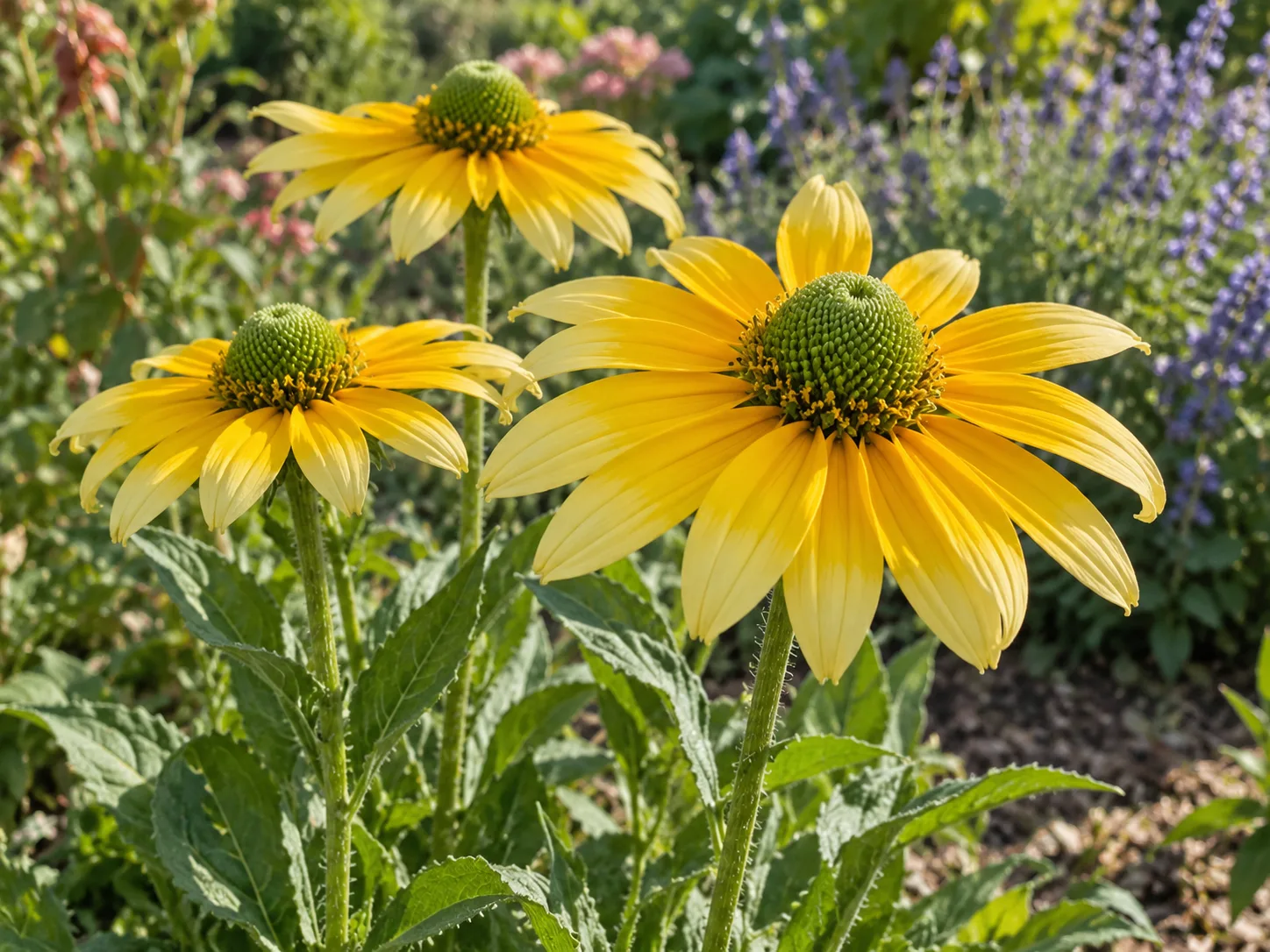
Use this cultivar where the unusual center will be visible: in a small group near a path, among blue or purple flowers, or in a cut-flower row. Its color contrast is subtle at a distance, so it is less effective as a single tiny plant at the far back of a deep bed. Like other R. hirta selections, it is a dependable source of first-season flowers, but plan on possible reseeding rather than guaranteed return of the same crown.
‘Moreno’: compact flowers in autumn shades
‘Moreno’ suits gardeners who want the warm, darker palette of a gloriosa daisy but do not have room for a tall specimen. Its petals combine burgundy, bronze, and orange tones, and its compact habit is generally listed around 12 to 18 inches. Set it near the front of a sunny border or use it to give a patio pot a richer focal color than the usual clear yellow.
The compact form is the main reason to choose it; it is not a permanent edging plant just because it is short. It belongs to R. hirta, so treat it as a seasonal accent that may reseed, not as a tidy groundcover that will steadily fill every gap. Leave enough room for air around the foliage, and remove only the flowers you do not want to turn into seed heads.
‘Irish Eyes’: yellow blooms with a light center
‘Irish Eyes’ is an easy way to change the familiar dark-centered look without switching to a dramatically different flower color. Its yellow petals frame a greenish-yellow central disk, and plants reach roughly 2 to 2.5 feet in many listings. The softer center reads best at close range, making it a good choice beside a path or at the middle of a mixed border.
This is also a useful option if your palette already includes green flowers, chartreuse foliage, or pale purple companions. Do not choose it on the assumption that every Rudbeckia is equally drought-proof: R. hirta tolerates some dry spells once established, but flowering and container plants still benefit from steady moisture. In a pot, use a free-draining mix and check it more often during hot, windy weather.
‘Cherokee Sunset’: double flowers in warm tones
‘Cherokee Sunset’ is the choice for a fuller, less wildflower-like flower head. Its blooms range through yellow, orange, bronze, and mahogany, with many semi-double or double forms that read more like informal dahlias than simple daisies. At about 2 to 2.5 feet, it sits comfortably in the middle of a border and supplies stems for cutting.
The added petals give the planting a richer look, but they can make the flower heads visually heavier than single forms. Combine it with simpler flowers and fine-textured grasses so the bed does not become a wall of dense, similar blooms. Like other named R. hirta cultivars, it may self-sow, but offspring from saved seed are not guaranteed to reproduce the parent’s flower form or color exactly.
‘Maya’: a compact double-flowered choice
‘Maya’ offers a neat, double-flowered look on a relatively short plant. Its layered yellow petals and reddish-brown center bring a mum-like texture to a container or the front half of a border, and horticultural variety guides place it around 1.5 to 2 feet tall (Plantura’s Rudbeckia species and varieties guide). That makes it a practical option when you want visual fullness without the height of ‘Indian Summer’ or giant coneflower.
Double flowers can make a small space feel more saturated, so use them as punctuation rather than repeating them in every container. They also give pollinators a different flower form to work around than open single blooms; if wildlife value is your first priority, mix double selections with single-flowered plants and other nectar-rich species rather than relying on one cultivar alone.
‘Prairie Glow’: a branching brown-eyed Susan
‘Prairie Glow’ belongs to Rudbeckia triloba, not R. hirta. It carries smaller, abundant flowers on a branching plant, with red-orange petals tipped in yellow that can shift toward bronze as blooms age. The RHS profile describes it as a bushy, short-lived perennial with dark stems, and Plantura lists a height of roughly 3 to 4 feet and a late-summer-to-autumn flowering period (RHS plant profile, Plantura variety guide).
Use ‘Prairie Glow’ where its branching habit has room to mingle with ornamental grasses or other late-season flowers. It is not the best pick for a small pot or a sharply clipped border: the airy stems and many blooms create a relaxed, naturalistic effect rather than a compact mound. As with other short-lived Rudbeckias, a patch can persist through seedlings, but the original plant may not behave like a long-lived, clump-forming perennial.
‘Cherry Brandy’: burgundy color in a low frame
For the deepest red in this group, look at ‘Cherry Brandy’. Its flowers are described as cherry-red to maroon, and plants commonly stay around 1 to 2 feet tall, which gives you a rich color without placing a tall stem at the front of the bed. Plantura identifies it as one of the few Rudbeckias with distinctly red flowers, while NC State Extension lists the cultivar among R. hirta selections (Plantura, NC State Extension).
Pair it with ‘Irish Eyes’ or yellow single-flowered Rudbeckias when you want contrast, or use it in a small container where its dark color can be seen up close. It is not as forgiving of dry spells as the most drought-tolerant descriptions might suggest: young transplants and plants in pots need regular checking, especially in warm weather. Water the soil when it begins to dry rather than waiting for repeated wilting, and remove spent blooms if you want to encourage more flowers instead of seed.
Giant coneflower: a tall, blue-green-leaved species
Giant coneflower (Rudbeckia maxima) is the architectural choice. Instead of a compact mass of several dark-centered daisies, it produces a tall stem with a prominent cone, backed by broad, blue-green leaves; established plants can stand roughly 5 to 7 feet tall. NC State Extension recommends average, moist, well-drained soil and full sun, while noting that the species can self-seed and spread by rhizomes in suitable conditions (NC State Extension: giant coneflower).
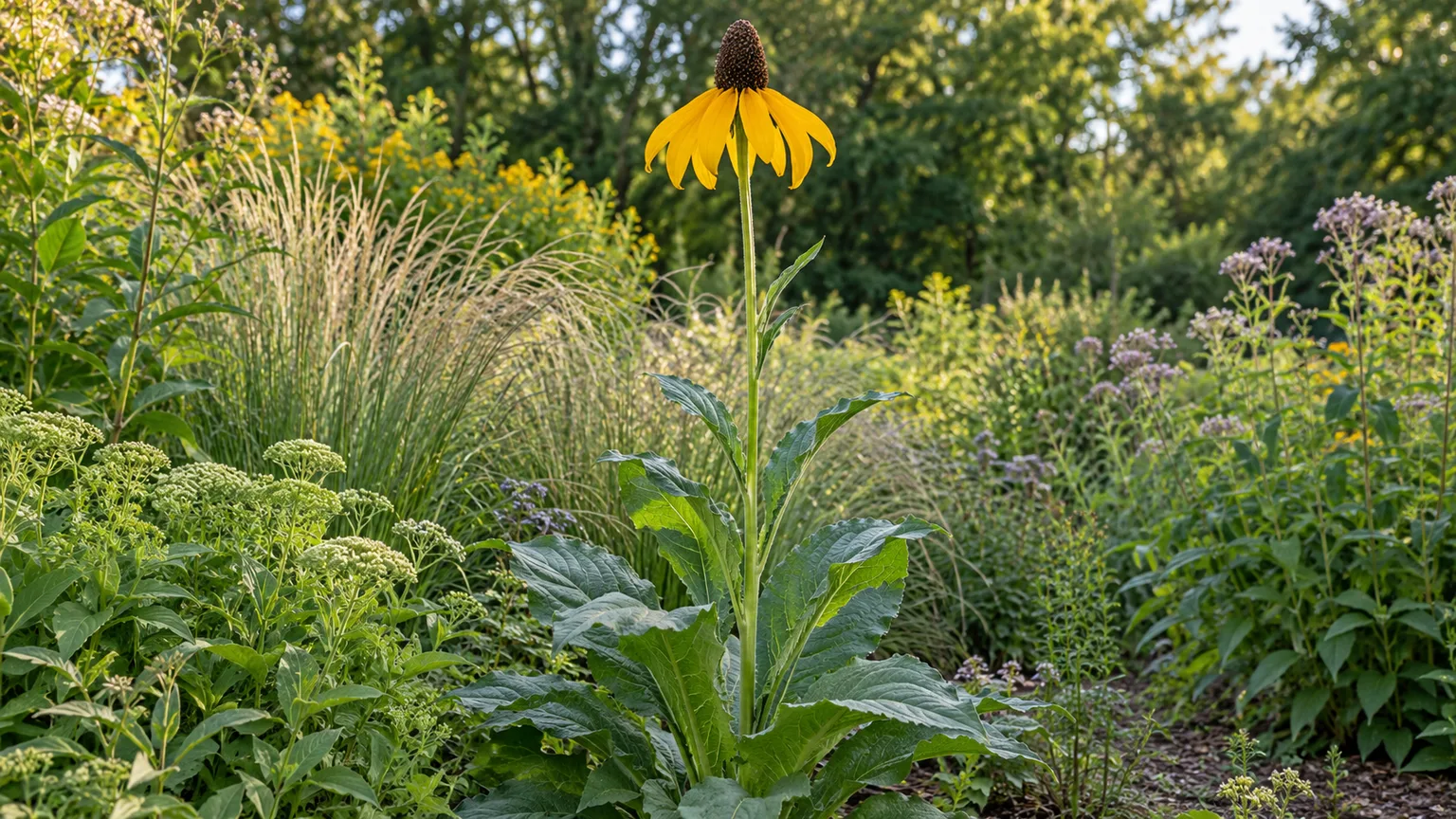
Give it the back of a large sunny border, a naturalized area, or a meadow edge where the unusual foliage and vertical flower stalk are assets. Do not place it where a six-foot plant will shade smaller neighbors or block a window. This species can tolerate some drought once established, but it grows best with more consistent moisture than the reputation of “tough black-eyed Susans” might imply; water during prolonged dry weather, especially during establishment.
Use species to predict how a Rudbeckia behaves
The nine choices fall into three useful groups. Most are R. hirta: showy, first-year flowering plants whose life span is often brief but whose seedlings may keep a patch going. R. triloba ‘Prairie Glow’ branches more freely and is usually treated as a short-lived perennial. R. maxima is a taller perennial with a strong architectural silhouette. The RHS growing guide likewise notes that R. hirta is particularly short-lived and not reliably hardy in some climates, so gardeners often grow it as an annual.
That explains why two people can describe a black-eyed Susan as either “annual” or “perennial” and both be telling the truth about their gardens. A named plant can overwinter in one region and fail in another; seedlings may appear even when the original plant dies. If you need the exact same flower form next season, buy the named cultivar again or keep a labeled seed packet from a source that specifies whether its seed comes true. If you are happy with variation, let a few seed heads mature and edit the seedlings where they emerge.
Do not treat the common names “black-eyed Susan” and “brown-eyed Susan” as dependable species labels. A common name can shift between regions and garden centers, while a dark flower center may be absent in cultivars such as ‘Irish Eyes’. Check the Latin name and cultivar in the label to tell whether you are choosing R. hirta, R. triloba, or the very different giant coneflower.
Sun, soil, and water for reliable flowers
Most Rudbeckias flower best in a bright position with several hours of direct sun. Partial shade can be workable in hot climates, but heavy shade tends to reduce flowering and make upright plants lean toward the light. The RHS guide emphasizes sun and moisture-retentive soil for rudbeckias; NC State describes R. hirta as adaptable to sun or partial shade and a range of well-drained soils. The practical middle ground is a sunny bed where water drains away instead of pooling around the crown.
Water new transplants consistently until their roots establish, then water deeply during a prolonged dry spell. “Drought tolerant” describes a plant’s ability to endure some dryness, not a promise that it will flower well without water. Containers dry faster than garden beds, and the compact cultivars are often the ones people grow in pots, so check the top inch of mix in hot weather and water when it starts to dry. Avoid keeping the root zone saturated; a pot needs drainage holes and a bed needs soil that does not stay waterlogged.
Skip routine heavy feeding unless a soil test or clear deficiency gives you a reason. Excess nitrogen can produce lush leaves and weaker flowering, and plants grown too close together trap humidity around foliage. Space plants according to the mature width on the tag, keep enough air moving through the planting, and choose a better-drained location before trying to fix a persistently wet crown with fertilizer or extra pruning.
Deadheading, seed saving, and self-seeding
Deadheading is a choice, not a requirement. Removing a fading flower before it sets seed keeps the display tidier and can encourage additional bloom; leave some heads on the plant if you want seedlings or winter seed for birds. Cut the flower stem back to a healthy side shoot or leaf rather than clipping only the browned petals, so the plant does not keep an empty stalk in the center of the border. NC State and Missouri Botanical Garden both describe R. hirta as a free self-seeder and note deadheading as a way to limit seed spread.
If you want to control a patch, deadhead most blooms before they dry and pull unwanted seedlings while they are small. Seedlings from a named cultivar may not copy the parent because pollen can come from other flowers and double or unusual colors may not breed true. Let only a few heads mature in a marked area, then thin the young plants next spring to preserve airflow and spacing. If you want reliable color in a formal bed, treat reseeding as a bonus, not your propagation plan.
For seed collection, wait until a selected flower head is dry and brown, then cut it into a paper bag and allow it to finish drying in a ventilated place. Store the cleaned seed cool and dry, and label it with the species or cultivar name plus the collection year. Do not collect from diseased plants, and do not assume a seedling will remain true to a named hybrid or cultivar.
Design with Rudbeckia by height and color
Arrange the plants by both mature height and flower weight. Compact ‘Moreno’, ‘Maya’, and ‘Cherry Brandy’ belong near the front or in containers; mid-height ‘Indian Summer’, ‘Prairie Sun’, ‘Irish Eyes’, and ‘Cherokee Sunset’ can anchor the middle; ‘Prairie Glow’ and giant coneflower need the back or a naturalized area. This stepped arrangement keeps smaller plants visible and gives tall stems space to move without shading every neighbor.
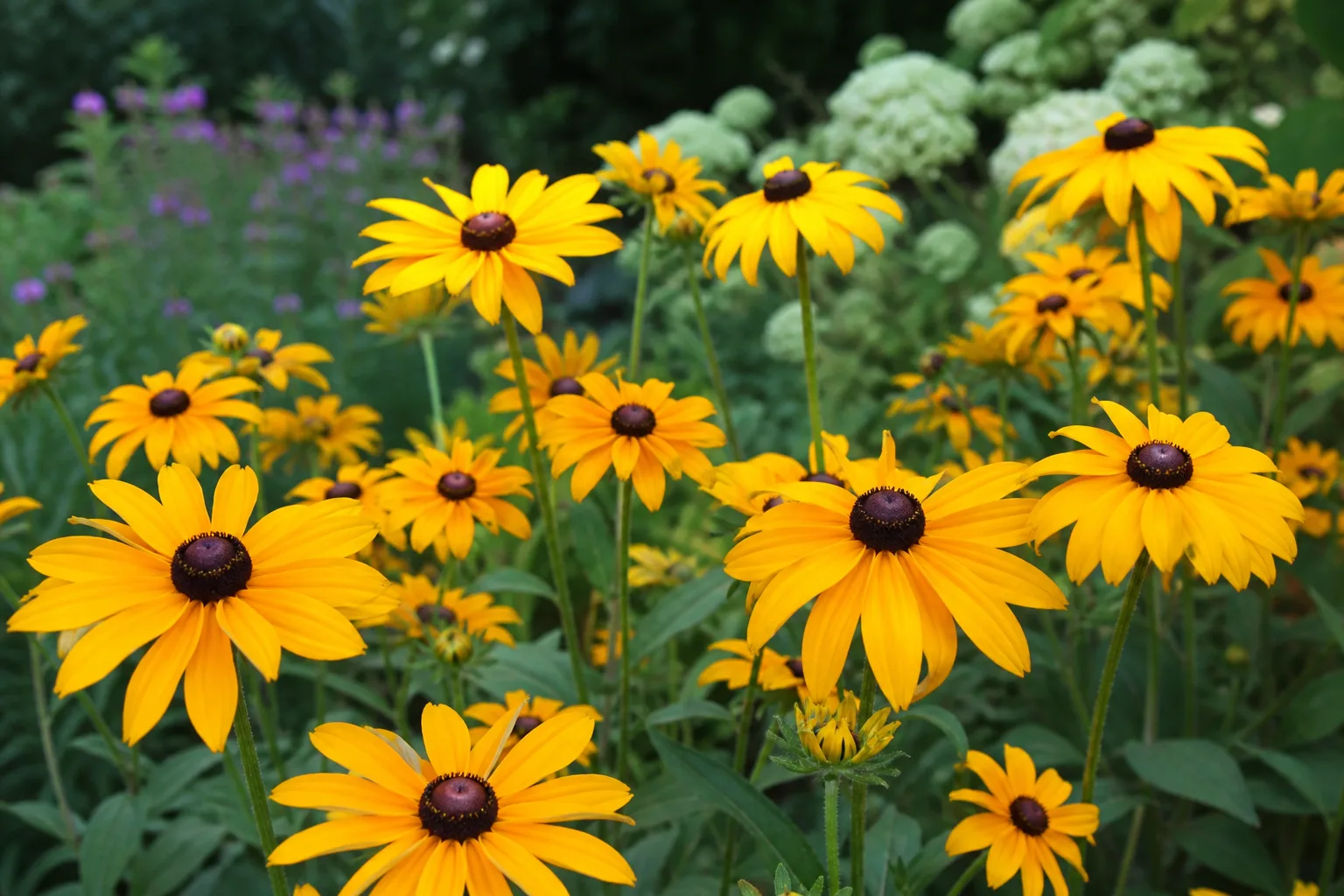
Use yellow cultivars to tie a sunny border together, then choose one or two bronze, orange, or burgundy forms for contrast. Blue and purple flowers cool the palette; fine-textured grasses soften the strong upright stems; small groups of native plants create a less formal meadow effect. Avoid planting every cultivar in a solid mass if you want to notice the differences between the green-centered, double, and red-flowered forms.
For pollinators, include open single flowers and a succession of other bloom types rather than expecting one named Rudbeckia to feed a garden all season. NC State Extension notes that R. hirta attracts insects and pollinators and also serves as a larval food plant for certain butterflies. Leaving some mature seed heads adds winter structure and can provide seed for birds, while the flowers that you deadhead can keep the border looking fresh.
Conclusion
Choose a Rudbeckia by the garden role you need, then use its species name to set realistic expectations. ‘Moreno’, ‘Maya’, and ‘Cherry Brandy’ bring compact color; ‘Prairie Sun’ and ‘Irish Eyes’ alter the familiar flower center; ‘Indian Summer’ and ‘Cherokee Sunset’ deliver bigger or fuller blooms; ‘Prairie Glow’ and giant coneflower add height and a looser perennial character.
The key distinction is whether you want a cultivar that gives you a brilliant first season or a perennial framework that returns more predictably. Many R. hirta plants renew themselves by seed rather than living for years, so let a few seedlings stay if you want the patch to continue. Check local labels for final size and hardiness, provide sun with good drainage, and choose the flower form that suits the space you actually have.