How to Grow and Care for Sassafras Trees
Sassafras is easy in the right place. Learn where to plant it, how to manage root suckers, when to water, and why safrole makes ingestion unsafe.
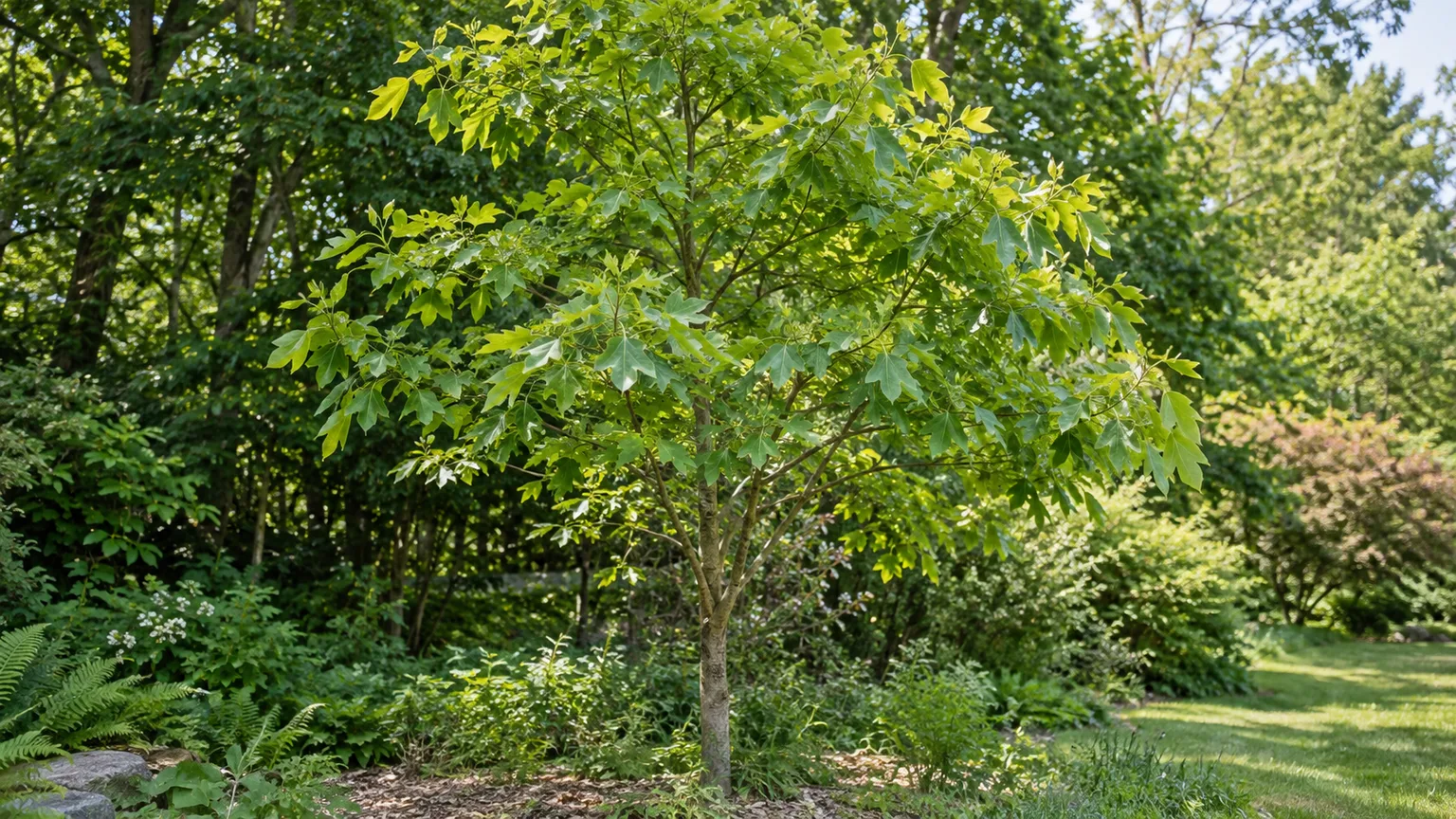
Sassafras (Sassafras albidum) is a native eastern North American tree with an unusually strong sense of place. Its aromatic leaves come in unlobed, mitten-shaped, and three-lobed forms; spring flowers are followed on female trees by blue-black drupes; and the canopy can finish the season in yellow, orange, red, or purple. It can also spread by root suckers, so the same trait that makes it useful for a naturalized grove can make it a nuisance beside a formal lawn.
The best way to grow sassafras is to decide what you want before planting: one managed specimen or a colony that can occupy a woodland edge. Put it in soil that drains, give it sun or bright dappled shade, water it through establishment, and resist the urge to move an older tree. The North Carolina Extension Gardener Plant Toolbox summarizes the central trade-off well: sassafras is drought tolerant once established, but its taproot makes established plants difficult to transplant and its suckers can form thickets. North Carolina Extension Gardener Plant Toolbox
Sassafras at a glance
| Feature | What to plan for |
|---|---|
| Botanical name | Sassafras albidum (Nutt.) Nees |
| Habit | Deciduous tree or large shrub; often colony-forming |
| Mature landscape scale | Commonly a medium-sized tree, with size shaped by climate, site, and whether suckers are retained |
| Light | Full sun to partial shade; bright woodland-edge light is a useful middle ground |
| Soil | Moist but well-drained sandy or loamy soil; slightly acidic conditions are usually easiest |
| Water | Regular deep watering while young; much less supplemental water after establishment |
| Flowers and fruit | Male and female flowers occur on separate trees; only pollinated female trees fruit |
| Main management issue | Root suckers that can turn a specimen into a thicket |
| Native range | Broadly eastern North America, from the Northeast and Great Lakes south into Florida and east Texas |
| Safety | Do not treat bark, root bark, oil, or homemade tea as a safe food or remedy |
The USDA Forest Service describes sassafras as a moderately fast-growing pioneer of old fields and open woodland, with dense stands often arising from underground runners rather than from seed. That ecology explains why it can look effortless in a meadow edge but require regular editing in a small suburban bed. USDA Forest Service species account
Decide whether sassafras fits your landscape
Sassafras makes sense when you have room for an informal, wildlife-friendly tree and can accept some maintenance at the edge of the root zone. It is a good candidate for a back corner, woodland transition, native planting, or screen where a loose colony is welcome. It is a poor match for a narrow foundation bed, a paved courtyard, or a lawn that must remain sucker-free without regular mowing.
Choose a specimen or a thicket
To grow a single-trunk specimen, start by leaving open space around the future canopy and inspecting the ground during the growing season. Cut unwanted suckers at ground level while they are small; mowing can work in turf, but repeated topping with a string trimmer can leave stubs that resprout and create a rougher maintenance cycle. Removing only the visible stem without dealing with the point where it emerges tends to make the problem look temporarily solved rather than finished.
If you want a thicket, do almost the opposite. Keep a few well-spaced suckers, thin only the stems that cross or crowd one another, and let the grove develop a layered edge. The result is more useful for screening and wildlife than a manicured specimen, but it also takes more space and can migrate farther than a new gardener expects.
Understand flowers, fruit, and pollination
Sassafras is dioecious: male and female flowers occur on separate trees. One tree can grow perfectly well by itself, but a single tree will not produce fruit unless it is a fruiting female and receives pollen from a compatible male nearby. The small greenish-yellow flowers are easy to miss, while the blue-black fruit on a red stalk is more conspicuous later in the season.
That means “I want berries” is a different buying brief from “I want a fragrant native tree.” If fruit matters, ask a native-plant nursery whether the stock is sexed or buy more than one genetically separate tree with enough room for both. Do not assume that a root sucker from a fruiting tree gives you a new sex or a genetically different pollinator; suckers are clonal parts of the parent’s root system.
Choose the site before you buy the tree
Sassafras is most forgiving in a site that resembles its native woodland-edge habitat: bright light, organic cover, and soil that holds moisture without staying saturated. It can handle sandy ground and can tolerate less-than-perfect fertility, but drainage matters more than adding fertilizer. In heavy clay, plant on a slight slope or raised shoulder rather than placing the root ball in a bowl that collects water.
Balance light, drainage, and soil reaction
Full sun encourages a broad, leafy crown and usually gives the strongest fall display. Partial shade or patchy light can produce a more open, understory form, which may be attractive if you are building a woodland garden. Deep shade is a different situation: weak light can produce sparse growth and an unbalanced tree, so do not choose sassafras for the darkest part of a dense canopy.
Aim for soil that is loamy or sandy, moist during establishment, and reliably well drained after rain. Slightly acidic to near-neutral soil is generally a better starting point than strongly alkaline soil. The RHS cultivation notes likewise describe a preference for deep, moist but well-drained acidic soil in sun or dappled shade and caution that young trees can be vulnerable to frost. RHS: Sassafras albidum
Before planting, dig a test hole about 12 inches deep, fill it with water, and see whether the water drains away rather than remaining for hours. A soil test is useful if leaves repeatedly turn pale green with darker veins or if neighboring acid-loving plants struggle. Do not use fertilizer as a substitute for correcting a persistently wet or alkaline site.
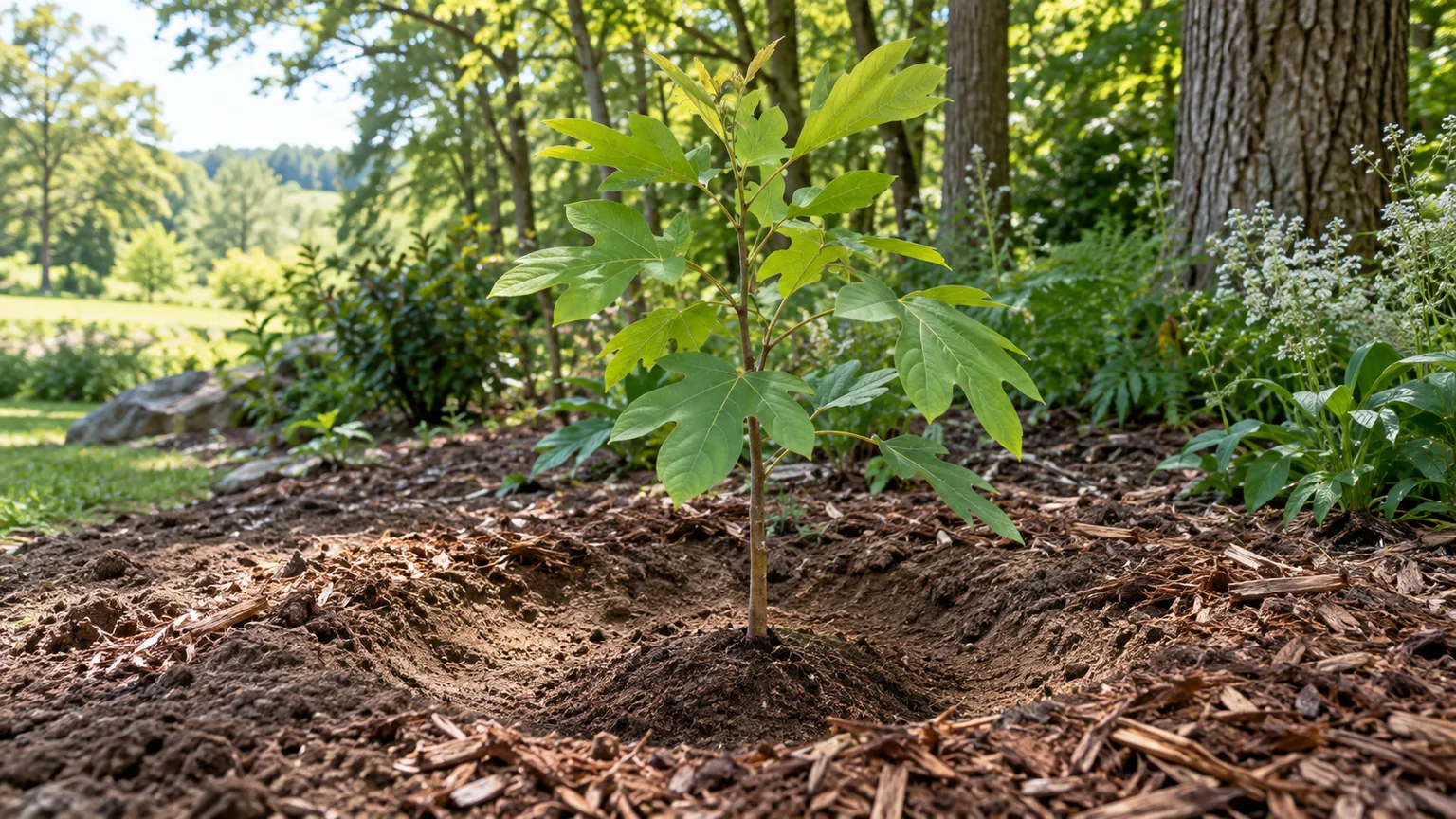
A bright woodland-edge site with loose soil and an exposed root flare gives young sassafras a better start than a wet, compacted planting pocket.
Plant sassafras with its roots and future size in mind
Container-grown nursery stock is usually the most sensible starting point. Look for a young tree with a visible, healthy root flare, no circling roots that have been left tightly bound, and a stem that is not already damaged or leaning. Avoid digging a large wild tree simply because you found one on a property; the taproot and limited fine-root mass make that move unusually risky.
Plant during a mild dormant period or another season recommended by your local nursery, and keep the root ball intact. The hole should be wider than the container root mass but no deeper than the root flare needs; set the tree so the flare is at or slightly above the surrounding grade. Backfill with the soil you removed unless a soil test supports a targeted amendment, then water slowly to settle air pockets.
Spread a thin, broad mulch ring over the root zone, keeping mulch several inches away from the trunk. A mulch volcano traps moisture against bark and hides a buried root flare, two avoidable problems that can undermine a tree that otherwise tolerates neglect. Stake only if the root ball is unstable or the site is unusually exposed, and remove the support once the tree can stand on its own.
Care after planting: water first, fertilize cautiously
The first growing season is when your care has the greatest effect. Sassafras may become drought tolerant after its roots are established, but a new tree cannot be expected to find deep moisture immediately after planting. Water the entire root ball slowly, then allow the surface to dry somewhat before watering again; the goal is deep moisture with oxygen between waterings, not a constantly wet pocket.
Use soil moisture—not a calendar—as your signal
During hot, dry weather, check the soil several inches down near the root ball and just beyond it. If it is dry at that depth and the tree is still establishing, give it a slow, deep soak. If it is cool and moist, wait. Rainfall, soil texture, mulch, wind, and canopy exposure can change the interval, so a fixed daily schedule is less reliable than a quick soil check.
Water at the base rather than spraying the foliage. A soaker hose or a low-flow wand aimed at the root zone reduces runoff and encourages the roots to explore outward. In the second season, lengthen the interval between waterings as growth and rainfall allow; after establishment, reserve supplemental water for prolonged drought, extreme heat, or unusually exposed sites.
Do not fertilize a newly planted sassafras automatically. Excess nitrogen can push soft, fast growth before the root system is ready to support it and can make the plant harder to manage. If an established tree grows poorly and a soil test identifies a nutrient deficiency, apply a complete fertilizer at the start of active growth according to the label and local recommendations. If the soil is reasonably fertile, composted leaf litter and a maintained mulch ring are usually more useful than routine feeding.
Prune for structure and control root suckers
Sassafras does not need a yearly haircut. Prune in late winter or very early spring before leaf-out to remove dead, broken, crossing, or weakly attached branches. Young trees can be guided toward one main stem if that is the desired form, but do not strip the lower trunk simply to force a formal silhouette; the tree’s natural shape is part of its landscape value.
Treat suckers as a design decision, not a disease symptom. For a specimen, trace each shoot to its point of origin and cut it as close to the ground as practical with clean, sharp tools. Check again later in the season because sassafras can resprout. For a grove, thin selectively instead of trying to remove every stem, and retain enough spacing that the strongest trunks do not rub or compete excessively.
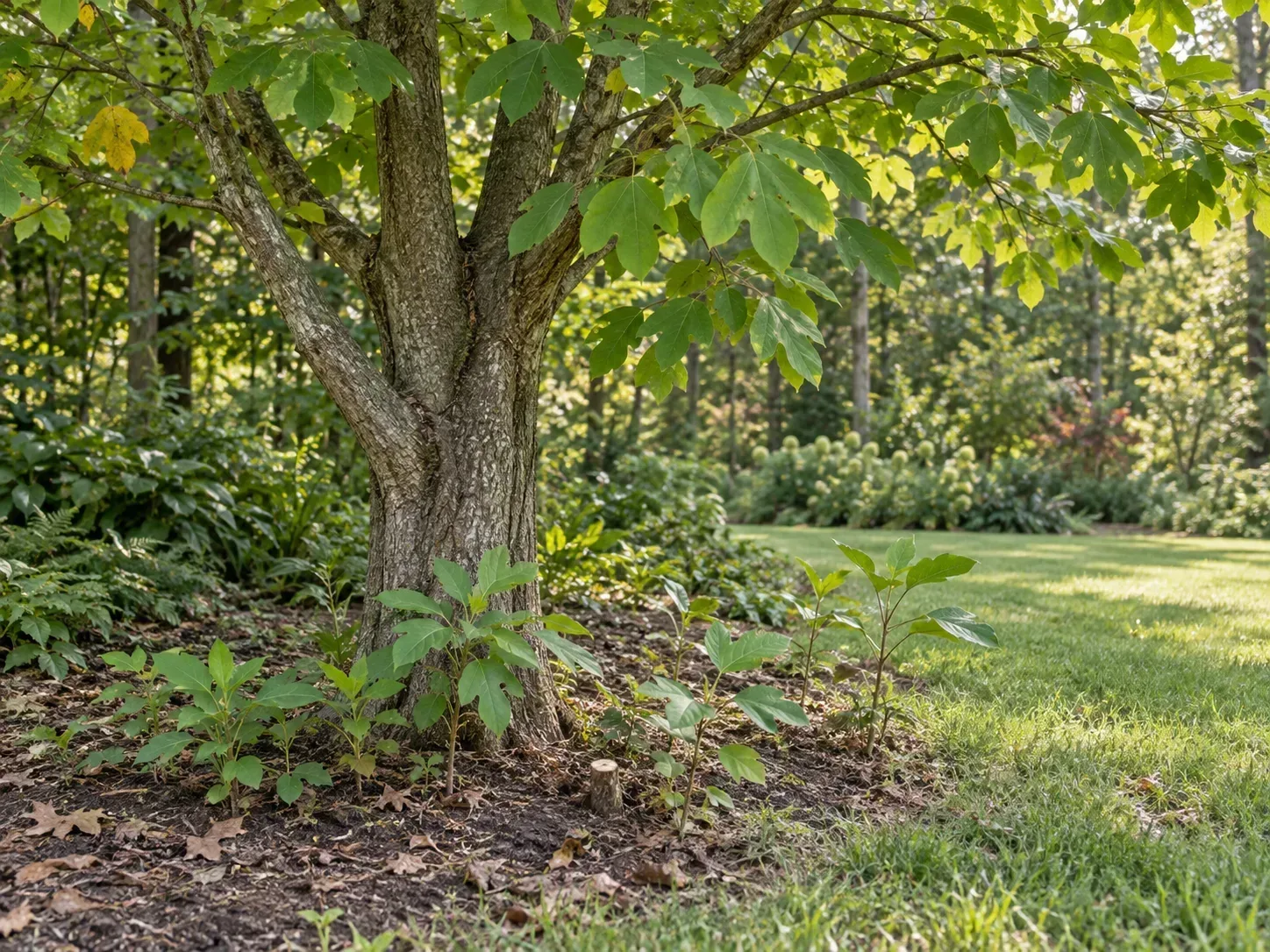
Root suckers are normal for sassafras. Keep them for a naturalized grove, or remove them at ground level when you want a single specimen.
Repeated cutting is safer than digging aggressively around the parent tree. Deep disturbance can damage the roots that support the main trunk, while herbicide use near a valuable tree can create its own risks and should not be improvised. If the suckers are invading paving, a fence line, or a neighbor’s property, get an arborist or extension recommendation before attempting a root barrier or chemical treatment.
Propagate sassafras realistically
Sassafras can be propagated, but it is not a good candidate for casual stem-cutting experiments. The USDA Forest Service reports that seed remains dormant until spring and that root sprouts are a major route of natural regeneration; the same account notes that root cuttings can work, while ordinary stem cuttings are unreliable. USDA Forest Service regeneration account
Start with seed, root cuttings, or a small sucker
Seed is the best choice when you want genetic diversity or are growing several trees for a naturalized planting. Collect fresh, fully developed fruit when it ripens, remove the fleshy coating, and keep the seed moist rather than letting it dry hard. A period of cold, moist stratification is commonly used to break dormancy; the Forest Service describes about 120 days at roughly 41°F in moist sand for natural dormancy release. Sow the treated seed in a protected, well-drained bed or container and keep it evenly moist until the seedling is established.
Root cuttings are a more specialized nursery method. They are taken while the plant is dormant and started in a coarse, well-drained medium, where warmth and steady moisture can encourage new shoots. Because the technique depends on correct timing and a viable root section, buying a small container-grown tree is often more reliable for a home landscape.
A young sucker can sometimes be moved, but success depends on how much root comes with it and how quickly it is replanted. Choose a small, vigorous shoot, work during dormancy, dig widely enough to retain attached roots, and keep the root zone moist while it re-establishes. Larger suckers and established trees are much less forgiving because their taproots and fine roots are easily damaged. Trees and Shrubs Online cultivation notes
Troubleshoot yellow leaves, breakage, pests, and wilt
Many sassafras problems are site problems wearing a leaf symptom. Before reaching for a spray, check drainage, light, the root flare, recent weather, and whether the tree was planted or disturbed recently. A tree that was moved, buried too deeply, or kept wet can decline even when no insect or disease is present.
Separate soil and weather stress from serious disease
Pale leaves with green veins can indicate iron or manganese availability problems in alkaline soil, especially when the pattern appears across newer leaves. Confirm the soil reaction with a test before adding amendments. Acidifying a large root zone by guesswork is slow and can create nutrient imbalances; improving drainage and choosing a better-adapted planting site may be the more realistic fix.
Sassafras branches are relatively slender and can break in ice, strong wind, or poorly balanced growth. Remove a damaged branch back to a sound lateral or the branch collar when conditions are safe, and have an arborist assess a split trunk or a large limb over a target. Do not climb or perform large-tree work with improvised equipment.
Japanese beetles may skeletonize foliage during their active season, while the sassafras borer can damage young terminals and small branches. Inspect wilted tips for entry holes, frass, or galleries; prune and discard clearly infested small branches rather than leaving them in a brush pile near the tree. Use only products labeled for the pest, tree, and site, and follow the label exactly.
Recognize laurel wilt and sassafras borer risk
Laurel wilt deserves a different response from ordinary drought. It is caused by a fungus carried by the redbay ambrosia beetle and can affect members of the laurel family, including sassafras. NC State Extension explains that the disease is associated with an invasive beetle-fungus complex and that sassafras is among the hosts; symptoms can advance quickly. NC State Extension: Laurel Wilt Disease
Sudden or rapidly progressive wilt, brown leaves that remain attached, dark streaking beneath the bark, or multiple declining branches should prompt a call to your county extension office or a qualified arborist. Do not move firewood or suspect branches to another property. There is no dependable home rescue treatment for an already infected tree, and removing or destroying infected material may be part of local disease-management guidance.
Wildlife value, seasonal interest, and safe handling
Sassafras earns its place in a native garden through more than fall color. Its fruit is eaten by birds, its leaves and twigs are browsed by mammals, and its open structure can complement other woodland-edge plants. The USDA Forest Service lists birds including wild turkeys, catbirds, mockingbirds, woodpeckers, and thrushes among the wildlife that use sassafras fruit, while deer and other browsers feed on foliage and twigs. USDA Forest Service wildlife account
That wildlife value comes with a less tidy appearance. Fallen fruit, leaf litter, and a few naturally occurring suckers are part of the habitat benefit, so place the tree where those features will not be mistaken for poor housekeeping. In spring, look for the subtle flowers; in summer, enjoy the leaf-shape variation; in fall, watch for color before the leaves drop.
The tree’s fragrance does not make it safe to ingest. Safrole is a naturally occurring component associated with sassafras oil, and the National Toxicology Program lists safrole as reasonably anticipated to be a human carcinogen based on animal evidence. National Toxicology Program: Safrole profile Avoid making tea, oil, or medicinal preparations from roots, bark, or leaves, and keep concentrated sassafras products away from children and pets. If someone swallows sassafras oil or a concentrated preparation, contact Poison Control or emergency services rather than trying to manage it with home remedies. MedlinePlus: Sassafras oil overdose
A simple year-round sassafras care calendar
Late winter: Inspect the trunk, branch unions, and root flare. Remove dead or crossing branches before leaf-out, and cut unwanted suckers at ground level while the soil is workable. If propagating from root cuttings or moving a very small sucker, dormant conditions are usually the least stressful window.
Spring: Plant container-grown stock when local conditions are mild, water the root ball deeply, and keep mulch off the trunk. Watch new leaves for chlorosis, but test soil before changing pH or feeding. Flowers appear before or as leaves expand, so this is also a good time to identify whether fruiting is a realistic goal.
Summer: Check soil moisture during heat and drought, especially for young trees. Inspect foliage and branch tips for Japanese beetles or borer damage, mow or remove unwanted suckers, and avoid unnecessary root disturbance beneath the canopy.
Fall: Enjoy the color, collect mature seed only if you are prepared to stratify it, and replenish a thin mulch layer after the ground cools. Remove storm-damaged branches safely, but leave healthy leaf litter in a naturalized planting unless it is harboring a known disease problem.
Conclusion
Sassafras is a low-input tree when the site matches its biology. Give it sun or bright dappled light, soil that drains, room for a taproot and root suckers, and consistent water while young. Buy small container-grown stock rather than moving an established tree, prune only for structure and design, and decide early whether you want one specimen or a colony.
Its unusual leaves, fragrance, wildlife value, and fall color make it rewarding, but the same tree is a poor fit for a cramped formal bed. If you can give sassafras a naturalized edge—and you handle its parts as ornamental plant material rather than food—it can become one of the most distinctive native trees in the landscape.



