Should You Water Houseplants With Ice Cubes?
Should you water houseplants with ice cubes? Learn what the orchid study actually found, why most plants need a deep watering, and how to check soil first.
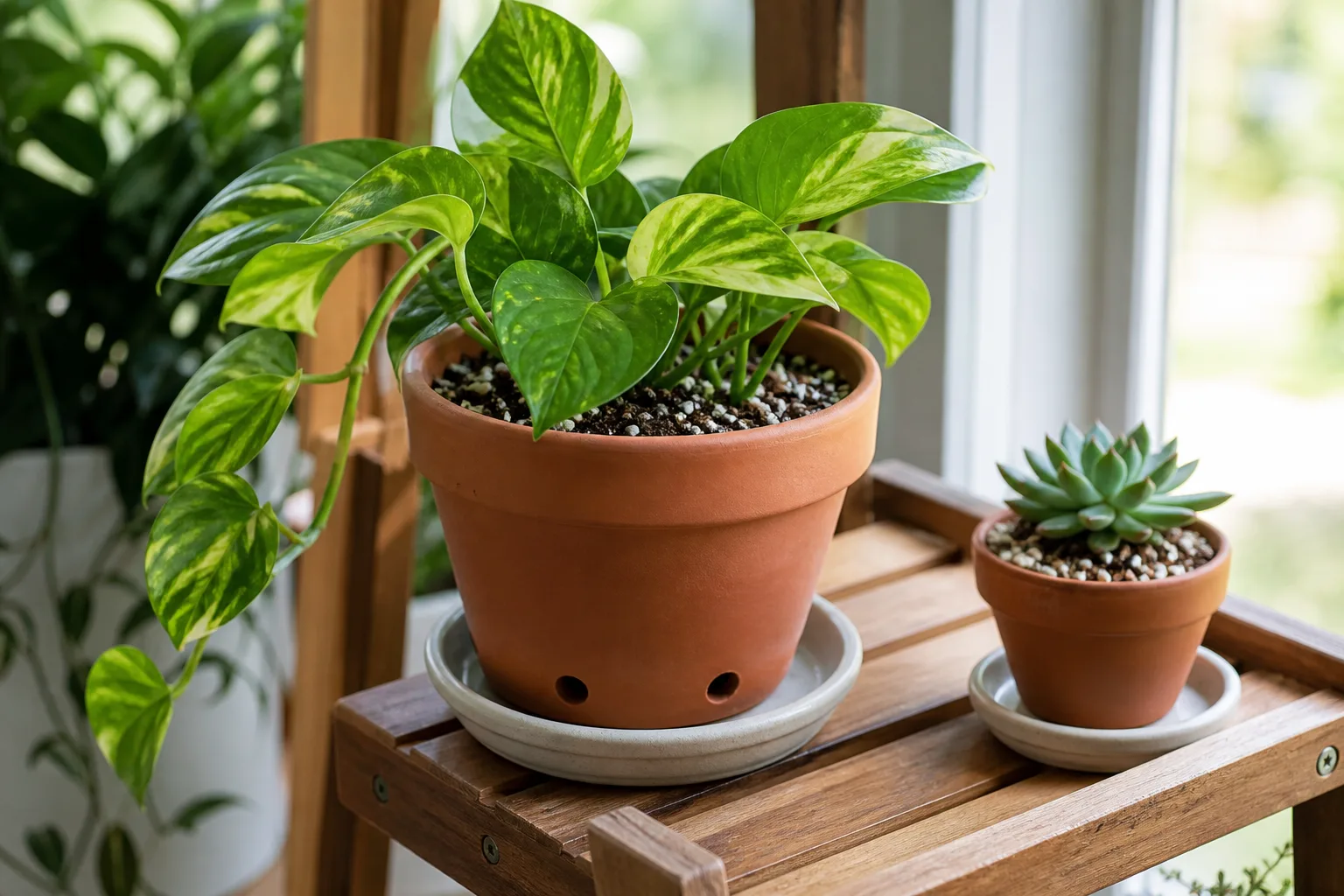
The practical answer is not as your default watering method. For most houseplants in ordinary potting soil, ice cubes deliver too little water too slowly and make it harder to wet the full root zone. A plant can look as if it has been watered while the lower roots remain dry—or the pot can stay damp in the wrong places.
There is one important exception. Research on small Phalaenopsis, or moth orchids, grown in bark media found no measured harm from a controlled ice-cube routine. That result does not make “three cubes a week” a universal prescription for pothos, monstera, peace lilies, succulents, or every orchid sold in a decorative pot. It means a specific method was tested on a specific plant in a specific setup.
The better question is not “Are ice cubes good or bad?” It is: Can this plant’s potting mix absorb the amount of water it needs, and can excess water leave the pot afterward? That answer depends on species, pot size, light, temperature, medium, drainage, and the plant’s current root health.
The short answer: usually no, with one narrow exception
Use a slow, room-temperature pour for most houseplants. Water around the surface until the mix is evenly wet and water begins to leave the drainage holes; then let the pot drain and empty the saucer or outer pot. This replenishes moisture through the root ball and gives you a chance to see whether the container is actually draining.
Ice cubes are a reasonable temporary convenience for a small, healthy Phalaenopsis in airy bark, provided the cubes sit on the bark rather than against leaves, the crown, or exposed roots, and no runoff is left in the cachepot. Even there, treat the cubes as a delivery shortcut—not as proof that the orchid has received enough water. Check the roots and bark before repeating the routine.
For a plant in a large pot, dense peat, compacted soil, or a container without drainage, skip the cubes. Slow melting does not correct an undersized dose, a hydrophobic root ball, or standing water hidden below the pot.
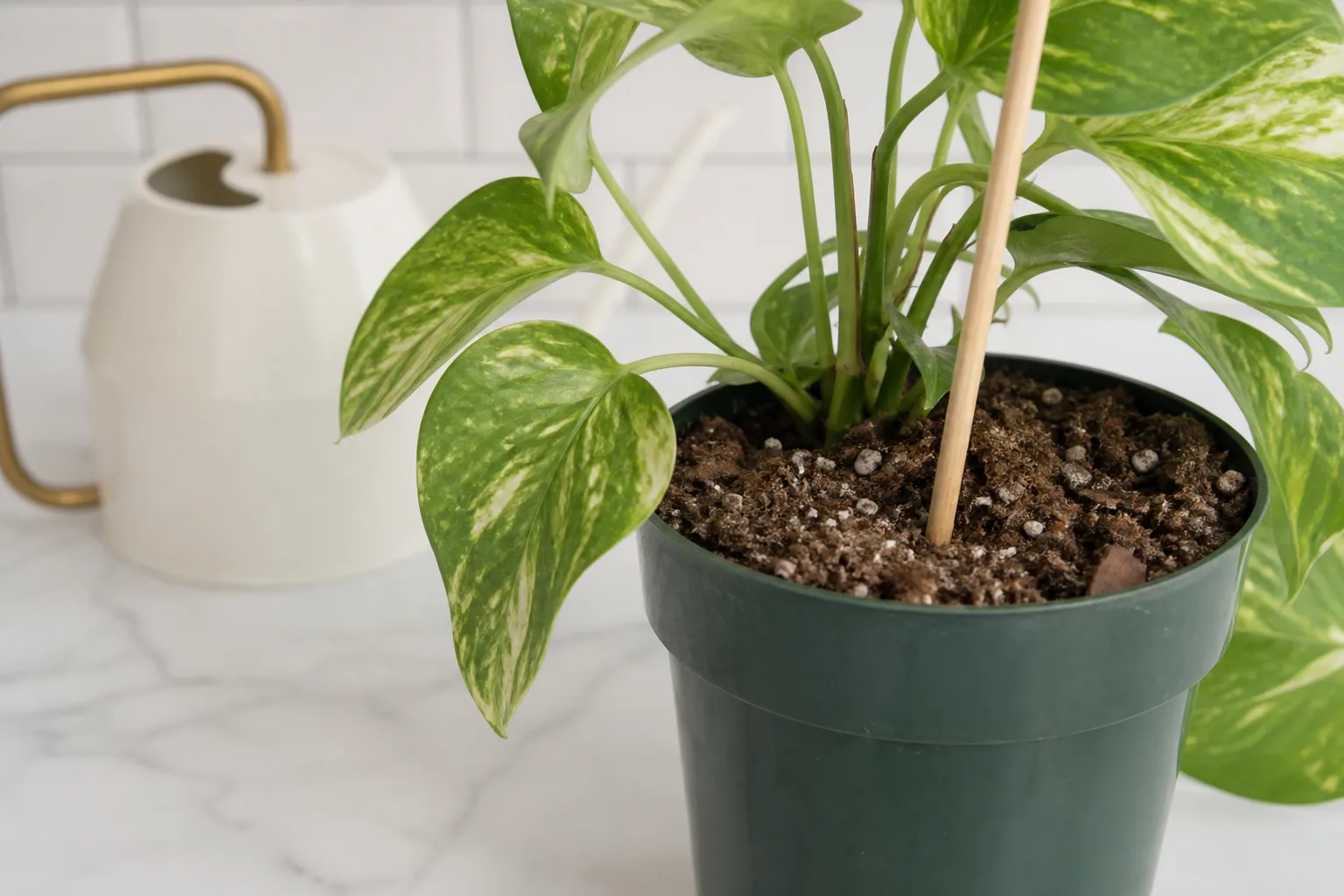
What ice-cube watering actually changes
An ice cube changes how quickly water enters the mix, not what the plant needs. As the cube melts, a small amount of water reaches one patch of the potting medium. That can reduce splashing and make it easier to water a hanging basket without a cascade of runoff. It can also make a nervous beginner feel less likely to drown a plant.
But plant roots do not need a ritual number of cubes. They need a suitable balance of moisture and air across the root zone. The same three cubes that are meaningful in a tiny orchid pot are negligible in a ten-inch monstera pot. The same meltwater that spreads through chunky bark may bead up or run down the side of compacted soil.
Why a slow melt feels safer
The appeal is easy to understand. A normal pour can rush through a bark-filled orchid pot or spill from a hanging container. A melting cube gives the surface time to absorb a little moisture, avoids a puddle on the floor, and creates a repeatable weekly cue. Practical horticulturist Leslie Halleck describes the orchid version as a workaround that grew out of commercial production and the challenging combination of small plastic pots, moisture-retentive media, and lower-light homes; her analysis of ice-cube watering is useful precisely because it separates that setup from other houseplants.
The problem is that less runoff is not automatically better watering. Runoff is evidence that water reached the lower portion of a draining pot; it is not itself the cause of root rot. Root rot becomes more likely when the mix stays wet too long, the container traps water, or roots cannot get enough oxygen between waterings. A few cubes may avoid visible runoff while quietly failing to moisten the bottom of the pot.
The slow melt also tempts people to repeat the dose too soon. If the surface looks dry the next day, that does not necessarily mean the root ball is dry. Conversely, a persistently wet top layer does not prove that the middle of a dense root ball is evenly hydrated. Check deeper and look at the container before adding more.
What the orchid research actually tested
The strongest evidence for ice-cube watering is narrower than the social-media version suggests. The Ohio State University Greenhouse Industry Roundtable summary describes experiments carried out at Ohio State and the University of Georgia on Phalaenopsis orchids grown in bark media.
The researchers compared orchids receiving ice cubes with orchids receiving an equivalent amount of room-temperature water. They evaluated the plants over four to six months, looking at flower longevity, display life, root and leaf health, photosynthetic performance, shoot biomass, and the temperature of the bark media.
What the study found
The ice-watered orchids performed comparably to the room-temperature-watered orchids under the conditions tested. The bark media reached about 51–56°F during ice-cube irrigation and returned to roughly its starting temperature of 70°F within five hours. In isolated root-segment tests, direct root temperatures around 40°F did not produce the damage seen at much colder temperatures, with injury appearing around 20°F.
That is reassuring if you own a small moth orchid in bark and have been afraid that a few cubes will instantly freeze its roots. The study also used the commercial-style recommendation of three cubes once a week, placed on top of the media and away from the foliage. It supports “this can work for this orchid setup,” not “cold water is ideal for every plant.”
What the study did not prove
The experiment did not establish a safe cube count for every houseplant. It did not test pothos, monstera, ficus, peace lilies, ferns, cacti, succulents, or plants in standard indoor potting soil. It also does not answer what happens to a large plant over years, to a plant with damaged roots, or to an orchid in a waterlogged decorative container.
The study’s medium matters. Bark is coarse and airy; it behaves differently from fine peat, compacted old mix, or sphagnum moss packed tightly around roots. The orchid’s pot size and commercial growing conditions matter too. A result from a small bark-filled nursery pot cannot be stretched into a watering volume for a six-inch pot of foliage plant soil.
That limitation is not a reason to dismiss the research. It is the reason to use it honestly. Empress of Dirt’s review of the history, research, benefits, and drawbacks reaches the same practical boundary: the evidence is useful for small Phalaenopsis orchids, while the case for using the method broadly is much weaker.
Which houseplants should skip ice cubes
Skip ice cubes when the plant needs a thorough soak, the container is large, or you cannot inspect where the water goes. This includes most foliage houseplants in standard potting mix. Pothos, philodendrons, monsteras, rubber plants, and peace lilies generally benefit more from an even wetting of the root ball followed by a period of drying appropriate to the species.
Be especially cautious with ferns and other plants that dislike becoming completely dry. A few cubes can create the false confidence of regular care while the deeper mix becomes too dry. These plants need you to check moisture more frequently and rehydrate the root zone evenly, not just place a cold object on the surface.
Succulents, cacti, snake plants, and ZZ plants are poor candidates for a fixed cube routine for the opposite reason. They typically need the mix to dry substantially before the next watering. Three cubes every week may be too little to wet the whole pot but too frequent for the soil to dry properly, leaving a repeated damp pocket near the surface.
Do not use ice to solve a pot with no drainage hole. A decorative cachepot can hide water at the bottom, and slow delivery still adds water to that reservoir. Penn State Extension’s houseplant repotting guidance emphasizes the practical fix: use a container that lets excess water drain, and remove leftover water from an outer pot rather than allowing the plant to stand in it.
The Phalaenopsis orchid exception
The narrow exception is a healthy, small Phalaenopsis in a well-aerated bark medium, usually the grocery-store or garden-center moth orchid with broad leaves and thick roots. It is not automatically every orchid. Dendrobiums, Cattleyas, Oncidiums, and orchids in very different media may have different drying cycles and seasonal needs.
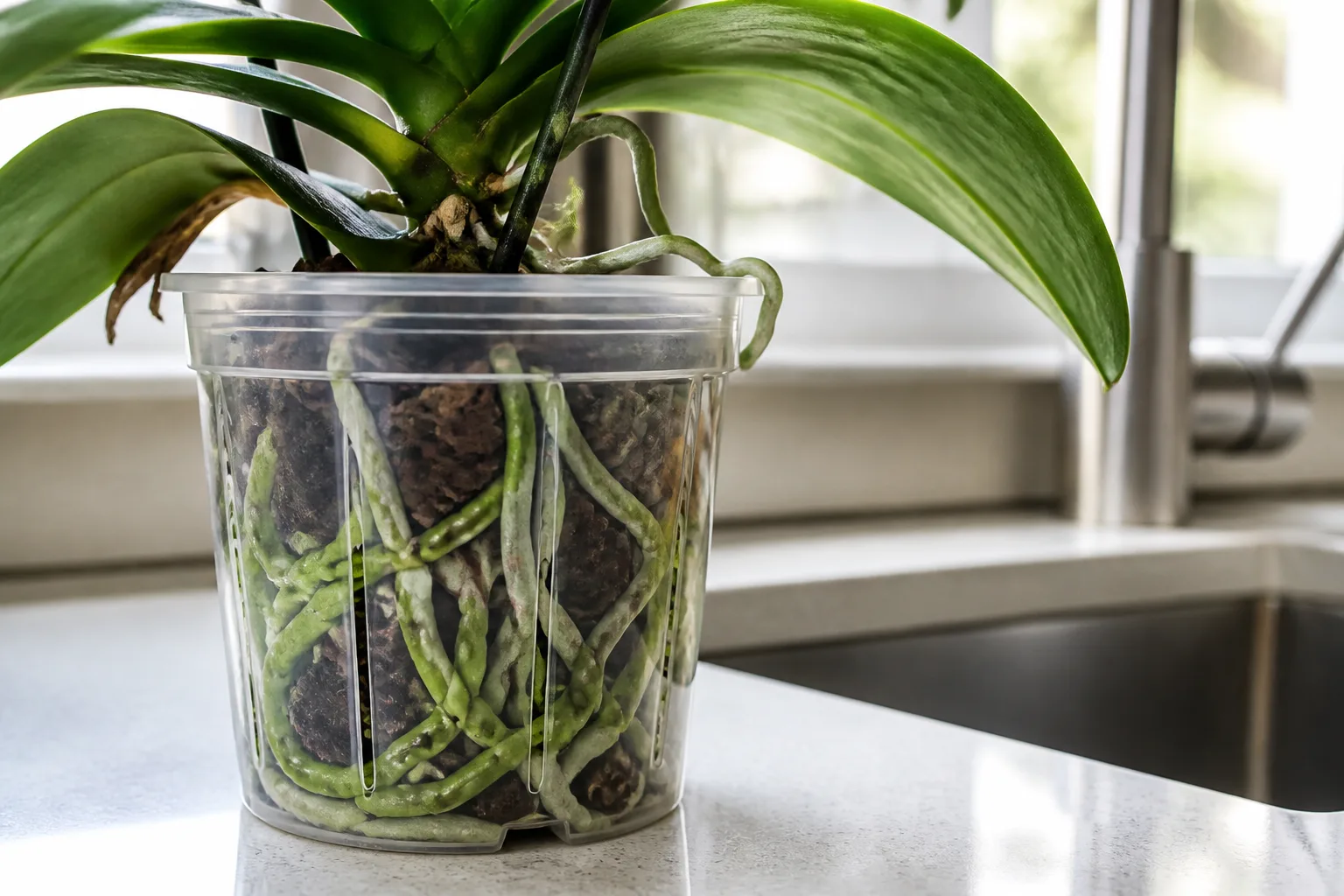
Look at the setup before following a care tag. Chunky bark should have visible air spaces and should not stay saturated for many days. A clear inner pot with drainage is easier to monitor than an opaque pot sitting in an outer container. Healthy Phalaenopsis roots often look silvery when dry and greener after they absorb water; brown, hollow, or mushy roots are a reason to inspect the plant rather than add another cube.
A cautious way to try it
If your orchid matches the tested setup and ice cubes are the routine you will actually follow, use this sequence:
- Check the bark and visible roots first. If they are still damp or green, wait.
- Place three ordinary ice cubes on the bark, spaced apart and away from leaves, the crown, and exposed roots.
- Keep the inner pot above any water in the decorative outer pot. Empty trapped runoff after the cubes melt.
- Recheck the roots and bark over the following week. Stretch or shorten the interval with light, room temperature, humidity, and drying speed.
- Give the orchid a thorough room-temperature watering from time to time when the root zone needs it, especially if bark is old or the plant looks wrinkled despite surface moisture.
This is a conditional convenience method, not a promise that the orchid needs exactly three cubes every seven days. If the bark has broken down into fine particles, the root ball is packed with old moss, or water is pooling in the cachepot, correct the setup before changing the cube count.
Why “three cubes” is not a universal watering dose
A standard ice cube contains a small amount of water, but cube size varies and a plant’s demand varies much more. The useful comparison is not the number of cubes; it is the volume needed to wet the plant’s actual root zone. A three-inch orchid pot and a twelve-inch monstera pot cannot share the same dose any more than a seedling and a shrub can share the same watering can setting.
The shape of the pot changes the result. In a tall narrow pot, meltwater may travel down a narrow channel. In a shallow wide pot, it may spread across the upper mix and evaporate quickly. In a pot with hydrophobic, bone-dry peat, water can move around the root ball instead of soaking it. In a dense, already-wet mix, adding small amounts repeatedly can keep one layer damp without giving the rest of the roots a useful wet-dry cycle.
Use this decision rule instead of copying a cube count:
| Your plant and setup | Ice-cube verdict | Better next step |
|---|---|---|
| Small Phalaenopsis in fresh, chunky bark with healthy roots and drainage | Maybe | Three cubes can be a monitored convenience routine; empty any runoff |
| Phalaenopsis in old bark, dense moss, or a hidden water reservoir | No | Check the root zone and consider a thorough soak-and-drain or repot |
| Foliage plant in a small pot of ordinary mix | Usually no | Water evenly when the appropriate soil depth is dry, then drain |
| Large monstera, ficus, or palm | No | Use enough room-temperature water to wet the full root ball |
| Cactus, succulent, snake plant, or ZZ plant | No fixed cube schedule | Wait for the mix to dry as the species requires, then water thoroughly |
| Any plant in a pot without drainage | No | Move it into a draining inner pot or correct the container first |
The reliable watering routine for most houseplants
The method below is less clever than dropping ice into a pot, but it gives you information and reaches more of the roots. It also works with a small watering can, a measuring cup, or a sink—whatever makes the job easy enough to repeat.
Check moisture at root depth
Check on a regular inspection rhythm, not a fixed watering day. Insert a clean finger or wooden skewer to the depth that matters for the plant: about an inch for a shallow-rooted or moisture-loving plant, roughly two inches for many tropical foliage plants, and much deeper for a drought-tolerant plant whose mix should dry almost completely. A moisture meter can help with consistency, but it is not a substitute for understanding the pot’s medium and drainage.
Lift small pots before and after watering. The difference in weight becomes an excellent personal baseline, especially when the top of the mix is covered with decorative stones or roots make a finger check awkward. For a large plant, press the potting mix at several points rather than testing one spot at the rim.
Light is part of the moisture check. A plant in brighter light or active growth may use water faster than the same species in a dim room. A winter plant near a cool window may use less; a plant beside a heater may lose water from leaves while its pot stays wet. The calendar can remind you to inspect, but it cannot decide for the roots.
Water thoroughly, then drain completely
When the soil is ready, pour slowly over the surface and move around the pot so water does not carve one channel. Pause if the mix repels water, then continue in smaller pours after the surface absorbs the first one. Keep going until water exits the drainage holes. That is the most practical confirmation that water has reached the lower pot, where a few surface cubes may never arrive.
Let the pot drain fully in a sink, shower, tub, or saucer. After several minutes, empty the saucer. If the plant sits in a cachepot, tip out water trapped below the inner pot. Penn State Extension’s container guidance also notes why the hole matters: excess moisture must have a route out, and a decorative outer container should function as a holder, not as a hidden reservoir.
There are exceptions. A fuzzy-leaved plant may be easier to bottom-water so its foliage stays dry, and a severely dry peat mix may need a short soak before it will accept top watering. Even then, lift the pot out, let it drain, and do not confuse bottom watering with a reason to leave the container standing in water.
Read the plant without guessing
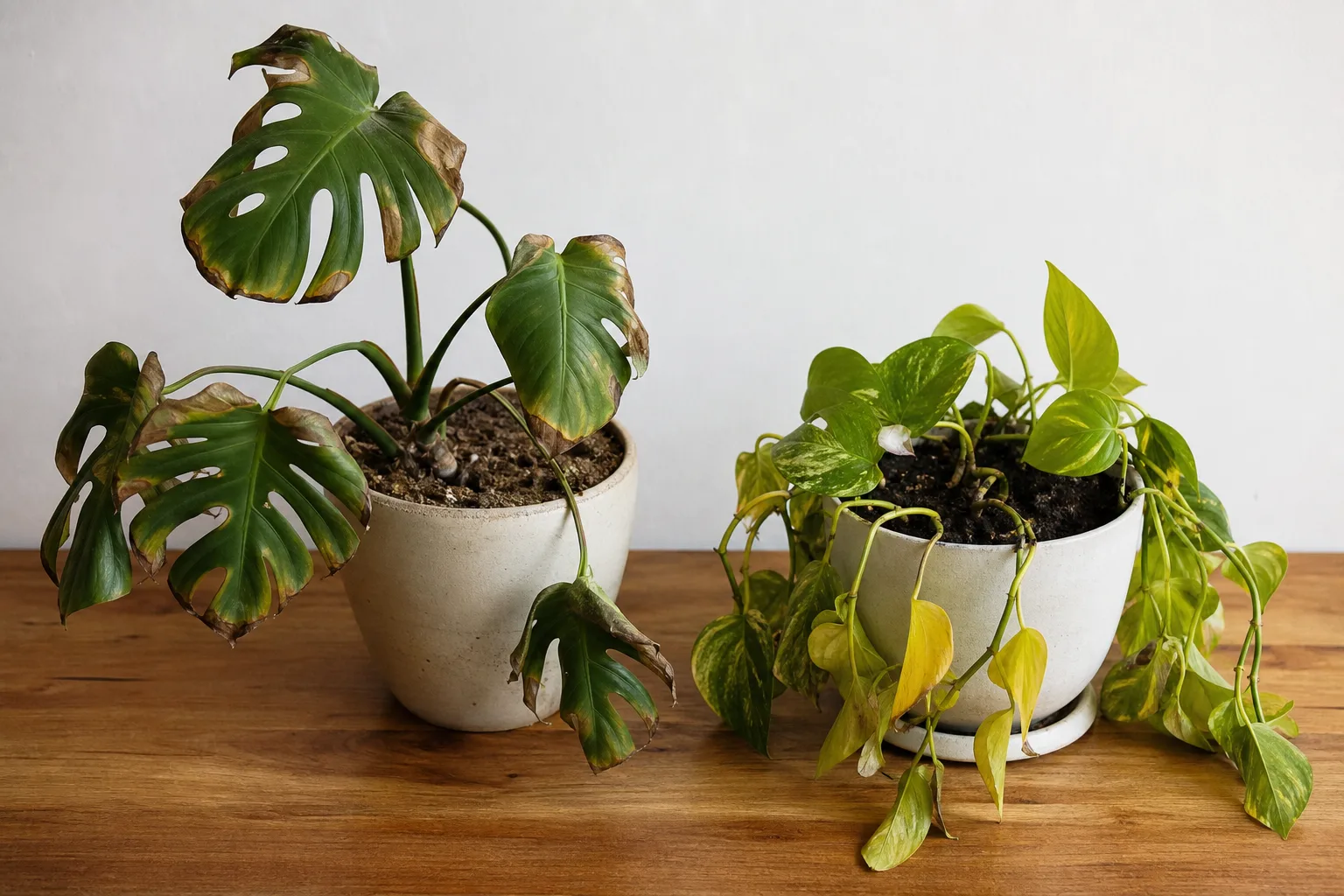
Wilting, yellow leaves, browning, curling, and leaf drop are clues, not diagnoses. Both overwatering and underwatering can reduce the roots’ ability to supply the leaves. The potting mix tells you which direction to investigate first.
Signs that point toward underwatering
Underwatering becomes more likely when the mix is dry at the plant’s usual checking depth, the pot feels unusually light, the soil has pulled away from the pot wall, and leaves recover after a thorough watering. Crispy edges and dry, papery foliage also support a drought-stress diagnosis, although low humidity, salt buildup, heat, and root damage can produce similar symptoms.
If the mix is bone-dry and water runs straight down the sides, do not keep sprinkling a few cubes onto the surface and assume the problem is solved. Rehydrate gradually from the top or use a controlled bottom soak, then let the pot drain. Once the root ball is evenly wet again, return to moisture checks rather than repeating an emergency dose every day.
Signs that point toward overwatering
Overwatering is more likely when the mix is still wet well past the plant’s normal drying window, the pot smells sour, lower leaves turn soft and yellow, or the plant wilts while the soil is damp. Mushy stems and dark, collapsing roots are more serious signs. White surface mold may indicate a persistently moist surface, but it is not by itself proof that roots are rotting.
If a wet plant is wilting, do not add water just because the leaves look thirsty. Move it into brighter suitable light if the species allows, improve airflow, check the drainage hole, and inspect roots if the mix remains wet or smells bad. A watering method cannot compensate for a pot that has no air space or a cachepot that never gets emptied.
What to do if you have already used ice cubes
Do not panic and do not immediately drown the plant to “make up” for the cubes. One occasional ice cube is unlikely to be the cause of a sudden collapse. First check the soil moisture, pot weight, drainage hole, saucer, and—if visible—roots.
If the mix is appropriately moist and the plant looks steady, simply switch to an evidence-based inspection routine at the next watering. If the surface is dry but the lower pot is wet, wait and improve drainage rather than adding more. If the entire root ball is dry and the plant is wilted, rehydrate it thoroughly with room-temperature water, allow it to drain, and monitor recovery.
For a small Phalaenopsis, inspect whether the roots are firm and whether the bark is fresh enough to drain. For a foliage plant, ask whether the cube routine has been under-watering the lower pot. Repeatedly adding tiny amounts can also leave fertilizer salts concentrated in the medium because the pot never receives enough plain water to move excess salts through and out.
If roots are brown, hollow, or mushy, the priority is root inspection and a container-and-medium correction—not colder or warmer water. Remove only clearly dead tissue, use a clean draining pot and suitable fresh mix, and adjust watering to the plant’s slower recovery. When the problem is severe or the plant is valuable, a local extension service or experienced horticulturist can help confirm the diagnosis.
Adjust for season, light, pot, and water quality
Houseplant water use changes even when the plant never leaves the room. Longer, brighter days can increase growth and transpiration; winter’s lower light and cooler root zone often slow drying. A heated room can make leaves lose moisture while the pot remains wet, which is one reason watering by a symptom or weekly reminder can backfire.
Pot material matters too. Unglazed terracotta can dry faster than plastic or glazed ceramic, while a large plastic pot may hold moisture long after a small plant has stopped using it. Dense mix, poor airflow, a covered soil surface, and a pot that is too large all change the interval. Check the actual container instead of importing a schedule from a plant in a different home.
Water quality is a separate question from water temperature. If repeated watering leaves a crust on the mix or brown tips on a sensitive plant, mineral or salt buildup, fertilizer concentration, dry air, and root stress all deserve consideration. Ice made from tap water is still tap water once it melts; freezing does not purify it or make a poor watering routine precise.
Penn State Extension’s humidity guidance makes a related point that helps prevent another shortcut: popular remedies often change conditions only briefly, while light and watering are the controllable fundamentals. Use a hygrometer if humidity is a concern, but do not use a pebble tray, misting habit, or ice-cube ritual to avoid checking the root zone.
Conclusion
For most houseplants, do not water with ice cubes as your regular method. Ice makes delivery slower and tidier, but it does not guarantee even root-zone moisture, and a small fixed dose is easy to under-water in an ordinary pot. The safest default is to check the mix at the right depth, water thoroughly with room-temperature water, let excess drain, and empty the saucer.
The exception is limited but real: a small, healthy Phalaenopsis in airy bark may tolerate three cubes once a week when the cubes stay on the medium and all runoff is removed. Even then, root color, bark condition, pot drainage, season, and drying speed matter more than the number printed on a care tag.
If you remember one rule, make it this: match the amount and timing of water to the plant’s root zone, not to the shape of the ice cube.



