Scots Pine Care: Plant It Right for Long-Term Growth
Scots pine can outgrow a small yard. Get practical advice on choosing a site, planting, watering young trees, and avoiding common care mistakes.
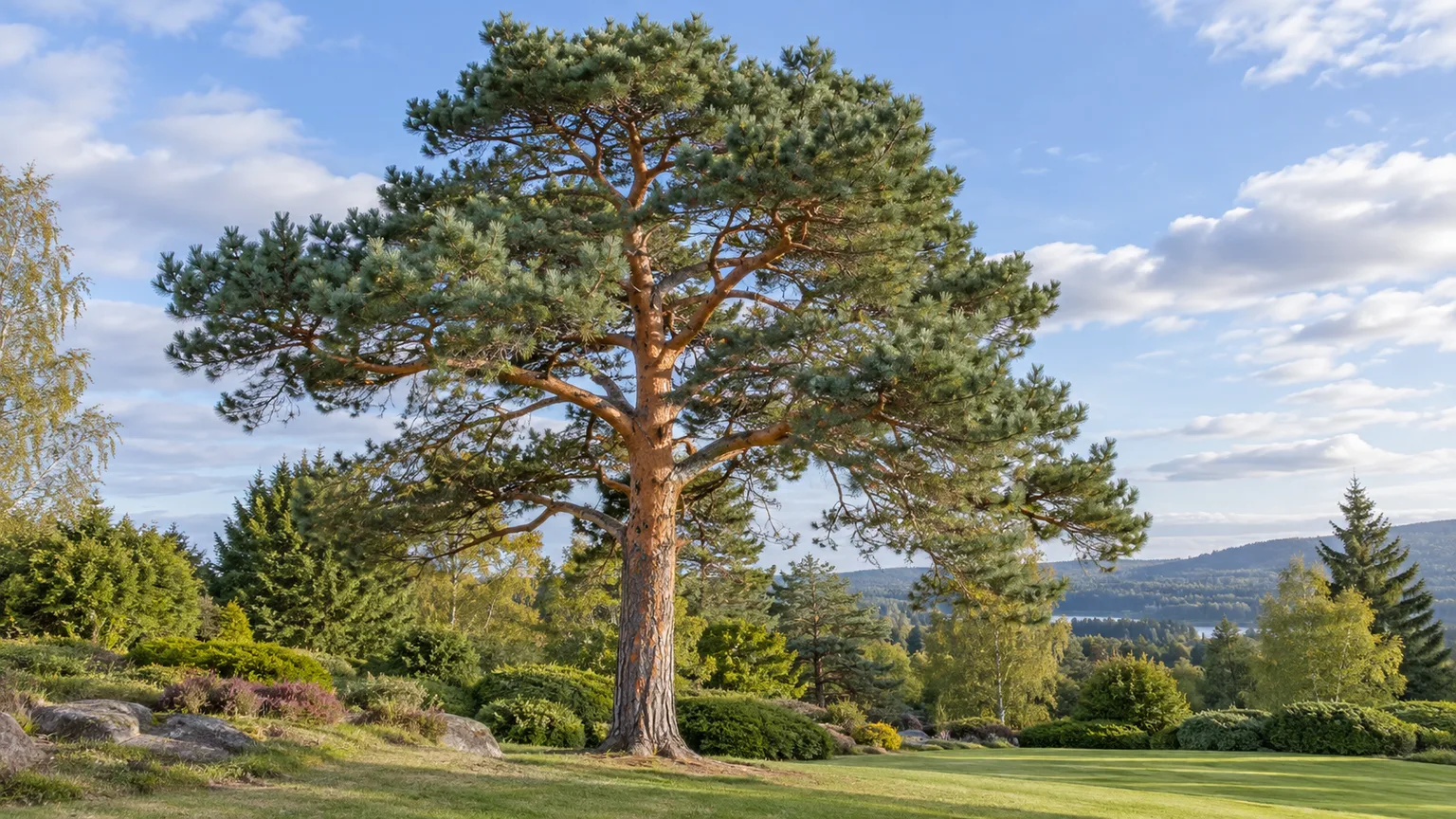
Scots pine (Pinus sylvestris) is a tough evergreen with blue-green needles, orange upper bark, and a crown that changes from conical to broad and irregular with age. It can live for generations, but its toughness is easy to misread: the tree tolerates poor soil, not a permanently wet root zone, and cold hardiness does not mean it enjoys hot, humid summers.
Before buying one, answer a more important question than “How much water does it need?”: can your site accommodate a full-size pine for decades? If yes, planting and aftercare are relatively simple. If the space is small, choose a genuinely compact named cultivar or a better-fitting tree rather than planning to prune a standard Scots pine down to size.
Is Scots Pine Right for Your Site?
Scots pine suits open, sunny properties, parks, larger gardens, and rural screens or windbreaks. It is a poor fit beside a house, under overhead wires, in a narrow foundation bed, or in a small lawn where its future canopy will dominate. The tree’s mature shape is part of its appeal: the lower trunk often clears as it ages and the upper crown spreads, so it will not stay a dense, tidy cone without repeated shaping.
Plan for the mature footprint
Published dimensions vary because trees differ by seed source, climate, site, and cultivar. NC State Extension describes a common landscape range of about 30–60 feet tall and 30–40 feet wide, while BBC Gardeners’ World gives 30–35 meters tall with a 6–12 meter spread over roughly 30–50 years. Those are not interchangeable promises; they show why a small nursery specimen is a poor guide to its eventual footprint. See the NC State Extension species profile and BBC Gardeners’ World profile.
Use the larger end of the local nursery’s mature-size estimate when planning. Leave room for the crown to expand without touching buildings, blocking sightlines, or growing into power lines; check local guidance for tree-to-structure and utility clearances. If you cannot provide that room, do not count on topping or hard pruning as a substitute for choosing the right tree.
Check regional fit before buying
This pine is native across parts of Europe and Asia and has been introduced to North America. It has naturalized in some northeastern and north-central U.S. areas. The Invasive Plant Atlas of the United States records local invasive listings, including regional and protected-area reports, and notes that its map is incomplete. That does not make the species invasive everywhere; it does mean you should check your state, county, and nearby natural-area rules before planting it outside its native range.
Climate matters as much as winter lows. Oregon State lists Scots pine as hardy to USDA Zone 2, but NC State notes that it prefers cooler summers and struggles with southeastern heat and humidity. A tree can survive winter temperatures and still perform poorly through long hot summers. If your area has humid heat, frequent summer drought, or a local invasive warning, ask a regional extension service or arborist whether another conifer is a better choice.
How to Identify Scots Pine
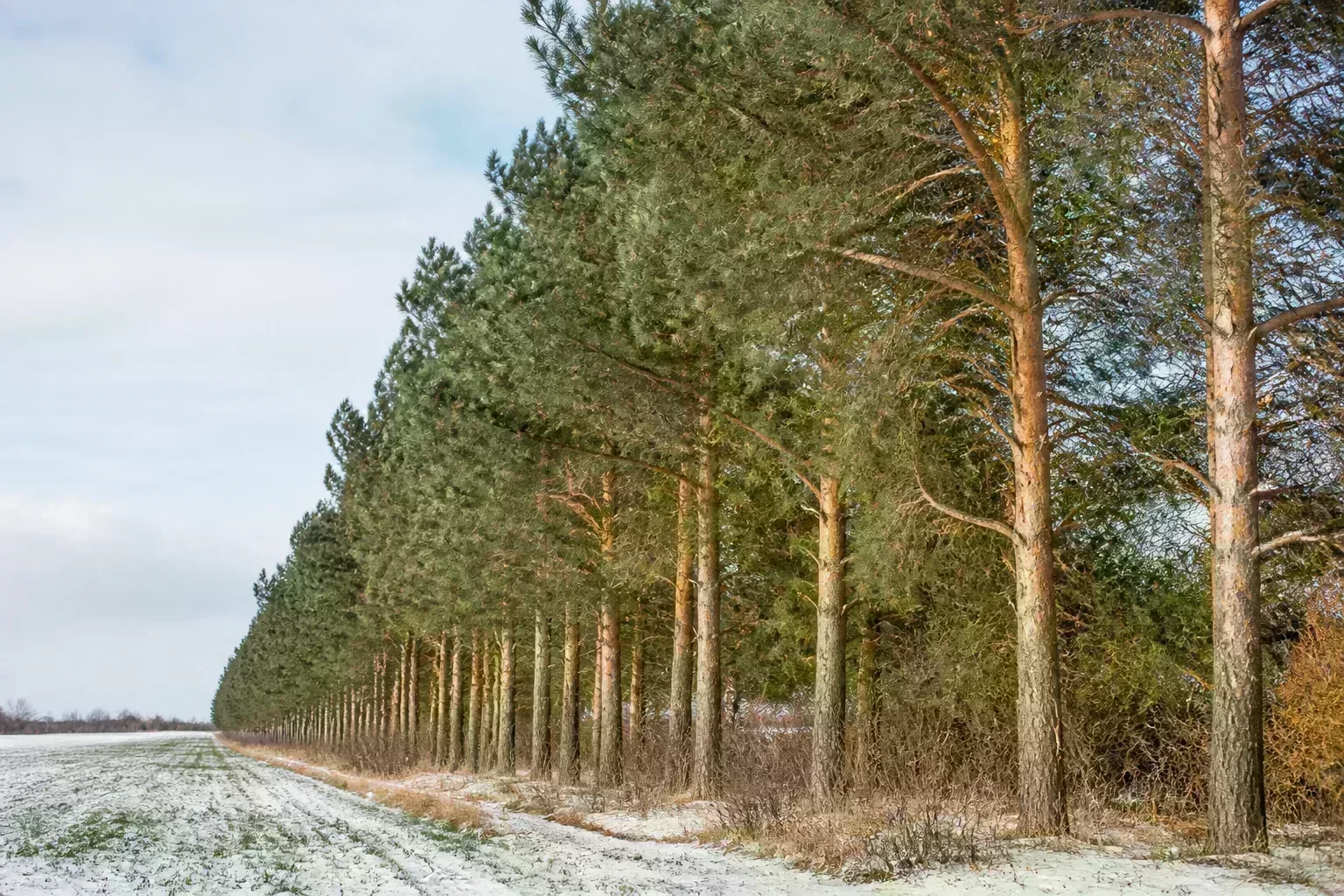
Look at several traits together because common names are inconsistent: “Scotch pine” is often used for the same species, but the accepted botanical name is Pinus sylvestris. A mature tree usually has orange to orange-brown, peeling bark on its upper trunk and branches, contrasting with darker, rougher bark low on the trunk. The crown begins more conical and becomes uneven, spreading, or flatter-topped with age.
The blue-green to gray-green needles grow in pairs and often twist slightly; they are shorter than those of many pines, commonly around 2.5–8 centimeters. The cones are woody and egg-shaped, generally around 2.5–7 centimeters long. Oregon State University’s Landscape Plants database describes the paired, twisted needles and orange upper bark, while the RHS species profile notes its mature irregular outline. A young tree may not show the dramatic bark or open crown yet, so confirm the nursery label and botanical name before purchase.
Sun, Climate, and Airflow
Choose an open position with at least six hours of direct sun. Scots pine can tolerate a range of soils, but shade slows and distorts its growth; crowded trees also lose lower branches as the canopy competes for light. Give it enough overhead and side clearance to develop a stable, balanced crown rather than squeezing it between taller trees or buildings.
Good airflow is helpful, particularly in humid places where foliage stays wet. Still, airflow cannot compensate for a climate mismatch: if summers are persistently hot and muggy, the tree may struggle even where it receives full sun and drains well. Oregon State’s profile notes its broad cold hardiness, while NC State specifically flags heat and humidity as limitations. Think of hardiness zone as one part of the decision, not a guarantee of success.
Soil and Drainage
Well-drained soil is the key requirement. Scots pine tolerates sandy, loamy, and even some clay soils, along with relatively poor or dry ground, but roots need oxygen. A site that stays saturated after rain is a reason to choose a different location or another species, not to add a little gravel at the bottom of the planting hole; that does not correct the drainage of the surrounding soil.
Do not assume the soil must be strongly acidic. The RHS profile lists Scots pine for a range of soil types and pH conditions, and Oregon State says it prefers acid soil while also tolerating varied ground. In practice, drainage and climate are more decisive than chasing a precise pH number. If you suspect a nutrient or pH problem, test the soil before amending it; avoid routinely acidifying or enriching soil that is already adequate.
When to Plant
Plant in the cool part of the year, when roots can establish without heat stress. In much of North America, early spring after the soil is workable or early autumn before the ground freezes works well. The RHS recommends autumn to early spring for conifers and advises avoiding waterlogged or frozen ground; container-grown trees can be planted at other times if you can keep them watered and out of extreme heat.
Choose a calm, overcast day if possible and plant promptly after bringing the tree home. If a bare-root or root-balled plant must wait, keep roots shaded and moist, not submerged. Delay planting during a heat wave, drought, frozen spell, or period when the hole would fill with water; waiting for workable soil is safer than trying to compensate later with extra fertilizer or constant watering.
How to Plant a Scots Pine
Start with a healthy, small nursery tree rather than a large specimen if you want the best chance of easy establishment. The RHS notes that larger conifers are harder to establish and need more careful watering. Check the root ball before planting: roots should be developed, but not so congested that the container is almost all roots. Water the pot well first so the root ball does not dry as you handle it.
Dig a broad hole no deeper than the root ball and loosen compacted soil around it so roots can move outward. Find the root flare—the point where the trunk widens into the first main roots—and keep it level with or slightly above the finished soil grade. Remove the pot, tease apart circling roots where feasible, and set the tree straight; backfill with the excavated soil rather than creating a rich, sharply different pocket that can discourage roots from moving into the surrounding ground.
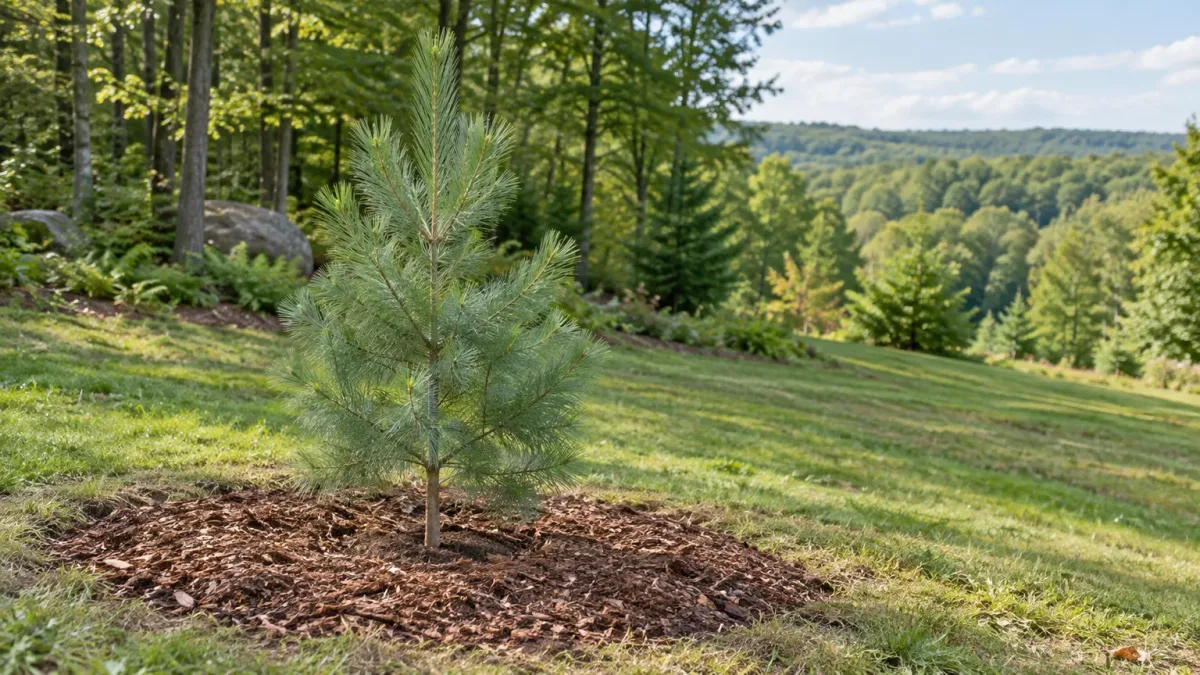
Firm the soil gently to remove large air gaps, then water slowly until the root ball and adjacent soil are wet. Apply a 2-inch layer of organic mulch in a broad ring, extending beyond the root ball, but keep it several inches away from the trunk. Avoid deep planting, “mulch volcanoes,” turf right up to the trunk, and tight staking. A small tree that stands securely usually benefits from normal movement in the wind; stake only if the root ball shifts or the site is unusually exposed, and remove the support once it is stable.
Watering During Establishment
During the first two growing seasons, water deeply when the root zone begins to dry rather than following a calendar blindly. The RHS conifer guide recommends regular watering during the first two years, especially in hot, dry spells. A weekly soak may be a useful starting point when rain is scarce, but clay, sand, rainfall, heat, and the size of the root ball all change how quickly the soil dries.
Check the soil a few inches below the surface near the edge of the original root ball. If it is cool and damp, wait; if it is dry, water slowly over the root zone so the water penetrates instead of running off. Do not keep the planting hole muddy. Waterlogged soil deprives roots of oxygen and can cause the same yellowing that an underwatered tree shows, so use the soil check—not limp foliage or a fixed weekly rule—to decide.
After establishment, a Scots pine usually needs supplemental water only during prolonged drought or heat, particularly if it is growing in shallow soil or surrounded by thirsty lawn. Water the whole area beneath the canopy, not just against the trunk, as the root system expands. Newly planted trees can still need attention beyond the first year; reduce watering gradually as you see healthy new growth and the surrounding soil holds moisture between rains.
Mulch and Fertilizer
Keep a weed-free mulch ring while the tree is young. Grass competes strongly for moisture near a new tree, and a broad, shallow layer of bark, leaf mold, or composted organic mulch slows evaporation while limiting that competition. Maintain roughly 2 inches of mulch, replenish as it breaks down, and keep it away from the trunk so bark stays dry and visible.
Routine fertilizer is usually unnecessary. Scots pine is adapted to relatively poor soils, and extra nitrogen can push soft, rapid growth without correcting the actual problem. The RHS advises that most conifers do well without supplemental feeding; if growth is weak, check drainage, light, root damage, and soil conditions first. Use a soil test and local extension advice before applying fertilizer, and follow any product label rather than borrowing a formula from another tree.
Pruning Without Ruining the Shape
A Scots pine generally needs no routine pruning. Remove dead, broken, or diseased branches with clean tools, cutting just outside the branch collar rather than flush to the trunk. If two branches rub, have an arborist assess which one to remove when the cut is large or overhead; unnecessary removal of lower limbs cannot be reversed and may expose the trunk without improving the tree.
Pines do not reliably sprout new foliage from old, bare wood. If you shorten a branch past the green needles, that section may stay bare, so avoid shearing the tree into a ball or cutting the top to limit height. On a young tree, a small amount of new spring candle growth can be pinched to encourage compact branching, but this is an optional shaping technique, not a way to keep a full-size species small. For mature-tree clearance, storm damage, or major structural cuts, hire a qualified arborist.
Cultivars for Smaller Gardens
The species is a large tree, but named cultivars vary greatly in size, color, and habit. If you want a Scots pine for a residential garden, buy a cultivar with a documented mature height and width, not a plant sold only as “dwarf pine.” The label’s 10-year dimensions may be much smaller than the plant’s eventual size; ask how large it becomes at maturity in your climate.
Choose a cultivar by mature size
‘Watereri’ is a smaller, blue-green form often listed at roughly 10–12 feet tall and nearly as wide by Oregon State University, so it can suit a garden where the species would overwhelm the space. ‘Beuvronensis’ is a slow-growing, rounded dwarf form; Gardenia’s cultivar profile describes it as only about 1–2 feet tall and wide after 25 years, with a potentially larger final size. These figures are approximate and vary among nursery stock and conditions, so confirm the cultivar name and expected mature spread with a local grower.
The right choice depends on the job. A compact cultivar can work in a rock garden or small border; the species type makes more sense as a long-term specimen on open land. Container growing is possible for a dwarf plant or bonsai under attentive care, but a pot does not turn a standard Scots pine into a low-maintenance patio tree: roots are restricted, watering becomes more frequent, and repotting or root work becomes part of the job.
Growing Scots Pine from Seed
Seed is a practical way to raise the species if you are patient and do not need an exact copy of a named cultivar. Seeds from a cultivar may produce offspring with different traits, so buy a grafted or otherwise clonally propagated plant when a specific compact size or color matters. For basic species seedlings, fresh seed from a reputable source is more predictable than collecting unknown cones from a distant tree.
The Conservation Volunteers’ Scots pine growing guide explains that cones can be dried warm until they open and that four weeks of moist, cold stratification sometimes improves germination, though it is not always necessary. Sow seeds in a clean tray of free-draining seed compost, cover lightly with grit or sand, and keep evenly moist—not waterlogged—in a bright, cool place. If collecting cones, gather only those already fallen within reach; do not climb a tree to collect them.
Move seedlings on when they are sturdy enough to handle, and protect them from drying out and competition from weeds. TCV recommends leaving seedlings in a seedbed for about two years before moving them to a final position. Expect a slow project: a seedling is not a ready-made landscape tree, and its early form will not tell you exactly how the mature crown will develop. For most homeowners, buying a correctly labeled young tree saves years and makes cultivar choice more reliable.
Pests and Diseases to Watch
Most Scots pines do not need preventive sprays. Inspect the tree when you notice a change, and look for a pattern: whether damage affects old or current-year needles, one branch or the whole crown, and whether there are insects, webbing, sticky residue, holes, or visible lesions. NC State lists pine tip blight and pests such as pine wilt nematode, sawflies, moths, and scale among possible problems, but a broad symptom like browning does not identify which one is present.
Sawfly larvae can eat needles; scale insects and aphids feed on plant sap; tip blight can brown the ends of shoots. If you find insects, take a clear photo or a sample in a sealed bag to your local extension office or a certified arborist before treating. A pesticide or horticultural oil that is safe and useful for one pest can be ineffective or harmful for another, and products must be labeled for the pest, plant, and location. Do not spray a tree simply because a few old needles have fallen.
Needle-cast fungi can also cause premature browning and drop, especially where needles remain wet and air circulation is poor. The Pacific Northwest Plant Disease Management Handbook notes that needle-cast symptoms can resemble normal seasonal needle shed and may require closer examination to distinguish. Rake up heavily affected fallen needles, improve airflow where practical, and have a diagnostician confirm disease before considering fungicide; timing and approved products depend on the disease and region.
Why Are the Needles Turning Yellow?
Start by noting where the color change appears and which needles are affected. Scots pine sheds older needles as part of normal growth; a modest amount of yellowing on the innermost, oldest needles, with healthy green needles at branch tips, is less concerning than discoloration spreading through new growth or affecting the whole crown. This shedding does not happen on a perfectly fixed three-year schedule, so judge the overall pattern and the condition of current growth.
If the soil stays wet, check drainage and stop adding water until the root zone is no longer saturated. If the tree has been planted recently or the weather has been hot and dry, check moisture at the root ball and water deeply if it is dry. Yellowing along one branch, spotted or banded needles, dead shoot tips, or progressive browning across several parts of the crown deserves a closer inspection for pests, cankers, tip blight, or needle cast. The handbook notes that fungal needle casts are easily confused with annual fall shed, so color alone is not a reliable diagnosis.
Do not peel bark from healthy branches to check whether the tree is alive, and do not prune away every discolored branch before you know the cause. Photograph the same branch from the same angle over several weeks, note recent weather and watering, and take a sample to an extension diagnostic service or arborist if the damage is spreading. Rapid whole-tree decline, extensive resin flow, trunk injury, or a dead leader warrants prompt professional assessment; the correct response depends on the diagnosis.
Winter Protection
Established Scots pines are cold hardy, but young trees can still suffer from dry soil, wind exposure, and animal damage. In late autumn, water a recently planted tree thoroughly if the soil is dry and not frozen; evergreens continue losing moisture through their needles, and frozen ground prevents roots from replacing it. During a dry winter thaw, water the root zone again when the soil can absorb it, then let it drain.
Maintain the mulch ring through winter, without piling mulch against the trunk. Protect a small sapling from rabbits or other browsing animals with a ventilated trunk guard that does not rub or constrict it. Avoid wrapping the entire crown unless a local specialist recommends a temporary wind screen for an unusually exposed site; tight covers can trap moisture and damage branches. Remove stakes and guards when they are no longer needed, and inspect them after storms so they do not cut into growing bark.
Conclusion
Scots pine care is straightforward after the hard choice is made: give the tree the right climate, full sun, well-drained soil, and room for its mature crown. Establish a young tree with careful planting and moisture checks, then rely on mulch and occasional drought watering instead of routine fertilizer, hard pruning, or preventive chemicals.
If you have a small yard, choose a named compact cultivar only after checking its eventual size. If your region is hot and humid, waterlogged, or lists Scots pine as invasive, consider a locally appropriate alternative. A good site decision will do more for the tree—and save more work—than any later care routine.