How to Grow and Care for Texas Mountain Laurel
Learn how to grow Texas mountain laurel with the right sun, drainage, establishment watering, pruning timing, and safe handling of its poisonous red seeds.
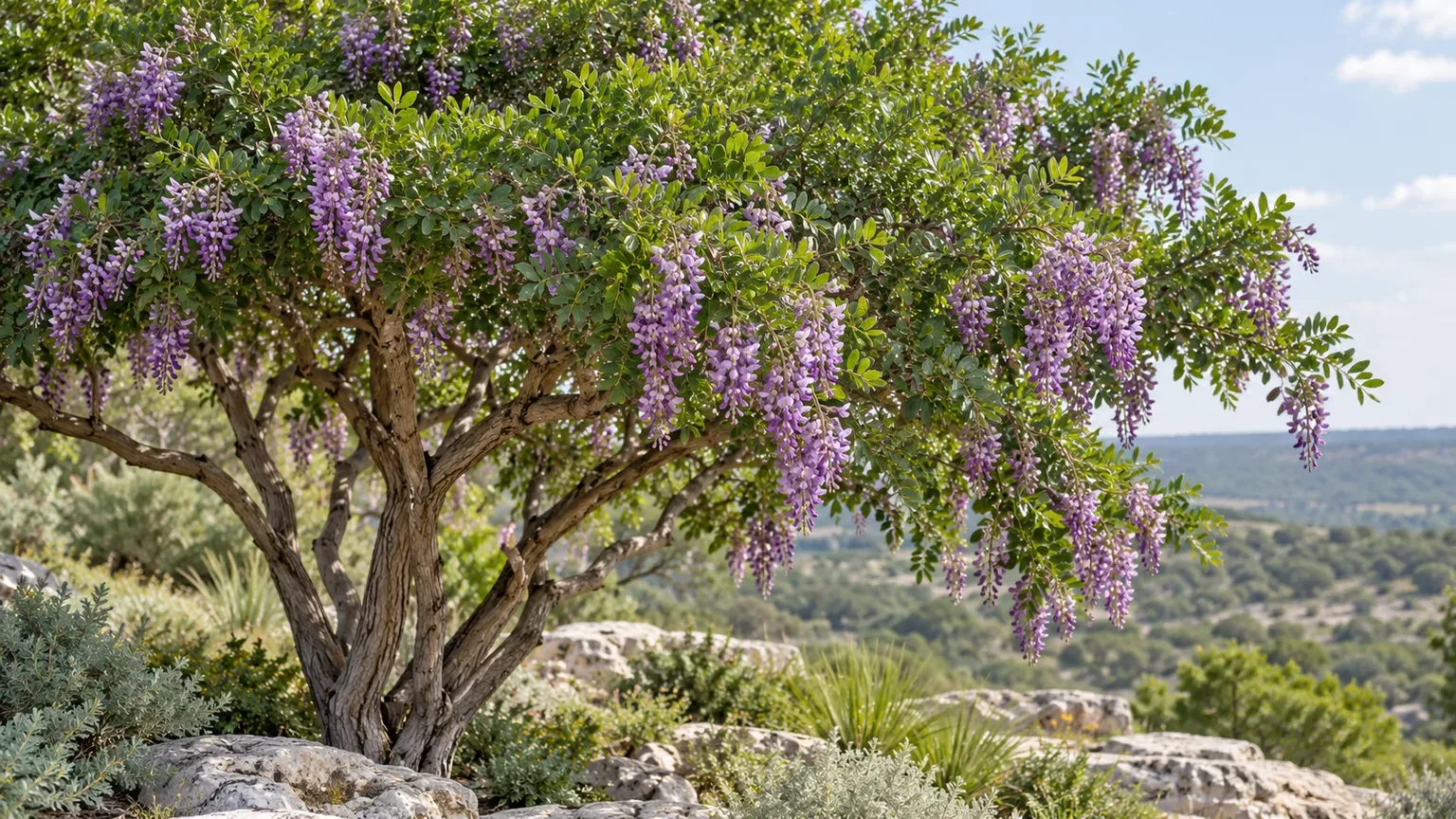
Texas mountain laurel is a slow-growing evergreen shrub or small tree for a sunny, sharply drained site in a warm region. Give a young plant regular, deep watering while its roots settle in; after establishment, it can handle dry spells with far less irrigation. The most common avoidable mistakes are putting it in soggy soil, expecting a new shrub to grow quickly, pruning away flower-bearing wood, and leaving its poisonous red seeds where a child or animal can eat them.
Verify the plant and plan for its mature form
The name is confusing; the species is specific
Texas mountain laurel is Dermatophyllum secundiflorum, a member of the pea family, Fabaceae. Nurseries and older books may still use its previous name, Sophora secundiflora. It is not the eastern mountain laurel, Kalmia latifolia, and it is not bay laurel, Laurus nobilis. Those plants have different leaf forms and different growing requirements; if you are comparing them, start with the guide to eastern mountain laurel.
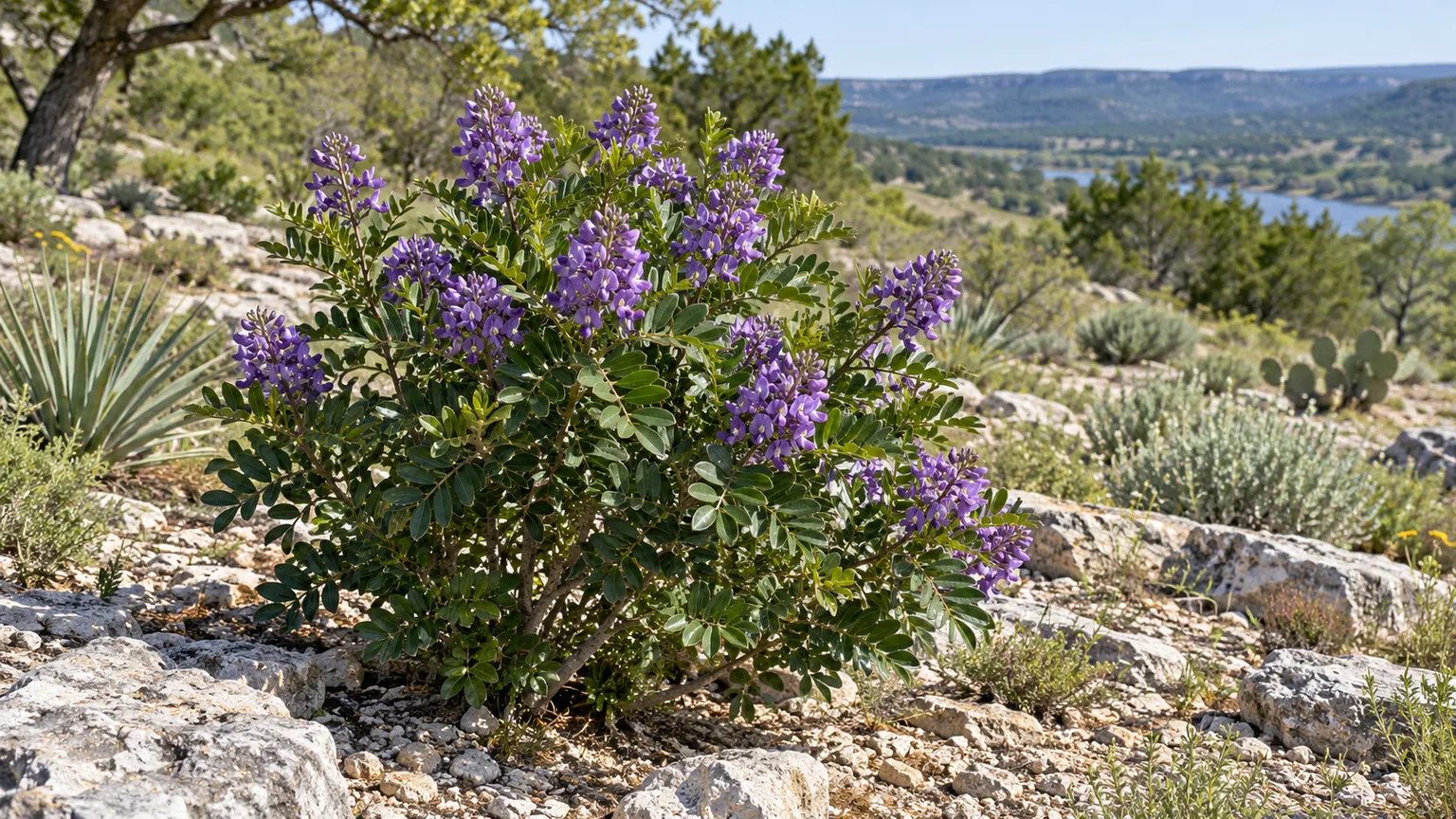
The Texas species is native to parts of Texas, the southwestern United States, and northern Mexico. It is an evergreen, often multi-trunked shrub that can be trained into a small tree. Its glossy, pinnately compound leaves carry several oval leaflets, and its drooping clusters of pea-shaped violet-blue flowers have a strong, sweet fragrance. NC State Extension’s plant profile records the accepted name and the former Sophora name, while Gardener’s Path’s Texas-focused growing guide describes its characteristic leaf and flower display.
Set realistic size and bloom expectations
A common mature height is about 10 to 15 feet, but an older specimen in favorable conditions can become much larger; NC State reports a possible height of 32 feet. Gardenia gives a comparable typical range of 8 to 15 feet tall and 6 to 10 feet wide, while noting that an exceptional plant can reach about 30 feet. Allow room for both the canopy and the view of its flowers, and ask a local native-plant nursery about the form sold in your area. This is a plant to place thoughtfully, not one to squeeze into a narrow foundation strip and repeatedly shear down. (Gardenia’s plant profile)
Growth is slow. A small nursery plant may take years to become a substantial screen or specimen, and trying to hurry it with excess water or fertilizer can produce weak, uneven growth instead of a sturdy framework. In much of Central Texas, flowers are noticed in February or March, while the broad guidance is late winter to spring; weather and location shift the display. The regional Texas Hill Country account of its February–March bloom is a useful local reference, not a fixed calendar for every climate.
Choose the site in the right climate
NC State Extension lists the plant for USDA Zones 7a through 10b; Gardener’s Path lists a slightly different range, 7b through 11. Those ranges are not a promise that a young plant will sail through every freeze at a zone boundary. Use the conservative range for a cold-exposed garden, ask a local extension office or native-plant nursery about regional performance, and consider winter wind, cold-air pockets, and the protection of nearby buildings.
This species is best suited to hot or warm landscapes where summers can be dry and the soil drains readily. It is less compelling in persistently humid or waterlogged sites, or places with deep shade. A plant that stays green in a marginal location may still flower poorly, grow slowly, or suffer repeated winter damage; match it to the site before buying rather than trying to correct a fundamental mismatch afterward.
Sun exposure
Choose full sun when you can. Light or partial shade can be tolerated, but dense shade reduces the energy available for flowering and tends to make a shrub less dense. If your yard gets strong afternoon sun, use the condition of the soil and the plant’s establishment stage to guide watering; do not automatically move it into shade just because a hot day is forecast.
Think about the light the mature plant will receive, not the bright opening you see on planting day. A small tree planted under a larger canopy can lose sun as nearby trees fill out. Keep enough clearance from fences and buildings for the crown to expand, and place it where the fragrance and spring flowers can be enjoyed without making future pruning a necessity.
Soil and drainage
Texas mountain laurel is adapted to rocky, often limestone-rich ground and tolerates drought once established. NC State describes it in well-drained soils that range from moist to occasionally dry, and Gardener’s Path notes that it can grow in clay, loam, or sand when drainage is good. The key distinction is soil texture versus drainage: clay is not automatically a deal-breaker, but a root zone that stays saturated is a poor fit.
After a substantial rain, notice whether water lingers where you plan to plant. If the site routinely stays wet, choose a naturally higher or sloping spot, or create a broad raised bed with enough depth for roots; simply placing gravel in the bottom of a small planting hole does not fix a poorly drained yard. Do not add lime or calcium just because the plant is associated with limestone. Test the soil first and amend only to solve a measured problem, not to imitate the plant’s native geology.
Planting and establishment
Buy a healthy container-grown shrub from a nursery familiar with native Texas plants. Choose a plant with a balanced crown and a root ball that is not tightly circling the container. Because the species grows slowly and established plants are difficult to move, take time to choose the permanent site before planting. Avoid digging mature plants from natural areas; nursery stock is more responsible and avoids the stress of moving a large root system.
Cooler weather reduces the immediate strain on new roots, so fall or early spring is often a practical window in warm climates. Avoid planting into frozen or waterlogged ground, or just before a stretch of punishing heat when you cannot keep the root ball from drying. Local timing matters more than a national calendar: ask a nearby native-plant nursery when container shrubs establish best in your county.
Set the root ball and finish the grade
Water the nursery pot before planting so the root ball is evenly moist and easier to handle. Dig a hole broad enough to loosen the surrounding soil, but no deeper than the root ball; the top of the root mass should finish level with, or slightly above, the surrounding grade. A buried crown can stay damp and encourages settling that leaves the trunk base too low.
Ease the plant out of its pot without pulling on the stems. If a few roots circle the outside, loosen them gently; if the root mass is densely matted, ask the nursery whether the plant is still a good candidate rather than tearing aggressively into it. Backfill with the soil you removed, firm it lightly to close large air pockets, and water slowly to settle soil around the roots. Do not bury the stem in a deep mound of compost or fertilizer.
A thin layer of organic mulch can reduce weeds and slow moisture loss, but keep it several inches away from the trunk and root crown. A thick wet pile against bark hides the base and holds moisture where it is not needed. Mulch is a surface aid, not a substitute for an appropriately drained planting site.
Support new roots with measured water
A drought-tolerant species still needs attention after planting. During establishment, water deeply enough to moisten the original root ball and the nearby soil, then let the surface begin to dry before watering again. Check the soil with a finger or narrow trowel beside the root ball; don’t decide from the surface alone, because a dry crust can sit over moist soil or a wet surface can conceal a dry container root mass.
The interval changes with heat, rainfall, soil, wind, and the size of the plant. Sandy or rocky ground dries sooner than heavier clay, while a rainy week can make another irrigation unnecessary. In the first season, inspect more often during hot, windy weather; in cool weather or after rain, wait and check before adding water. Gardener’s Path recommends regular watering through the first year, while NC State lists the species as tolerant of occasionally dry soil—together, those points support attentive establishment care without a fixed daily schedule.
Water an established shrub by conditions
Once roots have spread beyond the original nursery ball, reduce routine irrigation. An established Texas mountain laurel tolerates dry periods, but “drought tolerant” does not mean “never water.” During an extended hot drought, a slow, deep soak at the root zone can help; a brief sprinkle over leaves and pavement does little to wet the deeper soil.
Use the plant and the soil together as evidence. If the root zone is still moist several inches down, wait. If it is dry well below the surface and the plant is newly planted, showing persistent wilt, or growing in a very exposed spot during a long dry spell, irrigate slowly and reassess rather than repeating shallow watering every day. Leaves can look tired after heat, so do not respond to a midday droop by flooding the base; check again in the cool part of the day and test the soil first.
The main water-related risk is keeping the roots wet for too long. Poor drainage plus frequent irrigation can lead to root stress and decline, and fertilizer will not fix that underlying problem. A modest drip emitter or hand watering directed at the root zone is easier to manage than a lawn sprinkler that wets the area on a fixed schedule.
Feed lightly—or skip fertilizer
A healthy Texas mountain laurel in suitable soil generally does not need routine feeding. Its native habitat includes lean, rocky ground, and fast lush growth is not the goal for a naturally slow-growing shrub. Gardener’s Path likewise describes it as able to grow without fertilizer, with a small balanced application only for very poor soil.
If foliage is pale or growth is weak, first check drainage, sunlight, root establishment, and watering. A yellow leaf is not proof of a nutrient deficiency; waterlogged roots and transplant stress can look similar. If the plant remains weak after basic conditions are corrected, use a soil test to identify a shortage and follow its recommendation. Avoid high-nitrogen lawn feed, repeated “bloom booster,” and unmeasured calcium additions around the root zone.
Overfeeding can create long, soft shoots that do not fit the shrub’s natural structure and may support more leaf-feeding caterpillars. If a test supports fertilizing, apply only the stated rate and timing for the product and keep it away from the trunk. A plant that is already growing steadily and holding dark evergreen foliage is usually telling you that more fertilizer is unnecessary.
Prune to preserve the spring flower show
Most Texas mountain laurels need little pruning. Decide early whether you prefer a multi-stem shrub or a small tree, then make a few deliberate cuts while the plant is young instead of trying to transform an old, thick specimen all at once. To develop a tree form, gradually remove selected lower branches while keeping several strong, well-spaced upper limbs; to retain a shrub, let the lower branching remain and remove only crossing, dead, or poorly placed growth.
Timing matters because flowers develop on older wood. Prune lightly after the local flowers fade, when you can see the plant’s structure and know which branches have finished blooming. Avoid shearing the whole crown in winter or making a late-season haircut simply because the plant looks untidy; cuts can remove the next display. Gardener’s Path’s pruning guidance specifically cautions that flowers appear on year-old wood and recommends pruning after flowering.
Use sharp bypass pruners for small branches and a clean saw for larger limbs. Remove dead or damaged wood back to a healthy branch junction, then step back before taking more. If a mature shrub needs a major size reduction, spread the work across seasons and avoid removing a large share of the canopy at once; this slow-growing plant will not quickly replace a poor cut. Do not top it into a blunt hedge or cut into the main trunk to force a compact shape.
Diagnose a poor bloom before changing care
A Texas mountain laurel can have healthy green leaves and still flower sparsely. Start with light: a plant shaded for much of the day may survive but bloom less than one in an open sunny spot. Then consider the plant’s age and recent growth; small, newly planted shrubs may need time to mature, and their first few seasons are not a fair test of the eventual flower show.
Next review pruning. Heavy winter cuts, shearing, or removal of branch tips after summer growth may take away wood that would have carried flowers. If you have pruned, wait through the next flowering cycle before making another corrective cut. Also look at the soil and fertilizer history: waterlogged roots, prolonged stress after transplanting, and excess nitrogen can all leave the plant struggling to set a good display.
Bloom dates shift across Texas and beyond. A regional gardener may see flowers in February or March, while a colder site may flower later; a late freeze can also damage developing buds. Texas Hill Country’s local account gives a February–March example, while NC State classifies flowering as spring. Compare your shrub with healthy plants in the same area and year before assuming one missed bloom means the plant is sick.
Keep toxic seeds out of reach
The most conspicuous safety issue is the bright-red seed inside the woody pod. NC State Extension identifies the seeds as poisonous and notes the alkaloid cytisine; it lists vomiting, diarrhea, excitement, delirium, and coma among possible symptoms after ingestion. Gardener’s Path warns about other aboveground parts as well, so do not taste the plant or assume a flower, leaf, or pod is safe because the specific seed is the best-documented hazard.
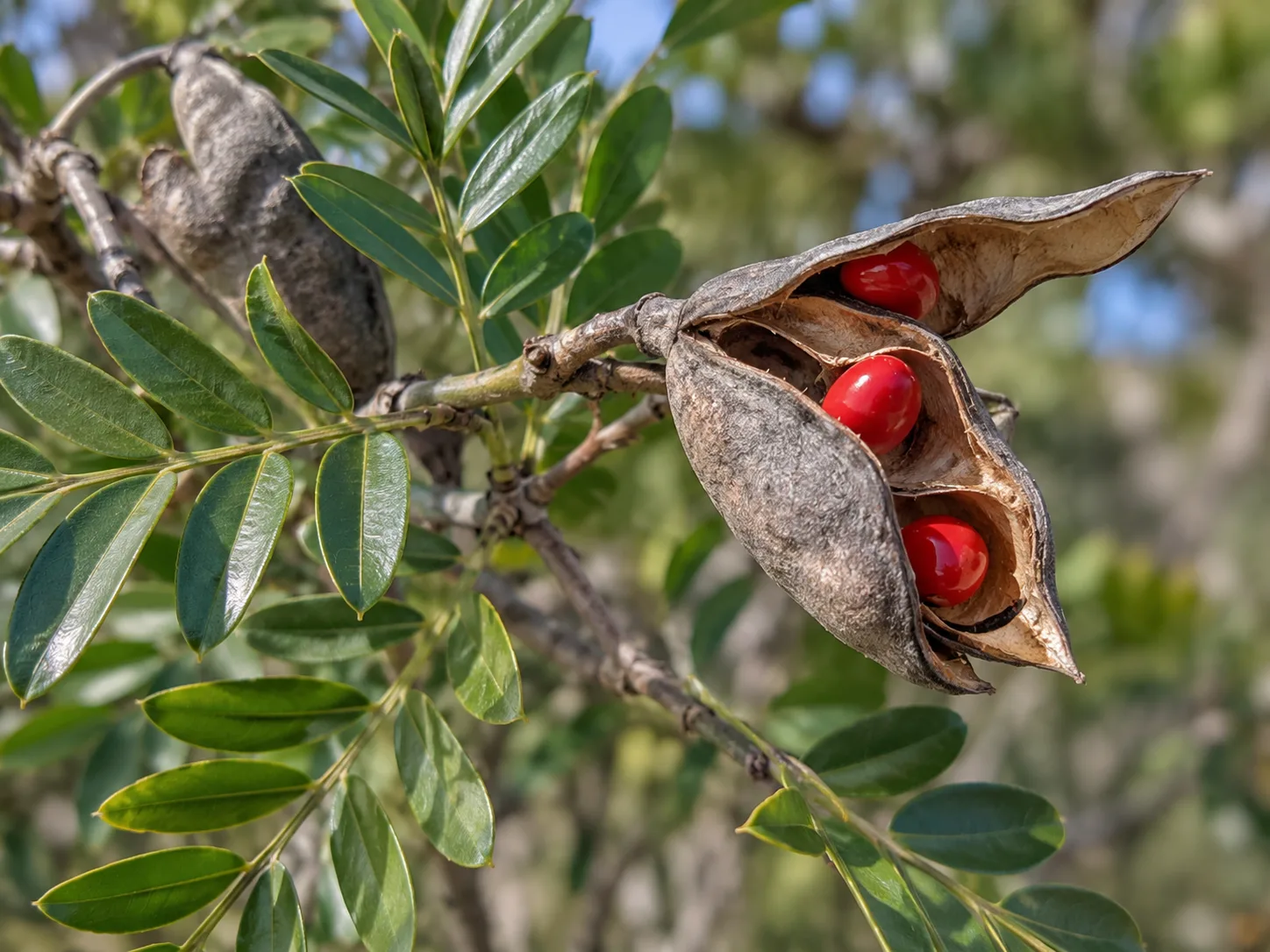
If children, dogs, or grazing animals can reach the shrub, make access control part of your planting decision. Pick up fallen pods before they become toys or chewable objects, keep pruning debris out of yards where animals roam, and never turn the seeds into beads, jewelry, or craft materials. NC State reports no contact dermatitis, but ingestion is serious enough that routine gardening should include handwashing and keeping plant parts away from mouths; gloves do not make the seeds safe to handle as a toy.
If anyone may have swallowed a seed or plant part, contact a poison-control service or medical professional promptly; for an animal, call a veterinarian or animal poison service. Do not wait for symptoms or try a home remedy. Tell the professional the plant’s name and what may have been eaten, and keep a sample or photograph only if you can do so without delaying the call.
Manage pests and signs of stress
NC State’s plant profile reports no known major insect or disease problems, although regional gardeners sometimes see genista caterpillars feeding on leaves. Gardener’s Path describes the caterpillars as capable of heavy but often temporary defoliation. That means a few chewed leaflets are not automatically an emergency; inspect the whole shrub and look for webbing or clustered larvae before deciding what to do.
For a small, accessible infestation, remove larvae by hand while wearing ordinary garden gloves and dispose of them away from the plant. If damage is spreading, identify the caterpillar first and ask your local extension office whether intervention is warranted. Use any pesticide only when the pest is correctly identified and the product label permits that target and site; avoid spraying open flowers or harming visiting pollinators.
Yellowing, leaf drop, or weak growth can have several causes. Check how long the soil stays wet, whether the root ball is drying out faster than the surrounding ground, and whether the plant was recently moved or pruned. If the base is persistently wet or a branch is dying back, correct irrigation and drainage first and request a local diagnosis if symptoms continue; random fertilizer or pesticide applications can make the original problem harder to understand.
Propagate with care; a nursery plant is usually better
The most reliable home-garden choice is usually to buy a nursery-grown plant. Texas mountain laurel grows slowly, and cuttings are difficult to root; an established container shrub also lets you see its branch structure before you choose a site. That is often more efficient than waiting years for a seed-grown plant to become a landscape specimen.
Seeds have a very hard coat, so germination can be erratic and may take a long time without pretreatment. Horticultural guides describe scarification and soaking as propagation approaches, but the red seeds are poisonous if eaten. For homes with young children or curious animals, skip seed handling and buy a plant instead. If you are an experienced native-plant grower who chooses to propagate, keep pods and seeds contained throughout collection and preparation, follow a trusted nursery or extension protocol, and wash equipment and work surfaces afterward.
Do not collect pods from public land or private property without permission, and do not transplant mature wild shrubs. Moving a large established root system is difficult, and wild collection damages native plant communities. When buying, ask whether the plant was propagated for nursery sale and whether the seller knows its local hardiness performance.
What to expect in a container
A small Texas mountain laurel can spend time in a large, stable outdoor pot, but container culture is a compromise rather than the easiest long-term plan. The species naturally becomes a substantial shrub or small tree and develops an extensive root system, so a pot can limit its eventual size and may increase the attention needed for watering. Choose a container with drainage holes and a free-draining outdoor mix, and do not let the pot stand in a saucer of water.
Container soil dries faster in hot wind and sun than an in-ground root zone, so check moisture rather than relying on a fixed interval. Water thoroughly when the mix has begun to dry, then let excess drain away. A container can also expose roots to more temperature extremes; in a marginal climate, place the pot in a sheltered location during severe cold and consult a local nursery about whether the species is suitable for long-term container growth where you live.
If you want a permanent screen, fragrant spring flowers, and the plant’s full natural structure, an in-ground sunny site with good drainage is a better fit. Use a pot for a young specimen, a temporary display, or a location where you can monitor it closely—not as a way to keep a mature shrub indefinitely miniature.
Conclusion
Texas mountain laurel is a rewarding choice when you can give it sun, room, and soil that drains well. Plant it carefully in a warm-climate site, water the root ball through establishment, then irrigate mature plants only when conditions call for it. Keep fertilizer modest, prune after flowering and with a light hand, and plan around its slow pace and mature size.
The final decision should include safety as well as horticulture. Its vivid red seeds are poisonous if eaten, so keep pods and fallen seeds away from children and animals and seek expert help immediately after a suspected ingestion. If your yard has a suitable climate, sharp drainage, and a safe place for the plant to grow, this evergreen native can deliver glossy foliage and a brief, unmistakably fragrant spring bloom for many years.