25 Evergreen Trees to Add to Your Yard
Find the right evergreen tree for privacy, small spaces, hot climates, or cold winters, with honest notes on size, mess, and safety.
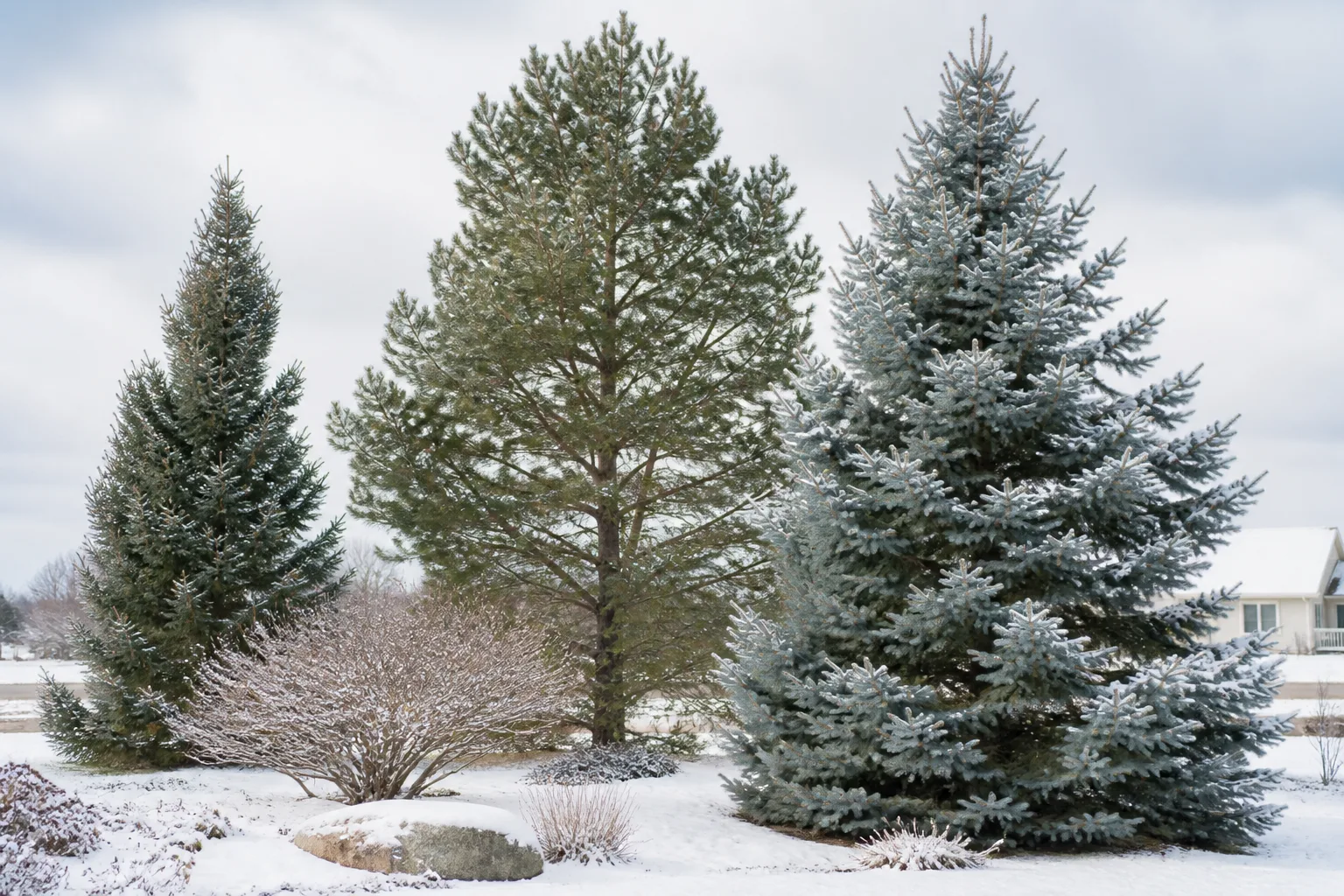
Evergreen trees do more than keep a yard green in winter. They can screen a neighbor, slow prevailing wind, frame a view, shelter birds, anchor a foundation bed, or act as a focal point when deciduous trees are bare. The hard part is that “evergreen” describes a foliage habit, not a single size, shape, or maintenance level.
The 25 choices below range from a three-foot dwarf pine to trees that can eventually occupy a hundred feet of sky. Use the list as a shortlist, not a shopping order. A tree that looks perfect in a nursery container can become a costly problem if its mature width, moisture needs, or winter exposure do not match your property.
How to choose an evergreen tree that will fit
The International Society of Arboriculture recommends matching a tree to its function and site rather than beginning with a favorite photo. Its guidance emphasizes mature form and size, soil, drainage, sun, wind, space, hardiness, and pest or disease exposure as selection factors. That site-fit framework is especially important for evergreens because many keep growing into the space long after their first few years look manageable.
Start with mature size and clearance
Measure the planting area before you compare foliage color. Write down the distance to the house, roof edge, driveway, sidewalk, fence, septic field, pool, and overhead or underground utilities. Then compare those measurements with the tree’s mature height and spread, not the size on the nursery tag today. A narrow tree can still be a poor choice if its roots, lower branches, or eventual height conflict with the site.
For a screen, calculate the planting line as a whole. A row of trees that are each 12 feet wide at maturity needs more room than their young, one-foot-wide root balls suggest. Give each plant enough space to develop its natural profile, unless the exact cultivar is intended for a maintained hedge and you are prepared to prune it regularly. Never make “we can top it later” part of the plan; topping creates weak regrowth and does not turn a large tree into a small one.
Match hardiness, sun, soil, and water
USDA hardiness zones are useful for screening out trees that cannot tolerate your area’s average winter low, but they are not a complete climate description. Utah State University Extension explains that zone maps can miss elevation and microclimate differences and that the zone values are averages, not absolute limits. A south-facing wall, windy ridge, salt-treated road, wet clay pocket, or irrigated lawn can create a very different growing environment from the zone printed on the map.
Treat these as four separate checks: cold hardiness, sun exposure, drainage, and summer water. A drought-tolerant tree can still fail in saturated soil, while a cold-hardy spruce may scorch in a hot, reflected-light planting strip. If the site is difficult, choose the tree that fits the site rather than trying to redesign the site around a tree that is merely attractive.
Choose between needled and broadleaf evergreens
Needled evergreens include pines, spruces, firs, cedars, cypresses, hemlocks, and yews. Their foliage may be needle-like, scale-like, or flattened into sprays, and most produce cones or cone-like structures. Broadleaf evergreens such as holly, live oak, and southern magnolia retain wider leaves and can add berries, acorns, flowers, glossy texture, or shade as well as winter color.
Neither group is automatically low-maintenance or tidy. Evergreen means the plant retains its living foliage through the year; it does not mean it never sheds older needles, leaves, cones, flowers, or berries. The right choice depends on what kind of litter, shade, pruning, wildlife activity, and seasonal change you can live with.
Best evergreen trees by landscape job
There is no single “best” evergreen tree. The better question is what you need the tree to do and which limitation matters most on your property. These quick groupings narrow the field before you read the full profiles.
Privacy screens and windbreaks
For a tall, relatively fast screen, look first at Green Giant arborvitae, Leyland cypress, Eastern red cedar, Serbian spruce, and Hinoki cypress. Green Giant and Leyland cypress are the speed-focused options, but speed also means faster mistakes: they need room, consistent establishment watering, and a realistic plan for their eventual height. Eastern red cedar brings better tolerance of heat and dry conditions, while Serbian spruce offers a narrower, more formal silhouette. Hinoki cypress is slower and more deliberate, useful when dense texture matters more than instant coverage.
Spacing is not cosmetic. Trees planted too close compete for light and water, develop thin inner growth, and become a stressed wall; trees planted too far apart may never close. Use mature width as a starting point, then adjust for the cultivar and whether you want a hedge or distinct specimens.
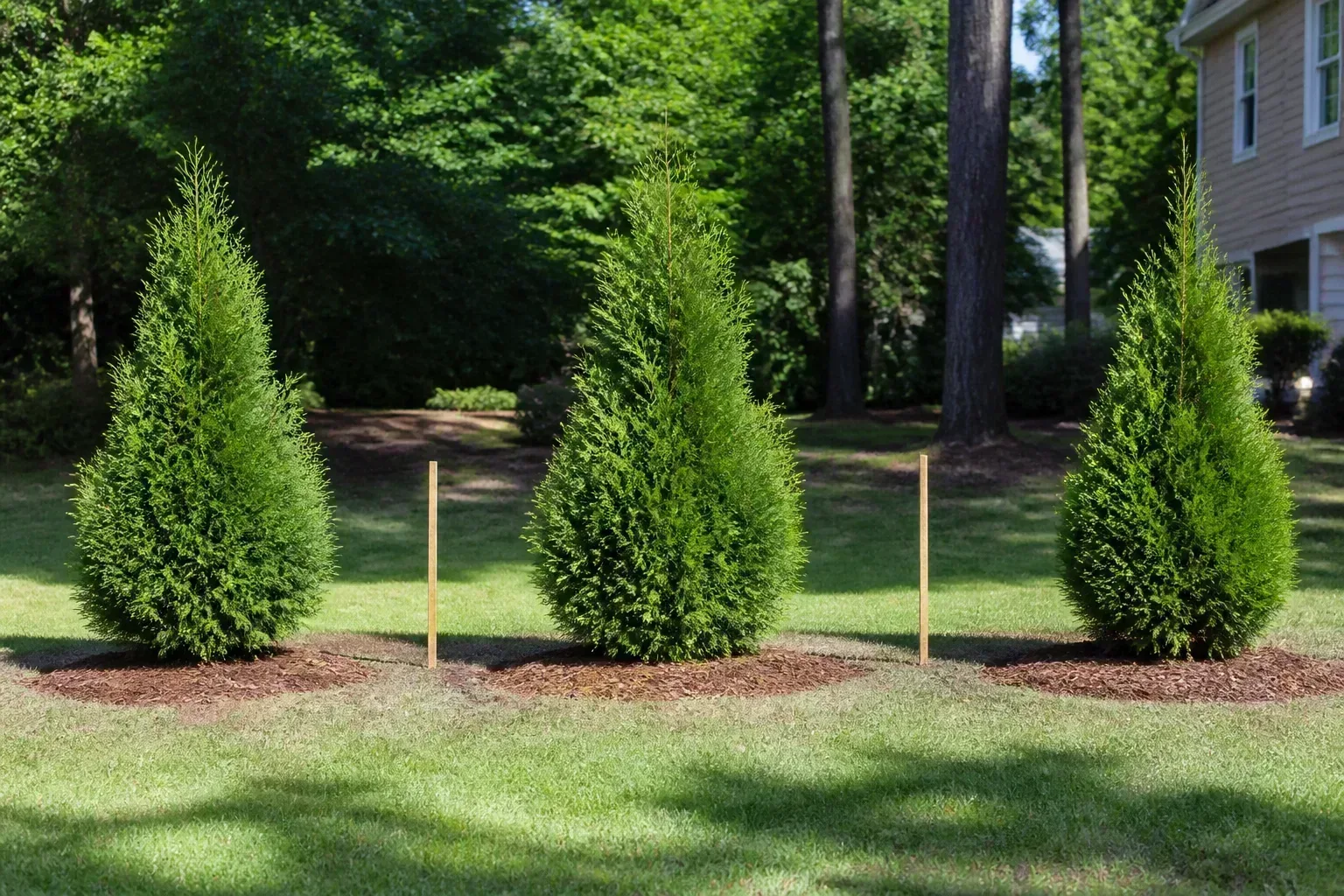
Small yards and narrow spaces
Small yards need a tree that is genetically small or naturally narrow, not a large tree that will be cut back forever. Japanese dwarf pine, Dwarf Alberta spruce, and Irish yew are among the most space-conscious choices here, although their climate and safety profiles differ. Verify the cultivar name on the tag: the species may be large while a named selection stays compact.
Japanese umbrella pine can work as a slow-growing specimen where 25 feet is acceptable, but it is not a foundation shrub. A narrow Irish yew takes little horizontal space, yet its toxicity makes it a poor choice where children, dogs, cats, or grazing animals can chew the foliage or red arils. For a small front yard, the best evergreen is often the one you can leave unpruned at its mature size.
Hot, dry, or exposed sites
Start with Aleppo pine, Arizona cypress, Eastern red cedar, and, in appropriate climates, Deodar cedar. Eastern red cedar is particularly adaptable across a broad range of conditions, but its mature size and possible cedar-apple rust relationship matter if you grow susceptible apple relatives nearby. Arizona cypress is a strong visual fit for dry, sunny landscapes, provided drainage is good. Aleppo pine belongs in warm regions with room for a medium-to-large tree and is not a substitute for a small patio evergreen.
Do not read “drought tolerant” as “never water.” New trees need help while roots expand, and drought tolerance does not cancel poor drainage or reflected heat. Penn State Extension’s guidance on selecting trees for a changing climate also highlights heat, salt, compacted soil, storms, and future climate conditions.
Cold climates and winter structure
Colorado blue spruce, Norway spruce, White fir, Scots pine, Eastern white pine, and Dwarf Alberta spruce handle cold climates well when their other requirements are met. Colorado blue spruce offers blue foliage and strong winter structure, while Norway spruce and white pine need generous room. Dwarf Alberta spruce is much smaller but can struggle when hot, dry summers or spider mites replace the cool conditions it prefers.
Cold hardiness does not prevent winter injury. Evergreen foliage can lose water on sunny, windy days while soil is frozen, and road salt can burn foliage or damage roots. Protect young trees from deicing spray and choose a sheltered site for shallow-rooted or delicate species.
25 evergreen trees to consider
The size and zone ranges below are planning estimates for typical landscape forms, not guarantees for every cultivar or region. Selections can be smaller, narrower, faster, slower, or less hardy than the species. The i-Tree Species tool also combines location, hardiness, mature height, and desired benefits; use it as a starting point, then confirm the plant with a local extension service or reputable nursery. Garden Design’s evergreen guide is a useful second look at how form changes a tree’s landscape role.
Pines
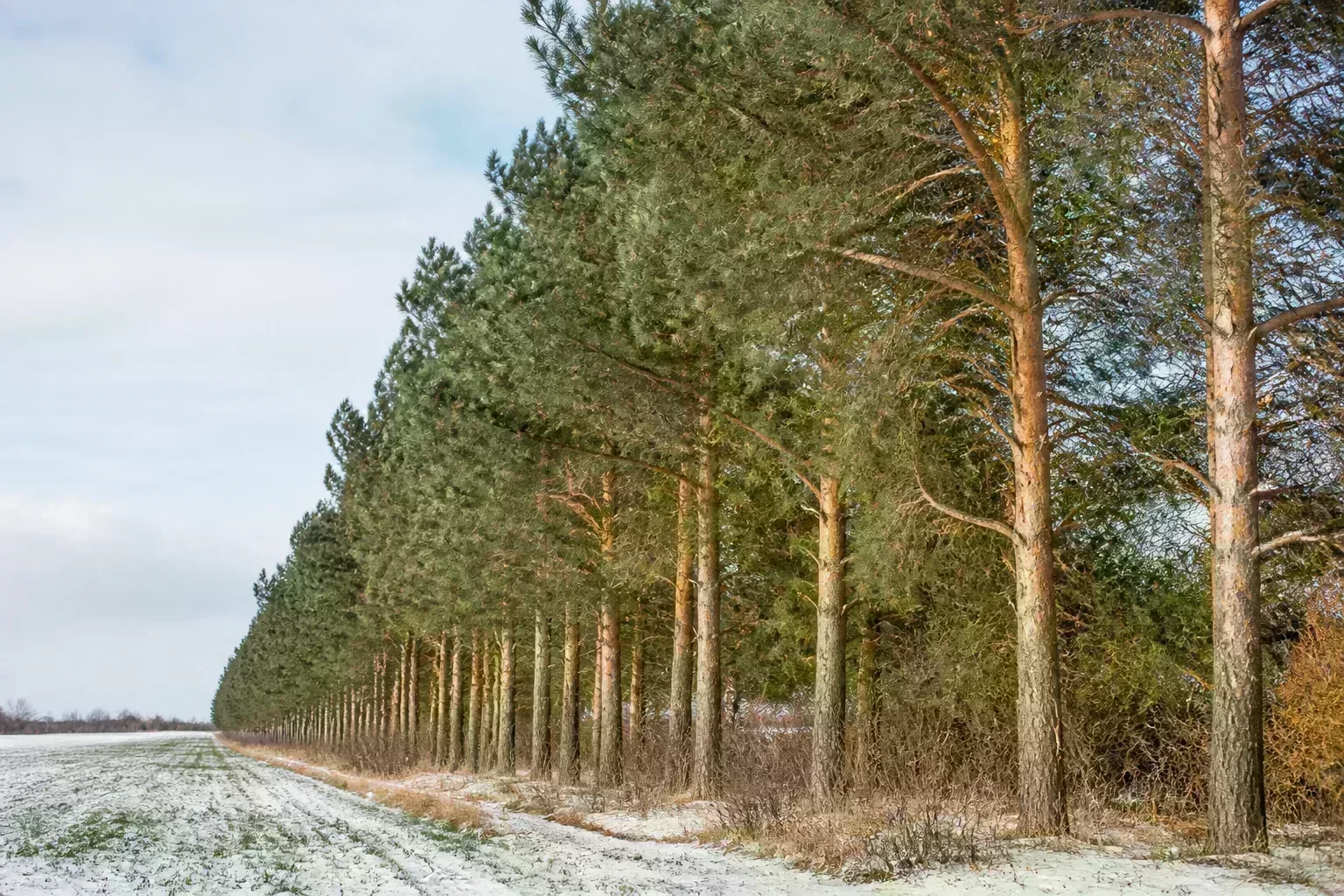
1. Eastern white pine (Pinus strobus) — Zones 3–8; about 50–80 feet tall and 20–40 feet wide. This fast-growing native is graceful, soft-needled, and excellent for a large property, wildlife planting, or informal windbreak. Its weakness is mess: long needles, large cones, and sticky pitch can frustrate anyone who parks or entertains beneath it. Give it full sun to partial sun and moist, well-drained soil. It is a poor “small yard” choice even when the young tree looks harmless.
2. Japanese umbrella pine (Sciadopitys verticillata) — Zones 5–8; about 20–30 feet tall and 15–20 feet wide. Its glossy, rubbery-looking needle clusters are unlike those of a true pine, making it a distinctive slow-growing specimen. Plant it in full sun with evenly moist, well-drained, humus-rich soil. It is a focal tree, not a privacy screen, and dislikes hot, dry exposure.
3. Longleaf pine (Pinus palustris) — Zones 7–9; roughly 80–100 feet tall and 30–40 feet wide. This majestic Southern tree has very long needles and large cones that bring texture and wildlife value. It tolerates clay but performs best with good drainage. Its size and open habit make it unsuitable close to a house or small patio. Fallen needles can be useful as pine-straw mulch, but still require seasonal handling.
4. Japanese dwarf pine (Pinus parviflora ‘Arnold Arboretum Dwarf’) — Zones 4–8; about 3 feet tall and 2 feet wide after 10 years. This is one of the few choices on the list that genuinely makes sense for a tight foundation bed, rock garden, or carefully managed container. It grows slowly, keeps its scale, and rarely needs corrective pruning. Use full sun and fertile, well-drained soil. Confirm the exact cultivar: “dwarf pine” is not a reliable description for every compact-looking young pine at a nursery.
5. Aleppo pine (Pinus halepensis) — Zones 8–11; roughly 20–50 feet tall and similarly wide. This Mediterranean pine suits warm, low-rainfall regions. Its yellow-green needles and orange-red bark add visual warmth, but the canopy needs room and full sun. Plant in well-drained, sandy or loamy soil, not a wet lawn. It is a regional choice, not a universal substitute for a cold-hardy pine.
6. Scots pine (Pinus sylvestris) — Zones 2–9; about 60–125 feet tall and up to 40 feet wide. Its orange-brown upper bark, long needles, and sculptural trunk make it a memorable specimen, but its eventual size is easy to underestimate. It tolerates relatively lean, well-drained soil and works best where its broad mature canopy will not threaten buildings or utilities. Expect cones and needle litter. In a small yard, select a genuinely compact cultivar or choose a different evergreen entirely.
Spruces and firs
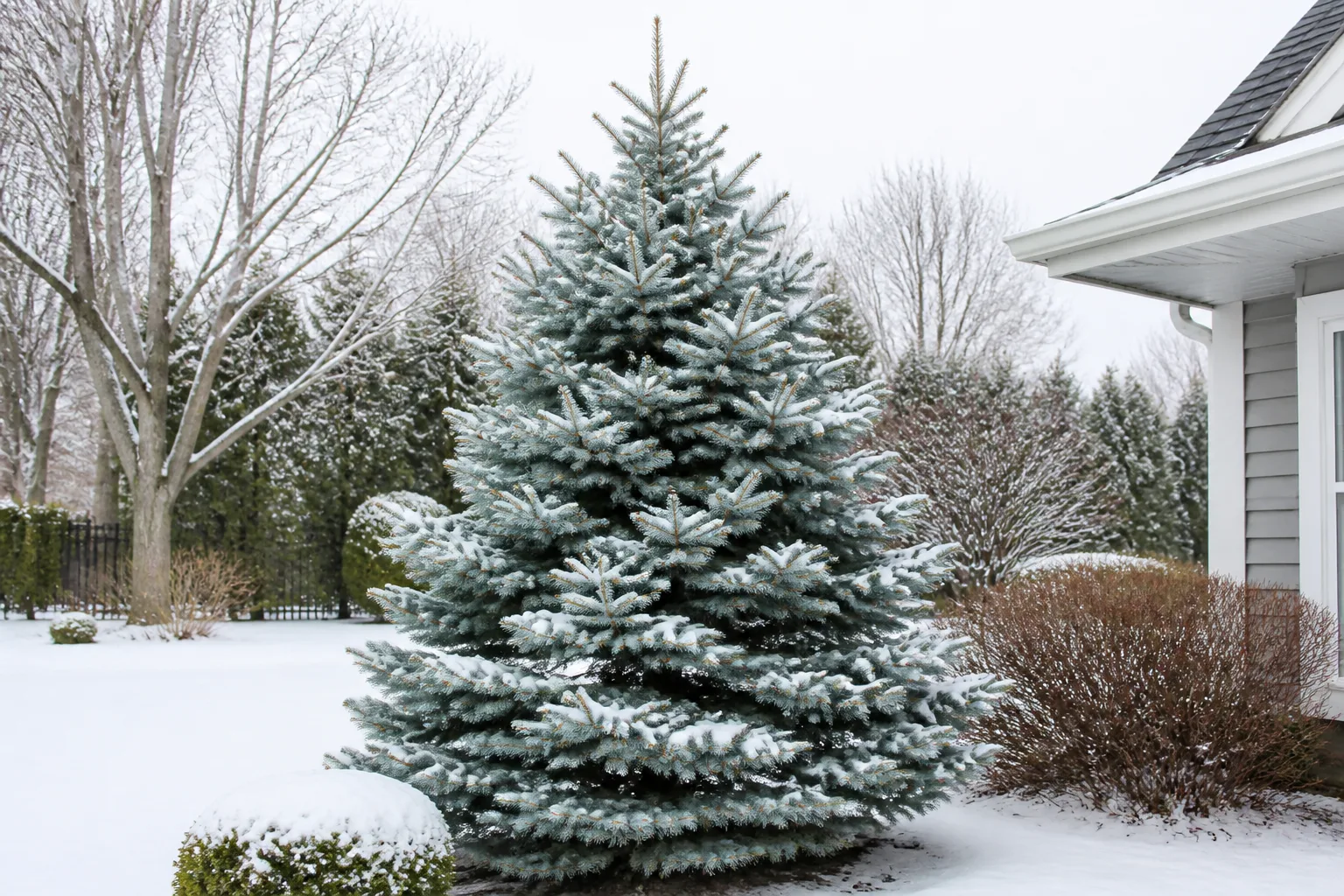
7. Colorado blue spruce (Picea pungens) — Zones 2–7; commonly 50–75 feet tall and 15–20 feet wide. Its blue needles and pyramidal outline suit cool-climate specimens and windbreaks. Full sun and moist, rich, well-drained soil produce the best color and density. Avoid hot, humid conditions or compacted wet soil, where stress invites pest and disease problems. Its prickly foliage may discourage deer, but not reliably.
8. Dwarf Alberta spruce (Picea glauca ‘Conica’) — Zones 3–6; about 10–13 feet tall and 7–10 feet wide. This slow, dense, fuzzy-looking spruce fits foundation beds and large containers better than most full-size spruces. It prefers full sun, cool conditions, and moist but well-drained soil. In hot summers it can become stressed and more vulnerable to spider mites, so it is not automatically low-care in every region. Treat it as a small tree with a real mature spread, not as a permanent miniature Christmas tree.
9. Norway spruce (Picea abies) — Zones 2–7; about 50–75 feet tall and 30–50 feet wide. Norway spruce grows into a large, broad, cold-hardy tree with dark green needles and conspicuous four-to-six-inch cones. It is useful for large property lines, windbreaks, and wildlife habitat, but its width can overwhelm a suburban lot. Provide full sun and moist, well-drained soil. If you want the look without the footprint, search for a named narrow or weeping cultivar rather than planting the straight species.
10. Serbian spruce (Picea omorika) — Zones 4–7; about 50 feet tall and only around 15 feet wide. The narrow, elegant profile is its main landscape advantage: it gives vertical structure and screening without the broad footprint of Norway spruce. Full sun to partial shade and average, well-drained soil suit it, and it tolerates some drought and salt better than many spruces once established. Purple young cones add seasonal interest. It still becomes tall, so keep it away from wires and tight rooflines.
11. Brewer spruce (Picea breweriana) — Zones 6–8; about 30–50 feet tall with a spread nearly as broad. Its long, pendulous branches create one of the most distinctive silhouettes among conifers. The trade-off is a narrow climate window: it performs best with cool, wet winters and dry, warm summers, similar to its native range in northern California and southern Oregon. Use it as a specimen only where that seasonal pattern and excellent drainage are realistic. It is a poor choice for humid, poorly drained, or consistently hot sites.
12. White fir (Abies concolor) — Zones 3–7; about 40–50 feet tall and 20–30 feet wide. White fir has soft, bluish-green needles and upright, barrel-shaped cones that add a quieter, refined look than the sharper outline of a spruce. Full sun and well-drained, sandy soil help it establish. It makes a handsome Christmas-tree-like specimen for a cool, spacious landscape, but it is too large for most foundation beds. Give it dependable water during establishment without keeping the root zone saturated.
Cedars, cypresses, hemlocks, and yews
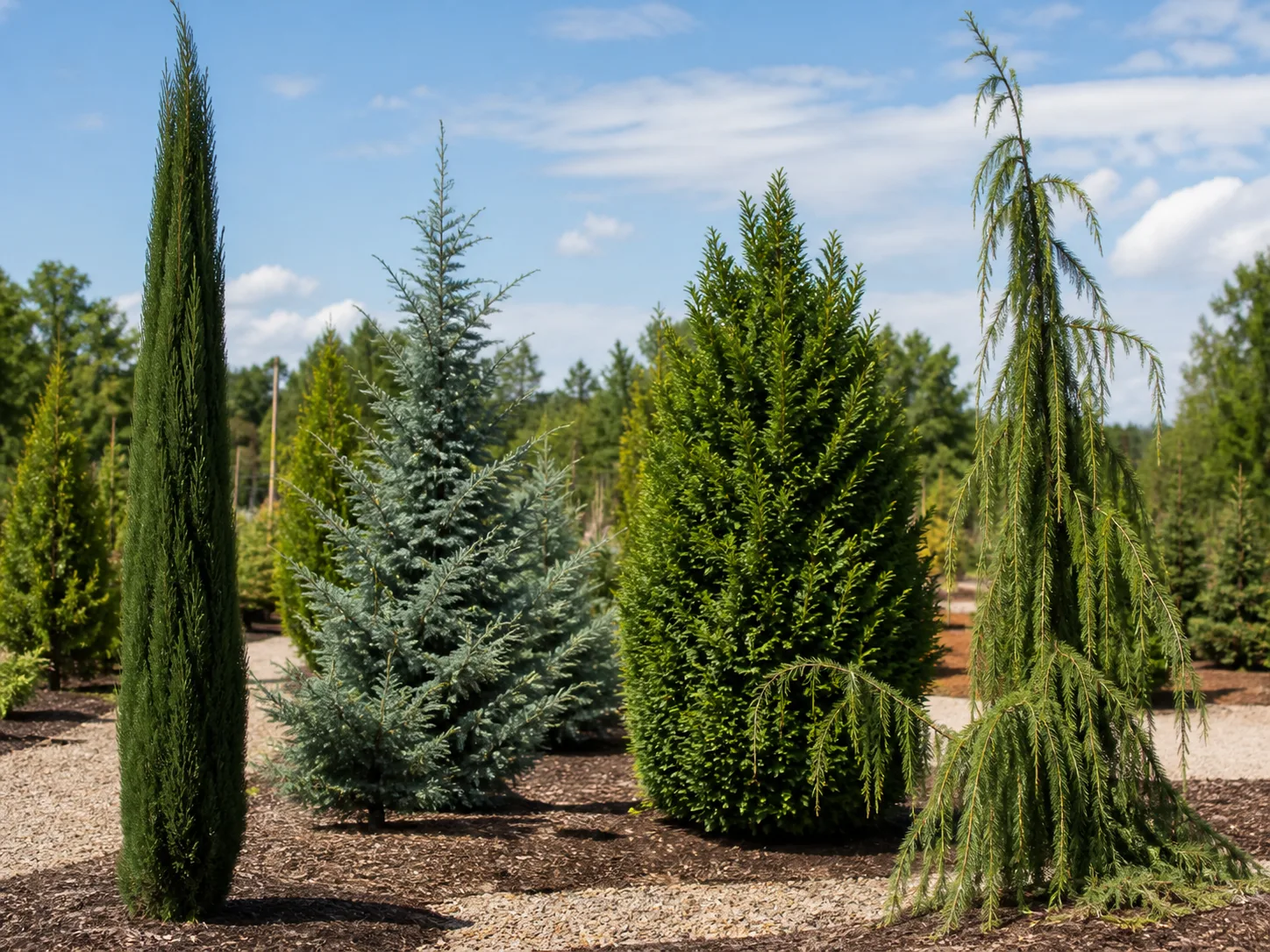
13. Canadian hemlock (Tsuga canadensis) — Zones 3–7; about 70 feet tall and 25–35 feet wide. Its delicate, flat foliage and small cones make it a softer screen. It wants cool, moist, well-drained soil and wind protection because of its shallow roots. It can work beneath taller trees or along a sheltered boundary, but not on a dry or salty site. The ASPCA lists Canadian hemlock as non-toxic to dogs, cats, and horses.
14. Eastern red cedar (Juniperus virginiana) — Zones 2–9; roughly 30–65 feet tall and 8–25 feet wide. Despite its common name, this is a juniper, with aromatic scale-like foliage and small blue, berry-like cones that birds use. Its broad native range helps it handle cold, heat, drought, and lean soil better than many ornamental evergreens. Plant it in full sun and well-drained soil. Keep it away from susceptible apple relatives if cedar-apple rust is common in your area, and allow for the mature spread of the exact form.
15. Cedar of Lebanon (Cedrus libani) — Zones 5–9; about 40–100 feet tall and 40–80 feet wide. Its horizontal branching and large barrel-shaped cones create a powerful specimen for a park-like property. It is not a patio tree, foundation tree, or narrow privacy screen. Give it full sun, moist but well-drained soil, and enough room for a canopy that can eventually be wider than the tree is tall. Choose it for long-term structure, not quick coverage or easy pruning.
16. Blue Atlas cedar (Cedrus atlantica) — Zones 6–9; the species can reach about 40–60 feet tall and 30–40 feet wide. The blue-green foliage is striking, and the weeping cultivar ‘Glauca Pendula’ can be trained into a much smaller, highly sculptural form. This is a case where cultivar identity changes the landscape use completely. Use full sun and well-drained soil. Before buying, confirm whether the nursery is selling the species or a trained weeping selection, and plan for support and shaping if the latter is intended.
17. Deodar cedar (Cedrus deodara) — Zones 7–9; about 40–70 feet tall and 20–40 feet wide. The drooping branch tips and blue-green or gray-green foliage give this Himalayan cedar a relaxed, architectural form. It grows relatively quickly and handles some drought after establishment, but it still needs well-drained, moderately moist soil and a warm enough climate. Keep it away from narrow walks and small beds. Its mature spread, low branching, and brittle-looking weeping habit need to be part of the design from day one.
18. Leyland cypress (× Cuprocyparis leylandii) — Zones 6–10; commonly about 60–70 feet tall and 10–15 feet wide, though cultivars vary. It is one of the fastest ways to create a tall screen, with dense, flattened sprays. That speed is the warning: a row too close to a property line can outgrow its maintenance plan. Full sun, fertile soil, and establishment water matter. Cornell University notes that cypress foliage should not become a major forage source for horses or livestock.
19. Hinoki cypress (Chamaecyparis obtusa) — Zones 5–8; the species can reach 40–75 feet tall and 10–20 feet wide. Its layered horizontal branches, drooping tips, and rich green sprays suit Japanese-inspired gardens, specimen plantings, and slower privacy screens. Full sun, moist soil, and good drainage produce the best growth. It is a more patient alternative to Leyland cypress, but the straight species still becomes large. Compact cultivars are often the better choice for a residential foundation bed.
20. Arizona cypress (Cupressus arizonica) — Zones 7–9; about 40–50 feet tall and 15–30 feet wide. Blue-gray to green scale foliage, reddish bark, and rounded cones give it a strong Southwest character. It is a good match for full sun, dry air, and well-drained soil, and it can tolerate drought after establishment. Avoid wet clay pockets and humid, poorly ventilated sites. The cultivar ‘Carolina Sapphire’ is often sold as a smaller, bluer landscape option, but confirm the mature dimensions before assuming it will stay compact.
21. Irish yew (Taxus baccata ‘Fastigiata’) — Zones 7–9; approximately 15–30 feet tall and only 4–8 feet wide. This slow, columnar form is a strong narrow accent. It tolerates full sun to partial shade and well-drained soil, but the ASPCA lists yew as toxic to dogs, cats, and horses. Do not plant it where children or animals can browse it.
Broadleaf and scale-leaf evergreens
22. Yaupon holly (Ilex vomitoria) — Zones 7–9; about 10–30 feet tall and 8–12 feet wide. This small native broadleaf evergreen offers glossy green leaves and red berries, making it useful as a specimen, informal screen, or multi-stemmed small tree in the Southeast. Plant it in full sun to partial shade and well-drained soil. You need compatible male and female plants for reliable berry production. Holly foliage and berries are toxic to dogs, cats, and horses according to the ASPCA plant listing, so locate it accordingly.
23. Live oak (Quercus virginiana) — Zones 8–10; about 40–80 feet tall and 60–100 feet wide. This broadleaf evergreen is a magnificent shade and habitat tree for spacious Southeastern properties, but its canopy is often wider than a suburban lot is deep. Give it full sun to partial shade and well-drained soil that can range from dry to moist. Plan around the spread, acorns, and surface roots rather than trying to confine it to a narrow lawn strip. The ASPCA identifies oak as toxic to horses, with acorns also posing an obstruction risk.
24. Southern magnolia (Magnolia grandiflora) — Zones 6–10; commonly 60–80 feet tall and 20–40 feet wide, with smaller cultivars available. Its glossy leaves, fragrant white flowers, and large evergreen presence make it a true focal tree, not a background filler. Give it full sun to partial shade, moist well-drained soil, and generous overhead clearance. Fallen leaves and cone-like fruit are part of the bargain. For a smaller property, look for a named compact form such as ‘Little Gem’ and confirm the mature width rather than assuming “dwarf” means small.
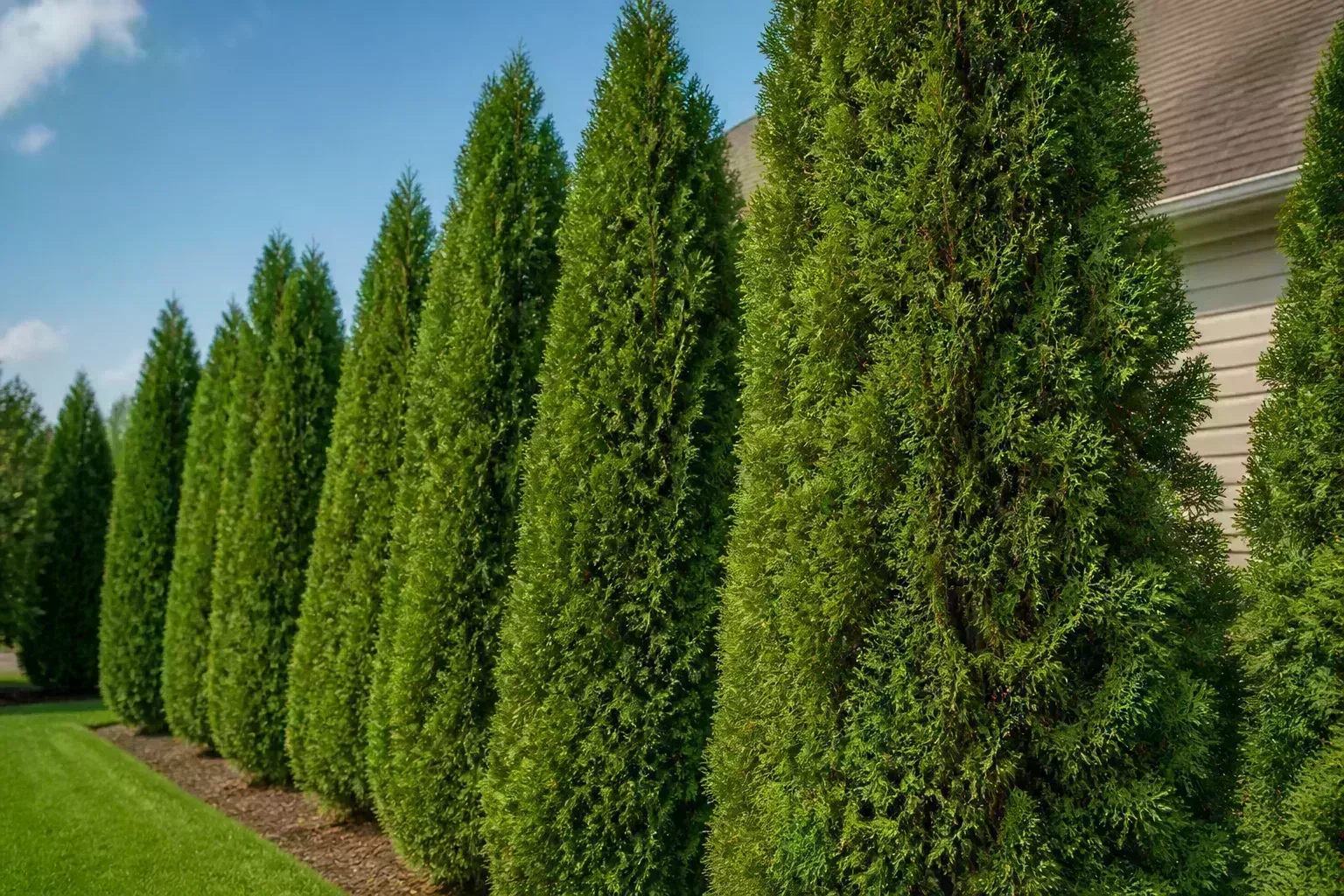
25. Green Giant arborvitae (Thuja standishii × T. plicata) — Zones 5–8; roughly 40–60 feet tall and 12–18 feet wide. Dense, soft, rich-green foliage and rapid growth make it one of the most popular privacy choices on this list. Full sun to partial shade and fertile, well-drained clay or loam suit it, but it needs room and establishment water. Deer may browse it despite its reputation for resistance. Use a wider spacing plan than the starter pots suggest, and do not shear the tops as a substitute for choosing a smaller arborvitae cultivar.
Planting and early care that protects the investment
Even the right species can fail after a careless planting job. Utah State University Extension recommends a hole two to three times wider than the root ball, a correctly placed root collar, watering of the root ball and surrounding soil, and a three- to four-inch organic mulch layer kept away from the trunk. Its landscape-tree guide cautions against fertilizer at planting and waterlogged soil.
For a new evergreen, the first season is about root contact, not pushing top growth. Check soil moisture below the surface, water slowly enough to soak the root ball, and extend the watered area outward as roots grow. Keep turf and thick groundcover away from the trunk, inspect for circling roots in container stock, and stake only when wind or vandalism makes it necessary. Remove temporary ties before they damage the trunk.
Avoid root-collar and watering mistakes
The most common planting error is setting the tree too deep because the top of the root ball is treated as the correct soil line. Find the trunk flare and root collar; if the trunk disappears straight into the soil, the tree may be buried. Deep planting reduces oxygen around roots, encourages trunk decay, and can lead to girdling roots years later, when the original mistake is difficult to fix.
The second mistake is confusing frequent shallow sprinkling with establishment watering. Evergreen foliage can look fine while the root ball remains dry inside, especially under burlap or dense mulch. Water the root zone deeply, then let excess drain. In heavy clay or a low spot, fix drainage or select a species that tolerates those conditions; do not compensate for a poor site with constant irrigation.
Safety, wildlife, and maintenance trade-offs
Evergreens can support birds, provide cover, and reduce winter wind, but berries, needles, cones, sap, and dense foliage change how a yard is used. Pines drop cones and pitch; spruces and firs shed needles and cones; hollies add wildlife-friendly berries with a safety concern. Broad canopies shade lawns, while tight screens compete for moisture.
Treat toxicity as species-specific, not conifer-versus-broadleaf. ASPCA lists holly and yew as toxic to dogs, cats, and horses, while its Canadian hemlock listing is non-toxic to those animals. Those listings do not cover every cultivar or animal, and “non-toxic” does not mean a plant is safe to eat in quantity. If an animal may have chewed a plant, contact a veterinarian or poison-control service promptly.
Maintenance is another form of site fit. Choose a naturally narrow tree instead of planning to shear a large one into a column. Do not cut conifers back into bare old wood unless you know the plant can break new growth there; many will not fill in. Remove dead, damaged, or crossing branches, protect young trunks from equipment, and inspect screens for brown interiors, lean, winter burn, or pest activity before reaching for fertilizer or a pesticide.
Conclusion
The best evergreen tree for your yard is the one that still fits when it reaches its mature height and width. Start by identifying the job—screen, windbreak, specimen, winter structure, habitat, or small-space accent—then eliminate choices that fail the site’s hardiness, sun, drainage, water, and safety checks.
For a small yard, favor a true dwarf or narrow cultivar. For a privacy screen, plan spacing and maintenance before buying a fast grower. For a hot, dry site, use a species adapted to that climate rather than hoping extra water will solve the mismatch. And for a family or livestock property, check the exact plant against a reliable toxicity reference. That short process will leave you with fewer options, but much better ones.