30 Types of Jade Plants (Crassula) to Grow
Compare 30 jade plant types by leaf shape, size, and light needs. ID charts for Gollum vs Hobbit, pet safety, dwarf picks, and links to Crassula care.
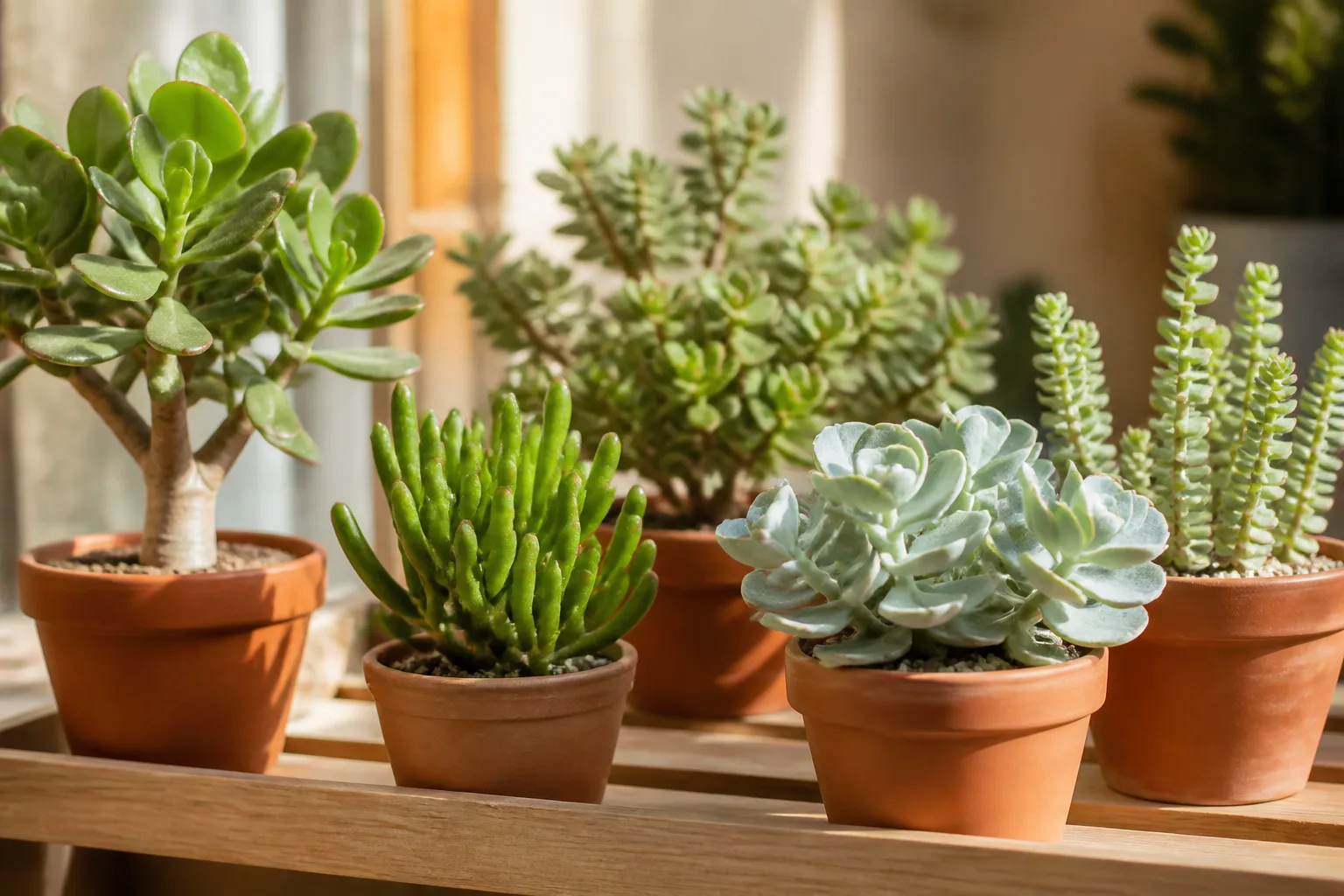
Jade plants are the succulents everyone recognizes—thick leaves, woody stems, and a reputation for surviving missed waterings. Botanically, most “jades” on this list belong to Crassula, a genus of roughly 300 species native largely to southern Africa, with Crassula ovata as the classic money plant or lucky plant sold worldwide. Retail tags blur the line: half the pots say “jade” when the plant is a campfire stack, a trailing comet, or a watch-chain shrub with nothing oval about the leaves.
This guide covers 30 types of jade plants (Crassula) worth knowing—grouped by leaf shape and growth habit so you can identify what you already own and pick the right plant for your light, space, and pet situation. For watering rhythms, soil mixes, and troubleshooting across the group, start with our jade plant care guide; the Jade Plant hub links light, watering, soil, propagation, pruning, and problem-fix pages when one plant needs deeper help.
What Counts as a Jade Plant—and What Is Just “Crassula”
In everyday speech, “jade plant” usually means Crassula ovata—the shrubby species with glossy oval leaves and a tree-like trunk as it ages. Wisconsin Horticulture notes that C. ovata is often called friendship plant, money plant, or money tree, and that the genus name crassula refers to thick leaves while ovata means egg-shaped. (Wisconsin Horticulture)
Crassula is the broader botanical genus. Not every Crassula is a jade in the ovata sense, but collectors and nurseries still group many species under “jade types” because they share succulent leaves, South African origins, and similar soak-and-dry care. Do not confuse true Crassulas with Portulacaria afra (elephant bush)—it looks jade-like but sits in a different genus and is not on this list.
Crassula ovata vs the Whole Genus
When a search says “types of jade plant,” intent usually spans C. ovata cultivars (Gollum, Hobbit, Sunset) plus related Crassulas sold as jades: silver dollar types (C. arborescens), stacked-leaf species (C. perforata, C. rupestris), and trailing forms (C. sarmentosa). This page covers all 30 from that practical retail lens while keeping species names straight for accurate care and propagation.
How to Choose the Right Jade Type Before You Buy
Nursery labels are unreliable. Wholesale growers reuse generic “jade succulent” tags, and the same cultivar arrives under three Latin names. Buy with your eyes, not the sticker.
Quick ID: Flat Leaves, Tubular Leaves, or Trailing Stems
Run through this order every time:
- Flat, oval, tree-form leaves on woody stems → Crassula ovata species or cultivar (classic jade, variegated, Sunset, Pink Beauty, Crosby’s Compact).
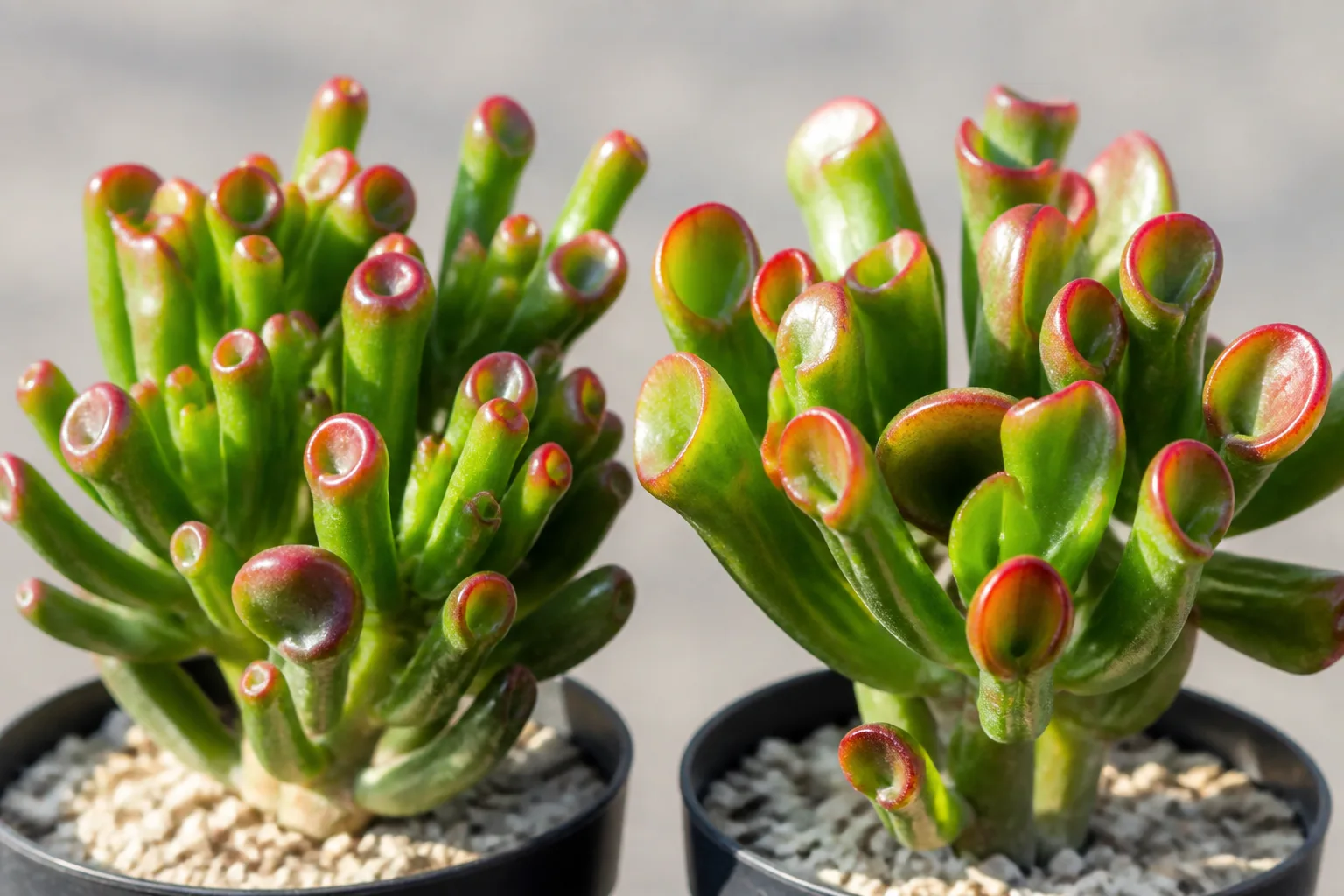
- Tubular or finger-like leaves → Tolkien group: Gollum (suction-cup tips), Hobbit (curled spoon tubes), Skinny Fingers (longer, thinner tubes), Red Coral (bright red-orange stress color).
- Round, blue-gray coin leaves → Crassula arborescens group (silver dollar, Blue Bird, ripple/undulatifolia).
- Stacked, triangular leaves on upright or sprawling stems → C. perforata (string of buttons), C. rupestris varieties (baby’s necklace, Tom Thumb, rosary vine).
- Trailing or vining stems → C. sarmentosa and ‘Comet’ variegated trailing jade.
- Unusual foliage architecture → propeller plant (C. falcata), miniature pine tree (C. tetragona), watch chain (C. muscosa), woolly rosettes (C. tomentosa).
| Your goal | Start with these types |
|---|---|
| First jade / easiest win | Classic C. ovata, Crosby’s Compact, Minima |
| Bright windowsill color | Hummel’s Sunset, Red Coral, Campfire (C. capitella) |
| Small desk or terrarium | Tom Thumb, Mini Jade, Watch Chain, Woolly Crassula |
| Bonsai specimen | Hummel’s Sunset, classic C. ovata, Minima |
| Hanging basket / spiller | Trailing jade ‘Comet’, String of Buttons |
| Outdoor rock garden (zones 9–11) | Fairy Crassula, Taylor’s Parches, Campfire |
| Pet household | None on this list are pet-safe—see pet section |
Shared Care Rules for Every Type on This List
Every Crassula on this list shares a succulent baseline. They are not tropical foliage plants that want evenly moist peat.
| Factor | Baseline for Crassula “jades” | Notes |
|---|---|---|
| Light | 4+ hours strong light daily; direct sun once acclimated | Wisconsin Horticulture and NC State both emphasize direct sun for compact growth and red leaf margins. (Wisconsin Horticulture) (NC State Extension) |
| Water | Soak when soil is dry through the pot; reduce in winter | Overwatering causes leaf drop and stem rot; drought causes spotting and leaf loss. |
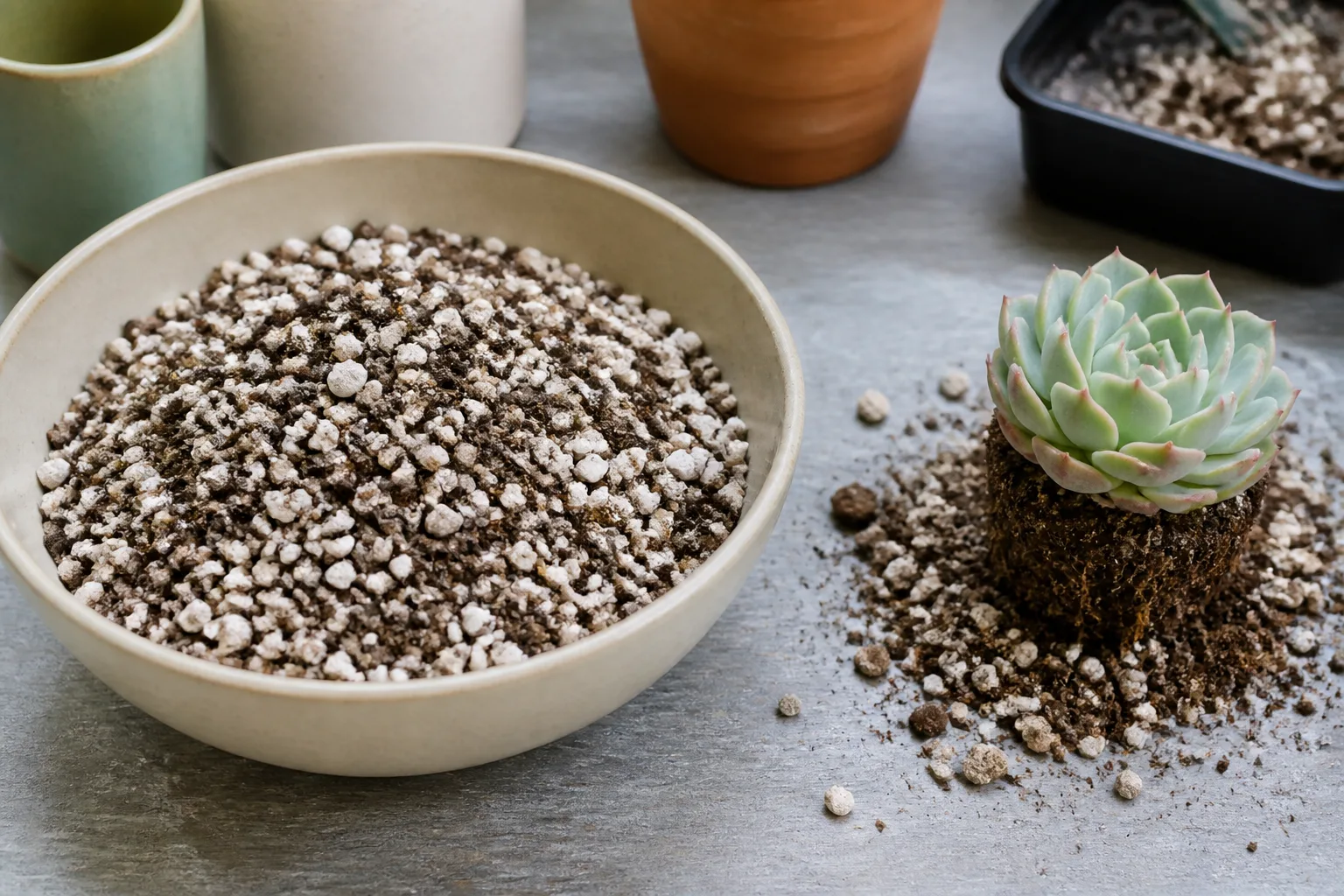
| Soil | Gritty succulent or cactus mix with fast drainage | Add perlite or sharp sand to heavy peat blends. |
| Pot | Drainage hole required | Terra cotta speeds dry-down between soaks. |
| Temperature | 65–75°F (18–24°C) indoors; protect from frost | Outdoor hardiness varies by species—most C. ovata types tolerate zones 9–12. |
| Fertilizer | Dilute feed spring–summer only | Skip or minimize in winter rest. |
| Repotting | Every 2–3 years or when top-heavy | Spring is ideal; do not upsize aggressively. |
First action when any jade looks unhappy: check light and soil moisture deep in the pot—not the calendar. Soft yellow leaves and mushy stems almost always mean wet roots or dim light, not “needs a drink.”
Variegated types (Variegata, Gollum Variegata, Blue Bird, trailing ‘Comet’) need brighter indirect light than solid green forms to hold white or cream streaks; in dim rooms they revert toward plain green within weeks.
Pet Safety: Are Jade Plants Toxic to Cats and Dogs?
Yes. ASPCA lists jade plant (Crassula ovata) as toxic to dogs, cats, and horses. Ingestion can cause vomiting, depression, and incoordination. (ASPCA) NC State Extension tags C. ovata as a problem for dogs, cats, and horses as well. (NC State Extension)
There is no pet-safe jade cultivar on this list—Gollum, Hobbit, silver dollar, and trailing types are still Crassulas with the same toxicity profile. Placement on unreachable shelves, closed rooms, or pet-free homes is the only mitigation. Call ASPCA Animal Poison Control at (888) 426-4435 or your veterinarian if a pet chews leaves.
Classic Crassula ovata and Everyday Cultivars
Most of the 30 types here are Crassula ovata—the species Wisconsin Horticulture describes as a small rounded evergreen shrub in its native Eastern Cape habitat, with egg-shaped glossy leaves that redden under sufficient light. (Wisconsin Horticulture) NC State lists numerous named cultivars including Gollum, Hobbit, Hummel’s Sunset, Minima, Pink Beauty, and Variegata. (NC State Extension)
Jade Plant, Variegated Jade, Crosby’s Compact, and Pink Beauty
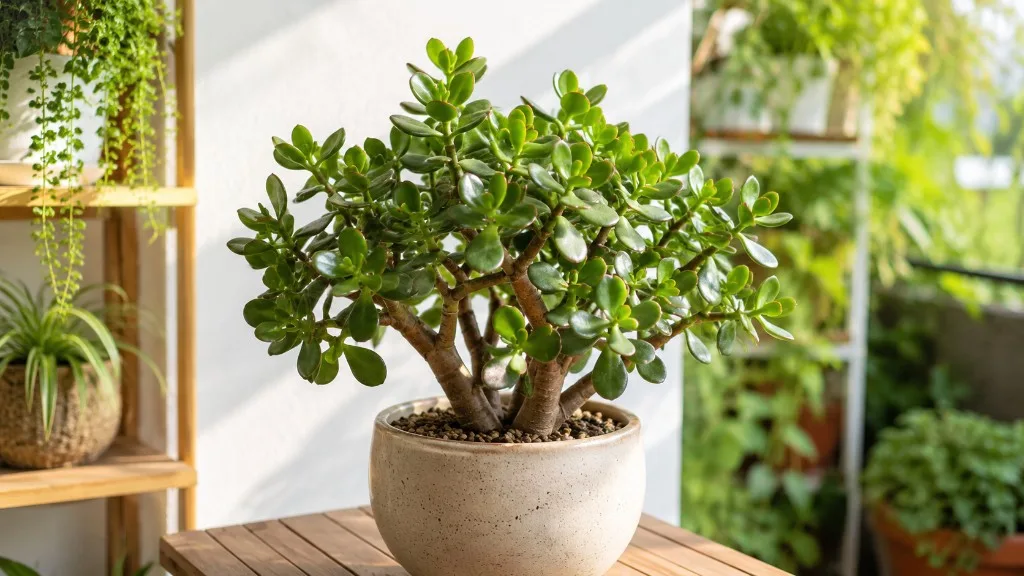
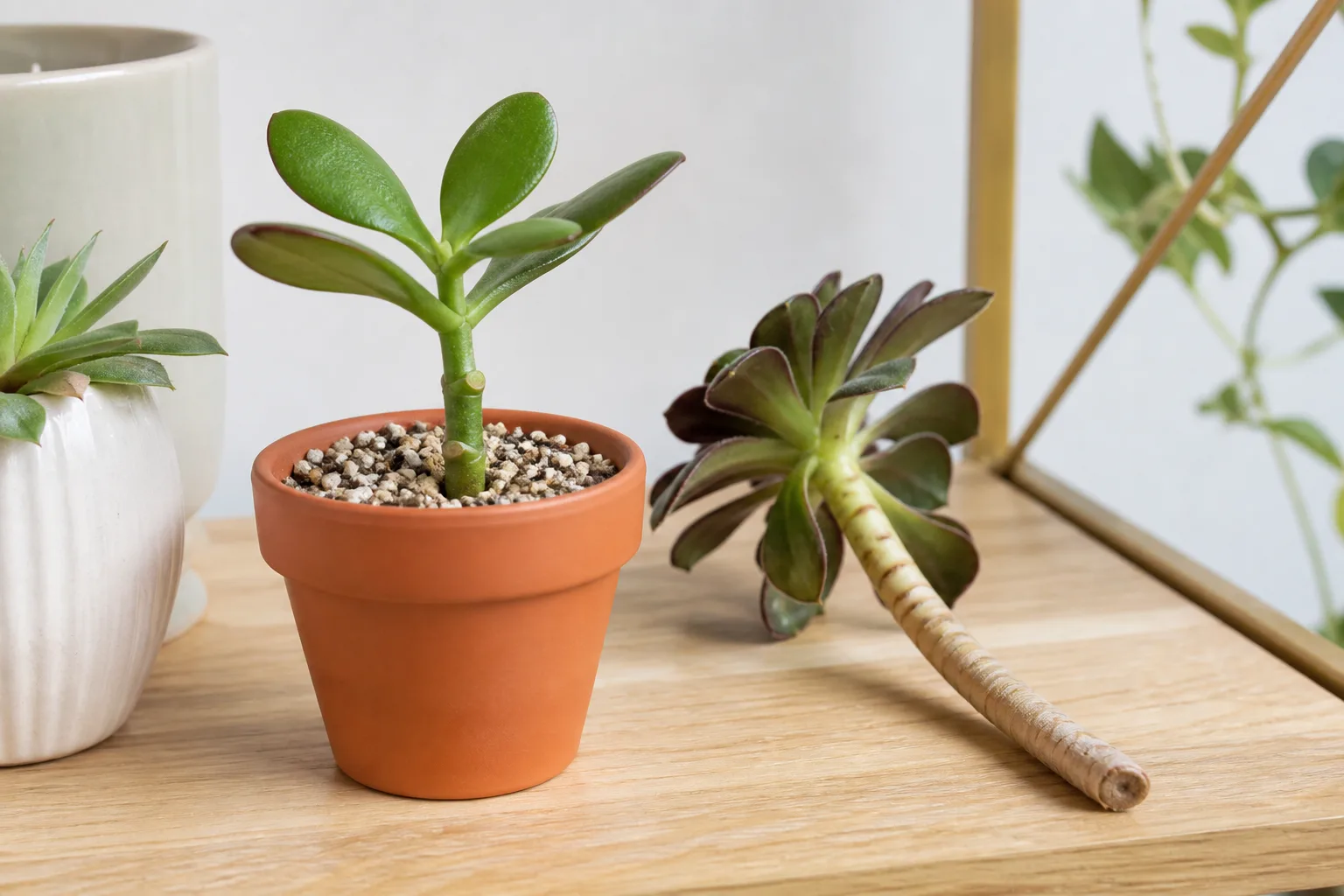
Classic Jade Plant (Crassula ovata) — The default money plant: medium green oval leaves, shrubby branching habit, woody trunk with age. Mature outdoor specimens in warm climates can reach 3–6 feet tall; indoor plants stay smaller but still become tree-like over decades. Zones 9–12 outdoors. Best beginner anchor for the genus—forgiving if you fix light and drainage first.
Variegated Jade (C. ovata ‘Variegata’) — Cream, white, and yellow streaks on light green leaves; often with pink tones in bright light. Slower than the species and more light-hungry—variegation narrows in shade. Zones 10–11 for outdoor planting. Mature size roughly 1–4 feet tall.
Crosby’s Compact (C. ovata ‘Crosby’s Compact’) — Dwarf with smaller, rounder leaves than standard ovata and a tight habit. Leaf tips turn red, yellow, and orange in direct sun. Also sold as Crosby’s dwarf or red jade. About 3 feet tall at maturity. Zones 10–11.
Pink Beauty (C. ovata ‘Pink Beauty’) — Grown for pink star-shaped flower clusters in fall and winter outdoors; small red-tipped leaves. Indoor blooms need cool nights (~55°F), reduced fall watering, and long nights without supplemental light—same flowering logic Wisconsin Horticulture describes for species C. ovata. (Wisconsin Horticulture) Mature 3–5 feet tall outdoors; zones 10–11.
Mini Jade, Botany Bay, and Hummel’s Sunset
Mini Jade (C. ovata ‘Minima’) — Petite leaves packed tightly for a bushy, clumping look; popular houseplant and bonsai starter. About 30 inches tall. Zones 10–11. Excellent for small pots and rock-garden gaps.
Botany Bay (C. ovata ‘Botany Bay’) — Compact, bushy habit with light green-yellow leaves and red tips; introduced as a landscape cultivar in the 2010s. 2–3 feet tall. Zones 9–12—slightly broader outdoor range than some dwarfs.
Hummel’s Sunset (C. ovata ‘Hummel’s Sunset’) — Often called sunset jade. Leaves shift yellow, orange, and red in winter cool and bright light—one of the best color cultivars for bonsai. Wisconsin Horticulture lists ‘Sunset’ with green leaves streaked cream/white and pinkish red. (Wisconsin Horticulture) 2–3 feet tall; zones 9–12.
Tolkien Succulents: Gollum, Hobbit, and Tubular Leaf Types
Collectors call Gollum, Hobbit, and close relatives the “Tolkien succulents”—C. ovata cultivars with tubular leaves instead of flat ovals. Wisconsin Horticulture describes ‘Gollum’ with nearly tubular leaves and a reddish tint, and ‘Hobbit’ with tubular leaves, reddish ends, and dense foliage. (Wisconsin Horticulture)
How to Tell Gollum, Hobbit, and Skinny Fingers Apart
These three arrive mislabeled on the same nursery bench. Use leaf tips, not pot stickers:
| Type | Leaf shape | Tip detail | Typical size |
|---|---|---|---|
| Gollum (C. ovata ‘Gollum’) | Short tubular | Circular suction-cup depression at the end | 2–3 ft |
| Hobbit (C. ovata ‘Hobbit’) | Spoon-shaped, curled inward | Tubular look but incurved sides, less cup-like | 2–3 ft |
| Skinny Fingers (C. ovata ‘Skinny Fingers’) | Longer, thinner tubes | No pronounced cup; also called E.T. fingers | 2–3 ft |
All three want the same care as classic jade—bright light for red tips, gritty mix, winter dry-down. Gollum and Hobbit are often sold as pairs for collectors who want matched Tolkien pots.
Red Coral and Variegated Gollum
Red Coral (C. ovata ‘Red Coral’) — Tubular form similar to Gollum but with intense red and yellow foliage under direct sun; may need a grow light indoors to hold full color. 2–3 feet; zones 10–11.
Variegated Gollum (C. ovata ‘Gollum Variegata’) — Pale green and white streaked tubular leaves; slower than the green Gollum and prone to reverting without bright indirect light. 1–2 feet tall; zones 10–11.
Silver Dollar Jade and the Crassula arborescens Group
Wisconsin Horticulture notes that Crassula arborescens—with almost spherical blue-gray leaves and a waxy bloom—grows in a different native range from C. ovata (Little Karoo and Central Karoo) and bears compact heads of pink flowers. (Wisconsin Horticulture)
Silver Dollar Jade (C. arborescens) — Round, blue-gray coin leaves with red margins in bright light; occasional red spots on leaves. Popular houseplant and outdoor shrub in zones 9–11. Mature 4 feet tall and wide—wider habit than tree-form C. ovata.
Ripple Jade and Blue Bird Variegata
Ripple Jade (C. arborescens ssp. undulatifolia) — Wavy, blue-green leaves on a slow shrub to about 4 feet. Red leaf edges in strong light. Often sold as a houseplant; outdoor in warm zones.
Blue Bird Jade (C. arborescens ‘Blue Bird Variegata’) — Large flat leaves with yellow edges and green stripes; may blush pink in sun. More elongated and pointed than silver dollar. About 2 feet tall; zones 10–11. Needs bright light to keep variegation.
Colorful and Architectural Crassula Species
These species stretch the “jade” label but show up on every types-of-jade list—and they reward growers who want foliage drama beyond oval leaves.
Crassula Campfire (C. capitella) — Low stacked leaves that blaze red and orange in direct sun; sprawls wider than it grows tall (8 inches tall, 3 feet wide). Full sun outdoors; grow light indoors for best color. Zones 9–11.
Propeller Plant (C. falcata) — Large propeller-shaped gray-green leaves on a slow plant 12–18 inches tall. Striking indoor specimen; blooms with red flower clusters in mature plants. Zones 9–11.
Miniature Pine Tree (C. tetragona) — Needle-like triangular leaves on branching stems suggest a tiny pine; 3–4 feet outdoors over time. Low-maintenance and popular with bonsai growers. Zones 10–11.
Crassula ‘Moon Glow’ (C. mesembryanthemoides) — Thin teardrop leaves coated in fine hairs for a fuzzy look; about 16 inches tall. Adaptable light; good textural contrast in mixed succulent bowls. Zones 10–11.
Taylor’s Parches (C. lactea) — Bushy, full appearance with obovate light green leaves that orange-red tint in direct sun. Low-trailing stems to 12 inches tall, 24 inches wide. Landscape filler in warm zones 9–11.
Trailing, Stacking, and Mat-Forming Crassulas
String of Buttons (C. perforata) — Square or triangular leaves stacked along upright stems; edges pink in sun. 1–2 feet tall, spreading 2–3 feet wide. Houseplant or outdoor in zones 9–12.
Baby’s Necklace (C. rupestris var. marnieriana) — Wedge-shaped leaves tightly stacked on long stems; clumping spreader about 4 inches tall and 20 inches long. Great terrarium or shallow bowl plant. Zones 9–11.
Crassula ‘Tom Thumb’ (C. rupestris ssp. commutata) — Fast-growing dwarf with bright green triangular leaves on stacked stems; 8 inches tall. Rock gardens, miniature planters. Full sun; zones 9–11.
Rosary Vine (C. rupestris var. monticola) — Compact soft succulent with thick triangular leaves; branches to about 12 inches. Native to South African rocky outcrops; popular collector plant.
Trailing Jade (C. sarmentosa) — Vining species with arrow-shaped, serrated leaves; stems can exceed 3 feet long. Often sold as the variegated form ‘Comet’ (cream margins) because it adds visual interest in hanging baskets and mixed succulent containers. Zones 9–11.
Watch Chain Plant (C. muscosa) — Tiny leaves packed on upright stems like interlocking chains; shrubby to 6–12 inches. Primarily outdoor in warm climates but works as a quirky houseplant. Zones 9–10.
Fairy Crassula (C. multicava) — Fast mat-forming spreader with pale green oval leaves and purple leaf undersides; rarely above 16 inches tall but spreads wide. Landscape groundcover in zones 9–11; also container-friendly.
Fairy Crassula, Woolly Crassula, and Moon Glow
Woolly Crassula (C. tomentosa) — Small rosette clusters with hairy leaves giving a woolly texture; grows in clumps on stony slopes in habitat. About 24 inches tall in ideal conditions. Monocarpic: if it flowers yellow or white, the rosette may die after bloom—rare indoors. Partial sun; zones 9–11.
Moon Glow and Taylor’s Parches are covered above; both add texture contrasts when you already own a classic tree-form jade.
Types to Grow with Caution—or Skip Entirely
Swamp Stonecrop (Crassula helmsii) — Also called New Zealand pigmy weed. Semiterrestrial succulent that forms dense mats in water and wet soil; historically sold as a pond plant and now listed as an invasive species in parts of the United States and Europe. MISIN tracks it as an aquatic invasive. (MISIN) It is not a houseplant choice and should not be planted in outdoor water features where it can escape. If you want a low green mat for a dry rock garden, choose Fairy Crassula instead—similar spread habit without the wetland risk.
Never confuse invasive helmsii with harmless stacked jades—the wetland mat former has tiny leaves on thread-like stems in saturated conditions, not the chunky stacked look of String of Buttons.
Conclusion
The best jade plant type for you depends on habit, not hype. Classic Crassula ovata remains the easiest tree-form starter; Hummel’s Sunset and Minima reward bonsai growers; Gollum and Hobbit satisfy collectors who want tubular leaves; silver dollar and ripple types fill the blue-gray coin-leaf niche; String of Buttons, trailing ‘Comet’, and watch chain handle vertical or hanging displays. Run the ID checklist before you buy, match light to variegation needs, and keep pets away from every Crassula on this list.
When a single plant needs watering logic, soil recipes, or help with yellow leaves or mealybugs, open the jade plant care guide and the Jade Plant hub—one species-focused home for light, watering, propagation, and problem-fix workflows without hunting scattered cultivar blurbs.