Why Are Mushrooms Growing in My Yard? Six Reasons and Fixes
Why are mushrooms growing in your yard? Learn the six common causes, when they are harmless, how to remove them safely, and which lawn fixes reduce repeats.
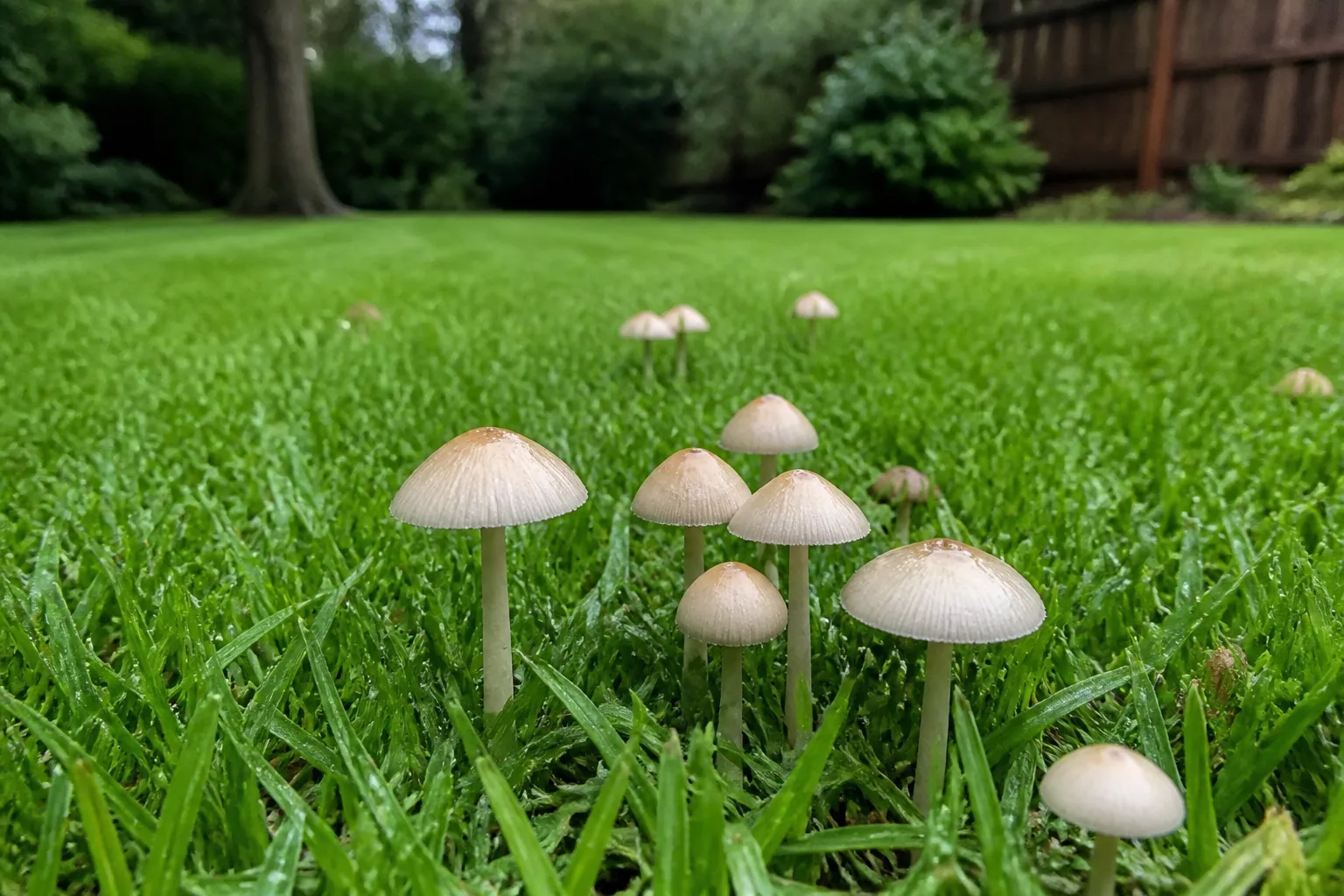
Mushrooms that appear in a lawn after rain are usually the temporary fruiting bodies of a fungus already living below the surface. The rain did not create the fungus overnight; it supplied the moisture and temperature change that told an established underground network to reproduce.
In most yards, a few mushrooms are a nuisance or a safety concern rather than a lawn emergency. Leave scattered caps alone when the grass is healthy and nobody will eat them, remove them when children or pets use the area, and investigate when the growth repeats in one wet spot, traces a ring, or arrives with thinning or dead turf.
The quick answer: leave, remove, or investigate
Use the lawn’s pattern and purpose to choose your first move:
| What you see | Best first move | What it suggests |
|---|---|---|
| A few scattered caps after a wet week, with healthy grass | Leave them or pick them for appearance | A short-lived flush of a decomposer fungus |
| Many caps in a play area, dog run, or path edge | Remove visible caps before people or pets use the space | An exposure problem, even if the grass is fine |
| Mushrooms returning in the same soggy spot | Check irrigation, drainage, compaction, and organic debris | The site keeps supplying moisture and food |
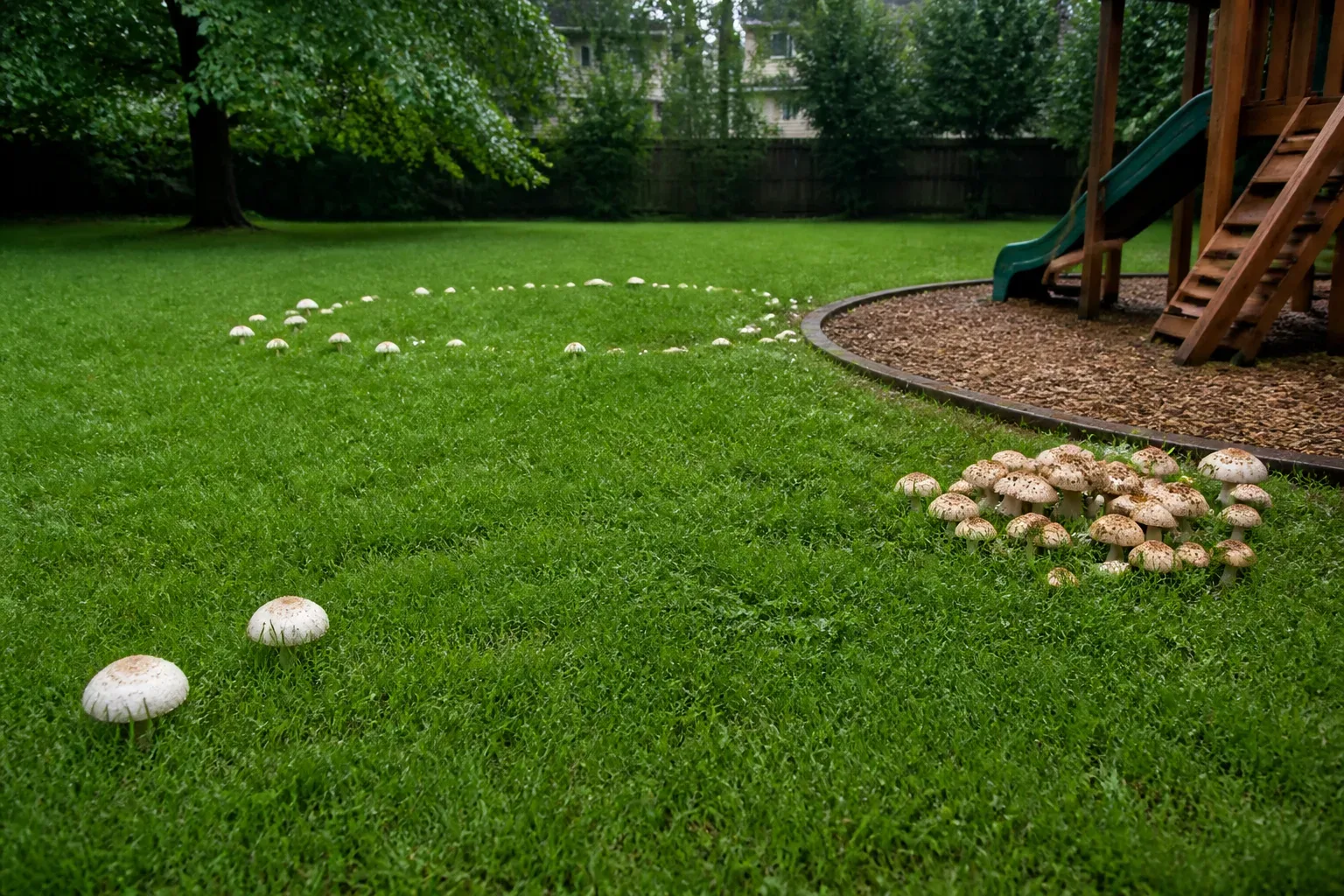
| A circle or arc with dark-green, brown, thin, or bare turf | Photograph and inspect the pattern before treating | A possible fairy ring or a separate turf problem |
Do not jump straight to fungicide. Surface mushrooms are not automatically a disease of living grass, and the visible cap is only one small part of the organism. UC Integrated Pest Management’s guidance on mushrooms and nuisance fungi explains that most lawn fungi are beneficial decomposers, while also warning that some wild mushrooms are poisonous and that removing the cap does not kill the underground mycelium.
What a mushroom in grass actually means
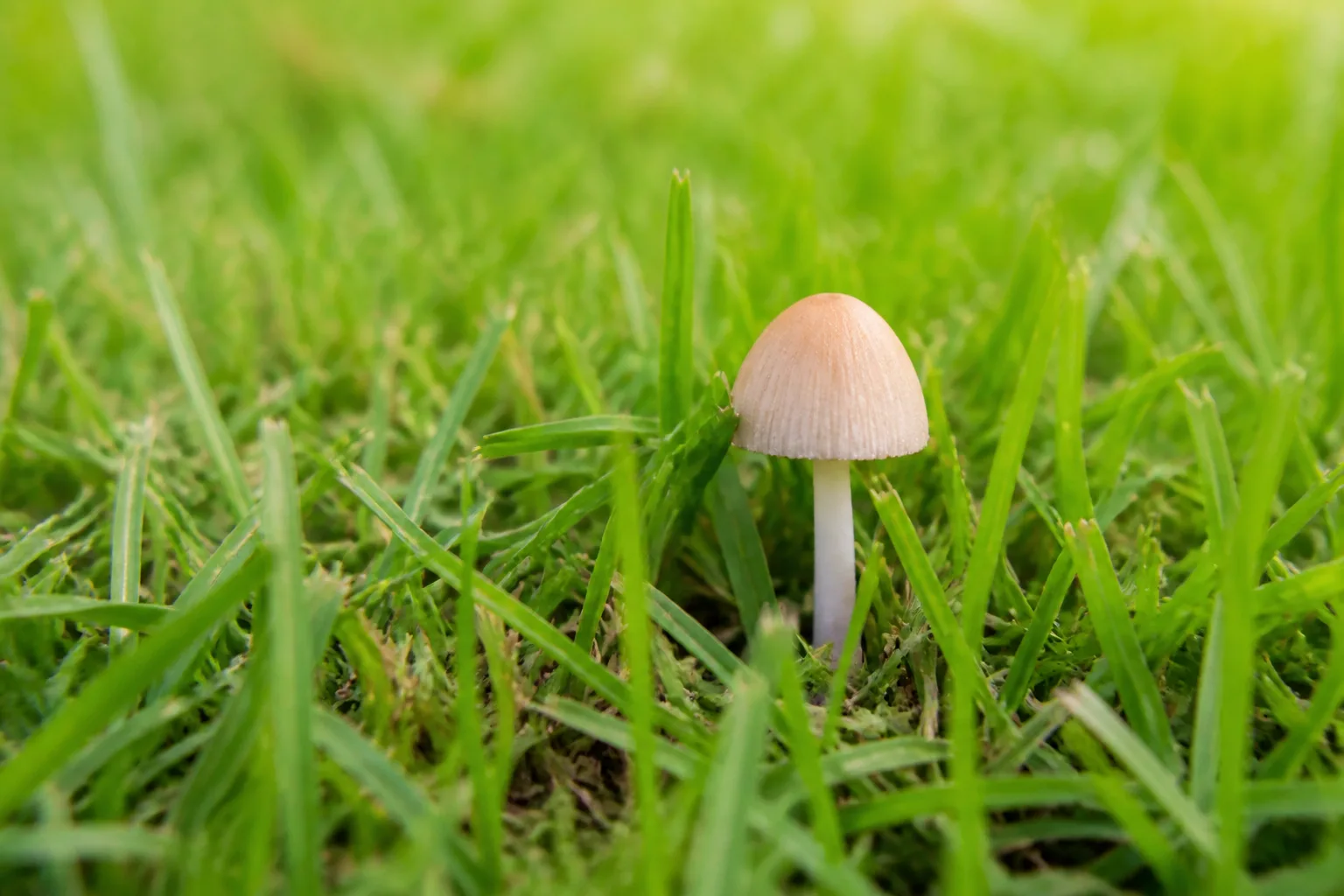
The visible cap is not the whole fungus
A mushroom is a fruiting body, much like the temporary flower or fruit of a plant. The main organism is a web of microscopic filaments called hyphae; a mass of those filaments is called mycelium. The network may be living in soil, thatch, buried wood, dead roots, or other organic material long before you see a cap.
When the mycelium has enough food and the conditions are favorable, it pushes up a cap and stem to release spores. Those spores can move on air currents, animals, tools, or water. Picking the cap improves the view and may reduce local spore release, but it does not sterilize the soil or guarantee that another flush will not appear.
NC State Extension describes mushrooms as the reproductive structures of fungi and notes that changes in temperature, light, and water can trigger fungi that have been underground all along. That is the useful explanation behind the “overnight” effect.
Why mushrooms can appear overnight
The time between a rainy evening and a mushroom-covered lawn can be short because the fungus does not need to build its entire body first. Once the underground network is established, it only needs the right moisture, temperature, and food conditions to produce the part you notice.
This is also why the same storm can produce mushrooms in one corner and none in another. A shaded low spot with thick thatch may stay damp for days, while an exposed sandy slope dries before the fungus can fruit. One flush after unusual weather does not prove that the entire yard has a drainage defect; repeated growth in the same place is a stronger clue.
Six reasons mushrooms grow in your yard
1. Wet weather or overwatering
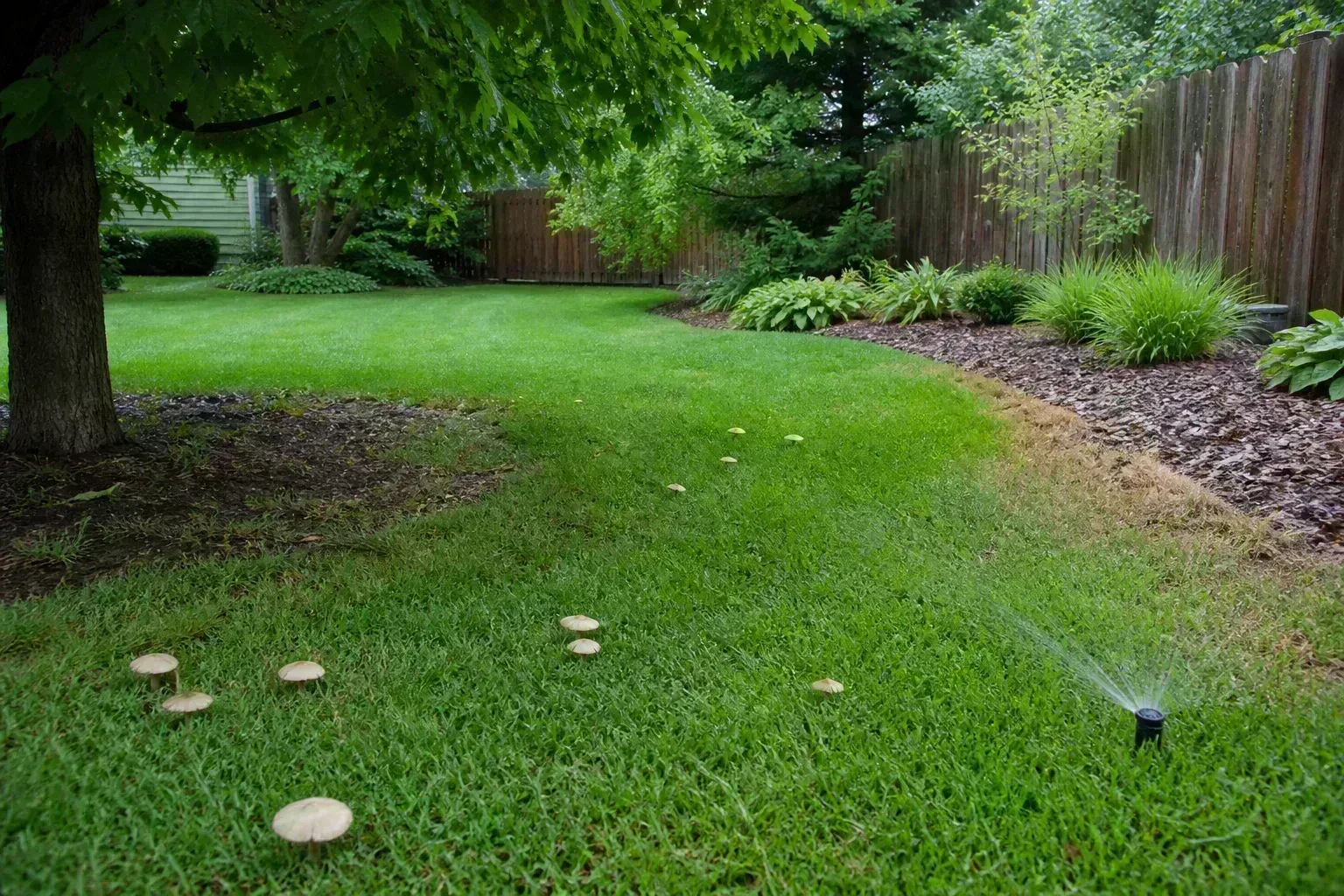
Extended rain, heavy dew, humid weather, and frequent irrigation all increase the moisture available to fungi. A lawn may suddenly fruit after several cloudy days because the soil surface, thatch, and buried organic matter have remained damp long enough for the fungus to reproduce.
Overwatering is easy to miss when the grass looks green. Automatic sprinklers may run during a rainy week, a head may overlap the same shady corner, or short evening cycles may wet the foliage without soaking the root zone evenly. Gardening Know How recommends checking whether a lawn is too wet, unusually shady, or accumulating organic waste before trying to eliminate mushrooms.
Fix: Pause or adjust irrigation after meaningful rainfall, inspect sprinkler coverage, and water according to the lawn’s actual root-zone need. Aim to reduce excess moisture, not to force the grass into drought. Newly seeded or newly laid turf still needs establishment water, so do not stop watering abruptly just to hide a temporary mushroom flush.
Water early enough for the grass to dry before night when practical. If the soil is already saturated, more water will not make the mushrooms disappear; it can prolong the conditions that support them and add stress to the turf.
2. Poor drainage and compacted soil
Compacted soil has fewer open spaces for air and water. Instead of infiltrating through the root zone, rainfall may pool on the surface or move sideways into a low spot. A compacted lawn beside a driveway, play area, construction route, or frequently used gate is especially likely to hold moisture after rain.
Test the site rather than guessing. Compare the mushroom patch with healthy grass by pushing a long screwdriver into both areas, walking the lawn after rain to look for deep footprints, and noting whether puddles remain after nearby areas have drained. Also check whether a downspout, roof runoff, or sloped hardscape sends water toward the patch.
Fix: Correct the water source or grade where practical, then aerate soil that is genuinely compacted during the grass’s active growing period. A core aerator removes plugs and opens channels for air and water; a garden fork can help with a small area. Aerate when soil is moist enough to penetrate but not sticky or saturated. It can improve the lawn’s growing conditions, but it does not remove the fungus’s food source or destroy every strand of mycelium.
The Royal Horticultural Society’s lawn guidance makes the same distinction between aeration and surface management: aeration improves movement of air and water, while scarifying or dethatching addresses a dense layer near the soil surface. Choose the operation that matches the problem instead of doing both aggressively at once.
3. Buried wood, stumps, or old roots
A buried piece of construction lumber, a decaying stump, old tree roots, or a woody root zone can supply food for decomposer fungi for years. Mushrooms may appear in a line over a root, around the former location of a tree, or beside a stump even when the lawn is otherwise well-drained.
This is one reason a mushroom flush can be a useful clue rather than a verdict on the grass. The fungus is often recycling dead material, not feeding on living blades. UC IPM notes that mushrooms in lawns commonly develop from buried wood, dead tree roots, or other organic matter and are usually harmless to grass.
Fix: Remove accessible dead wood or a small old stump if doing so will not damage living tree roots, irrigation lines, utilities, or nearby structures. If the source is deep or intertwined with a living tree, do not excavate blindly. Tolerating occasional mushrooms while the material decomposes may be the safest and least expensive choice; picking the visible caps handles the appearance and safety issue in the meantime.
If a tree near the mushroom cluster is declining, has loose bark, thinning foliage, or honey-colored clusters at its base, ask an arborist or local Extension office to assess the tree. The mushroom itself is not enough evidence to diagnose a tree disease.
4. Thatch, clippings, leaves, or mulch
Fungi need organic material to decompose. A thick thatch layer, matted grass clippings, wet leaf litter, compost spill, or woody mulch can give them both food and a protected, moist habitat. This is especially likely where the mower drops clippings in a clump, leaves collect against edging, or mulch has been piled deeply along a lawn border.
Do not interpret this as a reason to remove every clipping from every healthy lawn. Fine clippings that disperse across actively growing turf can return nutrients. The problem is a wet mat or a heavy accumulation that stays pressed together and dries slowly.
Fix: Rake leaves, spread or remove thick clipping clumps, and keep mulch from forming a deep wet pocket at the lawn edge. If the thatch is unusually thick and spongy, cut a small soil wedge and measure the dense layer before dethatching. Timing matters: aggressive dethatching can injure a heat-stressed or drought-stressed lawn.
Replace mulch only when it is exhausted, contaminated, or poorly placed—not because one flush proves the material is defective. Removing the food source can reduce repeat mushrooms, but spores can arrive from neighboring lawns and the underground organism may already extend beyond the visible patch.
5. Shade, humidity, and slow airflow
Shade does not create mushrooms by itself, but it slows evaporation. Dense shrubs, fences, buildings, tree canopies, and narrow side yards can trap humid air and keep grass, thatch, and soil damp after rain. A mushroom patch under a tree may therefore reflect the combination of shade, leaf litter, roots, and irrigation rather than one isolated problem.
Fix: Improve light and airflow where it is reasonable by pruning selected branches, opening an overgrown edge, or redirecting a sprinkler. Do not remove a healthy mature tree solely to stop mushrooms. If the lawn cannot thrive in the available light, choose a shade-tolerant turf or a different groundcover and accept that a less formal planting may be better suited to the site.
The Gardeningetc guide to lawn mushrooms also recommends aeration and stable moisture as practical ways to make the lawn less favorable to recurring fruiting. Those steps improve the turf’s resilience; they do not promise that spores will never germinate again.
6. Fairy rings or newly established turf
Sometimes the important clue is not the mushroom itself but the shape of the growth. A fairy ring is a circular or semicircular band caused by an expanding underground fungal network. Mushrooms may form along the edge, but a ring can also appear as a band of darker green, faster-growing grass or as brown, thinning, or bare turf with no caps at all.
Dark-green growth often occurs where the fungus is decomposing organic matter and releasing nutrients. A brown or bare ring is more concerning: dense mycelium can interfere with water movement, leaving grass inside the ring drought-stressed even when the surrounding soil is moist. Penn State Extension notes that more than 50 species of mushrooms can grow in a circle, so the folklore name does not identify one species or one treatment.
Newly laid sod is a different but common edge case. Establishment requires frequent irrigation, and UC IPM reports that common mushrooms may appear during this period without harming the sod; they often diminish as watering is reduced to the lawn’s normal needs.
Fix: For a green fairy ring with healthy turf, monitor the edge, keep moisture reasonably consistent, and remove visible caps only when needed. For a brown or bare ring, probe the soil inside and outside, improve water penetration, and plan reseeding or renovation only after you understand whether the crowns are alive. Large or advancing rings may need local turf or Extension advice; digging out an entire ring is laborious and does not guarantee that every underground strand has been removed.
Read the pattern before choosing a fix
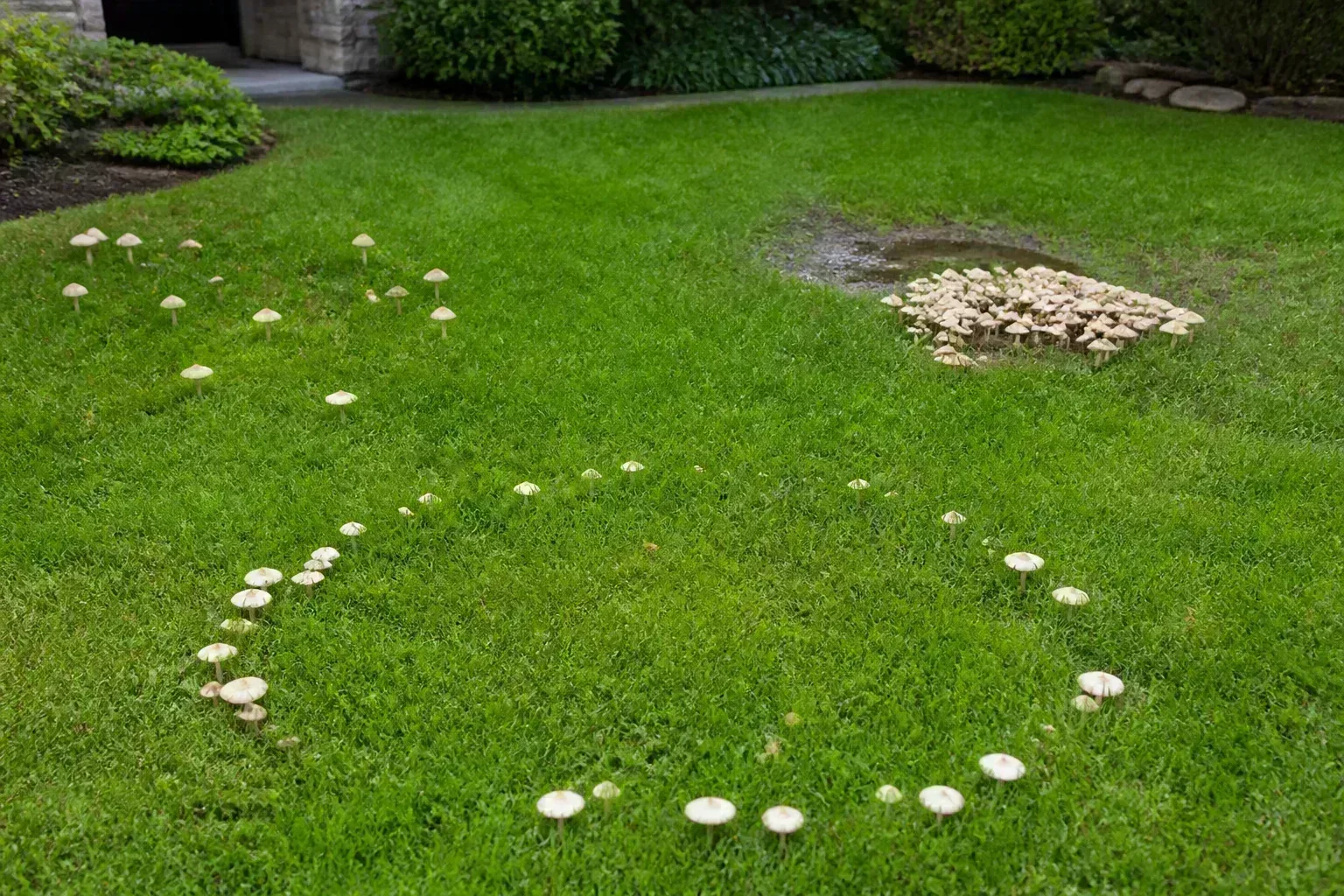
Scattered caps versus a food-source cluster
Scattered mushrooms after one rain usually call for observation, not renovation. Look for the nearest likely food source: an old stump, a tree-root line, a patch of thick thatch, clumped clippings, wet leaf litter, or a recently mulched edge. If the caps vanish as the lawn dries and the grass stays healthy, the event was probably a short-lived fruiting flush.
A tight cluster in one place points more strongly toward a local food source or moisture pocket. Correct that driver if it is accessible. Do not dig up a living tree’s root system or install drainage just because a few caps appeared once.
A mushroom ring versus a ring of changed grass
Photograph circles from above and note whether the grass inside the ring is greener, taller, brown, thin, or bare. A mushroom ring with no turf change is mainly an appearance and safety decision. A ring of changed grass needs a moisture and root-zone check because the fungal mat may be changing how water moves.
Also separate mushrooms from lawn diseases. Most fungal diseases of turf do not announce themselves with large umbrella-shaped fruiting bodies. If the grass has expanding leaf lesions, colored threads, powdery growth, or dead crowns beyond the mushroom pattern, send clear photos or a sample to a local Extension diagnostic service before using a fungicide.
Should you remove mushrooms from the yard?
Removal is reasonable for three practical reasons: safety, appearance, and access. Children and dogs may nibble a cap before an adult sees it, and an unknown mushroom should not be treated as edible just because it is small, white, or growing in grass. If the mushrooms are isolated from play areas and the turf is healthy, leaving them to disappear is also a defensible choice.
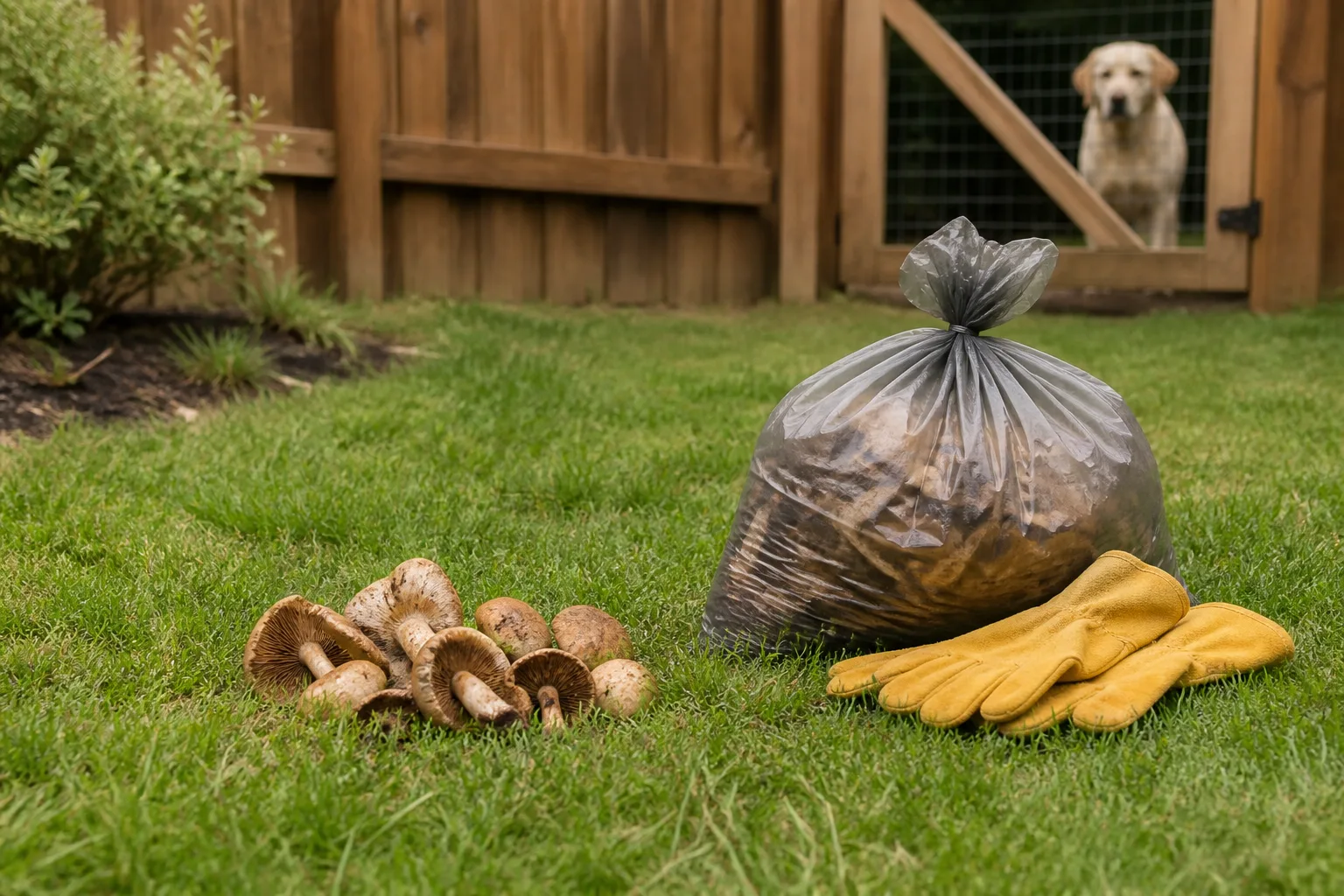
Some wild mushrooms are poisonous, and casual identification is unreliable. Penn State Extension does not have Master Gardeners identify saprophytic fungi because the chance of misidentification is too high. Do not taste a mushroom, rely on a silver-spoon test, or treat a photo app as final permission to eat one.
Routine handling is not the same as ingestion, but wear gloves, keep the material away from food, and wash your hands afterward. The ASPCA Animal Poison Control Center warns that mushroom ingestion can cause vomiting, diarrhea, drooling, unsteadiness, tremors, or delayed liver toxicity in pets. If a pet may have eaten an unknown mushroom, call a veterinarian or animal poison-control service promptly and take photos of the cap, underside, stem, base, and surrounding lawn.
For a child who may have swallowed one, contact your local poison center or emergency service and follow its instructions. Do not wait for symptoms or try to identify the mushroom by taste.
How to remove lawn mushrooms safely
Remove the visible fruiting bodies before they mature if you want to limit access and local spore release. On a calm, dry day, put on gloves, grasp the stem near the soil line, and lift it out. Use a trowel for a stubborn base rather than grinding it into the grass. Put unknown or pet-accessible mushrooms in a closed bag and dispose of them where children and animals cannot reach them.
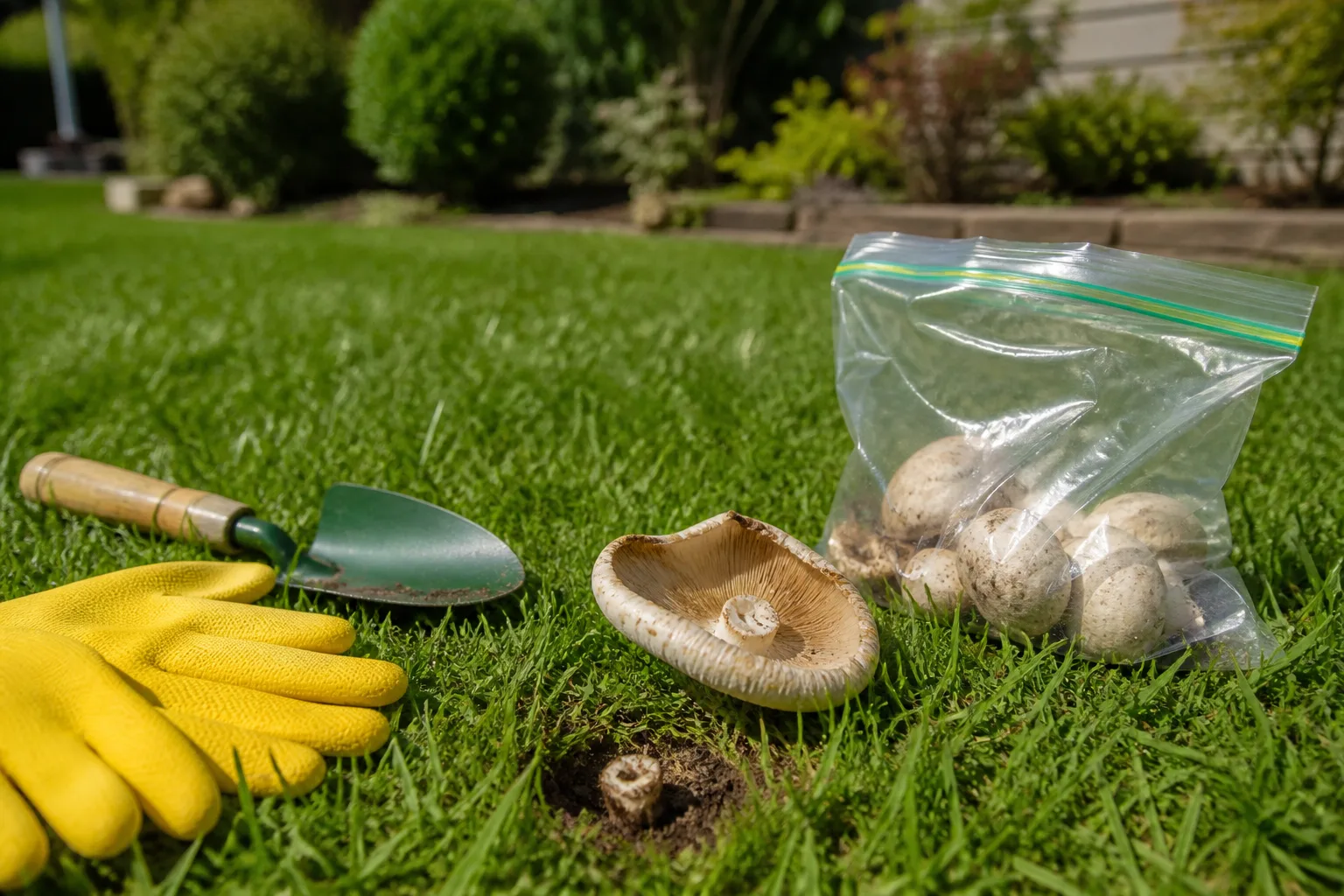
Mowing can knock down a large flush, and raking can dislodge small caps, but neither method kills the mycelium. Mow only when the lawn is dry and firm enough to avoid ruts. If the mushrooms are already dry and powdery, aggressive raking, a leaf blower, or a forceful hose stream can spread spores and fragments. Picking is usually cleaner.
Do not use a hose as a shortcut. Water can scatter material, keep the site wet, and make it harder to tell whether the original cause was overwatering or poor drainage. Clean the trowel or mower deck if you moved a large amount of mature material, but there is no need to disinfect the entire yard.
A practical reset plan for repeat flushes
If mushrooms keep returning, use this order so each action answers a question:
- Map the pattern. Photograph the area after rain and mark whether growth is scattered, clustered, or circular. Note shade, nearby trees, a former stump, a mulched edge, and whether the turf is greener or browner than its surroundings.
- Check water. Look for standing water, a blocked downspout, sprinkler overlap, or a timer that runs during rainy weather. Push a screwdriver into the soil inside and outside the patch to compare moisture and resistance.
- Remove obvious surface food. Rake leaves and disperse or collect wet clipping mats. Inspect for thick thatch before renting a dethatcher.
- Correct compaction when timing is right. Core-aerate actively growing turf when the soil is moist but not muddy. Keep heavy equipment off saturated ground, or the repair can create more compaction.
- Inspect buried material carefully. Remove a reachable stump or piece of dead wood only when excavation is safe. Leave deep roots alone if digging could injure a living tree or utility line.
- Reassess before adding products. If the turf is healthy and the caps are gone, stop. If the ring is expanding or the grass is dying, seek a local diagnosis rather than escalating blindly.
This sequence is deliberately smaller than a “treat everything” plan. A mushroom flush can be caused by a wet week and disappear without intervention. Aerating, dethatching, fertilizing, and excavating all at once may damage the lawn while leaving the actual food source or water pathway untouched.
When the grass problem is bigger than the mushrooms
Mushrooms themselves are usually not the cause of brown turf. A fairy ring can alter water movement, but brown grass elsewhere may be drought, pet urine, insect injury, compaction, salt, chemical damage, or a fungal disease with no visible mushrooms. Check the crown and roots if a patch is thinning: firm crowns with attached roots may recover, while missing or dead crowns will need repair in the correct planting season.
Avoid applying fertilizer simply because mushrooms appeared. Extra nitrogen may make green grass look more even for a short time, but it does not remove buried wood, fix drainage, or identify a disease. Base fertilizer decisions on a soil test, turf type, local timing, and the current product label.
Fungicides are a particularly poor first response to ordinary lawn mushrooms. Penn State Extension explains that saprophytic fungi recycle decaying organic matter and that fungicides used for plant diseases do not manage these nuisance fruiting bodies. UC IPM likewise emphasizes cultural practices for fairy rings and notes that removing caps does not remove the underground mycelium.
If the grass is actively declining, identify the turf type, record recent weather and irrigation, photograph the edge of the damage, and contact a county Extension office or qualified lawn professional. A confirmed disease may have a label-approved treatment; a mushroom cap alone is not enough evidence to choose one.
Conclusion
Mushrooms are growing in your yard because an underground fungus has found the right combination of moisture, temperature, and organic food. The six common contributors are wet weather or overwatering, poor drainage and compaction, buried wood or roots, thatch and other organic matter, shade and slow airflow, and a fairy ring or newly established turf.
Leave scattered mushrooms when the lawn is healthy and no one will eat them, remove unknown caps from play areas with gloves, and use the pattern to decide whether the site needs attention. Correct excess water, improve infiltration, manage wet organic buildup, and protect the grass from unnecessary stress. That approach makes the lawn healthier without pretending that a single picking session—or a bottle of fungicide—can erase the fungal life beneath it.