Magnolia Leaf Spot: Causes, Diagnosis, and Treatment
Identify magnolia leaf spot, separate it from bacterial blight and scale, and choose a treatment—or wait—based on the cause, season, and tree health with care.
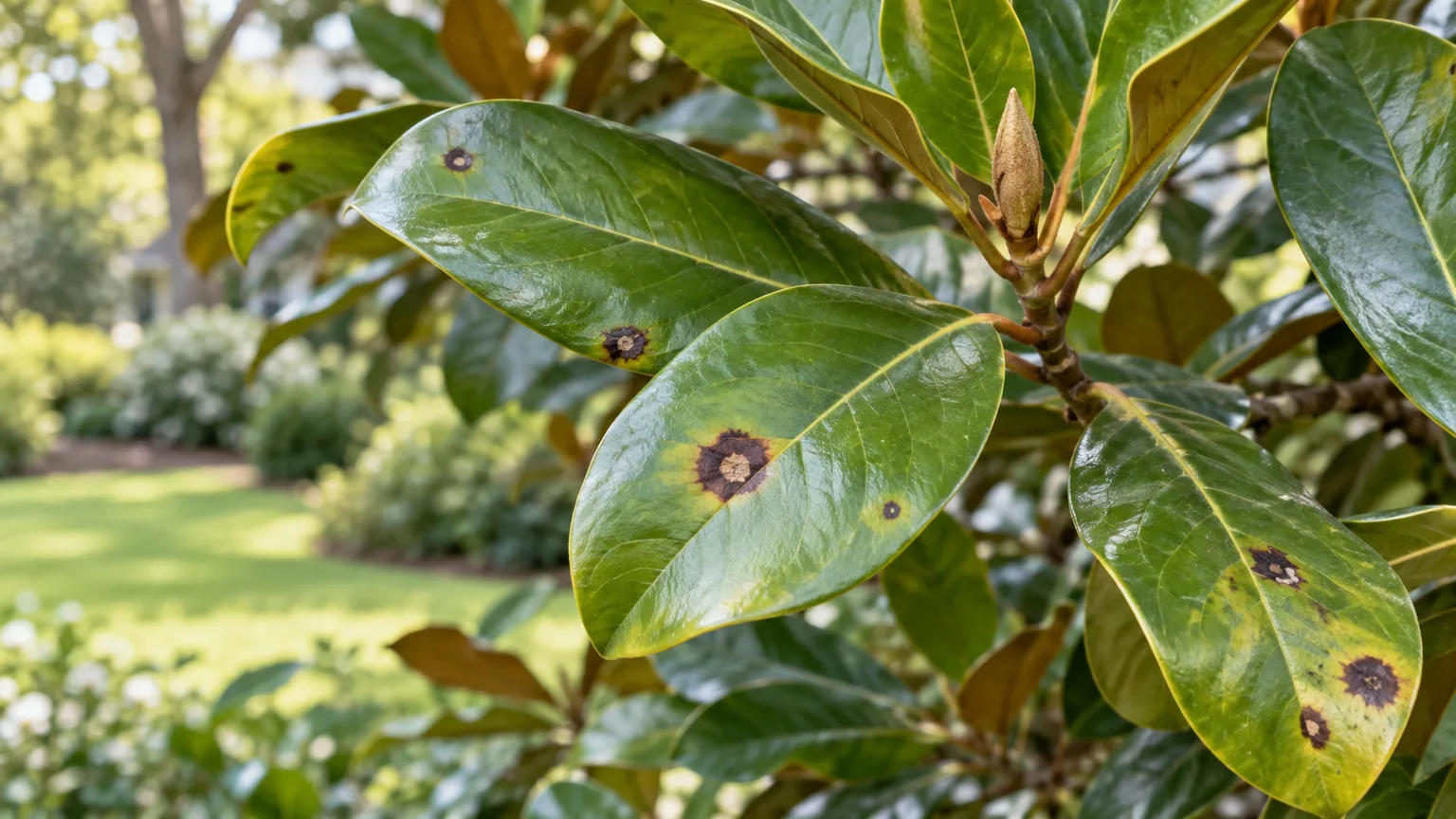
Black or brown marks on magnolia leaves are a symptom, not a diagnosis. Several fungi can cause true leaf spot, but magnolias can also develop bacterial blight, scale-related sooty mold, weather damage, or other problems that look dark from a distance. The useful first move is to check whether the discoloration is a distinct lesion inside the leaf, a coating sitting on its surface, or browning that follows the leaf edge or a whole shoot.
For many mature magnolias, scattered leaf spots are an appearance problem that improves when the weather turns dry; they do not automatically mean the tree is dying. A young or recently transplanted tree, repeated heavy defoliation, or dead and wilting shoots deserves closer attention. The steps below help you decide what you are seeing, what to do now, and when fungicide or a professional diagnosis is actually justified.
The first decision: Is this leaf spot or something else?
Start with distribution. Examine several leaves from different parts of the canopy, including the upper and lower surfaces, and look at the stems and nearby ground. A genuine leaf spot usually appears as separate areas of dead tissue within otherwise green leaf blades. If the entire leaf margin is scorched, a branch wilts, or a black film coats the surface, investigate those patterns before treating the tree for a foliar fungus.
Also note the season and the weather before symptoms appeared. Spots that follow a cool, rainy spring or a run of humid days fit a leaf-wetness pattern; symptoms that first appear after frost, a hot dry spell, transplanting, or saturated soil suggest other stresses may be involved. These clues narrow the possibilities, but they cannot identify a pathogen with certainty. Multiple fungi and bacteria can create overlapping leaf symptoms, and a laboratory diagnosis may be needed if damage is severe or recurring.
What magnolia leaf spot looks like
Magnolia leaf spots can be black, purple, tan, or brown. They may be round or irregular and may stay small, merge into larger dead patches, or develop a yellowish border. Spot color alone is not enough to name the disease: the Pacific Northwest Plant Disease Management Handbook reports several fungi from magnolia leaf spots, with Phyllosticta and Cladosporium found most often in its regional clinic observations, as well as other fungi and a bacterial organism (Pacific Northwest Plant Disease Management Handbook: Magnolia Leaf Spots).
Fungal spots: patterns to note
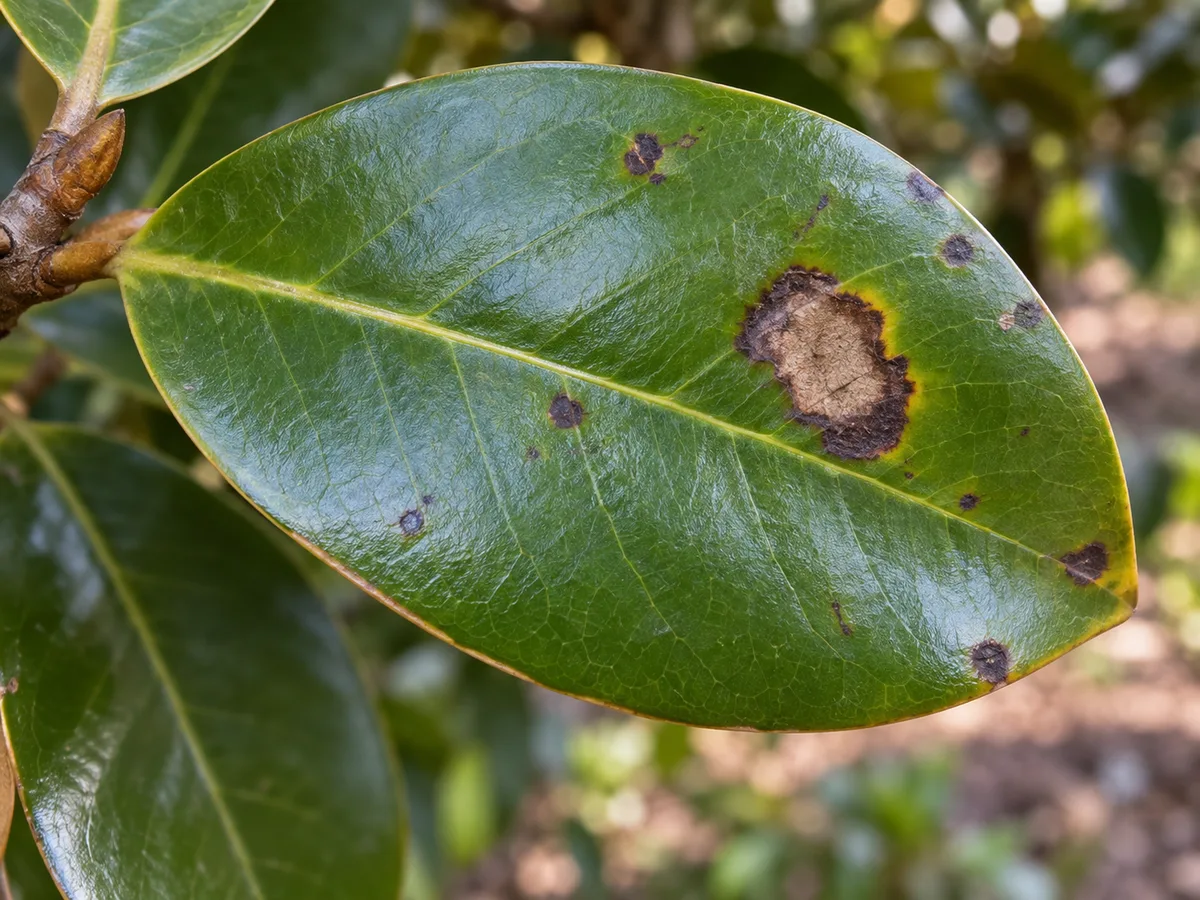
One described Phyllosticta pattern begins as tiny purple-to-black spots on the upper leaf surface. As some spots enlarge, the centers can turn off-white while the edge remains dark purple or nearly black; a faint yellow halo may surround them. Tiny black fruiting structures can appear within larger spots. This pattern is useful to record and photograph, but it still does not prove that Phyllosticta is the cause. Other fungi can make different-looking marks, and other organisms may be present in the same region.
Fungal leaf spot often becomes noticeable after wet spring weather because spores need moisture on the leaf surface to germinate and infect. UConn’s tree-and-shrub IPM guidance describes fungi overwintering on fallen leaves, with spores moved by wind or rain splash to new foliage; a film of water on the leaf supports infection. The time between infection and visible spots varies with the fungus and temperature, so new marks may appear after the rainy stretch has passed (University of Connecticut IPM: Leaf Spot Disease of Trees and Shrubs).
Bacterial blight: why shoots matter
Magnolia bacterial blight is a different possibility, especially after a cool, wet spring. The Pacific Northwest handbook describes small dark-brown, water-soaked leaf spots that may have a yellow halo and become angular as they are bounded by veins. Larger dark, irregular lesions can occur too, but the most important clue is often on the shoots: new growth wilts, becomes necrotic, or dies back, and dead leaves may remain attached to affected twigs. That combination is a stronger reason to seek a diagnosis than a few isolated leaf marks (Pacific Northwest Plant Disease Management Handbook: Magnolia Bacterial Blight).
Fungal and bacterial leaf spots can overlap visually, so do not use a home remedy or a fungicide as a diagnostic test. Fungicides do not treat bacteria, and a bactericide or copper product should not be selected simply because a lesion is dark. If whole young shoots are declining or the same symptoms return each spring, photograph the leaf and twig symptoms and ask your local Cooperative Extension office or a plant clinic how to submit a sample.
Causes and seasonal conditions
Magnolia leaf spot is a group of diseases rather than one fungus with one universal treatment. In the Pacific Northwest, the handbook lists Cladosporium, Coniothyrium, Epicoccum, Phyllosticta magnoliae, and Septoria among fungi found in magnolia spots; Pseudomonas syringae pv. syringae is also encountered. Which organisms occur and which matter most can vary by region, weather, magnolia species, and season. A webpage cannot determine the pathogen on your tree from a photograph alone.
Moisture helps explain why symptoms cluster in rainy periods. Spores can move from infected debris or nearby foliage by rain splash and wind, and prolonged leaf wetness gives some pathogens a chance to germinate. Dense growth that dries slowly, overhead irrigation late in the day, and a crowded planting can make those wet periods longer. That does not mean a magnolia needs to be stripped open or kept thirsty; the goal is to avoid unnecessary leaf wetting while maintaining steady root-zone moisture during drought, especially for a newly planted tree.
How to distinguish common look-alikes
Check whether the blackness is part of the leaf or on top of it. Scale insects feed on magnolia stems and excrete sticky honeydew; sooty mold can grow on that residue and leave leaves and branches looking black or sooty. A surface film that smudges, sticky leaves, ants or wasps, and rounded bumps on twigs point toward scale rather than fungal lesions inside the leaf. Wisconsin Extension explains the connection between magnolia scale, honeydew, and the sooty appearance (University of Wisconsin–Madison Extension: Magnolia Scale).
| What you notice | More consistent with | Useful next check |
|---|---|---|
| Separate brown, purple, or black dead patches within green leaf tissue after wet weather | Leaf spot; fungal or bacterial causes are possible | Check both leaf sides, note whether spots have halos or angular edges, and inspect shoots |
| Dark, sticky or wipeable film across leaves and twigs | Sooty mold associated with honeydew | Look for scale bumps on stems and sticky residue beneath the canopy |
| Browning mainly along tips or margins, especially on the exposed side | Drought, wind, salt, frost, or establishment stress | Review recent weather, root-zone moisture, and whether the tree was planted recently |
| New shoots wilt or die back, sometimes with water-soaked angular lesions | Possible bacterial blight or another serious shoot problem | Photograph twigs and seek extension or arborist diagnosis |
These are triage clues, not a substitute for lab identification. The Royal Horticultural Society notes that brown leaves can result from disease, pests, or environmental conditions, and that margins and tips often respond to drought or drying winds; use the pattern and context together rather than treating all browning as infection (RHS: Brown Leaves on Woody Plants). If symptoms do not fit neatly, check the whole plant and its growing conditions before pruning or spraying.
Does leaf spot threaten the tree?
A few spotted leaves on an established, vigorous magnolia usually call for monitoring and better leaf-drying conditions, not panic. Some ornamental leaf spots are conspicuous but have limited effect on a tree with a healthy canopy and functioning roots. UConn IPM cautions that even severe defoliation does not necessarily kill an otherwise healthy tree, although repeated disease pressure can add strain to a tree already weakened by drought, transplant shock, insects, or other problems.
Take the situation more seriously when a small or recently planted magnolia loses a large share of its leaves, when symptoms return year after year, or when spotted foliage accompanies shoot dieback. A tree that is losing leaves early may have less capacity to grow and store energy, and several years of stress can compound. The practical question is not “Are there spots?” but “How much of the canopy is affected, is the pattern advancing, and is the tree still producing healthy growth?”
What to do today: an evidence-led response
You do not need to spray as soon as you notice a dark mark. First determine whether the tree has a few blemished leaves or a spreading problem, then reduce conditions that favor new infection. The following sequence protects the tree while keeping unnecessary pesticide use and pruning to a minimum.
1. Document the pattern before removing leaves
Photograph a few affected leaves in good light, including a close view and a wider shot that shows where they sit in the canopy. Include the leaf underside and a section of the twig if you see water-soaked marks or dieback. Record when you first noticed symptoms, whether the tree is evergreen or deciduous, the recent rainfall or irrigation pattern, and whether the magnolia was planted in the last few years. These notes help an extension diagnostician distinguish a recurring seasonal leaf spot from a new issue.
Do not strip a healthy-looking canopy to make the tree appear clean. Removing many leaves reduces the surface available for photosynthesis, while it will not remove spores already present elsewhere or make existing lesions heal. If the pattern is unclear, keep a small sample of fresh affected tissue according to your local plant clinic’s instructions instead of sending only dry, decomposed leaves.
2. Reduce leaf wetness and splash
Water the root zone rather than showering the canopy. If you use a sprinkler, adjust it so the foliage is not repeatedly wetted or water early enough that leaves can dry before evening. During dry weather, continue watering the soil as needed: drought stress is not a disease treatment, and a newly established magnolia may need consistent attention to root-zone moisture.
Check whether shrubs, branches, or structures trap humid air around the magnolia. Improve airflow by removing only crossing, crowded, or dead growth that can be pruned safely without changing the tree’s natural structure. Practical guidance for other shrub leaf spots from Gardening Know How makes the same distinction—keep leaves relatively dry and allow air to move through the planting—while Magnolia-specific recommendations in the Pacific Northwest handbook also advise avoiding overhead irrigation and spacing plants for airflow (Gardening Know How: Brown Viburnum Leaves and Fungal Spot; Pacific Northwest Plant Disease Management Handbook).
3. Clean up debris and prune only what is needed
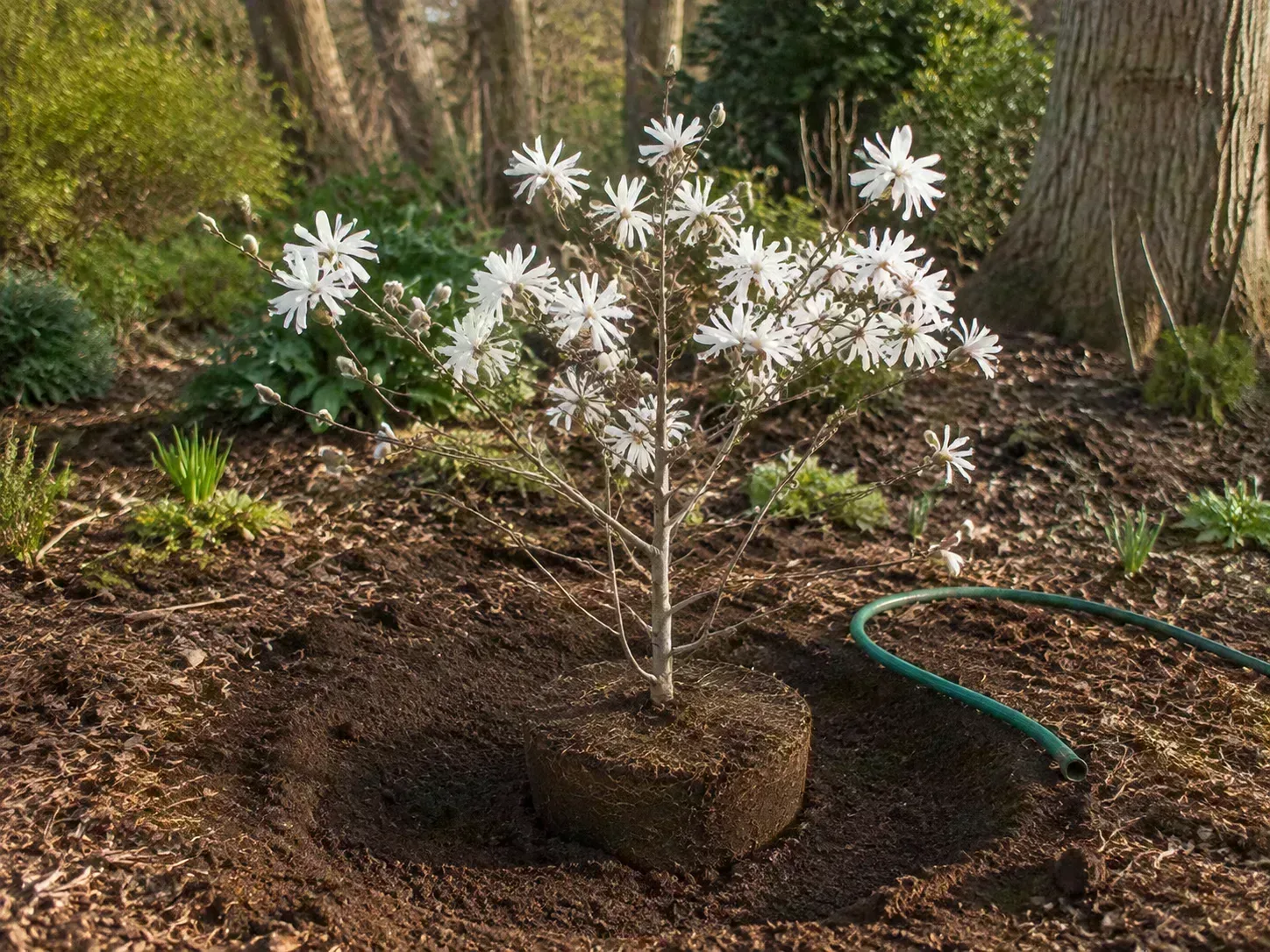
Pick up fallen spotted leaves, particularly under a young tree or where leaf spot has been severe. Bag them for municipal yard-waste disposal or use another disposal method recommended by your local extension service; do not leave a dense layer beneath the canopy. Sanitation can reduce some nearby sources of spores, but it cannot guarantee prevention because wind can carry spores from outside your yard. The RHS recommends prompt removal and careful disposal of infected plant material, while emphasizing that suitable disposal depends on the pathogen and local options (RHS: Disposing of Diseased Material).
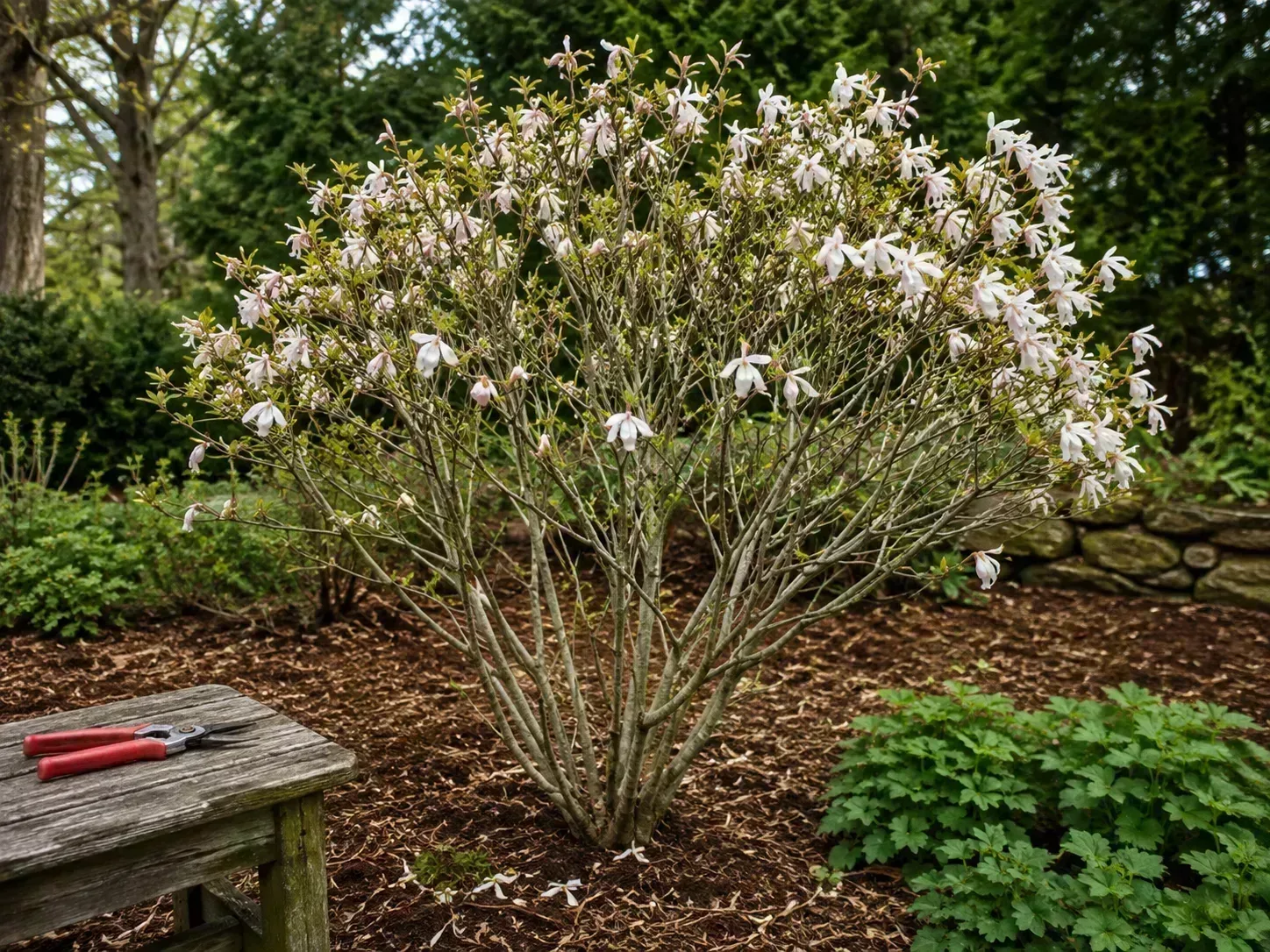
Avoid blanket pruning of branches that have healthy leaves. Remove dead or clearly infected shoots only when there is a sensible pruning target, and avoid working on wet foliage. Magnolia bacterial-blight guidance recommends pruning affected shoots and branches during the late dormant season; for fungal leaf spotting alone, leaf cleanup and moisture management may be enough. If you are unsure whether a branch is diseased or simply stressed, mark it and watch new growth before making a large cut. For a large tree, work beyond safe reach, or uncertainty about structural branches, hire a qualified arborist.
Do fungicides help magnolia leaf spot?
Sometimes, but they are protectants, not erasers. A fungicide applied after leaf tissue has died will not turn the existing spots green or restore fallen leaves. Some fungal products can protect susceptible new growth when an identified disease is likely to return and treatment is timed before infection; the Magnolia entry in the Pacific Northwest handbook says chemical control is most important during early shoot growth for fungal leaf spots. UConn’s broader tree guidance likewise explains that sprays must be present before spores infect and that timing and repeat applications depend on local conditions.
For a mature tree with a few spots that appear during a wet spring and then stop spreading in dry weather, the likely benefit of a spray may be small. A young, stressed tree with recurring heavy defoliation is a different decision, especially if a local diagnostic service confirms a susceptible pathogen and can recommend a currently labeled option. Before buying anything, ask what disease is being targeted, whether it can still be prevented at this stage, and what a successful result would look like in new foliage—not in leaves already marked.
When a protectant may make sense
Consider a protectant only when three conditions line up: the disease has been identified or is strongly supported by a recurring, characteristic pattern; the tree has a meaningful risk of damage, not just cosmetic spotting; and the application can be made before the next infection period according to local guidance. Timing matters because magnolia leaves are susceptible as new growth emerges, and repeated rainy weather can extend the period when infection is possible. If you discover spots only after the canopy is mature, spraying may be too late to prevent the current round of lesions.
There is no universal calendar date that works for every magnolia. Bud break, rainfall, temperature, species, local pathogen populations, and product labels differ by region. A local Cooperative Extension office can tell you whether treatment is warranted in your area and whether a sample should be submitted before you spend money on repeated applications.
Product safety and why copper is not automatic
Copper products are not a catch-all cure for any black mark. A product that can protect against certain fungi may not solve a bacterial problem, a scale infestation, or environmental browning. The Pacific Northwest handbook lists separate management guidance for magnolia leaf spots and bacterial blight; it also notes that copper-resistant bacteria have been found in Pacific Northwest nurseries. That is another reason not to assume that “dark spot” automatically means “spray copper.”
If an expert recommends a pesticide, read the current label for the exact product and confirm that it permits use on ornamental magnolia for the target disease in your jurisdiction. Follow the application rate, protective equipment, re-entry interval, weather limits, drift precautions, and restrictions around water, pollinators, people, and pets exactly as stated. Do not mix products or improvise a homemade spray. In its guidance on arbutus leaf spots, the RHS says it does not recommend fungicides where evidence of efficacy is lacking and warns that homemade products are unregulated and usually untested; use that as a reason to confirm a Magnolia-specific target before treating (RHS: Arbutus Leaf Spots). Pesticide labels remain the controlling directions for legal use in your area.
Prevention through the next growing season
Prevention is mostly about shortening the time leaves stay wet and reducing inoculum near the tree. During wet spring weather, avoid overhead irrigation, keep the root zone watered according to the tree’s needs, and do not crowd the canopy with other plants. After leaf fall, remove accumulated diseased foliage where practical. These steps lower risk; they cannot block every airborne spore or guarantee spot-free leaves in a humid climate.
Keep the magnolia’s overall condition steady. Mulch can moderate soil moisture and reduce the urge to irrigate the canopy, but keep it away from the trunk and do not pile it against the bark. Avoid drastic thinning, heavy fertilizer, or repeated sprays as a substitute for diagnosis. A healthy tree can usually tolerate some cosmetic leaf damage better than a tree subjected to drought, waterlogging, root injury, or unnecessary chemical stress.
At the start of the next spring, look at the first flush of leaves and the newest shoots, not only last year’s fallen foliage. If the same pattern starts again, take a photo early, note whether the lesions are water-soaked or dry, and check whether symptoms follow the veins or appear with shoot dieback. Early records make it easier to coordinate a preventive treatment with the actual infection window if a local expert recommends one.
When to call an arborist or diagnostic service
Ask your local Cooperative Extension or plant clinic for a diagnosis if spots are expanding quickly, the tree is losing substantial foliage, the same disease recurs, or new shoots wilt and die. Send the type of sample they request—often fresh symptomatic leaves together with a short twig—and include clear photographs, the tree’s location and species if known, when symptoms began, recent weather, irrigation, and any treatments already applied. A plant clinic can often distinguish fungi from bacteria or noninfectious injury more reliably than a retail product label or an online photo match.
Call a certified arborist when dieback affects major limbs, the canopy is declining across multiple seasons, the tree has a large scale infestation, or diagnosis and treatment would require climbing or spraying high in the canopy. Seek advice sooner for a newly planted magnolia that is failing to establish, because root-zone stress can make a minor foliar problem harder to tolerate. The goal is not to escalate every spotted leaf; it is to get a useful diagnosis when the pattern or risk justifies it.
Conclusion
Black spots on magnolia leaves can come from several fungi, bacterial blight, or a look-alike such as scale-related sooty mold. Read the pattern: separate lesions after wet spring weather suggest leaf spot; water-soaked angular marks plus dying new shoots raise concern for bacterial blight; a wipeable black coating and sticky honeydew point toward scale; browning at the edges after drought or wind suggests environmental stress.
For a mature, otherwise vigorous tree with scattered spots, begin with photos, root-zone watering, less leaf wetness, and cleanup of fallen debris. Do not expect a spray to repair leaves that are already damaged, and do not use copper by default. If a young or stressed magnolia is repeatedly defoliated or shoots are dying, get a local diagnosis and time any protectant treatment before new infections—not after the spots are established.



