Mold on Soil on Aglaonema Red Siam: Pink Variegation & Wet
Quick answer
Mold on Aglaonema Red Siam soil is usually harmless saprophytic fungus on peat that stays damp too long—not a pathogen attacking glossy pink leaves. First step: scrape the top inch of affected mix, let the upper 2–3 cm pass a dry skewer test before the next soak, and empty cachepot runoff within 30 minutes.
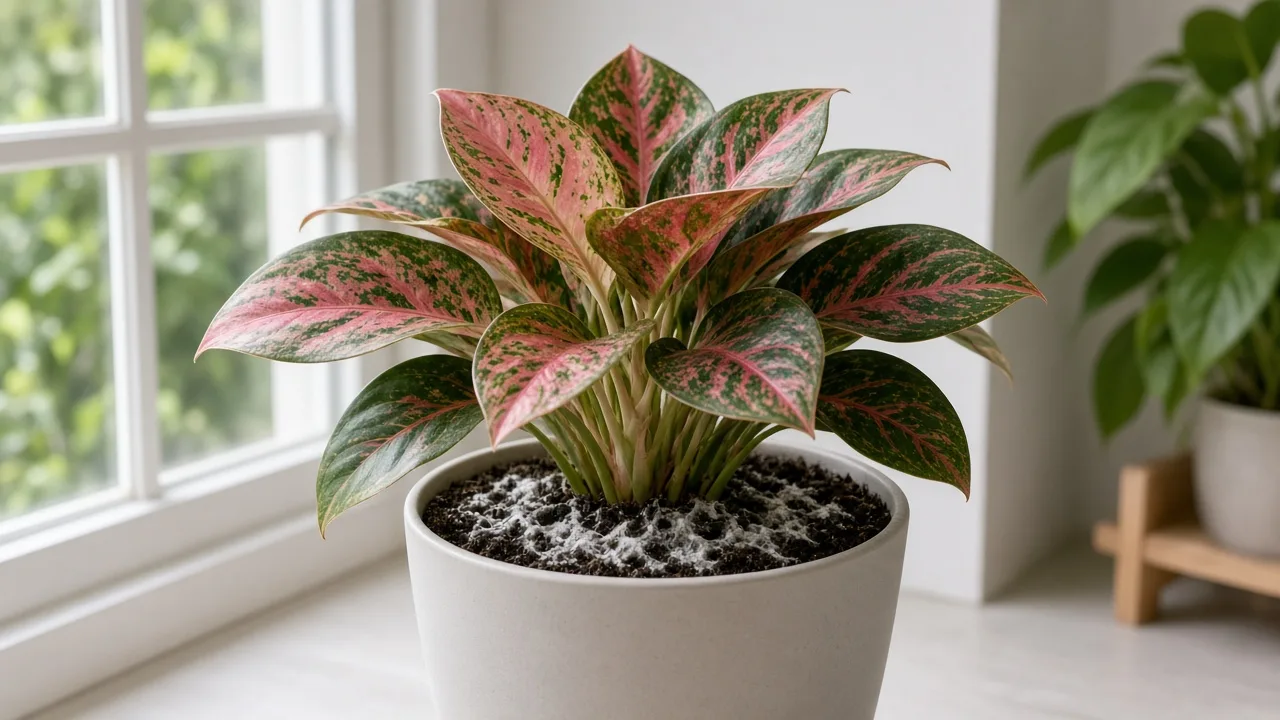
Mold on Soil on Aglaonema Red Siam: Causes, Checks & Fixes
This guide covers mold on soil on Aglaonema Red Siam. See also the general Mold on Soil guide, watering, and light pages for this plant.
Mold on Soil on Aglaonema Red Siam: Causes, Checks & Fixes
Quick answer
Your Aglaonema commutatum ‘Red Siam’ has white or gray fuzz on the potting mix and you need to know whether to scrape, repot, or panic. Start with what makes Red Siam different from green Chinese evergreens: the rose-pink and cherry-red anthocyanin zones need brighter indirect light than cultivars like Maria or Silver Bay, yet the plant still draws water slowly from peat-coco mix when light is marginal or the pot is oversized—so the surface can stay damp for days while glossy leaves above still look fine.
For how saprophytic fungi colonize wet organic mix in general, see our mold on soil guide. On Red Siam, the practical pattern is white fuzz on dark damp peat at the rim of a heavy pot, calendar watering while the top 2–3 cm never dries, and firm broad leaves with fading pink on new growth that signals the same wet conditions feeding the mold.
First step: scrape off the top inch of affected soil with a spoon, bag and trash the material, then let the upper 2–3 cm pass a dry skewer test before the next soak. Make that one correction before repotting, cinnamon dusting, or fungicide sprays.
When to use this page vs other Aglaonema Red Siam guides
This page is the symptom-first entry for fuzzy soil on a Red Siam pot. Use it to decide what the surface growth means and which action comes first.
| Pattern | Read next |
|---|---|
| Heavy wet pot, soft black crown base, sour smell | Root rot or overwatering |
| Small dark flies at the pot rim when you water | Fungus gnats |
| Light pot, crisp leaf margins, dry deep mix | Underwatering |
| Mix stays damp despite sparse watering | Soil guide — drainage and pot size |
| Long-term dry-down rhythm after mold clears | Watering guide |
| Yellow lower leaves with wet peat | Yellow leaves |
| New growth turning green, stretched stems | Not enough light |
What mold on soil looks like on Aglaonema Red Siam
Healthy Red Siam pots should show a lighter, drier peat surface between soaks. Mold shows up at the soil line beneath the compact crown—not on the glossy rose-pink and green leaves themselves.
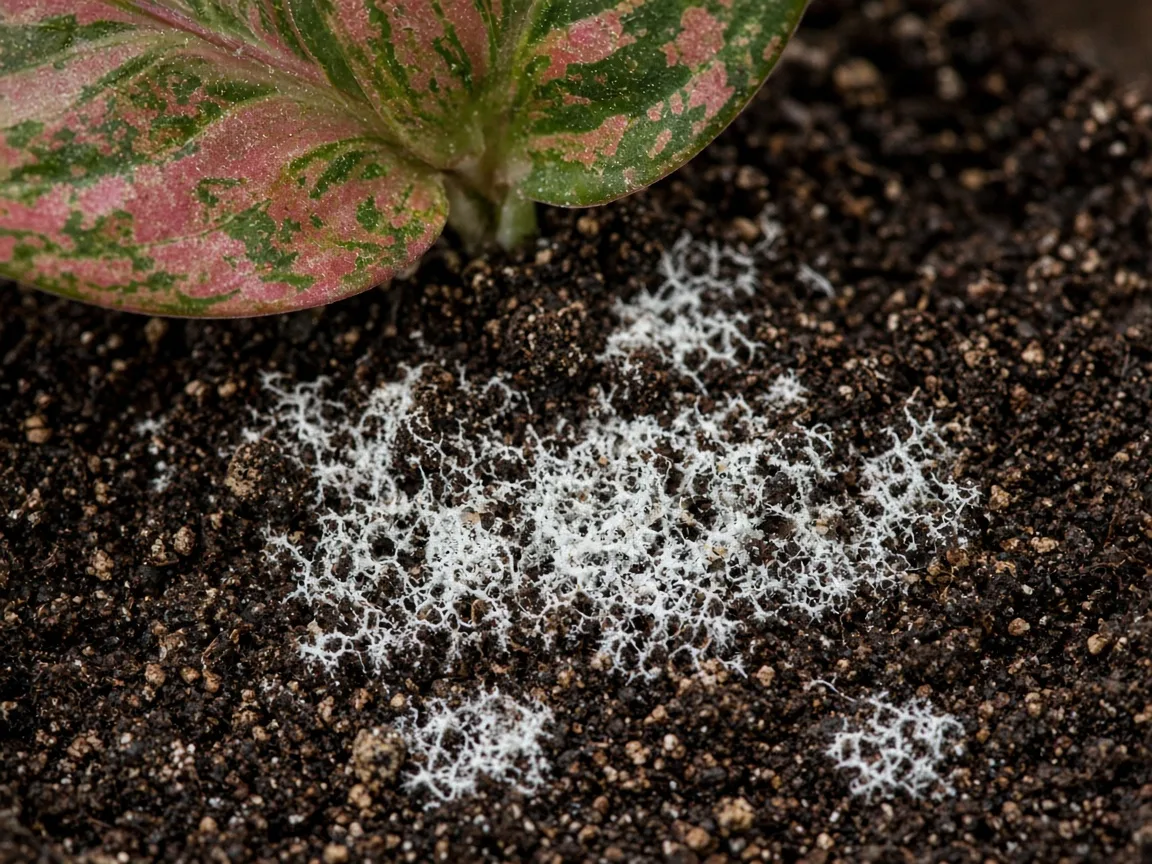
White saprophytic threads on dark damp peat at the Red Siam soil line—compare with the lighter dry surface you want between thorough soaks.
Typical harmless surface mold:
- White, gray, or occasionally tan fuzzy patches on the top of the mix
- Growth concentrated where organic debris collects—fallen lower leaves, peat fines, or decorative moss top-dressing
- Soil surface still damp or cool to the touch days after watering
- Upright broad leaves with firm petioles and recognizable pink variegation unchanged
Signs the wet conditions behind mold are hurting Red Siam:
- Mold returns within days of scraping
- Small dark flies hover when you disturb the surface—fungus gnats sharing the same damp habitat
- Pot feels heavy long after the last watering in a dim corner or oversized container
- Several yellow lower leaves at once while the surface stays dark and wet
- New leaves emerging mostly green instead of rose-pink—a moisture-and-light stress pair on this cultivar
- Soft tissue at the crown where petioles meet the mix
- Sour or swampy smell from the pot—distinct from normal earthy peat
Because Red Siam has fleshy stems and rhizomatous roots that tolerate brief drying better than prolonged saturation, broad leaves can stay upright while crowns at the soil line are already stressed. Do not treat surface mold as purely cosmetic when the pot stays heavy and the peat surface never lightens.
Why Red Siam gets mold despite needing good light
Red Siam is not a dim-office Aglaonema. The Thai tissue-cultured hybrid needs bright filtered light to hold its anthocyanin pink, and owners who meet that requirement can still overwater because the plant uses moisture slowly relative to faster tropicals. Mold appears when the top profile never dries between soaks.
Common Red Siam-specific triggers include:
Calendar watering after a light upgrade. Moving Red Siam to an east window for better color often comes with unchanged weekly watering. Clemson Extension recommends letting the top 1–2 inches of soil dry before watering again—roughly the top 2–3 cm Red Siam owners target. In cool months or heavy pots, that layer can stay damp two weeks while leaves still look glossy.
Peat-heavy mix without enough perlite. Standard indoor blend holds moisture at the rim where broad petioles emerge. Dense fine peat without perlite or bark stays dark and cool at the surface even when you think you watered lightly. See the soil guide for Red Siam-specific blends.
Oversized pots and cachepot runoff. Extra soil volume holds water around rhizomatous roots. Pots sitting in full saucers or decorative cachepots trap moisture at the bottom and keep the surface humid—especially common on display plants where runoff is not emptied promptly.
Cool winter rooms with unchanged watering. Red Siam slows in cooler dim months. Continuing summer soak frequency while evaporation drops prolongs surface wetness and mold recurrence.
Organic surface debris. Fallen lower leaves and sphagnum top-dressings give saprophytic fungi more food and hold moisture against the peat line where crowns emerge.
The mold itself is usually not pathogenic. The problem is the environment that grows it—the same environment that leads to root rot on overwatered Aglaonema and fungus gnats.
The pink-fade signal alongside surface mold
On Red Siam, mold and color loss often share one root cause: peat that stays wet too long in light that is weaker than the cultivar needs. Pink anthocyanin zones lack chlorophyll, so the plant photosynthesizes less efficiently in marginal light—and draws even less water from saturated mix.
When you see white fuzz and new leaves opening with washed-out green instead of rose-pink, treat it as a combined moisture-and-light problem:
- Scrape mold and dry the top 2–3 cm as below.
- Check whether the plant still receives bright indirect light for most of the day—not a dark hallway where green Aglaonemas might survive but Red Siam reverts.
- Pair dry-down correction with the light guide if pink is fading on emerging tissue.
Firm crowns with strong pink on new growth after one dry cycle suggest mold was a surface moisture issue only. Persistent green reversion with a never-drying skewer points to chronic overwatering—see overwatering.
The top 2–3 cm dry-down test for variegated Aglaonema
Red Siam watering is defined by depth, not the calendar. This plant-specific check separates cosmetic surface mold from a pot that is too wet throughout:
- Skewer to 2–3 cm depth — Insert a wooden skewer to roughly one inch (2–3 cm). If it exits damp or clings with dark peat, do not water yet—even if only the surface has visible mold.
- Pot weight at the shelf — Lift the container. A heavy pot days after the last soak confirms slow dry-down, not a one-day surface glitch.
- Peat color at the rim — Healthy cycles show the surface lightening from dark wet brown to lighter tan between soaks. Persistent dark peat at the crown base means mold will return after scraping.
- Season and light context — Mold appearing in a January room after unchanged weekly watering is a strong overwatering signal on slow-growing Red Siam. Pair with the light guide if the plant sits away from its brightest window.
If petioles are firm, new leaves still emerge with recognizable pink splashes, and the skewer dries at the proper depth within one to two weeks, you are likely dealing with cosmetic surface fungus on wet peat—not an active crown disease.
How to confirm the cause
Work through these checks before repotting or spraying anything:
- Surface moisture test — Press a finger into the top 2–3 cm. If it feels cool and clings to your skin days after watering, the mix is too wet for Red Siam in your light level.
- Crown firmness — Gently press where petioles meet the mix at the soil line. Firm tissue suggests mold is a moisture warning only. Soft or black tissue means rot may already be underway—follow the root rot guide.
- Smell check — Earthy odor is normal. Sour or rotten smell points to anaerobic decay in wet peat.
- Gnat check — Small flies rising when you disturb the surface mean larvae are feeding in damp organic soil in the same layer as the mold.
- New growth check — Strong pink on emerging broad leaves supports a surface-only diagnosis. Several yellow lower leaves with a heavy wet pot points to overwatering instead.
Lookalike comparison
| What you see | Likely cause | How to tell apart |
|---|---|---|
| White/gray fuzzy threads on damp peat | Saprophytic surface mold | Scraping reveals wet peat beneath; crowns firm |
| Hard white or tan crust | Mineral salt buildup from fertilizer or hard water | Scraping reveals dry soil beneath, not fuzzy threads |
| Smooth green film | Algae on constantly wet surface in low light | Same moisture fix as mold; slightly brighter filtered light helps |
| Store-bought moss on top | Decorative top-dressing holding moisture | Remove moss; mold often grows underneath |
| Brief white threads after repotting | Normal mycelium in fresh peat before first dry-down | Disappears once top 2–3 cm dries; no sour smell |
First fix for Aglaonema Red Siam
Stop the next scheduled soak and remove the upper layer of growing media along with the moldy surface using a spoon or fork.
University of Maryland Extension recommends discarding the upper layer when algae or fungal mats appear on indoor plant soil. Bag the scraped material and trash it—not the compost pile, where spores can spread. Leave the plant in place and let the top 2–3 cm dry completely before the next thorough watering. Do not mist broad leaves or top-dress with more sphagnum while correcting moisture.
This single step addresses both the visible mold and the root cause: a surface that never dries in a Chinese evergreen pot. Red Siam crowns tolerate measured dry intervals better than chronic saturation, so withholding the next soak is safe when petioles are still firm.
Step-by-step recovery
After the first dry-down, work through these steps in order based on what you find:
If mold was cosmetic and crowns are firm:
- Wait until a wooden skewer inserted to 2–3 cm depth comes out dry at that level.
- Water thoroughly once until runoff, then empty the saucer or cachepot within 30 minutes—see the watering guide.
- Confirm the plant still receives bright filtered light so the peat surface can lighten between soaks without scorching pale pink tissue.
- Resume dry-down rhythm: water only when the top 2–3 cm of mix has dried in your room, not on a fixed weekly calendar.
If mold returns within a week:
- Scrape the surface again and replace the top inch with dry, well-draining mix per the soil guide—extra perlite helps surface drying on peat-loving Red Siam.
- Confirm drainage holes are open and the pot is not sitting in a full saucer.
- Reduce pot size if the container is much wider than the crown clump—extra soil holds moisture Aglaonema never uses.
If fungus gnats appear with mold:
- Let the top 2–3 cm of soil dry completely between waterings to break the gnat life cycle.
- Add yellow sticky traps at the pot rim to catch adults while peat dries.
- See the fungus gnats guide for potato-slice monitoring and Bti if larvae persist.
If crowns soften or smell sour:
- Stop watering and inspect roots the same day—follow root rot triage rather than repeated surface scraping alone.
Recovery timeline
Surface mold often clears within one dry-soak cycle once the top profile dries reliably—roughly one to two weeks in a typical Red Siam pot. Persistent peat that never lightens may need a top-inch mix swap or spring repot—two to four weeks total.
Improvement signs: No new fuzz after scraping, lighter peat surface between soaks, firm petioles, new broad leaves with strong rose-pink color.
Worsening signs: Soft crown at soil line, several yellow lower leaves together, mold returning while the skewer never dries, or flies increasing—switch to overwatering and root rot diagnosis rather than another surface scrape.
Old lower leaves may yellow and drop on their own; that is normal aging on a compact clump, not proof mold damaged the crown.
Mistakes to avoid
Do not mist the soil or add sphagnum moss top-dressing to fight mold—extra surface moisture extends fungal habitat on peat-loving Red Siam.
Do not water on a fixed weekly calendar because the plant looks glossy. Variegated Chinese evergreens use water slowly; use the skewer test instead.
Do not repot into fresh peat-heavy mix without perlite while the surface is still chronically wet—you may spread spores without fixing drainage.
Do not bone-dry a clump that already shows soft tissue at the crown—measured dry-down on firm stems only.
Do not spray indoor fungicides across broad foliage as a first response—scraping and drying the top profile fixes most cases.
Do not ignore cachepot runoff. Standing water is both mold habitat and an overwatering risk for Chinese evergreen roots.
Do not handle soil bare-handed if you have sap sensitivity—Red Siam contains calcium oxalate crystals; wear gloves when disturbing crowns during inspection.
How to prevent mold next time
Use well-draining peat-perlite mix in a stable pot only one size larger than the crown clump.
Match watering to season and light—longer dry intervals in cool months per the watering guide.
Empty cachepots and saucers within 30 minutes after every soak.
Top-dress with a thin layer of perlite if peat surfaces stay dark and damp between drinks.
Quarantine new plants for two weeks before placing them beside Red Siam on a shared shelf.
Scout the soil line weekly after repotting or moving the plant to a new window.
Pair placement with realistic light—bright filtered light speeds dry-down and holds pink color; see the light guide.
When to worry
A small fuzz patch on an otherwise firm Red Siam with correctable wet surface peat is common in mixed houseplant collections and rarely threatens a mature clump once moisture is fixed.
Escalate when crowns soften at the soil line, several broad leaves yellow together, mold returns within days while the skewer never dries, or fungus gnats swarm the rim—those patterns overlap root rot and need root-zone triage, not another surface scrape alone.
Related Aglaonema Red Siam guides
- Overview — culture and toxicity
- Watering — top 2–3 cm dry-down for variegated leaves
- Soil — peat-perlite blends and pot size
- Light — holding pink color without overwatering
- Overwatering — when wet mix damages roots
- Fungus gnats — flies at the rim without surface fuzz
- Root rot — soft crown and collapse
- Problems hub — full symptom index
Conclusion
Mold on Aglaonema Red Siam soil is a pot-surface moisture signal in most homes—not fungus attacking rose-pink variegated leaves. Scrape the damp top inch, dry the upper profile before the next soak, and align watering with a slow-growing variegated Chinese evergreen. Firm crowns, strong pink on new growth, and a peat surface that lightens between drinks are the recovery markers; persistent wet mix with a soft base means root problems, not mold alone.
Related tool
Use the Plant Problem Diagnosis Tool to narrow causes for mold on soil on this plant before changing multiple variables at once.