Alocasia Cuprea Fertilizer: NPK, Schedule & Dormancy Rules
Alocasia Cuprea Fertilizer: NPK, Schedule & Dormancy Rules
Alocasia Cuprea Fertilizer: NPK, Schedule & Dormancy Rules
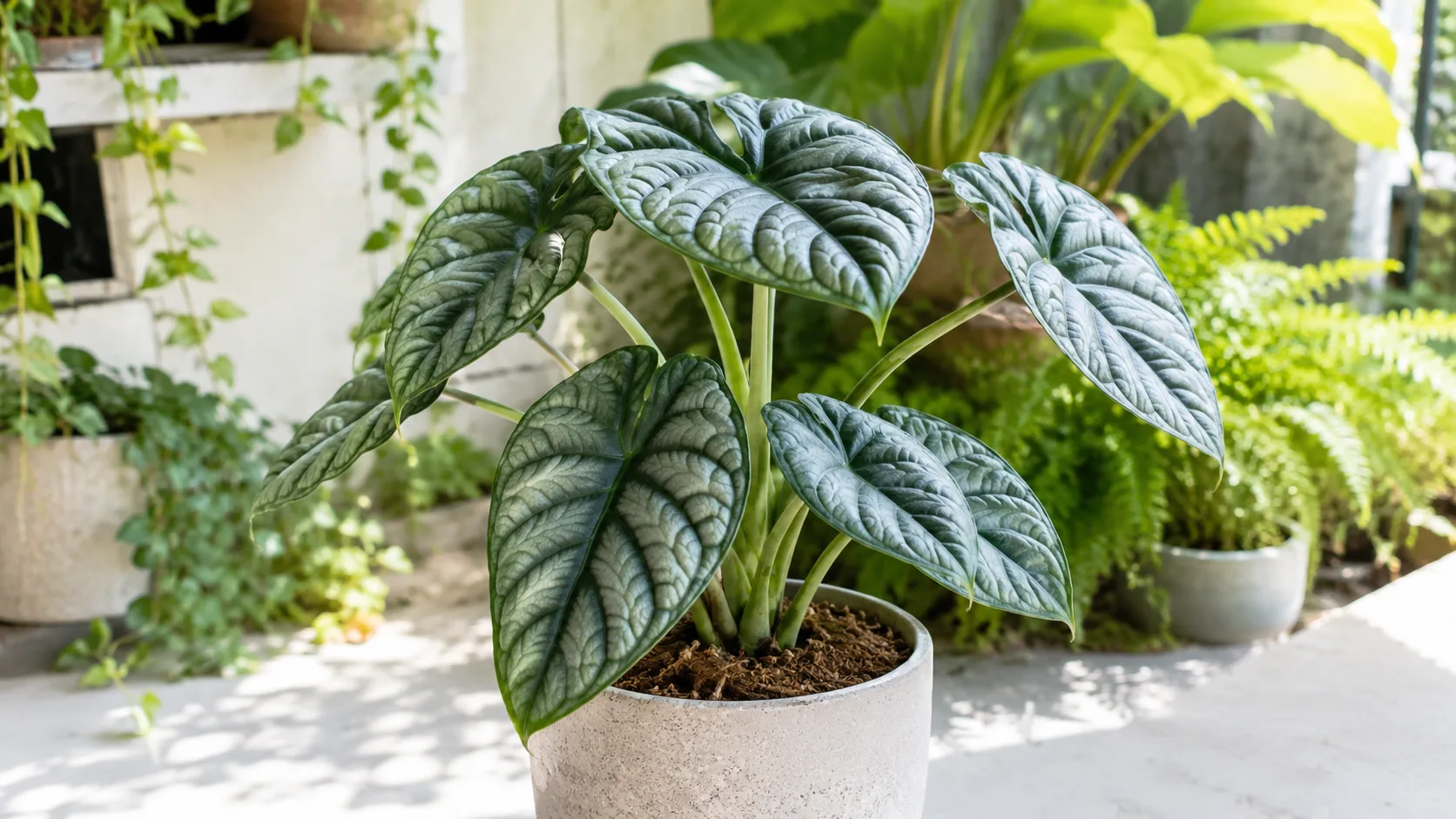
Alocasia Cuprea fertilizer decisions start with how slowly this plant actually grows — not with a generic houseplant feeding calendar. Alocasia cuprea — the copper mirror jewel sold as Red Secret or Mirror Plant — pushes thick, metallic leaves from a small underground corm with fine, rot-prone roots. That biology makes it a light feeder compared with faster aroids like heartleaf philodendron or the taller Alocasia × amazonica hybrids such as Polly. Feed lightly during active growth, dilute to half strength or less, and pause completely through dormancy; you get steady new spears without the brown tips and crusty soil that follow a heavy hand.
This page covers NPK choices, dilution, seasonal timing, dormancy rules, and recovery when salts build up — all specific to Cuprea’s slow corm-based growth and bullate mirror foliage.
Why Alocasia Cuprea Needs a Different Feeding Approach
Alocasia Cuprea is a compact jewel alocasia grown for reflective copper-bronze leaves, not volume. The same slow root system that keeps the plant small in a 10–15 cm pot also limits how much fertilizer it can process before soluble salts accumulate. Most Cuprea owners who see crispy margins, white crust on the mix surface, or a sudden stall in new leaves are dealing with salt stress from feeding, not a mysterious light or humidity failure — though light and watering still matter as the foundation.
The workable approach mirrors how nutrients reach understorey plants in the wild: small, infrequent doses while growth is active, then nothing while the corm rests.
Slow Growth, a Small Corm, and Borneo Understorey Biology
Alocasia cuprea is native to Borneo, where it grows as an understorey aroid in humid forest conditions. The RHS Alocasia cuprea profile describes young leaves flushed red maturing to copper-bronze above with a dark purple underside — a slow, energy-intensive leaf cycle that does not respond well to pushed growth from heavy nitrogen.
Indoors, Cuprea often holds only one to three leaves at a time and may take four to eight weeks between new spears in average home conditions. That pace is far slower than a trailing philodendron on the same windowsill, which is why copying philodendron’s twice-monthly feed schedule onto Cuprea is a common mistake. The corm stores reserves precisely so the plant can survive lean periods; your job is to supplement lightly during the months it is actually building leaves, not to drive greenhouse-speed growth from a windowsill pot.
Pair feeding with the chunky aroid mix and moisture rhythm from the watering guide — fertilizer cannot fix wet, oxygen-poor roots.
Why Salt Sensitivity Is the Defining Feature of This Jewel Alocasia
Salt sensitivity is the single most important concept before you choose a bottle. The University of Maryland Extension explains how soluble salts from fertilizer pull moisture from root tissues, producing marginal browning, leaf scorch, and wilting even when the mix feels moist. Jewel alocasias with small root mass in fast-draining bark mixes sit at the sensitive end of that spectrum.
A full-strength pour-through leaves residue behind; within a few weeks the mix’s salt load can burn fine root tips. On Cuprea, the warning signs — crispy leaf margins, white or yellow crust on the soil surface, stunted new spears — often appear on the mirror-finish leaves before the plant wilts. Dilute more than the label suggests, water thoroughly between feeds, and flush with plain water on a regular cadence during the growing season.
The Best NPK Ratio for Alocasia Cuprea
NPK is the nitrogen–phosphorus–potassium ratio on every label. For Cuprea, reputable indoor guidance converges on two safe families: a balanced 1:1:1 such as 10-10-10 or 20-20-20, or a foliage-leaning 3:1:2 such as 9-3-6 or 12-4-8. Both work; the choice is emphasis, not correctness.
A balanced formula supports leaf production, root maintenance, and corm storage at once — appropriate for a plant building one sculpted leaf at a time. A 3-1-2 ratio weights nitrogen slightly toward lamina expansion, which can help a young Cuprea size up new leaves when light and humidity are already strong. Avoid high-phosphorus “bloom” formulas; Cuprea is grown for foliage, not flowers.
Balanced 20-20-20 vs a 3-1-2 Foliage Ratio
Most jewel-alocasia growers keep a balanced 20-20-20 liquid on hand because it is widely available and most complete formulas include chelated iron, magnesium, and trace elements that prevent the pale, pinched new growth that shows up on indoor aroids. NC State Extension notes that alocasias in active growth benefit from regular watering and fertilizing — the qualifier is regular, not strong.
A 3-1-2 foliage ratio is fine if you already feed Monstera or Philodendron from the same bottle. In a warm, bright, humid setup — grow tent, bright bathroom, or terrarium — the extra nitrogen is usually used. In a cooler room that drops into the low 60s °F at night, unused nitrogen can linger as salts; a balanced 1:1:1 is the safer default.
Cuprea is slower than Polly and far slower than heartleaf philodendron. If you are coming from those plants, step down both concentration and frequency rather than matching their bottles.
Micronutrients That Matter: Calcium, Magnesium, and Iron
The deficiencies most often confused with “not enough fertilizer” on Cuprea are calcium, magnesium, and iron issues. Calcium shortfalls can distort new leaves at the growing point. Magnesium deficiency shows as interveinal yellowing on older foliage. Iron deficiency looks similar but hits the newest growth and is often a pH problem — iron becomes less available above pH 6.5.
A complete 20-20-20 with chelated iron covers most cases. If you use very soft water, reverse osmosis, or rainwater exclusively, add a low-dose Cal-Mag supplement or a small amount of dolomitic lime in the aroid mix at repot time. Cuprea’s preferred pH band is roughly 5.5–6.5; mixes that drift acidic over time may need occasional buffering if new leaves arrive torn or pinholed.
How to Dilute Fertilizer So It Doesn’t Burn the Roots
Dilution prevents more Cuprea casualties than brand choice. For a standard 20-20-20 liquid, half strength is the routine ceiling; quarter strength is the safer entry point after dormancy or repotting. For a 3-1-2 concentrate, default to quarter strength because the nitrogen density is higher.
Practical mixing: if the label calls for 1 teaspoon per gallon, use ½ teaspoon per gallon for 20-20-20, or ¼ teaspoon per gallon for 3-1-2. Apply to already-moist mix — never pour fertilizer onto bone-dry media, where salts contact dry root hairs directly. Water normally the day before a feed, apply the diluted solution as the next drink, then follow with a plain-water pour-through a few days later to keep salts moving.
If you use an EC meter, many experienced aroid growers aim for roughly 1.0–1.5 mS/cm pour-through right after a feed, drifting back toward 0.4–0.6 mS/cm between feeds. Without a meter, clean leaf margins, no white crust, and a steady leaf cadence are the practical signals.
Alocasia Cuprea Fertilizing Schedule by Season
A low-stress rhythm for most homes:
- Late winter to early spring (resumption): Feed only after at least one new leaf has fully hardened. Start at quarter strength, then half strength on the next round.
- Spring (active growth): Every 4 to 6 weeks with half-strength balanced liquid, or every third watering at quarter strength if the plant is warm, bright, and pushing spears steadily. The Royal Horticultural Society alocasia guide recommends liquid fertilizer from April through October during active growth.
- Summer (peak): Same interval. Warm pots concentrate salts faster — flush with plain water every 6 to 8 weeks even when you are not feeding that week.
- Early fall: One light half-strength feed if the plant is still producing leaves, then stop. Do not push a late-October dose onto a slowing corm.
- Winter (dormancy): No fertilizer. Resume only when new growth returns.
Count leaves, not just weeks. A healthy Cuprea in active growth often produces a new spear every four to eight weeks. Feeding once between hardened leaves naturally lands in the every-4-to-6-weeks band. If the plant is on a six-to-eight-week leaf cadence in moderate light, a fixed every-two-weeks calendar will overload the pot.
Dormancy Feeding: When to Stop and When to Restart
Dormancy is the most important — and most violated — part of the Cuprea fertilizer plan. Unlike some larger alocasia hybrids, Cuprea can drop every leaf and survive on the corm below the surface while daylength and temperatures fall. During that rest, root uptake collapses. Any fertilizer applied simply sits in the mix, raises soluble salts, and damages the fine roots and corm you need intact for spring.
Extension guidance on fertilizer salt buildup applies directly: salts accumulate when the plant cannot use them. Aroid dormancy references including PDA Exotic Plants’ Alocasia dormancy guide align on the practical rule — stop fertilizing when growth stops.
How to Tell Your Cuprea Has Gone Dormant
Cuprea dormancy can look dramatic. New spear production stops. Existing leaves may yellow from the oldest outward as the plant pulls reserves into the corm. The mix stays wet longer between drinks because uptake has slowed. In late autumn or winter, the plant may shed all foliage, leaving what looks like an empty pot — the corm is often still firm and alive. None of this is a cue to feed “for encouragement.”
When you see these signs, stop fertilizer, reduce watering per the watering guide, keep bright indirect light, and do not repot. Patience is the correct response.
Restarting Fertilizer in Spring Without Burning Fresh Roots
Spring restart is when growers most often burn a recovering Cuprea. Wait until the plant has pushed at least one fully unfurled, hardened leaf — two is safer. The new foliage signals that roots are taking up water again. Lead with quarter strength, move to half strength on the next round, then settle into the regular every-4-to-6-weeks rhythm.
If new leaf margins brown within days of a feed, step down dilution and flush the pot. Pair the first feeds of the season with stable light and humidity — fertilizer cannot replace either.
Foliar Feeding Alocasia Cuprea: Why Mirror Leaves Are Different
Foliar feeding — spraying diluted fertilizer on leaves — is a poor default on Cuprea. The bullate, mirror-like cuticle does not shed liquids evenly; fertilizer pools in leaf ridges, leaves mineral residue that dulls the metallic sheen, and can invite fungal spotting along veins. Smooth-leaved philodendrons tolerate occasional foliar use more forgivingly; Cuprea’s textured surface does not.
If you need a quick magnesium correction for interveinal yellowing on older leaves, mist very lightly on the underside in early morning at a trace concentration, only when foliage is already slightly damp. Routine nutrition should be a soil drench on moist mix.
Organic vs Synthetic Fertilizer for Jewel Alocasias
Synthetic balanced liquids like 20-20-20 offer precise, immediate nutrition — valuable on a slow plant where miscalculation shows on the next leaf. Organic options such as fish emulsion, seaweed extract, or worm-casting teas release nutrients more slowly and depend on microbial activity. Indoor aroid mixes heavy on bark and perlite are biologically lean, so organics can be unpredictable in small pots.
A practical hybrid: alternate one half-strength synthetic feed with one diluted fish emulsion feed every four to six weeks during active growth. Skip organics in winter. If odor in a closed room matters, stay with synthetic only — Cuprea does not need fish emulsion to color well when light and humidity are right.
Signs of Over-Fertilization and How to Fix It
Watch for:
- Brown, crispy tips and margins within days of feeding
- White or yellow crust on the soil surface or pot rim
- Sudden yellowing of older leaves faster than normal seasonal senescence
- Stunted or smaller new spears on an otherwise healthy corm
- Soft, dark, oversized leaves with weak venation — excess nitrogen
Treat these as salt problems, not underwatering. Pause all feeding immediately.
A late-autumn feed onto a plant already slowing down is a frequent trigger — symptoms in October or November often trace to the last seasonal dose, not the whole summer program.
How to Flush Salts Out of the Pot
Flush with roughly three times the pot volume of plain room-temperature water. For a 15 cm pot, that is about 4–5 litres total, poured slowly and evenly so water moves through the whole root ball. Let it drain fully; repeat if runoff is still discoloured. The University of California ANR describes the same leaching approach for houseplants with salt buildup.
Let the plant return to its normal dry-down weight before the next drink. Do not feed for at least four to six weeks. Burned leaf tissue on Cuprea will not revert — new spears should emerge clean if salts are actually gone. White crust on the rim is a classic sign of mineral salt deposits from fertilizer and hard water.
Common Fertilizer Mistakes With Alocasia Cuprea
The expensive errors are predictable:
- Feeding on a calendar while the plant is not pushing leaves.
- Full label strength on a slow windowsill corm.
- Feeding within four to six weeks of repotting — wait until roots recover; see the repotting guide.
- Slow-release pellets in a small pot — temperature-driven release is hard to control in 10–15 cm containers.
- Autumn or winter feeds to “help the plant through dormancy” — the opposite of what a resting corm needs.
- Copying philodendron or Polly schedules without slowing down for Cuprea’s pace.
Proven Winners’ alocasia guidance stresses that overwatering in winter kills more alocasias than any other mistake; paired over-fertilization in the same season compounds root damage. When unsure, feed less, dilute more, and never feed a resting plant.
Conclusion
Feeding Alocasia Cuprea well is mostly restraint. A balanced 20-20-20 or 10-10-10 liquid — or a 3-1-2 foliage formula — at quarter to half strength on moist mix every four to six weeks from spring through early fall is enough to support those copper mirror leaves. Flush with plain water every six to eight weeks in active growth, add Cal-Mag if your water is very soft, and stop completely when dormancy arrives — including the empty-pot phase when every leaf has fallen. Resume only after new foliage hardens in spring, leading with quarter strength.
One rule above the rest: Cuprea evolved on a slow nutrient trickle in Borneo’s understorey. The closer your indoor rhythm matches that patience, the more reliably the plant unfurls the leaves you bought it for.
When to use this page vs other Alocasia Cuprea guides
- Alocasia Cuprea overview — Whole-plant context, dormancy behaviour, and how Cuprea differs from Polly and Dragon Scale.
- Alocasia Cuprea watering — Moisture rhythm and winter reductions; read this before increasing feed frequency.
- Alocasia Cuprea light — Bright indirect light drives how much fertilizer Cuprea can actually use.
- Alocasia Cuprea problems hub — Symptom-specific fixes when feeding changes do not resolve the issue.