Alocasia Cuprea Yellow Leaves: Mirror-Leaf Diagnosis
Quick answer
Yellow leaves on Alocasia Cuprea usually trace to wet mix around a slow corm, natural senescence on a plant that holds only one or two mirror blades, or winter dormancy—not a pale new red spear that is still maturing to copper. First step: push a chopstick into the top 2–3 cm of mix, lift the pot for weight, and read the lowest yellow leaf together with the newest spear before watering, repotting, or feeding.
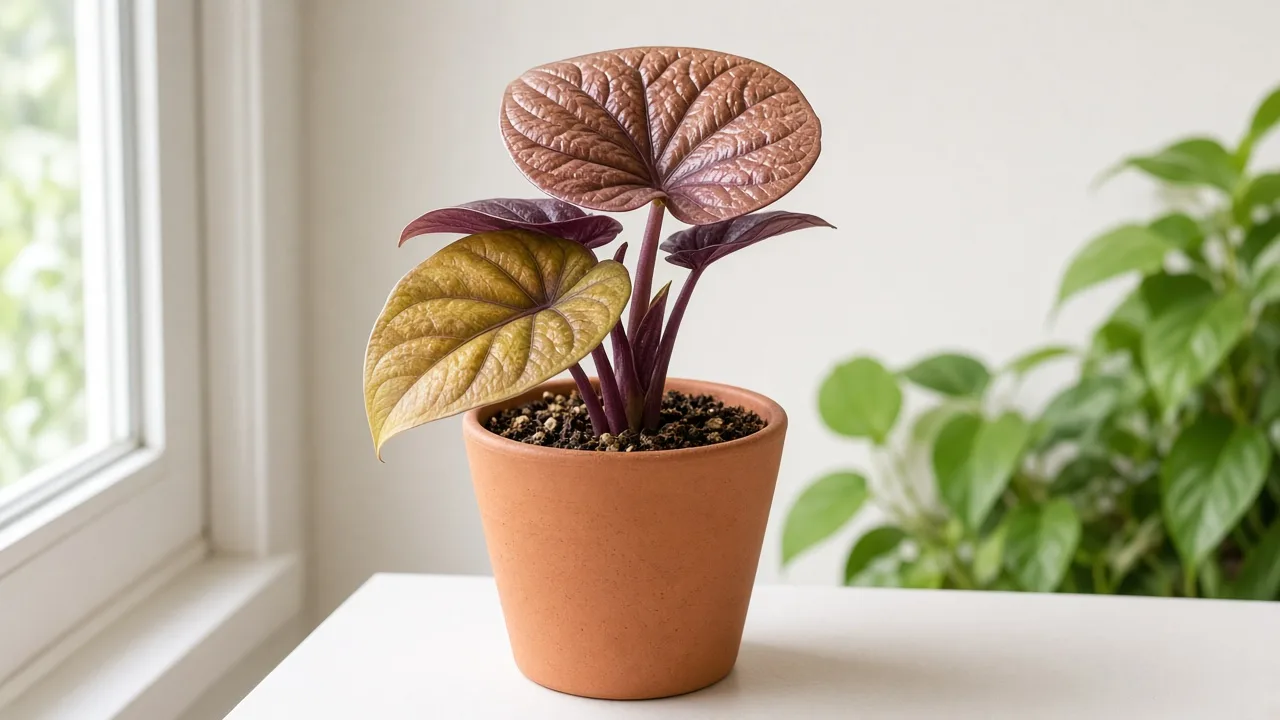
Yellow Leaves on Alocasia Cuprea: Causes, Checks & Fixes
This guide covers yellow leaves on Alocasia Cuprea. See also the general Yellow Leaves guide, watering, and light pages for this plant.
Yellow Leaves on Alocasia Cuprea: Causes, Checks & Fixes
Quick answer
Yellow leaves on Alocasia cuprea ‘Red Secret’ are usually a moisture-or-age signal on a slow corm, not a random leaf disease. Cuprea stores reserves underground and may hold only one or two stiff copper mirror blades at a time—so losing one lower leaf can look alarming even when the plant is fine. NC State Extension notes that alocasia yellowing can come from overwatering, too little water, or inadequate light—three causes that need opposite fixes.
For the general biology behind chlorosis, see our yellow leaves hub. On Cuprea, the decisive clues are bottom-up yellowing on a heavy wet pot, one oldest mirror blade fading while a red spear stays firm above drying mix, winter leaf drop with a firm corm below bare soil, or a dull bullate surface that precedes full yellow on chronically damp roots—not a pale silvery new leaf that darkens to copper within a week.
First step: push a chopstick or finger into the top 2–3 cm of mix, lift the pot for weight, and read the lowest yellow leaf together with the newest spear. Make that one check before watering, repotting, pruning every blade, or adding fertilizer.
When to use this page vs other Alocasia Cuprea guides
This page is the yellow-mirror-leaf entry when colour fades on copper blades and you need to separate normal senescence from wet roots, drought, light stress, pests, or nutrients.
| Pattern | Read next |
|---|---|
| Heavy wet pot, soft petioles, gnats at rim | Overwatering |
| Mushy corm, black petiole bases, sour smell | Root rot |
| Light dry pot, crisp edges, limp blades | Underwatering |
| Pale new spears, stretched petioles, dim corner | Not enough light |
| Fine stippling, webbing, cottony clusters | Spider mites or mealybugs |
| Older leaves pale during active growth, firm roots | Nitrogen deficiency |
| Empty winter pot, firm corm below | Overview — dormancy, not thirst |
What yellow leaves look like on Alocasia Cuprea
On a healthy Cuprea—sold as Red Secret or Mirror Plant—glossy copper-bronze leaves with a dark purple underside stand upright on stiff petioles in a compact 30–60 cm clump. Young leaves emerge flushed red before the metallic cuticle darkens. Yellowing changes that silhouette from the bottom up or across multiple blades at once.
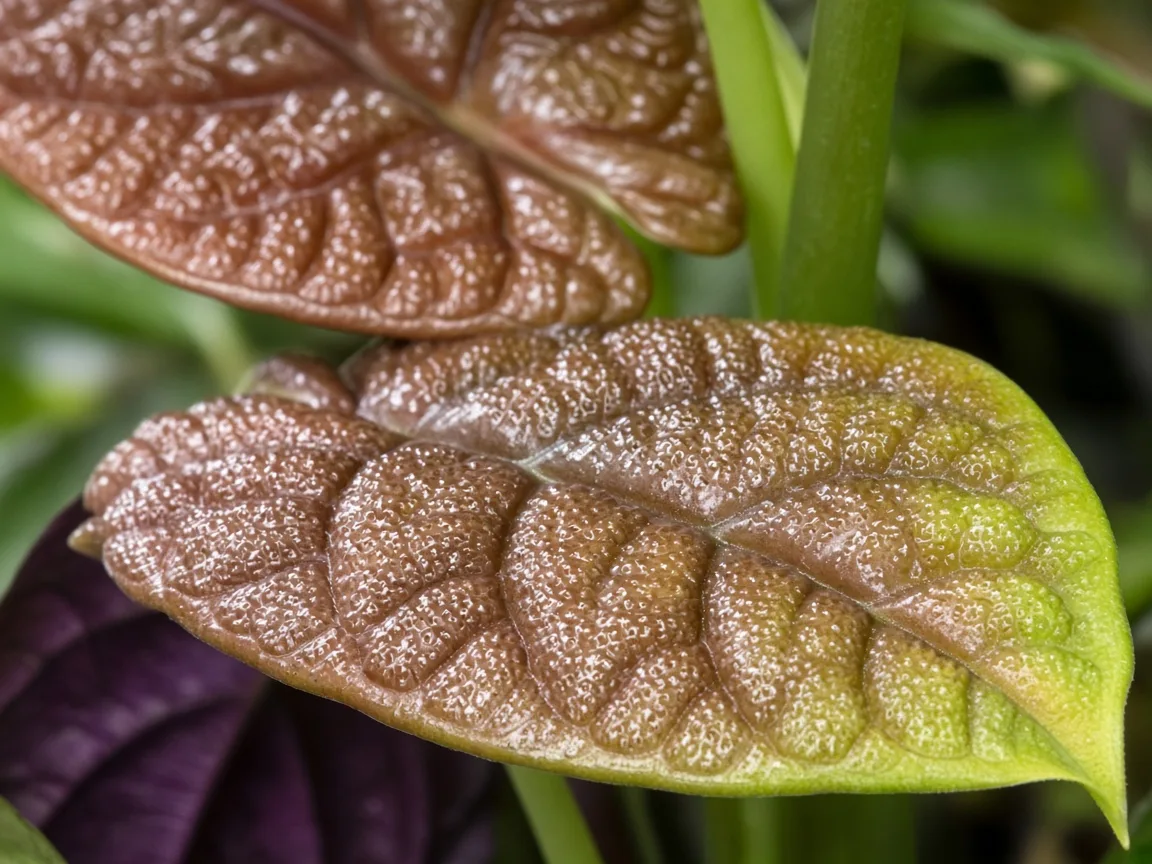
Yellow leaves on Alocasia Cuprea—oldest lower mirror blade fading yellow-green while the upper copper leaf and stiff petiole remain firm on moderately moist aroid mix.
Typical yellow-leaf patterns:
- Oldest lower mirror blade fades evenly from copper to yellow-green while upper leaves stay metallic
- Bullate mirror surface dulls to flat olive-bronze before full chlorosis on wet roots
- Multiple blades yellow within days on a heavy pot that never lightens between soaks
- New red spear stalls, yellows, or collapses before unfurling—stress, not maturation
- Winter leaf drop leaves bare mix above a firm corm while you kept summer watering
- Fine yellow stippling between veins with dry leaf undersides—pest feeding, not moisture alone
What is not yellow-leaf stress on Cuprea:
- A pale or silvery unfurling spear that firms and darkens to copper over several days—normal cuticle maturation
- One bottom leaf yellowing on a light pot with a stiff new red spear—often natural senescence on a slow corm
- Crisp brown edges on firm copper blades with a dry pot—see brown tips or underwatering
Read the red spear and oldest mirror leaf as a pair
Cuprea may display only one or two active mirror leaves at a time. Losing one blade is a large percentage hit on this jewel species—yet it is often normal cycling, not rot.
Normal senescence is likely when:
- the yellow blade is the oldest and lowest on the plant;
- yellowing is even across that single mirror leaf;
- a red-flushed spear is rising or recently unfurled above;
- remaining petioles and the visible corm area stay firm;
- the pot dries on schedule per the watering guide—top 2–3 cm passes a chopstick test between soaks.
A care or root problem is more likely when:
- two or more mirror leaves yellow within a short window;
- the new spear yellows or rots before opening;
- the pot stays heavy and dark for days after the last water;
- petioles soften where they meet damp mix;
- fungus gnats hover at the rim on never-drying soil.
Do not strip every copper blade for aesthetics. Cuprea needs photosynthetic surface during recovery. Wait until a petiole has fully failed, then trim cleanly—see pruning if your plant has that guide, or cut at the soil line with sterile scissors.
Mirror-leaf yellowing vs normal red flush — colour traps
Cuprea owners often panic at colour change. Separating stress yellow from normal development prevents watering an already-wet corm because a leaf “looks wrong.”
| What you see | Likely meaning | Next check |
|---|---|---|
| Entire lower mirror blade fades yellow-green on wet dark mix | Overwatering or early root stress | Chopstick dry test, pot weight, corm firmness |
| New spear flushed red, stiff petiole, mix drying normally | Normal young-leaf colour | No action unless mix stays wet |
| Pale silvery unfurling leaf that darkens to copper over days | Cuticle maturation | Compare petiole firmness and soil moisture |
| Yellow with brown mushy petiole base | Advancing rot | Root rot — probe corm immediately |
| Even yellow across several blades on heavy pot | Chronic wet roots | Overwatering dry-down first |
| Yellow stippling and webbing on undersides | Spider mites | Spider mites — isolate and inspect |
The bullate mirror surface can dull before full yellow appears under chronic wet-root stress. That dulling plus a heavy pot is a wet-soil warning even when only one leaf has turned colour.
Why Alocasia Cuprea gets yellow leaves
Overwatering and poor drainage — most common. Proven Winners lists overwatering as the primary reason alocasia leaves turn yellow, alongside drooping, soft tissue, mold, root rot, and fungus gnats. Cuprea’s compact corm rots fast in peat-heavy mix that never dries at the top 2–3 cm. Calendar watering in a humid bathroom is a frequent trigger.
Natural senescence on a slow corm. Older alocasia leaves naturally turn yellow and die as new leaves emerge. On Cuprea, that may mean one bottom mirror blade every few months while the crown stays active—especially if the pot is appropriately light and the corm is firm.
Winter dormancy with summer watering. The RHS alocasia guide notes that alocasias need winter dormancy in cooler, drier conditions and may lose foliage. Cuprea can drop every leaf while the corm stays alive below—yet owners often keep soaking on the summer rhythm, leaving damp mix above an inactive corm. Yellowing and collapse follow wet anaerobic soil, not thirst.
Underwatering and drought stress. Less common than overwatering but real: a very light pot, dry mix at depth, and limp copper blades that yellow from the edges inward. Cuprea wilts before it crisps like a succulent—check weight before assuming wet roots.
Insufficient light. Alocasias in lower light grow much slower and use less water. Dim corners plus unchanged watering schedules keep mix wet longer, producing bottom yellowing. Pale stretched spears without wet soil point toward not enough light.
Pests and nutrient stress. Spider mites, aphids, and mealybugs can yellow mirror tissue through feeding. Nitrogen or iron deficiency usually shows on older or interveinal patterns during active growth with otherwise sound roots—see nitrogen deficiency and iron deficiency only after moisture and light are ruled out.
How to confirm the cause
Work in this order so opposite problems do not get the same fix.
- Chopstick or finger to 2–3 cm depth — damp and cool vs. dry and light
- Lift the pot — heavy for days vs. very light
- Newest spear — stiff red flush maturing to copper vs. yellow collapsing spear
- Petiole bases at soil line — firm vs. mushy
- Leaf undersides — webbing, stippling, scale, or mealy wax
- Season and recent care — winter dormancy, repot, move, or feeding change
- Corm probe only if wet soil + spreading yellow — slide plant out and press the storage organ gently; firm corm with white/tan roots differs from soft brown tissue
| Confirmed finding | Likely cause | First targeted fix |
|---|---|---|
| Wet top 2–3 cm, heavy pot, bottom yellow first | Overwatering | Stop next soak; empty cachepot water |
| One bottom yellow, firm corm, drying mix, new red spear | Senescence | Monitor; keep steady watering rhythm |
| Bare winter pot, firm corm, damp mix | Dormancy overwater | Cut watering 60–70%; see overview |
| Very light pot, dry depth, limp blades | Underwatering | Thorough soak once; resume dry-down schedule |
| Pale spears, long petioles, normal moisture | Low light | Move to brighter indirect light per light guide |
| Stippling + pests visible | Feeding damage | Matching pest page—isolate first |
The first fix to try
If the top 2–3 cm of mix is still damp or the pot feels heavy: stop watering. Empty standing water from saucers and cachepots. Do not repot, prune every mirror leaf, or fertilize on day one.
That single dry-down correction resolves many mild Cuprea yellowing cases within one to two weeks when the corm is still firm. Waterlogged soil deprives roots of oxygen even though the pot feels wet—yellow leaves are often the first visible sign before petioles soften.
If the pot is very light and mix is dry at depth: water thoroughly once until a little runs from drain holes, discard runoff within 30 minutes, then return to the top 2–3 cm dry-down rule.
If one bottom leaf is yellow on an otherwise healthy plant with normal moisture: monitor. Senescence does not need rescue soaking or fertilizer.
Escalate to root rot salvage only when mushy petiole bases, sour smell, or a soft corm confirm advancing damage—not from colour alone.
Step-by-step recovery by cause
Wet roots (most common)
- Stop watering until the top 2–3 cm dries.
- Empty cachepot runoff; improve air around the pot base.
- Scout for gnats—see fungus gnats if flies persist on damp mix.
- Hold fertilizer until new stiff growth holds for two weeks.
- Repot only if corm or roots are mushy—use chunky mix per the soil guide.
Dormancy yellowing
- Confirm the corm is firm below bare or sparse foliage.
- Reduce watering to every 3–5 weeks in cool months—do not rescue-soak an empty-looking pot.
- Keep temperatures above 10°C (50°F) per RHS dormancy guidance.
- Resume normal soak rhythm when spring spears emerge.
Light or moisture mismatch
- Move to bright indirect light without direct midday sun on mirror leaves.
- Lengthen dry intervals in dim corners—less light means slower transpiration.
- Match watering to pot weight, not calendar apps.
Recovery timeline and what improvement looks like
Cuprea recovers slowly. Judge the corm and new spears—not old yellow mirror blades.
| Stage | Timeline | Good signs | Warning signs |
|---|---|---|---|
| Stabilization | 1–2 weeks | Yellowing stops spreading; mix dries on schedule | More blades collapse; corm softens |
| Early recovery | 2–6 weeks | Firm corm; new red spear emerges | Spear rots before unfurling |
| Established rhythm | 6–12 weeks | New copper leaves hold stiff petioles | Chronic heavy pot returns |
Recovery is judged by new growth, not by older yellow blades regaining metallic colour. Lower mirror leaves that already chlorosed usually will not return to full copper sheen.
Lookalike symptoms on jewel alocasias
| Symptom | Often confused with yellow leaves | How to tell apart |
|---|---|---|
| Pale new spear | Chlorosis | Stiff petiole + drying mix = normal red flush |
| Brown crisp edges | Yellowing from wet roots | Dry light pot + low humidity |
| Drooping copper blades | Overwatering yellow | Wet heavy pot vs. dry light pot |
| Black spots with halos | Moisture yellow | Fungal lesions—see black spots |
| Whole plant pale, not yellow | Nutrient issue | Pale leaves pattern table |
Mistakes to avoid on Alocasia Cuprea
- Watering because a mirror leaf changed colour — confirm moisture at 2–3 cm first; wet corms yellow faster when soaked again.
- Rescue-soaking a leafless winter pot — winter overwatering is the most common alocasia killer.
- Removing every copper blade at once — Cuprea may hold only one or two leaves; keep healthy blades for photosynthesis.
- Fertilizing yellow leaves on wet roots — pushes growth the corm cannot support.
- Assuming pale new spears are sick — wait for copper maturation before treating.
How to prevent yellow leaves next time
- Water when the top 2–3 cm of mix has dried—RHS recommends a similar top-layer dry-down for alocasias.
- Use chunky aroid mix in a snug pot per the soil guide.
- Cut winter watering 60–70% when growth slows—see overview dormancy notes.
- Match light to water use—dim corners need longer dry intervals.
- Scout leaf undersides weekly during the first month after repotting or purchase.
- Empty cachepot runoff within 30 minutes every soak.
Related Alocasia Cuprea guides
- Alocasia Cuprea overview — mirror-leaf colour, dormancy, and baseline care
- Alocasia Cuprea watering — top 2–3 cm dry-down and pot-weight checks
- Overwatering on Alocasia Cuprea — wet corm, soft petioles, fungus gnats
- Root rot on Alocasia Cuprea — mushy corm and sour roots
- Underwatering on Alocasia Cuprea — light pot and limp copper blades
- Not enough light on Alocasia Cuprea — pale stretched spears in dim corners
- Alocasia Cuprea problems — browse all common issues on this species
Conclusion
Yellow leaves on Alocasia Cuprea are a moisture, age, or season signal on a slow corm before they are a mystery disease. Read the lowest mirror blade together with the newest red spear, confirm dry-down at 2–3 cm, and lift the pot for weight before changing care. One bottom yellow on a firm corm is often normal; spreading yellow on wet mix needs dry-down or rot salvage. Recovery shows up as stiff new copper spears—not as every older blade turning metallic again.
Related tool
Use the Yellow Leaves Diagnosis Tool to narrow causes for yellow leaves on this plant before changing multiple variables at once.