Nitrogen Deficiency on Alocasia Cuprea: Causes, Checks &
Quick answer
Nitrogen deficiency on Alocasia Cuprea shows as uniform pale green or yellow on the lowest, oldest mirror leaves while newer copper-bronze crown foliage stays relatively normal. First step: confirm yellowing starts on bottom leaves—not new crown chlorosis with green veins—and that the corm and roots are firm before one half-strength balanced feed during active growth.
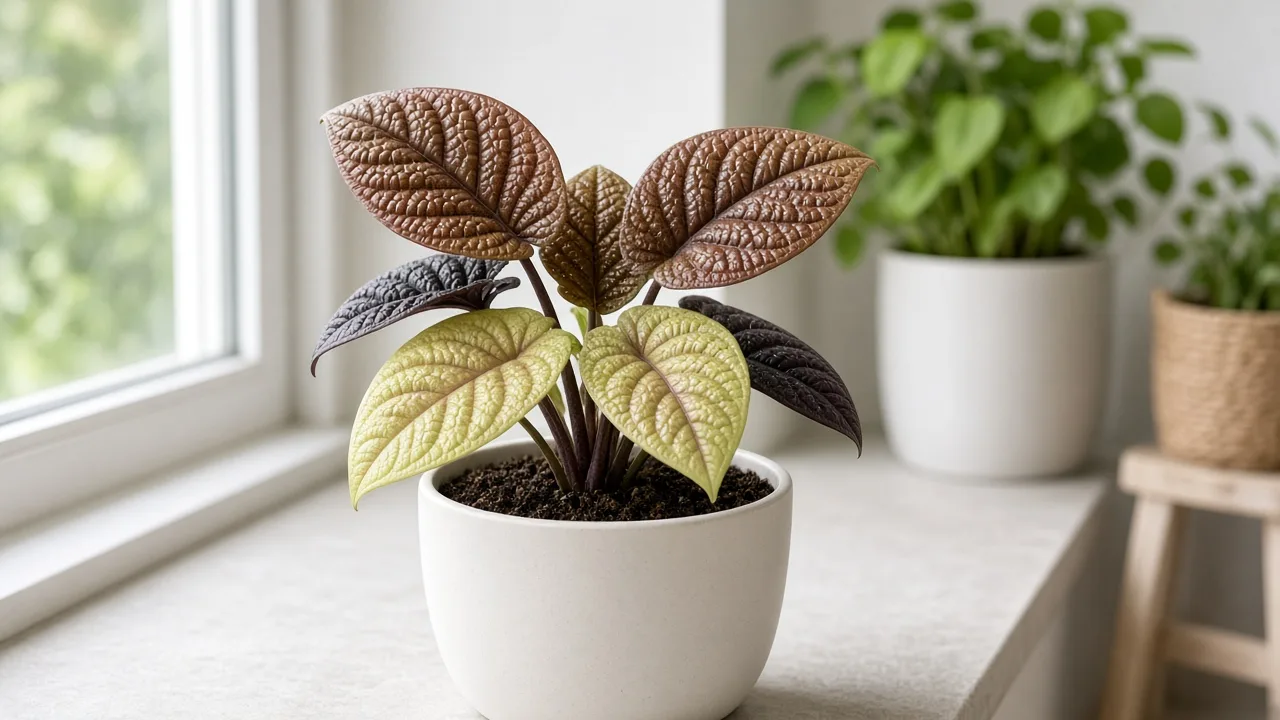
Nitrogen Deficiency on Alocasia Cuprea: Causes, Checks & Fixes
This guide covers nitrogen deficiency on Alocasia Cuprea. See also the general Nitrogen Deficiency guide, watering, and light pages for this plant.
Nitrogen Deficiency on Alocasia Cuprea: Causes, Checks & Fixes
Quick answer
Nitrogen deficiency on Alocasia Cuprea (Alocasia cuprea, Mirror Plant or Red Secret) shows as uniform pale green or yellow on the lowest, oldest mirror leaves while newer copper-bronze crown foliage stays relatively normal. Nitrogen is mobile in the plant, so the plant pulls it from older tissue first—deficiency symptoms show up on lower leaves before the crown washes out.
See our nitrogen deficiency guide for general macronutrient mechanics. On Alocasia Cuprea, inspect the bottom bullate blade on the shortest petiole first—it fades evenly while the rippled mirror leaves above keep metallic copper sheen and dark purple undersides.
First step: confirm bottom-up uniform yellowing on firm—not mushy—roots and corm, then rule out iron chlorosis on new crown leaves before feeding.
When to use this page vs other Alocasia Cuprea guides
| Pattern | Read next |
|---|---|
| Lowest old mirror leaves pale uniformly, crown copper-bronze | Nitrogen deficiency (this page) |
| New crown mirror leaf yellow with green veins | Iron deficiency |
| Interveinal yellow on old mid-stem leaves | Magnesium deficiency |
| Yellow lower leaves on wet mix, soft stem base | Overwatering or root rot |
| Whole plant washed-out in a dim corner | Not enough light or pale leaves |
| One or two lowest leaves yellow, otherwise healthy | Natural senescence or yellow leaves |
| Winter leaf drop with firm corm, bare pot | Dormancy per fertilizer guide—not nitrogen |
What nitrogen deficiency looks like on Alocasia Cuprea
Alocasia Cuprea carries upright bullate mirror leaves flushed copper-bronze above with a dark purple underside on a slow-growing corm-based crown. Healthy plants often hold only one to three leaves at a time. When nitrogen runs low, the oldest lowest mirror blade loses its metallic colour first—uniform pale green or yellow across the whole leaf—while blades on shorter newer petioles above may still look normally copper.
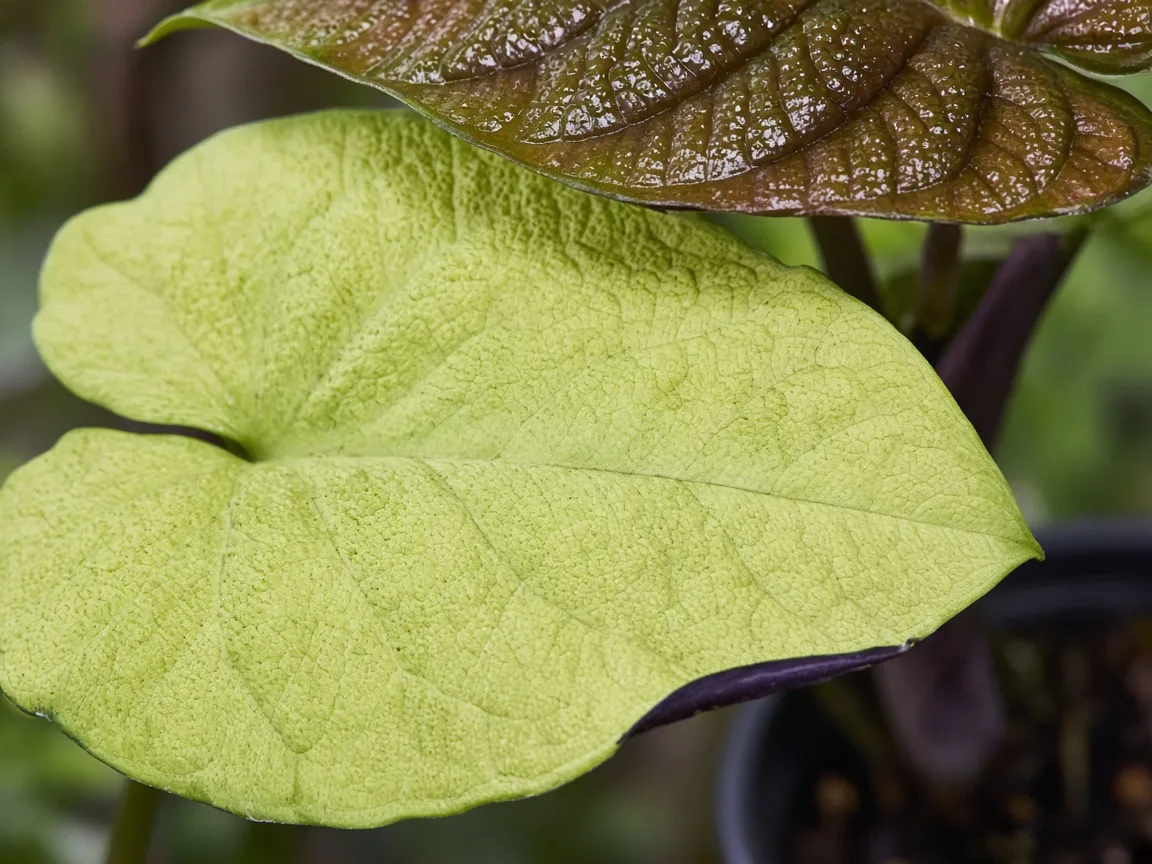
Uniform pale chlorosis on the lowest Alocasia Cuprea mirror leaf—the whole bullate blade washes out evenly while newer copper-bronze crown foliage above stays darker.
Typical signs:
- Uniform pale green or yellow on the lowest, oldest mirror leaf (nitrogen deficiency symptoms show up first on lower leaves)
- Newer crown leaves still copper-bronze with normal dark purple undersides
- Smaller or thinner new spears when deficiency has persisted through a growing season
- Firm corm and white roots if the root zone is healthy—unlike soft mushy tissue on wet mix
- Slow extension between new mirror leaves despite bright indirect light
- Progressive washout on the lowest leaf over months without feed in the same depleted pot
Not nitrogen deficiency:
- Yellow new mirror leaves with dark green veins at the crown — iron deficiency
- Interveinal yellowing with green midribs on older mid-stem leaves — magnesium deficiency
- Soft yellow leaves on soggy mix with mushy petioles — overwatering
- Washed-out green across many leaves with long weak petioles — pale leaves or not enough light
- All leaves yellow on persistently wet soil — root rot overlap
- Every leaf drops in winter with a firm corm below — dormancy, not feed shortage
Mobile nutrients like nitrogen show symptoms on older leaves first, while immobile nutrients such as iron affect new growth directly. On this slow jewel alocasia, the pattern is easiest to read on the single lowest mirror blade before the crown loses colour.
Why Alocasia Cuprea gets nitrogen deficiency
Alocasia Cuprea is a slow-growing tropical aroid that needs bright indirect light and careful feeding during active growth. Each new mirror leaf demands nitrogen for chlorophyll. In a container, bark-perlite mix does not replenish nitrogen the way garden soil does—depletion is gradual but real even on a light feeder.
Alocasia Cuprea-specific causes:
- Skipped feeds because growth is slow — Owners treat Cuprea as a zero-fertilizer plant for 12–24 months. Slow spring spear production still drains nitrogen from the lowest leaf.
- Depleted chunky aroid mix in a snug pot — A plant in the same bark-perlite container 18–24 months without repot or feed exhausts available nitrogen even when crown leaves look dramatic.
- Winter rest without spring resume — Feeding stopped through dormancy and never restarted when the first new spear hardens in spring per the fertilizer guide.
- Confusion with overwatering — Yellow lower leaves on wet mix with soft stem base is root stress, not nitrogen shortage. NC State Extension recommends moist, well-drained soil—the key is drained, not saturated.
- Salt crust misread as deficiency — Excess fertilizer can also yellow older leaves with brown crispy margins. White rim crust means flush and pause feed, not more nitrogen.
- Dim light masking the diagnosis — Low light produces small pale leaves everywhere. If only the lowest blade fades on otherwise copper crown foliage in a bright spot, nitrogen is more likely than a light problem alone.
Do not diagnose nitrogen deficiency on sour wet soil with a soft stem base—that is corm failure from chronic saturation until you unpot and see mostly white firm roots.
Copper mirror ageing vs nitrogen fade: read the lowest blade
Cuprea’s metallic copper-bronze mirror finish develops as each new spear hardens. Per the RHS Alocasia cuprea profile, young leaves emerge flushed red and mature to copper-bronze above with a dark purple underside. A single lowest leaf yellowing after months in the same pot is often nitrogen redistribution, not the normal red-to-copper hardening sequence.
Nitrogen fade shows as uniform washout across the entire oldest mirror blade—the bullate texture stays, but the copper sheen dulls to pale green or yellow. The leaf above on a shorter petiole still looks normally metallic. Worry when two or more bottom leaves wash out through a warm growing season while new spears stay small, not when one old blade yellows before dormancy.
Compare leaf position, not colour alone. A pale new crown spear with green veins is iron deficiency. A pale lowest leaf with a copper crown above fits nitrogen. If the whole plant—including newer leaves—looks uniformly washed out without a clear bottom-first pattern, start with the light guide and pale leaves page before feeding.
Corm dormancy and the empty pot: not nitrogen deficiency
Alocasia Cuprea grows from a thick underground corm that stores energy through seasonal slowdowns. In autumn and winter, shorter days and cooler rooms often trigger full dormancy: every leaf yellows and drops, leaving bare mix with a firm corm below.
Nitrogen deficiency is different: the corm remains firm, roots are white, and new crown leaves still emerge during warm months—but the lowest mirror blade on an otherwise leafy plant washes out evenly while upper blades stay copper. If every leaf yellows and the stem base softens on wet mix, treat overwatering or root rot first, not macronutrients.
Press the soil line gently with a gloved finger. A firm corm with one pale lowest leaf in spring or summer supports a light nitrogen fix. A mushy base on constantly damp mix means root failure regardless of leaf pattern. Hold all fertilizer through winter dormancy until new spears return per watering guidance.
Light feeder paradox: slow growth still depletes nitrogen
Cuprea is marketed as a jewel alocasia that needs little fertilizer—which is half true. It is salt-sensitive and should never receive full-strength pours on a calendar, but zero feeding for years in the same bark-perlite pot still exhausts nitrogen. The plant compensates by stripping chlorophyll from the oldest mirror leaf while keeping newer tissue greener.
This slow grower may take four to eight weeks between new spears in average home conditions. That pace makes deficiency easy to miss: one pale bottom leaf can sit for months before the next crown leaf also shrinks. Pair light feeding with the chunky aroid mix and top 2–3 cm dry-down rhythm from the watering guide—fertilizer cannot fix wet, oxygen-poor roots.
Lookalike symptoms
| Pattern | Check | Likely cause |
|---|---|---|
| Lowest old mirror leaf pale uniformly | Bottom-up fade | Nitrogen deficiency (this page) |
| New crown mirror leaf yellow, green veins | New vs old tissue | Iron deficiency |
| Interveinal yellow on old mid-stem leaves | Mid-stem pattern | Magnesium deficiency |
| Yellow lower leaves on wet heavy pot | Corm feel, soil moisture | Overwatering |
| Whole plant washed out in dim room | Light level | Not enough light |
| Brown crispy margins + salt crust | Pot rim, feed history | Overfertilization—flush, do not add N |
| Fine webbing on leaf undersides | Magnifier | Spider mites |
How to confirm
Work through this checklist before fertilizer, repotting, and watering changes in the same week:
- Old vs new leaf pattern — Uniform pale green or yellow on the lowest mirror leaf; newer crown blades still copper-bronze with dark purple undersides.
- Dormancy ruled out — Firm corm with active new growth in spring/summer; winter bare pot without a single pale bottom leaf on an otherwise leafy plant is dormancy.
- Root and corm inspection — White firm roots and firm corm support nutrient fixes; brown mushy roots need drainage first.
- Soil moisture halfway down — Wet many days after watering on a heavy pot points to overwatering, not nitrogen alone.
- Fertilizer history — No balanced feed in 6–12+ months during active growth?
- Growing medium age — Same bark-perlite mix 18+ months without repot or feed?
- Salt crust — White rim suggests flush before any feed, not more nitrogen.
Nitrogen deficiency causes general yellowing that appears first on lower leaves. If soil is wet throughout, the stem base softens, and roots are mostly mushy, treat as confirmed overwatering or root rot—not a mild nitrogen-only case.
First fix for Alocasia Cuprea
Water lightly so the top 2–3 cm of chunky mix is evenly moist—not bone dry, not soggy—then apply one half-strength balanced liquid fertilizer drench with excess draining freely.
This single step addresses depleted nitrogen without stacking repotting, full-strength feed, and chelated iron on the same day. Wait about four weeks before the next feed during active growth.
Only feed when the corm is firm, roots are white, and the plant is pushing or has recently hardened a new spear in spring or summer. Do not fertilize during winter dormancy, on waterlogged roots, or on a plant that has not been watered in weeks—moisten the mix first per the watering guide.
Step-by-step recovery
- Rule out overwatering — Confirm top 2–3 cm dry-down rhythm and firm corm; fix drainage before feeding a stressed plant.
- Apply one half-strength balanced feed to moist mix during active growth per the fertilizer guide.
- Flush salts if white crust rings the pot rim—leach with plain water before resuming dilute feed.
- Repot into fresh chunky aroid mix in a snug pot if roots fill the container and old bark has compacted—see soil guide and repotting guide for spring timing only.
- Monitor the next two crown spears for larger, darker copper blades.
- Confirm bright indirect light if every new blade stays tiny and pale without a clear bottom-first pattern—see light guide.
- Resume light feeding every four to six weeks only while new hardened leaves appear—not through dormancy.
Recovery timeline
The currently pale lowest mirror leaf rarely re-greens to full copper-bronze once it has washed out. The next one or two crown leaves after one corrected half-strength feed usually emerge darker and slightly larger within four to eight weeks on firm roots—slower than fast Alocasia × amazonica hybrids because Cuprea pushes new tissue less often.
Severe corm damage from chronic overwatering may delay recovery a full growing season. If successive crown spears stay small and pale despite complete feed and stable care, inspect roots for rot before increasing fertilizer strength.
Mistakes to avoid
- Do not confuse dormancy leaf drop or one old lower leaf yellowing before winter with nitrogen deficiency—check for uniform bottom-first fade on an otherwise active plant in warm months.
- Do not heavy-feed a plant on wet soil—fix drainage and corm health before macronutrient drenches.
- Do not expect the current pale lowest blade to re-green—judge the next crown spear unfurl.
- Do not stack repotting, corm division, and full-strength feed the same week on a stressed plant.
- Do not feed during winter dormancy when the corm is resting—resume at half strength only after spring growth returns.
- Do not treat every yellow lower leaf as nitrogen—old-leaf yellowing on wet mix is usually overwatering, not bottom-up fade on firm roots.
- Do not mistake new crown green-vein chlorosis for nitrogen trouble—that is iron deficiency.
Prevention
- Feed lightly with complete balanced fertilizer at half strength during active growth per the fertilizer guide.
- Maintain consistent top 2–3 cm dry-down per the watering guide.
- Refresh depleted chunky mix every 18–24 months when roots crowd the pot per repotting guide—stay snug, not oversize.
- Flush white salt crust periodically if you use hard tap water or feed heavily.
- Inspect the lowest mirror leaf monthly during spring and summer—early uniform fade is easier to correct than a stunted crown.
- Do not assume slow growth eliminates fertilizer need—light, regular feeds beat starvation in the same depleted pot.
Related Alocasia Cuprea guides
- Alocasia Cuprea overview
- Alocasia Cuprea problems hub
- Alocasia Cuprea fertilizer
- Alocasia Cuprea watering
- Alocasia Cuprea soil
- Iron deficiency — new crown leaves yellow with green veins
- Magnesium deficiency — interveinal yellow on older leaves
- Pale leaves — washed-out foliage in dim light
- Yellow leaves — moisture-first diagnosis when causes overlap
Use the Fertilizer Dilution Calculator to work out a safe half-strength dose before changing multiple variables at once.
Conclusion
Uniform pale green or yellow on the lowest Alocasia Cuprea mirror leaf while crown foliage stays copper-bronze points to nitrogen depletion in older tissue—confirm the bottom-first leaf pattern, distinguish dormancy and iron chlorosis from macronutrient fade, stabilize watering on a firm corm, apply one half-strength balanced feed to moist mix during active growth, and judge recovery by the next crown spear unfurling with darker metallic colour.