Yellow Leaves on Alocasia Frydek: Causes, Checks & Fixes
Quick answer
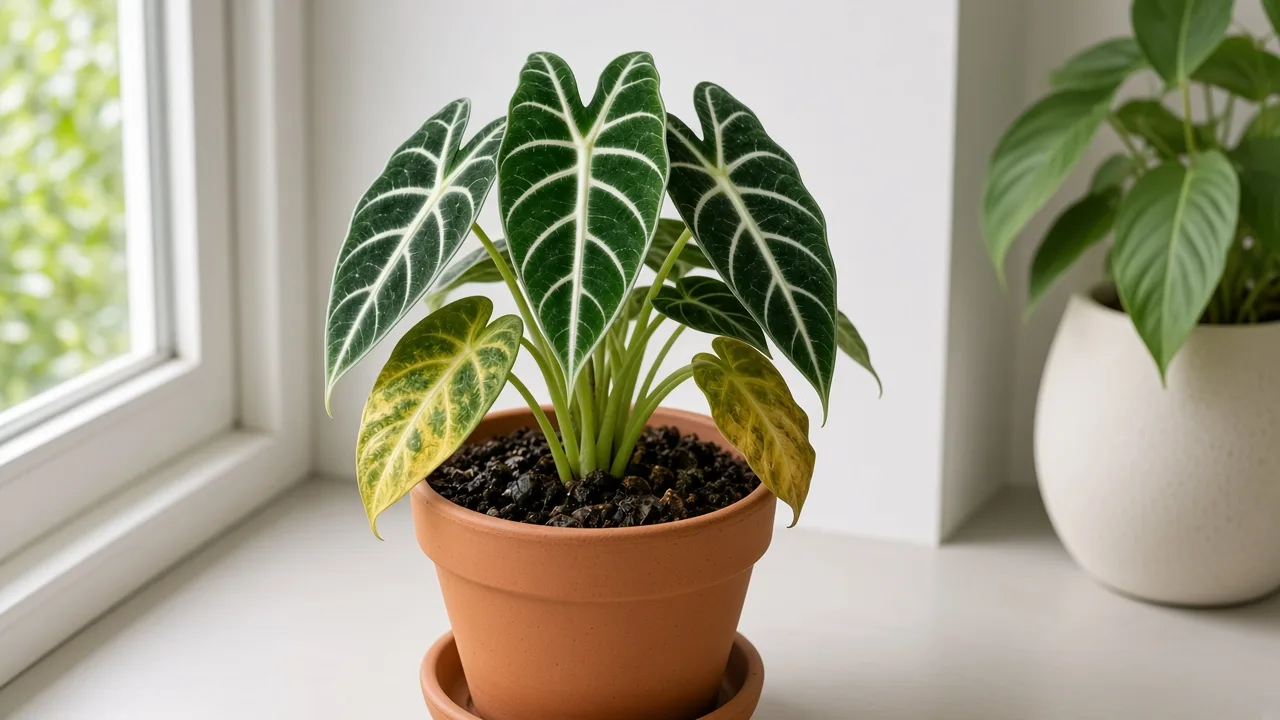
Yellow leaves on Alocasia Frydek are often normal when one oldest velvet blade yellows while a dark new spear unfurls above—but bottom-up yellow on wet, heavy mix usually means overwatering or root stress. First step: lift the pot and probe the top 2–3 cm of mix before watering, repotting, or feeding.
Yellow Leaves on Alocasia Frydek: Causes, Checks & Fixes
This guide covers yellow leaves on Alocasia Frydek. See also the general Yellow Leaves guide, watering, and light pages for this plant.
Yellow Leaves on Alocasia Frydek: Causes, Checks & Fixes
Quick answer
Yellow leaves on Alocasia Frydek split into two very different stories. One oldest velvet arrow leaf turning chartreuse while a dark new blade with crisp white veining unfurls above is normal senescence—Frydek holds only a small fan of leaves at a time. Bottom-up yellow on wet, heavy mix usually means the underground corm and roots are stressed by oversaturation, not hunger. For how chlorophyll loss works in general, see our yellow leaves guide. On Frydek, lift the pot and probe the top 2–3 cm of mix before you water, repot, or fertilize.
First step: check moisture at the root zone, not the leaf color alone. A heavy pot with damp depth and limp lower petioles points to overwatering; a light pot with dry mix and sagging velvet blades points to underwatering.
When to use this page vs other Frydek guides
| What you see | Read next |
|---|---|
| One or two lowest leaves yellow, crown green, firm corm | Yellow leaves (this page)—often normal aging |
| Bottom-up yellow on wet, heavy pot | Overwatering or root rot |
| Yellow edges on dry mix, light pot | Underwatering |
| Pale wash across many leaves in a dim corner | Not enough light or pale leaves |
| Oldest lower blades fade evenly, firm corm | Nitrogen deficiency |
| New crown leaf yellow with green veins | Iron deficiency |
| Fine speckles and webbing on undersides | Spider mites |
| Winter leaf drop, bare pot, firm corm | Dormancy—reduce water per fertilizer guide |
What yellow leaves look like on Alocasia Frydek
Healthy Frydek carries four to six dark green velvet arrow blades with bright white veining on stiff upright petioles in a 40–60 cm fan. Yellowing breaks that silhouette in patterns that tell you which guide to open next.
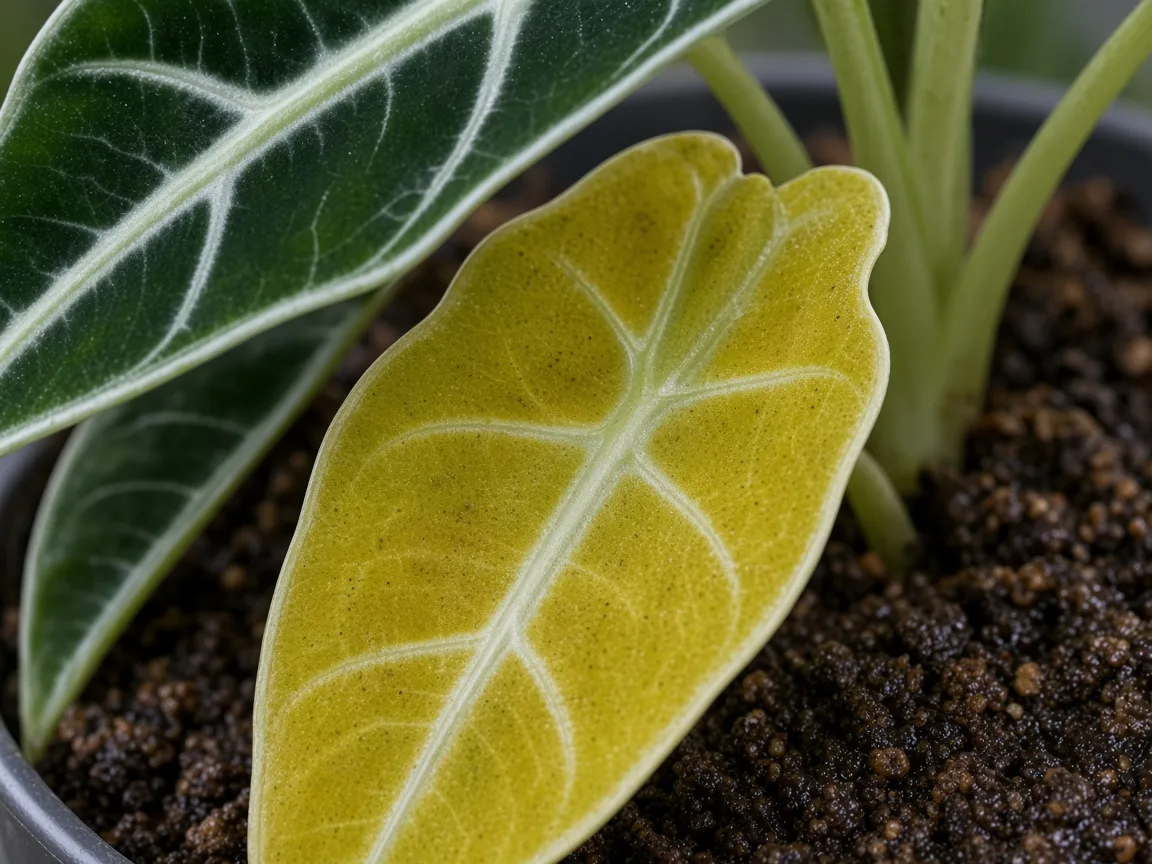
Oldest lower velvet leaf turning chartreuse while the crown blade above stays dark green—classic Frydek senescence when mix moisture is appropriate.
Normal senescence (one bottom leaf). The lowest velvet blade softens to chartreuse or yellow, white veining dulls to flat gray-green, and the petiole may lean outward. Meanwhile the crown pushes a new dark spear with crisp vein contrast. The corm feels firm when pressed at the soil line. Older leaves naturally turn yellow and die as new leaves emerge on alocasias—Frydek does this aggressively because it keeps so few leaves at once.
Wet-soil yellow (multiple lower leaves). Two or more lower blades yellow from the bottom up while mix at depth stays dark and cool. Petioles feel limp even though you watered recently. The pot stays heavy for days. Yellowing leaves can occur from overwatering when roots lose function in oxygen-poor mix—leaves lose color despite wet soil.
Dry-soil yellow (lower leaves first). When mix dries completely for too long, lower velvet blades yellow at edges or uniformly before the crown collapses. The pot feels light. Frydek despises drying out completely and typically yellows lower leaves first when underwatered—distinct from one-leaf aging on appropriate moisture.
Light-stress yellow. In a dim winter corner, several leaves may fade to olive or chartreuse without wet mix or dry collapse. Reduced light slows growth and can cause leaves to yellow on alocasias even when watering rhythm looks unchanged. Long petioles and small new blades often accompany this pattern—see not enough light.
Dormancy yellow. Late autumn through winter, Frydek may yellow and drop leaves one by one—or lose the entire visible fan—while the corm below stays firm. Alocasias may lose foliage during winter dormancy without indicating death. Do not read bare mix as a call to flood the pot.
The Frydek leaf-fan rule
Unlike bushy pothos or philodendrons, Frydek maintains a tight rosette of velvet arrows on an underground corm. Each new crown leaf often retires an older lower blade. That turnover looks alarming if you expect six perfect leaves year-round—but on Frydek, one yellow bottom leaf with healthy crown growth is the default rhythm during active seasons.
Worry when:
- Yellow climbs to young crown leaves within days
- Multiple lower blades yellow simultaneously on wet mix
- New spears emerge pale, small, or distorted—not just one old leaf fading
- The corm softens, mix smells sour, or petiole bases turn mushy
Why Alocasia Frydek gets yellow leaves
Overwatering and root stress (most common widespread yellow)
Chronic saturation around the corm is the top cause when several lower velvet leaves yellow on wet mix. Roots in waterlogged soil may die because they cannot absorb oxygen, so leaves yellow despite damp soil—owners often add more water because petioles look limp. Oversized cachepots, dense peat-heavy mix, and calendar watering in winter all accelerate this on Frydek’s fast-rotting corm.
Normal aging in a small leaf fan
Frydek simply does not hold a deep stack of foliage. Retiring one oldest blade while unfurling a new dark spear is efficient, not failure. Trim the fully yellow petiole at the base once it is more than half chartreuse if it bothers you—or let the plant reabsorb nutrients until it drops naturally.
Underwatering after dry-down
Complete dry-out yellows lower leaves first, sometimes with crispy edges on the same blade. Frydek stores water in its corm but still needs regular moisture during active growth. A light pot and dusty dry top 2–3 cm confirm thirst—not the same as wet-soil yellow.
Low light, especially in winter
Short days reduce photosynthesis. Several leaves may fade together without root rot. Move toward brighter filtered light per the light guide before increasing fertilizer.
Dormancy and the empty-pot trap
Cooler, drier winter conditions trigger partial or full dormancy. Lower leaves yellow and drop; the pot may look empty. Overwatering during dormancy can cause roots to rot—the worst response to yellowing is flooding an already stressed corm.
Nutrient deficiency (less common than moisture)
Progressive fading of oldest lower blades on firm corm and appropriate moisture may indicate nitrogen deficiency. New crown leaves yellow with green veins point to iron deficiency instead. Do not feed a stressed Frydek on wet mix before confirming the pattern.
Pests and lookalikes
Spider mites cause stippled yellow speckles with fine webbing—not uniform chartreuse senescence. Aphids and mealybugs may yellow young growth through sap loss; check sticky residue and leaf undersides before assuming a watering mistake.
How to confirm the cause
Work through these checks in order:
- Count and position — One lowest leaf yellow, crown green? Likely senescence. Multiple lower leaves on wet mix? Root stress first.
- Top 2–3 cm moisture — Damp depth with yellow lower leaves confirms oversaturation; bone-dry with limp petioles confirms underwatering.
- Pot weight — Heavy, cool pot days after watering means slow dry-down.
- Corm firmness — Press gently at the soil line. Firm corm with early yellow is recoverable; soft or sour corm means root rot.
- New growth quality — Dark new spear with white veins = stable. Pale, small, or rapidly yellowing crown leaves = escalate.
- Season and light — Winter dormancy or dim placement explains fade without rot.
- Pest scan — Webbing, stickiness, or crawling insects on velvet undersides.
Lookalike symptoms
| What you see | Likely cause | Where to go |
|---|---|---|
| One bottom leaf yellow, dark new spear above | Normal senescence | Stay on this page |
| Bottom-up yellow on wet, heavy pot | Overwatering | Overwatering |
| Yellow lower leaves, light pot, dry top 2–3 cm | Underwatering | Underwatering |
| Several leaves olive-yellow in dim room | Low light | Not enough light |
| Gradual fade of oldest lower blades, firm corm | Nitrogen deficiency | Nitrogen deficiency |
| New leaf yellow with green veins | Iron deficiency | Iron deficiency |
| Stippled yellow with webbing | Spider mites | Spider mites |
| Soft corm, sour smell, mushy petioles | Root rot | Root rot |
First fix for Alocasia Frydek
Lift the pot and probe the top 2–3 cm of chunky mix before changing anything else. Do not fertilize, repot, and prune on the same day while leaves are yellowing.
- If mix is wet and heavy with bottom-up yellow → stop watering until the top 2–3 cm dries; see overwatering for the full dry-down path.
- If mix is dry and light with limp lower leaves → water thoroughly once, discard runoff within 30 minutes, then resume the top 2–3 cm dry-down rhythm.
- If one bottom leaf yellows on appropriate moisture with a firm corm and healthy crown spear → no rescue needed; optionally trim the spent blade.
- If winter dormancy with firm corm → reduce water to every 2–4 weeks; do not flood.
Make this single correction first and wait one to two weeks before stacking secondary fixes.
Step-by-step recovery
Normal senescence (one bottom leaf)
- Confirm crown growth is dark green with crisp white veining.
- Verify corm is firm and mix moisture matches the watering guide.
- Trim the fully yellow petiole at the base if desired, or let the plant drop it naturally.
- Resume normal care—no fertilizer boost required.
Wet-soil yellow (early overwatering)
- Stop watering until the top 2–3 cm of mix dries.
- Empty cachepots and saucers; confirm drain holes are open.
- Move slightly brighter if the plant sits in deep shade—slow evaporation worsens wet feet.
- When dry-down is confirmed, water once thoroughly and discard all runoff.
- If yellow keeps climbing after one week, inspect roots per root rot.
Dry-soil yellow
- Water thoroughly until a small amount drains; discard runoff within 30 minutes.
- Do not leave Frydek bone-dry for weeks during active growth—it triggers dormancy.
- Resume watering only when the top 2–3 cm dries again—not on a fixed calendar.
Light-stress yellow
- Move to bright indirect light (roughly 10,000–20,000 lux)—see light guide.
- Avoid hot direct afternoon sun on velvet foliage.
- Adjust watering to match faster transpiration in brighter placement.
Nutrient-related yellow
- Confirm moisture and corm health first.
- Match pattern to nitrogen or iron deficiency guides.
- Feed only during active growth with half-strength complete fertilizer per the fertilizer guide—never on a dormant or rot-stressed plant.
Recovery timeline
| Stage | What improvement looks like | Typical timeframe |
|---|---|---|
| Normal senescence | One old leaf drops; next crown spear stays dark | Ongoing seasonal turnover |
| Early wet-soil yellow | Yellow spread stops; pot weight drops | 3–7 days after stopping water |
| Corrected underwatering | Lower yellow does not climb; petioles firm after drink | 2–5 days |
| Light adjustment | New leaves emerge darker and larger | 2–4 weeks |
| Root stress rescue | Small new velvet leaf with crisp veining | 2–6 weeks if corm stayed firm |
Old yellow velvet blades rarely re-green. Judge progress by new growth with crisp white vein contrast, not by forcing every damaged lower leaf back to perfect green.
What not to do
- Watering limp velvet foliage when soil is already wet—the classic Frydek rot accelerator.
- Flooding a dormant, leafless pot in winter trying to force spring growth.
- Fertilizing yellow leaves before confirming moisture, light, and corm firmness.
- Removing every yellow blade at once when the plant still needs foliage for photosynthesis—except fully spent senescent leaves.
- Moving an oversaturated plant to a darker corner “to rest”—low light slows evaporation.
- Mistaking one bottom-leaf senescence for root rot and repotting unnecessarily.
- Stacking repot, prune, and pesticide on the same day while the corm is stressed.
How to prevent yellow leaves on Alocasia Frydek
Water when the top 2–3 cm of chunky aroid mix has dried—not on a fixed weekly schedule. Use well-draining mix in a pot sized to the corm with open drainage; review the soil guide if mix stays wet too long.
Give Frydek bright indirect light so it uses water predictably. Maintain 60–80% humidity with a humidifier rather than misting velvet leaves. Reduce watering 60–70% during dormancy. Feed at half strength only during active growth.
Accept that one retiring lower leaf is normal in Frydek’s small fan—chasing perpetual full green on every blade fights the plant’s growth habit.
When to worry
Seek aggressive action—not another routine watering—when:
- Yellow climbs quickly to crown leaves while soil stays wet.
- The corm feels soft or smells sour.
- Petiole bases turn mushy and detach in clusters.
- Most roots are brown and slimy on inspection.
- New growth stops entirely through spring while the corm softens.
If the corm is firm and only one bottom leaf yellows on appropriate moisture, patience—not panic—is usually correct.
Alocasia Frydek care cross-check
Yellow leaves rarely appear without a setup clue:
- Watering rhythm — Calendar watering in winter is the top widespread-yellow cause.
- Pot and cachepot — Decorative outer pots without drainage recreate chronic wet feet.
- Mix — Dense peat holds water at the corm; chunky bark mix dries predictably.
- Light — Dim corners slow dry-down and fade foliage together.
- Dormancy — Empty-looking pots need less water, not rescue floods.
- Leaf fan habit — One bottom yellow with crown growth is often normal senescence.
Related Alocasia Frydek guides
- Alocasia Frydek overview — light, humidity, dormancy, and velvet leaf care baseline
- Alocasia Frydek watering — top 2–3 cm dry-down and pot-weight checks
- Overwatering on Alocasia Frydek — wet-soil yellow and corm rescue
- Root rot on Alocasia Frydek — mushy corm, soft petioles, sour smell
- Underwatering on Alocasia Frydek — dry-soil yellow and limp petioles
- Not enough light on Alocasia Frydek — olive fade in dim corners
- Alocasia Frydek problems — browse all common issues on this species
Conclusion
Yellow leaves on Alocasia Frydek are a pattern-reading exercise, not a single diagnosis. One bottom velvet blade fading while a dark new spear unfurls above is often normal turnover in a plant that holds only a few leaves at a time. Bottom-up yellow on wet, heavy mix demands a moisture correction before fertilizer or repotting. Lift the pot, confirm corm firmness, match the pattern to the right sibling guide, and judge recovery by the next crown leaf—not by re-greening tissue that has already yellowed.
Related tool
Use the Yellow Leaves Diagnosis Tool to narrow causes for yellow leaves on this plant before changing multiple variables at once.