Calcium Deficiency on Alocasia Stingray: Causes, Checks &
Quick answer
Calcium deficiency on Alocasia Stingray shows as cupped, hood-like, or margin-burned round ray-tail leaves on the newest upright flush while older glossy blades on red-mottled petioles may stay normal. First step: confirm damage is on the softest unfurling ray-tail—not thrips scarring or low-humidity crisping—and check whether soft water and skipped complete fertilizer have limited calcium uptake during active summer growth.
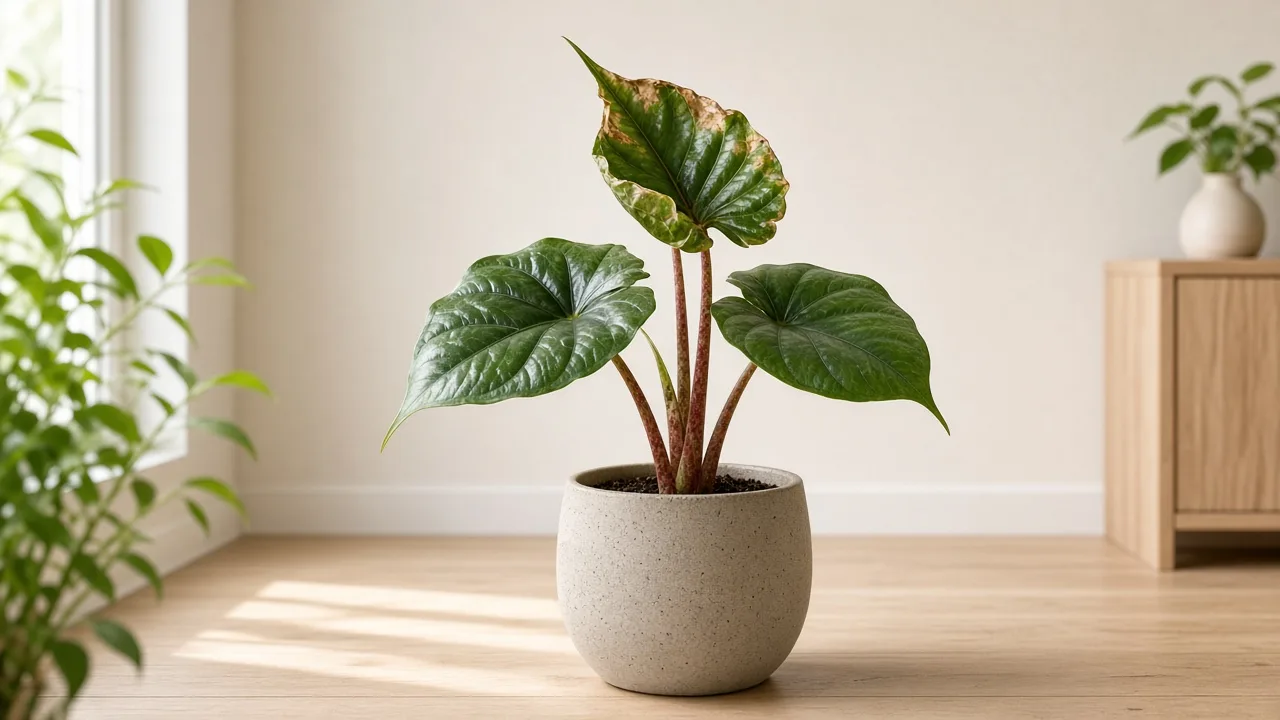
Calcium Deficiency on Alocasia Stingray: Causes, Checks & Fixes
This guide covers calcium deficiency on Alocasia Stingray. See also the general Calcium Deficiency guide, watering, and light pages for this plant.
Calcium Deficiency on Alocasia Stingray: Causes, Checks & Fixes
Quick answer
Calcium deficiency on Alocasia Stingray (Alocasia macrorrhizos ‘Stingray’) shows as cupped, hood-like, or margin-burned round ray-tail leaves on the newest upright flush while older glossy blades on red-mottled petioles may look normal. Calcium is plant-immobile, so deficiency appears on young expanding tissue first—not on mature lower leaves the way nitrogen deficiency does.
See our calcium deficiency guide for general new-tissue distortion mechanics. On Stingray, inspect the softest round ray-tail blade still unfurling from its upright stalk—cupped margins, uneven width, or necrotic edges there point to calcium before magnesium, which hits older mid-canopy foliage.
First step: confirm cupped or margin-burned tissue on the newest expanding ray-tail, not silver-streaked thrips damage or uniform brown crisping from dry air.
When to use this page vs other Stingray guides
| Pattern | Read next |
|---|---|
| New ray-tail cupped or margin-burned | Calcium deficiency (this page) |
| Puckered or twisted unfurl on new tips | Distorted leaves or Thrips |
| New ray-tail yellow with green veins | Iron deficiency |
| Yellow between veins on older blades | Magnesium deficiency |
| Pale lower old blades without tip cupping | Nitrogen deficiency |
| Brown scorched margins on old blades | Potassium deficiency or Brown tips |
| Yellow lower leaves on wet mix | Overwatering or Root rot |
| Long bare petioles, small weak blades | Leggy growth or Not enough light |
What calcium deficiency looks like on Alocasia Stingray
Stingray carries round, glossy blades that taper to an elongated ray-tail on upright red-mottled petioles—a much larger floor aroid than compact jewel alocasias. Healthy new ray-tails emerge glossy and flat, widening evenly as the pointed tail extends. Calcium supports cell wall formation in expanding tissue, so when uptake fails, the newest ray-tail still opening shows damage while older canopy often looks fine.

Newest round ray-tail at the crown with inward cupping and tan necrotic edge spots—older glossy blades on upright stalks below may look normal.
Typical signs:
- Inward cupping or hood-like curling on the margin of the newest ray-tail before it fully hardens
- Small tan or brown necrotic spots along the expanding margin or near the petiole junction
- Narrow or stunted new ray-tail compared with the prior spear on the same plant
- Center of the round blade expands while edges stay tight, leaving a rippled or puckered profile
- Older lower ray-tail leaves on the same plant may look completely normal and glossy
- Firm corm and white roots if the root zone is healthy; mushy petiole base on wet mix suggests rot instead
Not calcium deficiency:
- Silver streaks, black specks, or sticky honeydew on soft new growth—Thrips or Aphids (distorted leaves covers unfurling pest scarring)
- Uniform brown crisp edges across many open blades in dry winter air—Low humidity or Brown tips
- Pale lower old blades without tip distortion—Nitrogen deficiency
- New ray-tail yellow with dark green veins—Iron deficiency
- Interveinal yellowing on older mid-canopy blades—Magnesium deficiency
- Uniform pale wash on many open blades—Pale leaves from light or general stress
- Yellow stems on persistently wet soil—Overwatering or Root rot
Why Alocasia Stingray gets calcium deficiency
Stingray is a fast-growing macrorrhizos cultivar that can produce a new leaf on a weekly basis in warm bright summer conditions per the RHS Alocasia growing guide. Each large ray-tail demands calcium for rigid cell walls in that wide glossy blade. Very soft water, incomplete fertilizer, depleted chunky aroid mix, or root stress from chronic wet soil limits uptake—and shows on the newest expanding ray-tail while older blades stay healthy.
Stingray-specific causes:
- Distilled or reverse-osmosis water only — Irrigation removes the small calcium contribution tap water normally supplies unless fertilizer replaces it. Owners chasing fluoride-sensitive brown tips sometimes create uptake gaps on a plant pushing large summer leaves fast.
- Skipped complete fertilizer during active growth — The RHS recommends feeding alocasias with a general liquid fertilizer during the growing season from April to October. A Stingray in bright summer light without any complete feed for a full season can exhaust available calcium even when blades look glossy.
- Incomplete micronutrient fertilizer — Nitrogen-heavy products expand ray-tail area without calcium for cell wall integrity in those new rows.
- Inconsistent 2–3 cm dry-down — Calcium moves with water through the xylem to the crown growing point. A heavy floor pot sitting wet for weeks in dim light, then drying unevenly, starves the apical spear even when lower tissue absorbed enough for mature blades. Match water to how fast the mix dries per the Stingray watering guide.
- Depleted chunky aroid mix — NC State Extension notes alocasias need moist, well-drained soil. Bark and perlite that started airy compost down over seasons in an unchanged pot; roots stay alive but calcium availability drops until you refresh per the soil guide.
- Root stress blocking uptake — Chronic overwatering in low light is a primary indoor killer on alocasias per Proven Winners and limits calcium transport regardless of what is in the fertilizer bottle.
- Thrips or mite confusion — Thrips and spider mites rasp the softest crown flush and leave permanent ripples. Magnify the newest ray-tail before assuming a nutrient gap.
Ray-tail unfurl and margin cupping on new spears
Stingray allocates calcium to each expanding round blade as a new ray-tail opens from the crown. When uptake fails, the center of the new ray-tail may expand while margins stay stunted—producing cupping, hood-like curling, or cracked edges along the unfurling margin. Calcium is extremely immobile in plants, and NC State calcium deficiency work notes marginal curling on new expanding leaves before older tissue is affected.
That pattern differs from nitrogen or magnesium deficiency, which show on older lower blades first. It also differs from one outer ray-tail yellowing while a green spear unfurls above—a normal aging pattern covered on yellow leaves.
Judge severity by successive crown spears: one slightly wrinkled unfurl after a long dry spell differs from three consecutive cupped ray-tails on stable care. On Stingray, the glossy round blade makes margin burn easy to spot against healthy tissue—look at the softest tip still lighter green, not fully hardened lower canopy.
Fast summer flush vs winter dormancy timing
Stingray can push large ray-tail leaves weekly in warm bright summer but may drop every leaf and rest as a corm below the mix in winter per the RHS Stingray profile, which advises keeping above 15°C and reducing watering to a minimum in winter. Calcium problems surface on isolated summer spears when uptake fails during active growth—not during honest dormancy when no new tissue is forming.
A plant entering winter dormancy with one slightly cupped ray-tail needs reduced watering and no fertilizer, not emergency feeding on bare mix. Resume complete quarter-strength feeding only when spring growth returns per the Stingray fertilizer guide. Dumping full-strength fertilizer on a dormant corm raises salt injury without fixing cell walls in the next spear.
Closing the gap in summer means stable 2–3 cm dry-down per the watering guide and half-strength complete fertilizer every two to four weeks during active growth, not more nitrogen to force wider ray-tails the cell walls cannot support.
Lookalike symptoms
| Pattern | Check | Likely cause |
|---|---|---|
| New ray-tail cupped or margin-burned | New vs old tissue | Calcium deficiency (this page) |
| Silver streaks on new blade | Magnifier on unfurl | Thrips |
| Fine webbing and stippling | Blade undersides | Spider mites |
| Old lower blades pale first | Leaf position | Nitrogen deficiency |
| New ray-tail yellow, green veins | Vein pattern | Iron deficiency |
| Interveinal yellow on old blades | Mid-canopy pattern | Magnesium deficiency |
| Brown crisp edges on many blades | Humidity, season | Low humidity |
| Soft petioles, wet soil, mushy base | Corm and root feel | Overwatering |
How to confirm
- New vs old tissue — Distortion confined to the newest ray-tail while older glossy blades on the same plant look normal strongly suggests calcium.
- Pest inspection — Magnify the softest emerging ray-tail for silver scarring, black specks, webbing, or insects before feeding.
- Water source — Distilled-only or very soft water without calcium listed on the fertilizer label.
- Fertilizer completeness — Micronutrients and calcium on the label vs nitrogen-only products or skipped feed through a full summer flush.
- Corm and root health — Firm corm below the surface and white roots vs brown mush from soggy soil in dim light.
- Watering rhythm — Mix staying wet for weeks, then drying unevenly, interrupts xylem flow to the crown.
- Successive crown spears — Two or more distorted ray-tails in a row on stable care points to uptake failure, not one-time mechanical damage.
First fix for Alocasia Stingray
One half-strength dose of complete balanced fertilizer containing calcium and micronutrients on already-moist mix—only after confirming firm corm roots, stable 2–3 cm dry-down rhythm, and no active thrips or mites on the newest emerging ray-tail.
Do not repot, prune, and triple-feed a recently relocated Stingray the same week. Stabilize watering per the Stingray watering guide first—water when the top 2–3 cm of mix is dry, empty saucer standing water within 30 minutes after each drink.
If you use distilled or reverse-osmosis water exclusively, ensure your feed supplies calcium. Penn State notes calcium deficiency inhibits root tip growth and affects meristems first—water alone will not correct deficiency on a plant pushing a new ray-tail in bright summer light.
Step-by-step recovery
- Rule out thrips and mites with a magnifier on the softest crown ray-tail—treat confirmed pests before fertilizer.
- Apply half-strength complete feed once on moist mix; repeat every two to four weeks through active growth if the next spear responds per the fertilizer guide.
- Maintain consistent 2–3 cm dry-down—uptake fails when roots alternate between saturated and desiccated in an oversize floor pot.
- Repot into fresh chunky aroid mix if roots fill the pot and distortion persists after two measured feeds on healthy corm roots—see Stingray repotting.
- Move the plant away from hot window glass or cold HVAC drafts if mature blades also curl—environmental stress compounds nutrient distortion; see light guide.
- Monitor the next two crown spears—the currently cupped ray-tail rarely straightens; recovery shows on subsequent new growth.
- Flush white salt crust at the pot rim before resuming feeding if buildup blocks uptake—salt accumulation from over-fertilizing indoors causes leaf margin injury on alocasias.
Recovery timeline
The currently cupped ray-tail rarely straightens once cell walls set as the blade hardens. The next one or two summer spears after corrected complete feeding and stable watering usually open with cleaner margins within four to eight weeks on firm corm roots—faster than slow office aglaonemas because Stingray can push new tissue weekly in warm bright conditions.
Severe corm damage from chronic overwatering may delay recovery a full growing season. If successive ray-tails stay cupped despite complete feed and stable care, inspect roots for rot before repeating fertilizer or repotting again.
Mistakes to avoid
- Do not confuse thrips-scarred unfurling tissue with calcium cupping—magnify the softest crown ray-tail first.
- Do not use distilled water without ensuring fertilizer supplies calcium.
- Do not heavy-feed a Stingray on wet soil in low light—fix drainage before fertilizer.
- Do not expect the current cupped ray-tail to flatten—judge the next crown spear unfurl.
- Do not stack repotting, division, and full-strength feed the same week on a stressed plant.
- Do not feed a dormant corm in winter—wait for spring growth per the fertilizer guide.
Prevention
- Feed lightly with complete balanced fertilizer including calcium and micronutrients during active growth per the Stingray fertilizer guide—the RHS recommends general liquid feed from April to October.
- If using soft or distilled water, choose a feed that lists calcium—do not rely on irrigation water alone.
- Maintain consistent 2–3 cm dry-down per the watering guide.
- Refresh depleted chunky aroid mix every one to two years when roots crowd the pot.
- Inspect new ray-tail spears monthly during spring and summer—early margin cupping is easier to correct than a stunted crown.
- Keep the plant in enough bright indirect light for firm glossy blades—not a dark corner where every new ray-tail stays tiny; see light guide.
Related Alocasia Stingray guides
- Alocasia Stingray overview
- Stingray problems hub
- Stingray fertilizer
- Stingray watering
- Stingray soil
- Distorted leaves — thrips, mechanical damage, and unfurl scarring before nutrient gaps
- Iron deficiency — new ray-tail yellow with green veins
- Magnesium deficiency — interveinal yellow on older blades
Use the Fertilizer Dilution Calculator to work out a safe half-strength dose before changing multiple variables at once.
Conclusion
Cupped or margin-burned new ray-tail leaves on Stingray point to calcium uptake failure on expanding tissue—confirm the new-vs-old blade pattern, rule out thrips on the softest crown flush, stabilize 2–3 cm dry-down watering and corm root health, ensure complete fertilizer supplies calcium especially on soft water, and judge recovery by the next summer spear.