Nitrogen Deficiency on Alocasia Stingray: Causes, Checks &
Quick answer
Nitrogen deficiency on Alocasia Stingray shows as uniform pale yellow-green on the oldest lower round ray-tail leaves while newer upright blades stay greener, often with smaller new leaves and washed-out gloss on depleted lower tissue. First step: confirm even chlorosis on the lowest mature leaves—not interveinal banding or new-tip green veins—then check whether the firm corm has gone a full warm season without complete fertilizer in leached chunky aroid mix.

Nitrogen Deficiency on Alocasia Stingray: Causes, Checks & Fixes
This guide covers nitrogen deficiency on Alocasia Stingray. See also the general Nitrogen Deficiency guide, watering, and light pages for this plant.
Nitrogen Deficiency on Alocasia Stingray: Causes, Checks & Fixes
Quick answer
Nitrogen deficiency on Alocasia Stingray (Alocasia macrorrhizos ‘Stingray’) shows as uniform pale yellow-green on the oldest lower round ray-tail leaves while newer upright blades stay greener, often with smaller new leaves and washed-out gloss on depleted lower tissue. Nitrogen is mobile in plants, so deficiency symptoms show up first on the lower leaves as a general yellowing—veins and tissue fade together, unlike magnesium deficiency (interveinal banding on old blades) or iron deficiency (green veins on new crown tissue).
See our nitrogen deficiency guide for general mobile-nutrient mechanics. On Alocasia Stingray, inspect the lowest round ray-tail blades on long red-mottled petioles—even washout there, with the crown still pushing smaller green leaves, is classic nitrogen starvation before wet-corm failure or low-light pale leaves.
First step: confirm uniform pale color on the oldest lower leaves—not interveinal chlorosis or new-tip green veins—then check corm firmness and whether the plant has gone a full warm season without complete fertilizer in leached mix.
When to use this page vs other Alocasia Stingray guides
| Pattern | Read next |
|---|---|
| Uniform pale oldest lower ray-tail leaves, smaller new upright growth | Nitrogen deficiency (this page) |
| Yellow between veins on oldest lower leaves | Magnesium deficiency |
| Yellow new leaf with green veins at crown | Iron deficiency |
| Washed-out green with weak gloss, dim room | Pale leaves or not enough light |
| All leaves yellow on wet heavy pot | Overwatering |
| One bottom leaf only while green ray-tail unfurls above | Normal aging—yellow leaves |
| Cupped or margin-burned newest crown leaf | Calcium deficiency |
| Brown scorched margins on old leaves | Potassium deficiency or brown tips |
| Slow growth without clear lower-leaf wave | Slow growth |
What nitrogen deficiency looks like on Alocasia Stingray
Healthy Alocasia Stingray holds glossy deep-green round blades that taper to an elongated ray-tail on upright red-mottled petioles—a floor specimen that can reach 60–150 cm indoors with individual leaves to 60 cm. Nitrogen stress breaks that pattern on mature foliage lower on the canopy, not with a vein-retained banding pattern.
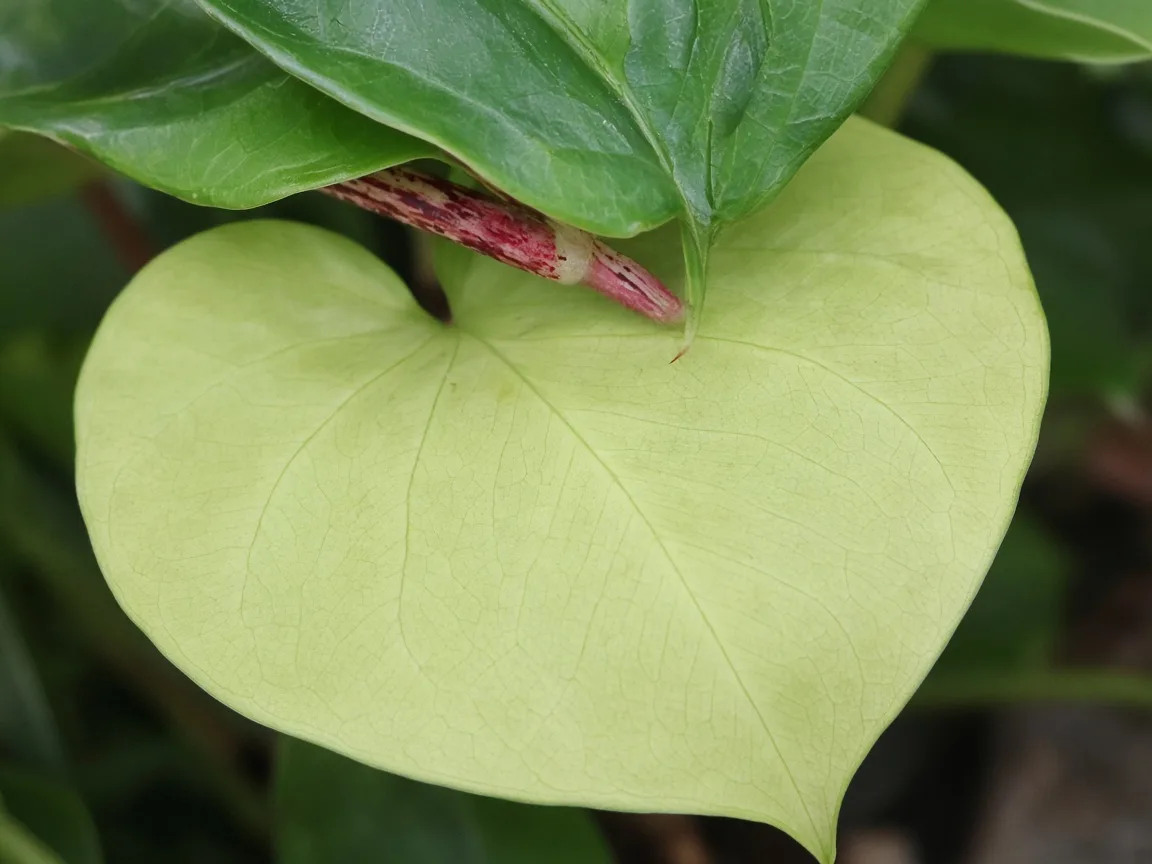
Oldest round ray-tail blade at the base of the upright canopy with uniform pale yellow-green and weak gloss—newer greener blade above still holds more chlorophyll.
Typical signs:
- Uniform pale yellow-green on the oldest lower ray-tail leaves—veins and tissue lose color together
- Progressive climb up the lower canopy over weeks as the plant strips nitrogen from old tissue to fund new upright growth
- Smaller new ray-tail blades and dull gloss on depleted lower tissue
- Thin, papery feel on fully chlorotic lower leaves before they drop
- Firm corm and petioles unlike mushy overwatered Alocasia Stingray on soggy mix
Not nitrogen deficiency:
- Yellow tissue between dark green veins on oldest lower leaves—magnesium deficiency (magnesium deficiency initially develops on lower or older foliage with interveinal chlorosis)
- Yellow new crown leaves with dark green veins at the unfurling center—iron deficiency
- One bottom ray-tail yellow while a green blade unfurls above—often normal senescence; see yellow leaves
- All leaves yellow at once on persistently wet soil—overwatering or root rot
- Uniform washed-out green across the whole canopy with long bare petioles—not enough light before assuming starvation
- Cupped or margin-burned newest crown leaf—calcium deficiency on expanding tissue, not mobile nitrogen loss on old blades
Slow growth and uniform yellowing of older leaves are usually the first symptoms of nitrogen deficiency. On a fast-growing floor Stingray pushing large summer blades, that lower-canopy washout can appear within one season if feed was skipped while the corm expanded in the same pot.
Why Alocasia Stingray gets nitrogen deficiency
Alocasia Stingray is a moderate-to-fast-growing macrorrhizos corm aroid that can push large new ray-tail leaves every one to two weeks in warm bright indoor light. Nitrogen is found in chlorophyll, amino acids, and proteins—when soil reserves run low, the plant dismantles chlorophyll in older ray-tail tissue and redirects nitrogen to the crown growing point.
Alocasia Stingray-specific causes:
- Never fed or skipped seasons—Owners treat elephant ears as “big but low feed” and skip fertilizer for years while the floor plant slowly expands in the same decorative pot.
- Leached chunky aroid mix—Each deep watering through light well-draining Alocasia Stingray soil flushes soluble nitrogen through drainage holes faster than owners replace it.
- Years in the same floor pot—A canopy that has not been repotted in two seasons sits in depleted mix while the corm fills the container; the RHS notes nitrogen is easily washed out of compost by watering.
- Water-only recovery after stress—Owners hold feed after relocation, pest treatment, or dormancy, then forget to resume complete fertilizer through the next warm season.
- Blocked uptake from wet roots—Chronic saturation in a cachepot on a dim shelf prevents absorption even when nitrogen is present; see overwatering before feeding a waterlogged corm.
Do not diagnose nitrogen deficiency on sour wet soil with a soft corm at the soil line—that is root failure until you confirm mostly firm corm tissue and white roots.
Ray-tail gloss fade on the lower floor canopy
Nitrogen deficiency on Alocasia Stingray shows on the oldest round ray-tail blades lowest on long upright petioles—a pattern that would be nonsense on a compact jewel alocasia rosette or a calcium-stressed crown where the newest leaf cups first. Stingray’s glossy round blade with pointed tail normally reads deep green from across the room; when nitrogen runs low, that gloss washes out together with the leaf surface into uniform pale yellow-green, without the dark green vein pattern of magnesium or iron chlorosis.
That lower-canopy locus distinguishes nitrogen from iron, which appears on the leaf still unfurling at the crown. It also differs from calcium, which damages expanding new tissue while older lower blades may look normal. Because Stingray can carry only three to six large leaves at a time on a floor specimen, one uniformly pale lower ray-tail blade—firm petiole, normal top 2–3 cm dry-down rhythm—is enough to anchor your diagnosis before changing fertilizer, mix, or pot size.
Summer growth appetite in a heavy floor pot
The diagnostic trap on Alocasia Stingray is the stable decorative floor pot watered on schedule while nitrogen silently leaches out of airy chunky aroid mix.
Big blade demand: Each new 40–60 cm ray-tail leaf is a large nitrogen sink compared with compact jewel alocasias. A Stingray in a bright living room can outpace small-container nutrient reserves within one active summer if you never feed.
Leaching in light mix: Each deep watering per the Alocasia Stingray watering guide flushes nitrate through drainage holes. Months of flushing without complete fertilizer—or with micronutrient-only products—leaves uniform pale lower leaves while the upright canopy still looks acceptable from across the room.
Oversized cachepots: A floor Stingray in a pot far larger than its root mass dilutes what little fertilizer you apply across too much inactive mix—pale lower ray-tails follow even when you feed occasionally.
Heavy pot in dim light: A plant that has not been repotted in two years sits in depleted mix with crowded roots. Nitrogen deficiency causes a more general yellowing initially on older leaves, often accompanied by a lack of vigour—when that mix is exhausted, mobile nitrogen leaves the oldest leaves first.
Closing the gap means stable top 2–3 cm dry-down and quarter-strength complete fertilizer during active growth, not more nitrogen dumped on wet roots in a dark corner.
Corm dormancy and the skipped-feed trap
Alocasia Stingray stores energy in an underground corm and commonly drops all foliage in winter when light and temperatures drop. The RHS recommends feeding alocasias from April to October and letting them go dormant in cooler, drier winter conditions—correct winter care means reduced watering and no fertilizer while the corm rests, but owners who skip feed through dormancy sometimes never resume when the first spring ray-tail unfurls.
That seasonal gap matters because Stingray replaces leaves one at a time from the crown. Each undersized pale-green ray-tail after dormancy represents weeks of missed uptake, not a one-day mistake. NC State Extension notes Alocasia are tuberous perennials that reduce watering in winter and can lose foliage seasonally—the corm should stay firm while older leaves yellow and drop, but a plant that pushes two successive small pale blades in spring on stable care has likely depleted nitrogen in the same pot for more than one season.
Wait for the second new ray-tail to unfurl before resuming feed, then apply one measured dose—not full-strength fertilizer dumped on a resting corm the day a single pale blade appears.
Lookalike symptoms
| Pattern | Check | Likely cause |
|---|---|---|
| Oldest lower ray-tails uniformly pale | Leaf position | Nitrogen deficiency (this page) |
| Yellow between veins on old leaves | Vein pattern | Magnesium deficiency |
| New crown leaf yellow, green veins | New vs old tissue | Iron deficiency |
| New crown leaf cupped or margin-burned | Expanding tip | Calcium deficiency |
| Washed-out green, weak gloss, dim room | Light level | Pale leaves or not enough light |
| Soft corm, wet soil, mushy base | Corm feel | Overwatering |
| Brown scorched old leaf margins | Margin pattern | Potassium deficiency |
How to confirm
- Old vs new tissue — Uniform pale color confined to the oldest lower ray-tail leaves while newer upright growth holds more green strongly suggests nitrogen.
- Vein pattern — Even chlorosis without dark green vein rails rules out magnesium and iron before feeding.
- Corm and root health — Firm corm at the soil line and white roots vs brown mush from soggy soil in dim light.
- Fertilizer history — Years without complete feed, or micronutrient-only products, on a plant that has not been repotted.
- Watering rhythm — Mix staying wet for weeks in low light blocks uptake even when nitrogen is present.
- Successive crown leaves — Two undersized pale-green ray-tails in a row on stable care points to depletion, not one-time stress.
- Pot weight and mix age — Light dry pot with pale lower canopy and exhausted chunky mix after years in the same floor container.
First fix for Alocasia Stingray
One quarter-strength dose of complete balanced fertilizer on already-moist mix—only after confirming uniform pale color on the oldest lower leaves (not interveinal or new-tip green veins), firm corm, and stable top 2–3 cm dry-down rhythm.
Do not repot, prune, and triple-feed a recently relocated floor plant the same week. Stabilize watering per the Alocasia Stingray watering guide first—water when the top 2–3 cm of soil dries, empty saucer standing water within 30 minutes after each drink.
If the corm is soft and roots are brown on wet soil, fix drainage and corm health before any fertilizer. Nitrogen on a failing root system burns soft tissue without correcting the underlying uptake block. UC IPM notes that adding nitrogen will not remedy causes of insufficient uptake such as poor drainage or root decay—quarter strength is the safer starting point on salt-sensitive corm aroids.
Step-by-step recovery
- Rule out iron and magnesium patterns on the lowest ray-tail and the softest crown unfurl—vein color tells you which nutrient page to use.
- Apply quarter-strength complete feed once on moist mix; repeat at four- to six-week intervals through active growth if the next ray-tail responds per the fertilizer guide.
- Maintain consistent top 2–3 cm dry-down—uptake fails when roots alternate between saturated and desiccated in a heavy floor pot on a dim shelf.
- Repot into fresh chunky aroid mix if roots fill the pot and lower leaves stay pale after two measured feeds on healthy roots—see Alocasia Stingray repotting.
- Move the plant one step brighter if new ray-tails stay tiny and gloss stays dull on every unfurl—see light guide before assuming feed alone will fix a dark-corner specimen.
- Monitor the next two crown leaves—yellowed lower blades rarely re-green; recovery shows on subsequent new growth size and gloss.
- Flush white salt crust at the pot rim before resuming feeding if buildup blocks uptake—over-fertilization indoors causes soluble salt buildup and leaf margin injury on sensitive aroids.
Recovery timeline
Yellowed lower ray-tail leaves rarely return to deep green once chlorophyll is dismantled. The next one or two crown blades after corrected complete feeding and stable watering usually open larger and brighter within four to eight weeks on a firm corm—faster than compact jewel alocasias in warm bright conditions because Stingray pushes new tissue more aggressively in summer.
Severe corm damage from chronic overwatering in dim corners may delay recovery a full growing season. If successive crown blades stay undersized despite complete feed and stable care, inspect the corm for rot before repeating fertilizer or repotting again.
Mistakes to avoid
- Do not confuse dim-light pale leaves with nitrogen loss—check whether only the oldest lower ray-tails fade uniformly.
- Do not heavy-feed a floor plant on wet soil in low light—fix drainage and corm health before fertilizer.
- Do not expect current pale lower leaves to re-green—judge the next ray-tail unfurl.
- Do not stack repotting, division, and full-strength feed the same week on a stressed plant.
- Do not skip feeding for years then dump full-strength fertilizer on a pale canopy—that path burns margins without fixing chlorophyll on the next blade.
- Do not treat interveinal yellow on old leaves as nitrogen—switch to the magnesium deficiency page.
Prevention
- Feed lightly with complete balanced fertilizer during active growth per the Alocasia Stingray fertilizer guide—the RHS recommends feeding alocasias with general liquid fertiliser from April to October during the growing season.
- Refresh depleted chunky aroid mix every one to two years when roots crowd the pot.
- Maintain consistent top 2–3 cm dry-down per the watering guide.
- Inspect lower leaves monthly during spring and summer—early uniform pale washout is easier to correct than a stripped lower canopy.
- Keep the floor plant in enough bright indirect light for firm ray-tail blades—not a dark corner where every new leaf stays tiny; see light guide.
Related Alocasia Stingray guides
- Alocasia Stingray overview
- Alocasia Stingray problems hub
- Alocasia Stingray fertilizer
- Alocasia Stingray watering
- Alocasia Stingray soil
- Pale leaves — pattern fade in dim rooms before lower-leaf nitrogen loss
- Iron deficiency — new leaf yellow with green veins
- Magnesium deficiency — interveinal yellow on older leaves
Related tool
Use the Fertilizer Dilution Calculator to work out a safe quarter-strength dose before changing multiple variables at once.
Conclusion
Uniform pale yellow-green on the oldest lower Alocasia Stingray ray-tail leaves points to mobile nitrogen depletion in depleted chunky mix—confirm the lower-canopy locus, rule out interveinal magnesium and new-tip iron patterns, stabilize top 2–3 cm dry-down watering and corm health, apply one measured complete feed on firm roots, and judge recovery by the next ray-tail size and gloss.