Not Enough Light on Alocasia Stingray: Ray-Tail Fade &
Quick answer
Not enough light on Alocasia Stingray shows as smaller new round ray-tail leaves on visibly longer red-mottled petioles, washed-out green color, and potting mix that stays wet for weeks in a dim corner. First step: move the plant to bright indirect light—within a few feet of an east window or add a timed grow lamp—before changing water or fertilizer.
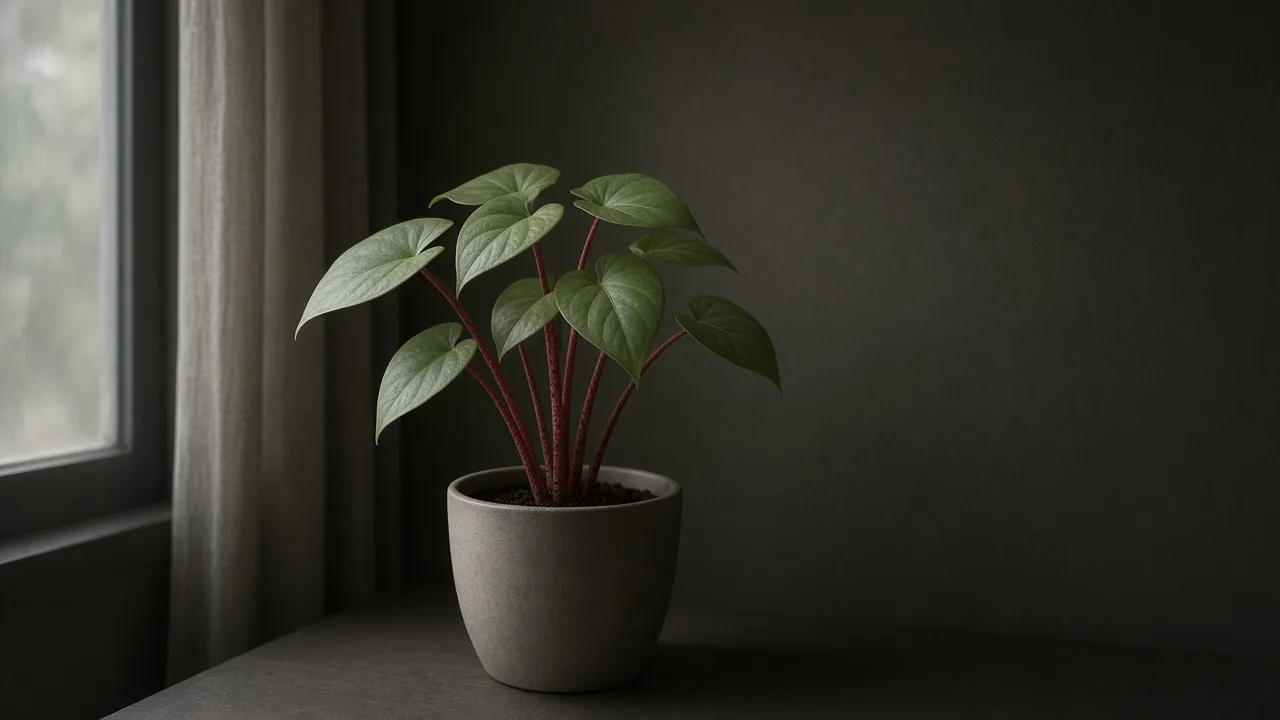
Not Enough Light on Alocasia Stingray: Causes, Checks & Fixes
This guide covers not enough light on Alocasia Stingray. See also the general Not Enough Light guide, watering, and light pages for this plant.
Not Enough Light on Alocasia Stingray: Causes, Checks & Fixes
Quick answer
Alocasia Stingray (Alocasia macrorrhizos ‘Stingray’) is sold as a dramatic floor elephant ear with round glossy blades and a pointed ray-tail on upright red-mottled petioles. In a dim hallway it can linger for months while quietly losing the cultivar shape that defines it—smaller new leaves on stretched petioles, washed-out green color, and potting mix that stays wet for weeks because photosynthesis barely keeps up.
For how chronic low light limits growth in general, see our not enough light hub. On Stingray, the decisive clues are loss of the round ray-tail silhouette on new crown leaves, elongated red-mottled petioles, and a watering cycle that no longer matches how slowly the plant uses moisture in shade.
First step: move the pot to bright indirect light—typically within a few feet of an east window, or several feet back from sheer south or west glass—and add a timed full-spectrum grow lamp if usable daylight does not reach the leaf canopy.
When to use this page vs other Alocasia Stingray guides
This page is the symptom-first entry for shade-stressed Stingray—shrinking ray-tails, stretched petioles, stalled crown flushes, and chronically wet mix in dim rooms.
| Pattern | Read next |
|---|---|
| Long bare red petioles with tiny crown leaves | Leggy growth |
| Washed-out green, plant still compact | Pale leaves |
| Yellow lower leaves on heavy wet pot | Overwatering or root rot |
| No new leaves but light seems adequate | Slow growth |
| Placement, foot-candles, grow lights | Light guide |
| Water schedule after a move to dimmer spot | Watering guide |
| Full problem index | All Stingray problems |
What not enough light looks like on Alocasia Stingray
Healthy Stingray pushes large round glossy ray-tail leaves—each blade tapers to an elongated point like its namesake—on upright red-mottled petioles from a central crown above an underground corm. Shade stress breaks that signature on the newest fully opened ray-tail, not across every leaf at once.
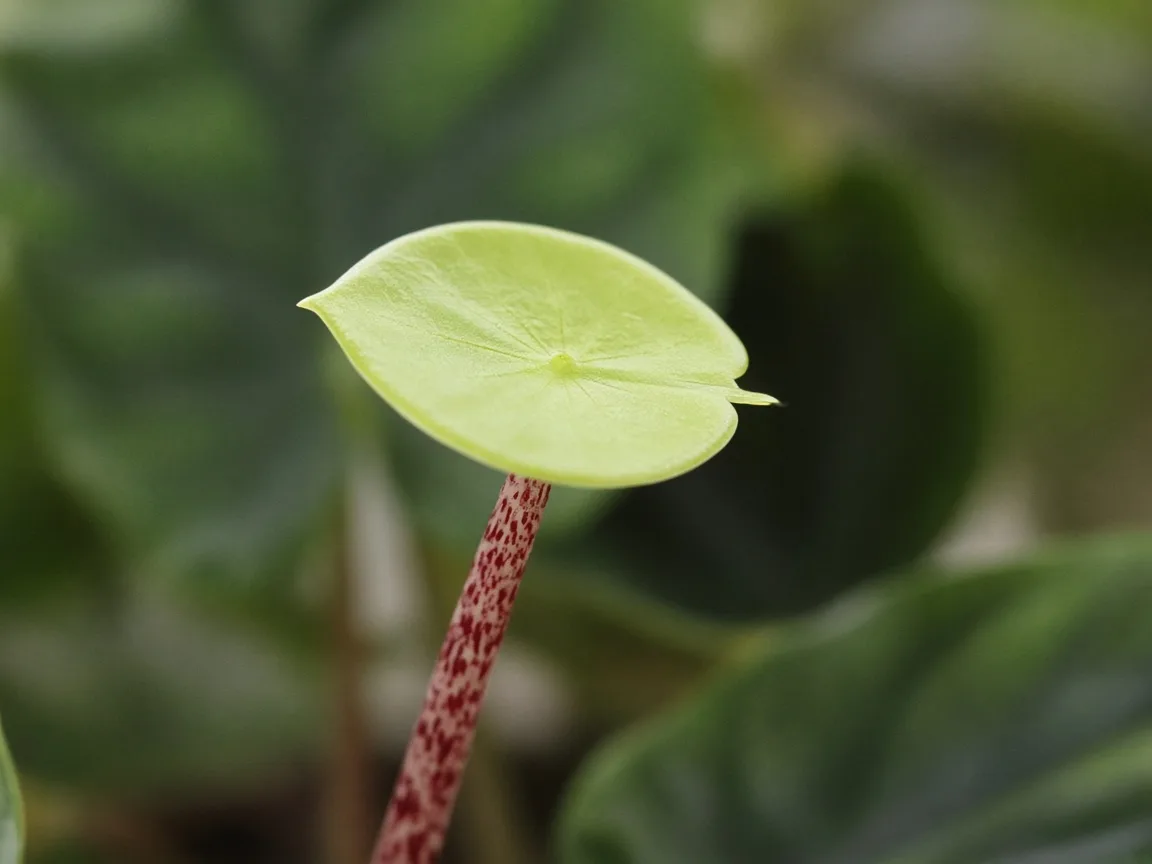
New round ray-tail leaf opening smaller and paler on a visibly stretched red-mottled petiole—the classic Stingray low-light pattern before lower leaves yellow.
- Smaller new ray-tail leaves on longer petioles — Each new blade emerges smaller than the last healthy flush, with wider gaps between leaves along the red-mottled stalk.
- Loss of the round ray-tail silhouette — Low light produces narrow, arrow-like new blades without the pronounced round “body” and tail proportion that distinguish this cultivar from generic elephant ears.
- Washed-out or lime-green new foliage — Deep glossy green fades on expanding crown leaves; overlaps with pale leaves when color wash is the main complaint.
- Plant leaning toward the brightest gap — The crown angles toward a window crack, doorway light, or monitor glow.
- No new crown flush across a warm indoor season — Stingray can push new leaves weekly in summer in bright light; zero new ray-tails for many weeks in a heated room points to insufficient usable light or coupled root stress.
- Pot stays heavy 14–21+ days after watering — Dim light reduces water use; owners who keep a bright-room watering calendar in a darker corner often trigger yellow lower leaves and soft corms.
Alocasias grow best in bright but indirect light, and while they can survive in lower light, growth will be much slower—on a macrorrhizos floor cultivar, that slower growth shows up quickly as smaller blades and weak structure, not just a pause in size.
Why Alocasia Stingray gets not enough light
Stingray evolved under tropical forest canopy as a large-leaf light catcher—the RHS notes alocasias developed extra-large foliage to catch maximum filtered sunlight coming through the tree canopy. Indoors, that translates to bright indirect light for most of the day, not a dark corner shelf.
NC State Extension lists genus-level light as dappled sunlight or partial shade—direct sun only part of the day, which indoors means bright ambient light with brief gentle morning sun, not baking afternoon beams or deep interior shade.
Stingray-specific triggers:
- Dark corners and interior hallways — A spot more than 6–8 feet from any window, or blocked by walls and tall furniture, drops below the band where Stingray produces firm round ray-tails. See the light guide for foot-candle targets around 200–400 at the leaf surface.
- Misreading “elephant ear” toughness — Green generic elephant ears sometimes survive dim halls. Stingray is a macrorrhizos cultivar bred for dramatic tail-tipped foliage; without photons it reverts toward generic arrow-shaped alocasia growth.
- Seasonal shade creep — A room that felt adequate in winter can lose effective brightness when outdoor trees leaf out or a building shades the pane.
- Watering on a bright-room schedule after a dim move — The Spruce notes you should water less often in lower light. Light controls how fast Stingray draws moisture through fast-draining aroid mix. Chronic wet mix in shade mimics overwatering injury even when you pour the same volume as before.
- Grow-light gaps in windowless rooms — The Sill states Alocasia Stingray is not suited for low light conditions and may enter dormancy when light and humidity drop in fall and winter.
Do not assume a large floor alocasia needs no light adjustment. Stingray outlasts many fussy houseplants in a dim hall, but it still etiolates and weakens when photons fall short for months.
Reading the ray-tail silhouette: a Stingray-only early warning
Polly and jewel alocasias fail with silver-vein fade. Stingray fails when the round blade and pointed tail proportion collapse on new crown leaves—a pattern that would be nonsense on a snake plant rosette or a fern frond.
| What you see on Stingray | What it usually means | First adjustment |
|---|---|---|
| New ray-tail smaller; tail tip less pronounced | Early low-light etiolation | Brighter filtered spot; measure at leaf level |
| Long red-mottled petioles; leaves clustered at top | Active stretch for photons | Move closer to window or add grow lamp |
| Lower leaves yellow on a wet heavy pot | Shade slowed water use; corm at risk | Brighten light and extend dry-down before next water |
| Leafless firm corm in cool short days | Winter dormancy, not chronic shade | Hold fertilizer; see watering guide |
| Compact round ray-tails return on next two leaves | Diagnosis confirmed | Hold new placement; adjust watering to match |
If pale new leaves show green-vein yellowing during warm active growth, inspect for iron deficiency before blaming light alone.
Wet mix in dim rooms: the Stingray light–water trap
Stingray in dark rooms follows a predictable failure loop on fast-draining floor pots: less light → slower photosynthesis → slower water uptake → mix stays wet → corm softens → more drooping leaves and yellowing.
Owners often water when the top 2–3 cm of chunky aroid mix dries—sound advice in a bright east window. After the same plant moves to a dim corner, that top layer may take two to three weeks to dry while the underground corm sits in stale moisture. The Spruce recommends allowing the top inch of soil to dry slightly between waterings—in low light, that dry-down stretches far longer than owners expect.
This is why Stingray problems get blamed on watering first even when light set the failure in motion. Brighter placement dries the pot predictably and reduces the wet-soil stagnation that kills corms in dim corners—exactly the link the light guide emphasizes between exposure and root rot risk.
Dormant empty pot vs chronic low-light stretch
Stingray owners often confuse cool-season leaf drop with shade failure. During dormancy when light and temperature drop, Stingray may shed every leaf, leaving bare mix with a firm corm below—while the RHS Stingray profile advises reducing watering to a minimum in winter. That rest period is not the same as chronic low light during warm active growth.
The diagnostic split:
- Winter dormancy — leafless or few pale leaves, firm dry corm, cool room, no active crown flush. Hold fertilizer and do not panic-move to the brightest baking window until spring wake-up.
- Chronic low light in warm season — active growth attempts with smaller ray-tails on stretched petioles while corm is firm on slow dry-down; mix may stay wet if you water on a summer calendar.
Moving a dormant leafless corm into harsh direct afternoon sun to “fix” winter rest can scorch the first spring ray-tail. Add gradual bright indirect light or a timed grow lamp instead.
Lookalike symptoms
| Pattern | Check | Likely cause |
|---|---|---|
| Smaller ray-tails on long red petioles | Newest crown leaf shape | Not enough light (this page) |
| Whole plant lime-green, weak structure | Window exposure | Pale leaves or not enough light |
| Long bare stems with tiny top leaves | Petiole length trend | Leggy growth |
| New crown ray-tail yellow with green veins | Vein pattern on expanding leaf | Iron deficiency |
| Yellow lower cluster, wet soil, soft corm | Corm squeeze at soil line | Overwatering or root rot |
| Drooping with dry light mix | Pot weight | Underwatering |
| Leafless firm corm in cool months | Night temperature | Normal dormancy |
How to confirm the cause
Work through these checks in order. Stingray responds on a seasonal rhythm; one change at a time makes it easier to read the next crown ray-tail over four to eight weeks.
- Season and growth stage — Warm active flush with new ray-tails opening? Light stress. Leafless cool dormancy? Not chronic shade—wait for spring.
- Newest ray-tail morphology — Round body and tail proportion shrinking on successive crown leaves? Light. Green-vein yellowing on expanding blade? See iron deficiency.
- Petiole length trend — Each new red-mottled stalk longer than the last? Strong light signal.
- Light measurement — Medium indoor light runs roughly 100–300 foot-candles; Stingray targets the upper band. Soft fuzzy shadow at leaf level at midday = usable; no shadow = too dim.
- Dry-down rhythm — Top 2–3 cm dry before watering per the watering guide; chronically wet outer mix in a dim spot supports the light–water trap diagnosis.
- Corm firmness — firm tissue at soil line; soft corm on wet mix means fix overwatering even if light is also low.
- Lean direction — crown angles toward brightest gap? Supports insufficient current placement.
The first fix to try
Move the pot to bright indirect light where the leaf canopy receives usable daylight most of the day—before changing water volume, repotting, or fertilizer.
That single placement correction is the first fix—not a bundled checklist of grow lamps, repotting, pruning, and feed. If the room has no usable window light at leaf level, add one timed full-spectrum LED for 12–14 hours during active growth, mounted roughly 25–45 cm above the foliage per the light guide.
Do not move Stingray into direct afternoon sun through bare west glass in one step—scorched ray-tail tissue will not recover. Filter harsh beams with sheer curtain and acclimate over two to three weeks.
After light improves, adjust watering to match slower or faster dry-down—do not fertilize a stressed Stingray until new crown growth looks stable for two weeks.
Step-by-step recovery
- Measure light at the leaf canopy — shadow test or phone lux app; confirm below productive range before moving.
- Relocate to bright indirect light — east window within a few feet, or filtered south/west placement; avoid dark interior corners.
- Add grow lamp if needed — timed LED when windowless; run longer in winter supplement mode.
- Wait one full dry-down cycle — then water only when top 2–3 cm is dry; do not pour on the old bright-room calendar.
- Remove only fully yellow or collapsed lower leaves — keep green blades for photosynthesis while new ray-tails form.
- Resume light feeding — half-strength balanced liquid per fertilizer guide after two healthy new crown leaves, not before.
Use the Light Requirement Calculator to compare your room reading against Stingray targets before stacking other treatments.
Recovery timeline
Stingray flush growth is seasonal. Expect four to eight weeks for the next crown ray-tail to show shorter petioles and a rounder blade after corrected placement. A full warm season may pass before two consecutive ray-tails look like the cultivar you bought.
Signs of improvement: larger new round blades, deeper green color, shorter red-mottled petioles, faster appropriate dry-down, firm corm.
Signs the problem is worsening: each successive ray-tail smaller and paler during warm growth, mix soggy for weeks with soft corm, widespread yellow leaves—stop guessing and check root rot.
Stretched petioles and small pale ray-tails rarely revert once hardened; judge success by new crown foliage, not old blade shape.
Mistakes to avoid
- Fertilizing before brightening — nitrogen push on etiolated crown growth does not fix stretch and adds salt stress on a corm-sensitive aroid.
- Repotting on day one — unnecessary unless mix is failing or roots are rotting; light correction comes first.
- Blaming winter dormancy for summer stretch — leafless cool rest differs from warm-season etiolation with active small ray-tails.
- Moving into direct scorching sun — bleached ray-tail patches do not heal; filter and acclimate.
- Keeping the summer water schedule in a dim corner — the light–water trap kills corms faster than shade alone.
- Expecting old stretched petioles to shorten — judge the next two crown flushes.
Prevention
- Place Stingray where bright filtered daylight reaches the canopy most of the day per the light guide.
- Re-check brightness after seasonal tree shade, furniture moves, or switching on room-darkening curtains.
- Add a timed grow lamp in windowless offices before stretch begins.
- Match watering to dry-down at top 2–3 cm—extend intervals automatically when light drops.
- Rotate the pot a quarter turn monthly in asymmetric window light so ray-tails open evenly.
- Pause fertilizer when the plant enters winter dormancy and growth stops.
Related Alocasia Stingray guides
Scope note: Use this page when new crown ray-tail leaves shrink on stretched red-mottled petioles in dim placement. Use leggy growth when bare stem length is the main complaint, pale leaves for whole-plant wash-out without dramatic stretch, and overwatering when the corm softens on wet mix—regardless of petiole length.
Related tool
Use the Why Is My Plant Dying? Tool to narrow causes for not enough light on this plant before changing multiple variables at once.