Alocasia Stingray Care Guide: Light, Water & Humidity
Alocasia macrorrhizos 'Stingray'
Alocasia Stingray (Alocasia macrorrhizos 'Stingray') care: bright indirect light, 60–75% humidity, chunky aroid mix, corm-safe watering, ray-tail leaf tips, and dormancy.
Alocasia Stingray Care Guide: Light, Water & Humidity
Start with wateringThe most common care mistake for Alocasia StingrayWatering guide →Alocasia Stingray care essentials
Light
bright indirect light
Water
Water when the top 2–3 cm of soil is dry; reduce sharply in winter dormancy. Avoid overwatering — the corm rots fast in wet mix.
Soil
Chunky, well-draining aroid mix with perlite and orchid bark; never use dense peat-heavy mix alone.
Humidity
60–75%
Temperature
18–26°C (65–80°F)
Fertilizer
Stop fertilizing, reduce watering to roughly every 3–5 weeks (just enough to keep the corm from desiccating), and keep the pot warm with bright indirect light.
About Alocasia Stingray
Alocasia Stingray is native to C Malesia to NE Australia (parent species), typically reaches 60–150 cm tall indoors; leaves to 60 cm indoors, with moderate to fast in warm, bright conditions growth. Alocasia Stingray has a upright growth habit and part of the Araceae family. It is also known as Stingray Elephant Ear, Alocasia Stingray, and Elephant's Ear 'Stingray'.
| Detail | Information |
|---|---|
| Also known as | Stingray Elephant Ear, Alocasia Stingray, Elephant's Ear 'Stingray' |
| Native region | C Malesia to NE Australia (parent species) |
| Mature size | 60–150 cm tall indoors; leaves to 60 cm |
| Growth rate | Moderate to fast in warm, bright conditions |
| Growth habit | Upright |
| Scientific name | Alocasia macrorrhizos 'Stingray' |
| Family | Araceae |
Alocasia Stingray Care Guide: Light, Water & Humidity
Alocasia Stingray (Alocasia macrorrhizos ‘Stingray’) is the elephant ear people buy for its unmistakable foliage — round, cordate leaves with a long pointed tail that really does resemble a stingray — and then struggle with because the care is corm-first, not leaf-first. Unlike forgiving vining philodendrons, Stingray stores energy in an underground corm, can drop every leaf in winter dormancy, and rots within days when the mix stays wet. The Royal Horticultural Society’s alocasia guide lists A. ‘Stingray’ among the most widely available cultivars and recommends bright but indirect light, medium to high humidity, and cooler drier winter conditions that let the plant rest. Get those basics right with a chunky aroid mix that dries predictably, and Stingray pushes new spears steadily through the growing season. Miss any one variable, and the same plant sulks for months. This overview covers identity, the full care stack, dormancy, common failures, and where to go next in the cluster.
What Alocasia Stingray Actually Is
Alocasia macrorrhizos ‘Stingray’ is a selected cultivar of giant taro, a species in Araceae — the arum family shared with Monstera, Philodendron, peace lilies, and Colocasia. Botanists A. Kurniawan and Peter C. Boyce formally described A. macrorrhizos in 2011 from cultivated material linked to Eastern Kalimantan, Indonesian Borneo (Kurniawan & Boyce 2011). Most plants sold as Stingray are this named cultivar rather than the wild type species, and the trade also uses Stingray Elephant Ear on labels.
Indoors, Stingray typically reaches 60–150 cm (about 2–5 feet) with an upright, clumping habit — no trunk, leaves emerging on long petioles directly from the corm. NC State Extension notes that indoor alocasias are tuberous perennials preferring shaded sites with slightly acidic, moist, well-drained, humus-rich soil; the container version stays much smaller than outdoor specimens but follows the same biological rules.
The Stingray Leaf and Why It Matters for Care
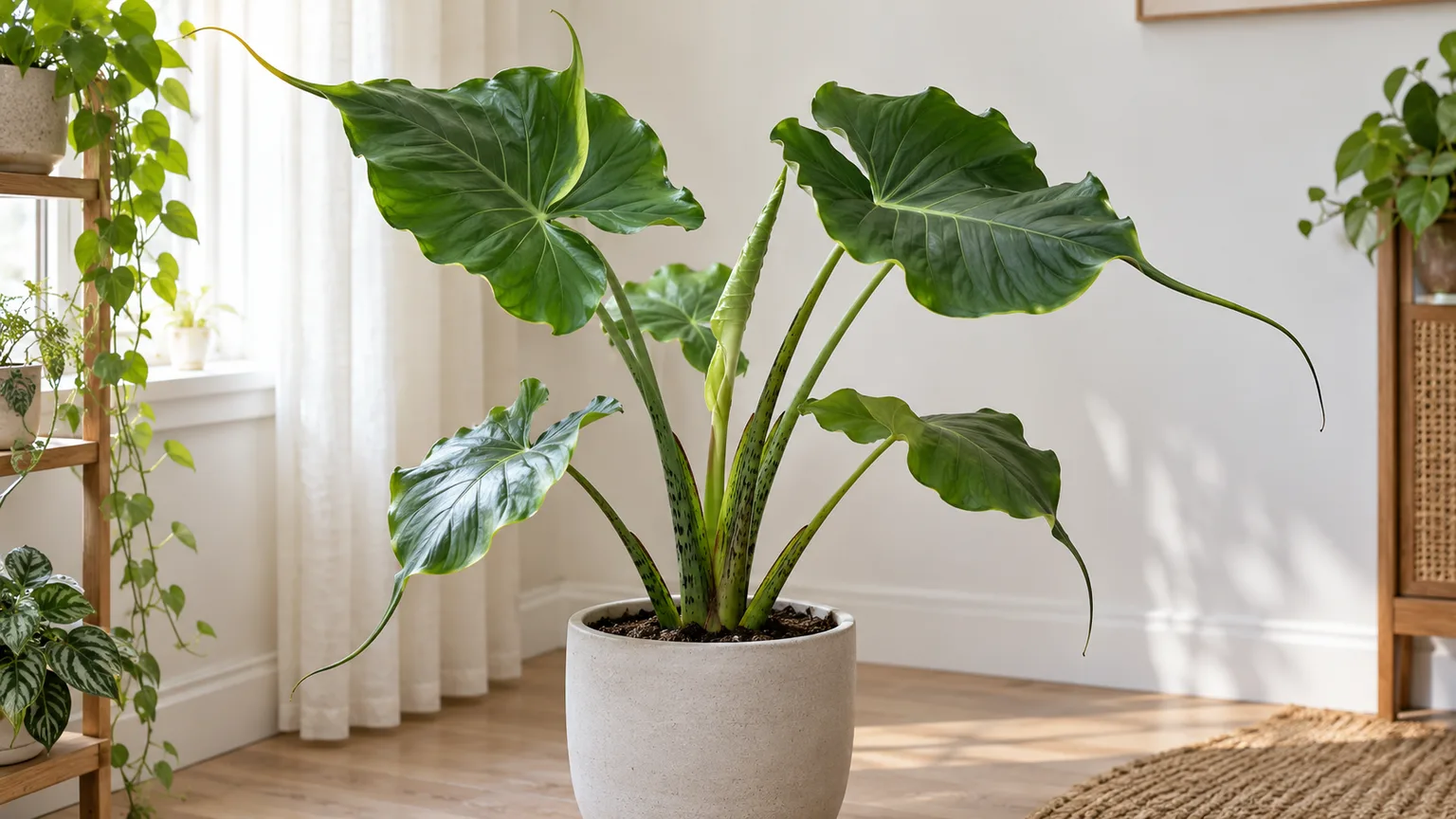
The signature feature is the leaf silhouette: a broad, rounded blade tapering to a distinct pointed tail, like a marine stingray viewed from above. The RHS describes A. ‘Stingray’ as having leaves shaped like its sea-dwelling namesake — a visual ID feature that separates it from arrow-shaped Alocasia amazonica hybrids and zebra-striped Alocasia zebrina petioles. Leaves are thick and somewhat leathery, usually held upright on stiff petioles, and a healthy plant carries a small fan of three to six leaves at a time rather than a dense canopy.
That leaf shape has a practical care implication. The broad blade moves a lot of water through transpiration, which raises humidity demand, while the stiff cuticle means wilting shows up later than on thin-leaved alocasias — by the time leaves curl or crisp, the corm may already be stressed. Read the pot and corm, not just the foliage, when deciding whether to water.
Stingray vs Polly, Zebrina, and Other Elephant Ears
Stingray shares the macrorrhizos corm biology with cultivars like ‘Silver Dragon’ and ‘Green Dragon’, but looks nothing like the compact, dark-veined Alocasia × amazonica ‘Polly’ most beginners know. Polly stays smaller and shows stress on leaves faster; Stingray is a statement plant that needs floor space and tolerates slightly lower humidity than jewel alocasias like Alocasia baginda ‘Dragon Scale’, but still demands more than a typical philodendron. Alocasia zebrina is another common comparison — same genus care rules, but Zebrina’s Philippine native range and graphic striped petioles are a different aesthetic. For every comparison, the corm-safe watering rhythm is the same; only size, leaf count, and humidity margin differ.
Like all alocasias, Stingray grows from a corm — a compact underground storage organ that survives leaf loss and seasonal slowdowns. That corm is why an apparently dead pot in January can push a new spear in March, and why overwatering on Alocasia Stingray kills faster than underwatering: saturated mix suffocates the corm before the leaves show obvious distress.
Light: Bright, Indirect, and Stable
Stingray is an understorey plant evolved for bright but indirect light — strong enough to sustain large leaves, filtered enough to avoid scorch. The RHS alocasia growing guide is explicit: position in bright but indirect light, because strong direct sun scorches foliage. While alocasias can survive lower light, growth slows sharply and the plant holds fewer leaves at a time.
Too much direct sun shows up as bleached patches, brown crisp edges on the sun-facing side, or sudden collapse after a window move. Too little light shows up as long weak petioles, smaller new leaves, and a plant stuck at one or two leaves instead of the small fan a healthy specimen should carry. Pair light decisions with the Alocasia Stingray light guide when you need window-by-window placement detail.
Best Window Placement Indoors
An east-facing window with morning sun filtered through a sheer curtain is usually the safest default. A bright north-facing room works if ambient light is strong. West windows need afternoon protection; south exposures almost always need filtering or placement set back from the glass. Rotate the pot a quarter turn each week so growth stays symmetrical — the RHS recommends turning the plant slightly at each watering to prevent leaning.
If you use grow lights, full-spectrum LED panels 30–60 cm above the canopy for 10–12 hours daily are a workable substitute. If the leaf surface feels warm to the touch, raise the fixture; heat stress on alocasia leaves does not show the same obvious wilting pattern as drought.
Watering When the Top 2–3 cm Is Dry
The single most common cause of death for Stingray is overwatering — keeping the corm in wet, oxygen-poor mix until roots rot. The RHS recommends watering from April to October once the top 5 cm (2 in) of compost is dry, then reducing to a minimum in winter when the plant goes dormant. That band translates cleanly to home care: test the actual pot, do not follow a calendar.
Water thoroughly when the top 2–3 cm feels dry, soaking until water runs from drainage holes, then empty the saucer. A small daily sip is the worst pattern — it wets the surface while the bottom stays dry or, worse, keeps the corm zone chronically damp. Underwatering is more recoverable: curled leaves and crispy edges usually respond to a thorough soak if the corm is still firm. For step-by-step rhythm, seasonal dormancy dial, and recovery paths, see the Alocasia Stingray watering guide.
Pot Weight, Finger, and Chopstick Checks
Three checks cover most homes. The finger test: push to the second knuckle — dry at depth means water, damp means wait. The chopstick test: insert a clean skewer to the bottom, wait 30 seconds, pull out — clinging soil means moisture remains; a nearly clean stick means the root zone is ready. Pot weight is fastest once you learn it: lift after a thorough soak and again before the next watering; a distinctly light pot with a dry surface means go.
Humidity and Temperature
Stingray wants 60–75% relative humidity during active growth — well above the 30–50% typical of heated winter rooms. The RHS lists alocasias as liking medium to high humidity through the growing season and suggests pebble trays, grouping plants, bathroom placement, misting, or a humidifier. Temperature should stay above 16 °C (60 °F) from spring through autumn per RHS guidance, with winter minimums above 10 °C (50 °F) even during dormancy.
Cold drafts from winter windowsills or air-conditioning vents push the plant toward dormancy or leaf drop within hours. NC State Extension puts optimal daytime temperatures at 68–77 °F (20–25 °C) for the genus — a useful comfort band for active growth indoors.
Practical Humidity Fixes Beyond Misting
Misting raises humidity around the leaf for minutes, not hours, and wet leaf surfaces on a broad Stingray blade can invite fungal spotting. A humidifier on a hygrometer is the reliable fix. Pebble trays, grouping plants, and a bright bathroom all help measurably. If humidity chronically sits below 50%, expect brown tips on Alocasia Stingray and higher spider mite pressure — dry air favours mites on large-leaved alocasias.
Soil: Chunky, Airy Aroid Mix
Standard houseplant potting mix compacts within months and is the fastest route to root rot on Alocasia Stingray. The job of the indoor mix is drainage plus air around the corm — imitating the well-drained tropical soils macrorrhizos evolved in. The RHS recommends repotting into peat-free houseplant compost with about one part horticultural grit to three parts compost for drainage. Target mildly acidic conditions around pH 5.5–6.5, which most coco- or peat-free blends provide without adjustment.
A Reliable 1:1:1 Mix Recipe
A well-documented starting point is equal parts coco coir (or peat-free compost), perlite, and orchid bark by volume. Coco holds a thin moisture film; perlite keeps pores open; bark creates channels for fast drainage. Add a small amount of horticultural charcoal if the mix smells sour between waterings. Do not add fine sand to “improve drainage” — it fills air gaps. Do not use garden soil. For structure tweaks and wrong-mix warning signs, see the Alocasia Stingray soil guide.
Fertilizer and Repotting Rhythm
Stingray is a modest feeder. A balanced liquid houseplant fertilizer at one-quarter to one-half label strength, every four to six weeks from spring through early autumn, is enough when light, water, and mix are already correct. The RHS advises feeding with general liquid fertiliser during the growing season following label rates. Pause feeding during dormancy, for the first month after repotting, and whenever the plant recovers from pests or root damage.
Repot every one to two years, or when the pot dries much faster than it used to, roots circle drainage holes, or the plant becomes top-heavy. Go up only one pot size — about 5 cm (2 in) wider per RHS guidance — because oversized pots hold water the slow root system cannot use. Spring at the start of active growth is the safest window. Details live in the Alocasia Stingray repotting guide and fertilizer guide.
Propagation by Division and Corms
Stingray cannot be propagated from leaf or stem cuttings. The two reliable home methods are offset division and corm propagation. The RHS describes separating offsets that form around the base in spring, taking as much root as possible, and potting into gritty peat-free compost. For corms, unpot the plant, find small firm bulb-like corms near the root mass, and place them on moist sphagnum in a sealed clear container at warm room temperature in bright indirect light — roots typically appear in two to four weeks.
Do not harvest every corm from one plant. The mother plant relies on them as water and energy reserves, especially through dormancy. Full step-by-step timing and aftercare are in the Alocasia Stingray propagation guide.
Dormancy and the Bare Winter Pot
Late autumn or winter — shorter days, cooler nights — can trigger full leaf drop while the corm below the surface stays alive. The RHS notes that alocasias may lose foliage during winter dormancy and that this is nothing to worry about; fresh leaves return in spring. During dormancy, stop fertilizing, reduce watering to barely enough to keep the corm from desiccating (roughly once every three to five weeks in most homes), and keep the pot warm with bright indirect light.
Resist repotting, dividing, or “rescuing” a bare pot with extra water — that is how dormant corms rot. If no growth appears by mid-spring, gently check that the corm is still firm; if it is, repot into fresh mix, water lightly, and wait. A bare pot in January is alarming and normal.
Common Problems on Alocasia Stingray
Most Stingray problems are environmental and show up as leaf symptoms that map to moisture, light, or pests. Diagnostic order: check soil moisture and roots first, then light, then leaf undersides for pests.
Yellow Leaves, Curl, and Root Rot
Yellow leaves on one older leaf while new growth looks healthy is normal turnover — Stingray holds only a few leaves at a time. Widespread yellowing or yellow new leaves is almost always overwatering or a water-retentive mix. Less common causes include low light, salt buildup, and pests. Leaf curl inward usually means underwatering, very low humidity, or cold draughts — if soil is wet and leaves still curl, suspect recent light change or heat from a grow lamp placed too close.
Root rot follows chronically wet mix: yellowing, soft stems at the base, sour smell. Unpot, trim mushy roots with sterile scissors, repot into dry chunky mix, and hold water until the plant stabilises. Yellow leaves on Alocasia Stingray and wilting guides cover symptom-specific recovery paths.
NC State Extension lists spider mites as a primary alocasia pest, with root rot and leaf spots from overwatering. Dry indoor air and dusty leaves favour mite outbreaks on large blades — isolate, shower the foliage, wipe undersides, and treat with insecticidal soap or dilute neem at five-day intervals while raising humidity.
Toxicity to Pets and People
Every part of Alocasia macrorrhizos ‘Stingray’ is toxic to cats, dogs, horses, and humans if chewed or ingested. The toxic principle is insoluble calcium oxalate in needle-like raphide crystals. The ASPCA lists Alocasia spp. as toxic to dogs, cats, and horses, with signs including oral irritation, pain and swelling of mouth, tongue and lips, excessive drooling, vomiting, and difficulty swallowing. The RHS adds that alocasias contain toxic compounds, should not be eaten, and it is best to wear gloves when handling them because sap can irritate skin.
If a pet or child chews the plant, call the ASPCA Animal Poison Control Center at (888) 426-4435 or your veterinarian immediately. Do not induce vomiting unless instructed. For pet-owning households, place Stingray on a high shelf or choose a non-toxic alternative for accessible spots.
Buying Tips and the First 30 Days at Home
A healthy Stingray at purchase should have firm upright leaves with the characteristic round-and-tail silhouette, no webbing or sticky residue on undersides, and mix that does not smell sour. Cosmetic damage on one older leaf is normal; collapsed crowns, mushy petioles, or yellow new growth are not. The RHS advises choosing unblemished plants when buying in person and keeping tropical alocasias warm during transport — cold shock on the way home causes damage that only shows up days later.
In the first 30 days, do not repot, fertilize, or propagate. Quarantine away from other houseplants for at least two weeks. Learn how fast your specific pot dries before changing anything. If one leaf drops early, that is often transport stress, not failure — provided you do not overwater the corm in response. Change one variable at a time: light first, then watering, then humidity.
When to Use This Page vs Other Alocasia Stingray Guides
- Alocasia Stingray overview — Canonical hub for this species; care topics and problems branch from here.
- Alocasia Stingray problems — Symptom-first path when you already know something is wrong.
- Sibling topic guides — Use watering, light, soil, fertilizer, repotting, and propagation when one variable needs full depth.
Related Alocasia Stingray Guides
- Alocasia Stingray watering
- Alocasia Stingray light
- Alocasia Stingray soil
- Alocasia Stingray propagation
- Alocasia Stingray fertilizer
- Alocasia Stingray repotting
- Alocasia Stingray pruning
- Root rot on Alocasia Stingray
- Spider mites on Alocasia Stingray
- Yellow leaves on Alocasia Stingray
- Brown tips on Alocasia Stingray
- Overwatering on Alocasia Stingray
Conclusion
Alocasia macrorrhizos ‘Stingray’ rewards growers who treat watering, humidity, and dormancy as one system centred on the corm. Keep the mix airy, the light bright but filtered, winter care conservative, and the humidifier honest about room readings — and Stingray will push new spears when conditions improve. The habits that matter most are the boring ones: lift the pot before watering, accept a bare winter pot without panic, and fix moisture before reaching for fertilizer or repotting.
How to care for Alocasia Stingray?
How much light does Alocasia Stingray need?
bright indirect light
- bright indirect light - bright indirect light.
When should you water Alocasia Stingray?
Water when the top 2–3 cm of soil is dry; reduce sharply in winter dormancy. Avoid overwatering — the corm rots fast in wet mix.
- Finger or chopstick to 2–3 cm depth; lift pot to gauge weight - Water when the top 2–3 cm of soil is dry; reduce sharply in winter dormancy.
- Drain excess water - Water when the top 2–3 cm of soil is dry; reduce sharply in winter dormancy.
What soil works best for Alocasia Stingray?
Chunky, well-draining aroid mix with perlite and orchid bark; never use dense peat-heavy mix alone.
- perlite - Chunky, well-draining aroid mix with perlite and orchid bark; never use dense peat-heavy mix alone.
- orchid bark - Chunky, well-draining aroid mix with perlite and orchid bark; never use dense peat-heavy mix alone.
- peat-free potting mix - Chunky, well-draining aroid mix with perlite and orchid bark; never use dense peat-heavy mix alone.
Grower notes for Alocasia Stingray
Dormancy and the corm
Alocasia Stingray may drop all leaves in winter while the underground corm stays alive. Reduce watering to every 3–5 weeks, stop fertilizer, and wait for spring growth — do not discard a pot that looks empty.
Ray-tail leaves need space and light
Each round, glossy leaf tapers to an elongated point like a stingray tail — often 60 cm long on upright red-mottled stalks. Give the plant room to spread; crowding against walls or shelves bends petioles and blocks new leaves from opening cleanly.
What matters most with Alocasia Stingray
Alocasia Stingray is easiest to grow when you judge the whole plant: new growth, root-zone moisture, light exposure, and how quickly the pot dries after watering. The care checkpoint is bright indirect light paired with chunky aroid mix in a stable floor spot — this macrorrhizos cultivar is larger and faster than compact jewel alocasias but still rots fast when overpotted or kept wet in low light.
Best placement in a real home
Alocasia Stingray belongs where bright indirect light is realistic for most of the day. Water when the top 2–3 cm of soil is dry; reduce sharply in winter when dormancy is likely. Humidity target: 60–75%. Temperature comfort zone: 18–26°C (65–80°F). A bright living room or humid bathroom with floor space beats a dark corner shelf.
Before you buy this plant
Choose Alocasia Stingray with firm new growth, round ray-tail leaves on upright stalks, and soil that does not smell sour. Be cautious if you see collapsed crowns, mushy petioles, or a pot that stays wet in poor light. Also sold as Stingray Elephant Ear — verify the distinctive round blade with pointed tail, not a mislabeled Polly or generic elephant ear.
First month after bringing it home
Do not repot Alocasia Stingray on day one unless the mix is failing or pests are obvious. Quarantine it, learn how fast the pot dries, and keep care boring while it adjusts. If a leaf drops in week one, the corm below may still be fine — resist overwatering an empty-looking pot.
Is it pet safe?
Alocasia Stingray is toxic to cats and dogs and humans.
Contains insoluble calcium oxalate crystals causing oral irritation, drooling, and vomiting if ingested.
Watering Alocasia Stingray
For Alocasia Stingray, finger or chopstick to 2–3 cm depth; lift pot to gauge weight and water every 7–10 days in summer; every 2–4 weeks in winter. Reduce watering 60–70% in autumn/winter when dormancy is likely; keep corm from drying out.
| Detail | Information |
|---|---|
| How often | Every 7–10 days in summer; every 2–4 weeks in winter |
| How to check | Finger or chopstick to 2–3 cm depth; lift pot to gauge weight |
| Seasonal changes | Reduce watering 60–70% in autumn/winter when dormancy is likely; keep corm from drying out |
Signs of overwatering
- yellow leaves
- mushy petioles
- soggy soil
- root rot
Signs of underwatering
- drooping leaves
- dry crispy edges
- slow growth
Soil & potting for Alocasia Stingray
Use a mix of perlite, orchid bark, peat-free potting mix, coarse sand for Alocasia Stingray. Fast-draining; corm must never sit in saturated soil. Target soil pH around 5.5–6.5. Repot every 1–2 years, ideally in spring.
| Detail | Information |
|---|---|
| Recommended mix | perlite, orchid bark, peat-free potting mix, coarse sand |
| Drainage | Fast-draining; corm must never sit in saturated soil |
| Soil pH | 5.5–6.5 |
| Repotting frequency | Every 1–2 years |
| Best season to repot | Spring |
Signs it needs repotting
- roots circling pot
- rapid soil drying
- stunted growth
Humidity & temperature for Alocasia Stingray
Alocasia Stingray prefers 60–75%, though normal home humidity is usually fine. Keep temperatures around 18–26°C (65–80°F).
| Detail | Information |
|---|---|
| Humidity | 60–75% - normal home humidity is fine. |
| Ideal temperature | 18–26°C (65–80°F) |
Fertilizer & pruning for Alocasia Stingray
Use stop fertilizing, reduce watering to roughly every 3–5 weeks (just enough to keep the corm from desiccating), and keep the pot warm with bright indirect light. for Alocasia Stingray.
| Detail | Information |
|---|---|
| Fertilizer type | Stop fertilizing, reduce watering to roughly every 3–5 weeks (just enough to keep the corm from desiccating), and keep the pot warm with bright indirect light. |
Common problems on Alocasia Stingray
Yellow Leaves
MediumLikely cause: Common on this plant type; confirm with recent watering, light, and root checks.
Quick fix: Inspect the plant and correct the most likely care stressor before stacking treatments.
Full fix guide →Brown Tips
MediumLikely cause: Common on this plant type; confirm with recent watering, light, and root checks.
Quick fix: Inspect the plant and correct the most likely care stressor before stacking treatments.
Full fix guide →Root Rot
MediumLikely cause: Common on this plant type; confirm with recent watering, light, and root checks.
Quick fix: Inspect the plant and correct the most likely care stressor before stacking treatments.
Full fix guide →Overwatering
MediumLikely cause: Common on this plant type; confirm with recent watering, light, and root checks.
Quick fix: Inspect the plant and correct the most likely care stressor before stacking treatments.
Full fix guide →Underwatering
MediumLikely cause: Common on this plant type; confirm with recent watering, light, and root checks.
Quick fix: Inspect the plant and correct the most likely care stressor before stacking treatments.
Full fix guide →Spider Mites
MediumLikely cause: Common on this plant type; confirm with recent watering, light, and root checks.
Quick fix: Inspect the plant and correct the most likely care stressor before stacking treatments.
Full fix guide →Mealybugs
MediumLikely cause: Common on this plant type; confirm with recent watering, light, and root checks.
Quick fix: Inspect the plant and correct the most likely care stressor before stacking treatments.
Full fix guide →Aphids
MediumLikely cause: Common on this plant type; confirm with recent watering, light, and root checks.
Quick fix: Inspect the plant and correct the most likely care stressor before stacking treatments.
Full fix guide →Leggy Growth
MediumLikely cause: Common on this plant type; confirm with recent watering, light, and root checks.
Quick fix: Inspect the plant and correct the most likely care stressor before stacking treatments.
Full fix guide →Slow Growth
MediumLikely cause: Common on this plant type; confirm with recent watering, light, and root checks.
Quick fix: Inspect the plant and correct the most likely care stressor before stacking treatments.
Full fix guide →Wilting
MediumLikely cause: Common on this plant type; confirm with recent watering, light, and root checks.
Quick fix: Inspect the plant and correct the most likely care stressor before stacking treatments.
Full fix guide →Drooping Leaves
MediumLikely cause: Common on this plant type; confirm with recent watering, light, and root checks.
Quick fix: Inspect the plant and correct the most likely care stressor before stacking treatments.
Full fix guide →Low Humidity
MediumLikely cause: Common on this plant type; confirm with recent watering, light, and root checks.
Quick fix: Inspect the plant and correct the most likely care stressor before stacking treatments.
Full fix guide →Not Enough Light
MediumLikely cause: Common on this plant type; confirm with recent watering, light, and root checks.
Quick fix: Inspect the plant and correct the most likely care stressor before stacking treatments.
Full fix guide →Fungus Gnats
MediumLikely cause: Common on this plant type; confirm with recent watering, light, and root checks.
Quick fix: Inspect the plant and correct the most likely care stressor before stacking treatments.
Full fix guide →Mold on Soil
MediumLikely cause: Common on this plant type; confirm with recent watering, light, and root checks.
Quick fix: Inspect the plant and correct the most likely care stressor before stacking treatments.
Full fix guide →Curling Leaves
MediumLikely cause: Common curling leaves pattern on Alocasia Stingray under indoor care stress.
Quick fix: Inspect roots, watering, light, and pests; adjust one variable and monitor new growth.
Full fix guide →Brown Leaves
MediumLikely cause: Common brown leaves pattern on Alocasia Stingray under indoor care stress.
Quick fix: Inspect roots, watering, light, and pests; adjust one variable and monitor new growth.
Full fix guide →Black Spots
MediumLikely cause: Common black spots pattern on Alocasia Stingray under indoor care stress.
Quick fix: Inspect roots, watering, light, and pests; adjust one variable and monitor new growth.
Full fix guide →Holes in Leaves
MediumLikely cause: Common holes in leaves pattern on Alocasia Stingray under indoor care stress.
Quick fix: Inspect roots, watering, light, and pests; adjust one variable and monitor new growth.
Full fix guide →Pale Leaves
MediumLikely cause: Common pale leaves pattern on Alocasia Stingray under indoor care stress.
Quick fix: Inspect roots, watering, light, and pests; adjust one variable and monitor new growth.
Full fix guide →Distorted Leaves
MediumLikely cause: Common distorted leaves pattern on Alocasia Stingray under indoor care stress.
Quick fix: Inspect roots, watering, light, and pests; adjust one variable and monitor new growth.
Full fix guide →Scale Insects
MediumLikely cause: Common scale insects pattern on Alocasia Stingray under indoor care stress.
Quick fix: Inspect roots, watering, light, and pests; adjust one variable and monitor new growth.
Full fix guide →Thrips
MediumLikely cause: Common thrips pattern on Alocasia Stingray under indoor care stress.
Quick fix: Inspect roots, watering, light, and pests; adjust one variable and monitor new growth.
Full fix guide →Whiteflies
MediumLikely cause: Common whiteflies pattern on Alocasia Stingray under indoor care stress.
Quick fix: Inspect roots, watering, light, and pests; adjust one variable and monitor new growth.
Full fix guide →Leaf Miners
MediumLikely cause: Common leaf miners pattern on Alocasia Stingray under indoor care stress.
Quick fix: Inspect roots, watering, light, and pests; adjust one variable and monitor new growth.
Full fix guide →Caterpillars
MediumLikely cause: Common caterpillars pattern on Alocasia Stingray under indoor care stress.
Quick fix: Inspect roots, watering, light, and pests; adjust one variable and monitor new growth.
Full fix guide →Nitrogen Deficiency
MediumLikely cause: Common nitrogen deficiency pattern on Alocasia Stingray under indoor care stress.
Quick fix: Inspect roots, watering, light, and pests; adjust one variable and monitor new growth.
Full fix guide →Iron Deficiency
MediumLikely cause: Common iron deficiency pattern on Alocasia Stingray under indoor care stress.
Quick fix: Inspect roots, watering, light, and pests; adjust one variable and monitor new growth.
Full fix guide →Magnesium Deficiency
MediumLikely cause: Common magnesium deficiency pattern on Alocasia Stingray under indoor care stress.
Quick fix: Inspect roots, watering, light, and pests; adjust one variable and monitor new growth.
Full fix guide →Potassium Deficiency
MediumLikely cause: Common potassium deficiency pattern on Alocasia Stingray under indoor care stress.
Quick fix: Inspect roots, watering, light, and pests; adjust one variable and monitor new growth.
Full fix guide →Calcium Deficiency
MediumLikely cause: Common calcium deficiency pattern on Alocasia Stingray under indoor care stress.
Quick fix: Inspect roots, watering, light, and pests; adjust one variable and monitor new growth.
Full fix guide →