Whiteflies on Alocasia Stingray: Ray-Tail Checks & Fixes
Quick answer
Whiteflies on Alocasia Stingray show up as tiny moth-like insects on glossy ray-tail leaf undersides and red-mottled petioles, often with a white cloud when you brush the plant. First step: isolate Stingray and rinse every leaf underside and petiole base with lukewarm water—wear gloves because Alocasia sap irritates skin and is toxic to pets.
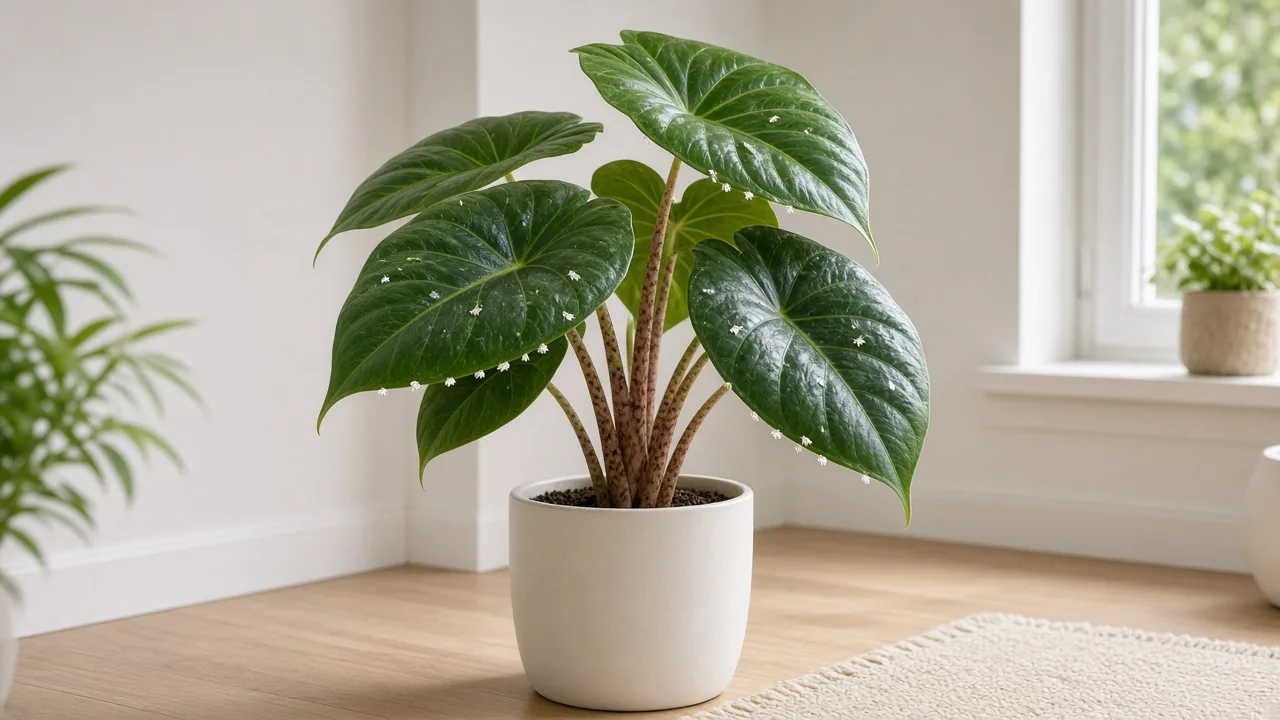
Whiteflies on Alocasia Stingray: Causes, Checks & Fixes
This guide covers whiteflies on Alocasia Stingray. See also the general Whiteflies guide, watering, and light pages for this plant.
Whiteflies on Alocasia Stingray: Causes, Checks & Fixes
Quick answer
Whiteflies are tiny sap-sucking insects that fly around plants when disturbed. On Alocasia Stingray (Alocasia macrorrhizos ‘Stingray’), adults look like miniature white moths tucked under large glossy ray-tail leaves and along red-mottled petioles at the crown. Brush the foliage and a white cloud of insects rises before they resettle on the undersides.
For general whitefly biology, life cycle, and why nymphs cause most feeding damage, see our whiteflies pest guide. On Stingray, the practical pattern is colonies on glossy round undersides and inside unfurling ray-tail blades, sticky honeydew shining on wide green tissue, and extra vigilance because this macrorrhizos cultivar is a tall floor specimen whose red-mottled petiole bases sit above eye level.
First step: move the plant away from others and rinse it thoroughly. Wear gloves because Alocasia contains insoluble calcium oxalate crystals that irritate skin and are toxic to cats and dogs if chewed. Use lukewarm water in a bathtub or shower, angling the spray at leaf undersides and petiole bases where whiteflies hide. Knock down live adults and nymphs before reaching for soap or oil.
For overlapping dry-edge damage without stickiness or flying insects, see low humidity on Alocasia Stingray. For white cottony clusters instead of flat disks and flying adults, check mealybugs on Alocasia Stingray.
What whiteflies look like on Alocasia Stingray
On this upright floor alocasia, whiteflies rarely spread evenly across every mature ray-tail leaf. They concentrate where sap flow is highest and where the round glossy blades give them cover:
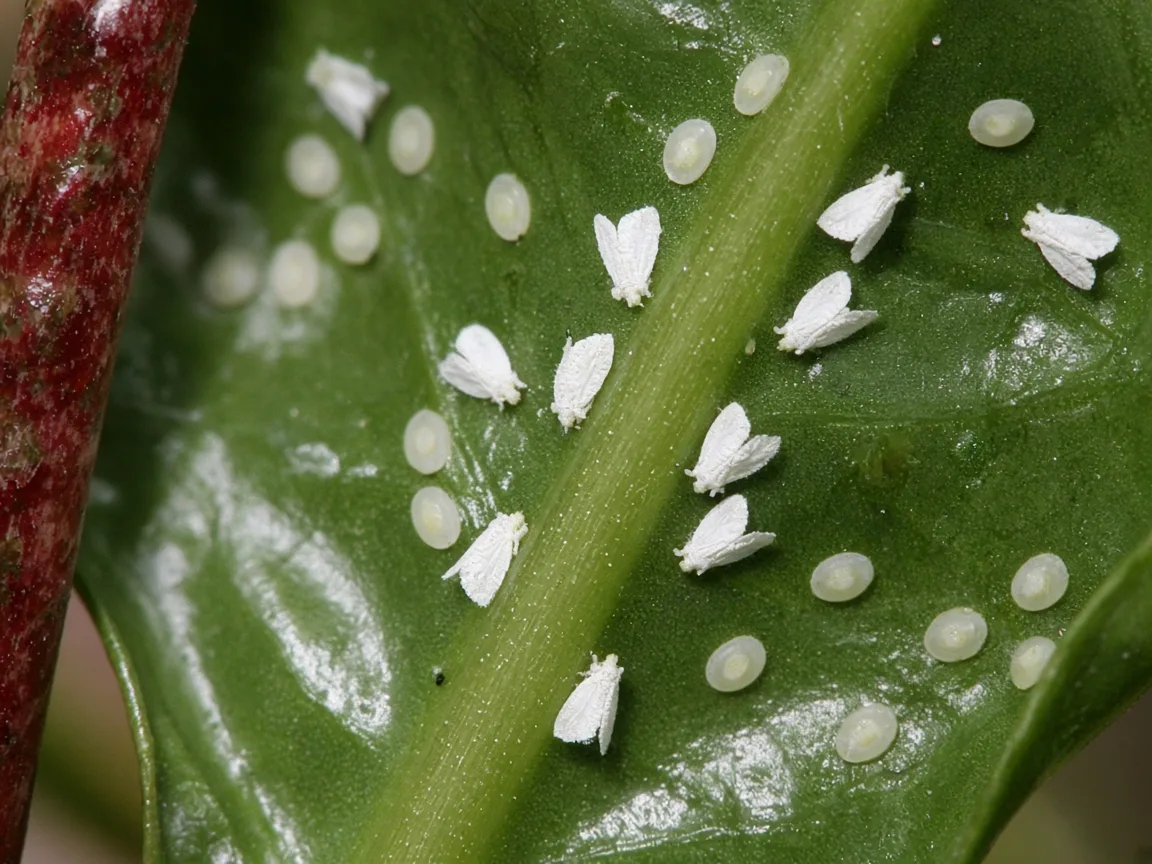
Whitefly adults and flat nymph disks on a Stingray ray-tail underside—compare with healthy glossy green tissue on the same blade.
- New round ray-tail blades still unfurling from the central corm
- Glossy green leaf undersides along the midrib, margins, and elongated ray-tail tip
- Red-mottled petiole bases—the tight angle where each stalk meets the corm
- Lower leaves on tall floor specimens—easy to miss when you only inspect the crown
Individual adults are tiny insects with yellowish bodies and four whitish wings, roughly 1/16 inch long. They are not true flies—they belong to the same order as aphids and mealybugs. When you disturb the plant, adults fly briefly, then resettle on undersides.
Immature whiteflies look very different: after a brief crawler stage, nymphs become oval, legless, and immobile—flat pale disks glued to leaf backs. Nymphs cause most of the feeding damage, not the flying adults you notice first.
Damage on Stingray shows up as:
- A sudden white cloud when you water, move, or brush leaves
- Shiny, sticky leaf surfaces from honeydew excreted during feeding
- Yellowing, silvering, or drying of ray-tail blades with heavy nymph colonies underneath
- Black sooty mold growing on honeydew-coated glossy undersides; see black spots on Alocasia Stingray when the coating wipes off
- Stunted or distorted unfurling ray-tail leaves when feeding is heavy at the crown
Stingray’s wide round blades and glossy undersides make honeydew and sooty mold especially obvious compared to matte-leaved houseplants. A fine black coating on sticky areas is sooty mold fungus growing on sugar-rich residue—not a separate disease, but a sign whiteflies have been feeding for a while.
Where whiteflies hide on Stingray’s ray-tail leaves and red-mottled petioles
Stingray grows upright to 60–150 cm indoors with round glossy leaves on long red-mottled petioles. That architecture creates specific hiding spots whiteflies exploit—and that a standing owner easily misses:
Red-mottled petiole bases at the crown. The dense cluster where each stalk meets the corm is the first place to inspect on a floor specimen you cannot easily lift overhead. Colonies here coat several new ray-tail blades within weeks.
Inside unfurling round blades. Each new leaf emerges rolled like a scroll before the ray-tail tip extends. Whiteflies settle along the midrib inside that tight cylinder and feed undisturbed until the blade opens.
Glossy undersides along the midrib and ray-tail extension. Honeydew pools on the wide round tissue and drips onto lower leaves or the pot rim. What looks like a watering splash is often insect residue.
The junction where petiole meets blade. The tight angle on each red-mottled stalk traps nymph disks where rinse pressure does not reach.
Lower mature ray-tail leaves only when colonies are heavy. Whiteflies prefer tender tissue, but on a neglected plant they spread to older blades and along entire petiole lengths.
This crown-and-petiole inspection pattern is plant-specific. A compact jewel alocasia like Alocasia Black Velvet sits closer to eye level; Stingray’s height and floor placement mean weekly checks require tilting the pot, using a step stool, or enlisting a second person to see petiole bases clearly.
Why Stingray’s fast macrorrhizos growth attracts whiteflies
Whiteflies are not a sign that you failed at basic care. They are common indoor pests that suck plant juices from many houseplants and thrive when natural predators are absent. Several factors make Alocasia Stingray a frequent target:
Fast seasonal growth. During warm months, Stingray can push a new ray-tail leaf every one to two weeks when light, humidity, and watering align. Each emerging round blade and red-mottled petiole is fresh tissue for crawlers to colonize.
Large leaf surface and long petioles. A single Stingray blade can reach 60 cm across with a long ray-tail extension on a stalk 30–60 cm tall. More stem length means more protected feeding sites along red-mottled tissue—and more honeydew to clean if you miss an early cluster.
Indoor conditions without predators. Outdoors, lady beetles, lacewings, and parasitic wasps keep whitefly numbers low. Inside, populations can build unnoticed because nothing is eating them. Warm room temperatures (18–26°C / 65–80°F)—ideal for Alocasia—also speed crawler development.
Introduction from outside or new plants. Whiteflies hitchhike on nursery stock, shared benches, or infested neighbors. Inspect new plants before mixing them with your collection; eggs and nymphs on leaf undersides are the usual entry route.
Ant-tended colonies. Ants protect whiteflies from natural enemies while harvesting honeydew. If ants patrol your Stingray saucer, assume the infestation is larger than visible adults suggest.
Dormant pots are not pest-free. Stingray may drop every leaf in winter while the corm below stays alive—a normal dormancy pattern. Whitefly nymphs can persist on remaining petiole stubs and crown tissue through that bare phase, then explode when spring ray-tail leaves unfurl. Do not assume an empty-looking pot is insect-free.
Stress does not cause whiteflies—but it slows recovery. Overwatering in winter is the most common alocasia killer. Soggy mix weakens roots while you fight foliage pests. Confirm the watering rhythm separately: top 2–3 cm dry before soaking, not extra water because leaves look yellow.
How to confirm the cause
Work through these checks in order before treating:
- Disturbance test — Brush a glossy ray-tail leaf over white paper. Adults fly up and resettle on undersides. That white cloud is the fastest whitefly confirmation on Stingray.
- Underside inspection — Tilt each leaf with bright sidelight. Look for flat pale nymph disks and powdery white adults along the midrib, especially on the youngest blades.
- Petiole base check — Inspect the angle where each red-mottled petiole meets the corm. Colonies often start on tender tissue before spreading across mature ray-tail leaves.
- Honeydew and ants — Sticky residue on glossy undersides or ant trails on saucers strongly support sap-feeder diagnosis.
- Neighbor scan — Check plants on the same shelf or in the same humid corner. Whiteflies spread by short flights and contact between touching leaves.
- Lookalike cross-check — Pear-shaped clusters without a flying cloud point to aphids. Cottony wax in crevices suggests mealybugs. Silvery stippling without stickiness fits thrips better.
If you see flying white adults plus immobile nymph disks on undersides with honeydew, whiteflies are confirmed. Treat before overlapping life stages make elimination much harder.
Symptom lookalike comparison table
| What you see | More likely cause | Where to read |
|---|---|---|
| White cloud when disturbed + flat disks on undersides | Whiteflies | This page |
| Pear-shaped soft insects, no flying cloud | Aphids | Aphids guide |
| Cottony white wax in petiole axils | Mealybugs | Mealybugs guide |
| Silvery stippling, no honeydew | Thrips | Thrips guide |
| Fine webbing on glossy undersides | Spider mites | Spider mites guide |
| Crisp brown edges, no stickiness | Low humidity | Humidity guide |
| Mushy petioles, sour soil smell | Root rot | Root rot guide |
First fix for Alocasia Stingray
Isolate the plant and rinse every leaf underside and petiole base with lukewarm water.
Isolate infested plants away from others immediately—whiteflies fly short distances and hitchhike on hands, tools, and touching leaves.
For a tall Stingray floor specimen, a shower or bathtub rinse works better than misting:
- Wear gloves—oxalate-rich sap irritates skin
- Support large ray-tail leaves so the spray does not snap red-mottled petioles
- Angle water at leaf undersides and petiole bases, not just the glossy upper surface
- Work from lower leaves upward so dislodged insects do not resettle on clean tissue above
- Rinse until you see adults flying off and nymph disks loosening
Let foliage dry completely in bright indirect light before the next step. This single rinse knocks down adults and soft nymphs without coating the plant in chemicals on day one.
Step-by-step recovery
After the initial rinse, follow this sequence—one layer at a time:
1. Yellow sticky traps for monitoring
Hang yellow sticky traps at canopy height with the sticky side facing the plant. Traps monitor adult numbers and catch some flyers—they will not eliminate a colony alone, but they confirm whether your rinse-and-spray program is working. Replace traps when coated with insects or dust.
2. Insecticidal soap on undersides (second visit)
Once leaves are dry, spray insecticidal soap thoroughly on leaf undersides, petiole bases, and unfurling ray-tail blades. Soap only kills on contact—it must coat nymphs and adults directly. Avoid runoff into saturated potting mix; Stingray corms rot quickly in wet chunky aroid mix that never dries.
3. Repeat on a five- to seven-day cycle
Whiteflies pass through multiple nymphal stages on leaf undersides. Repeat soap or horticultural oil treatments every five to seven days for at least three to four cycles to catch newly hatched crawlers before they settle. Missing one week often lets the population rebound.
4. Prune only heavily infested lower leaves
If a few lower ray-tail leaves carry dense nymph colonies you cannot rinse clean, cut them at the petiole base with clean shears. Bag and discard foliage—do not compost indoors. Do not strip the crown bare; Stingray needs remaining leaves to photosynthesize during recovery.
5. Avoid disruptive pesticides indoors
Broad-spectrum sprays that kill natural enemies often make whitefly outbreaks worse. Reserve systemic products for severe cases after soap cycles fail, and never apply them to a dormant, leafless plant without reading the label for indoor use.
Recovery timeline
Judge progress by new growth and trap counts, not by whether old blemished ray-tail leaves look perfect.
| Timeframe | What to expect |
|---|---|
| Days 1–3 | Fewer adults on sticky traps after rinse; honeydew may still feel tacky on older leaves |
| Week 1 | Flying insects noticeably reduced; new nymph disks should be sparse on unfurling blades |
| Weeks 2–4 | Clean round ray-tail leaves unfurling from the center; sooty mold wipes off with a damp cloth |
| Weeks 4–6 | Stable trap counts near zero; remaining yellowed lower leaves can be removed if unsightly |
Badly silvered or distorted mature foliage usually will not regain perfect shape. Recovery means the problem stops spreading and new ray-tail blades emerge without stickiness or nymph disks underneath.
Mistakes to avoid
- Treating only the crown on a tall plant — Lower ray-tail leaves often host the first colonies. Inspect the full height.
- Spraying upper leaf surfaces only — Nymphs feed on undersides. Upper-surface sprays waste product and miss the life stage that does the damage.
- Overwatering after repeated rinses — Extra soil moisture stresses the corm. Stick to the watering guide dry-down check.
- Heavy horticultural oil on a drought-stressed plant — Oils can burn soft alocasia tissue. Rinse and let the plant rehydrate before oil sprays if leaves are limp from underwatering.
- Fertilizing during active infestation — Do not feed a pest-stressed Stingray until new growth looks healthy for two weeks and insects are controlled.
- Assuming dormancy cleared the pests — Treat petiole bases on bare winter pots if you saw whiteflies before leaf drop.
When to worry
Treat immediately if you see:
- Whiteflies on multiple plants in the same humid room—adults disperse quickly indoors
- Black sooty mold coating several ray-tail leaves—colonies have been feeding long enough to support fungus
- Ants on saucers or plant stands—often signals a larger hidden infestation protected from predators
- Stuck or distorted unfurling leaves at the crown—nymphs may be on tissue contact sprays cannot reach
- A pet chewing treated or pruned foliage—oxalate toxicity is separate from the pest problem
Pet safety: Alocasia is toxic to cats and dogs because of insoluble calcium oxalate crystals in all plant tissue. Treatment sprays do not neutralize that risk. Keep Stingray on a stand pets cannot reach during and after treatment.
When to escalate: If three to four weekly treatment cycles fail, adults return within days, or whiteflies appear on multiple plants, consult your local extension office for integrated pest management options labeled for indoor use—or isolate and discard severely infested plants to protect your collection.
Alocasia Stingray care cross-check
After pests are controlled, confirm the growing conditions that keep Stingray resilient:
- Light: Bright indirect light per the Alocasia Stingray light guide—not so dim that growth stalls, not so harsh that ray-tail tips crisp
- Humidity: 60–75% supports healthy leaf texture without the dry air that favors spider mites
- Watering: Top 2–3 cm dry before watering per the watering guide—avoid soggy mix that stresses roots while you fight foliage pests
- Soil: Chunky aroid mix per the soil guide—moist but well-drained mix dries predictably between waterings
A plant pushing steady, moderate new growth is easier to inspect than one cycling between flush and stall.
How to prevent whiteflies next time
- Quarantine new Stingray purchases for two to three weeks; inspect glossy undersides and unfurling ray-tail blades twice weekly
- Space plants so round leaves do not touch—whiteflies spread by short flight and contact
- Inspect lower leaves monthly on tall specimens, not just the crown
- Hang one yellow sticky trap near the plant during warm months as an early-warning system
- Keep ants off saucers—they protect whiteflies from predators that would otherwise help indoors
- Avoid broad-spectrum indoor pesticides that disrupt any remaining beneficial insects on patio plants you bring inside
When to use this page vs other Alocasia Stingray guides
- Alocasia Stingray watering guide — Use for routine moisture checks before assuming whiteflies is the main issue.
- Alocasia Stingray problems hub — Browse all common issues on this species.
- Aphids on Alocasia Stingray — Different entry point when symptoms overlap with whiteflies.
- Mealybugs on Alocasia Stingray — Different entry point when symptoms overlap with whiteflies.
- Thrips on Alocasia Stingray — Different entry point when symptoms overlap with whiteflies.
Related Alocasia Stingray guides
- Alocasia Stingray overview
- Alocasia Stingray watering
- Alocasia Stingray light
- Alocasia Stingray soil
- Aphids on Alocasia Stingray
- Scale insects on Alocasia Stingray
- Alocasia Stingray problems
Related tool
Use the Pest Identifier Tool to narrow causes for whiteflies on this plant before changing multiple variables at once.