Mealybugs on Alocasia Stingray: Crown Checks & Fixes
Quick answer
Mealybugs on Alocasia Stingray settle in crown crevices, red-mottled petiole bases, and inside unfurling ray-tail leaves—often with sticky honeydew on glossy undersides. First step: isolate the plant, wear gloves, and dab every visible cottony cluster with 70% isopropyl alcohol before spraying anything.
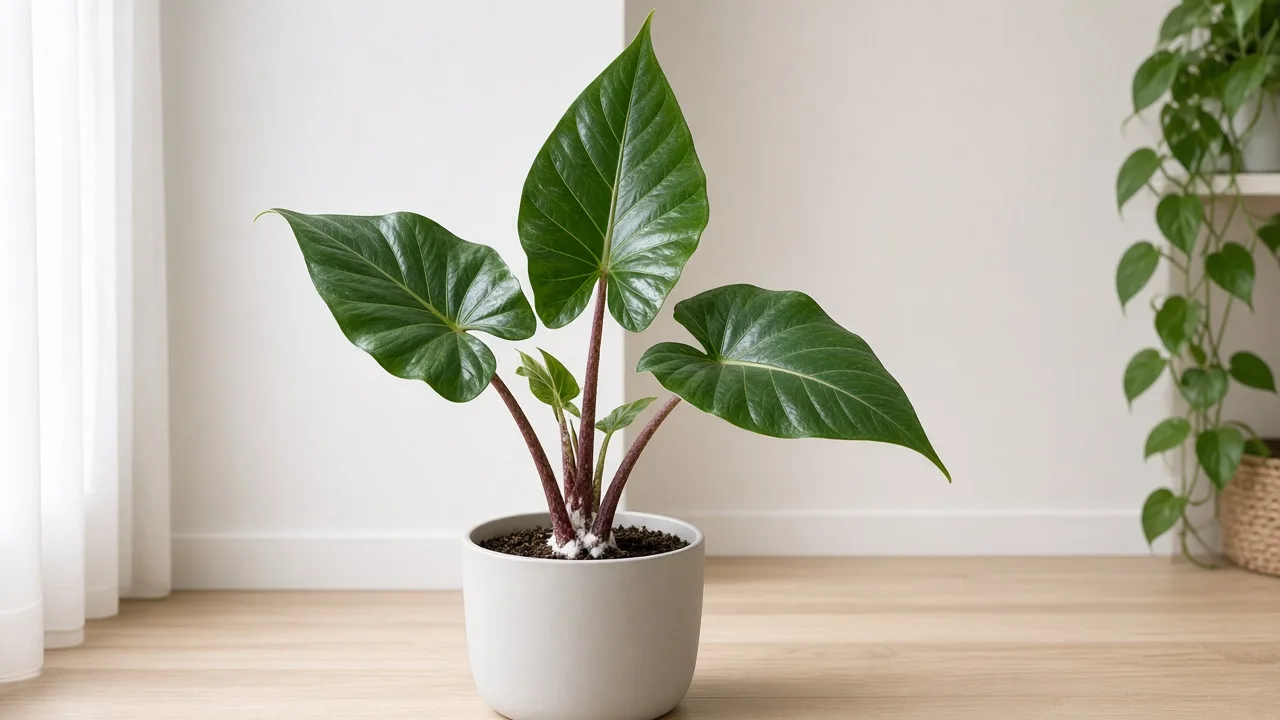
Mealybugs on Alocasia Stingray: Causes, Checks & Fixes
This guide covers mealybugs on Alocasia Stingray. See also the general Mealybugs guide, watering, and light pages for this plant.
Mealybugs on Alocasia Stingray: Causes, Checks & Fixes
Quick answer
Mealybugs on Alocasia Stingray (Alocasia macrorrhizos ‘Stingray’) are small, soft, wax-covered insects that look like tiny white cotton balls tucked into crown crevices, red-mottled petiole bases, and inside unfurling round ray-tail leaves. They suck sap, leave sticky honeydew that can feed sooty mold, and thrive in the protected angles where several upright stalks meet the underground corm.
For how mealybugs reproduce, why ants defend them, and when alcohol dabs work in general, see our mealybugs pest guide. On Stingray, the practical pattern is cottony tufts at petiole axils and inside rolled ray-tail blades, sticky shine on glossy undersides, and extra care because this macrorrhizos cultivar is a tall floor specimen whose crown sits above eye level on red-mottled stalks.
First step: move the plant away from others, wear gloves, and dab every visible cottony cluster with a cotton swab soaked in 70% isopropyl alcohol—then re-inspect in three days before spraying anything.
For overlapping sticky damage with pear-shaped insects on new growth, see aphids on Alocasia Stingray. For fine stippling and webbing without cotton, check spider mites on Alocasia Stingray.
What mealybugs look like on Alocasia Stingray
On this upright floor alocasia, mealybugs rarely spread evenly across mature ray-tail leaves. They concentrate in protected crown tissue where cells are dividing quickly:

Cottony mealybug masses at a Stingray petiole base—compare with healthy red-mottled stalk tissue on the same plant.
- White cottony tufts in crown crevices — Wax-covered clusters where red-mottled petioles meet the stem
- Cotton inside unfurling round blades — Mealybugs slip into rolled ray-tail leaves before they open
- Sticky shine on glossy undersides — Honeydew pools on wide round tissue and drips onto lower leaves
- Black sooty coating on sticky areas — Fungus growing on sugar-rich residue, not a separate leaf disease
- Ant trails on saucers or pot rims — Ants harvest honeydew and protect colonies from lady beetles
- Yellowing or distorted new ray-tail leaves — Heavy feeding on soft emerging tissue while older blades look fine
- Pale crawlers before wax builds — Newly hatched nymphs are mobile and orangish until they settle and produce cottony coating
Individual adults are oval, segmented, and wax-covered. They do not move quickly when disturbed—unlike thrips that run or aphids that are pear-shaped and slow but not cottony. Stingray’s large glossy blades make honeydew and sooty mold especially obvious compared to matte-leaved houseplants.
Where mealybugs hide on Stingray’s ray-tail crown
Stingray grows upright to 60–150 cm indoors with round glossy leaves that taper to an elongated ray-tail on long red-mottled petioles. That architecture creates specific hiding spots mealybugs exploit:
Petiole junctions at the crown. The dense cluster of red-mottled stalk bases where they meet the corm is the first place to inspect on a floor specimen you cannot easily lift overhead. Mealybugs often live in protected areas such as the crown of a plant and in branch crotches. Colonies here coat several new leaves within days.
Inside unfurling round blades. Each new leaf emerges rolled like a scroll before the ray-tail tip extends. Mealybugs slip into that tight cylinder and feed undisturbed until the blade opens. By then, the leaf may already show permanent curl or a kinked tail point.
Soil line and outer pot rim. Some mealybug species feed on roots, but on Stingray the aboveground crown colonies are more common. Still check where petioles emerge from the mix—cottony tufts at the soil surface often mean the infestation is older than it first appears.
Glossy undersides along the midrib. Honeydew pools on the wide round tissue. What looks like a watering splash is often insect residue—run a finger along the underside; tackiness confirms sap feeders.
The ray-tail tip on soft new growth. The pointed extension at the end of each round blade stays tender longest. Mealybugs often cluster at this tip where the leaf is still expanding, distorting the signature Stingray silhouette.
This is different from compact jewel alocasias where the crown sits closer to eye level. Stingray’s height and floor placement mean weekly checks require tilting the pot, using a step stool, or enlisting a second person to see petiole bases clearly.
Why Stingray’s fast macrorrhizos growth attracts mealybugs
Mealybugs are not a sign that you failed at basic care. They are common problems on houseplants that thrive when tender new growth is available and natural predators are absent indoors. Several factors make Alocasia Stingray a frequent target:
Fast seasonal growth. During warm months, Stingray can push a new ray-tail leaf every one to two weeks when light, humidity, and watering align. Each emerging leaf is fresh tissue mealybugs prefer for egg laying.
Large protected crown. A full Stingray specimen carries multiple upright petioles emerging from one corm. The angles between stalks create pockets contact sprays miss on the first pass.
Indoor conditions without predators. Outdoors, lady beetles, lacewings, and parasitic wasps keep mealybug numbers low. Inside, all life stages may be present year-round because mild room temperatures favor continuous reproduction. Warm room conditions (18–26°C / 65–80°F)—ideal for Alocasia—also speed mealybug colonies.
Introduction from new plants. Mealybugs hitchhike on nursery stock, cuttings, or tools. Skipping quarantine is the most common entry route into a collection.
Nitrogen-rich, soft growth after repot or feed spike. Over application of nitrogen combined with regular irrigation stimulates new plant growth where mealybugs prefer to lay eggs. A fresh repot with nutrient-rich mix can push the same soft flush—watch the crown closely for two weeks after repotting per the repotting guide.
Stressed plants are not immune. Low humidity, drafty windows, or inconsistent watering weaken Stingray, but mealybugs colonize healthy, actively growing specimens just as readily. Focus on removal first, then review care if growth stalls after treatment.
How to confirm the cause
Work through these checks before committing to sprays:
Five-step crown inspection
- Locate cottony clusters. Use a hand lens or phone macro mode on the newest round leaf and each petiole base. White wax that does not move when prodded confirms mealybugs. Pear-shaped insects suggest aphids instead.
- Test stickiness. Honeydew feels tacky and does not wipe away dry like hard-water spots. If your finger picks up a sugary film on a glossy underside, sap-feeding insects are present.
- Look for ants. Ants protect mealybugs from natural enemies in exchange for honeydew—especially on plant saucers or nearby windowsills.
- Check egg sacs. Adult females lay 100–200 or more eggs in cottony egg sacs attached to crowns, leaves, or stems near soil. A single sac can restart an infestation after you remove visible insects.
- Rule out lookalikes using the table below.
If you find cottony tufts on one new leaf and the rest of the plant is clean, you likely caught the infestation early. If honeydew covers multiple leaves or ants are present, assume the colony is wider than it first appears.
Symptom lookalike comparison table
| What you see | Likely cause | How to tell apart on Stingray |
|---|---|---|
| White cottony clusters in crown crevices | Mealybugs | Wax does not move; pink smear when crushed; honeydew on glossy undersides |
| Sticky leaf surface, pear-shaped insects on new growth | Aphids | Slow movement; cast skins near colonies; see aphids guide |
| Silvery streaks on leaves | Thrips | Insects are slender and fast; no cottony wax |
| Fine stippling, webbing | Spider mites | Dry leaf edges; paper tap test shows moving specks |
| Brown immobile bumps on petioles | Scale | Scraping reveals a hard shell; no cottony filaments |
| White powder on leaf surface, no insects | Mineral dust or edema | No stickiness; wipe tests clean; linked to uneven watering |
Leaf curl alone is not diagnostic. Alocasia Stingray can curl new leaves briefly from low humidity or draft stress. Curl plus cottony wax plus stickiness points to mealybugs.
First fix for Alocasia Stingray
Isolate the plant and dab every visible cottony cluster with 70% isopropyl alcohol on a cotton swab.
Move Stingray away from other plants. Wear gloves when handling broken petioles or reaching into the crown—Alocasia contains insoluble calcium oxalate crystals that irritate skin and are toxic to cats and dogs if chewed. Dab directly on mealybugs with a cotton swab to kill or remove them. Work petiole axils, crown crevices, and inside unfurling ray-tail rolls where tufts hide.
Test alcohol on one mature leaf first. Apply to a small part of the plant 1–2 days beforehand and monitor for leaf burn (phytotoxicity). Stingray’s glossy round blades can show pale spotting if alcohol sits too long in direct light.
Keep the corm dry. Stingray stores energy in an underground corm that rots quickly in saturated mix per NC State Extension’s alocasia guidance. Do not flood the crown reservoir while dabbing—wet corm tissue plus pest stress invites rot.
Why dab first:
- Penetrates wax better than a single broad spray on hidden colonies
- Lets you map infestation size before adding chemicals
- Removes egg sacs you can see at petiole bases
- Reduces risk of spreading crawlers to neighboring plants during handling
After dabbing, let foliage air-dry out of direct sun. Large Alocasia leaves can scorch if wet or alcohol-treated tissue sits in a hot window.
If live mealybugs remain after dabbing
Apply insecticidal soap labeled for houseplants. Coat petiole bases and leaf undersides thoroughly—soap only kills on contact. Repeat every five to seven days for at least three applications to catch newly hatched crawlers. Mist leaf surfaces, not the crown reservoir.
Horticultural oil or neem oil can follow if soap alone is not enough, but the waxy coating of adult mealybugs makes contact insecticides less effective than on soft-bodied aphids. Test for phytotoxicity first. Apply late in the day and keep treated foliage out of bright direct light until dry.
For moderate infestations on sturdy plants, a strong stream of water in a shower can dislodge exposed nymphs—repeat every few days. Angle spray at foliage, not a flooded pot center.
Do not reach for systemic insecticides indoors unless the label explicitly permits houseplant use and you have exhausted contact treatments.
Pet and human safety during treatment
Alocasia is toxic to cats and dogs because of insoluble calcium oxalate crystals in all plant tissue. Chewing any part—even a treated leaf—causes oral irritation, drooling, and vomiting. Keep Stingray on a stand pets cannot reach during and after treatment until foliage is dry. Bag and discard pruned infested leaves rather than composting indoors. If a pet ingests plant material, contact your veterinarian or the ASPCA Animal Poison Control Center.
Mealybugs through Stingray dormancy
Stingray may drop every leaf in late autumn or winter while the underground corm stays alive. That empty-looking pot is not pest-free by default—mealybugs can persist on remaining petiole stubs, crown tissue, or egg sacs on stems near soil and explode when spring ray-tail leaves unfurl.
During dormancy:
- Inspect petiole bases even when no blades remain—cottony tufts hide in dried axils
- Use alcohol dabs and rinse contact methods rather than heavy oil on a leafless, low-light plant
- Do not overwater an empty pot while hunting pests—wet corm plus cool room is a faster killer than mealybugs per the watering guide
- Resume weekly crown checks the moment a new round ray-tail tip appears
Treating a live colony during dormancy is worthwhile. Waiting until spring often means fighting insects inside tightly rolled new leaves where spray cannot reach.
Step-by-step recovery
Once the first alcohol dab pass is done, follow this sequence based on severity:
Light infestation (one cluster on new growth)
- Dab visible tufts every three days for two weeks
- Wipe sticky honeydew off mature ray-tail leaves with a damp cloth
- Monitor the crown for new colonies when the next leaf emerges
Moderate infestation (multiple leaves, visible honeydew)
- Dab, then apply insecticidal soap within 24 hours
- Prune only heavily infested new leaves you cannot reach inside curled tissue—see the pruning guide for safe technique
- Repeat soap every five to seven days for three to four cycles
- Inspect neighboring plants weekly for two weeks
Heavy infestation (sooty mold, ants, stunted new growth)
- Dab and soap as above
- Consider pruning the worst-affected new leaves if insects are hidden inside tightly curled ray-tail tissue
- Clean saucers and tray areas so ants cannot protect colonies
- If three to four weekly cycles fail, consider discarding severely infested plants to protect your collection per UC IPM guidance
- Continue weekly checks for one month after the last live mealybug is seen
Throughout recovery, keep watering on your normal Stingray rhythm—water when the top 2–3 cm of mix is dry. Do not fertilize until new growth looks clean and the plant is actively pushing leaves again. Avoid unnecessary nitrogen that produces more soft tissue for survivors to colonize.
Recovery timeline
Expect visible improvement within one to two weeks if treatment is consistent:
- Days 1–3: Honeydew accumulation stops; dabbed areas look cleaner
- Week 1: Live mealybug counts drop sharply after alcohol pass plus first soap application
- Weeks 2–3: New ray-tail leaves emerge without cottony tufts or heavy distortion
- Week 4+: Old blemished leaves remain imperfect, but the crown produces normal round foliage
If new leaves still curl or feel sticky after three soap cycles, re-inspect with magnification—you may have missed egg sacs in the crown or confused scale on lower petioles with mealybugs.
Alocasia Stingray may drop an older leaf during recovery. That is common and not a sign of failure if the center keeps producing green growth.
What not to do
- Spraying alcohol or oil in direct sun. Treated Alocasia foliage in a bright window can burn. Treat in indirect light per the light guide and let leaves dry first.
- Skipping the dab before soap. Wax and honeydew block contact; residue sits in ray-tail leaf grooves.
- One-and-done treatment. Mealybug crawlers hatch continuously indoors. A single spray misses the next generation.
- Homemade dish soap mixes. Unlabeled detergents can strip the waxy cuticle and cause permanent leaf spotting. Use products sold as insecticidal soap for plants.
- Ignoring neighboring plants. Mealybugs spread slowly but steadily to any species with soft crown tissue. Check plants on the same shelf or floor area.
- Fertilizing during active infestation. Soft new shoots feed the next wave of mealybugs. Wait until insects are gone.
- Soaking the corm center during rinse. Waterlogged crown tissue invites rot on a plant already under pest stress.
- Composting pruned infested leaves indoors. Crawlers can migrate. Bag and discard.
- Returning from isolation too soon. Wait at least two weeks after the last live mealybug before placing Stingray back with your collection.
- Handling without gloves on a pet household. Oxalate sap and treatment residue both pose risks.
How to prevent mealybugs on Alocasia Stingray
Prevention is mostly about early detection and limiting introduction:
- Quarantine new plants for at least two weeks before placing them near Stingray
- Inspect the crown weekly during active growth—check petiole bases every time you water
- Dab early tufts immediately before egg sacs multiply
- Avoid excess nitrogen that produces a burst of soft shoots—follow the fertilizer guide at half strength during active growth only
- Keep stable humidity at 60–75% per the low-humidity guide so growth is steady rather than stressed
- Watch the crown after repotting—fresh mix and root disturbance often push soft new shoots mealybugs target first
- Use chunky aroid mix per the soil guide so the pot dries predictably and you are not overwatering while distracted by pests
Mealybugs rarely disappear on their own indoors. Catching a cluster on a single unfurling ray-tail leaf takes minutes; cleaning honeydew and sooty mold from a full Stingray specimen takes much longer. Make the crown the first place you look whenever you walk past your plant.
When to worry — multi-plant spread, sooty mold, and pet safety
Treat immediately if you see:
- Mealybugs on multiple plants in the same room—crawlers and contaminated tools spread colonies
- Black sooty mold coating several leaves—colonies have been feeding long enough to support fungus
- Ants on saucers or plant stands—often means a larger hidden infestation
- Stunted or stuck unfurling leaves at the crown—insects may be inside curls contact spray cannot reach
- A pet chewing treated or pruned foliage—oxalate toxicity is separate from the pest problem
When to escalate: If three to four weekly treatment cycles fail, egg sacs return within days, or colonies coat multiple branch arms, consider consulting your local extension office for integrated pest management options labeled for indoor use—or isolate and discard severely infested plants to protect your collection.
Alocasia Stingray care cross-check
After pests are controlled, confirm the growing conditions that keep Stingray resilient:
- Light: Bright indirect light per the Alocasia Stingray light guide—not so dim that growth stalls, not so harsh that ray-tail tips crisp
- Humidity: 60–75% supports healthy leaf texture without the dry air that favors spider mites
- Watering: Top 2–3 cm dry before watering per the watering guide—avoid soggy mix that stresses roots while you fight foliage pests
- Soil: Chunky aroid mix per the soil guide—moist but well-drained mix dries predictably between waterings
A plant pushing steady, moderate new growth is easier to inspect than one cycling between flush and stall.
When to use this page vs other Alocasia Stingray guides
- Alocasia Stingray watering guide — Use for routine moisture checks before assuming mealybugs is the main issue.
- Alocasia Stingray problems hub — Browse all common issues on this species.
- Aphids on Alocasia Stingray — Different entry point when symptoms overlap with sticky new growth.
- Scale insects on Alocasia Stingray — Different entry point when bumps are hard, not cottony.
- Spider mites on Alocasia Stingray — Different entry point when you see webbing without wax.
Related Alocasia Stingray guides
- Alocasia Stingray overview
- Alocasia Stingray watering
- Alocasia Stingray light
- Alocasia Stingray soil
- Aphids on Alocasia Stingray
- Scale insects on Alocasia Stingray
- Alocasia Stingray problems
Related tool
Use the Pest Identifier Tool to narrow causes for mealybugs on this plant before changing multiple variables at once.