Caterpillars on Black Pepper: Causes, Checks & Fixes
Quick answer
Caterpillars on Black Pepper chew irregular holes through glossy vine leaves or bore tender terminal shoots, often with dark pellet-like frass, usually after balcony season, nursery hitchhikers, or moths near open windows. First step: isolate the vine and hand-pick every caterpillar from the newest tip growth and node axils on the support at dusk with a flashlight.

Caterpillars on Black Pepper: Causes, Checks & Fixes
This guide covers caterpillars on Black Pepper. See also the general Caterpillars guide, watering, and light pages for this plant.
Caterpillars on Black Pepper: Causes, Checks & Fixes
Quick answer
Caterpillars on Black Pepper (Piper nigrum, pepper vine or kali mirch) are larvae of moths and butterflies that chew leaf tissue or, on cultivated pepper vines, bore into tender terminal shoots, leaving irregular holes, notched margins, dark frass pellets, or blackened wilted tips on leaves, node joints, or the pot rim below. Indoor cases are less common than mealybugs, scale, thrips, and mites on warm humid vines, and usually trace to hitchhiking larvae after balcony season, nursery stock, or eggs laid near open windows.
For how caterpillars feed, leave frass, and respond to handpicking and Bt in general, see our caterpillars guide. On Black Pepper, damage clusters on soft tip growth and clasping node axils along the climbing support—not evenly across old lower foliage or at the collar alone.
First step: isolate the vine and hand-pick every caterpillar from the newest tip growth and node axils on the support at dusk with a flashlight.
When to use this page vs other Black Pepper guides
| Pattern | Read next |
|---|---|
| Ragged chew + frass pellets + visible larvae | This page |
| Blackened hollow terminal shoot with boring larva | This page (top shoot borer pattern) |
| Holes but unsure of chewer type | Holes in leaves |
| Pale serpentine tunnels inside the blade | Leaf miners |
| Silvery streaks and black specks, little frass | Thrips |
| White cottony clusters at stem collar | Mealybugs |
| Brown armored bumps on stems | Scale insects |
| Fine webbing and stippling on undersides | Spider mites |
| Sticky honeydew on new growth | Aphids |
| Wilting, collar softness, sour soil, no leaf frass | Overwatering or root rot |
What caterpillars look like on Black Pepper
Caterpillars damage plants by chewing leaves and often leave fecal deposits on the damaged foliage. On a climbing pepper vine, you may notice chew marks only after frass appears on a lower leaf or saucer—the glossy blades hide early feeding at the tip and along the support.
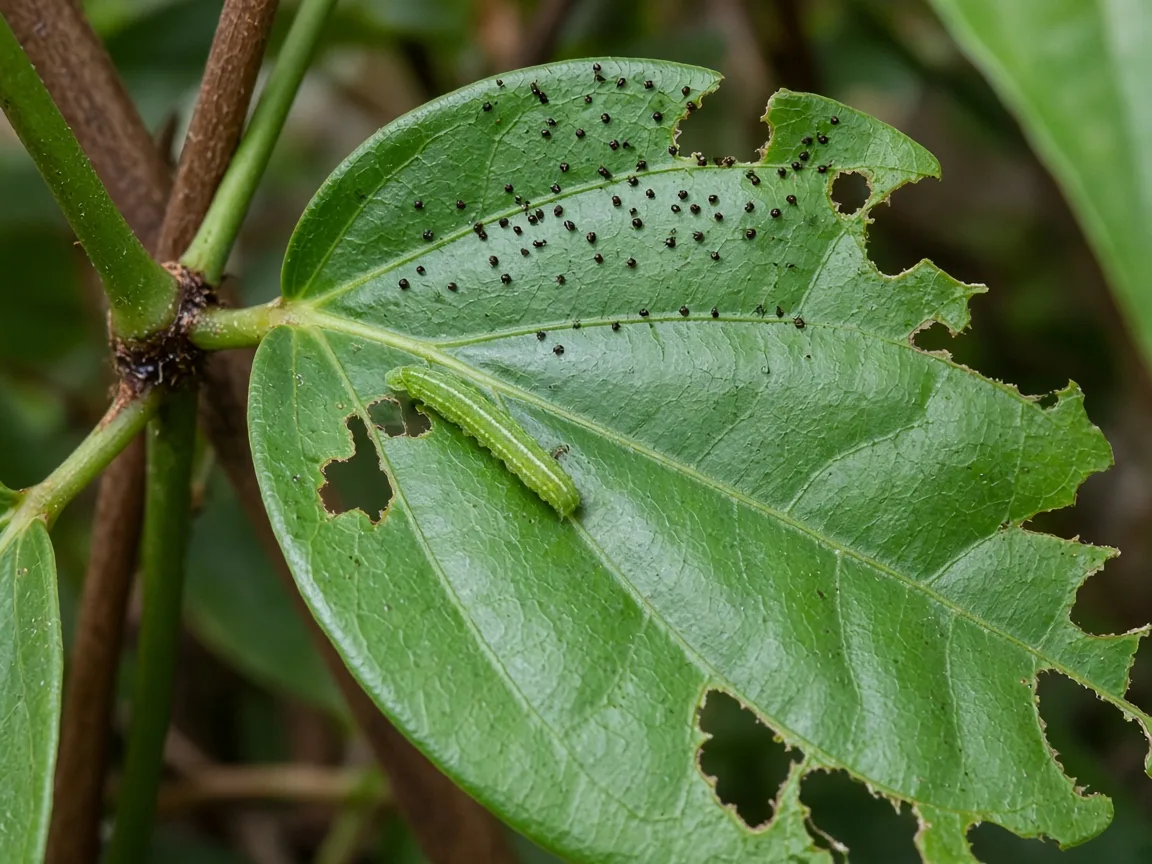
Irregular chew notches through a glossy Piper nigrum leaf with dark pellet-like frass at a climbing node—compare with an intact neighbor leaf on the same stem.
Chewed holes and ragged margins:
- Irregular holes and notched edges on glossy cordate to oval leaves with tissue torn inward, not a clean crease from moving the pot
- Damage concentrated on newest soft tip leaves before it spreads to mature lower foliage on the climbing stem
- Dark pellet-like frass on leaf surfaces, node joints, pot rims, saucers, or the trellis below arching stems
Larva signs (when you can see them):
- Green, brown, or grey-green caterpillars tucked along the underside midrib, at node axils, or inside rolled or webbed leaf sections
- Visible chewing on the highest unfurling leaf before damage spreads down the vine
- Thin silk threads on leaves from some leaf rollers—another cue to inspect further
- Unlike leaf miners, damage goes through the leaf—not inside a bordered tunnel visible when backlit
Top shoot borer pattern (pepper-specific):
- Larvae bore into tender terminal shoots and feed inside, leaving blackened, decaying tip growth rather than open holes only
- The full-grown caterpillar is greyish green; infestation often rises when succulent shoots are plentiful in warm humid months
- A small moth is the adult stage—outdoor vines and balcony plants see more pressure than dry indoor rooms
Unlike spider mites, caterpillars do not produce stippling or webbing. Unlike mealybugs, no cottony wax appears—only open chewing wounds and frass.
Trellis-node hiding spots (Black Pepper only)
Piper nigrum grows as a semi-shade climbing vine in the Piperaceae with adventitious roots at nodes—not a compact rosette or upright cane. Caterpillars exploit that architecture:
- Larvae curl between the leaf base and the trellis, pole, or prop where adventitious roots form moist crevices a spray from across the room misses
- Soft new tip nodes are easier to chew than mature lower foliage—repeat hole damage often starts on the highest unfurling leaf before older leaves show notches
- Some species roll or tie leaves with silk; on pepper vine a curled glossy blade stuck shut is a leaf-roller sign, not humidity curl alone
- Night feeding means daytime inspections skip active larvae—plan dusk passes along the full climbing stem, not one rushed glance at glossy tops only
This climbing-node pattern is why Black Pepper caterpillar cases get misdiagnosed as distorted leaves or curling leaves until someone spreads a tied leaf or finds frass at a node joint.
Terminal shoot borer vs leaf chewers (Black Pepper only)
Commercial pepper guides emphasize top shoot borer (Laspeyresia hemidoxa) on succulent terminal shoots—a caterpillar that tunnels inside tips rather than only skimming leaf blades. That split matters on a container vine at home:
- Shoot borer blackens and hollows the leading tip shoot; you may find internal feeding without obvious through-holes on lower leaves
- Leaf-feeding caterpillars leave open chew and frass on blades while the tip may still extend if the larva is not inside the shoot
- TNAU notes higher borer pressure when numerous succulent shoots are available—the same warm flush that follows good light and watering on a supported indoor vine
- Collar foot rot softens the base in cool, wet mix with sour soil and no pellet frass—route to root rot or overwatering, not caterpillar spray on foliage alone
Do not spray old field rates meant for plantation pepper on a kitchen windowsill vine without reading the label and local rules. Hand removal and targeted tip pruning often suffice on one container plant.
Humid balcony exposure (Black Pepper only)
Black Pepper performs best in bright filtered light, high humidity, and evenly moist fertile soil on a support—conditions that mirror outdoor shade-house culture in warm regions. That same microclimate suits caterpillar outbreaks on balcony vines:
- Outdoor monsoon-season vines on east balconies or under shade cloth see more moth activity than strictly indoor collections
- Dense humid foliage along a trellis gives larvae daytime hiding spots between overlapping glossy blades
- Bringing a vine indoors for cool nights without inspection can import egg masses from outdoor summer culture
- Strictly indoor vines in dry heated rooms get caterpillars far less often than spider mites or low-humidity brown tips—outdoor or balcony time is the usual entry point
Why Black Pepper gets caterpillars
Caterpillars are far less common indoors than sap-sucking pests on tropical vines. When chew damage appears on a supported pepper plant, suspect a recent introduction rather than chronic indoor pressure.
Outdoor balcony and shade-house hitchhikers. Black Pepper summered outdoors or near open windows can pick up moth or butterfly eggs on leaf undersides. Pests arrive on nursery stock and outdoor plants and continue feeding indoors where predators are absent.
Soft tip growth on a fast vine. Pepper vine pushes new glossy leaves from tip nodes whenever filtered light and warmth are good. Caterpillars prefer soft, expanding tissue—one larva can shred an unfurling leaf or bore a succulent shoot before you notice holes on mature lower foliage.
Pepper top shoot borer in warm humid flushes. Integrated pest management for pepper targets shoot borers when tender growth is abundant—relevant if your vine recently surged after repotting, pruning, or a move to a brighter humid spot.
Indoor warmth without predators. Indoor plants lack natural enemies that control caterpillars outdoors. A single egg mass can hatch into multiple larvae feeding along the same climbing stem where birds and parasitic wasps cannot reach.
How to confirm the cause
Work through these checks before you spray:
- Tip nodes first — Examine the softest new growth at the vine end and where petioles meet each node on the support. Caterpillars feed where tissue is softest.
- Shoot borer check — If the terminal shoot is black and wilted, slice it carefully lengthwise to look for a grey-green larva or frass-filled tunnel inside.
- Night inspection — Inspect at night with a flashlight; larvae feed actively and are easier to spot on undersides and inside rolled leaves.
- Frass check — Hold a damaged leaf over white paper and tap lightly. Black or green pellets rolling off suggest caterpillars—not sticky honeydew or silvery scrape marks.
- Backlight test — Hold a suspect leaf to light. Internal bordered tunnels confirm leaf miners, not caterpillars.
- Unroll tied leaves — Silk-bound curled blades may hide a small larva or frass line inside—gently open one suspect roll before assuming humidity curl.
- Isolate first — Move the vine away from other houseplants. Caterpillars walk between pots on shared shelves.
- Collar cross-check — White cottony wax or brown scale at the base without tip chew points to mealybugs or scale insects, not caterpillars.
- Recent history — Note outdoor time, new purchases, open windows, or monsoon balcony culture in the past month.
If you find a larva with ragged holes and pellet frass—or a boring larva in a blackened tip—caterpillars are confirmed. If only internal tunnels appear, switch to the leaf miners guide.
First fix for Black Pepper
Hand-pick every caterpillar you can find before reaching for sprays. Handpicking caterpillars early prevents excessive damage on ornamentals and food vines alike. Gardening Know How recommends plucking caterpillars and dropping them into a bucket of soapy water, and checking for egg clusters on leaf undersides at the same time.
Work at dusk or dawn when larvae feed openly. Start at the highest tip node and move down the stem:
- Flip glossy leaves and inspect midribs and node axils on the trellis or pole
- Prune blackened terminal shoots back to firm green tissue if a shoot borer hollowed the tip—bag and discard bored sections
- Cut out and bag rolled leaves that hide larvae or egg clusters rather than unrolling onto your hand
- Check the pot rim and soil surface where cutworms and larger larvae hide by day
- Remove frass and dropped leaf bits from the saucer so you can tell whether new feeding continues
Make this one correction before insecticides. Watch the vine for five to seven days. If new holes appear, move to the secondary steps below.
If hand-picking is not enough
When larvae are too numerous, hidden in tied leaves along a tall support, or returning after a first pass, escalate in this order rather than stacking treatments the same day.
Apply Bacillus thuringiensis (Bt kurstaki)
Bacillus thuringiensis subsp. kurstaki kills caterpillars that eat treated leaves and leaves most beneficial insects unharmed when used as directed. Ask Extension notes Bt kurstaki as an option for caterpillars on houseplants when hand removal fails.
Spray both sides of leaves in late afternoon or on a cloudy evening when larvae are actively eating—Bt must be ingested to work. Repeat every seven to ten days until you see no new damage. On Black Pepper grown for foliage or eventual peppercorns, wait at least one to two weeks after any spray before harvesting spikes or leaves for kitchen use, and always follow the product label.
Target rolled leaves and node axils
For leaf rollers, clip and bag tied blades with visible silk and frass rather than spraying the entire vine. Direct any spray to tip growth and node axils where pepper vine keeps soft tissue—not the collar region where mealybugs usually live.
Insecticidal soap on small larvae only
Insecticidal soap labeled for ornamentals can contact-kill very small caterpillars on houseplants. It does not replace Bt on larger larvae and can stress leaves if you spray in harsh midday sun on a balcony vine. Test one leaf first on glossy Piper foliage.
Avoid broad-spectrum synthetic sprays on food-adjacent vines unless a local extension agronomist directs them—and never stack soap, Bt, and neem on the same day on stressed foliage.
Recovery timeline
Judge progress by new clean nodes and frass-free tip leaves, not by old holey blades lower on the stem.
- Within one week: Hand-picking should stop new frass at the pot rim if you caught active larvae
- Two to four weeks: Expect glossy new leaves from tip nodes on a firm stem in filtered light with even moisture
- Chewed mature leaves: Permanent cosmetic damage—remove only after the vine pushes replacement growth so you do not strip too much photosynthetic area at once
- Pruned shoot tips: Side branches often emerge below a clean cut; give the vine stable soil moisture without waterlogging while it resprouts
- Repeated defoliation: If tip leaves are stripped every warm month, review outdoor exposure, quarantine new vines, and scout weekly during monsoon and summer balcony season
Whole-vine wilt with soft collar tissue and sour soil is a root-zone emergency, not caterpillar recovery—read overwatering before you keep spraying foliage.
Mistakes to avoid
- Spraying the collar for tip chew — Basal mealybug and scale treatments do not replace tip and node scouting for caterpillars
- Fertilizing a chewed vine first — Nutrients do not remove larvae; confirm pests before feeding—see the Black Pepper fertilizer guide only after new growth looks stable
- Repotting on day one — Unnecessary unless you also find waterlogged mix or root failure; caterpillars rarely require repotting
- Ignoring blackened tips — A hollow terminal shoot can harbor the next generation until you prune or remove the larva inside
- Ignoring rolled leaves — One tied blade can hide larvae after hand-picking adults
How to prevent caterpillars next time
- Quarantine new vines two to three weeks before placing them beside established pepper plants
- Inspect node axils and tip leaves after every outdoor balcony stay or monsoon season
- Screen open windows at night in warm months when moths are attracted to lights near plants
- Scout weekly during fast growth—pepper vine can push new soft tips quickly in humid shade
- Keep supports clean — frass and dropped leaves at the pot rim signal ongoing feeding if you miss a larva
- Maintain even moisture without waterlogging — stressed vines recover slower after defoliation; follow the Black Pepper watering guide and soil guide
Related Black Pepper guides
Use this page when you see ragged chew, pellet frass, and larvae or egg clusters on glossy pepper vine leaves—especially at tip nodes and climbing joints—or blackened bored terminal shoots with internal larval feeding. Route to holes in leaves when damage is unclear, leaf miners for internal tunnels, and aphids or thrips when sap-feeding signs dominate without frass. For baseline culture that keeps vines resilient after pest removal, start with the Black Pepper overview and problems hub.
Related tool
Use the Plant Problem Diagnosis Tool to narrow causes for caterpillars on this plant before changing multiple variables at once.