Black Pepper Care: Light, Water, Soil & Tips
Piper nigrum
Black Pepper (Piper nigrum) needs filtered light, high humidity, and evenly moist fertile soil on a support. Water when the top 2–4 cm dries; avoid waterlogging and cold below 50°F.
Black Pepper Care: Light, Water, Soil & Tips
Start with wateringThe most common care mistake for Black PepperWatering guide →Black Pepper care essentials
Light
bright filtered light or part shade with a sturdy trellis, pole, or prop tree
Water
Keep soil evenly moist but never waterlogged. Water thoroughly when the top 2–4 cm feels dry; water more often in heat and less in cool months. Avoid standing water in the saucer.
Soil
Fertile, well-draining mix rich in organic matter; moisture-retentive but never soggy. Slightly acidic. pH about 5.5–6.5.
Humidity
High (60–80%+); mist foliage in dry rooms
Temperature
about 23°C to 32°C (73–90°F); protect below about 10–13°C (50–55°F)
Fertilizer
Feed every 2–4 weeks in spring and summer with a balanced liquid fertilizer diluted to half strength (include micronutrients), or top-dress with compost.
About Black Pepper
Black Pepper is native to Southern India and Sri Lanka (Western Ghats / Malabar); widely cultivated across the wet tropics, typically reaches 3–4.5 m (10–15 ft) on a support in cultivation; up to ~10 m in the wild; container vines often kept shorter indoors, with moderate to fast in warm, humid, shaded tropical conditions growth. Black Pepper has a climbing growth habit and part of the Piperaceae family. It is also known as Kali Mirch, Pepper Vine, Common Pepper, White Pepper Plant, and Gol Mirch.
| Detail | Information |
|---|---|
| Also known as | Kali Mirch, Pepper Vine, Common Pepper, White Pepper Plant, Gol Mirch |
| Native region | Southern India and Sri Lanka (Western Ghats / Malabar); widely cultivated across the wet tropics |
| Mature size | 3–4.5 m (10–15 ft) on a support in cultivation; up to ~10 m in the wild; container vines often kept shorter |
| Growth rate | Moderate to fast in warm, humid, shaded tropical conditions |
| Growth habit | Climbing |
| Scientific name | Piper nigrum |
| Family | Piperaceae |
Black Pepper Care: Light, Water, Soil & Tips
Black Pepper care starts with one honest framing: Piper nigrum is a humid-shade climber grown for glossy foliage and eventual peppercorn spikes—not a full-sun Capsicum “pepper” plant and not a drought-tolerant succulent. Get placement right—bright filtered light or part shade, fertile soil kept evenly moist, high humidity, and a support to climb—and the rest of the routine becomes predictable. Treat it like a baking-sun terrace shrub or a plant that loves wet feet, and you will see scorched leaves, brown tips, or soft collar rot long before fertilizer helps.
This overview covers identity, mature size, light, water, soil, temperature, feeding, support, fruiting realism, propagation basics, common mistakes, and pet cautions. Use it as the hub, then open the sibling guides when you need depth on one topic.
What Is Black Pepper?
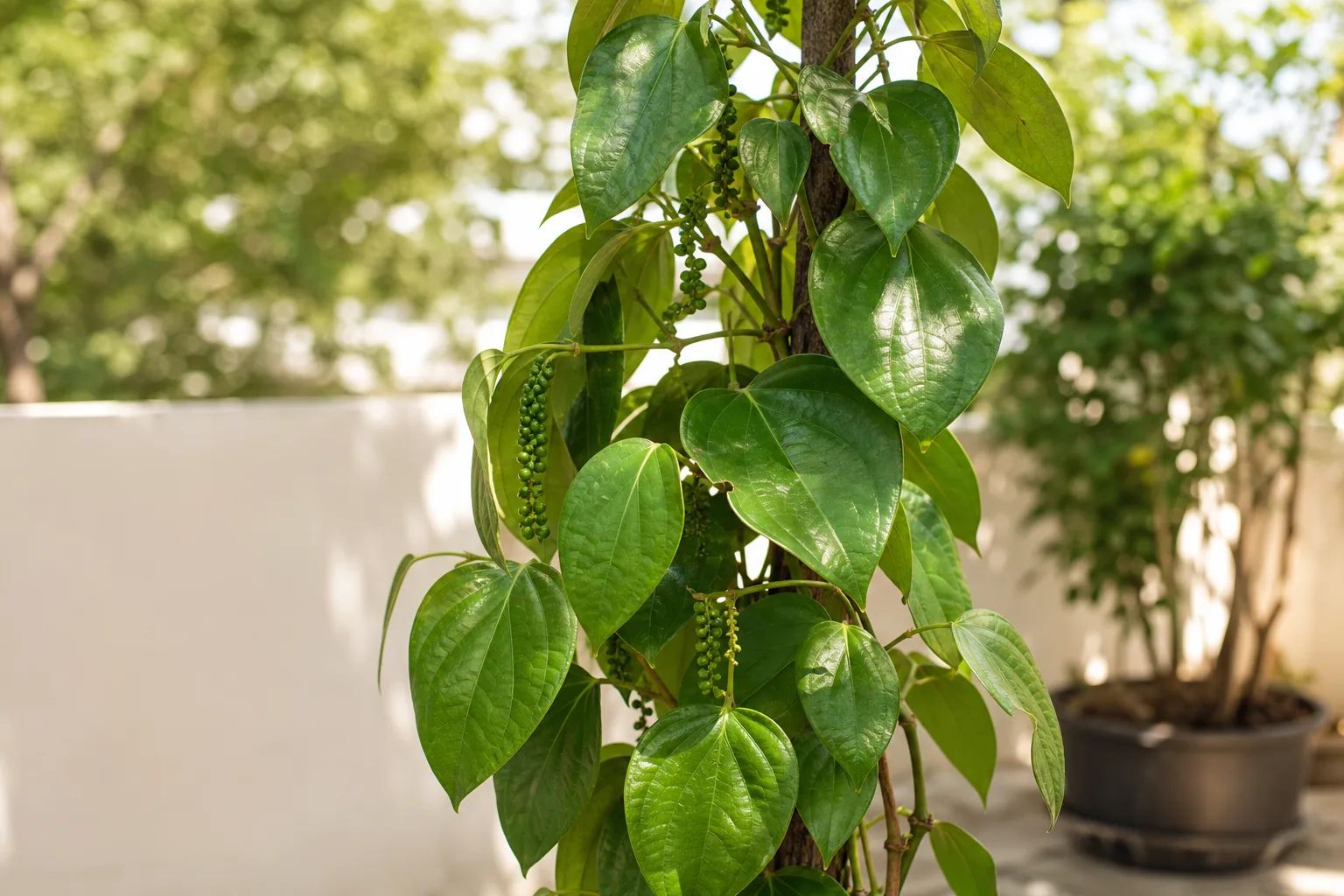
Black Pepper—also sold as Kali Mirch, Gol Mirch, pepper vine, common pepper, or white pepper plant—is a perennial evergreen climber in the pepper family. Home growers keep it for handsome ovate leaves on balconies, shade houses, and bright indoor rooms with a trellis or moss pole. Commercial growers across the wet tropics cultivate it for dried peppercorns; the biology is the same plant, scaled down to a pot or prop-tree vine.
If you are deciding whether the Black Pepper plant hub fits your home, match it to humid, dappled placement first. It is a poor fit for harsh midday sun, cold drafts, dry AC rooms, and waterlogged pots.
Botanical Identity and Common Names
The accepted botanical name is Piper nigrum in the family Piperaceae. Kew’s species profile places wild black pepper in the Western Ghats of Kerala, with long cultivation across the wet tropics. Missouri Botanical Garden similarly lists it as native to southern India and Sri Lanka. Field marks for care purposes are alternate glossy ovate leaves, climbing stems with adventitious roots that cling to moist supports, and flowering spikes that become single-seeded fruits—the peppercorns of commerce.
Do not confuse true black pepper (P. nigrum) with chilli peppers (Capsicum species), pink pepper (Schinus), or Sichuan pepper (Zanthoxylum). Those are different families with different light and water needs. Confirm the botanical tag when a nursery label only says “pepper plant.”
Regional cultivar names (Panniyur series and other Indian releases) matter more for field yield and disease tolerance than for basic balcony care. For a home vine, treat them as the same species with the same light–moisture–support checklist.
Mature Size With Support vs in Containers
With support, black pepper commonly reaches about 10–15 feet (3–4.5 m) in cultivation and can run longer in the wild; Kew describes a climber that may reach 10 m or more once the main stem is established. Plants For A Future lists an evergreen climber to roughly 6 m by 1 m at a fast rate in warm conditions. That is a real climber, not a compact windowsill mound.
In containers with a pole or trellis, expect several metres of trainable stem if you keep tying nodes to the support, while overall height stays limited by pot size and pruning. Plan on Black Pepper repotting every one to two years when roots circle drainage holes or the pot dries within a day of watering. Without a support, stems sprawl, leaf size drops, and the plant looks sparse even when watered correctly.
Best Growing Conditions for Black Pepper
Four variables decide almost every outcome: light quality, humidity, soil drainage with steady moisture, and climbing support. Align those four and feeding, training, and propagation become routine. Misalign any one—especially harsh sun or stagnant wet soil—and the vine stalls, scorches, or softens at the collar no matter how often you mist.
Light and Placement
Black Pepper needs part shade or bright filtered light—sun-dappled understory conditions, not all-day harsh sun. Missouri Botanical Garden recommends sun-dappled areas or bright indirect sun. University of Arkansas Extension describes it as a plant of the moist tropical forest understory that climbs supporting trees. On an Indian balcony, that usually means an east exposure, under shade cloth, or behind a sheer curtain on a bright window. Gentle morning sun is often fine; midday and west summer rays commonly scorch leaves.
Indoors, place the vine in the brightest indirect light you can offer and train it onto a stake or moss pole. Deep shade produces thin, leggy internodes and smaller leaves even when water and fertilizer look “correct.” For window choice, acclimation, and warning signs of too much or too little light, use the dedicated Black Pepper light guide.
Temperature and Humidity
Black Pepper is frost-tender. PFAF lists USDA hardiness zones 10–12 and prefers daytime temperatures roughly 22–35°C, with broader tolerance near 10–40°C. Missouri Botanical Garden frames a practical tropical band around 55–90°F (about 13–32°C) and notes that houseplants are intolerant of winter temperatures below 50°F (10°C). For home growers in India, a comfort zone near 23–32°C matches how the vine grows outdoors in warm humid months.
Humidity is not optional decoration. TNAU stresses that pepper needs high humidity and a warm climate with heavy rainfall in field culture. Target 60–80%+ relative humidity at home. Dry heated or AC rooms brown leaf tips quickly even when the mix is moist. Group plants, use a pebble tray with the pot above the water line, or run a small humidifier near the vine. Mist foliage in dry rooms, as Mobot recommends for containers, but keep airflow moving so leaves do not stay wet overnight.
Soil, Drainage, and pH
Use a rich potting soil with good drainage that still holds steady moisture. TNAU notes that pepper thrives on virgin soils rich in humus; PFAF prefers organic-rich soil and a pH roughly 6–7, tolerating about 5–7.5. For pots, aim slightly acidic—about pH 5.5–6.5—and never let the mix go anaerobic for days.
A practical container blend is about 40% quality potting mix or coco coir, 30% compost or well-rotted manure, 20% perlite or coarse sand, and 10% orchid bark or fine coco chips. Always use a pot with a drainage hole and empty the saucer after watering. If the mix stays heavy, smells sour, or the vine softens at the collar, fix drainage before changing fertilizer. Full recipes and drainage troubleshooting live in the Black Pepper soil guide.
How to Water Black Pepper Without Causing Foot Rot
Keep soil evenly moist but never waterlogged. Water thoroughly when the top 2–4 cm feel dry, then let excess drain. In hot weather that often works out to every 2–4 days; in cooler months every 5–8 days is a common starting range. Your calendar should remind you to check, not force a pour.
TNAU describes pepper as mainly rainfed in the field but recommends protective irrigation in dry months—translated for pots, that means steady moisture without stagnant basins. Phytophthora foot rot is a major commercial disease on black pepper; chronically wet, oxygen-starved mix in cool weather raises the same risk on a balcony. ICAR–IISR research continues to track Phytophthora stress on vines, which is a reminder that drainage and airflow are not optional.
Overwatering signs include yellowing leaves with soft stems, sour-smelling soil, collar soft rot, and fungus gnats in constantly wet mix. Underwatering shows as dull limp leaves, brown crispy tips when air is also dry, slowed vine extension, and soil pulling from the pot edge. When unsure, check depth with a finger and wait one more day rather than adding a “little sip” on already wet roots. Step-by-step seasonal cadence is in the Black Pepper watering guide.
Feeding and Vine Growth
Feed only after light, moisture, and drainage are stable. During active growth (roughly spring through early monsoon and warm humid months), use a balanced liquid fertilizer diluted to half strength every 2–4 weeks, or top-dress lightly with compost. Include micronutrients if your mix is mostly inert coir. Stop or cut back in cool weather, after repotting, or when the plant is stressed.
Commercial schedules from TNAU are field-scale (split NPK per vine with organic manure). Do not copy hectare rates into a 20 cm pot. Over-fertilising in containers burns roots and tips without improving leaf quality. Fertilizer cannot compensate for harsh sun, low humidity, damaged roots, or a mix that stays wet too long. Dilution, timing, and burn signs are covered in the Black Pepper fertilizer guide.
Support, Training, and Fruit Expectations
Every vine needs a bamboo stake, trellis, moss pole, or outdoor prop tree. Kew notes that plants form adventitious roots that connect to surrounding supports; Mobot likewise says the vine needs a support structure. On a balcony, check every couple of weeks and gently tie new nodes before stems flop and break.
Fruiting realism matters. Black, white, and green peppercorns all come from the same Piper nigrum fruits harvested and processed differently. Missouri Botanical Garden states that indoor houseplants will not usually produce fruit. Outdoor vines in long warm tropical seasons may eventually set spikes, but a foliage-first indoor vine is still a success. Do not chase fertilizer hoping for a kitchen spice harvest if light, heat, and vine age are the real limits.
Pair structural cuts and training with the Black Pepper pruning guide. Do not change pot size, placement, and watering all at once after a hard cut.
Propagation Snapshot: Runner Cuttings
The reliable home method is stem cuttings from runner shoots. TNAU describes taking runner shoots, trimming leaves, and planting cuttings of 2–3 nodes in nursery bags with adequate shade and frequent irrigation. PFAF calls cuttings very easy and mentions shoots about 45 cm from wood that has already flowered in field practice. For pots, shorter nodal cuttings with at least one healthy leaf often root in warm, humid mix.
Keep cuttings warm and humid until roots establish; water-rooting then potting also works for patient growers. Seeds work but are slower and less uniform for home use. Give each new plant immediate support and the same filtered light and even moisture as the parent. Full timing, failure modes, and aftercare live in the Black Pepper propagation guide.
Common Mistakes and Warning Signs
The most common failure pattern is harsh midday sun plus inconsistent watering. Scorched patches on sun-facing leaves mean the plant wants more shade or slower acclimation. Soft yellowing with a wet, sour mix means roots are drowning—improve drainage and airflow before you add more water or fertilizer.
Watch for mealybugs, aphids, scale, and mites on new growth, especially when dry indoor air and weak light stress the vine. Sticky residue or white cottony clusters deserve quarantine and mechanical cleaning before chemical reflex. Brown tips with dry indoor air are usually humidity, not a mystery nutrient deficiency. Repeated collar wilt in cool, wet weather should raise Phytophthora suspicion—remove affected material, dry the surface slightly between waterings, and fix the root environment first.
Diagnose from the roots and placement upward. A single blemish matters less than a pattern: repeated yellowing, soft stems, stalled nodes, or soil that never dries.
Pet Caution and Capsicum Confusion
Piper nigrum is not clearly verified with a species-specific listing in the major ASPCA toxic and non-toxic plant database used for LeafyPixels reviews. Do not confuse it with Capsicum “pepper” database entries. Culinary pepper and piperine-rich leaf or fruit tissue may irritate pets that chew foliage or spikes. Treat the vine as caution, keep it out of reach, and contact a veterinarian if ingestion or oral irritation occurs. This is not veterinary advice.
When to use this page vs other Black Pepper guides
Use this overview to decide whether Black Pepper fits your space and to set the baseline routine. Switch to sibling pages when one variable is clearly wrong:
- Light — window choice, shade cloth, scorch vs legginess
- Watering — finger-test cadence, monsoon and winter adjustments, wilt vs drought
- Soil — DIY mixes, drainage fixes, pH and salt issues
- Fertilizer — dilution, seasonal feeding, burn recovery
- Repotting — pot size, timing, post-move care
- Propagation — runner cuttings, rooting, aftercare
- Pruning — training, cleanup cuts, vine management
Related Black Pepper guides
- Black Pepper hub — profile, toxicity notes, and cluster entry
- Black Pepper light — filtered light and sun-scorch prevention
- Black Pepper watering — even moisture without foot-rot-prone wet feet
- Black Pepper soil — organic mixes that drain yet stay moist
- Black Pepper propagation — runner and nodal cuttings
Conclusion
Black Pepper rewards growers who treat it as a humid-shade climber: filtered light, fertile free-draining soil kept evenly moist, high humidity, and a support for adventitious roots. It punishes harsh midday sun, chronically soggy pots, cold drafts below about 10°C, and dry AC air. Start with placement and moisture rhythm, train new growth onto a pole every couple of weeks, and open the sibling guides when one topic needs a deeper fix. That sequence keeps glossy Kali Mirch leaves coming—and keeps fruiting expectations honest—without chasing fertilizer for problems that began at the roots or the window.
How to care for Black Pepper?
How much light does Black Pepper need?
bright filtered light or part shade with a sturdy trellis, pole, or prop tree
- bright filtered light or part shade with a sturdy trellis - bright filtered light or part shade with a sturdy trellis, pole, or prop tree.
- pole - bright filtered light or part shade with a sturdy trellis, pole, or prop tree.
- or prop tree - bright filtered light or part shade with a sturdy trellis, pole, or prop tree.
When should you water Black Pepper?
Keep soil evenly moist but never waterlogged. Water thoroughly when the top 2–4 cm feels dry; water more often in heat and less in cool months. Avoid standing water in the saucer.
- Finger test at 2–4 cm depth - Water thoroughly when the top 2–4 cm feels dry; water more often in heat and less in cool months.
- water when that layer feels dry but the mix below is still lightly damp - Water thoroughly when the top 2–4 cm feels dry; water more often in heat and less in cool months.
- Drain excess water - Keep soil evenly moist but never waterlogged.
What soil works best for Black Pepper?
Fertile, well-draining mix rich in organic matter; moisture-retentive but never soggy. Slightly acidic. pH about 5.5–6.5.
- 40% quality potting mix or coco coir base - Fertile, well-draining mix rich in organic matter; moisture-retentive but never soggy.
- 30% compost or well-rotted manure - Fertile, well-draining mix rich in organic matter; moisture-retentive but never soggy.
- 20% perlite or coarse sand - Fertile, well-draining mix rich in organic matter; moisture-retentive but never soggy.
Grower notes for Black Pepper
What matters most with Black Pepper
Black Pepper is a Piperaceae climber grown for glossy foliage and eventual peppercorn spikes—not a full-sun clumping grass. In practice, the care checkpoint is simple: bright filtered light or part shade with a sturdy trellis, pole, or prop tree. Pair that with fertile, well-draining organic soil kept evenly moist (pH about 5.5–6.5), and avoid changing water, pot size, and placement all at once.
Best placement in a real home
Black Pepper belongs on an east balcony, under shade cloth, or in bright indirect indoor light—sun-dappled understory conditions, not harsh midday sun that scorches leaves. Keep soil evenly moist but never waterlogged. Water thoroughly when the top 2–4 cm feels dry. If the pot stays wet longer than expected, improve airflow or reassess the mix before watering again. Humidity target: High (60–80%+); mist foliage in dry rooms. Temperature comfort zone: about 23°C to 32°C (73–90°F); protect below about 10–13°C (50–55°F).
Before you buy this plant
Choose Black Pepper with firm green nodes, unspotted leaves, and soil that does not smell sour. Prefer vigorous tip cuttings or nursery vines on a support over tired, woody, mealybug-covered stems. Be cautious if you see waterlogged mix, sticky residue, collar soft rot, or a pot kept wet in poor light. Cosmetic transport leaf scuffs matter less than weak roots or active aphids, scale, and mealybugs.
First month after bringing it home
Do not repot Black Pepper on day one unless the mix is failing or pests are obvious. Quarantine it, give it a support to climb, learn how fast the pot dries, and keep care boring while it adjusts. Watch especially for overwatering wilt, brown tips from low humidity, and mealybugs or aphids on new growth. If problems appear, correct light, moisture, and airflow first rather than stacking fertilizer, repotting, and heavy pruning together.
Pet-aware note for Black Pepper
Piper nigrum is not clearly verified with a species-specific listing in the major pet-toxicity databases used here. Culinary peppercorns and piperine-rich tissue can irritate pets that chew leaves or fruit spikes. Keep the vine out of reach and treat it as caution, not chew-safe.
How to tell Black Pepper is settling in
Also sold as Kali Mirch, Pepper Vine, and Common Pepper, this plant should be judged by steady new nodes and firm climbing stems rather than label names alone. If you plan to multiply it later, common methods include Stem cuttings from runners (most reliable) and Seeds (slower, less uniform). Repot only when you see roots circling or emerging from drainage holes and the pot drying within a day after watering. Indoor vines often stay foliage-first; fruiting needs long warm seasons. If yellowing shows up early, inspect drainage, humidity, and light before assuming the vine is permanently weak.
Is black pepper safe for pets?
Piper nigrum is not clearly verified in major pet-toxicity databases. Treat leaves and peppercorn spikes as caution around cats and dogs that chew plants, and keep the vine out of reach.
This review did not confirm a species-specific ASPCA listing for Piper nigrum (do not confuse with Capsicum “pepper” plants). Culinary pepper and piperine-rich tissue may cause gastrointestinal irritation if chewed or eaten in quantity. Keep out of reach of pets.
Watering Black Pepper
For Black Pepper, finger test at 2–4 cm depth; water when that layer feels dry but the mix below is still lightly damp and water every 2–4 days in hot weather; every 5–8 days in cooler months. Increase frequency in hot, dry spells and when the vine is climbing strongly; reduce in winter and after cool nights; never leave roots sitting in stagnant water.
| Detail | Information |
|---|---|
| How often | Every 2–4 days in hot weather; every 5–8 days in cooler months |
| How to check | Finger test at 2–4 cm depth; water when that layer feels dry but the mix below is still lightly damp |
| Seasonal changes | Increase frequency in hot, dry spells and when the vine is climbing strongly; reduce in winter and after cool nights; never leave roots sitting in stagnant water |
Signs of overwatering
- yellowing leaves with soft stems
- root rot or sour-smelling soil
- collar or foot-rot wilt (Phytophthora-style)
- fungus gnats and constantly wet mix
Signs of underwatering
- dull, limp leaves
- brown crispy tips when air is also dry
- slowed vine extension and sparse nodes
- soil pulling from the pot edge
Soil & potting for Black Pepper
Use a mix of 40% quality potting mix or coco coir base, 30% compost or well-rotted manure, 20% perlite or coarse sand, 10% orchid bark or fine coco chips for Black Pepper. Excellent drainage with steady moisture retention; intolerant of waterlogging and compacted pots (Phytophthora foot rot risk). Target soil pH around 5.5–6.5. Repot every 1–2 years, or when roots fill the pot and dry-down becomes very fast, ideally in spring to early monsoon (February–June in most of India).
| Detail | Information |
|---|---|
| Recommended mix | 40% quality potting mix or coco coir base, 30% compost or well-rotted manure, 20% perlite or coarse sand, 10% orchid bark or fine coco chips |
| Drainage | Excellent drainage with steady moisture retention; intolerant of waterlogging and compacted pots (Phytophthora foot rot risk) |
| Soil pH | 5.5–6.5 |
| Repotting frequency | Every 1–2 years, or when roots fill the pot and dry-down becomes very fast |
| Best season to repot | Spring to early monsoon (February–June in most of India) |
Signs it needs repotting
- roots circling or emerging from drainage holes
- pot dries within a day after watering
- vine stalls despite warm humid placement and a secure support
Humidity & temperature for Black Pepper
Black Pepper prefers high (60–80%+); mist foliage in dry rooms, though normal home humidity is usually fine. Keep temperatures around about 23°C to 32°C (73–90°F); protect below about 10–13°C (50–55°F).
| Detail | Information |
|---|---|
| Humidity | High (60–80%+); mist foliage in dry rooms - normal home humidity is fine. |
| Ideal temperature | about 23°C to 32°C (73–90°F); protect below about 10–13°C (50–55°F) |
Fertilizer & pruning for Black Pepper
Use feed every 2–4 weeks in spring and summer with a balanced liquid fertilizer diluted to half strength (include micronutrients), or top-dress with compost. for Black Pepper.
| Detail | Information |
|---|---|
| Fertilizer type | Feed every 2–4 weeks in spring and summer with a balanced liquid fertilizer diluted to half strength (include micronutrients), or top-dress with compost. |
Common problems on Black Pepper
Yellow Leaves
MediumLikely cause: Common on this plant type; confirm with recent watering, light, and root checks.
Quick fix: Inspect the plant and correct the most likely care stressor before stacking treatments.
Full fix guide →Brown Tips
MediumLikely cause: Common on this plant type; confirm with recent watering, light, and root checks.
Quick fix: Inspect the plant and correct the most likely care stressor before stacking treatments.
Full fix guide →Root Rot
MediumLikely cause: Common on this plant type; confirm with recent watering, light, and root checks.
Quick fix: Inspect the plant and correct the most likely care stressor before stacking treatments.
Full fix guide →Overwatering
MediumLikely cause: Common on this plant type; confirm with recent watering, light, and root checks.
Quick fix: Inspect the plant and correct the most likely care stressor before stacking treatments.
Full fix guide →Underwatering
MediumLikely cause: Common on this plant type; confirm with recent watering, light, and root checks.
Quick fix: Inspect the plant and correct the most likely care stressor before stacking treatments.
Full fix guide →Spider Mites
MediumLikely cause: Common on this plant type; confirm with recent watering, light, and root checks.
Quick fix: Inspect the plant and correct the most likely care stressor before stacking treatments.
Full fix guide →Mealybugs
MediumLikely cause: Common on this plant type; confirm with recent watering, light, and root checks.
Quick fix: Inspect the plant and correct the most likely care stressor before stacking treatments.
Full fix guide →Aphids
MediumLikely cause: Common on this plant type; confirm with recent watering, light, and root checks.
Quick fix: Inspect the plant and correct the most likely care stressor before stacking treatments.
Full fix guide →Leggy Growth
MediumLikely cause: Common on this plant type; confirm with recent watering, light, and root checks.
Quick fix: Inspect the plant and correct the most likely care stressor before stacking treatments.
Full fix guide →Slow Growth
MediumLikely cause: Common on this plant type; confirm with recent watering, light, and root checks.
Quick fix: Inspect the plant and correct the most likely care stressor before stacking treatments.
Full fix guide →Wilting
MediumLikely cause: Common on this plant type; confirm with recent watering, light, and root checks.
Quick fix: Inspect the plant and correct the most likely care stressor before stacking treatments.
Full fix guide →Drooping Leaves
MediumLikely cause: Common on this plant type; confirm with recent watering, light, and root checks.
Quick fix: Inspect the plant and correct the most likely care stressor before stacking treatments.
Full fix guide →Low Humidity
MediumLikely cause: Common on this plant type; confirm with recent watering, light, and root checks.
Quick fix: Inspect the plant and correct the most likely care stressor before stacking treatments.
Full fix guide →Not Enough Light
MediumLikely cause: Common on this plant type; confirm with recent watering, light, and root checks.
Quick fix: Inspect the plant and correct the most likely care stressor before stacking treatments.
Full fix guide →Fungus Gnats
MediumLikely cause: Common on this plant type; confirm with recent watering, light, and root checks.
Quick fix: Inspect the plant and correct the most likely care stressor before stacking treatments.
Full fix guide →Mold on Soil
MediumLikely cause: Common on this plant type; confirm with recent watering, light, and root checks.
Quick fix: Inspect the plant and correct the most likely care stressor before stacking treatments.
Full fix guide →Curling Leaves
MediumLikely cause: Common curling leaves pattern on Black Pepper under indoor care stress.
Quick fix: Inspect roots, watering, light, and pests; adjust one variable and monitor new growth.
Full fix guide →Brown Leaves
MediumLikely cause: Common brown leaves pattern on Black Pepper under indoor care stress.
Quick fix: Inspect roots, watering, light, and pests; adjust one variable and monitor new growth.
Full fix guide →Black Spots
MediumLikely cause: Common black spots pattern on Black Pepper under indoor care stress.
Quick fix: Inspect roots, watering, light, and pests; adjust one variable and monitor new growth.
Full fix guide →Holes in Leaves
MediumLikely cause: Common holes in leaves pattern on Black Pepper under indoor care stress.
Quick fix: Inspect roots, watering, light, and pests; adjust one variable and monitor new growth.
Full fix guide →Pale Leaves
MediumLikely cause: Common pale leaves pattern on Black Pepper under indoor care stress.
Quick fix: Inspect roots, watering, light, and pests; adjust one variable and monitor new growth.
Full fix guide →Distorted Leaves
MediumLikely cause: Common distorted leaves pattern on Black Pepper under indoor care stress.
Quick fix: Inspect roots, watering, light, and pests; adjust one variable and monitor new growth.
Full fix guide →Scale Insects
MediumLikely cause: Common scale insects pattern on Black Pepper under indoor care stress.
Quick fix: Inspect roots, watering, light, and pests; adjust one variable and monitor new growth.
Full fix guide →Thrips
MediumLikely cause: Common thrips pattern on Black Pepper under indoor care stress.
Quick fix: Inspect roots, watering, light, and pests; adjust one variable and monitor new growth.
Full fix guide →Whiteflies
MediumLikely cause: Common whiteflies pattern on Black Pepper under indoor care stress.
Quick fix: Inspect roots, watering, light, and pests; adjust one variable and monitor new growth.
Full fix guide →Leaf Miners
MediumLikely cause: Common leaf miners pattern on Black Pepper under indoor care stress.
Quick fix: Inspect roots, watering, light, and pests; adjust one variable and monitor new growth.
Full fix guide →Caterpillars
MediumLikely cause: Common caterpillars pattern on Black Pepper under indoor care stress.
Quick fix: Inspect roots, watering, light, and pests; adjust one variable and monitor new growth.
Full fix guide →Nitrogen Deficiency
MediumLikely cause: Common nitrogen deficiency pattern on Black Pepper under indoor care stress.
Quick fix: Inspect roots, watering, light, and pests; adjust one variable and monitor new growth.
Full fix guide →Iron Deficiency
MediumLikely cause: Common iron deficiency pattern on Black Pepper under indoor care stress.
Quick fix: Inspect roots, watering, light, and pests; adjust one variable and monitor new growth.
Full fix guide →Magnesium Deficiency
MediumLikely cause: Common magnesium deficiency pattern on Black Pepper under indoor care stress.
Quick fix: Inspect roots, watering, light, and pests; adjust one variable and monitor new growth.
Full fix guide →Potassium Deficiency
MediumLikely cause: Common potassium deficiency pattern on Black Pepper under indoor care stress.
Quick fix: Inspect roots, watering, light, and pests; adjust one variable and monitor new growth.
Full fix guide →Calcium Deficiency
MediumLikely cause: Common calcium deficiency pattern on Black Pepper under indoor care stress.
Quick fix: Inspect roots, watering, light, and pests; adjust one variable and monitor new growth.
Full fix guide →