Iron Deficiency on Black Pepper: Yellow New Leaves & Green
Quick answer
Iron deficiency on Black Pepper shows as pale or yellow new leathery leaves with darker green veins (interveinal chlorosis) at active climbing vine tips during warm humid growth, while older glossy leaves lower on the same runner often stay deep green. First step: confirm the vein pattern is on the newest expanding leaf at an extending node—not uniform yellowing from waterlogged soil—then check whether alkaline tap water, stagnant mix, or skipped micronutrients blocked iron uptake before one chelated iron drench.
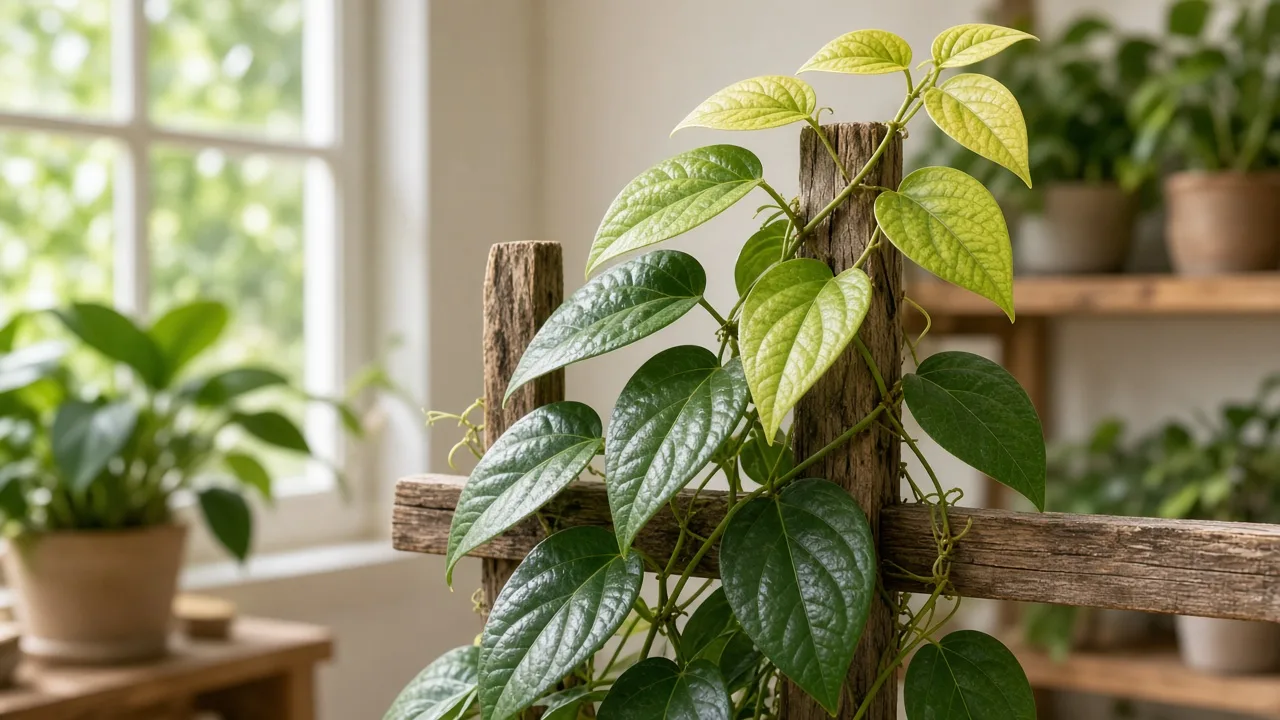
Iron Deficiency on Black Pepper: Causes, Checks & Fixes
This guide covers iron deficiency on Black Pepper. See also the general Iron Deficiency guide, watering, and light pages for this plant.
Iron Deficiency on Black Pepper: Causes, Checks & Fixes
Quick answer
Iron deficiency on Black Pepper (Piper nigrum) shows as pale or yellow new leathery leaves with darker green veins (interveinal chlorosis) at active climbing vine tips during warm humid growth, while older glossy leaves on the same runner may stay deep green. Iron is immobile in plants, so chlorosis appears on young expanding tissue first—not on the lowest old leaves the way nitrogen deficiency does.
See our iron deficiency guide for general chlorosis mechanics. On Black Pepper, inspect the thick leathery leaf still opening at the tip of a supported runner—veins stay green while tissue between them yellows on the newest blade above a firm node.
First step: confirm new-growth interveinal chlorosis with green veins during active warm-season extension, then check whether alkaline tap water, waterlogged mix, or depleted organic soil blocked iron uptake before applying chelated iron.
When to use this page vs other Black Pepper guides
| Pattern | Read next |
|---|---|
| New tip leaves yellow with green veins | Iron deficiency (this page) |
| Lowest leaves pale uniformly; no vein pattern | Nitrogen deficiency |
| Whole vine washed-out in a dim corner | Pale leaves or not enough light |
| Interveinal yellowing on older mid-stem leaves | Magnesium deficiency |
| Yellow leaves, wet soil, soft collar, sour smell | Overwatering or root rot |
| General yellowing without clear vein pattern | Yellow leaves |
| Brown crispy tips in dry AC air | Brown tips or low humidity |
What iron deficiency looks like on Black Pepper
Healthy pepper vine pushes thick, leathery, alternately arranged leaves from nodes along a trellis or pole in warm, humid, filtered light. Iron stress breaks that pattern at each active growing point, not across every leaf on the plant at once.
Typical signs:
- Pale or lime-yellow new leathery leaves at vine tips with veins remaining darker green
- Successively paler new leaves on the same runner if untreated—two or three pale openers in a row during monsoon-season flush
- Older leaves farther down the stem may stay glossy green while only the newest tip leaf looks chlorotic
- Smaller or thinner new blades when chlorosis is severe on a vine pushing rapid extension in heat
- Firm nodes and stems if roots are functional—soft collar tissue on sour wet mix points to overwatering or foot rot instead
Not iron deficiency:
- Uniform pale lower leaves first — nitrogen deficiency
- Washed-out green across many leaves with long bare internodes — pale leaves or not enough light
- Interveinal yellowing on oldest mid-stem leaves — magnesium deficiency
- Stalled extension with dull limp leaves in a dry pot — underwatering
- All leaves yellow on persistently wet soil — root failure overlap with root rot
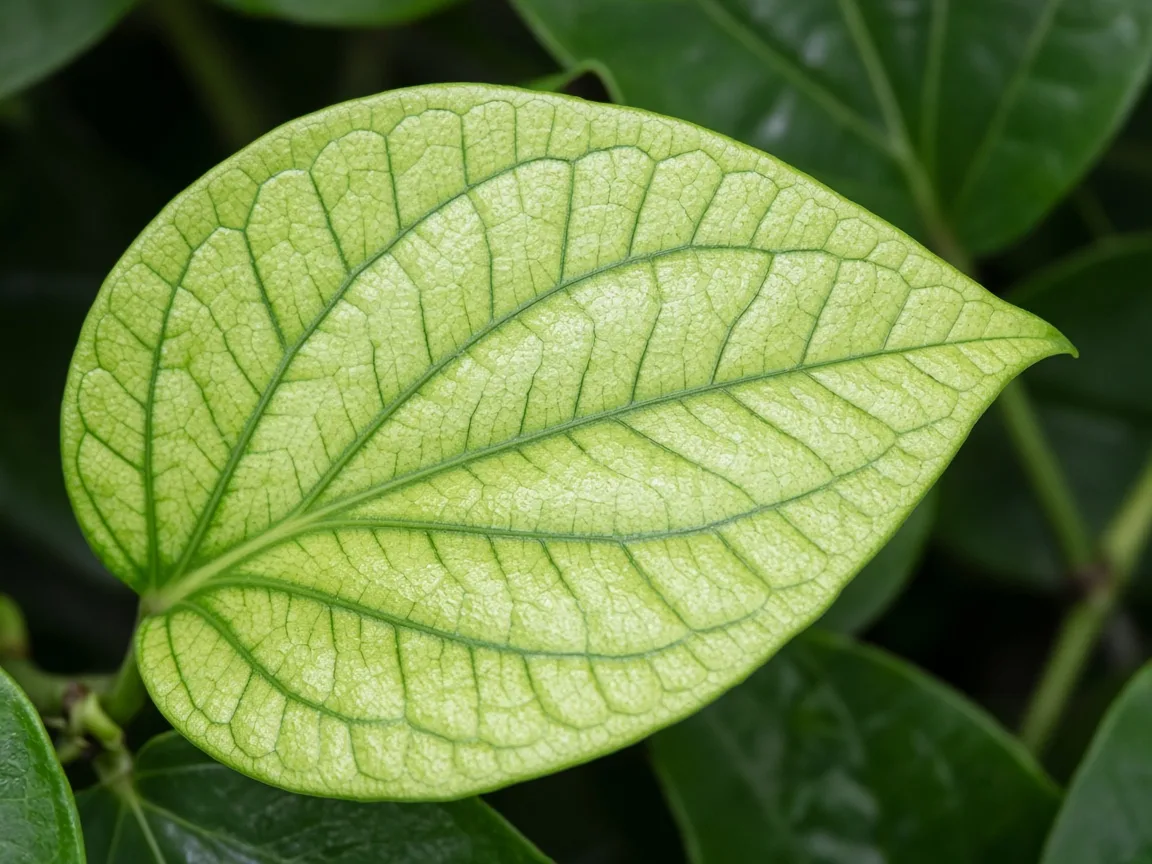
New leathery leaf at a Black Pepper vine tip: pale yellow-green tissue between dark green veins while older glossy leaves lower on the runner stay normal—classic iron chlorosis on expanding tropical foliage.
The classic symptom of iron deficiency is interveinal chlorosis where leaf tissue yellows while veins stay green. RHS notes iron deficiency affects the youngest leaves first, unlike magnesium problems that tend to start on older foliage. On a fast moisture-loving Piperaceae climber grown for foliage and eventual pepper spikes, that pattern is easiest to read on the leathery blade still opening at each tip—not on mature lower leaves that may simply be aging out.
Why Black Pepper gets iron deficiency
Black Pepper is a humid-tropical vine that wants fertile, moisture-retentive but well-draining soil rich in organic matter near slightly acidic pH (about 5.5–6.5)—yet many container setups drift alkaline or stay too wet at the root zone. Iron chlorosis often results when roots cannot absorb iron even when it is present in fertilizer; high pH, waterlogged mix, salt crust, or exhausted organic soil block uptake while vine tips keep trying to open new leaves.
Black Pepper–specific causes:
- Alkaline or hard tap water in pots — Repeated irrigation with high-pH water raises container pH over time and locks iron chemically; high pH makes iron unavailable to plants even when you feed occasionally. Field culture targets pH around 5.5–6.5; home pots that creep toward neutral or alkaline show tip chlorosis first.
- Micronutrient leaching through frequent summer watering — Black Pepper watering stays “evenly moist” in heat; daily or twice-daily soaks in small pots wash iron from organic-rich mix faster than slow-release pellets replace it.
- Waterlogged mix despite good intentions — Symptoms worsen in heavy, poorly drained soils, and cool saturated conditions increase chlorosis risk. Pepper vines hate stagnant roots; chlorosis on wet heavy mix often pairs with fungus gnats or collar softness that mirrors Phytophthora foot rot on poorly draining soil.
- Nitrogen-heavy feeding without micronutrients — Owners pushing leafy vine growth with high-nitrogen formulas during monsoon flush may skip chelated iron if labels lack complete micronutrients—see the Black Pepper fertilizer guide.
- Cold or dry stall mistaken for hunger — Growth slows below about 10–13°C (50–55°F); pale tips in a cool draft are not iron targets until warm extension resumes per light and placement.
- Misread nitrogen deficiency — Old leaves yellow first with nitrogen; iron hits the newest leathery tip blade with green veins.
Do not diagnose iron deficiency on sour wet soil with soft stems at the collar—that is root failure from chronic saturation until you confirm mostly firm nodes and appropriate dry-down at 2–4 cm depth.
Leathery tip flush: chlorosis on extending pepper vine foliage
Black Pepper shows iron stress on the thick leathery leaf still opening at each active vine tip during warm humid growth—a pattern that would be nonsense on a snake plant rosette or a desert succulent caudex. Veins remain green while the expanding blade between them yellows before the leaf fully hardens to its usual deep gloss.
That tip-only chlorosis distinguishes iron from nitrogen, which starts on the lowest oldest leaves before they drop. It also differs from brief juvenile color: a brand-new pepper leaf can look slightly lighter for a few days in bright filtered light, then deepen to glossy green. Worry when every new tip leaf on a runner stays yellow-green with dark veins for two or more flushes in a row during active season.
Because Black Pepper can extend several nodes per month in monsoon heat on a trellis, compare two or three consecutive new tip leaves on the same stem. One pale opener after repotting stress may be transient; two or three in a row with green veins during warm growth is a strong iron signal.
Evenly moist culture vs foot-rot trap on climbing pepper
Commercial guidance stresses consistent moisture without waterlogging—easy to misread as “keep the pot heavy.” Home growers copy tropical humidity—pebble trays, misting, cachepots—but often irrigate with hard alkaline tap into organic-rich mix that never fully dries. That combination is a classic setup for iron lockout while simultaneously raising foot rot risk on wet, poorly draining soil.
The diagnostic split:
- Appropriate moisture — top 2–4 cm dries between thorough soaks; nodes firm; new tips open regularly in filtered light per soil and drainage goals. Chlorosis with green veins here points to pH, salts, or micronutrient depletion.
- Chronic saturation — pot heavy for days, sour smell, soft collar. Fix overwatering before any iron drench; wet chemistry worsens iron chlorosis.
Rainwater, RO water, or acidified irrigation helps when white mineral crust rings the pot rim. Flush with plain water at two to three times pot volume before adding chelated iron so salts do not antagonize uptake.
Organic-rich trellis pots and the micronutrient wash-out cycle
Unlike lean succulent mix, Black Pepper soil holds compost and coco coir for steady moisture—excellent for vine extension, hard on micronutrient retention when you water heavily in summer. Every deep soak can carry iron out of a small pot before roots absorb it, especially when:
- The pot is undersized for a fast-flushing vine on a humid balcony
- You water frequently in heat but feed only monthly with a nitrogen-forward formula lacking chelated iron
- White salt crust rings the rim from hard tap and fertilizer
- The same organic mix has not been refreshed in two or more years while roots fill the container
Check whether watering rhythm matches dry-down at 2–4 cm depth. Firm nodes on appropriate moisture with tip chlorosis despite occasional feeding points to uptake or leaching, not simple underwatering.
Lookalike symptoms
| Pattern | Check | Likely cause |
|---|---|---|
| New tip yellow, green veins | Newest leathery leaf on warm runner | Iron deficiency (this page) |
| Old lower leaves pale first | Leaf position on stem | Nitrogen deficiency |
| Whole vine lime-green, long internodes | Window or shade exposure | Pale leaves or not enough light |
| Interveinal yellow on older mid-stem leaves | Leaf age | Magnesium deficiency |
| All yellow, wet soil, soft collar | Stem squeeze at soil line | Overwatering or root rot |
| Dull limp leaves, dry pulling mix | Pot weight | Underwatering |
| Cool room, slowed nodes | Night temperature | Seasonal stall—not iron until growth resumes |
How to confirm the cause
Work through these checks in order. Black Pepper responds on a warm-season rhythm; one change at a time makes it easier to read the next tip leaf over three to five weeks.
- Season and growth stage — Is the vine in warm active extension with new leathery leaves opening? Iron. Cool stall with few new nodes? Hold iron until growth resumes.
- Leaf age pattern — interveinal chlorosis on the newest tip leaf only; older leaves green? Iron. Lowest leaves pale uniformly? See nitrogen deficiency.
- Vein pattern — tissue between veins yellow while veins stay green confirms interveinal chlorosis.
- Node and collar firmness — firm stems at nodes; soft collar on wet mix means fix overwatering before iron drenches.
- Soil moisture rhythm — top 2–4 cm dries before the next thorough soak per the watering guide; chronically heavy outer mix blocks uptake.
- Feeding history — months without complete micronutrients during summer growth; white crust on pot rim suggests flush before iron.
- Light level — deep shade stalls flush and washes color; confirm bright filtered or partial shade per the light guide.
- Multiple runners — chlorosis on several active tips during warm growth supports systemic uptake failure.
The first fix to try
Confirm nodes are firm and the top 2–4 cm of mix dries appropriately between soaks during warm active growth, then apply one chelated iron soil drench at label rate for container plants—only if interveinal chlorosis is on expanding tip leathery leaves, not during a cool-season stall.
Iron drenches on stressed, waterlogged roots waste product and can burn foliage. Correct the uptake environment first: appropriate watering, flush salts if white crust rings the pot, and pause feeding until roots recover. If interveinal chlorosis persists on the next tip leaf after those corrections, apply one chelated iron drench—FeEDDHA forms work best in alkaline mix per NMSU Extension. Avoid foliar sprays in harsh midday sun that scorches leathery pepper leaves.
Use the Fertilizer Dilution Calculator to halve strength if you are unsure of dose. Do not stack repotting, hard pruning, and iron treatment on the same day.
Step-by-step recovery
- Confirm diagnosis — green-vein chlorosis on newest tip leathery leaves during warm growth; rule out yellow leaves from moisture stress alone.
- Fix watering — let the top 2–4 cm dry before soaking; improve airflow if the pot stays cold and heavy.
- Flush salts if white crust rings the pot—plain water at two to three times pot volume, draining fully.
- Apply chelated iron once on firm roots after steps 2–3, during active tip flush in spring or summer—not on a cold-stalled vine.
- Resume light complete feeding — half-strength balanced liquid with micronutrients per fertilizer guide after three to four weeks if new tip leaves green up.
- Repot into fresh slightly acidic organic mix if chlorosis returns after two iron cycles and roots are compacted in depleted mix.
Recovery timeline
Black Pepper flush growth is seasonal, not year-round in every climate. Expect three to five weeks for the next tip leathery leaf to show greener tissue between veins after corrected watering, a salt flush if needed, and one iron drench during warm active growth. A full warm season may pass before two consecutive tip leaves look normal on a large supported vine.
Signs of improvement: darker green tissue between veins on the newest unfurling leaf, normal gloss returning, firm nodes, stable dry-down rhythm.
Signs the problem is worsening: each successive tip leaf more chlorotic during warm growth, soft collar on wet soil, widespread yellowing beyond active tips—stop iron and check root rot.
Chlorotic tip leaves rarely re-green fully once hardened; judge success by new glossy leathery leaves, not old blade color.
Mistakes to avoid
- Iron before drainage — chelated iron on waterlogged mix fails and can stress roots; firm nodes and appropriate dry-down first.
- Iron during cool stall — slowed vines below about 10–13°C cannot use nutrients efficiently; salts accumulate while roots are vulnerable.
- Treating every yellow leaf as iron — one fading bottom leaf may be normal aging; see yellow leaves.
- Heavy nitrogen fertilizer instead of iron — nitrogen push on chlorotic tip growth does not fix interveinal pattern and adds salt stress.
- Expecting the current chlorotic leaf to re-green — judge the next tip flush.
- Using non-chelated iron sulfate alone on alkaline container mix when FeEDDHA chelate is available for high-pH pot culture.
Prevention
- Feed lightly with complete fertilizer including micronutrients during warm active growth per the fertilizer guide—not nitrogen-only formulas alone for entire seasons.
- Flush organic-rich mix occasionally with plain water during the feeding season to limit salt buildup from tap water and fertilizer.
- Match watering to dry-down at 2–4 cm depth; never leave roots in stagnant saucer water.
- Use pH-friendlier water when hard alkaline tap repeatedly crusts the pot rim.
- Repot into fresh fertile mix when roots exhaust depleted soil every one to two years per repotting guidance.
- Pause iron and heavy feeding when nights drop below about 10–13°C and extension slows.
Related Black Pepper guides
- Overview
- Problems hub
- Watering
- Soil
- Light
- Fertilizer
- Nitrogen deficiency
- Magnesium deficiency
- Pale leaves
- Overwatering
Scope note: Use this page when new tip leathery leaves show green-vein yellowing during warm active growth. Use pale leaves for whole-vine wash-out in weak light, nitrogen deficiency when oldest lower leaves pale first, and overwatering when the collar softens on wet mix—regardless of leaf color.
Related tool
Use the Fertilizer Dilution Calculator to narrow causes for iron deficiency on this plant before changing multiple variables at once.