Magnesium Deficiency on Black Pepper: Vein Yellowing
Quick answer
Magnesium deficiency on Black Pepper shows as yellow or pale green tissue between dark green veins on the oldest lower glossy cordate leaves along the climbing stem while new nodes at the vine tip may still flush deep green. First step: confirm interveinal chlorosis on mature lower foliage—not yellow new leaves with green veins at the growing tip.
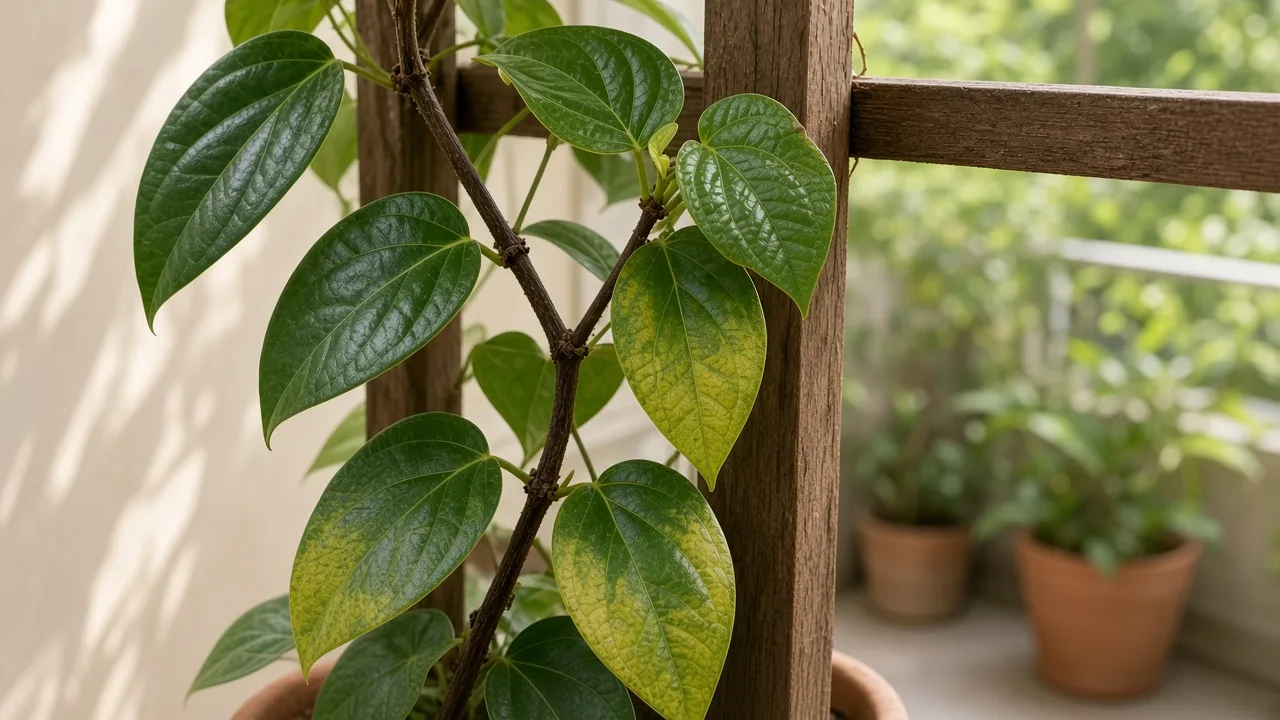
Magnesium Deficiency on Black Pepper: Causes, Checks & Fixes
This guide covers magnesium deficiency on Black Pepper. See also the general Magnesium Deficiency guide, watering, and light pages for this plant.
Magnesium Deficiency on Black Pepper: Causes, Checks & Fixes
Quick answer
Magnesium deficiency on Black Pepper (Piper nigrum, Kali Mirch) shows as yellow or pale green tissue between dark green veins on the oldest lower glossy cordate leaves along the climbing stem while new nodes at the vine tip may still push normal-looking foliage. Magnesium is highly mobile in plants, so deficiency symptoms appear first on lower leaves as the vine relocates magnesium to fund extending shoots and, when climate allows, developing pepper spikes.
See our magnesium deficiency guide and the magnesium deficiency symptom hub. On Black Pepper, inspect the oldest cordate blades on the lowest nodes closest to the pot or trellis—interveinal yellow bands there are classic magnesium before iron deficiency, which hits new unfurling tip leaves with green veins.
First step: confirm interveinal chlorosis on older lower cordate leaves, not on the newest leaf at the growing tip.
When to use this page vs other Black Pepper guides
| Pattern | Read next |
|---|---|
| Yellow between veins on oldest lower cordate leaves | Magnesium deficiency (this page) |
| Yellow new tip leaves with green veins | Iron deficiency |
| Uniform pale older leaves without vein pattern | Nitrogen deficiency |
| Brown scorch at leaf edges on lower blades | Potassium deficiency or brown tips |
| All leaves yellow on wet heavy pot, soft collar | Overwatering or root rot |
| Washed-out uniform green, long bare stems | Pale leaves or not enough light |
| Multiple yellow causes at once | Yellow leaves |
What magnesium deficiency looks like on Black Pepper
Healthy Black Pepper holds thick, glossy, heart-shaped cordate leaves in alternating pairs on a woody climbing vine trained to a trellis, pole, or moss support. Magnesium stress breaks that pattern on mature foliage on the lowest nodes, not at the active vine tip.
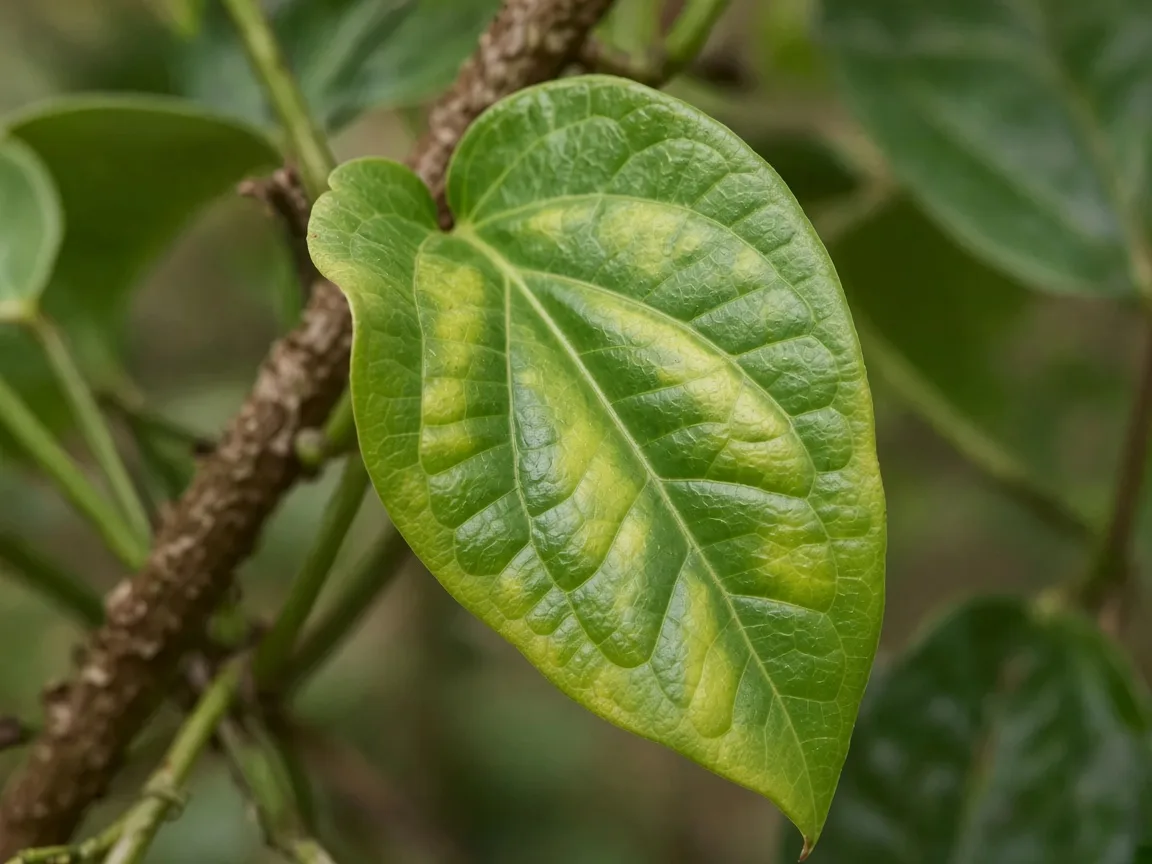
Interveinal chlorosis on an older pepper leaf—veins stay green while tissue between them turns pale yellow-green. New tip foliage may still look normal in early magnesium stress.
Typical signs:
- Yellow or pale green between dark green veins on oldest lower cordate leaves
- Veins remain relatively green on mature blades—classic interveinal banding across the glossy surface
- Chlorosis often starts near the central proximal half of the leaf and spreads toward the tip and margin as stress continues (black pepper magnesium deficiency progresses from older leaves toward younger ones)
- Small necrotic spots may appear inside pale areas on advanced cases (TNAU describes interveinal chlorosis with necrotic lesions on pepper)
- New leaves at extending nodes may look normal in early stages while the lower cordon shows chlorosis
- Firm stems and collar unlike mushy overwatered pepper vine on soggy mix
Not magnesium deficiency:
- Yellow new tip leaves with dark green veins at the unfurling shoot—iron deficiency (iron deficiency affects the youngest leaves first)
- Chlorotic younger upper canopy leaves with a herringbone vein pattern—manganese stress on pepper (manganese deficiency on black pepper is more severe in the upper canopy on younger leaves)
- Uniform pale older leaves without a strong vein pattern—nitrogen deficiency
- Brown crispy margins without interveinal mid-blade banding—brown tips or low humidity
- All leaves yellow at once on persistently wet soil with a soft collar—overwatering or root rot
- One bottom cordate leaf yellow while a large green blade unfurls above—often normal senescence; see yellow leaves
RHS notes interveinal chlorosis from manganese, iron, or magnesium deficiency, with manganese and magnesium symptoms tending to start on older leaves. On a pepper vine, that older-leaf banding is easiest to read on the glossy blades closest to the support base.
Why Black Pepper gets magnesium deficiency
Black Pepper is a moderate-to-fast, leaf-heavy Piperaceae climber grown for glossy foliage and eventual peppercorn spikes in humid filtered light. Magnesium sits at the center of the chlorophyll molecule, and when soil reserves run low the vine strips it from older tissue to fund new nodes on the support.
Black Pepper–specific causes:
- Leached compost-rich mix in frequent warm-season watering—Thorough drinks through fertile black pepper soil (pH about 5.5–6.5) drain magnesium faster than owners replace it with complete feed.
- Nitrogen-heavy fertilizer without micronutrients—Neem cake, manure top-dresses, or leafy-growth formulas keep flushes coming while magnesium in the root zone depletes; see Black Pepper fertilizer.
- Iron excess competing with magnesium—High amounts of iron may induce magnesium deficiency on pepper soils; iron-heavy water or repeated iron sprays without soil testing can mimic or worsen low-Mg banding on lower leaves.
- Hard tap water and calcium competition—Conditions that lead to magnesium deficiency are often related to fertilizer programs that supply too little Mg, or when Ca and K compete with Mg for uptake.
- Years in the same container—Vine mass doubles on a trellis while mix stays depleted without repotting.
- Blocked uptake from wet roots—Chronic saturation in a cachepot prevents absorption even when magnesium is present; see overwatering before drenches.
Do not diagnose magnesium deficiency on sour wet soil with a soft collar at the stem base—that is root failure until you confirm mostly firm white roots.
Lower-cordon cordate leaves on the supported vine
Magnesium deficiency on Black Pepper shows on the oldest cordate blades on the lowest nodes along the trellis—a pattern that would be nonsense on a rosette succulent or a single-trunk rubber tree. The pepper vine invests new tissue at extending tips while mobile magnesium exits the lower cordon first.
Walk the stem from the pot upward: if interveinal yellowing sits on the first one or two mature leaves above the soil line while the tip flush stays deep green, magnesium belongs on the list. If every new cordate leaf at the tip emerges yellow with green veins, switch to iron deficiency—magnesium deficiency initially develops on lower or older foliage.
Because pepper leaves are large and glossy, one chlorotic lower blade is visible from across a humid balcony—use that single cordate leaf as your diagnostic anchor before changing fertilizer, mix, or pot size.
Upper-canopy manganese vs lower-canopy magnesium
Black pepper growers in Kerala and similar humid regions often see two different interveinal patterns on the same vine. Manganese deficiency is more severe in the upper canopy on younger leaves, while magnesium deficiency symptoms first appear on older leaves and progress toward younger ones.
On a home container vine, use height on the support as a quick split:
- Pale bands between veins on the lowest mature leaves only → magnesium (this page)
- Chlorotic younger leaves high on the trellis with a herringbone green-vein pattern → manganese lockout or excess—soil testing before guessing
This canopy split is pepper-crop logic; it does not apply to generic pothos nutrient guides.
Pepper spikes and mobile magnesium during fruiting
When a mature Black Pepper sets pendulous pepper spike clusters, the vine redirects mobile nutrients—including magnesium—from older leaves into developing berries. Magnesium deficiency can progress from older foliage as the plant funds reproductive tissue.
Indoor vines often never fruit, but the same mobility rule applies during heavy warm-season flushes: a vine pushing long internodes and large new cordate leaves after monsoon growth can show lower-leaf banding even when you still feed lightly. If spikes are present, pair one measured magnesium correction with complete fertilizer that includes micronutrients rather than potassium-only bloom formulas that can compete with magnesium uptake. Field guides note that magnesium and potassium fertilizers should not be banded together at high rates; in a small pot, space potassium-heavy feeds and magnesium corrections by at least two weeks rather than stacking both on the same day.
Monsoon flush vs winter feed pause on depleted mix
The diagnostic trap on container Black Pepper is correct winter rest while magnesium silently stays depleted in old compost-rich mix.
Post-monsoon depletion: When the vine pushes its strongest flushes in warm humid months, you feed every 2–4 weeks per the Black Pepper fertilizer guide. If you stop feeding from late autumn through winter but keep the same pot, the first spring nodes draw from empty magnesium reserves. Yellow bands between veins on the earliest mature leaves after the pause often mean depleted mix, not a sudden care mistake.
Do not feed a cold stalled vine: Applying Epsom salt or strong NPK to a pepper vine below about 10–13°C (50–55°F) with stalled extension wastes effort and can salt a cold, barely-used mix. Wait until steady new nodes appear, then correct one measured dose on moist soil.
Match feed to extension: A vine climbing a tall trellis in bright filtered light depletes magnesium faster than a short cutting in partial shade. Track whether lower cordon leaves band between veins before tip growth thins—that blade is your early warning.
Lookalike symptoms
| Pattern | Check | Likely cause |
|---|---|---|
| Interveinal yellow on oldest lower cordate leaves | Feed history, mix age, spike load | Magnesium deficiency (this page) |
| New yellow leaves, green veins at vine tip | Wet mix, alkaline water | Iron deficiency |
| Young upper leaves chlorotic, herringbone veins | Soil Mn, pH | Manganese disorder (test before treating) |
| Uniform pale older leaves, small new hearts | No balanced feed in months | Nitrogen deficiency |
| Edge scorch on lower leaves | Bloom or potassium-heavy feed | Potassium deficiency |
| All yellow, wet heavy pot, soft collar | Root smell, stem softness | Overwatering |
| Washed-out uniform green, long internodes | Window placement | Pale leaves |
| Distorted new hearts with stippling | Leaf undersides | Thrips or spider mites |
How to confirm
- Vein pattern on lower cordate leaves—interveinal chlorosis on the oldest foliage on the lowest nodes, not the newest tip leaf alone.
- Iron vs magnesium split—green veins on new tip leaves point to iron; banding on lower mature cordate blades points here.
- Canopy height—upper young-leaf herringbone chlorosis suggests manganese, not this page.
- Collar and stem firmness—soft base at the soil line rules out simple starvation until rot is addressed.
- Season and growth rate—warm extension with partial canopy vs cold stalled vine with no new nodes.
- Fertilizer label—complete micronutrient mix vs nitrogen-only organic top-dresses used all season.
- Soil pH and salts—alkaline crust or lime in mix suggests lockout before more Mg in acidic-target soil.
- Moisture cross-check—wet core in a sealed cachepot rules out simple starvation until roots recover per Black Pepper watering.
First fix for Black Pepper
Confirm interveinal chlorosis on older lower cordate leaves—not on the newest tip leaf—before any supplement.
Once the pattern matches, apply one soil drench with Epsom salt at 1 tablespoon per gallon of water on already-moist mix, only after confirming firm collar, warm active growth, and interveinal chlorosis on older lower leaves. Water normally first so roots are hydrated, then apply solution until a small amount drains from the bottom. Alternatively, one half-strength dose of complete liquid fertilizer that lists magnesium on the label follows the Black Pepper fertilizer guide.
Do not drench a waterlogged pot, a vine with a soft collar, a plant you repotted within the last month, or a cold stalled specimen with no new nodes. Fix the limiting stress first, then apply one measured magnesium correction.
Step-by-step recovery
- Apply one Epsom salt drench at 1 tablespoon per gallon on moist mix, or one half-strength complete feed with magnesium during active warm-season growth.
- Flush salts if white crust rings the pot rim—leach with plain water, then resume with a complete formula that replaces magnesium.
- Adjust watering so the top 2–4 cm dries between drinks per Black Pepper watering—uptake fails in chronic wet mix.
- Repeat measured correction once after four to six weeks if lower chlorosis spreads but the collar stays firm—do not drench weekly.
- Repot into fresh compost-amended mix if roots fill the pot and banding persists after two measured treatments—see Black Pepper repotting.
- Trim fully yellow older leaves only when they pull away easily; do not strip half the lower cordon at once on a vine still climbing strongly.
- Monitor the next two cordate leaves on extending nodes for even green color without vein-retained banding.
Mistakes to avoid
- Epsom salt before collar and moisture check—Drenching rotting tissue worsens stress and will not fix chlorosis.
- Feeding during cold stall—Salts accumulate on roots that cannot use them when nights drop and extension stops.
- Confusing iron and magnesium—New-tip green veins mean iron page, not this one.
- Treating upper-canopy herringbone chlorosis as magnesium—Manganese and magnesium sit on different parts of the vine on pepper.
- Repot + Epsom + hard prune same week—Stack one change at a time on a stressed Kali Mirch vine.
- Nitrogen-only top-dress after banding appears—More leafy flush without magnesium deepens interveinal chlorosis on lower cordate blades.
- Expecting old leaves to re-green—Judge recovery by fresh tip growth color, not by lower blades darkening again.
Recovery timeline
Correct magnesium on healthy roots shows greener new cordate leaves without interveinal banding within three to six weeks during warm active growth. Older chlorotic blades rarely return to full deep green; the vine slowly replaces them as nodes extend up the support.
Full lower-cordon refresh on a tall trellis specimen may take one warm season. Judge success by even green color on fresh leaves at extending nodes, not by old yellow hearts darkening again. If three successive new leaves stay banded or pale after two measured treatments with a firm collar, reassess iron lockout, light, and overlapping pale leaves causes.
Prevention
- Feed with complete balanced fertilizer that includes magnesium during active warm growth per the Black Pepper fertilizer guide—pause in cool months when extension stalls.
- Flush salts mid-season if you use hard tap water or feed frequently on a fast-climbing vine, then resume with a complete formula that replaces magnesium.
- Refresh compost-rich mix every one to two years when repotting pot-bound vines on a support.
- Keep mix in the slightly acidic range this species prefers; avoid dumping lime or coral into a pepper pot without a pH reason.
- Space heavy potassium bloom feeds and magnesium corrections when the vine carries spikes—do not band both at full field rates in a small container.
Related Black Pepper guides
- Black Pepper overview — species baseline and care hub
- Black Pepper problems — full symptom index for this vine
- Black Pepper fertilizer — warm-season feed timing and winter pause
- Black Pepper watering — 2–4 cm finger test that pairs with nutrient uptake
- Black Pepper soil — fertile acidic mix that holds nutrients without waterlogging
- Iron deficiency — when new tip cordate leaves yellow with green veins
- Nitrogen deficiency — uniform pale older leaves without vein banding
- Potassium deficiency — margin scorch vs interveinal mid-blade banding
- Yellow leaves — moisture-first diagnosis when color shifts broadly
Scope note: Use this page when yellow sits between green veins on the oldest lower cordate leaves on a firm climbing vine. Use iron deficiency when new tip foliage shows the vein pattern; use yellow leaves when the whole vine yellows on wet mix or after a major care change.
Conclusion
Yellow bands between green veins on the oldest lower Black Pepper cordate leaves are a magnesium signal during warm active growth—confirm the pattern stays off the vine tip, verify a firm collar, rule out alkaline or waterlogged mix, then apply one measured Epsom drench on moist soil.
Related tool
Use the Fertilizer Dilution Calculator to narrow causes for magnesium deficiency on this plant before changing multiple variables at once.