Leggy Growth on Black Pepper: Light & Trellis Fixes
Quick answer
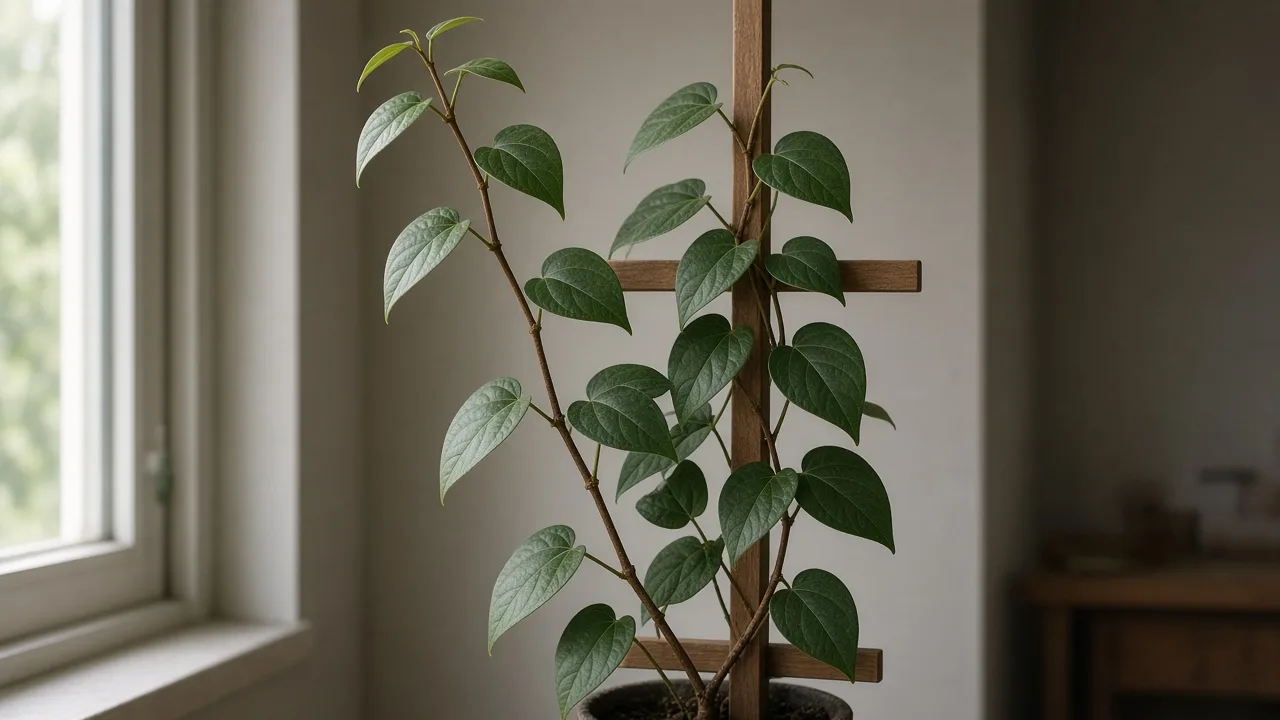
Leggy Black Pepper shows long bare gaps between small ovate leaves on a woody climbing stem that leans toward the brightest window—etiolation from too little usable light for a fast tropical Piper vine. First step: move the pot to bright filtered light (east window or dappled south) and tie the vine back onto a sturdy trellis or pole before repotting, feeding, or hard pruning.
Leggy Growth on Black Pepper: Causes, Checks & Fixes
This guide covers leggy growth on Black Pepper. See also the general Leggy Growth guide, watering, and light pages for this plant.
Leggy Growth on Black Pepper: Causes, Checks & Fixes
Quick answer
Leggy growth on Black Pepper (Piper nigrum) is etiolation on a woody climbing spice vine: the pepper plant lengthens bare stem sections between leaves while new blades stay small and thin instead of the glossy, palmately veined ovate leaves growers expect on a supported vine.
For how insufficient light causes stretch in general, see our leggy growth hub. On Black Pepper, the telltales are wide internode gaps on the newest climbing stem, a lean toward one window, pale or undersized cordate leaves, and adventitious root bumps at nodes that never reach a trellis or pole.
First step: move the pot to bright filtered light—typically an east-facing window or a south/west window softened by sheer curtain—and loosely tie the vine back onto a sturdy support the same day. Wait two to three weeks before repotting, feeding, or hard pruning so you can read the plant’s response.
This page covers stretch while the vine still pushes leaves. If blades are mostly pale without much height gain, see pale leaves. If growth has nearly stopped, see slow growth. For placement basics, see the Black Pepper light guide.
When to use this page vs other Black Pepper guides
| Pattern | Read next |
|---|---|
| Dim room but internodes not yet stretched | Not enough light |
| Washed-out or yellow-green blades without long bare stems | Pale leaves or yellow leaves |
| Vine stalled despite warm humid placement | Slow growth |
| Soft collar on wet, heavy pot | Overwatering or root rot |
| Ready to tip or train after light is fixed | Pruning guide |
| Window placement, shade cloth, scorch vs stretch | Light guide |
What leggy growth looks like on Black Pepper
Healthy Piper nigrum builds reasonably short internodes on a woody perennial vine, with dark green ovate to cordate leaves (often 5–7 inches long on mature outdoor vines) and flexible climbing stems that root at nodes when a support stays moist. Kew’s Plants of the World Online describes the species as a climbing shrub of the wet tropical biome—indoors, that habit should look full on a trellis, not like a thin curtain of naked stem.
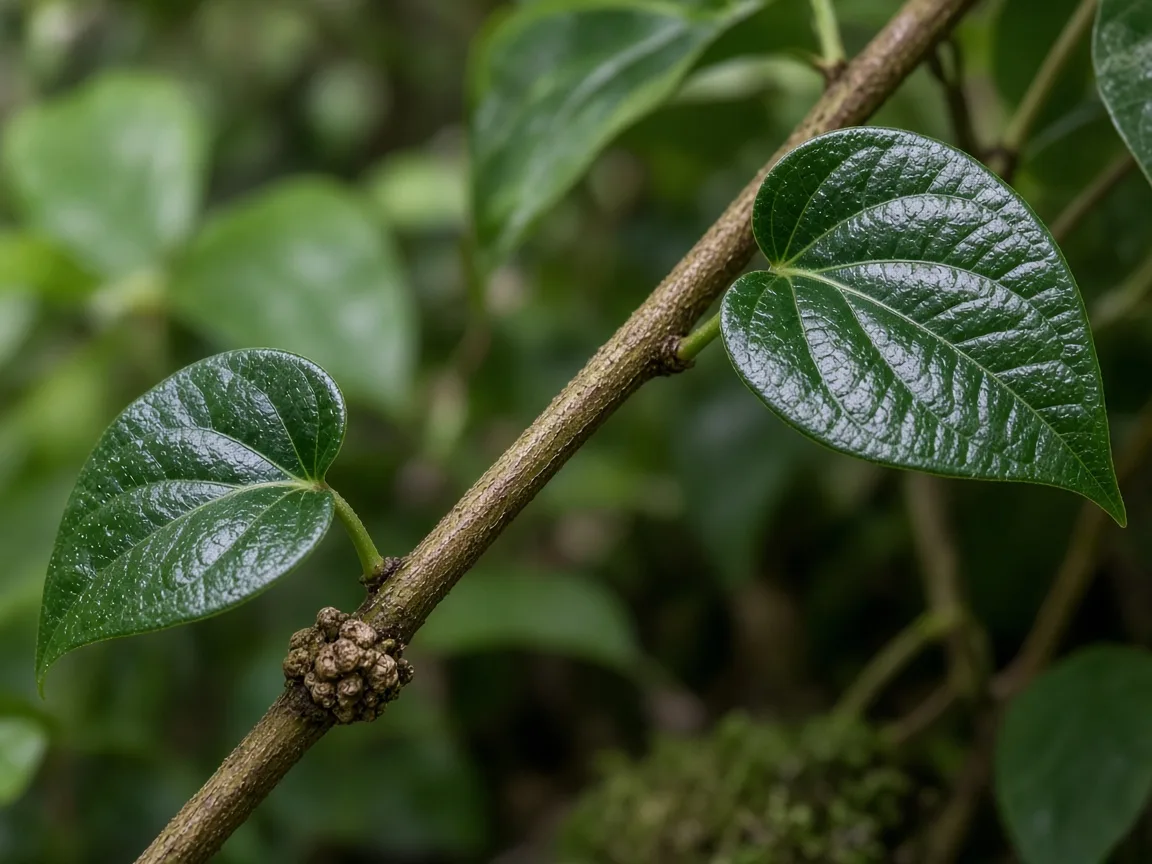
Long bare woody stem between undersized glossy leaves on Piper nigrum—compare stretched newest internodes with tighter spacing on older firm stem below.
Classic etiolation markers:
- Long gaps between small cordate leaves on the newest 30–60 cm of vine while older lower nodes look tighter
- Thin, pale, or undersized new blades compared with mature leaves farther down the same stem
- Woody brown-green stems with visible nodes and tiny adventitious root bumps that do not reach the support
- Hard lean toward one window, lamp, or doorway
- Sparse canopy on a tall trellis—the vine reaches height but leaves cluster only at the tip
- Winter stretch after short days in the same north or interior spot
A young cutting with only two or three leaves may simply be establishing. Concern starts when a vigorous pepper vine that once flushed glossy leaves suddenly pushes widely spaced small leaves for several nodes in a row.
Standard-tree spacing logic: a plant-only check
Field black pepper is grown as a climber on live standards or trellises in partial sunlight, with room to spread upward. PlantVillage notes that vines are climbers needing partial to full sunlight for healthy growth and a trellis at least 4 meters high in plantation layouts. That field logic translates to container diagnosis:
- One long naked run to the ceiling with leaves only at the tip — Light is too weak for the leaf canopy; the apical bud keeps climbing while lateral nodes stay dormant.
- Adventitious roots form at nodes but hang in air — Missing, dry, or too-narrow trellis; the vine elongates searching for something to climb (pruning guide training interval).
- Stretch on the side away from the window — One-sided light; rotate the pot and improve exposure on the weak side.
- Stretch plus wet heavy pot in a dim corner — Low light slowed water use; check watering before feeding.
This standard-and-trellis logic does not apply to rosette succulents or self-heading shrubs.
Why Black Pepper gets leggy growth
Piper nigrum is a fast-growing evergreen climber that tolerates semi-shade and moist, well-drained soil. Shade tolerance does not mean a dark room produces harvest-quality foliage—deep shade keeps the vine alive but drives internode elongation and smaller blades while the plant reaches for photons.
Missouri Botanical Garden recommends part shade, sun-dappled areas or bright indirect sun, and a support structure such as a wooden frame or prop tree. That is brighter than many interior corners where pepper vines get parked as “tropical houseplants.”
Plant-specific triggers:
- “Part shade” interpreted as deep interior gloom — Human eyes overestimate brightness. Clemson HGIC notes that well-lighted home interiors are often under 100 foot-candles, far below outdoor dappled understory. Black Pepper wants bright filtered exposure, not a hallway with no window sightline.
- Pot in a bright room but canopy never sees the glass — Floor pots against a north wall are a common cause; the wall is bright, the vine is not.
- Winter short days without supplementation — Stretch that begins in fall often shows by late winter. Supplemental lamps help when natural light is insufficient (Clemson HGIC light guidance).
- No climbing support or dry trellis wrap — Useful Tropical Plants describes climbing stems that attach by adventitious roots; unsupported vines sprawl with long naked sections.
- Excess nitrogen while light is weak — Soft, fast elongation without firm leaves; fix light before fertilizer.
Leggy growth is almost always a light-and-support problem, not a mystery disease. Fertilizer does not shorten internodes on a dim vine.
How to confirm leggy growth vs lookalikes
Work through this order before repotting or heavy cutting:
- Internode-gap comparison — Measure spacing between the last three leaves and compare to a section from earlier growth on the same stem. Widening gaps confirm etiolation.
- Leaf production rhythm — Leggy vines usually still push new leaves, just farther apart. No new leaves for months points to slow growth or root stress.
- Hand-shadow test at the canopy — At midday, hold your hand between the top leaves and the window. A soft, defined shadow suggests usable filtered light; faint or no shadow means the spot is too dim for compact pepper growth.
- Support audit — Is a trellis, coco-wrapped pole, or bamboo frame present, stable, and moist enough for adventitious roots to grip?
- Soil moisture and collar firmness — Wet mix for weeks with a soft base is overwatering in a dim corner—not etiolation alone. Firm stems on appropriately moist mix support a light-first diagnosis.
- Pest check on stressed tips — Dry AC plus weak light invites spider mites on tender new growth; stippling plus webbing is not stretch.
Confirmation test: Improve filtered light and re-tie the vine to a moist support. If the next one or two leaves emerge with tighter internode spacing within two to three weeks, light was the limiter.
First fix: improve filtered light and re-seat the vine on support
Relocate the pot so the top leaves receive bright filtered light—without jumping into harsh unfiltered midday sun that scorches thin pepper blades.
Practical targets for container Piper nigrum:
- East-facing window as the safest default (gentle morning sun, bright ambient rest of day)
- South or west glass with sheer curtain or several feet of setback
- Balcony or shade house with dappled light, matching MOBOT’s sun-dappled placement
Same day: install or re-seat a sturdy trellis, coco-wrapped pole, or bamboo frame. Loosely tie the stem below nodes with soft plant ties. Mist the wrap or keep it slightly moist so adventitious roots can attach—attached roots help fuel larger leaves once light improves (Useful Tropical Plants).
Do not repot, fertilize, or hard-prune on day one. Make the light and support move first.
Grow-light supplementation
If a brighter window is unavailable, add a full-spectrum LED grow light 30–45 cm above the canopy for 12–16 hours daily. Center the lamp over the vine, not off to one side, and rotate the pot weekly.
Tip-prune and train after light improves
Existing stretched internodes do not shorten. The recovery path is better light, then shape the vine you already have.
When to cut
Improve light and wait until the plant pushes at least one new leaf with tighter spacing—usually two to three weeks after relocation. Pruning before the light fix can stall a weak vine that lacks energy to break buds below cuts.
Where to cut on a pepper vine
Cut 6–10 mm above a node where a leaf, adventitious root, or leaf scar sits. For a long bare run, make several cuts above lower nodes rather than only trimming the tip and leaving feet of naked stem. See the Black Pepper pruning guide for tipping and training intervals.
Recovery timeline and what improvement looks like
Under warm, humid conditions with corrected light:
- 1–2 weeks — Lean may stop worsening; the next bud may open closer to the previous leaf
- 3–6 weeks — Noticeably larger ovate leaves and shorter gaps on new growth
- 6–10 weeks — Canopy looks fuller on the support; lower naked stem remains unless pruned
Old stretched stem and small leaves on it do not revert. Judge recovery by new node spacing and leaf size, not by old tissue remodeling.
Signs the problem is worsening: new leaves keep shrinking, collar softens on wet mix, or mites spread on pale tips—re-check watering, drainage, and low humidity when RH drops.
Mistakes to avoid
- Treating part shade as “no light needed” — Piper nigrum grows in forest shade outdoors with far more ambient light than a dim interior corner.
- Jumping to full midday sun — Scorches thin leaves; acclimate over one to two weeks if moving from deep gloom.
- Fertilizing a stretched dim vine — Does not fix internodes; can burn roots on moist mix.
- Hard rejuvenation before light is fixed — The vine elongates again toward the window.
- Dry trellis wrap — Adventitious roots cannot anchor; the vine keeps searching.
How to prevent leggy growth next time
- Place the leaf canopy where it sees the window, not just where the pot fits the room.
- Rotate the pot a quarter turn weekly during active growth.
- Train and tip on a schedule—tie new growth every couple of weeks and pinch soft tips above nodes when internodes stretch.
- Match watering to light—dim vines use less water; soggy mix in low light invites rot. Use the finger test at 2–4 cm.
- Keep humidity near 60–80% at canopy height so new pepper leaves stay glossy, not paper-thin in heated air.
Conclusion
Leggy growth on Black Pepper is etiolation on a tropical Piper vine, not a death sentence. The spice vine tells you plainly: long bare stems, small cordate leaves, and a lean toward the brightest escape route. Move to bright filtered light, give nodes a moist support to climb, then tip-prune once new growth tightens. Old naked stem stays unless you cut it—but glossy, closely spaced new leaves mean you fixed the right problem. Return to everyday Black Pepper care and the problems hub when symptoms overlap sibling pages.
Related Black Pepper guides
- Black Pepper overview — identity, placement, and cluster map
- Black Pepper light — filtered shade vs harsh sun and scorch
- Black Pepper watering — finger test and seasonal rhythm
- Black Pepper soil — mixes that hold moisture without drowning roots
- Not enough light on Black Pepper — early dim-light signs before advanced stretch
- Black Pepper pruning — tipping, training, and support management
- Black Pepper problems hub — all common issues on this species
Related tool
Use the Plant Problem Diagnosis Tool to narrow causes for leggy growth on this plant before changing multiple variables at once.