Calcium Deficiency on Black Pepper: New Leaf Cupping & Tip
Quick answer
Calcium deficiency on Black Pepper shows as cupped, crinkled, or margin-burned new glossy leaves at the climbing vine tip while older alternating leaves may still look fine. First step: confirm damage is on the newest expanding leaf—not brown tips on mature foliage from dry air or salt burn after heavy feed.
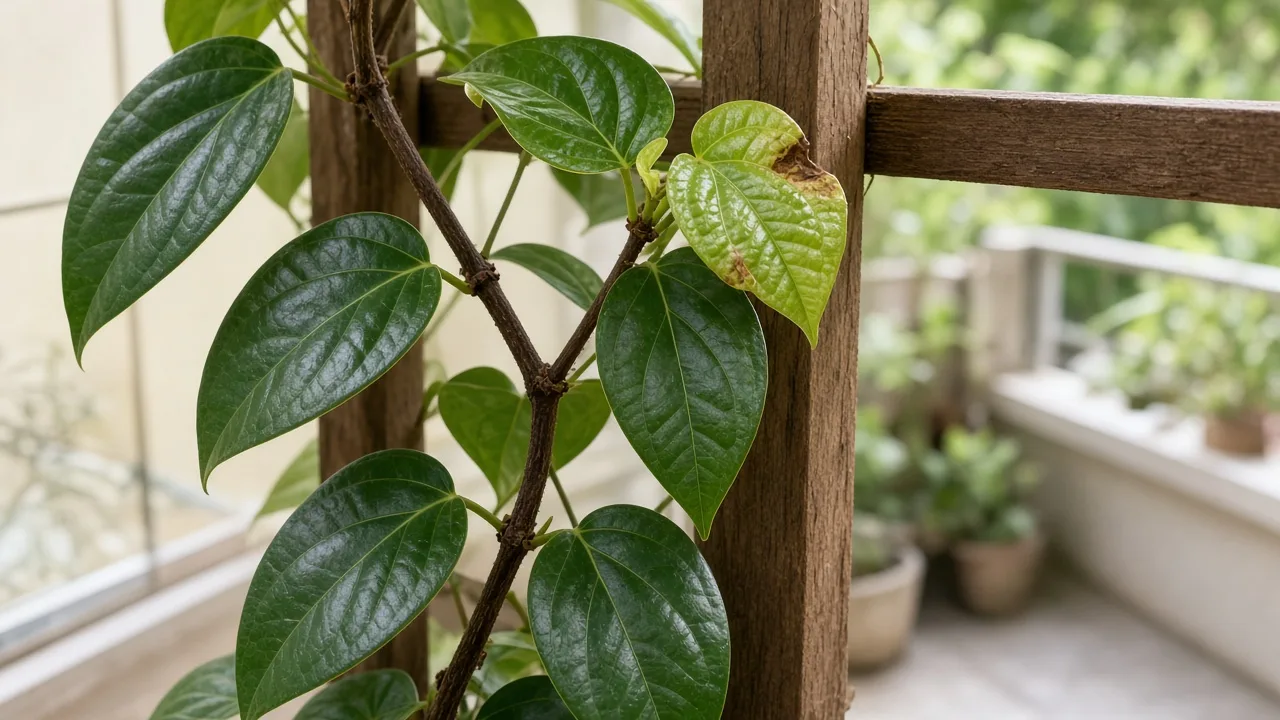
Calcium Deficiency on Black Pepper: Causes, Checks & Fixes
This guide covers calcium deficiency on Black Pepper. See also the general Calcium Deficiency guide, watering, and light pages for this plant.
Calcium Deficiency on Black Pepper: Causes, Checks & Fixes
Quick answer
Cupped, crinkled, or margin-burned new glossy leaves at the climbing vine tip on Black Pepper (Piper nigrum, Kali Mirch) usually mean calcium is not reaching expanding tissue—while older alternating leaves farther down the stem may still look fine. Calcium is plant-immobile, so deficiency manifests on new growth first. For universal mechanics, see our calcium deficiency guide. On a pepper vine, inspect the newest leaf still unfurling past the last node—distortion there points to calcium before nitrogen deficiency, which hits older lower leaves.
First step: confirm distorted new leaves at the vine tip, not brown margins on mature foliage from low humidity or fertilizer burn.
When to use this page vs other Black Pepper guides
| Pattern | Read next |
|---|---|
| New tip leaf cupped, crinkled, or margin-burned | Calcium deficiency (this page) |
| Crispy edges on mature glossy leaves | Brown tips |
| Pale lower old leaves | Nitrogen deficiency |
| Yellow margins with necrotic spots on older leaves | Potassium deficiency |
| Random mature leaf twist with stippling | Distorted leaves |
| Soft collar, sour mix, wilt after watering | Root rot |
What calcium deficiency looks like on Black Pepper
Black Pepper pushes glossy cordate-ovate leaves in alternating pairs along a woody climbing stem, so calcium stress shows at the growth front—not on random mature blades. The newest leaf past the last node may emerge smaller, cupped, hooded, or with brown necrotic tissue at the margin before it fully opens.
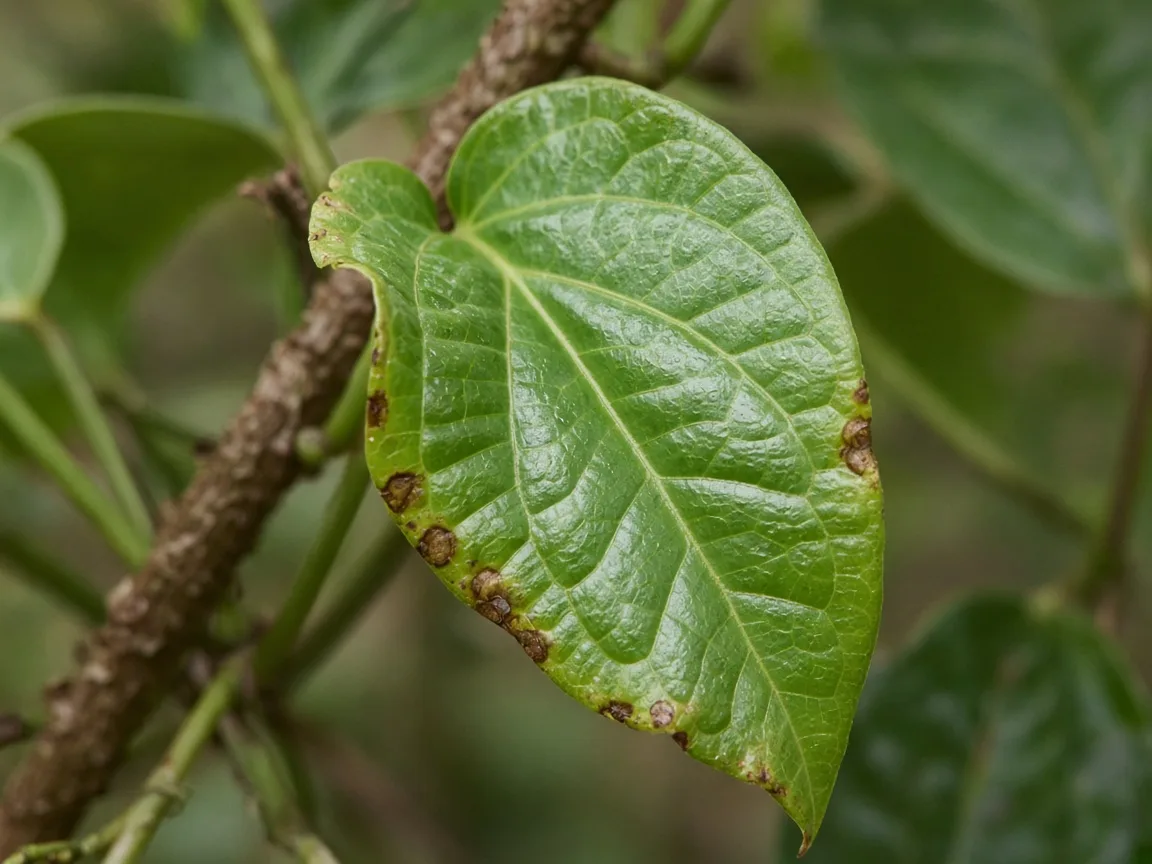
Distorted expanding tissue on the newest leaf—older glossy leaves on the same vine may still look normal.
New-growth distortion:
- Crinkled, cupped, or uneven margins on the newest leaf at the vine tip
- Brown or papery necrotic spots near the leaf margin on tissue still expanding
- Stunted new leaf size compared with prior glossy leaves on the same stem
- Older alternating leaves farther down the vine may remain healthy-looking
Nodes still firm:
- Adventitious roots at nodes gripping a trellis should look white and active when humidity is adequate
- Soft, sour-smelling mix with a mushy collar points to overwatering or root rot blocking uptake—not calcium alone
Not calcium deficiency:
- Crispy margins only on older open leaves—brown tips from low humidity or salt buildup after heavy feed
- Uniform pale lower old leaves—nitrogen deficiency
- Mature leaves curl from cold draft or dry soil—curling leaves
- Interveinal yellowing on older foliage with green veins—iron deficiency
Why Black Pepper gets calcium deficiency
Incomplete or nitrogen-heavy fertilizer is common on a vine grown mainly for glossy foliage. PlantVillage recommends applying a balanced fertilizer with micronutrients regularly while using organic matter to enrich the soil. Nitrogen-forward feeds without calcium or secondary nutrients promote soft new leaves that cannot form strong cell walls at the expanding tip.
pH drift and alkaline water limit availability. Black pepper prefers ideal soil pH around 5.5 to 6.5. Container guidance for potted vines similarly targets slightly acidic soil pH of 5.5 to 6.5. Hard alkaline tap water, cement-pot leaching, or a mix that has drifted above neutral can limit calcium even when fertilizer is present.
Moisture swings interrupt delivery. The vine wants evenly moist, well-draining soil without waterlogging. Letting the pot go bone-dry between heavy drenches stalls the transpiration stream that moves calcium to the enclosed growing tip inside a still-unfurled leaf—while chronic saturation invites Phytophthora-style foot rot that also blocks uptake.
Low humidity slows transpiration in dry AC rooms. Missouri Botanical Garden notes that container vines need a rich potting soil with good drainage and that growers should mist foliage frequently when humidity is low. When air is very dry, calcium delivery to the vine tip slows even if soil moisture looks correct.
Depleted acidic mix in the same pot for over a year loses structure and can limit calcium availability even when roots look fine. See the soil guide for the fertile organic mix this Piperaceae climber expects.
Pepper spikes, nodes, and where calcium stress shows
Unlike rosette houseplants, Black Pepper climbs by adventitious roots at each node gripping a rough stake, coir-wrapped pole, or trellis while the stem lengthens toward filtered light. Calcium deficiency does not start at those anchor points—it starts at the apical vine tip where the next glossy leaf is still expanding. If nodes look dry and roots fail to cling while the tip leaf cups inward, check whether the support dries out between mistings; a dehydrated pole can slow tip extension without causing true calcium starvation.
When diagnosing, compare one vine tip against mature leaves three to four nodes below. Calcium-poor tips stay distorted while older glossy blades remain acceptable. That age pattern is your strongest home-lab clue on Kali Mirch. Future peppercorn spikes form at leaf axils on mature wood; tip distortion alone does not predict fruit failure, but repeated tip dieback will stall the nodes that eventually carry spikes.
Filtered light, dry rooms, and the transpiration trap
Black Pepper is a sun-dappled understory vine that tolerates bright indirect light indoors—not harsh midday sun that scorches margins. In very deep shade, growth slows and nutrient demand drops, which can mask deficiency until you move the vine to brighter filtered light and a flush of soft new tissue suddenly shows cupping.
In heated winter rooms, low humidity plus steady watering can look like “good care” while transpiration stays too weak to move calcium upward. Pair moisture checks from the watering guide with humidity toward 60–80% before assuming the vine needs more fertilizer.
Lookalike symptoms
| Pattern | Check | Likely cause |
|---|---|---|
| New tip leaf distorted, margin necrotic | Older leaves normal | Calcium deficiency (this page) |
| Crispy mature leaf edges only | Humidity below 50% | Brown tips |
| Old lower leaves pale | Veins still green? | Nitrogen deficiency |
| Yellow margins, necrotic spots on older leaves | Not tip-only | Potassium deficiency |
| Sour soil, soft collar | Wet heavy pot | Overwatering |
| Stippled mature leaves with webbing | Undersides dusty | Spider mites |
How to confirm
- Tissue age — distortion confined to the newest leaf at the vine tip, not random mature blades.
- Water chemistry — white crust on soil, alkaline tap, or recent shift to hard water.
- Fertilizer label — calcium listed; not nitrogen-only feed on a heavy leaf crop.
- Node and collar firmness — solid vs mushy on sour mix.
- Humidity and drafts — cold window air hitting the unfurling tip.
- Watering rhythm — dry spells vs steady moist per the watering guide.
First fix for Black Pepper
One half-strength dose of complete balanced fertilizer containing calcium and micronutrients—after confirming firm nodes, even moisture (not alternating bone-dry and saturated), and that water is not strongly alkaline or salty.
Per the Black Pepper fertilizer guide. Do not repot, prune, and feed on the same day.
Mistakes to avoid
- Do not assume every crinkled tip leaf is calcium—check for thrips or aphids on new soft growth.
- Do not pour full-strength fertilizer on dry soil; container vines burn easily and tip burn can mimic margin necrosis.
- Do not let Black Pepper bone-dry between drinks while diagnosing—dry cycles worsen calcium delivery on a moisture-loving tropical vine.
- Do not confuse mature-leaf edge crisp from low humidity with new-tip necrosis on the unfurling leaf.
- Do not repot repeatedly on a wilted vine before fixing moisture, pH, and feed.
Step-by-step recovery
- Switch to complete fertilizer through active warm-season growth.
- Flush accumulated salts if white crust is visible; then resume half-strength feed on moist soil only.
- Keep mix evenly moist—avoid letting the vine go completely dry between waterings.
- Raise humidity toward 60–80% with a pebble tray or humidifier if air is very dry; mist lightly if that matches your routine.
- Repot into fresh mix only if roots fill the pot and distortion persists after two corrected feeds.
- Monitor the next glossy leaf after the distorted one—not the leaf that already emerged damaged.
Recovery timeline
Three to six weeks for a clean new tip leaf. The currently distorted leaf rarely straightens—judge success on the next vine flush and firm new nodes, not old tissue.
Prevention
- Feed complete balanced fertilizer with micronutrients during growth per the fertilizer guide.
- Avoid alkaline or salty water; flush pots seasonally if salts build.
- Maintain evenly moist mix; see watering for dry-down checks at 2–4 cm depth.
- Target 60–80% humidity in dry seasons; place away from cold AC drafts on unfurling tips.
- Refresh depleted organic mix when roots circle the pot.
- Keep filtered or part-shade light steady so new flushes are not stacked on stress.
Related Black Pepper guides
Conclusion
Distorted new glossy leaves on Black Pepper are a calcium delivery signal at the vine tip—confirm the newest expanding leaf, rule out humidity crisp and soggy collar rot, then correct complete feeding on stable moisture before repotting.
Related tool
Use the Fertilizer Dilution Calculator to narrow causes for calcium deficiency on this plant before changing multiple variables at once.