Spider Mites on Bunny Ear Cactus: Pad Stippling &
Quick answer
Spider mites on bunny ear cactus show as pale yellow or bronze stippling on flat pad faces, often with fine silk in pad joints and along areole rows—worst on the sunniest stack in hot, dry indoor air. First step: isolate the pot, use tongs, and tap or shake stippled pads over white paper to confirm moving specks before you mist or spray anything.
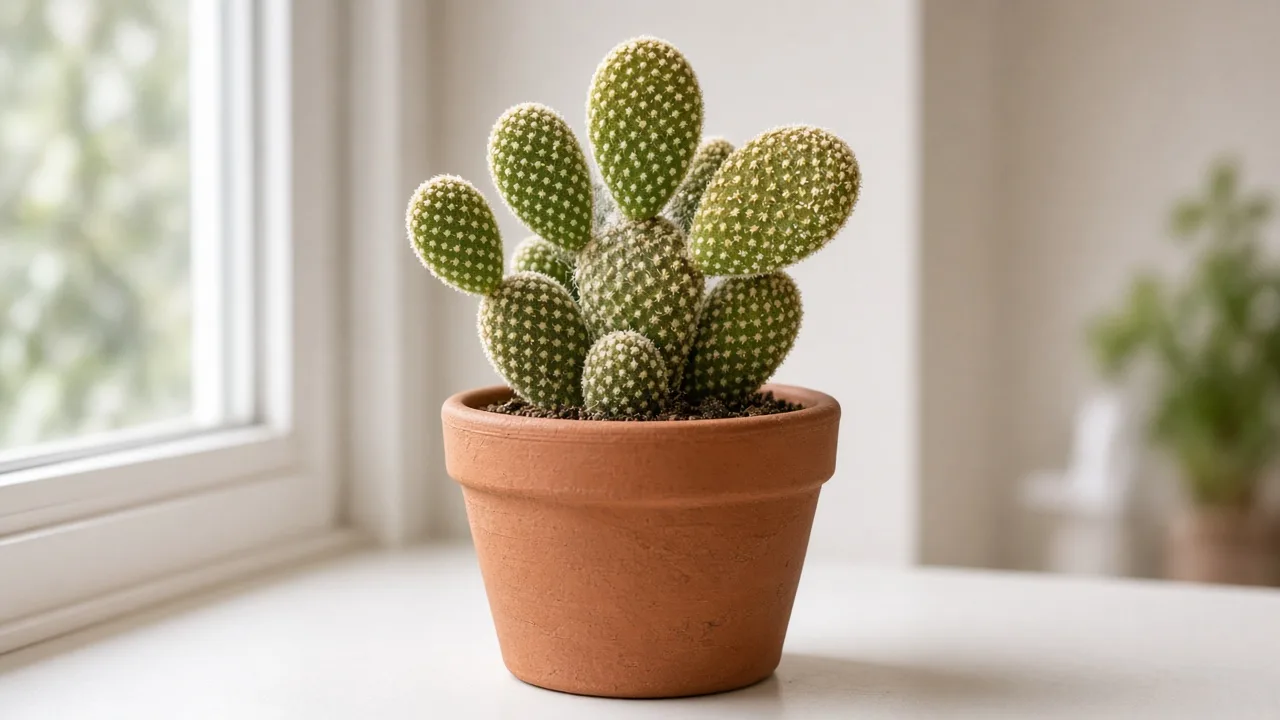
Spider Mites on Bunny Ear Cactus: Causes, Checks & Fixes
This guide covers spider mites on Bunny Ear Cactus. See also the general Spider Mites guide, watering, and light pages for this plant.
Spider Mites on Bunny Ear Cactus: Causes, Checks & Fixes
Quick answer
Spider mites on Opuntia microdasys are tiny arachnids—not insects—that pierce pad cells and leave pale yellow or bronze stippling on flat segments, often with fine silk webbing in pad joints when colonies grow. They thrive in hot, dry, still air—common on bunny ear cactus in bright south or west windows, beside heating vents, or on the upper stack while the pot mix below stays on a long dry cycle.
For mite life cycles, why some insecticides backfire, and when horticultural oils help in general, see our spider mites pest guide. On bunny ear cactus, the tell is stippling plus webbing on flat pad faces and paired-pad seams—not white cottony wax in areoles (mealybugs), soft colonies on new pad tips (aphids), or bleached scorch without moving specks (sunburn).
First step: isolate the pot away from other succulents, handle pads only with tongs or folded paper, and tap a stippled pad over white paper to confirm slow-moving mites before you mist, soap, or oil anything.
Firm pads with stippling only on the sunny side is a pest problem. Soft yellow pads on wet mix is a different emergency—see root rot on bunny ear cactus before you treat mites.
When to use this page vs other Bunny Ear Cactus guides
This page is the mite-first entry for pale stippling, bronze mottling, and fine silk on flat pads.
| Pattern | Read next |
|---|---|
| White cottony wax in areoles | Mealybugs |
| Soft pear-shaped insects on new pad tips | Aphids |
| Papery pad edges, no stippling or silk | Low humidity |
| Bleached or tan scorch patches, no webbing | Sunburn |
| Soft yellow pads, black base, wet mix | Overwatering or root rot |
| Slight pad wrinkling, bone-dry pot | Underwatering |
| Small dark flies above damp soil | Fungus gnats |
| Browse all issues | Bunny Ear Cactus problems |
Why bunny ear cactus gets spider mites in sunny, dry windows
Houseplant collections are listed mite hosts. UC IPM notes spider mites as common pests of houseplants and ornamentals, and twospotted spider mites feed on over 180 plant species in hot, dry weather. Bunny ear cactus is not immune just because it is succulent—mites colonize the living epidermis on pad faces, not the woody core.
Bright windows mimic mite weather. Bunny ear cactus wants direct sun per the light guide and long dry intervals between drinks. That combination can leave pad surfaces hot and air at the glass very dry while roots still follow a sparse soak schedule—damage is usually worse on water-stressed plants in hot, dusty conditions.
Flat paired pads expose a large sun-facing surface. Opuntia microdasys grows flat, segmented pads produced in pairs stacked like ears. The pad face angled toward the window transpires heavily; mites settle along areole rows and in the tight seam where two pads overlap—still air plus dust from glochid shed holds heat there.
Grouped succulents share infestations. Mites disperse on breezes when foliage quality drops. A stippled echeveria or haworthia on the same sill can seed the bunny ear stack within a week.
Broad-spectrum sprays can spike populations. NC State notes that insecticides disrupting natural enemies often cause spider mite outbreaks, including imidacloprid and other neonicotinoids. If you recently treated aphids with a general “bug” spray, suspect mites before you blame care alone.
What spider mites look like on Bunny Ear Cactus
On bunny ear cactus you are diagnosing pad epidermis, not leaf undersides:
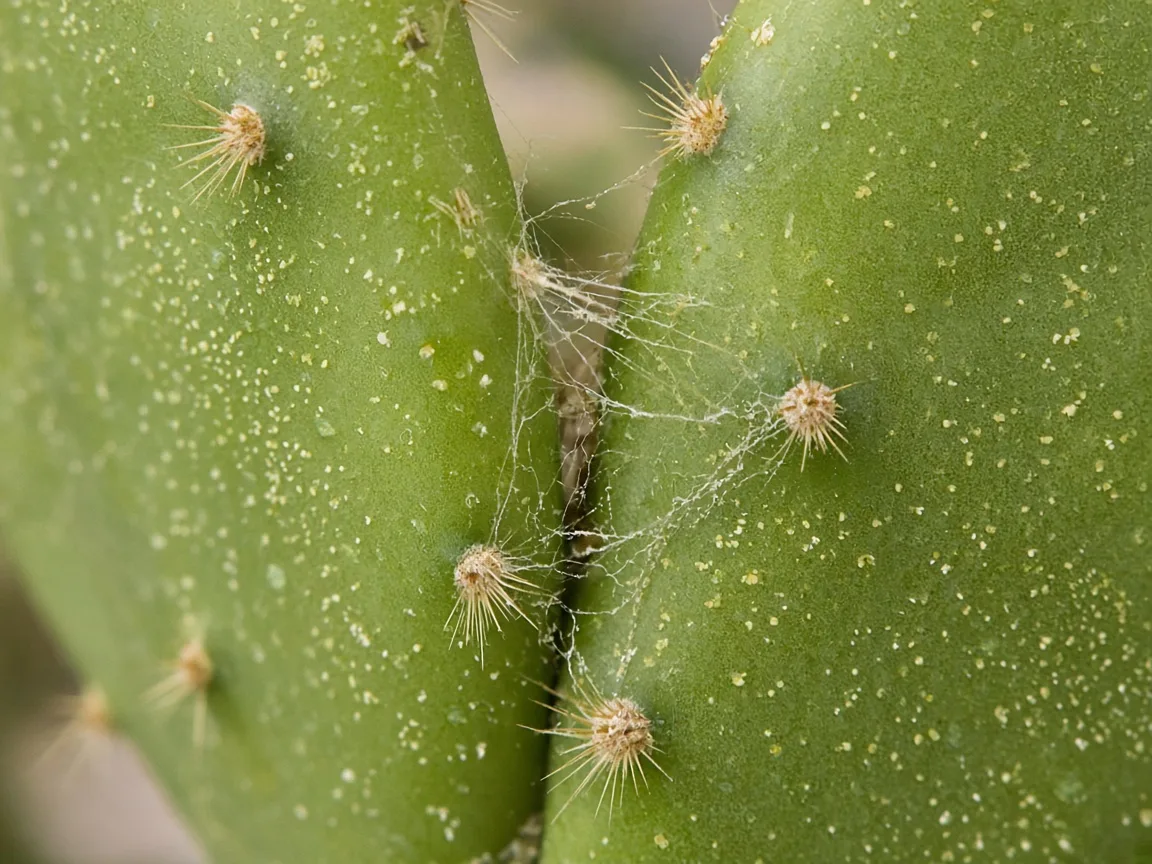
Pale stippling with fine silk in a pad seam—tap test should show slow-moving specks, not fixed glochids.
- Fine yellow or white stippling on flat pad faces—light dots that may bronze as feeding continues
- Dull or bronze cast on the pad half facing the window while the shaded half still looks deep green
- Delicate silk webbing in paired-pad joints, along areole lines, or bridging one pad to the next
- Tiny slow-moving specks on white paper after tapping a pad—mites are less than 1/20 inch long and live in colonies
- Worst on the upper stack and newest paired flush; base pads may stay clean until webbing spreads downward
- No honeydew shine like aphids—mites pierce cells without the sticky residue aphids leave on new pad tips
NC State Extension lists insect monitoring on bunny ear cactus alongside rot risks from overwatering—firm pads with stippling only on the sunny face usually points to mites, not the soft yellowing you see when mix stays wet too long.
Glochid-safe inspection: where mites hide on paired pads
Bunny ear pads look fuzzy, but the dots are glochids—thin, barbed bristles that detach with the slightest touch. Spider mites are mobile specks on the pad surface and in silk, not fixed bristles in the areole.
Work with kitchen tongs wrapped in paper towel or thick gloves. Never rub a stippled pad with bare fingers to “feel” the damage—you will embed glochids long before you confirm pests.
Scan in this order:
- Newest paired pads at the tip — First stippling often appears on the expanding flush
- Pad seam where two segments overlap — Silk and colonies pack into the angle
- Areole rows on the sun-facing pad half — Mites track lines of glochid clusters
- Upper third of the stack — Heat rises along the vertical column of pads
- Neighboring succulents on the same windowsill — Shared hot microclimate
Paper tap test: Hold white paper under a stippled pad, tap the pad face firmly with tongs, and watch for specks that move rapidly once disturbed. Glochids and mineral dust do not crawl.
Confirm spider mites vs sun scorch, drought, mealybugs, and rot
| What you see | Likely cause | Key check |
|---|---|---|
| Bronze stippling + fine webbing on pad faces | Spider mites | Paper tap shows moving specks |
| White cottony wax in areoles | Mealybugs | Alcohol dab smears orange-gray |
| Soft insects on new pad tips + honeydew | Aphids | Colonies on tips; no silk mats |
| Bleached tan patches, crisp edges, no mites | Sunburn | Sudden after move to hotter glass |
| Even pad wrinkling, bone-dry skewer | Underwatering | No stippling pattern; no webbing |
| Soft yellow pads, wet mix, black base | Overwatering / root rot | Soil never dries; pads soften |
| Papery margins, no stippling, low RH | Low humidity | Even green pad center |
Confirmed diagnosis — Stippling plus webbing with live mites on the tap test and firm pads throughout. Suspected — Stippling only may need a 10× lens on pad seams before treating.
First fix: isolate and confirm with a pad tap test
Move the pot away from other succulents for at least two weeks while you treat. Mites walk and drift between pots on a shared windowsill.
Hold each suspect pad with tongs and tap over white paper. If nothing moves, re-check in three days—sometimes mites leave after brief hot spells and pads stabilize. If specks crawl, proceed to targeted rinses—not a whole-plant shower that soaks the mix.
Do not repot, fertilize, or drench the root zone on day one. Bunny ear cactus is slow-growing and recovers from pad stress slowly; one clear pest step beats stacking variables.
Step-by-step recovery on Opuntia microdasys
1. Targeted pad rinse (not a leafy-houseplant shower)
Epic Gardening recommends hitting spider mites with a strong stream of water as an early control step—adapt that for cactus anatomy:
- Work in morning so pad surfaces dry before cool evening
- Use a syringe, spray bottle on stream, or short faucet blast on stippled pad faces and joints only
- Keep water off the pot rim and out of the pad stack base when possible
- UC IPM suggests misting undersides at least once a day for infested plants—on bunny ear, that means the shaded pad half and seams, repeated every two to three days while colonies are active
Stop rinsing if the base pad softens or mix stays wet more than a few days—switch to rot checks on the watering guide before continuing pest work.
2. Insecticidal soap or horticultural oil (after water fails)
If stippling spreads after a week of firm pads and targeted rinses:
- Use insecticidal soap or horticultural oil labeled for mites on ornamentals
- Coat pad seams and stippled faces thoroughly; mites hide on protected surfaces
- Patch-test one older lower pad first—oils can stress sun-heated epidermis
- Repeat in 7–10 days in warm weather to catch eggs and resting stages
- Avoid spraying when pads are sun-scorched or the plant is drought-wilted
3. Protect predators and avoid mite flares
UC IPM emphasizes natural enemies that limit mite numbers. Indoors, avoid broad pyrethroids or neonicotinoids on neighboring plants—those treatments often kill predators and spike mites.
If you must treat aphids on another pot, isolate it away from the bunny ear stack until colonies collapse.
4. Trim only when silk mats a pad pair
Heavy webbing on a single older pad pair that stays stippled after two treatment cycles can be removed with a sterile knife—cut at the joint, not through the base pad. Do not strip half the stack at once on a slow grower; each removed pair is a season of photosynthetic area lost.
Recovery timeline on a slow pad-forming cactus
Bunny ear cactus may push only one or two new paired flushes per warm season indoors. Expect:
- 3–7 days — Active mites knocked down after first targeted rinses; webbing may remain until you wipe dry silk gently with a paper towel on tongs
- 2–3 weeks — Stippling stops spreading to new pads; firmness stays even through the stack
- Next growth flush — Clean paired pads at the tip are the real win; old bronze pads lower down often stay marked
If stippling climbs to every pad, webbing coats the stack, and the base pad softens despite dry mix on schedule, escalate with a local extension office—by then rot and pest stress may overlap.
Mistakes that worsen mites or rot pads
- Showering the whole pot like a tropical foliage plant — Water between stacked pads and soggy mix invites stem rot while you chase mites
- Rubbing pads bare-handed — Glochid injury sidetracks treatment for days
- Heavy nitrogen while infested — Excess fertilizer can make tissue more nutritious to mites; skip feed until new pads look clean
- Broad insecticides for “everything” — Often kills predators and worsens mite outbreaks
- Assuming bleached pads are mites — Move to sunburn if patches appeared right after a window upgrade with no tap-test specks
How to prevent spider mites next season
- Scout pad seams weekly during spring and summer bright growth
- Quarantine new cacti two weeks before placing them on a shared sill
- Keep the dry-down rhythm from the soil and watering guides so drought stress does not compound dry furnace air
- Improve airflow between grouped pots—mites outbreak faster on plants surrounded by heat-radiating surfaces
- Rinse neighboring succulents when one pot tests positive; mites are already walking
Related Bunny Ear Cactus guides
- Bunny Ear Cactus overview
- Bunny Ear Cactus watering
- Bunny Ear Cactus light
- Bunny Ear Cactus soil
- Mealybugs on Bunny Ear Cactus
- Aphids on Bunny Ear Cactus
- Low humidity on Bunny Ear Cactus
- Sunburn on Bunny Ear Cactus
- Overwatering on Bunny Ear Cactus
- Bunny Ear Cactus problems
Related tool
Use the Pest Identifier Tool to narrow causes for spider mites on this plant before changing multiple variables at once.