Date Palm Care Guide — Sun, Water, Soil & Fruiting
Phoenix dactylifera L.
Grow true Date Palm (Phoenix dactylifera) in full sun and heat. Learn about drainage, irrigation and salinity, container limits, pollination, and sharp frond spines.
Date Palm Care Guide: Growing Phoenix dactylifera
Start with wateringThe most common care mistake for Date PalmWatering guide →Date Palm care essentials
Light
An open, sunny outdoor site with heat and room for the mature crown.
Water
Water deeply through the active root zone, especially while a young palm establishes and while a female tree is carrying fruit. Let excess water drain; do not leave the roots in stagnant, waterlogged soil.
Soil
Choose sandy or loamy soil that drains freely. Date Palm can grow in a range of mineral soils, but it is not a swamp palm; persistent saturation and salt accumulation reduce performance.
Humidity
Temperature
Fertilizer
About Date Palm
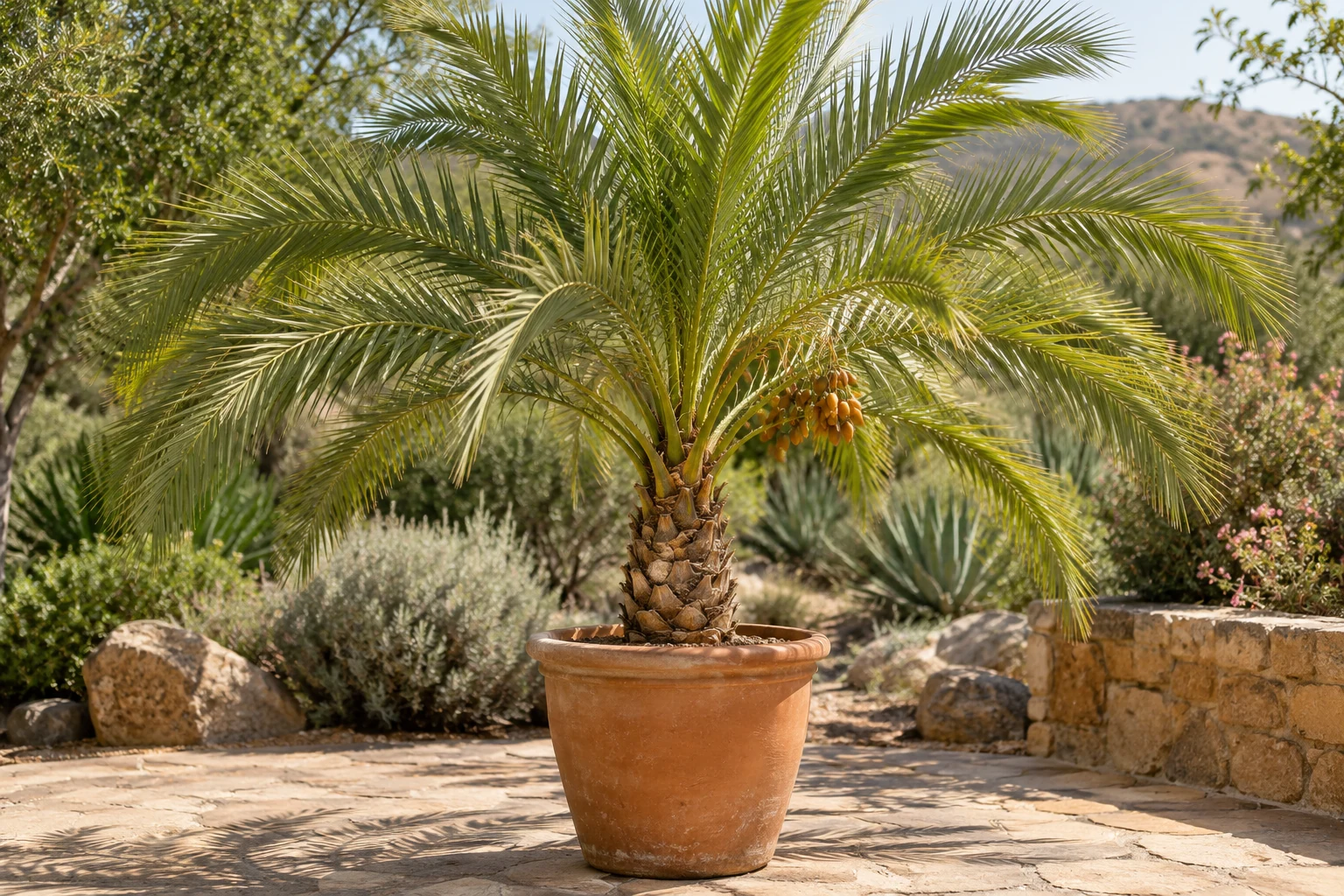
Date Palm is native to Believed to originate in Mesopotamia (modern Iraq); cultivated across West Asia and North Africa since antiquity, typically reaches Commonly 15–23 m (50–75 ft) tall, with arching fronds about 3–6 m (10–20 ft) long indoors, with slow growth. Date Palm has a tree growth habit and part of the Arecaceae family. It is also known as True Date Palm and Date Palm Tree.
| Detail | Information |
|---|---|
| Also known as | True Date Palm, Date Palm Tree |
| Native region | Believed to originate in Mesopotamia (modern Iraq); cultivated across West Asia and North Africa since antiquity |
| Mature size | Commonly 15–23 m (50–75 ft) tall, with arching fronds about 3–6 m (10–20 ft) long |
| Growth rate | Slow |
| Growth habit | Tree |
| Scientific name | Phoenix dactylifera L. |
| Family | Arecaceae |
How to care for Date Palm?
How much light does Date Palm need?
An open, sunny outdoor site with heat and room for the mature crown.. Brief light afternoon shade in very hot sites. direct sun
- An open, sunny outdoor site with heat and room for the mature crown. - An open, sunny outdoor site with heat and room for the mature crown..
- Brief light afternoon shade in very hot sites - Brief light afternoon shade in very hot sites.
- direct sun - direct sun.
When should you water Date Palm?
Water deeply through the active root zone, especially while a young palm establishes and while a female tree is carrying fruit. Let excess water drain; do not leave the roots in stagnant, waterlogged soil.
- Check moisture about 5–8 cm (2–3 in) down near the root zone. Reassess after hot - Water deeply through the active root zone, especially while a young palm establishes and while a female tree is carrying fruit.
- windy weather and after rain rather than watering by the calendar - Let excess water drain; do not leave the roots in stagnant, waterlogged soil.
- Drain excess water - Let excess water drain; do not leave the roots in stagnant, waterlogged soil.
What soil works best for Date Palm?
Choose sandy or loamy soil that drains freely. Date Palm can grow in a range of mineral soils, but it is not a swamp palm; persistent saturation and salt accumulation reduce performance.
- In the ground - Choose sandy or loamy soil that drains freely.
- use the site's well-drained sandy or loamy soil without burying the crown - Choose sandy or loamy soil that drains freely.
- For a young container palm - Date Palm can grow in a range of mineral soils, but it is not a swamp palm; persistent saturation and salt accumulation reduce performance.
- use a coarse palm mix with mineral grit or pumice and an open drainage hole - Date Palm can grow in a range of mineral soils, but it is not a swamp palm; persistent saturation and salt accumulation reduce performance.
Grower notes for Date Palm
Confirm that the label says Phoenix dactylifera
This page covers the true Date Palm, Phoenix dactylifera, a large fruit crop palm. It is a different species from Pygmy Date Palm (Phoenix roebelenii) and from other Phoenix palms sold under loose common names. Check the botanical label before buying: related Phoenix palms can look similar, but they do not all produce comparable edible dates.
Give it sun, heat, and room
Date Palm grows best outdoors in full sun and hot conditions. A sunny, sheltered site supports growth, while the long warm season is especially important if you want fruit to ripen. Leave generous clearance for a very tall trunk and several-metre fronds; avoid narrow paths, low roofs, and overhead wires.
Water deeply, then let the soil drain
A mature palm tolerates dry spells better than a newly planted one, but drought tolerance does not mean it needs no water. Young roots occupy a smaller soil volume and need more regular irrigation; fruiting trees also need a dependable supply. Water the root zone deeply, then allow drainage. Do not apply a houseplant-style fixed schedule to a large outdoor tree. Date Palm is traditionally described as salt tolerant, yet it performs better with good-quality soil and water. Salts left behind by irrigation can build up around roots; FAO guidance discusses leaching as a response, which requires both suitable drainage and extra water. In a pot, avoid salty water and fertilizer buildup rather than assuming the palm will absorb it harmlessly.
A pot is a temporary growing stage
A young Date Palm can grow in a large, well-drained container for a time, but its adult scale, need for strong direct light, and extensive roots make it a poor fit for an ordinary living room. Use a very bright conservatory or outdoor patio while it is small, and plan for a permanent sunny landscape site or a protected, spacious growing area.
Fruiting requires a female palm and pollination
Date palms normally bear male and female flowers on separate trees. Only a pollinated female produces fruit, and commercial growers commonly manage pollination by hand. Seed-grown plants may be male or female and do not reliably reproduce a named cultivar, so a single seedling is not a dependable route to a date harvest.
Protect people and pets from the spines
The long frond stalks carry sharp spines and spine-like leaflets. Keep the palm away from pet routes, play areas, and narrow paths; wear sturdy gloves, long sleeves, and eye protection when handling or pruning it. ASPCA's Date Palm search returned no species-specific listing, so do not treat the plant as confirmed safe for pets just because the ripe fruit is eaten by people.
Is Date Palm safe for pets?
ASPCA's Date Palm search returned no species-specific entry, so ingestion safety for cats, dogs, and horses is unverified. The fronds have sharp spine-bearing stalks and leaflets that can puncture skin; keep pets away from the crown and pruning debris.
The edible dates are a human food and do not establish pet safety. No species-specific ASPCA toxicity result was found for Phoenix dactylifera. Treat ingestion status as unresolved and prevent chewing; the sharp frond spines are a separate physical injury hazard.
Watering Date Palm
For Date Palm, check moisture about 5–8 cm (2–3 in) down near the root zone. Reassess after hot, windy weather and after rain rather than watering by the calendar. and water no fixed calendar interval. Check soil several inches below the surface and irrigate deeply when that root zone begins to dry; adjust for heat, sandy soil, rainfall, and tree age. Increase irrigation in hot, dry weather and during establishment; reduce it during cool or rainy periods while keeping the root zone from drying severely.
| Detail | Information |
|---|---|
| How often | No fixed calendar interval. Check soil several inches below the surface and irrigate deeply when that root zone begins to dry; adjust for heat, sandy soil, rainfall, and tree age. |
| How to check | Check moisture about 5–8 cm (2–3 in) down near the root zone. Reassess after hot, windy weather and after rain rather than watering by the calendar. |
| Seasonal changes | Increase irrigation in hot, dry weather and during establishment; reduce it during cool or rainy periods while keeping the root zone from drying severely. |
Signs of overwatering
- Persistently wet soil or standing water around the root zone
- Declining growth where drainage is poor
Signs of underwatering
- Dry soil well below the surface during establishment
- Reduced growth or poor fruit development during sustained heat
Soil & potting for Date Palm
Use a mix of In the ground, use the site's well-drained sandy or loamy soil without burying the crown., For a young container palm, use a coarse palm mix with mineral grit or pumice and an open drainage hole. for Date Palm. Fast drainage is important. Do not plant in a low spot that holds water or use a container without drainage holes. Target soil pH around Tolerates a broad soil reaction; do not chase a narrow pH target when drainage and irrigation-water quality are the main constraints. Repot repot a young container palm only when roots fill the pot or the mix no longer drains; it is not a practical permanent houseplant., ideally in early spring or fall in a mild, warm region; avoid extreme heat or cold.
| Detail | Information |
|---|---|
| Recommended mix | In the ground, use the site's well-drained sandy or loamy soil without burying the crown., For a young container palm, use a coarse palm mix with mineral grit or pumice and an open drainage hole. |
| Drainage | Fast drainage is important. Do not plant in a low spot that holds water or use a container without drainage holes. |
| Soil pH | Tolerates a broad soil reaction; do not chase a narrow pH target when drainage and irrigation-water quality are the main constraints. |
| Repotting frequency | Repot a young container palm only when roots fill the pot or the mix no longer drains; it is not a practical permanent houseplant. |
| Best season to repot | Early spring or fall in a mild, warm region; avoid extreme heat or cold. |
Signs it needs repotting
- Roots are circling densely or emerging from the drainage holes
- The pot dries unusually quickly despite thorough watering
- The container is unstable or too small for the expanding crown