Dragon Fruit Light Needs: Full Sun, Shade & Scorch
Dragon Fruit Light Needs: Full Sun, Shade & Scorch
Dragon Fruit Light Needs: Full Sun, Shade & Scorch
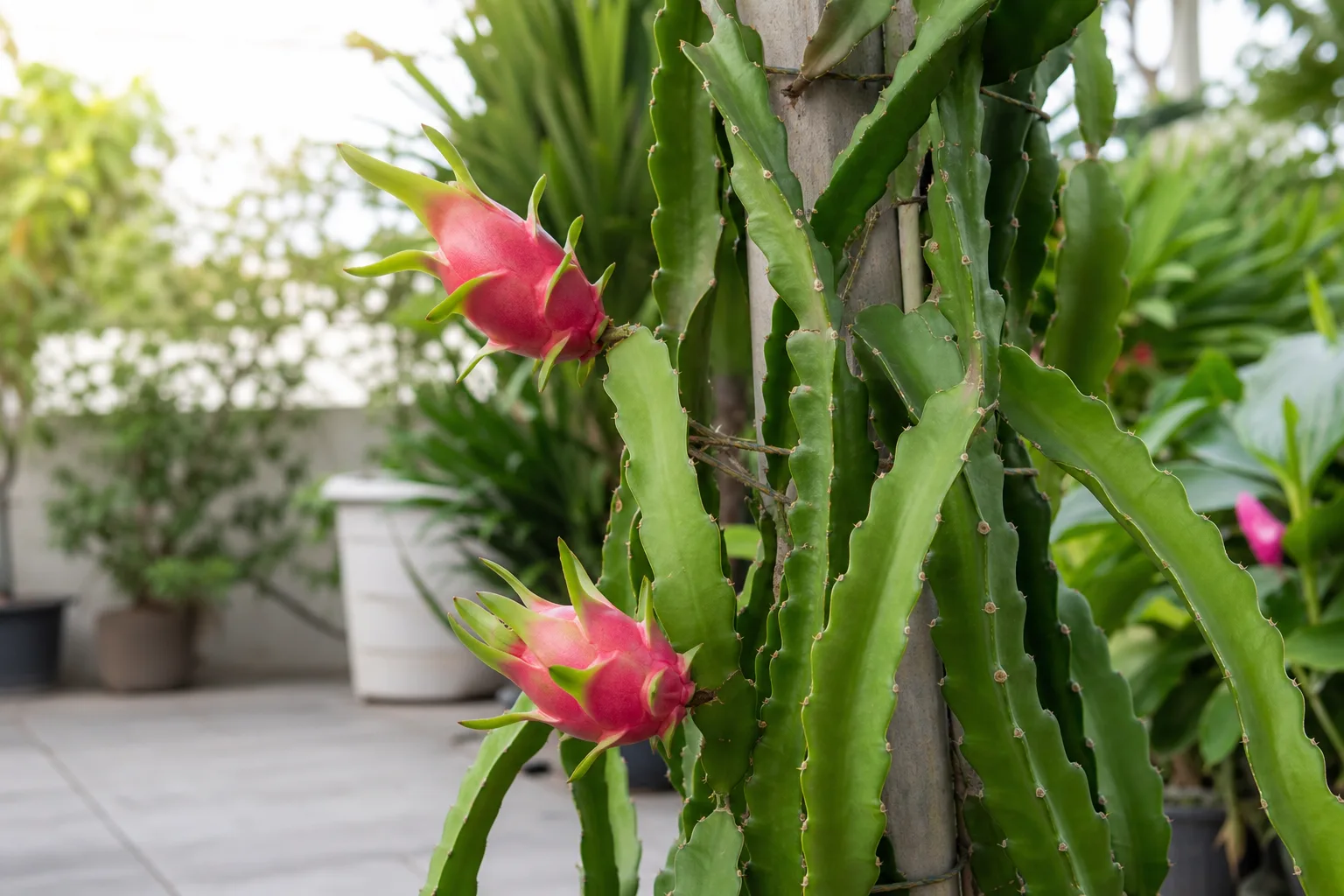
Dragon fruit (Selenicereus undatus, often still sold as Hylocereus undatus) is a climbing cactus that runs on light the way a mango tree does, not the way a shade-tolerant parlor plant does. The green, three-angled stems (cladodes) are the photosynthetic surface. If those stems never see strong daylight, the plant can stay alive for a long time and still refuse to thicken, flower, or set usable fruit.
This guide is about placement: how much sun dragon fruit needs outdoors in India and similar climates, when temporary shade is smart, what indoor light can and cannot deliver, and how to read pale, stretched, or scorched stems before you change watering or fertilizer by mistake.
How Much Light Dragon Fruit Actually Needs
For outdoor plants that you want to fruit, aim for full sun — roughly six or more hours of direct sunlight on most clear days. NC State Extension lists the species as a full-sun plant and describes a preference for bright, direct light in warm conditions. University of Florida Extension treats pitaya as a full-sunlight crop in its native range and recommends planting in full or almost full sun for best growth and fruit in the home landscape. (UF/IFAS EDIS HS303)
That does not mean every stem should bake unprotected from day one. The same Florida guidance notes that pitayas tolerate some shade, can be injured by extreme insolation, and often need about 30% shading for the first three to four months after planting or where sunburn risk is high. Too much lasting shade, though, cuts production and fruit quality. University of Guam Extension likewise reports that dragon fruit grows well under full sunlight when temperature and moisture are adequate. (University of Guam Extension)
Full Sun Outdoors vs Bright Indoor Light
Translate the labels into real placements. Outdoors on a terrace, rooftop, or open garden, full sun means the canopy sits in open sky for most of the day, not under a dense tree, balcony overhang, or north-facing wall. Indoors or in a cool greenhouse, the closest practical match is the brightest plant-facing light you can give — often what the RHS describes as bright indirect light with high humidity for greenhouse culture, with a listed garden position of partial shade on east- or west-facing, sheltered aspects. (RHS)
Those two standards are not contradictions. Commercial and landscape fruiting plants need high total daily light. Conservatory and houseplant culture usually cannot deliver outdoor-level photon load through glass and walls, so growers accept slower growth and rarer flowering unless they add strong supplemental light. Hawaii’s CTAHR diagnostic notes also list partial shade among cultural conditions for pitaya, which matches protected or humid island plantings better than a bare, high-altitude desert exposure. (Hawaii CTAHR)
Why Light Drives Flowering and Fruit Quality
Dragon fruit flowers are large, fragrant, and nocturnal. They only appear after the plant has built enough stem mass under strong light. Guam Extension notes that most dragon fruit types behave as long-day plants, needing longer daylight periods for flowering and fruiting. Weak light delays that calendar even when temperatures are warm.
Dense, unpruned stem masses create a second light problem: outer cladodes shade the inner ones. Florida Extension stresses that a tangled canopy reduces light penetration, complicates harvest, and raises disease pressure — and that keeping sunlight and air movement through the plant helps stems dry after rain. (UF/IFAS EDIS HS303) Light management is therefore both placement and canopy thinning; pruning is part of the light story, not a separate aesthetic chore.
Best Placement for Balcony, Terrace, and Garden Growers in India
In most of India, dragon fruit is happiest as an outdoor plant on a strong post or trellis in an open yard, terrace, or sunny balcony edge. Put the main stem where it receives morning-to-midday sun and continues to see bright sky into the afternoon. Keep the pot or root zone out of standing monsoon water, and give the climbing stems something solid to attach aerial roots to.
Avoid “bright room” language that really means a living-room corner with no direct plant-facing sky. Human eyes adapt to dim interiors; cladodes do not. If a hand held above the stems casts only a faint shadow at midday, the plant is underpowered for fruiting even if the room feels cheerful.
South and West Exposures in Hot Summers
South-facing terraces (northern hemisphere) usually give the highest total daily light and suit mature, acclimated plants. West-facing walls add intense late-day heat through the hottest months. That heat can push stem surface temperatures past what a recently moved or newly rooted cutting can handle, even though the species is considered a full-sun crop in milder tropical sites.
Use west exposures for established plants with thick, green, well-hydrated stems, and watch the sun-facing ribs in April–June. If ribs bleach to cream or develop corky brown patches after a heat spike, pull the plant a little farther from reflective walls, add temporary 30% shade during peak hours, or shift to a south or east-heavy position until the plant hardens. East morning sun is the gentlest entry point for nursery plants coming out of shade houses.
Using Shade Cloth Without Starving the Plant
Shade cloth is a tool for stress periods, not a permanent lifestyle for fruiting dragon fruit. UF/IFAS recommends roughly 30% shade during establishment and where insolation is damaging, while warning that excess shade lowers yield and fruit quality. (UF/IFAS EDIS HS303)
Practical pattern for Indian summers: start new cuttings or soft nursery plants under 30% shade for a few weeks to a few months, then step them into longer hours of direct sun. On mature plants, deploy shade cloth only during extreme heat waves, heat-reflecting terrace situations, or after a sudden move from a shaded nursery to a bare rooftop. Remove or open the cloth once stems hold color and new growth looks firm. Permanent deep shade under trees is the wrong trade for a plant you bought to fruit.
Can Dragon Fruit Take Direct Afternoon Sun?
Yes — mature outdoor plants often need it. Direct afternoon sun is productive when stems are acclimated, the root zone drains freely, and temperatures stay within a workable band. Florida Extension cites optimum growth temperatures around 18–25°C (65–77°F) and injury risk when temperatures exceed about 38°C (100°F), alongside sunburn reports in low-humidity or high-altitude regions. (UF/IFAS EDIS HS303)
The failure mode is not “afternoon sun is always bad.” It is sudden, unfiltered intensity on soft tissue, combined with heat and drought stress. NC State notes that too much sun can cause sun-scorch and dehydration. (NC State Extension) Pair bright placement with a potting mix that drains, then adjust water to how fast that mix dries in strong light — details that belong in the soil and watering guides once light is corrected.
Young Plants and New Cuttings Need Temporary Shade
Fresh cuttings callus and root best in bright shade or filtered light, not on a scorching concrete terrace. After planting, Florida’s establishment shade recommendation (about 30% for the first months) is the safest default. Harden plants by increasing direct-sun hours every few days rather than jumping from a covered nursery bench to all-day west sun.
The same caution applies when you repot or move a container plant to a brighter floor. Light intensity can rise faster than the plant’s epidermal protection. Give one to three weeks of transition light whenever you change exposure dramatically.
Sunburn on Cladodes: What It Looks Like
Sunburn on dragon fruit shows on the sun-facing ribs first: pale yellow or whitish patches, then dry tan or corky brown tissue that does not green again. Damage often appears within days of a hard move into stronger light or during a heat spike on reflective tile. Soft, watery lesions that spread in humid weather are more likely disease than sunburn; good light and airflow still matter because shaded, wet canopies dry slowly after rain. (University of Guam Extension)
Do not “fix” scorched tissue with fertilizer. Move or shade the plant, keep the root zone from staying soggy, and wait for new green growth from healthy segments. Old burned skin is a scar, not a nutrient deficiency.
Indoor and Greenhouse Light Limits
Indoors, dragon fruit is a large, vigorous climber that outgrows most windowsills. RHS greenhouse guidance — warm space, epiphytic cactus compost, bright indirect light, high humidity — is a fair model for Indian apartments that cannot offer a terrace. (RHS) Expect upright training on a stake or small trellis, slower stem thickening than outdoor plants, and unreliable fruiting unless light is exceptional.
A south or west window with the pot close to clean glass is the indoor minimum for maintenance growth. A north room without supplemental light is a holding pattern at best. If stems stay thin, deep green-to-pale, and endlessly elongated toward the pane, the plant is telling you the room is too dim for its biology.
Grow Lights When You Want Flowers Indoors
If fruiting indoors is the goal, treat grow lights as required infrastructure, not a gadget. Use full-spectrum LED bars or panels aimed at the canopy for roughly 12–16 hours daily during the long-day season, hung close enough that cladodes cast crisp shadows without leaf-surface heat stress. Raise intensity gradually on soft growth.
Even with lights, pollination remains a separate hurdle — many flowers open at night and may need hand pollination for fruit. Strong light builds the stems that can flower; it does not replace cultivar compatibility or pollination. For rooting new segments under lights, keep intensity moderate at first and link aftercare to the propagation guide.
Warning Signs of Too Little Light
Chronic low light shows as thin, soft, elongated stems, wide gaps between ribs’ productive growth, poor branching at the trellis top, and months without flower buds despite warm weather and decent feeding. Stems may look hungry for water because growth is slow, which tempts overwatering in a mix that never dries — a placement problem masquerading as a watering problem.
Compare with a plant in open sun: thicker cladodes, tighter growth, and seasonal flowering once the plant is mature. If your plant only thrives on the balcony edge and collapses in vigor when pulled indoors for décor, trust that result. Move it back to strong light and prune crowded stems so remaining cladodes can photosynthesize. Feeding cannot substitute for photons; see fertilizer only after light and drainage are honest.
Seasonal Light From Peak Summer to Monsoon and Winter
In peak summer, manage heat load as carefully as hours of sun. Temporary midday shade on west terraces can prevent scorch while still delivering a high daily light integral. During monsoon, cloud cover lowers intensity but humidity and rain raise disease risk — keep the canopy open so light and air reach inner stems after storms.
In cooler winter months at higher elevations or northern latitudes, day length and sun angle drop. Move containers closer to the brightest exposure, reduce watering to match slower use, and do not expect the same flowering pace as long-day summer months. Guam Extension’s note on long-day flowering behavior is a useful reminder that calendar light matters as much as thermometer readings. (University of Guam Extension)
When to use this page vs other Dragon Fruit guides
Use this page when the question is where to put the plant, how many hours of sun it needs, whether shade cloth helps, or how to read pale versus scorched stems. Switch to watering when the mix stays wet or bone-dry after you fix placement. Use soil when drainage or mix structure is the bottleneck. Use pruning when a dense canopy is shading itself. Use overview for the full care picture and propagation when you are rooting cuttings under controlled light.
Related Dragon Fruit guides
- Dragon Fruit overview — habit, size, and how light fits the full care routine
- Dragon Fruit watering — how strong light changes dry-down speed
- Dragon Fruit soil — drainage mixes that support sunny placements
- Dragon Fruit fertilizer — feeding only after light and roots are stable
- Dragon Fruit pruning — opening the canopy so stems receive light
- Dragon Fruit repotting — moving containers without shocking sun-facing tissue
- Dragon Fruit propagation — curing and rooting cuttings in bright filtered light
- Dragon Fruit plant hub — cluster home for all care topics
Conclusion
Dragon fruit is a full-sun fruiting cactus outdoors and a bright-light climber indoors. Give mature plants long hours of direct sky light for flowering and fruit, use about 30% shade mainly for establishment or extreme heat, and treat pale stretched stems as a placement problem first. Fix the light, open the canopy, then adjust water and feeding to match how fast the plant actually grows.