Giloy Fertilizer Guide: When, What & How Much
Giloy Fertilizer Guide: When, What & How Much
Giloy Fertilizer Guide: When, What & How Much
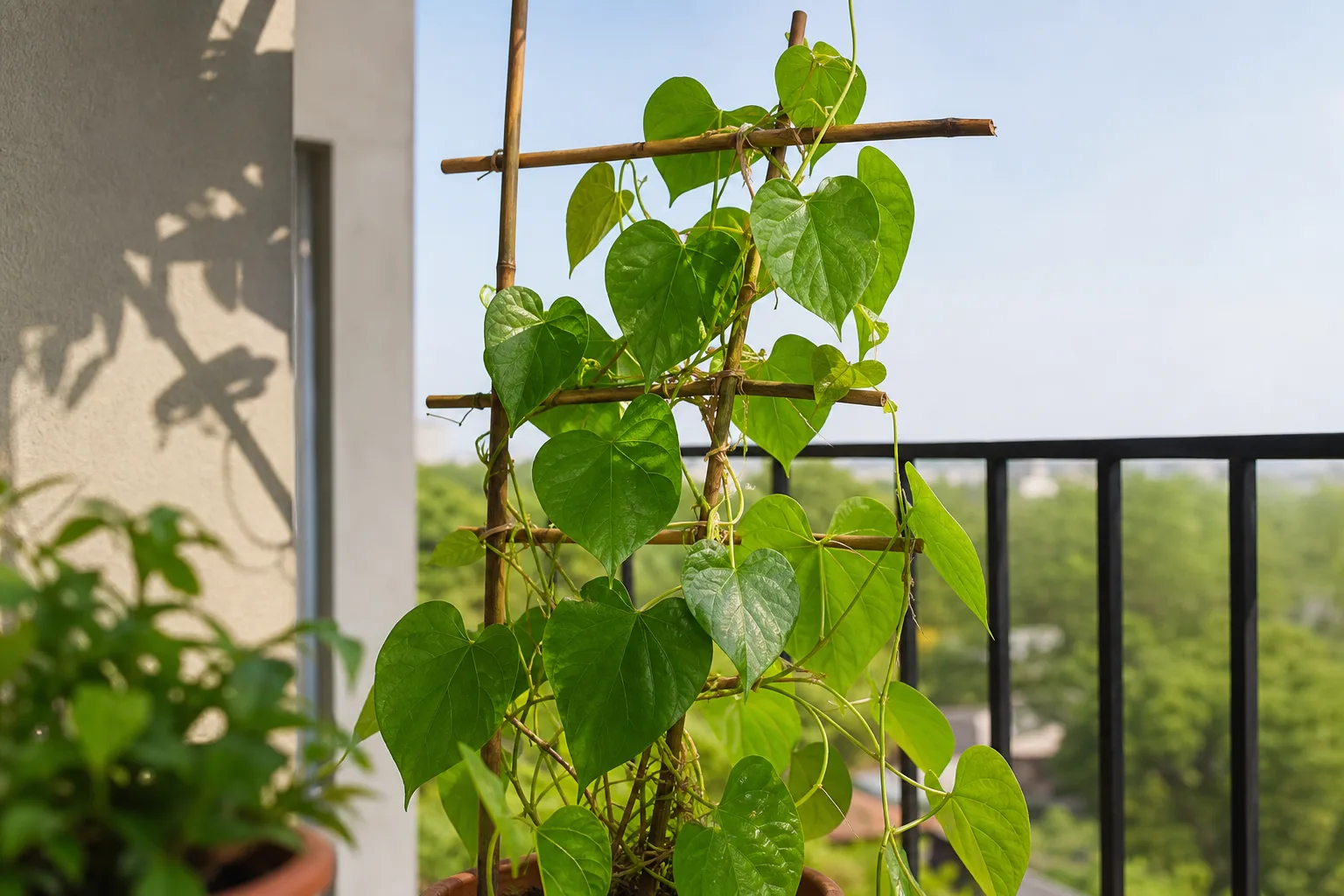
Giloy (Tinospora cordifolia) is a fast moonseed-family climber grown for woody stems and steady vine extension—not a balcony herb that needs weekly full-strength bottles. Kew records it as a liana native from the Indian Subcontinent to Indo-China in the wet tropical biome. The practical default for home growers is organic matter first, then light seasonal feeding: well-rotted compost or farmyard manure at planting and as a spring top-dress, plus a balanced liquid fertilizer at half label strength about every four to six weeks while new nodes and aerial roots keep forming. Skip fertilizer when growth stalls in cool weather, when the mix stays soggy, or when the vine is newly repotted and still settling.
That lean, drainage-aware approach matches how giloy is cultivated in India. Package-of-practices guidance emphasizes light sandy loam rich in organic matter with good drainage and warns that the crop does not tolerate waterlogging. Fertilizer can support climbing, but it cannot fix shade, a missing trellis, or a pot that never dries. For the sun that drives nutrient use, see giloy light needs. For dry-down timing that must align with feeding, see giloy watering. For the mix that keeps salts from trapping roots, see giloy soil. The giloy care hub covers the full cluster.
Why Giloy Feeding Differs from Generic Vine Advice
Treat fertilizer as support for an already working system—bright light, a trellis, and a watering rhythm that lets the top of the mix dry slightly—not as a substitute for any of those. Plants For A Future describes giloy as a deciduous climber that can reach about 15 m, suited to well-drained soils in full sun, with a native range across India, Sri Lanka, and Myanmar. A plant built for tropical and subtropical climbing does not need the aggressive weekly nitrogen schedules used for soft kitchen herbs in small pots.
Climbing habit, organic soils, and drainage biology
Field packages for Tinospora cordifolia start with organic manure and moderate nitrogen rather than constant soluble “boost” products. Vikaspedia’s agro-technique applies a basal dose of farmyard manure at 10 tonnes per hectare plus 75 kg nitrogen at land preparation, then a follow-up of another 10 tonnes FYM with 75 kg nitrogen. That pattern tells you what the vine responds to at scale: organic matter for structure and slow nutrition, plus measured nitrogen during establishment—not daily liquid feeds.
In containers, the same biology still applies, but the root volume is tiny and watering leaches nutrients faster. You still lead with compost or well-rotted manure in the mix, then use dilute liquids only while the vine is actively climbing. Excess soluble fertilizer in a cramped pot mainly raises salt stress on a species already sensitive to wet, poorly aerated roots.
When to Fertilize Giloy in Indian Climates
Feed when giloy is actively pushing new leaves, nodes, and stem length—typically the warm, bright months across most of India. Hold feed when nights cool, when monsoon rains keep the pot saturated, or when the vine is wilting from drought or root stress rather than from nutrient lack. Clemson Extension’s woody-plant guidance is clear: apply fertilizer when plants are actively growing, and avoid fertilizing drought-stressed plants because moisture is required for uptake.
Active growth from spring through monsoon
For terrace and garden giloy in India, the reliable window is roughly March through September, with strongest response from late spring into the monsoon and early post-monsoon flush. Start only after you see fresh heart-shaped leaves and extending shoots—not on a calendar day alone. Young pots in full sun that dry every few days may use a half-strength liquid every four to six weeks through this window. In-ground vines in compost-amended beds may need only the planting-time manure plus one mid-season organic top-dress.
If you overwinter containers in a cooler room with weaker light, keep the same rule: feed only while new growth is visible under strong light. Warmth without adequate sun does not create a feeding season.
Cool-season, wet-root, and stress pauses
From roughly November through February in most Indian regions, taper to a stop. Give a final light feed in early autumn only if soft new growth is still forming, then pause. Resume in late winter or early spring when consistent climbing resumes.
Also pause during waterlogging or acute drought stress. Clemson’s nutrient-management guidance stresses applying fertilizer at the right time when plants can absorb it, delaying applications in drought, and postponing feeds before heavy rain that will leach nutrients away. Water first if the pot is bone-dry, restore turgor, then feed days later on moist—not soggy—mix. Never fertilize giloy sitting in stagnant water; fix drainage and watering first. Field guidance likewise notes the crop is mainly rain-fed and intolerant of waterlogged ground—container growers should treat a perpetually heavy pot as a stop-feeding signal.
Best Fertilizer Types for Giloy
The best giloy fertilizer for most home growers is well-rotted organic matter paired, when needed, with a complete balanced water-soluble formula (for example 10-10-10 or 20-20-20) at half label strength. You do not need a specialty “giloy” bottle. You need restraint and drainage.
Farmyard manure, compost, and vermicompost
For in-ground beds or large patio tubs, well-rotted farmyard manure, compost, or vermicompost is the primary feed. Scale the field recommendation down: commercial packages use 10 tonnes FYM per hectare at planting with a similar follow-up. In a home bed, work a generous layer of finished compost or FYM into the planting hole and top-dress once in spring. In a 30–40 cm pot, a thin handful of vermicompost or compost worked into the top few centimeters once or twice in the warm season is usually enough organic support. Keep fresh, hot manure off roots and the stem collar—only use well-rotted material.
RPCAU-authored cultivation notes likewise recommend a basal dose of about 10 tonnes farmyard manure plus 75 kg nitrogen for higher yield, reinforcing that giloy’s commercial fertility program is manure-led rather than bloom-booster-led.
Balanced liquids and half-strength dilution
Balanced NPK supports foliage, roots, and overall vigor without pushing the soft, overly leafy flush that excess nitrogen encourages on woody climbers. Clemson notes that excessive nitrogen stimulates lush shoot growth that is more susceptible to cold, drought, and pests—exactly the opposite of the firm, trellis-ready stems you want on giloy. Measure dilutions carefully. If the label says one tablespoon per gallon for outdoor vegetables, use half for container giloy; if it lists a houseplant rate, still start at half of that and watch the next flush before increasing frequency.
Organic liquids such as diluted compost tea, seaweed extract, or fish emulsion can substitute at half strength or weaker during warm months. Use fish emulsion outdoors or near ventilation; skip it when pots stay damp and fungus gnats are already a problem. Skip high-phosphorus bloom boosters and undiluted “boost” spikes in small pots—they add salt without fixing light or drainage limits that usually stall giloy.
How Much and How Often: Containers vs Ground
Use this as a starting schedule, then adjust to flush quality and salt signs.
| Setup | Warm-season schedule | Strength / amount | Notes |
|---|---|---|---|
| Balcony / terrace pot (25–40 cm) | Every 4–6 weeks, March–September | Balanced liquid at half label strength | Feed only on moist mix; pause if pot stays heavy after rains |
| Large tub with trellis | Monthly half-strength liquid or compost top-dress mid-season | Thin organic top-dress + optional dilute liquid | Prefer organics if drainage is excellent |
| In-ground / garden bed | Planting FYM/compost + one warm-season top-dress | Finished compost/FYM layer; optional light N only if growth is clearly pale | Follow soil test if available; do not copy hectare N rates into tiny beds without scaling |
| Cool months / new transplants | None | — | Resume after active climbing returns |
After any repot, wait two to four weeks—or until you see new shoot tips—before the first liquid feed. Fresh mix plus transplant stress is enough work for the roots.
Signs of Underfeeding vs Overfertilizing
Nutrient lack and fertilizer damage can both look like “unhappy leaves,” so read the whole plant and the pot, not one symptom.
Pale weak shoots versus salt burn and tip scorch
Likely underfed (or light-limited): thin pale new shoots, slow node production despite warmth and sun, and leaves that stay small while older growth looks otherwise healthy. Confirm light and support first—shade often mimics “hunger.” If light and drainage are good, a half-strength feed or compost top-dress is a reasonable next step.
Likely overfertilized: brown leaf tips and margins within days of a feed, white crust on the soil surface or pot rim, sudden leaf-edge scorch on dry mix, or soft, overly lush stems that flop off the trellis. Fertilizers are salts; Clemson explains that excess can cause fertilizer burn when moisture is drawn from leaf tissue. If you see those signs, flush the pot thoroughly with plain water, hold fertilizer for several weeks, and restart later at half strength on moist soil only.
Also rule out waterlogging yellowing and underwatering wilt before you add more NPK. Giloy’s documented intolerance of waterlogged conditions means many “fertilizer fails” are actually wet-root fails with fertilizer on top.
Common Fertilizer Mistakes with Giloy
The most common mistake is feeding a wet, shaded, or unsupported vine and expecting fertilizer to create growth. Second is using full-strength vegetable rates every week in a small pot—salts build fast, and excess nitrogen pushes soft stems that break or attract problems. Third is copying hectare nitrogen rates into a balcony container without scaling; field 75 kg nitrogen doses are for plantation beds, not 30 cm pots. Fourth is fertilizing immediately after repotting or during peak monsoon saturation. Fifth is stacking multiple products—cake, liquid, spikes, and compost tea—in the same week. Pick one organic base and, if needed, one dilute liquid schedule.
When to use this page vs other Giloy guides
Use this page when you need what to feed, when to feed, how strong to dilute, and how to read burn vs hunger on Tinospora cordifolia. Switch to giloy watering if the pot stays soggy or bone-dry—those problems must be fixed before any fertilizer schedule works. Use giloy soil when the mix is compacted or holds water too long. Use giloy light when internodes stretch or leaves pale in shade. Use giloy propagation when you are rooting cuttings and should avoid strong feeds on new plants. Use giloy repotting when roots circle the pot or the mix is exhausted. For the full species overview, start at the giloy care hub.
Related Giloy guides
- Giloy care overview — placement, support, and whole-plant priorities
- Giloy watering — dry-down checks that must align with feeding
- Giloy light — sun levels that drive nutrient use
- Giloy soil — sandy-loam drainage that prevents salt trapping
- Giloy repotting — when to refresh mix instead of pouring more NPK
- Giloy propagation — aftercare for cuttings without harsh feeds
- Giloy pruning — training the vine so fertilizer supports structure, not chaos
Conclusion
Giloy fertilizer success is mostly timing and restraint. Lead with well-rotted organic matter, then use a half-strength balanced liquid every four to six weeks only while the vine is climbing in warm bright months. Pause in cool weather, after repotting, and whenever roots sit wet—giloy’s cultivation guidance is built around organic manure and drainage, not constant soluble boosts. If tips burn or crust appears, flush and wait; if growth is pale despite strong sun and a trellis, feed lightly once and reassess. Keep fertilizer downstream of light, support, soil, and watering, and the vine will use what you give.