Giloy Pruning Guide: When, Where, and How Much to Cut
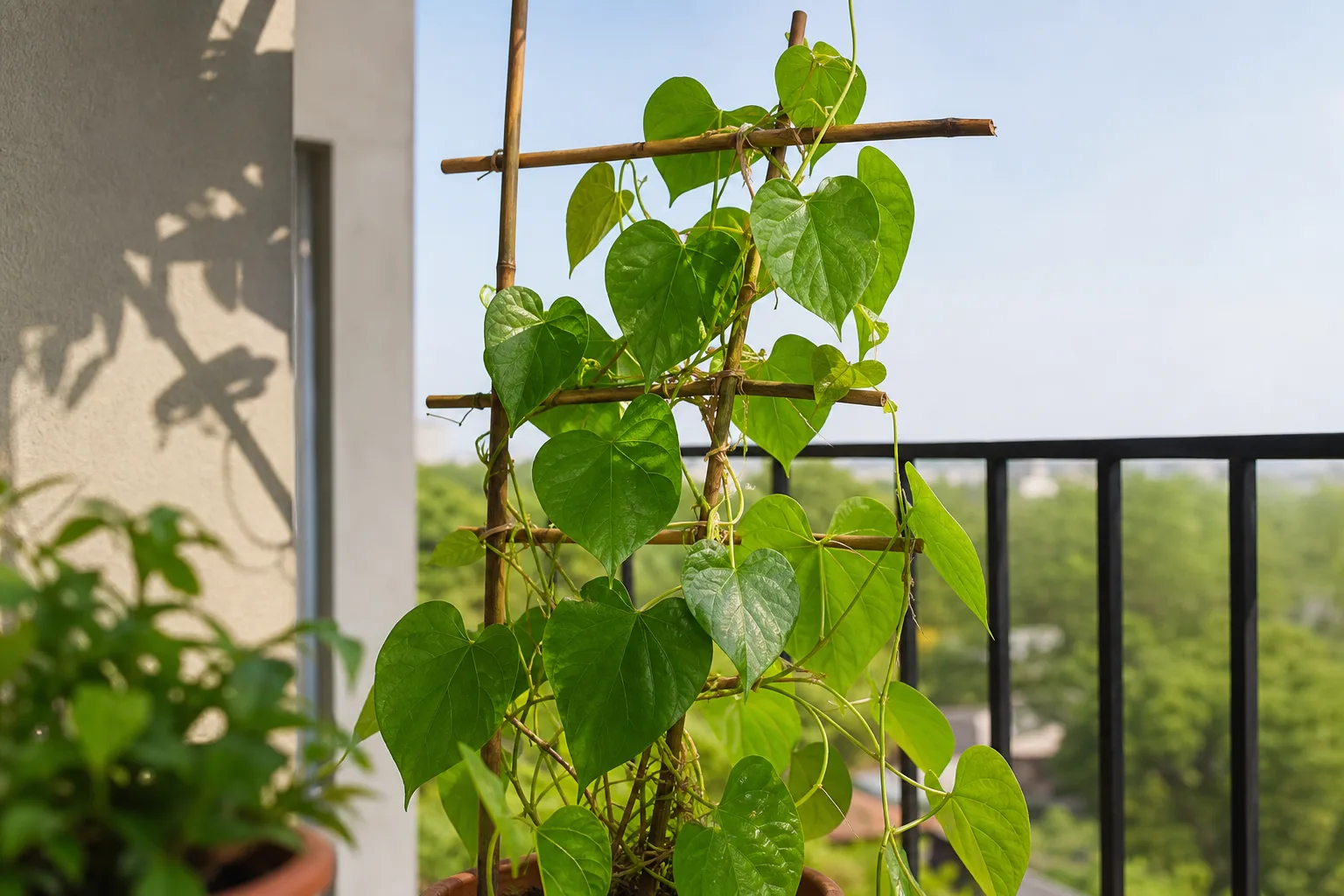
Giloy Pruning Guide: When, Where, and How Much to Cut
Giloy Pruning Guide: When, Where, and How Much to Cut
First action: Walk the vine and remove only fully yellow, brown, soft-rotted, or clearly diseased leaves and stem tips with clean sharp scissors or bypass pruners—finish that cleanup before you shorten healthy leaders or thin a tangled canopy. Giloy grows from swollen nodes, so you want a clear map of live joints and aerial-root bumps before you decide how much length to take.
For whole-plant context—bright light, drainage, and watering rhythm—see the Giloy overview.
Reviewed by LeafyPixels Review Board · Author: sai-ananth
Quick answer
Prune Giloy (Tinospora cordifolia), also sold as Guduchi, Amrita, or heart-leaved moonseed, to keep this fast twining vine on a trellis, remove failing tissue, and harvest or recycle healthy stem sections—not to “fix” shade stretch, soggy roots, or a missing support. Kew treats the species as a liana native from the Indian Subcontinent to Indo-China; Useful Tropical Plants describes a deciduous climbing shrub that can reach about 15 m and drop long, thread-like aerial roots.
Make tip and size-control cuts just above a node—the swollen joint where leaves and aerial roots form—limit live canopy removal to about one-third per session on pots, and schedule major cutbacks for warm active growth. Pruning improves shape and branching, but it cannot replace bright sun or a watering rhythm that lets the top of a free-draining mix dry slightly between drinks.
What pruning does for Giloy
Giloy is a Menispermaceae climber with succulent, often corky stems and heart-shaped leaves. Left alone on a sunny balcony, it will race along a railing, knot itself into loops, and send aerial roots seeking soil or a host. Cultivation manuals stress that the plant requires support—wooden stakes, a trellis, or an existing shrub or tree—because it is a large twiner that covers a host quickly. Official agrotechnology notes also frame Tinospora cordifolia (Giloye/Guduchi) as a cultivated medicinal crop under varying climates.
Four jobs show up repeatedly:
- Cleanup removes yellow, scorched, pest-coated, or rotting leaves and soft stem tips whenever you spot them.
- Training loosely ties new growth to a stake or trellis so the vine climbs with clearer leaders instead of a ground tangle.
- Tip cuts / heading shorten soft leaders just above a node to encourage side shoots and denser leaf cover within reach.
- Size-control / stem harvest shortens overlong vines when they outgrow the support—or when you want nodal cuttings for new plants.
Pruning cannot fix chronic shade (long internodes, pale thin shoots), waterlogging (soft bases, yellow leaves on wet mix), or a pot with no trellis. Correct those conditions first, then cut.
Cleanup vs training vs size control
Cleanup is safe anytime and should always come first. Clemson HGIC advises removing dead, diseased, or injured growth before any shaping cuts, then heading back to a healthy bud when you shorten shoots. Training is ongoing during active growth—tie new stems as they lengthen rather than waiting for a midsummer knot. Size control is the heavier job: when vines overrun a balcony frame, cut back to a framework of sturdy stems with several live nodes left on the support—not stripping every green stem at once.
When to prune Giloy
Best season for structural pruning
Use spring through early monsoon—while the vine is actively climbing—for tip cuts, thinning, and height reduction. NMPB cultivation guidance recommends taking stem cuttings from mother plants in June–July, which is also a practical window for planned size-control pruning: you can recycle healthy nodal sections into pots while the parent vine is still flushing hard.
Avoid stacking a hard cutback with cool, stagnant weather or a chronically wet pot. Growth slows when light drops and roots sit cold and soggy, so a heavy October cut on a shaded balcony may sit longer before nodes break. Light maintenance—removing a yellow leaf or pinching a soft tip—is fine whenever you see firm green growth.
If you repotted within the last two to three weeks, delay heavy pruning unless you are only removing dead material. Root disturbance plus a large canopy cut stacks two stresses on a vine that already hates waterlogging.
What can be removed anytime
Dead leaves, fully yellow leaves, broken tips, and clearly soft or diseased stem sections can be removed year-round. That cleanup is different from reshaping a healthy canopy. Defer major cuts if the plant was just moved, newly repotted, or is yellowing from wet soil—fix drainage and light first.
What to check before cutting
Before your first structural cut, check four things:
- Node positions: New shoots and cuttings succeed from nodes, not smooth internode stretches. Feel for the slight swelling where a leaf attached and for aerial-root bumps along the stem.
- Light quality: Giloy wants bright sun or very strong light—it cannot grow in shade. Long internodes and pale thin tips usually mean not enough light—improve placement before expecting a topped vine to stay compact.
- Current stress: Soft bases, sour wet soil, or ongoing yellowing means delay major cuts. Pair with watering checks and drainage when the pot stays heavy.
- Support status: Confirm a stake, trellis, or railing is ready. Cutting without a plan for how remaining stems will climb only recreates a floor tangle.
Also note whether lower stems are corky and bare. Older wood may still hold live buds at nodes, but smooth, dried stubs without nodes rarely resprout well—cut back to a clear live joint.
Tools and sanitation
Use sharp bypass pruning shears or clean scissors for stems up to finger thickness. Dull blades crush the succulent stem and leave ragged stubs that dry slowly. Wipe cutting surfaces with 70% isopropyl alcohol before you start and between plants if you prune more than one vine.
Wear gloves if your skin is sensitive—medicinal stems can leave sap residue—and keep trimmed stems away from pets that chew plants. Bag diseased tissue; healthy nodal cuttings can go straight into the propagation workflow if you want more plants.
Where and how to cut Giloy
The first cut to make
After cleanup, pick one overlong leader that is clearly beyond the support and cut it 5–10 mm above a healthy outward-facing node. Step back. That single heading cut shows you how the vine will respond before you thin the rest of the canopy.
Step-by-step size-control pruning
- Untangle gently and identify 2–4 main leaders you want to keep on the trellis.
- Cut each chosen leader just above a firm node, angling the cut slightly so water does not sit on the stub.
- Remove crossing, rubbing, or inward-growing stems that create a dense knot with poor airflow.
- Thin weak, pencil-thin shade shoots that have long internodes and tiny leaves—those rarely thicken into good leaders without brighter light.
- Retie remaining stems loosely with soft ties; do not girdle corky bark.
- Collect healthy nodal pieces (older stems with nodes) if you plan to propagate—NMPB guidance is to plant cuttings within about 24 hours, keeping the lower end half-dipped in water until you pot them.
Do not leave long leafless stubs between nodes. The vine does not sprout reliably from blank internode tissue.
How much you can safely remove
On container and balcony plants, keep live foliage and stem removal to roughly one-third of the canopy in one session. Giloy can cover a host rapidly outdoors, but a pot has limited root volume and leaf area to rebuild from. If the vine is badly overgrown, take a second third after new shoots appear and firm up—usually one to three weeks later in warm weather.
Emergency removal of soft, rotten, or fully dead tissue does not count against that one-third limit. Leave at least several live nodes on each retained leader so the plant has clear growing points.
What not to cut
- Do not strip every green stem down to the soil line “to restart the plant” in one day on a stressed pot.
- Do not cut below the last live node on a leader you still want—blank stubs die back.
- Do not remove all aerial roots from stems you are training; they help the vine cling and can root if they reach moist soil.
- Do not prune hard on a newly relocated or waterlogged plant before fixing light and drainage.
- Do not shear the vine like a hedge. Random tip shearing without regard to nodes produces dense outer tips and a hollow, tangled interior—the same problem Clemson describes when shrubs are headed without thinning.
Aftercare and recovery timeline
Keep light bright and watering steady: water when the top 2–3 cm of mix feels dry, and never leave the pot sitting in a saucer of rainwater. Do not fertilize heavily on pruning day; wait until you see firm new shoots, then resume a light feeding rhythm if the plant is in active growth.
Recovery signs (usually 1–3 weeks in warm weather): buds swelling at nodes below cuts, new heart-shaped leaves unfurling, aerial-root bumps lengthening, and remaining stems staying firm rather than soft.
Warning signs: soft blackening from the cut downward, widespread yellowing on a wet pot, or no bud break after several warm weeks—those point to rot, low light, or a cut made on dead wood. Trim back to clean live tissue and correct the growing condition before cutting again.
Mistakes to avoid
- Cutting for shape while the vine sits in shade or soggy soil
- Leaving long internodal stubs instead of cutting to a node
- Removing more than about one-third of a pot vine’s live canopy at once
- Skipping support after a cutback so new shoots sprawl on the floor
- Stacking hard pruning with same-day repotting and fertilizer
- Discarding healthy nodal stems you could have rooted
Related Giloy guides
- Giloy overview — habit, support needs, and whole-plant care
- Giloy light — bright sun vs stretch that looks like a “pruning problem”
- Giloy watering — dry-top rhythm and waterlogging risk after cuts
- Giloy soil — drainage that protects pruned stems from soft bases
- Giloy propagation — turning pruning offcuts into new vines
- Giloy repotting — when pot-bound vines need a larger home instead of endless cutbacks